


To continue reading…
This article is exclusively for Rowing News subscribers. For as little as $5 a month, you can get access to the best quality, independent reporting on all the issues that matter to the North American rowing community.
By Bob Ford
It isn’t easy to row from a small Serbian city on the southern bank of the Danube River to the leafy New York City suburbs of Westchester County and southern Connecticut, where life is considerably calmer, even if the waters aren’t necessarily so.
Marko Serafimovski and Aleks Radovic, teammates at Rowing Club Smederevo who experienced childhoods in the war-torn region, were able to make that passage from one world to the other, however.
After various stops, they landed together at RowAmerica Rye, where Serafimovski is the owner and head women’s coach of the successful private program that works primarily with middle-school and high-school rowers, and Radovic is the head men’s coach.
“What we picked up from rowing in Serbia was the discipline the coaches taught us,” Serafimovski said. “That helped us work our way up within the coaching system here and create what we have within RowAmerica.”
What they have at the moment is a three-year stretch of gold medals in the men’s eight at the USRowing Youth National Championships and a two-year stretch in the same event on the women’s side [extended to three years by another Youth Nationals win in June, 2026 —Editor].
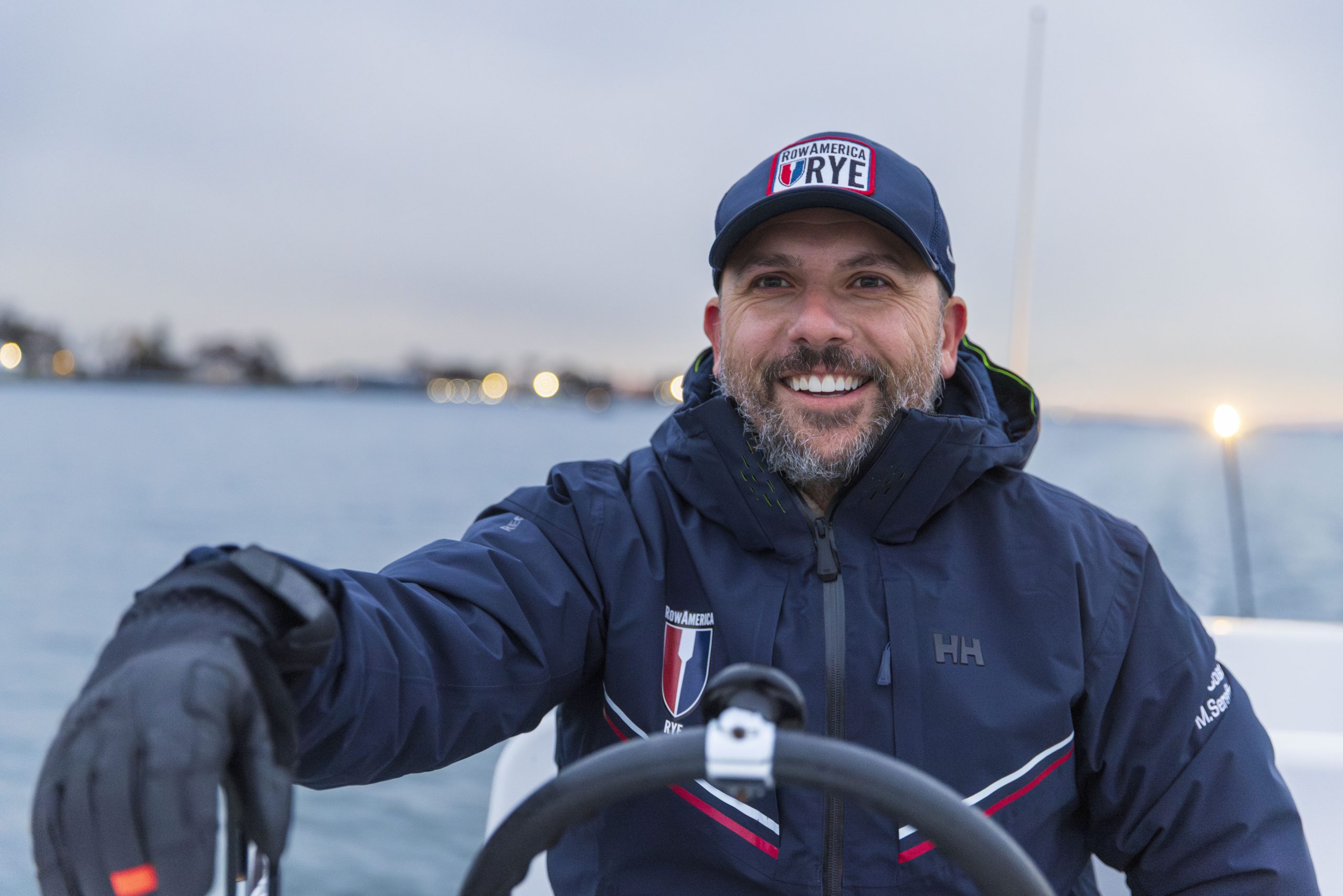
“If you tell me, ‘I can’t really move a single or a double but I’m really good at moving the eight,’ well, that doesn’t really make sense. It means the other people are carrying you.”
— Marko Serafimovski, RowAmerica Rye
Three of the rowers from those lineups are on the United States U19 national team and also competed in August at the World Rowing Under 19 Championship Regatta in Bulgaria. Claire Van Praagh, now a freshman at Stanford, brought home a gold medal in the straight four at junior worlds.
“I can speak pretty confidently that we left Rye with so much more than when we came to it,” said Van Praagh, who was the 2025 USRowing U19 Female Athlete of the Year. “The camaraderie and the teamwork that Marko and Aleks foster, and the emphasis on accountability, showing up on time, being prepared, and that every individual has an important role. It’s never just about the success of the 1V8 but about how can we get the 150 or so athletes that compete in youth nationals on the podium.”
That’s a great goal, and RAR took a run at it last June. There were 155 Rye rowers in 24 boats. Five of the boats finished on the podium, and of the 24 qualified crews, 10 reached the A final to place in the top eight nationally.
“Working hard will allow you to succeed, and that was instilled in me at a young age,” Serafimovski said. “That’s what drives us to succeed and, you know, let’s win, but we don’t define the win by the results only. If we can touch these kids’ lives and help them become better people down the road, that’s a greater success than just winning that national championship or winning that medal at a regional regatta.”
Not that there’s anything wrong with medals and inspiring young athletes to stay in the sport. At the 2025 Head of the Charles, more than 40 RowAmerica Rye alumni were racing for their various college programs.
“Those two guys have changed my life, and they have changed many other lives,” said George Dolce, a three-time 1V8 champion at nationals and a fourth-place finisher in the straight four at worlds. He is now a freshman at Princeton.
“Just the impact that they have on us. It’s beyond just the sport of rowing. They’ve instilled a fire in all of us to succeed in life. I’m forever grateful. Aleks was my main coach. He changed my life. If I hadn’t bumped into that guy, I would not be at Princeton and I would not be the man I am today.”
“Howard allowed us to build this program the way we wanted to. He handled finances and buying boats and all that stuff but said that when it came to the program we wouldn’t hear from him. That’s why I accepted the job.”
— Marko Serafimovski, RowAmerica Rye
The Rowing Club Smederevo boathouse isn’t much to look at. It squats aside the Danube like an industrial warehouse, but for Serafimovski, Radovic, and others it held more than boats and oars. It held opportunity—if they were willing to accept the discipline that opportunity required, something they would eventually pass along to others.
Serafimovski won six national titles between 1997 and 2003 as a lightweight rower and competed as a member of the junior national team at the 2001 world championships. Radovic was on the Serbian national team from 2003 to 2009 and won multiple medals at junior worlds and U23 worlds.
Both of these rowers wanted to emigrate to the United States, and that became possible through agencies that placed young Serbs in an environment with even more opportunities for success in life. Serafimovski still had a year of high school left when he moved to the U.S. He asked to be placed some place where he could continue rowing, but that message didn’t get through.
“They tossed me in the middle of a nowhere called Kansas,” Serafimovski said. “You’re talking about a culture shock. It was a town of about 1,500 people and no stoplights.”
Unable to row, Serafimovski acquired an erg and tried to stay in shape but he didn’t attract any scholarship offers for college and went to the University of Alabama at Birmingham, where he earned a degree in industrial management and marketing.
“To be very fair, I wasn’t the caliber of rower who could go to a top rowing school. I was a lightweight, which made it more difficult, and I didn’t have a couple of world-championship gold medals in my pocket before I came,” Serafimovski said.
Radovic, a heavyweight with experience in the engine room of an eight, did have those. When he decided to emigrate, he contacted coach Paul Savell at Drexel and was recruited successfully by the Dragons.
“I didn’t have the culture shock Marco had. It was a big city, and there were other Serbs there, so that helped my transition,” Radovic said.
One of the Serbs, Filip Topalovic, was a recent Drexel rower and an assistant to Savell. Topalovic, who began rowing at Partizan Belgrade, is also at RowAmerica Rye now. He is the novice women’s head coach and assistant to Serafimovksi with the women’s youth team. The other current coach on staff is Stan Nelson, who started the Rye High School program that was folded eventually into RAR.
Radovic was part of the Drexel eight that won the Dad Vail Regatta for the first time, and he raced with the Dragons at two IRA championships as well as at Henley Royal Regatta.
Serafimovski and Radovic stayed in close touch after college, and when Serafimovski was hired to coach at Greenwich Crew, he brought Radovic in as an assistant. After that, they went together to Rye in 2014 to work for RowAmerica founder Howard Winklevoss, and in 2023 Serafimovski bought the program.
“Howard allowed us to build this program the way we wanted to. He handled finances and buying boats and all that stuff but said that when it came to the program we wouldn’t hear from him. That’s why I accepted the job,” Serafimovski said.
An aspect of the program that was important to the Serbian coaches was to back off focusing on the eight, which they see as an American preoccupation not shared by the European rowing community.
“We try to grow everything. We come at this from a little different angle and do a lot of training in smaller boats,” Serafimovski said. “We strongly believe that sculling is the foundation of the rowing stroke. By the time our kids become high-school freshmen, they all know how to scull. They all know how to row a racing single.
“If you tell me, ‘I can’t really move a single or a double but I’m really good at moving the eight,’ well, that doesn’t really make sense. It means the other people are carrying you. So we want to see all the boats do well. That’s the real definition of how we measure success.”
If the RowAmerica Rye rowers think the program represents the hard way to go, wait until they get on the water.
“The crappiest water in America,” Radovic said. “Put it this way, it’s not the Schuylkill River.”

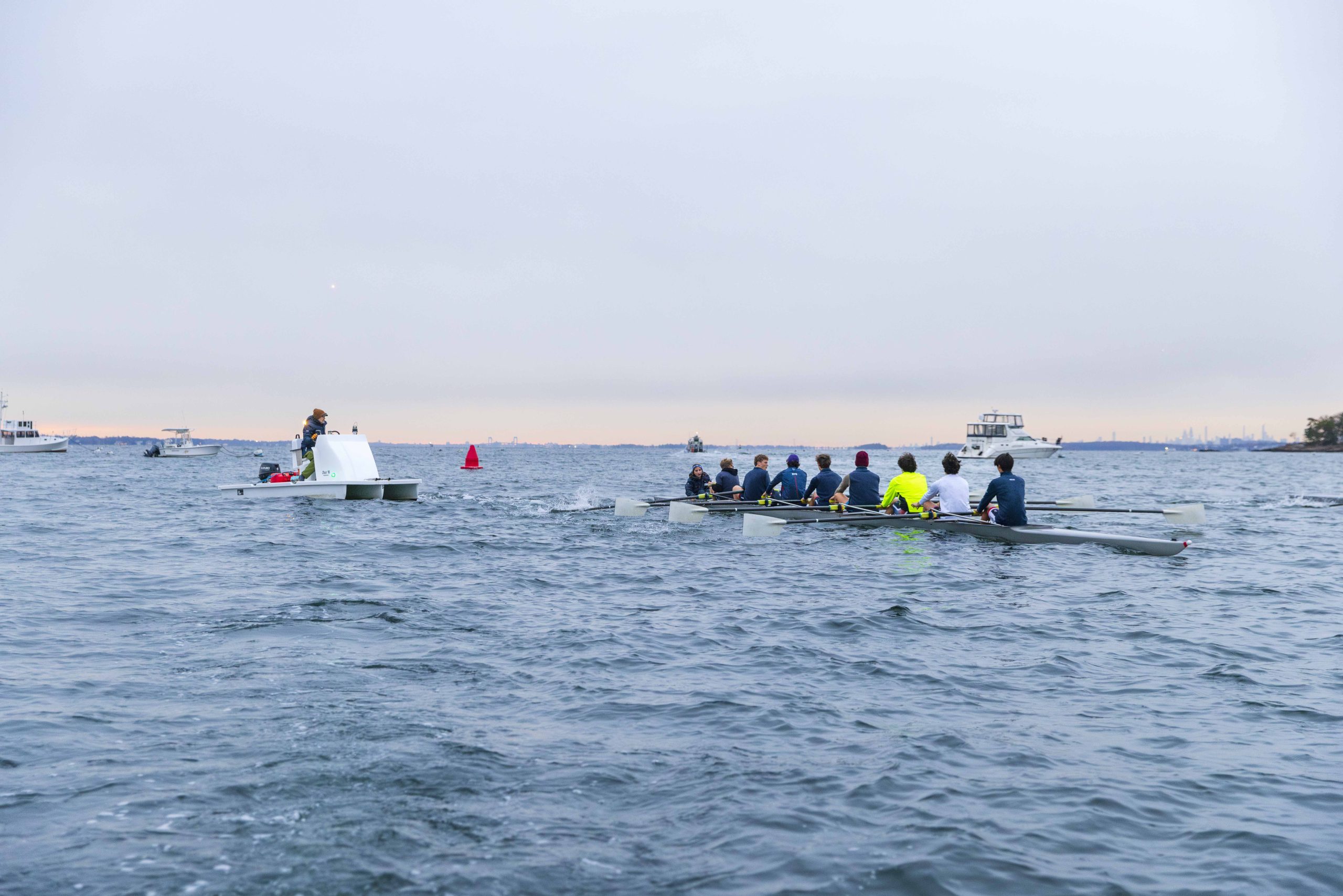
The water is Milton Harbor in Rye, a narrow north-south channel that dumps into Long Island Sound and is essentially a wind tunnel that throws heavy chop across the bows of the boats regularly.
“About 1,500 yards out, you’re already in the sound. There are three marinas and a lot of motorboat traffic and objects in the channel that you either dodge or find by running them over unexpectedly,” Serafimovski said. “We deal with it. We make it work. Collegiate coaches come and watch our practices and they’re like, ‘How the hell do you do this?’ We don’t have a river or a lake, so we have to make do.”
If nothing else, when RAR shows up at a regatta that is experiencing poor conditions, the rowers think very little of it.
“My first year at Rye, I was out there learning how to scull my single, and there were motorboats everywhere and I thought, this isn’t going to end well,” Van Praagh said. “But you get that discipline, that idea that even if conditions aren’t great, you’re going to find a way to get it done. It’s going to benefit you so much in the long run. The place wasn’t great for rowing, but we never focused on that, we never talked about it. It was just something to work through and find a way to use it to our advantage.”
“It definitely builds a bit of character,” Dolce said. “There’s stuff floating in the water, and the winds just rip through that marina channel. But we still worked our asses off every day. You give 100 percent, and there’s never a day where you could be like a sack of potatoes in the boat. At the end of the year, when you achieve the success, you know it’s because you earned it.”
Along with Van Praagh and Dolce, the other U19 national team member in 2025 was Isaac Rabinowitz, who is back at Rye this season and has committed to Harvard in the fall.
The list of accomplished rowers turned out by the program continues to grow. Cole Thomas and Lucas Liow were other recent U19 team members. Both are sophomores at Princeton. Current U23 team member Ellie Smith, a junior at Princeton, is another alumnus, as is Gus Rodriguez, who rowed at Brown and Cal and was selected as a spare for the U.S. rowing delegation to the 2024 Paris Olympics and won a bronze medal in the U.S. eight at worlds last summer.
The distance from Smederevo to Rye isn’t that far, after all—if you’re measuring just by what it takes to rise to the top in rowing. Old World principles translate across countries and continents into new successes. And if you have to dodge a few floating obstacles in the harbor along the way, all the better.
Bob Ford, a seven-time Pennsylvania Sportswriter of the Year, wrote for The Philadelphia Inquirer for more than 30 years, during which he covered plenty of rowing. His rowing-related thrills included stories about Prince Albert of Monaco, grandson of Jack Kelly, the fabled Philadelphia oarsman—albeit focused on bobsledding.
