

To continue reading…
This article is exclusively for Rowing News subscribers. For as little as $5 a month, you can get access to the best quality, independent reporting on all the issues that matter to the North American rowing community.
Story by Mike Jensen | Photos by Stewart Cohen
You should row.
When you reach 6-foot-8, you get suggestions about life choices.
You should play basketball, volleyball, paint ceilings.
But the randomness of You should row, you’d be good at it that helped start Cedar Cunningham on his path was more about the couple who said it, how they had moved down the street by chance, and became friendly with Cunningham’s parents.
Cedar had never met Anna or Bob Cummins before they made their suggestion. He was home from his freshman year at Washington State after Covid ended his spring semester.
Growing up in the Seattle suburbs, Cunningham had heard the rowing idea before. But in high school, his sports were football and track and field. He hadn’t always been towering. A football roster his sophomore year listed him at 6-1. A late growth spurt that got him to 6-6 before college wasn’t a complete shock; his dad is 6-5.
His legal name came with tall expectations. Cedar is named after his father’s grandfather, who had picked up Cedar as a nickname.
“He was tall and had red hair,” Cedar said. “He kind of looked like a cedar tree.”
That couple down the street finally met the tall kid home from college. Bob Cummins had been a two-time IRA champion and a world-champion rower. Anna Cummins had been an Olympic gold medalist (Beijing, 2008.)
“You’d probably be good at this,” Cunningham heard from the friendly neighbors.
“I was interested in just working out more. I thought it was something to work toward potentially. They gave me an old erg with a wooden handle. I started doing some workouts. I talked to them about the basics.”
Cunningham reached out to the coach at Washington State, found out there weren’t really any cuts.
If you keep seeing this name, if Cedar Cunningham continues his current national-team path to a U.S. Olympic boat in 2028, people may be tempted to assume he was destined to row. If true, let’s at least acknowledge that destiny doesn’t require a straight path. Destiny is not in an entirely separate lane from luck. Maybe they just come together under the banner of circumstance.

Does Cedar’s first coach remember his first impression?
“Oh my gosh, yes,” said Devon McCormack, who was working with Washington State novice rowers when Cunningham signed up. “Cedar is hard to miss.”
Come to think of it, McCormack said, that wasn’t his real first impression. With everyone home during the pandemic, the first team meeting of Cunningham’s sophomore season occurred via Zoom. It’s hard to capture 6-foot-8 in a Zoom square. And introductions are just that. Were these new guys really going to show up in person?
“Recruiting for rowing is already a challenge,” McCormack said. “What keeps them in is the camaraderie and the community.”
There was little of that. Here are some erg workouts. Send in your times. Cedar’s times caught McCormack’s attention, but what did they mean?
“I had no sense for physicality, for build, for athleticism,” McCormack said. “Some of the tall guys we got to come through, they can be very fit, but they’re not always very coordinated. You tell your body to do one thing, it does something else.”
But this guy Cedar, the coach soon found out, “was always kinesthetically aware.”
Classes were still virtual that fall of 2020 when students were allowed to return to campus. The rowers weren’t on the water yet. The coaches were trying to assess both athleticism and competitiveness. In addition to erging and running, “we had this assault-bike assessment,” McCormack said. “See how hard people are willing to go, and how they will dig. He did some insane effort. Not numbers we had seen.”
As it happened, McCormack had just been to a U23 national-team identification camp himself. He hadn’t advanced to the next stage, the final team camp, but he knew the times of those who did. This novice he was coaching at Washington State was already within range, so McCormack made a point of grabbing him for a conversation. The team was erging outside behind the student rec center. Cunningham had yet to pull an oar in the water.
“I was telling Cedar, ‘OK, I know you don’t know what these numbers mean,’” McCormack said. “I showed him an Excel sheet [from the ID camp]. ‘There’s no reason you can’t hit these numbers by the end of your time here.’”
“Everybody was telling me I was good,” Cunningham said. “It’s a little bit addicting.”
But that one conversation with McCormack, he said, was so crucial.
“He kind of first brought up ideas like rowing in the summer, and rowing after college,” Cunningham said.
When Cedar finally got in a boat, he had it all down?
“It was not pretty,” McCormack said. “To be totally transparent, I have seen him row recently. It’s beautiful. I want to emphasize he’s super-coachable.”
And, the former coach added, “fiercely” competitive.
“It might be the ugliest rowing in the world,” McCormack said of those initial rows. “No matter what, he was getting his bow ball in front.”
He at least felt comfortable?
“Terrifying, the whole stability of the boat,” Cedar said. “I’m still not even used to it.”
His competitiveness did not cause friction at Washington State. Everyone could see what it meant for their boat.
“He wouldn’t be shoving it in his teammates’ faces,” his coach said. “He was just better than you. He just dominated his seat, his position, whatever it was. He was indomitable.”
While Seattle is a rowing hotbed and the University of Washington is a historical power, there has been no movie made about the boys in the boats out in Pullman. Washington State is a club program.
“We had to fundraise, pay to be there,” Cunningham said. “We did this thing, Rent a Rower, all the time. We’d do odd jobs, like manual labor. Most of them were pretty tame.”
One time, he remembers, a bunch of the rowers were sent to a full working farm.
“A really neat place,” Cunningham said. “But we were just moving mulch the whole time.”
What he termed “a very, very robust” alumni group bought boats and paid other major expenses.
“What the jobs helped pay for the most went to travel and competing at races,” Cunningham said.
For a guy now rowing internationally, it’s interesting to note the precise detail Cunningham still recalls of Washington State races. They were never going to break into the big time. They were striving for such things as breaking into the A final at ACRAs, the collegiate club national championships. Even getting to the A-B semifinal and ending up in the B final was a big step. Trying to beat fully funded Gonzaga was another goal.
“We felt like we were finally going to do it,” Cunningham said. “Someone caught a crab. Two crabs, with 250 meters left.”
They would go race a duel with Washington—Washington State’s 1V against the Washington 3V.
“We would lose pretty significantly to their 3V,” Cunningham said.
Something that stuck with Cedar about that race: You didn’t have to be a jerk just because you’re faster. The Huskies guys were cool.
“They were all very complimentary to us,” Cunningham said of the Washington rowers.
From his current vantage point, Cedar understands it was all worthwhile.
“I do very frequently look at those races as very important,” Cunningham said. “I don’t hold them with any less weight. There’s a common phrase in rowing: It doesn’t get any easier; you just get faster.”
A teammate did tell him once, “You’re going to be racing in so many more important races; this is just a drop in the bucket.”
“There was never going to be an issue with him burning out,” McCormack said. “He was very aligned. He would never admit, I think, how far he wanted to go, but there was never an issue with motivation.
“The advantage of rowing someplace like a Washington State, because the depth isn’t there, there was never a question he was going to be selected. Those guys at [Washington], day in and day out are battling each other for their seats. That makes them great as a team, as a program.
“The double-edged sword is, they’re operating out of this fearful mindset. Cedar was going to improve just for the love of the game. He had a vision of where he wanted to go. He could execute that in his little bubble.”
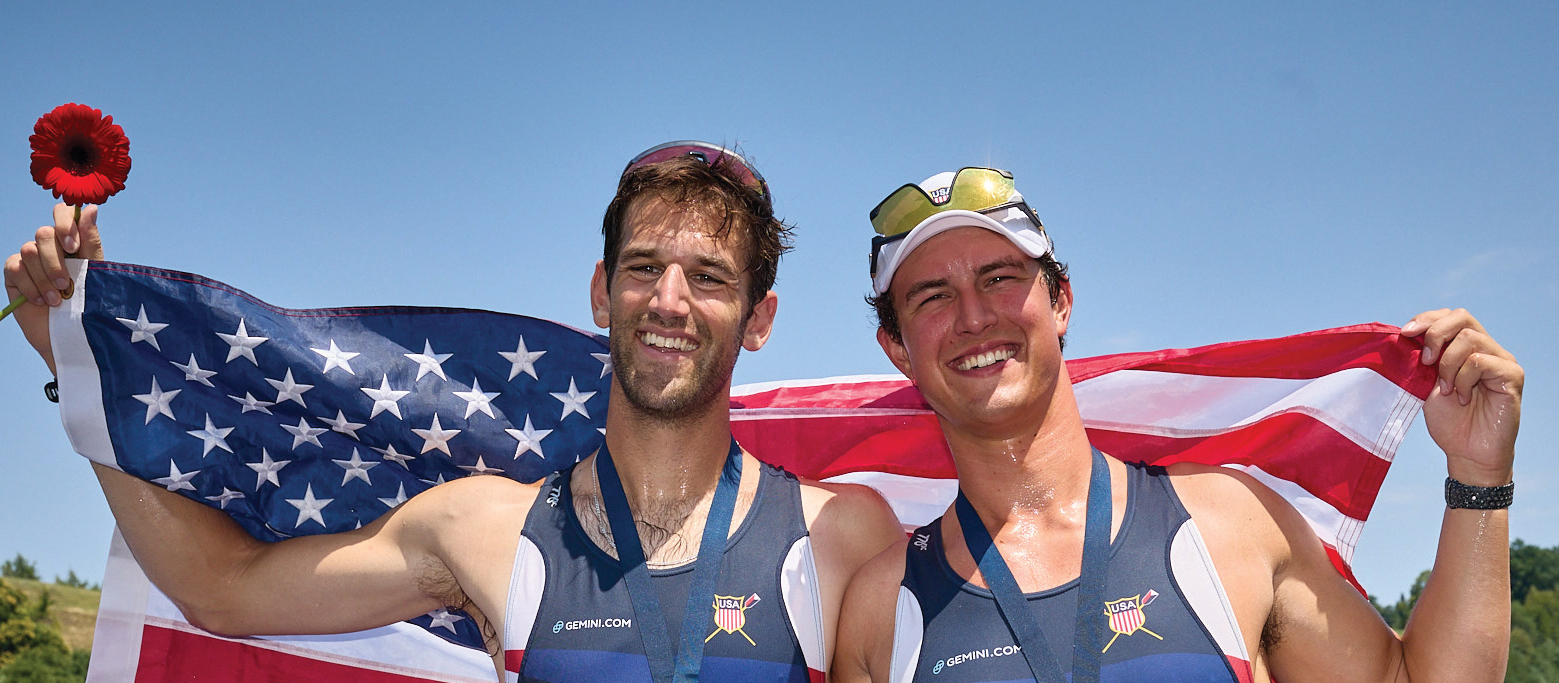
A Washington State alum, David Herrick, now the men’s lightweight rowing coach at Navy, was an assistant at Oregon State when he heard his alma mater had a novice who was fairly impressive. He drove up to Pullman.
“OK, this kid has capacity,” Herrick remembers of seeing Cedar on the erg. “I need to have a conversation with him.”
Herrick explained that being in an isolated place like Pullman, far away from the rowing powers, “the benefit is it’s insulated, and the problem is it’s insulated. Guys know only their own space.”
Herrick remembers telling Cunningham, who would graduate in three years, “I think you have another gear.”
“That sounds great,” Cedar said. “Where do we go?”
Philadelphia became the answer. Boathouse Row. Penn AC had a U23 program willing to take him.
“Put him in with guys who are better than him,” Herrick said. “He can say, ‘Not only can I keep pace; maybe I can do better than them.’”
He was still only 20 years old, so he knew he had a couple of years to try to make the U23 team.
“That was the goal, see if I could make it,” Cunningham said. “Give myself a little glory for all the work put in.”
He can still remember getting to Philly—“just my suitcase, off the plane.”
The Penn AC U23 guys had a place to stay—the Monastery, they called it.
“It was this old convent,” he said. “It was in worse shape than my frat house. There were no full-time residents. It was all Vesper and Penn AC U23 kids there for the summer.”
The place was pretty empty the moment he got there. He found a lady who told him, “Choose whatever room is open.”
He walked across the street and got “probably the worst Philly cheesesteak I ever had.”
But the rest of it …
“I absolutely fell in love with it,” Cunningham said of seeing the history “plastered all over the walls” in the boathouse, and what he described as the perfect work environment set up by Bill Manning, who had vast national-team and big-time college coaching experience. For Cedar, here were like-minded peers, with speed similar to his but more experience—“they were getting a lot more out of themselves.”
That summer was all sculling, another learning curve, different rhythms to pick up. A formative experience. Costs were kept low. A summer highlight was a Penn AC quad getting silver at club nationals, losing “to a bunch of guys who had just been cut from the U23 quad camp. I was getting a silver medal.”
His first big medal. Looking back, it wasn’t a great row.
Manning even told them that right after the race. Cedar had to readjust. He’d thought it had gone pretty well. The whole thing was “almost perfect” as a steppingstone to a national camp.
“Bill was very in touch with the national-team scene, knew what it took, but he allowed me the time to develop,” Cunningham said. “It took me another two years to develop. Bill was very helpful throughout. It takes a long time to build your baseline fitness. My physicality did let me skip a few steps.”
Cunningham describes his path to his current status as having a couple of lucky breaks, like when he would win the C final in a 2024 winter erg competition, when only the A and B finalists got a national-camp invite.
“I was pretty sad about it,” Cunningham said. “Bill said this is not your timeline. Your timeline is LA.”
In other words, 2028, the Olympics. Far off on the horizon at the time.
“Luckily for me, several people from the A and B final declined,” Cunningham said, of getting his invite. “It slowly trickled down to me.”
“It definitely wasn’t lucky,” said Casey Galvanek, head U.S. men’s coach, who had assembled the team in Sarasota.
Cunningham’s relative lack of experience isn’t unique; Olympians occasionally come out of non-elite college programs.
“The absolute best thing—they seem to be a little less rowing aloof, “Galvanek said. “People who were successful in college, nothing wrong with that. There’s always the trouble, though, if your last program was incredibly successful, you think what you did was correct and everything you did was the thing.”
Starting over at the next level, the national team coach said, “you’re coming from the A final of the IRAs, you’re thinking, ‘I know best.’ I don’t mind. I’m always happy to have them. But if you won the IRA and I’m telling you how to hold the oar”—yeah, that can be confusing.
“There has to be a middle,” Galvanek said. “I also have to understand you just won.”
Even Olympians returning to camp after getting a medal hung around their neck need to get past that, he said.
“Everyone assumes the level of competition is going to be up a notch. A repeat performance is usually going to be a step below.”
So here comes a Cedar Cunningham, open to it all, ready to learn as the national team coaches break things down to the fundamentals—this is proper hip action, this is how you apply pressure to the foot stretcher.
“You’re going to be slower for a while,” Galvanek would tell them all.
This summer meant more competition for Cunningham in Europe. Can he keep raising his game? At a June World Rowing Cup event in Plovdiv, Bulgaria, Cunningham was part of a double sculls team with James Wright that reached the A final, finishing fifth.
The ceiling keeps getting higher as he takes on some of the best scullers in the world.
“Every once in a while, he’ll send me a 2K or 6K time,” said McCormack, his first coach. “Every time he sends it, it’s been faster.”
However it plays out, this much we know about the guy named after a tall tree: You should keep rowing.
MIKE JENSEN wrote for The Philadelphia Inquirer for 35 years and was named Pennsylvania Sportswriter of the Year in 2023. He covered rowing on the Schuylkill River and at the Beijing Olympics and wrote the weekly Merion Mercy Academy crew newsletter for seven years while two of his daughters were champion rowers at the school. His book, Philly Hoops: How Philadelphia Transformed Basketball, will be published later this year.
