

To continue reading…
This article is exclusively for Rowing News subscribers. For as little as $5 a month, you can get access to the best quality, independent reporting on all the issues that matter to the North American rowing community.
Thirty-five years ago, American junior rowing had no universally recognized national championship.
Today it does.
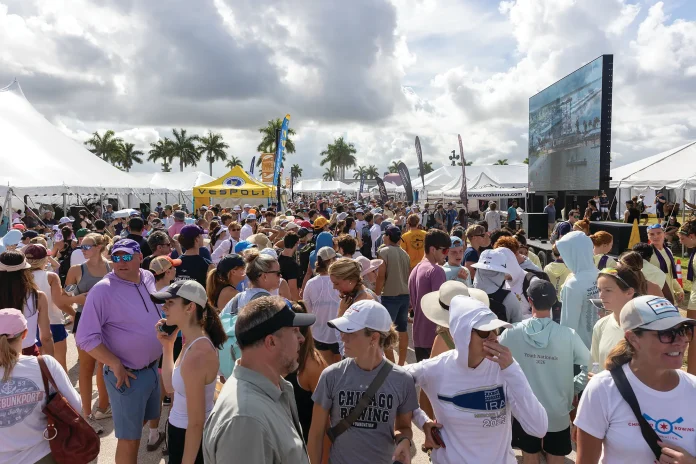
The 2026 USRowing Youth National Championships drew roughly 4,000 athletes and thousands more family, friends, and supporters to Nathan Benderson Park in Sarasota, Fla., where the country’s best crews raced for national titles across 38 events.
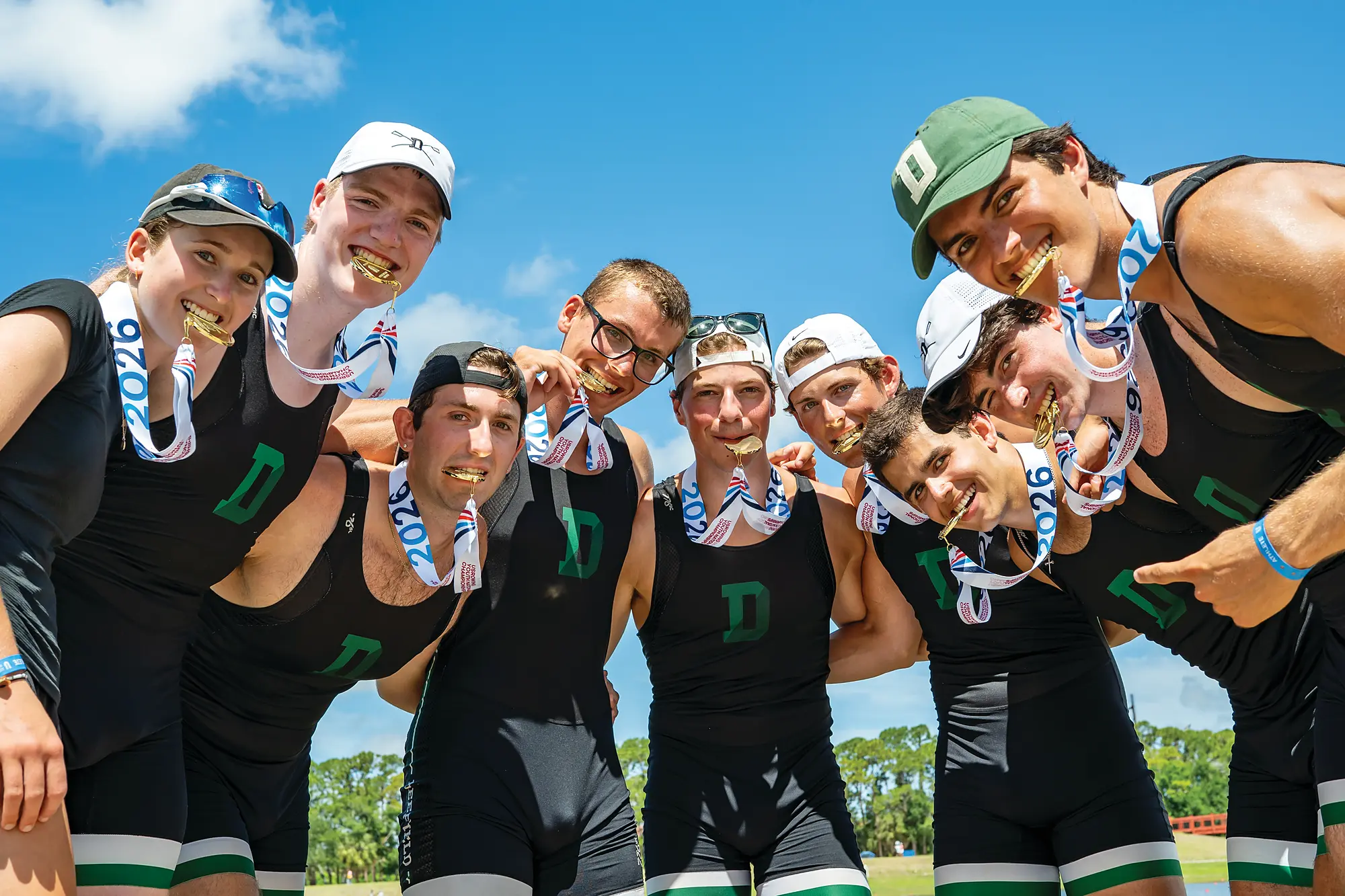
Deerfield Academy won the men’s youth eight, and RowAmerica Rye won the women’s youth eight for the third consecutive year.
In the singles, Community Rowing, Inc.’s Simeon John gave all he had—capsizing after crossing the finish line—to outdistance Porter Collins in the men’s event. On the women’s side, Shay Triepel of Coastal Virginia Community Rowing made it to the line first barely ahead (0.29 seconds) of the inspired final sprint of Avisa Rezaei of First Coast Rowing Club for the win.
Competitors earned entries in the championship through racing in 11 regional championships and qualifying regattas across the country. After four days of weather delays, schedule revisions, and summer heat in mid-June, 38 national champions were crowned.
For John, the men’s single title represented the culmination of a process that had included both disappointment and growth. As a U17 athlete, he finished third and left crushed. Last year, he thought he had a strong chance to win and left disappointed with a second-place finish to Tony Madigan. This year, he arrived determined to focus on his own race rather than the athletes around him.
“I was just trying to make sure I was pacing it my own way,” John said. “If I was losing, then I’m just racing my StrokeCoach, and if it says I’m fast and I get second place, I’m gonna be happy with what I did.”
Porter Collins, son of the eponymous two-time Olympian and Brown oarsman, advanced to the final through the time trial and semifinals with better times. John admitted he was nervous to race him, but he had learned over the previous year that measuring himself against competitors was not helping him perform.
When officials began calling lanes for the final, he found himself calmer than he had ever been before a major race.
“The only nerves I had were that this was going to hurt,” he said.
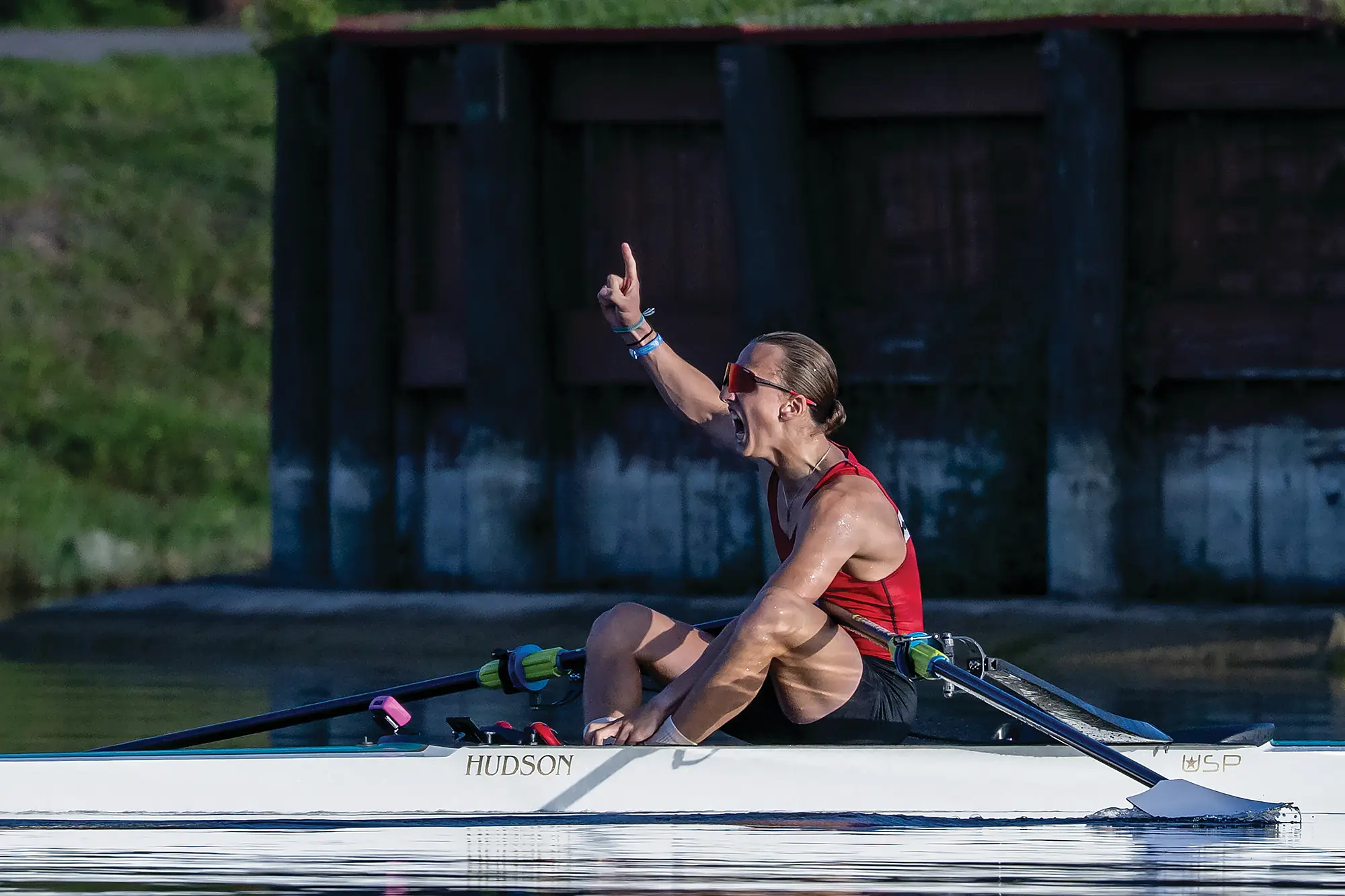
Five years of training led to Sunday morning in Sarasota. Afterward, exhausted and recovering in the cooling area, John reflected on the result.
“Five years has led to this day,” he said. “It’s a special moment to graduate with a national championship.”
The women’s single produced one of the closest races of the regatta. Triepel’s margin over Avisa Rezaei was just 0.29 seconds after 2,000 meters, a national championship decided by less than a second after months of training and qualification racing.
The eights remain the marquee events of American junior rowing, and both produced champions that had spent the season proving themselves against top competition.
Deerfield Academy won the men’s youth eight over a deep field from across the country. Sophomore coxswain Nadia Vieira expected Marin and other challengers to start quickly but believed her crew’s strength would come later in the race.
“We just stayed stubborn,” she said. “Unbreakable, undeniable.”
For a crew that won the New England Interscholastic Rowing Association 1,500-meter regatta by open water, Deerfield adapted well to the full 2,000-meter youth national championship.
“There is so much more room for things to happen,” Vieira said.
The extra distance allowed races to develop, crews to move, and momentum to change. Deerfield handled the middle thousand effectively and left Nathan Benderson Park as youth national champions.
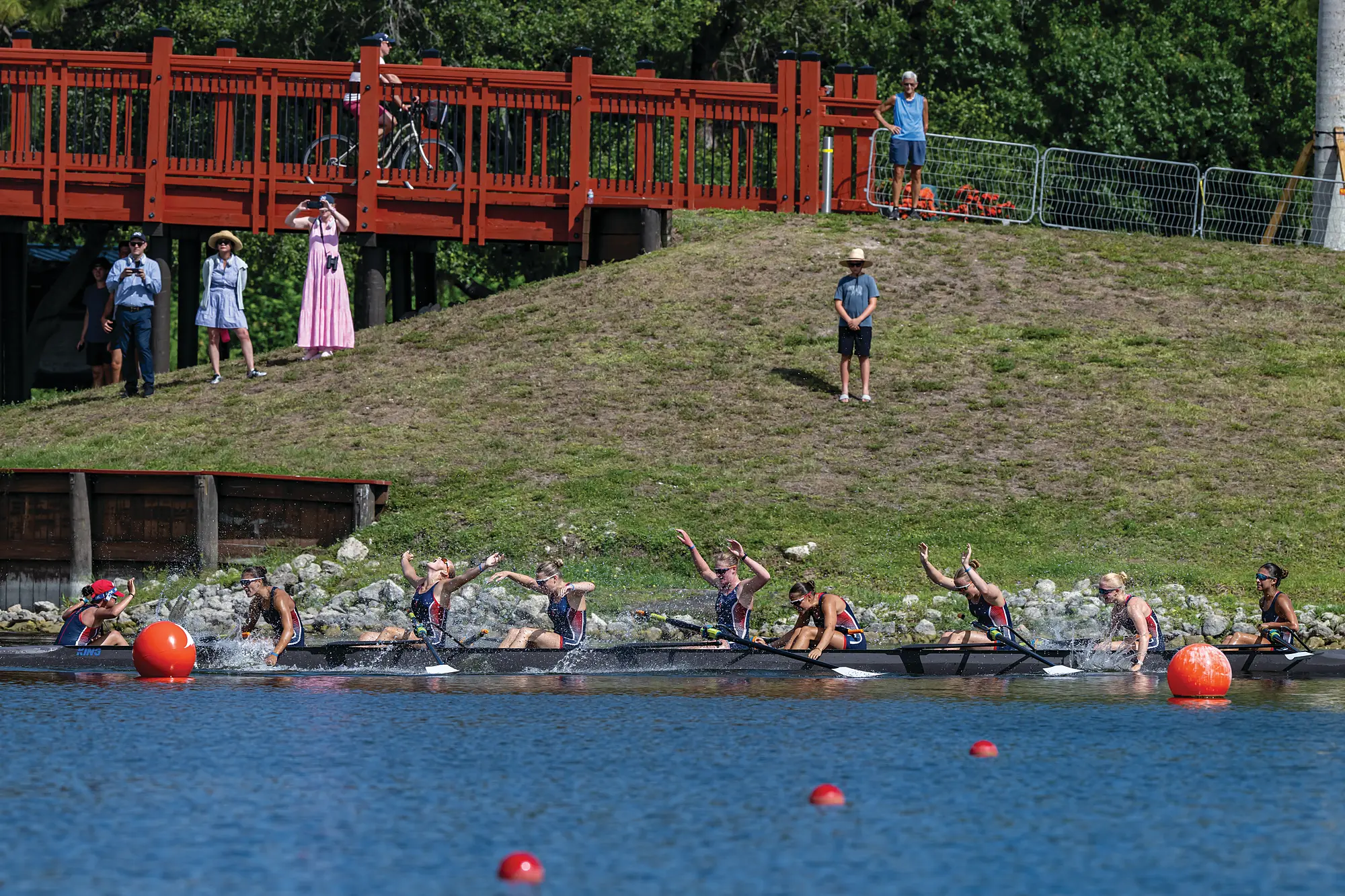
The women’s youth eight belonged once again to RowAmerica Rye. The for-profit club won its third consecutive national title and will now continue its season at Henley Royal Regatta.
Coach Marko Serafimovski credited the crew’s development to an emphasis on simplicity.
“We just put a lot of effort on simplicity of a rowing stroke,” he said. “We wanted them to feel the difference between when the boat is moving versus when it is not and allow them to make technical changes on their own based on the feeling. In order for this to work, it had to be done collectively, and I believe they have done a really good job at it.”
Chicago Rowing Foundation again emerged as one of the country’s fastest programs. Coach Mike Wallin called this year the best field ever and noted that Chicago, Rye, Deerfield, Winter Park, and Green Lake would all continue on to England.
“We’ve been in eight of the last 11 grand finals,” Wallin said. “This year’s race felt like the deepest and most intense field we’ve ever faced.”
Chicago’s trip to Henley will be historic for the club.
“We are going to Henley,” Wallin said. “I don’t know if a crew from Chicago has ever gone before. It’s certainly the first time CRF has.”
His view of the American crews heading overseas reflected the spirit and mutual respect expressed at Youth Nationals by the programs that make it to Sarasota.
“If they are not in the lane next to us during the regatta, we will be rooting for them,” he said.
Malvern Prep won the men’s youth quad, another major scholastic victory. Los Gatos Rowing Club had one of the strongest regattas of any program, winning both men’s and women’s second varsity quads while posting strong performances across multiple events.
Coach Channing Walker attributed much of the success to years of emphasis on small boats.
“A lot of singles, a lot of doubles, a lot of pairs,” Walker said.
He also credited a senior class that had helped raise expectations throughout the club.
“We had 18 kids who were really competitive,” he said. “I’m glad that they’re all here and pushing themselves to the limit.”
Taken together, the results reinforced something that has become increasingly apparent over the last decade. Youth Nationals has become the place where the highest-achieving youth rowers in the country come together after first proving themselves elsewhere.
Thirty-five years ago, American junior rowing had no recognized unified national championship. There were strong leagues and regional championships, traditional rivalries, and highly competitive regattas, but there was no single event where the best crews from across the country gathered to race one another.
Now, thanks to early pioneers in Cincinnati and the continuing efforts of USRowing staff members and hundreds of volunteers, there is.
The athletes who arrive in Sarasota have earned their places in the field by having already won their league championships or qualified through regional regattas. They are not simply participants. They are, by definition, the highest-achieving young rowers in the country.
The reward for those accomplishments is the opportunity to race everybody else who accomplished the same thing.
“Who doesn’t want to race everybody in the country and see speed and be inspired by it?” said Sandy Armstrong, who has coached Marin Rowing Association for over 40 years.
For Armstrong, Youth Nationals represents both years of hard work and a vision of what younger athletes might become.
“It’s the culmination of four to five hardworking years for the senior kids,” Armstrong said. “I believe that it is building a vision for that young group. To watch the varsity kids perform, and see speed, and be inspired by them and by their coaches is outstanding.”
The road to the current version of Youth Nationals has not been perfectly smooth. Holding an event of this size takes a pile of money—like that provided by entry fees from as many crews as possible. An independent unofficial analysis obtained by Rowing News suggests that Youth Nationals generates over $800,000 in member and entry fees for USRowing.
A huge field—863 crews, this year—requires multiple rounds of racing, even with Sarasota’s 10 lanes (Youth Nationals features eight-lane racing, with the extra lanes available for special situations like dead heats in semifinals). There have been failures, such as a previous version of a qualification format that for some crews resulted in one-and-done time-trial experiences.
When USRowing tried to institute a mild version of “stay to play,” a requirement at many youth sports tournaments that competing teams stay at sponsoring hotels, communication was botched. Even though Youth Nationals participants had to report where they were staying only for informational purposes, community outrage on social media was brutal.
Questions continue about awarding second varsity crews “national champion” titles. If you can’t make the first boat at your own program, how can you be a national champion in that boat class?
But none of those discussions changes the central fact that thousands of athletes now spend an entire season trying to qualify for a championship event that did not exist a generation ago.
The regatta itself continues to grow. Before Covid, Youth Nationals offered 27 events. Today, there are more than 40, counting “inclusion” events designed to show that all are welcome, even if no one enters a specific event. Younger athletes now have additional opportunities to experience the championship environment, though USRowing eliminated U15 competition after determining those athletes were too young for this level of competition.
Sarah McAuliffe, USRowing’s senior director of programs, says the goal is to do more than just run a regatta.
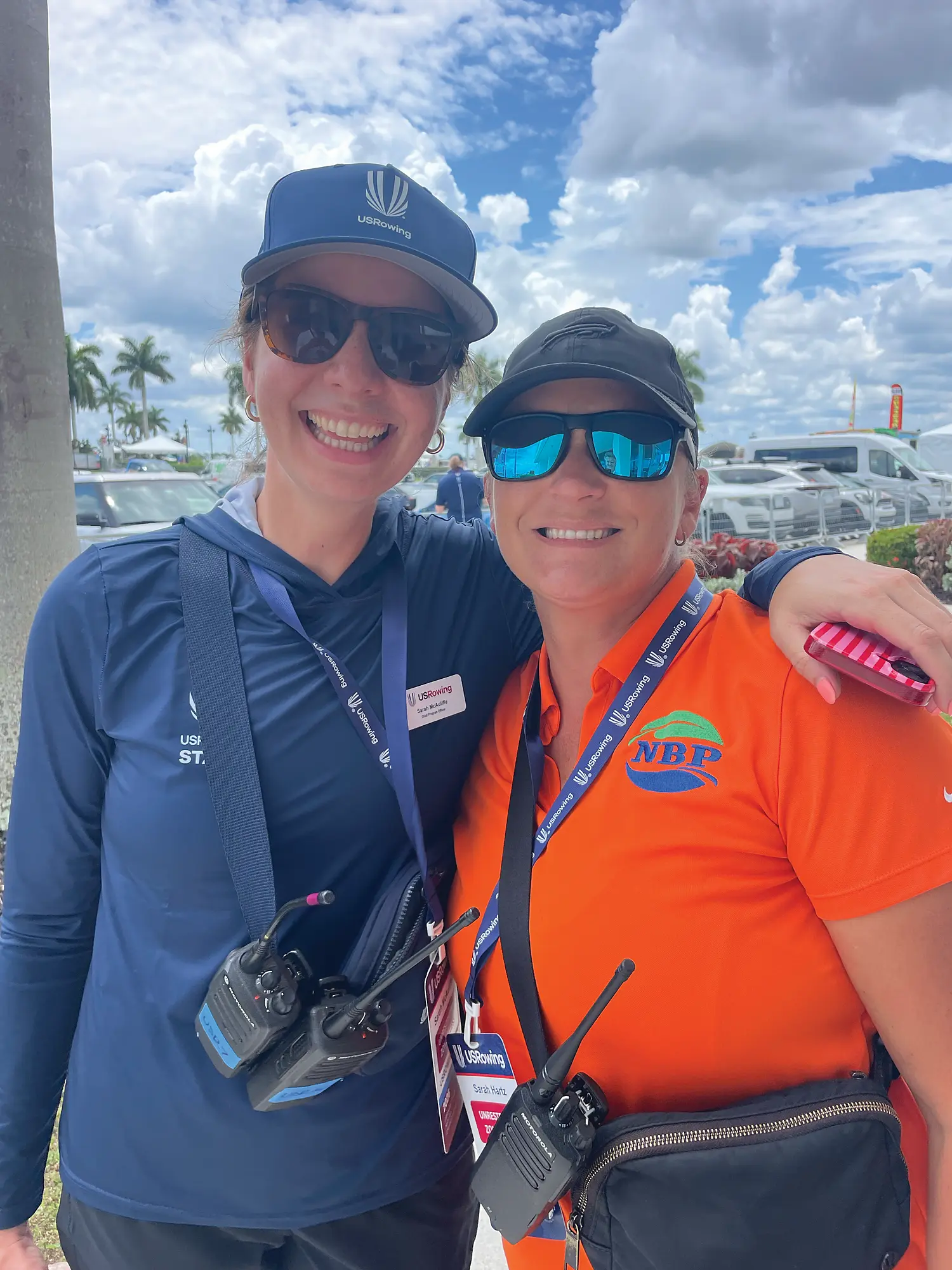
“The end goal here is not only to be the best regatta for a youth athlete but also to be the best sporting event that the youth athlete goes to on an annual basis,” she said.
McAuliffe was promoted in June 2025 from director of competition to senior director of programs. She continues to oversee USRowing-owned regattas, including Youth Nationals and RowFest, while also taking on camps and referee initiatives.
A week before racing, she described preparations as “controlled chaos.”
Working with Sarasota County and the staff and volunteers of Nathan Benderson Park, USRowing staff had already spent days preparing the venue, organizing trailer parking, staking boundaries, taping off areas, building athlete and spectator zones, and turning the park into a championship venue.
“We’re the manual labor behind it all,” she said.
By the time teams arrived, the focus shifted from construction to service. McAuliffe’s team spends years in discussions with stakeholder groups trying to understand what athletes, coaches, referees, parents, and spectators want from the event.
The coaches’ lounge grew from those conversations.
“The coaches want a moment of silence,” she said. “They want to watch the livestream. They probably don’t want to talk to a lot of people. They want coffee.”
The result was a climate-controlled coaches’ space with food, real restrooms, and a place to step away from the noise of the regatta. The athlete experience received similar attention. The athlete tent included air conditioning, recovery space, Concept2 BikeErgs, and rowing machines for athletes to warm up and cool down.
“We’re very intentional about every inch of the experience of this event,” McAuliffe said.

Tom Rooks sees Youth Nationals from a different perspective.
Also promoted in June 2025, from director of safeguarding to chief sport officer, Rooks oversees competition, camps, referees, sport growth, safety, and risk management. In practice, that means safeguarding, insurance, regatta sanctioning, USRowing-owned competitions and camps, trials, speed orders, referees, and the safety systems that allow an event this large to happen.
Rooks came to USRowing in 2022 after years in the sport as an athlete, coach, board member, and club administrator.
“I work vastly more now than at the peak of my military career,” he said. “I love this—it brings me joy. And when I don’t love it, I’ll leave.”
This year’s championship tested every part of the operation. Daily weather delays forced constant schedule revisions. A set of semifinals for lower events was pushed to Saturday morning, the same day as the B finals of those events. To reduce the risk of athletes racing twice on a hot day without adequate recovery, organizers converted one of the national team operations trailers into an additional cooling station.
“We’re bringing an even better product than last year,” Rooks said, “which is all we can do.”
Youth Nationals now operates under some of the most stringent heat-safety standards in sports. Several years ago, because of concern for their health in the heat, more than 100 athletes were removed from boats during the regatta. According to Rooks, that number fell to six in 2025.
Coaches may not always agree with those decisions.
“Coaches aren’t always speaking for the rowers,” Rooks said. “The crowning achievement of our sport happens because of everyone involved and hours of work that are never seen,” Rooks said.
The referees are an intrinsic part of that effort. Rooks said in recent years, USRowing has done everything referees have asked, from better facilities to better support. On the final day of racing, referees pass through a gauntlet of cheers. When the final white flag drops, they pop a cork.
“I live for that moment,” Rooks said.
USRowing Foundation chair Bill McNabb has been one of the biggest proponents of Youth Nationals, Rooks said, and proclaims often that everyone involved in rowing should attend the regatta to see how to run one. USRowing staffers like Jake Robinson have been part of the same effort to continue raising standards and building the championship, Rooks said.
The regatta has become something larger than a collection of races. It is an event. There is airport signage welcoming participants. There are graduation events. In 2025, some 500 athletes attended a graduation celebration after deciding initially that they were not going to miss commencement at home.
Youth rowing itself appears healthy. The challenge, McAuliffe said, is what comes afterward.
“We absolutely need to grow that U23 audience,” she said.
The question is not simply how to keep athletes racing. It is how to keep them coaching, refereeing, volunteering, and participating in the sport after high school and college. McAuliffe sees opportunities to expose former athletes to coaching education, officiating, and other pathways that keep them connected to rowing.
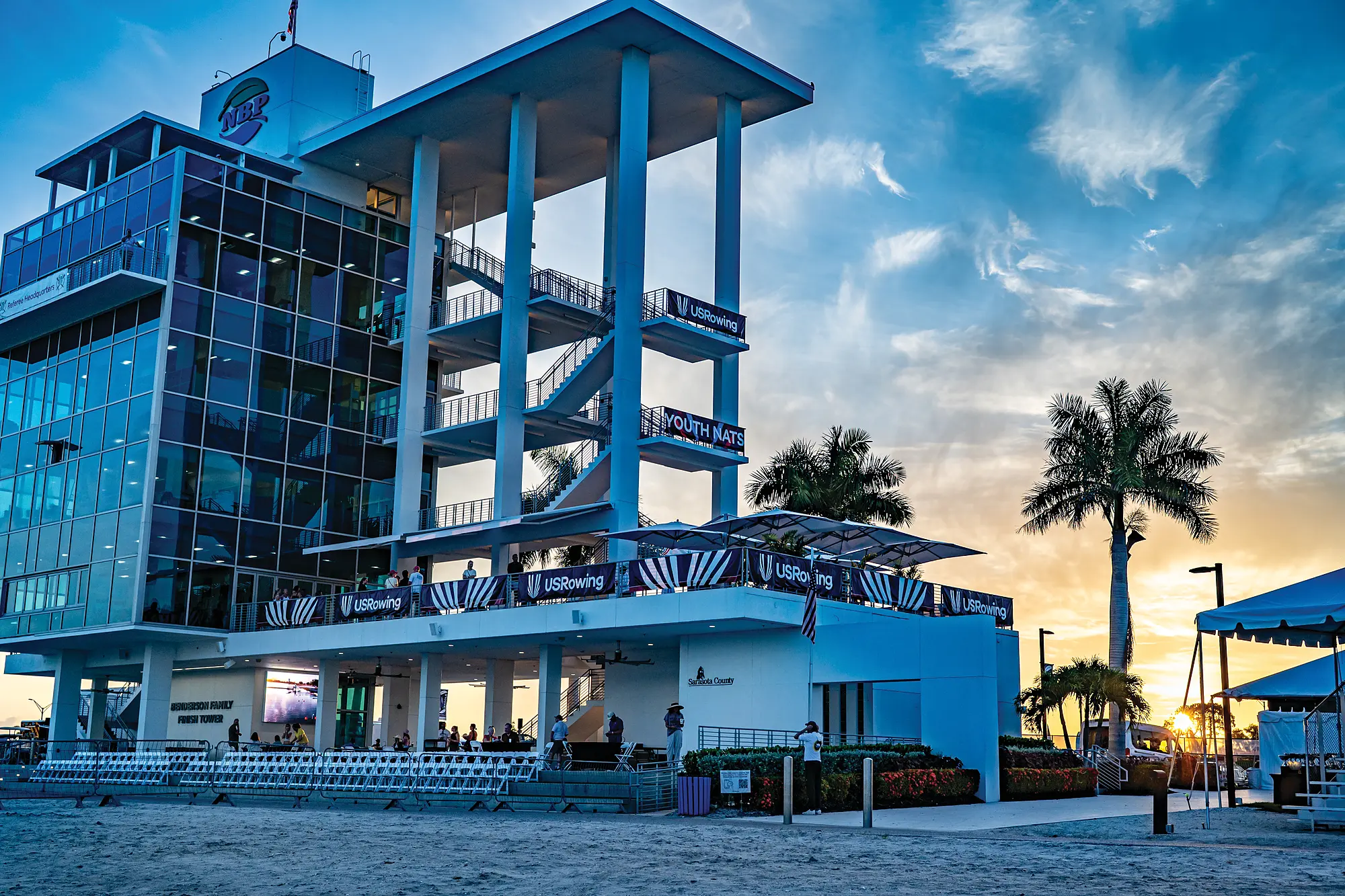
Nathan Benderson Park is preparing for growth as well.
McAuliffe called Benderson one of the top rowing venues in the world. The venue has become an ideal home for a regatta that wants to be both a championship and an event, with room for thousands of athletes, coaches, spectators, volunteers, medical personnel, and officials.
Asked when the regatta will move to another venue, McAuliffe said, “When they can compete with this.”
Bruce Patneaude, Nathan Benderson Park’s chief operating officer, said the impact extends beyond the venue itself.
“I heard we had filled up every hotel in a two-county area here,” he said. “That’s spectacular for the economic impact for the area.”
There is more coming.
The board of the Nathan Benderson Park Conservancy has commissioned architectural plans for a new indoor sports complex and elite boathouse. Florida lawmakers have approved $10 million for the project, and a $36-million capital campaign has been launched.
The facility will include 100,000 square feet of air-conditioned indoor athletic space for basketball, volleyball, pickleball, wrestling, dance, cheer, and other events when rowing is not on the water.
“We’ll actually have a boathouse along with an indoor facility,” Patneaude said. “That’ll give us the ability to do whatever we want. Right now, everybody’s in a tent.”
The facility will provide athlete lounges, indoor team space, referee and volunteer areas, air conditioning, and a place to go during weather delays instead of sending everyone back to their cars.
“We can all go inside instead of trying to flee the island,” Patneaude said. “Referees will have space and volunteers will have space to get out of the heat and get into the air conditioning. It’ll be a great thing for this event and for all events we have.”
In August 2028, Nathan Benderson Park will host the combined Senior, U23, and U19 World Rowing Championships, the so-called “Mega Worlds,” bringing senior international rowing back to Sarasota for the first time since the highly successful 2017 World Rowing Championships. The new facility is expected to be completed by then.
The next chapter is already taking shape. A new boathouse, a new indoor facility, and a world championship are coming to Nathan Benderson Park. The athletes racing in Sarasota this June qualified for a national championship that did not exist a generation ago. Some of them may return to the same course in 2028 for a world championship.
Chip Davis is the founder and publisher of Rowing News. An oarsman from birth, he rowed on championship crews at St. Paul’s School and Dartmouth College, where he captained the lightweights. Now he sculls in Vermont when the weather is suitable and ergs the other half of the year.
