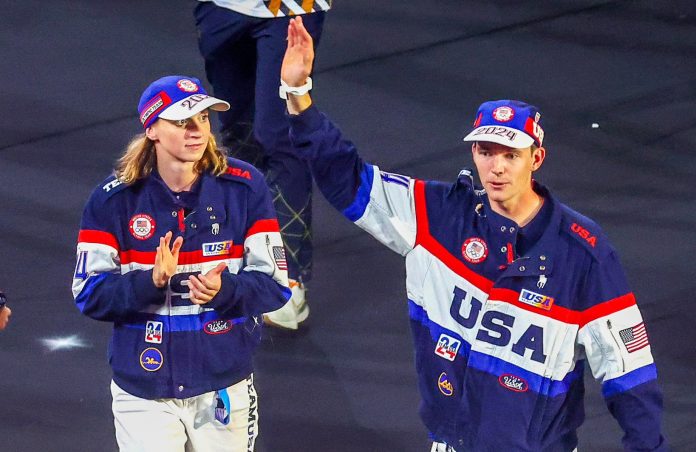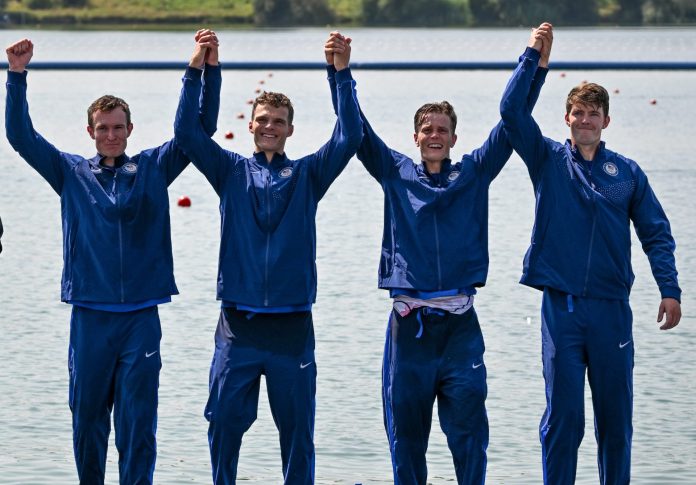
The U.S. men’s four led from the start and dictated the pace of the Olympic final, seizing control of an event Great Britain has owned since the days of Steve Redgrave. The U.S hadn’t won Olympic gold in the event since 1960, but on the warm waters of Varies-sur-Marne, Nick Mead, Justin Best, Michael Grady, and Liam Corrigan raced to victory, re-establishing American rowing glory at the Olympic Games. Corrigan, who stroked the four, credited the continuity of rowing together.
“The last five years since 2019 in different boats and pairs with each other, against each other—there’s so much trust that’s been developed in that amount of time you feel like one unit. It doesn’t feel like four people, it feels like one boat.”
“One unique thing about this lineup and this crew is we’ve been together for so long relative to other American crews in the past,” said bowman Nick Mead. “We’ve been rowing together now for about a year and training together for five or six years, so that’s a huge advantage for us.”
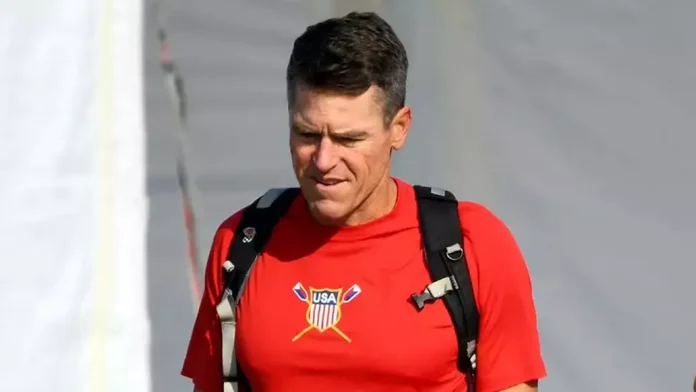
“One of the things with the men’s four, specifically, was getting out of their comfort zone,” said head men’s sweep coach Casey Galvanek, who selected both the four and the eight and was the boat coach for the four, working with them over the past two years.
“We put a lineup together and then I would ask them to make changes, and it was uncomfortable. They said, ‘It doesn’t feel good.’ I know it doesn’t feel good. We’ve got to give up the short-term feel for the long-term success, which they clearly understood. They decided they would do that, and that’s where I think part of the success came from.”
Contributing to that success were the clubs that supported and trained the athletes before they came together for the seven months leading up the Games.
“Three of us are fully from CRC [California Rowing Club], and they’ve been hugely supportive,” Corrigan said. “The clubs are a big part of it for one portion of the year.”
“NYAC has been hugely supportive of me,” echoed Mead. “Helping me both train in New York City, then also helping send me to the fall speed order and out to California to do some rows with them.
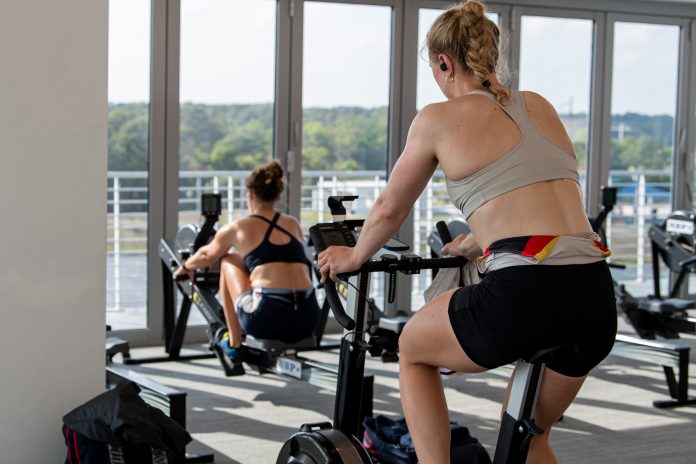
“One of the huge advantages of Josy’s program is that we’re all on the same training program throughout the country, so I might be in New York and they might be in Oakland, but on Tuesday morning we’re doing the same workout. So when we come together as a big team, it’s an easier confluence, having all done the same training.”
By nomination of the medal-winning athletes, the United States Olympic and Paralympic Committee (USOPC) awarded Galvanek, Kris Korzeniowski, Mike Teti, and Tim McLaren the Order of Ikkos in recognition of their instrumental support of the crew.
Two days after the four’s victory—the Olympic regatta spanned eight days, with four days of finals—the U.S men’s eight delivered a medal-winning performance, winning bronze and earning the first Olympic medal in the event for the U.S. since 2008 after three straight fourth-place Olympic finishes.
“It’s been a childhood dream of mine growing up, seeing Olympic paraphernalia from Seoul and Barcelona,” said two-seat Nick Rusher, whose parents both rowed in the Olympics. “Just seeing my parents in the stands, cheering me on, when I got my medal, it’s the proudest moment of my life.”
“We worked really hard looking at which athletes would be best in each boat,” said Galvanek. “The word prioritize gets thrown around a lot, but we were trying to prioritize the speed of each boat.”
Once Galvanek selected the crew (rather than the next eight fastest guys after the four) that would be the eight, Washington coach Michael Callahan coached the boat, which included four Washington athletes and still needed to qualify for the Games in May.
“There’s a couple of guiding principles about this campaign,” said Callahan, who noted that he’d never worked with such a detail-focused and determined crew, “and we’ve been talking a lot about what we’re going to do this whole week.”
“That crew came in with the highest of expectations, and a bronze medal is a great accomplishment,” said Galvanek. “It’s an Olympic medal; it’s pretty fantastic.”
The USOPC awarded Callahan the Order of Ikkos as well.
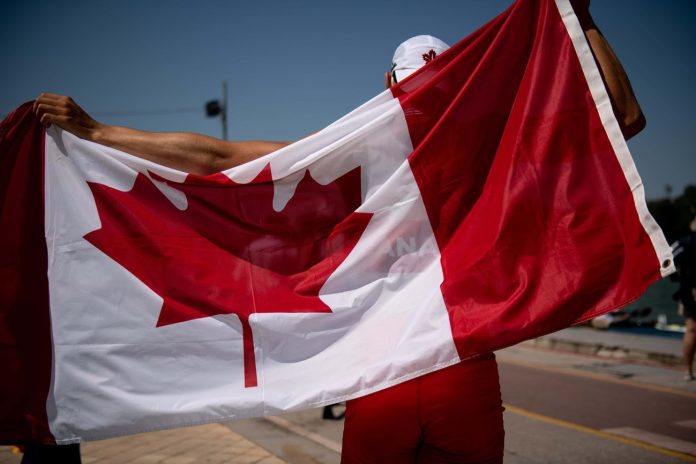
Defending Olympic champions in the eight, the Canadian women won silver, outlasting Great Britain in the race behind Romania, which won by open water. All eight Romanian women doubled up at the Paris Olympics, winning silver in the double and pair, and finishing fourth in the four.
Only three nations, excluding Romania, won more Olympic rowing medals than the Romanian women’s eight: The Netherlands (eight, including four gold), Great Britain (eight, including three gold), and New Zealand (four, one gold). Romania also won gold in the men’s double and silver in the lightweight women’s double for five medals total.
The gold medal of the men’s marked the first Olympic medal of any color for the U.S. since getting shut out in Tokyo and the first time a U.S. National Team senior crew has been first across the line since the 2019 World Rowing Championships.
Besides that gold and the bronze of the men’s eight, there was plenty of disappointment among the other 10 U.S. boats, especially for the women’s crews. The new pair of Jess Thoennes and Azja Czajkowski, formed for April’s Olympic trials, mounted a brave sprint to nip Lithuania by three one-hundredths of a second for fourth place—the best finish of the U.S. women, who qualified for every event for the fifth Olympics in a row.
“Coming from Tokyo, something that we really wanted to emphasize was the culture and how we lifted each other up,” said Thoeness. “Everybody has done a very nice job of contributing and adding to the positive energy.”
The U.S. women’s eight, selected with the four as a group of 12 by USRowing’s head women’s sweep coach Jesse Foglia, finished fifth, more than seven seconds behind Romania. The women’s eight was two-plus seconds out of the medals, a further step back from the Tokyo result. The four finished fifth, an improvement over Tokyo’s seventh place.
“Both Jesse Foglia and Josy [Verdonkschot] have been absolutely amazing in creating a structure,” said Regina Salmons, of the eight. “The team of girls—both the team that is here and the team that’s been training the last three years, all the women that we’re pulling for back at home—have been so positive, and the vibes have been really good.”
“We all learned a lot because for all of us it was our first Games,” said Emily Kallfelz, bow seat of the four that finished fifth in the A final. “It’s a different caliber out there. Coming off a world championship, you think you know, but it’s definitely a different ball game.”
Sophia Vitas and Kristi Wagner experienced how different the Olympics can be. After winning World Rowing Cup II in Lucerne in May, the U.S. double entered the Games as the top seed but struggled through their heat and semifinal.
“They didn’t go straight, so they just couldn’t deliver on the power they would be able to deliver normally,” said Verdonkschot after the semi. (Isabelle Jacobs coaches the double.) “It’s very unfortunate for them, because I think they’re much better than this.”
After their third-place finish in the B final for ninth place overall, Wagner said, “It’s frustrating when you have all the pieces, and they don’t come together, and there’s no explanation. But I don’t think we would do anything differently. We did everything we could have done. We didn’t give up. We raced till the last stroke.
“Sometimes it’s not a medal, it’s not a win.”
Olympic lightweight rowing came to an end at these Games, the only rowing events ever to feature an African gold medal (South Africa’s lightweight men’s four at London 2012) and the closest racing ever (less than a second from gold to fifth in the women’s lightweight double in Tokyo). But the International Olympic Committee wanted to eliminate weight-class events outside of combat sports, and World Rowing acquiesced, getting Beach Sprints into the Olympic program for LA28 as a consolation prize.
Ireland’s Fintan McCarthy and Paul O’Donovan put the men’s lightweight doubles in the history books with a commanding gold-medal performance, as did Great Britain’s Emily Craig and Imogen Grant. The Brit duo concluded an undefeated Olympiad after finishing half a second out of gold, but in fourth place, in Tokyo. Right behind them was the U.S. crew of Molly Reckford and Michelle Sechser, who were less than a tenth of second off the Brits at last year’s Varese stop of the World Rowing Cup. But at these Games, the U.S. crew finished sixth.
“We knew it was going to be hard,” said bow seat Reckford. “We gave it all in that first 1K to stay with the pack, but you pay for that. It meant we couldn’t get to that final gear. These women are fast.”
Canada’s lightweight double of Jill Moffatt and Jennifer Casson, the only other Canadian crew besides the women’s eight to qualify for the Olympics, finished second in the B final of the women’s lightweight double for eighth place overall.
In the men’s double, Ben Davison and Sorin Koszyk were in the thick of the race for medals in the A final, going as fast as eventual winner Romania across the 1,000-meter mark and staying in third through the middle of the race. But they had spent all that they had to stay in it and were passed by the Irish in the final 500 to finish fourth.
“We needed to put ourselves in a position to be in it in the sprint,” said Davison after the race. “We lost it in that last minute, unfortunately, but I have no regrets.”
“I’m gonna keep training” was Koszyk’s response to “What’s next?”
“I gotta take care of my back this next year and then keep training.”
Kara Kohler, a collegiate rowing walk-on at Cal, continued her long Olympic career—she won a bronze in the quad at London 2012—with an appearance in the A final in her third Games, where she finished fifth.
Five-time Olympian Emma Twigg, 37, continued to be the only woman who can push her friend, Karolien Florijn, the 25-year old Dutch phenom who won gold.
Twigg was “super proud that I could go out there and execute when it counted, to have the race of my life. And being there with Karolien, who I’ve been chasing for the last three years, was equally special, and sharing it with her as well was pretty cool. We’ve formed an awesome friendship over the last three years.”
Lithuania’s Viktorija Senkute, who rowed at the University of Central Florida and has epilepsy, outsprinted Australia’s Tara Rigney for the bronze.
“It’s not a limitation at all,” said Senkute, after winning Lithuania’s first medal of the Games. “People who have epilepsy are normal, regular people and they win Olympic medals.”
U.S. men’s single sculler Jacob Plihal (13th), the men’s pair of Dartmouth’s Billy Bender and Oliver Bubb (10th), and the women’s quad of Grace Joyce, Emily Delleman, Teal Cohen, and Lauren O’Connor (ninth) all turned in performances that constituted a U.S improvement over Tokyo.
They also raced in events with historic performances for the winners: Oli Zeidler set a new Olympic best time in a semifinal of the men’s single before winning the gold. Croatia’s Sinkovic brothers stormed from midfield to win the pair gold—their third—on the last stroke, as did Great Britain’s quad.
As first-time Olympians, the U.S. rowers are like law-school students going up against Supreme Court justices. The old U.S. rowing approach to elite rowing, in which top collegiate rowers treat it like grad school—two or three years of training and competing after graduating before getting on with their lives—doesn’t work in the 21st century against top Olympic rowers.
“They train professionally every day since the first day they enter the training center,” said Verdonkschot of the European competition. “And they do study, but they do not have jobs to earn their living.
“It’s also the conscious decision of an athlete to put their life on hold for four to eight or 12 years. That’s a culture people have to understand and accept. If you want results, you have to invest more.”
The U.S. qualified 12 crews for the 14 Olympic events, tied with Romania for the most of any nation, and eight U.S. boats advanced to grand finals, proving the U.S. has the athletes who did the training to compete at the Olympics. But they weren’t prepared properly to perform at the highest level of the sport against the best in the world.
“We’ve made a lot of progress,” said Verdonkschot, who began coaching for USRowing in 2022 after the national governing body wasted more than a year squabbling before preparing for Paris. “Looking at how far we got, I’m proud of the job I did.
“We are very close but we need to make the final step, not just to train in the events and be competitive in the events but also to medal in the events.”
That will require making some changes, including following “what the rest are doing.”
“They come back in October and they continue,” said Verdonkschot. “In that respect we need to find clever solutions.”
U.S. rowers have shown that they have the fitness and skill to compete on the Olympic level. But to win medals at LA28, they’ll need to continue developing and gaining international racing experience. More than a World Cup here and a Henley trip there, this year’s Olympians—plus those who weren’t on this squad—need dozens of repetitions of lining up and racing against the world’s best.
With World Rowing showing no signs of expanding elite rowing events beyond Europe, that means joining the Kiwis and Aussies and racing in Europe every spring and summer for the next four years. USRowing has generated the revenue to afford that, but the current board and staff leadership have yet to make it happen.
Preparing for LA28 the same way USRowing prepared for Paris will produce the same result: two medals. That is certainly better than none but too few for a nation with the resources and tradition of rowing excellence like the United States.