

Home Blog
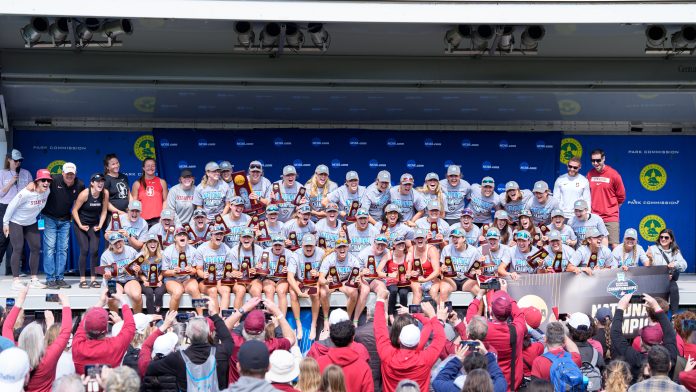
Stanford Remains #1 in Pocock CRCA Coaches Poll
Pocock CRCA Coaches Poll, Division I
Week 2 | March 17, 2026
Rank Team (1st Place Votes)
1 Stanford University (22)
2 University of Texas (3)
3 Yale University
4 University of Washington
5 University of Tennessee
6 University of Virginia
7 Princeton University
8 Brown University
9 Syracuse University
10 University of California, Berkeley
11 Rutgers University
12 University of Central Florida
13 Harvard-Radcliffe University
14 University of Pennsylvania
15 Duke University
16 University of Miami
17 University of Alabama
18 University of Michigan
19 University of North Carolina
20 Ohio State University
21 University of Oklahoma
22 Oregon State University
23 Dartmouth College
24 University of Southern California
25 UCLA
The Ultimate Walk-On: Mike Herman
By Frank Fitzpatrick
Not surprisingly, at the moment his life changed, Mike Herman was in the gym.
A Navy SEAL aboard the USS Herschel Woody Williams in 2021, Herman liked to incorporate a long run into his job’s daily rigors. But on that morning, the lone treadmill in the ship’s gym was out of service.
“I went looking for something else and I noticed there was an erg. So I got on it,” Herman recalled. “One of the guys in my platoon had rowed, and I asked him for a couple of workouts. And I just went from there.”
As much as he liked the rowing-machine sessions, he wasn’t sure how to gauge his efforts. The platoon-mate, once a collegiate lightweight rower, suggested the best way might be to test himself with a 2K.
“I said, ‘OK, what’s your best 2K?’” Herman said. “And he was like, ‘It’s a 6:17, but you’re not going to beat that.’”
The provocation ignited Herman’s hyper-competitiveness. On his initial attempt, he pulled a 6:15. Before his deployment ended, he would, with his friend’s assistance, cut that time to 6:02.
“That led me to believe that maybe I could do this for real,” Herman said recently during a break from training in Colorado Springs. “And like anyone getting into something, when you realize you’re pretty good at it, you kind of think, ‘I wonder how far I can take this?’”
The answer, as it turns out, might be all the way to the Los Angeles Olympics in 2028.
Mission-oriented and resolute, Herman, a native of a Maryland suburb of Washington, D.C., has undergone a remarkably rapid transformation. At 29, he’d never been in a rowing shell. At 33, he’s an Olympic-caliber oarsman.
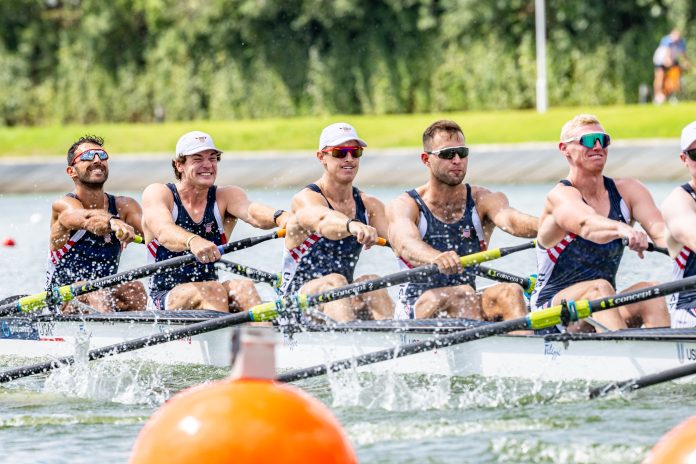
Herman’s sudden leap to prominence, just four years after he discovered the sport, helped the U.S. men’s eight pull off a coup of its own at last summer’s World Rowing Championships in Shanghai. A year after the Paris Olympics, in what typically is a transition year for American rowers, the U.S. crew surprised almost everyone by capturing a bronze medal. With Herman in three-seat, the U.S. finished 2.42 seconds behind a powerful Netherlands boat and just a breath (.16 of a second) after runner-up Great Britain.
A few weeks before, Herman had been part of a mixed-eight crew that won at the World Rowing Cup II Varese. At that same event, he also competed in the men’s double sculls, finishing 15th.
“I never thought he’d get this far and I told him as much,” said Bill Manning, who mentored Herman at Philadelphia’s Penn AC. “I said, ‘You’re 30, and I’d hate for you to spend time doing something that’s not productive. It was highly unlikely he’d ever make a senior national team. Well, he proved me wrong.”
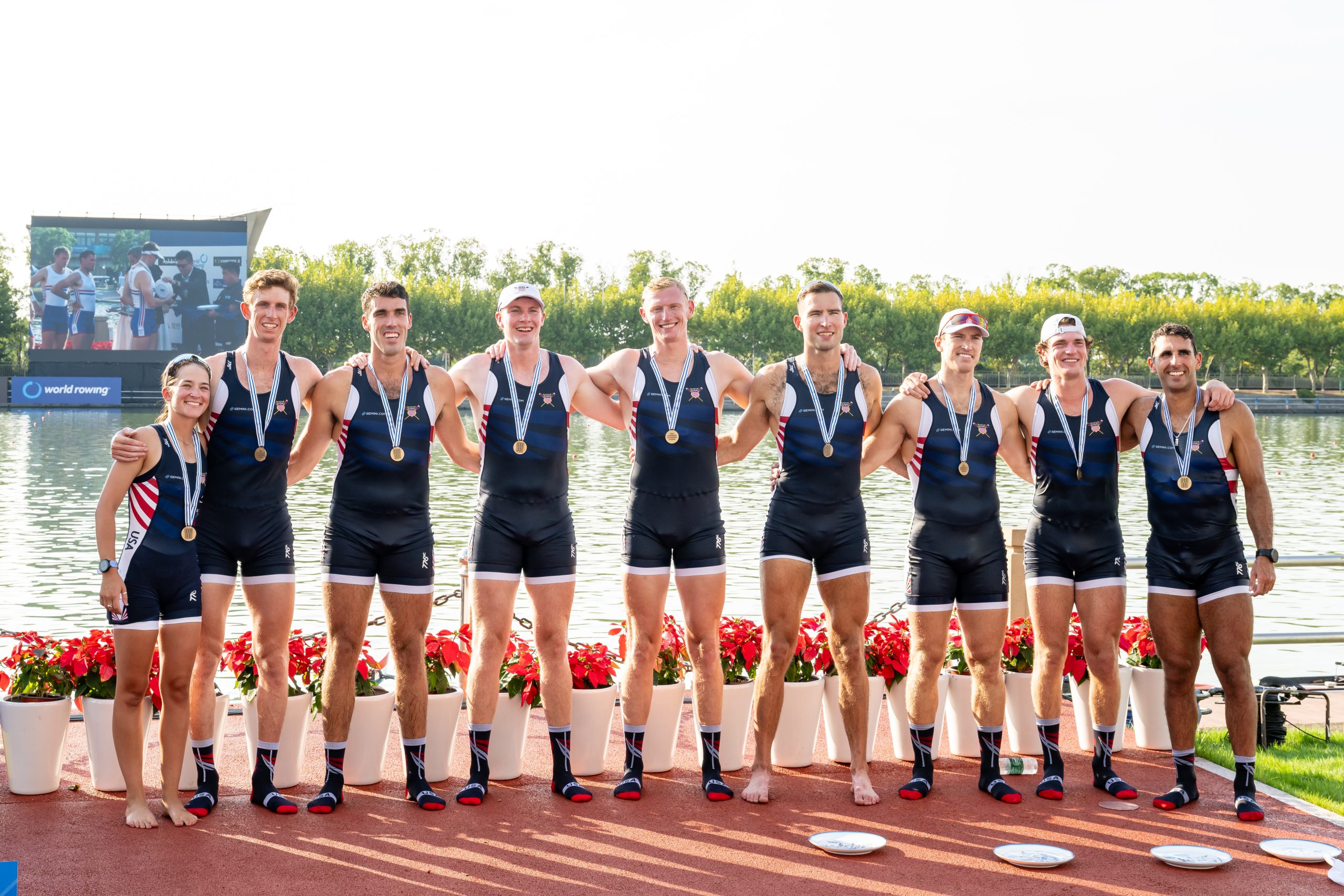
Herman’s steely eyes are now focused on 2028, when he hopes to win a spot in the men’s eight that will go for America’s first Olympic gold in the event since 2004. If he succeeds, those who helped him develop won’t be surprised.
“The reason he’s been so successful so quickly is that he’s so incredibly persistent. He’s a tenacious SOB when it comes to going after something he wants,” Manning said. “He was a Navy SEAL, and for those kinds of people, that’s probably a common quality. Elsewhere, it’s pretty unusual.”
Herman grew up in Bethesda, Md. He wrestled and played lacrosse at The Heights School. But at the University of San Diego, he didn’t compete in a single sport.
“I was in Navy ROTC,” he said, “and that pretty much took up all my time.”
After graduation, Herman—6-foot-3, 215 pounds—was commissioned in the Navy, where his appetite for physical activity was whet by the intense SEAL training and enhanced by his belated embrace of rowing. Ending his eight-year Navy career as a lieutenant in 2022, Herman went looking for assistance, reaching out to coaches he found on USRowing’s website.
“A lot of them didn’t reply, said they didn’t take novices, or they no longer had a high-performance program,” he said. “But I was able to get in touch with Bill at Penn AC. He was just starting to platform his program there and he said I should come to Philly.”
Used to uprooting every two years in the Navy, Herman had no difficulty abandoning Virginia Beach and heading north. He found a place to live, got a job selling software to the Department of Defense, and began training with Manning.
“He’s not like most of these national-team wannabes,” Manning said. “He didn’t row at some elite prep school or brand-name Ivy college. He was willing to relocate his life, move out of the home he owned, come to Philadelphia, find a roommate, find a job, and devote himself to making the team. Most people are like, ‘Well, I want to make the team but I have this relationship I can’t leave.’ Or ‘I have to keep this job or live in this town.’ It doesn’t work. Mike threw caution to the wind and said, ‘I’m going to go after this.’ That’s rare.”
The veteran coach initially stuck the almost 30-year-old novice in a U23 camp. All of Herman’s crewmates were several years younger, most were just as inexperienced.
Before long, Manning realized that the eager ex-SEAL’s ambition required more personal schooling then his busy schedule would permit. So he directed him to Dan Beery, a member of the U.S. eight that won gold at the Athens Games.
Herman moved in with Beery, and at 6 a.m. each morning, the two were out on the upper Schuylkill, a tranquil stretch of the river near Norristown.
His new roommate’s potential was obvious and, wanting to ensure that it flowered, Beery drew on lessons from his old mentor, legendary coach Ted Nash. Nash, who died in 2021, had been a participant or coach at every Olympics from 1960 through 2008.
“I knew what Ted looked for. And Mike checked a lot of those boxes,” Beery said. “We did some of Ted’s rhythm-comp workouts that go all the way back to the Boys in the Boat. Mike really wanted to do those old workouts. Those Boys in the Boat guys won a gold medal at the 1936 Olympics for a reason. They trained like beasts. Their boats were 50 pounds heavier and they used wooden oars. Ted picked up those workouts when he went out to Washington and trained with Stan Pocock [the legendary boatbuilder and coach]. And Mike just attacked them like a beast.”
At one point, Herman asked Beery to run him through a training exercise that perhaps only a SEAL would request. To simulate racing speeds without fatigue, a rope from the launch is attached to a rowing shell. Unless the launch creates a perfect V-shaped wake, the rower is in danger of capsizing, or worse.
“The possibility of injury is great,” Beery said. “You’ve got to create that perfect V. And if the rope’s not perfect, it twists the boat, and you can catch a crab and flip over. But Mike is so strong, he was able to do it. You should really do it only with someone who’s done it before. Or a Navy SEAL.”
Herman tends to be reticent and self-effacing, adhering to the tenet in the Navy SEAL Code that says “I do not advertise the nature of my work.”
“He’s been through some stuff, but he would talk about it only vaguely and indirectly,” Beery said. “I never tried to dig into it. About the most he’ll ever say is ‘I enjoyed the training.’”
Whatever the experiences, they helped Herman deal with the nerves rowers–especially novice rowers–face in competition, his coaches say.
Gradually, as Herman’s abilities were refined, he was entered in races that Manning termed “the very bottom rung on the ladder”—C and D events at the Independence Day Regatta, Canadian Henley, the club nationals. Still, he kept improving, and practicing more intensely.
“Another athlete came up to me and said, ‘Bill, Mike’s lips are turning blue,’” Manning said. “And I said, ‘Yeah, that’s what happens when you’re pulling really stinking hard.’ He has that ability to put himself at a level of physical discomfort a vast majority of people would not do.”
Early on, Herman was a single sculler almost exclusively. He sought every racing opportunity he could find, frequently finishing at the bottom of those C and D finals. But he progressed rapidly, and that improvement caught the eyes of USRowing officials. In late 2024, Herman was invited to the National Training Center in Sarasota. He’s made his home there ever since.
There, the ex-SEAL’s self-confidence and determination have enabled him to overcome his inexperience as well as any unease he might have felt in the company of the nation’s top rowers, said Casey Galvanek, USRowing’s head men’s coach.
“He’s flexible and willing to do what it takes to get it right,” Galvanek said. “He asks questions. He’s willing to make changes. He came down here thinking, ‘I need to work on these things to make my stroke better.’ He figures it out. That’s a huge positive. A lot of people are waiting for the coaches to do things for them.”
Until the serious international season begins this summer, Herman will shuttle between Sarasota and Colorado Springs. Working out in the high-altitude Rockies increases red-blood cell counts and helps rowers utilize oxygen more efficiently when they return to sea level.
“We send them to altitude two or three times a year,” Galvanek said. “Right now, we’ve got 32 people there and 20 here in Sarasota.”
In Sarasota, the long days typically include two sessions on the water, plus weight training, boat maintenance, meetings, nutrition lessons—a schedule one of Herman’s companions called “an off day for a SEAL.”
At some point, the 50-plus rowers will be culled and the national teams selected. Right now, a spot on the eight looks like Herman’s primary target.
“My first time ever in an eight was in January 2025,” he said. “I’d been primarily sculling. But at our training camp, there were eight sweepers—four ports, three starboards, and me. So they were like, ‘OK, you’re a starboard now.’ I started sweeping a little more and was in the eight for most of camp.”
Herman occupied the three-seat when that boat took third at Shanghai. And that spot was fine with him.
“I wasn’t in any position to argue,” he said. “When we were preparing for worlds, we heard from a gentleman, Stan Cwiklinski, who’d been on the 1964 Tokyo gold-medal winners. He was the three-seat in that boat. He said his coach told him the three was the seat with the least responsibility. I told him that was OK. I didn’t mind at all.”
Frank Fitzpatrick, a longtime sportswriter for The Philadelphia Inquirer, was a finalist for the 2001 Pulitzer Prize. He covered nine Olympics, including the 2004 Games in Athens when the U.S. men’s eight ended a 40-year drought by winning a gold medal.
Crew Angels
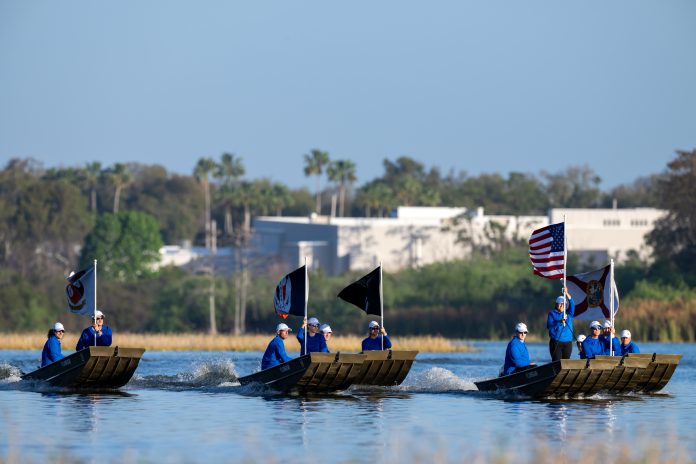
At the Orlando Area Rowing Society, Inc.’s OARS Youth Invitation, the Crew Angels Launch Boat Team, led by Steve D’Amico, 25-year veteran of the United States Air Force, parades the U.S., Florida, and other flags down the Turkey Lake course at Bill Frederick Park in Orlando, Fla.
Sarasota 2K Featuring Benderson Cups This Weekend
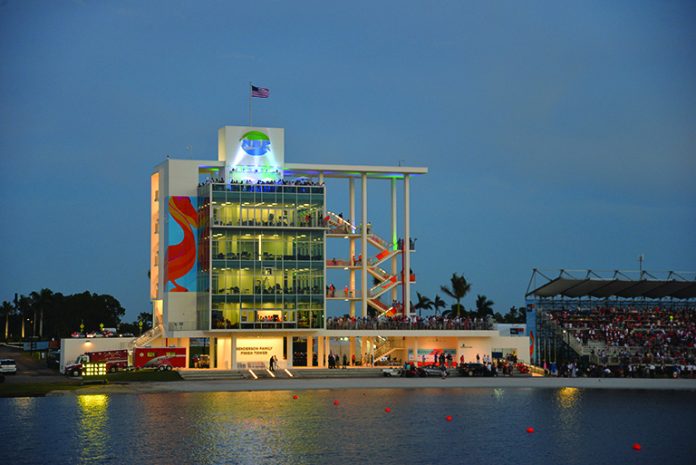
The Sarasota 2K regatta brings together 34 top collegiate rowing programs at Nathan Benderson Park, home of the 2017 and 2028 World Rowing Championships, Friday through Sunday, March 27-29.
Men’s racing starts on Friday, when Washington will face Harvard and Stanford in a double-dual regatta for the Bolles Cup and Andrea and Everett Peter Paup Cup, competing in four race categories (first, second, third, and fourth varsity eights). On Saturday, crews will race in the Sarasota Invitational, with the Benderson Cup on the line, including Brown, Harvard, Stanford, Yale, and Northeastern. All six programs are ranked in the top 20 of the Rowing News Rankings.
The women’s field features 19 NCAA Division I teams: No. 14 UCF, No. 15 Dartmouth, No. 18 Miami, No. 20 UNC, Albany, Boston College, Drexel, High Point University, Iowa, Jacksonville University, Kansas, Kansas State, Louisville, Michigan State, Old Dominion University, SMU, Tulsa, UMass, and West Virginia.
“We are always excited to race at Sarasota and going against four ranked teams will be a good measuring stick of where we need to improve throughout the rest of the season,” said Iowa head coach Jeff Garbutt. “It should be a great weekend of racing! Go Hawks!”
Women’s NCAA Division I schools like Michigan State race their NCAA boats—first varsity eight, second varsity eight, and varsity coxed four—as well as their Big 10 boats—a third varsity eight comprised of novice and frosh athletes and a second varsity coxed four.
From The Editor: Don’t Believe What You Hear
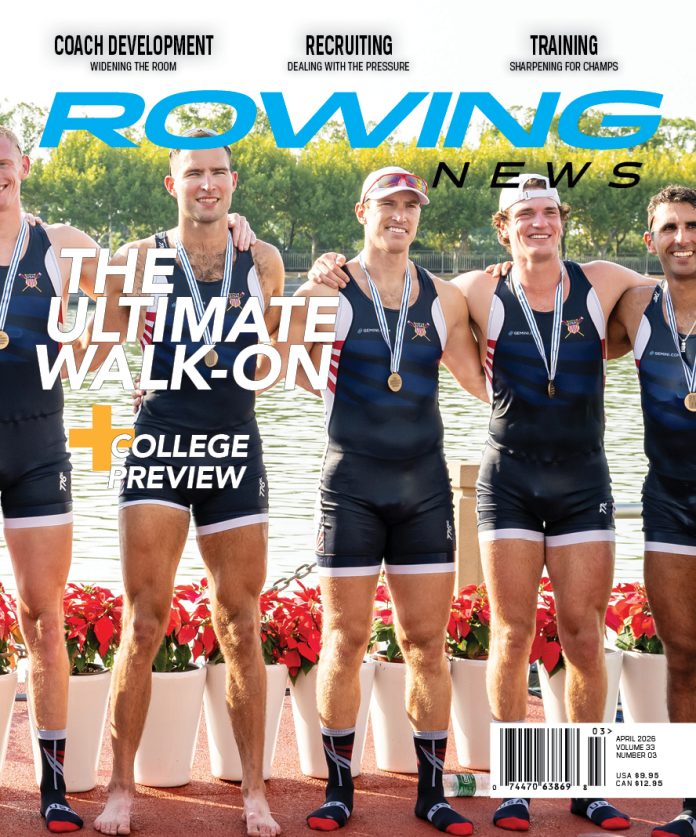
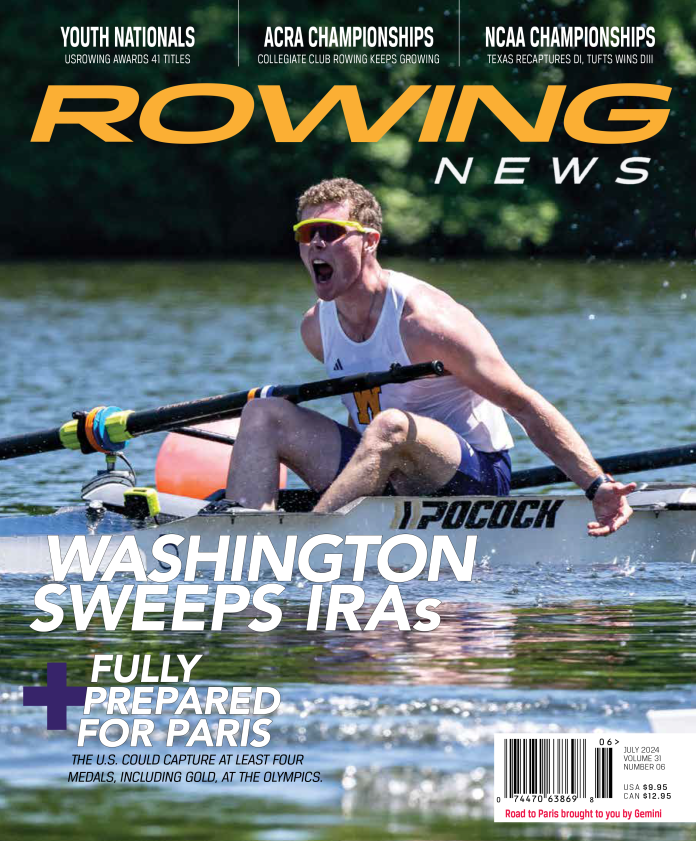
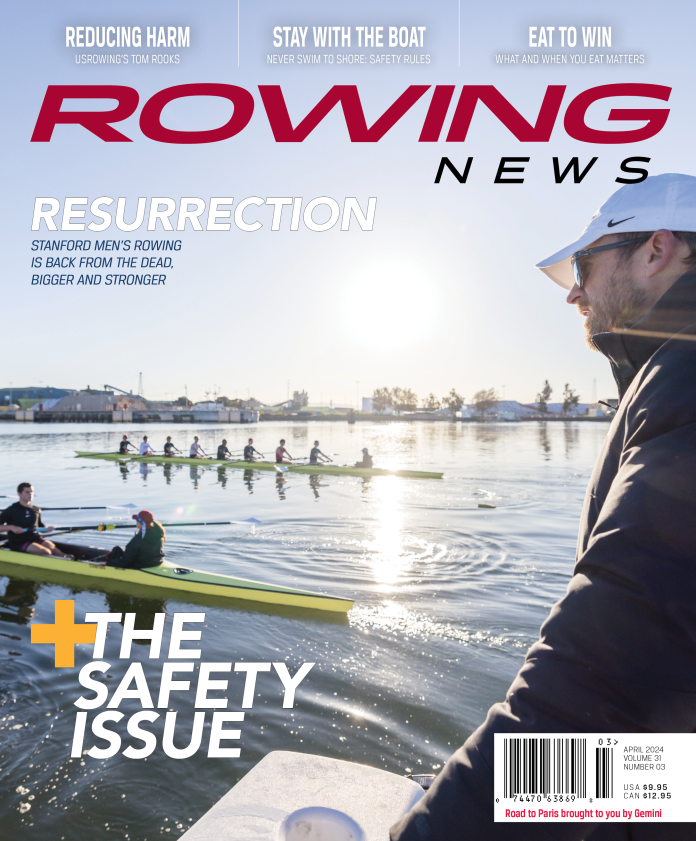
The biggest myth in rowing is that we can’t [insert your idea here]. There are four other whoppers, all equally false, that I debunk in the feature “The Five Biggest Myths In Rowing,” in the April issue of the print magazine.
I’m sure more than one person told Michael Herman, who didn’t find our sport until after college, that you can’t just teach yourself to row on an erg and then go to the Olympics. He’s well on his way to doing so, however, having won a bronze medal in the men’s eight—less than two tenths of a second off the defending Olympic champs, Great Britain—at last summer’s world championships.
Of course, he hasn’t gotten this far without a lot of help from others since that fateful first time he sat on the erg (because the treadmill was broken). Frank Fitzpatrick, a veteran sportswriter and Pulitzer Prize finalist we’re proud to have join the Rowing News crew, tells the Navy SEAL’s incredible story in this month’s issue.
Finally, the spring racing season—the only one that really matters for student-athletes—is under way, and the two fastest rivalries in American rowing, Cal-Washington and Stanford-Texas, are on collision courses, as described in the feature “Old Familiar Foes“, to decide the men’s and women’s national champions on May 31.
We can’t wait.
Letter to the Editor: Life Saver
I know that rowing is good for me and keeps me fit and healthy. But as it turns out, my rowing was also good for someone else. I saved a man’s life! Here’s what happened.
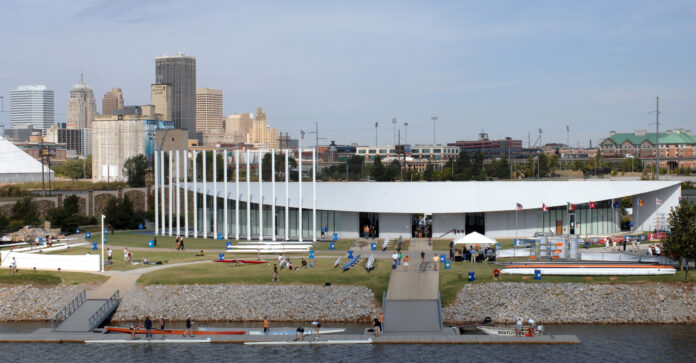
I row on the North Canadian River in Oklahoma City with a Liteboat 5.0 coastal rower. The river was dammed in 1918 to form adjacent Lake Overholser, but the river is still there and is an excellent channel for rowing.
My route runs from the Riversport boathouse to the dam and back (twice), which is about 7,500 meters. On a recent morning, as I approached the dam, I saw a pickup truck in the river, close to the bank and half submerged. That was not normal!
I had my phone with me, so I called 911 and reported it. Remarkably, no one else had called it in. A few minutes later, I heard the sirens of the Oklahoma City Fire Department rescue team and the OKC police.
They asked me to look in the windows of the truck to see if anyone was inside, but the windows were tinted, so I couldn’t see. But yes, a man was inside, and he was alive! They had to break the driver’s side window to get him out.
He had been in the water for 10 hours at that point, having driven off the road at about 1 or 2 in the morning. It was a little after 11 a.m. when I saw the truck and called 911. The water had invaded the cab, and the man was submerged up to his neck. The temperature the night before had gone down to 30 degrees, so it’s amazing that hypothermia had not rendered the man unconscious, if not worse.
Hooray for rowing!
Bob Woods
Oklahoma City, Okla.
It’s Either Cal or UW men, Stanford or Texas women
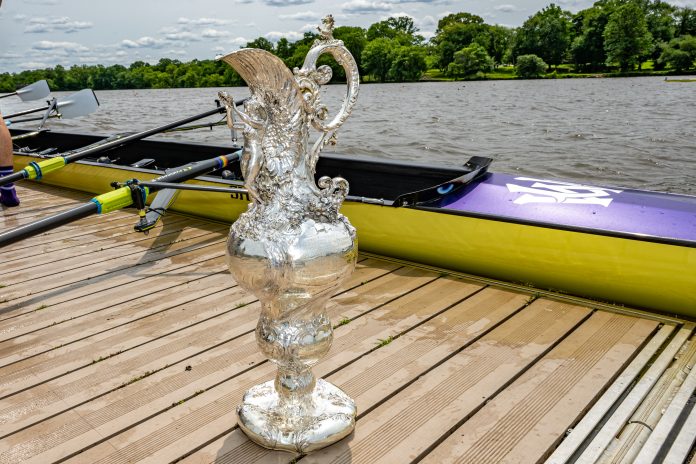
Either Cal or Washington will win each of the next two IRA national championships until the Olympics draws enough of their top international recruits home to train and be selected (they hope) for the LA2028 Games.
Even with a boat full of European giants who have rowed since they were boys, Harvard, coached by the great Charley Butt, has managed no better than runner-up to the West Coast duopoly since Covid canceled the IRA in 2020.
Only the University of Washington and the University of California, Berkeley, have been the national champions since then, and each has won every men’s heavyweight event at the IRA recently—first, Cal in 2023; then, Washington in 2024.
“It’s hard to beat Cal one day and Washington the next,” mused Butt at last year’s wind-whipped IRA. Harvard finished ahead of Cal in the Saturday semifinal when white-capping conditions (worst in the center lanes where the top-ranked crews raced) caused Cal to crab. Cal went on to post the fastest time of the regatta, a blistering 5:24, in the petite final.
The tailwinds at the 2025 IRA made times as unreliable as the racing conditions and compressed the finishing margins. But they didn’t change the final outcome from the year before. In the Sunday final, Washington finished ahead of Harvard for the second year in a row, 5:29.78 to 5:30.75.
Ever respectful and modest in his comments, Cal head coach Scott Frandsen likes how his crews are racing already this year after the first varsity went 5:26 against the University of California San Diego at the Redwood Shores Invitational on March 7.
Comparing times in rowing is rife with folly, but you have to be a fast crew to break 5:30, no matter the conditions. Cal has proven early in the season that it is fast. And deep: The Golden Bears raced six varsity eights at Redwood Shores. Frandsen has enough athletes to boat seven eights, he said, if no one is sick, injured, or otherwise unavailable because of the never-ending and random challenges that befall a program—like water unfit for racing in the seeded lanes.
“That’s outdoor sports,” Frandsen said. “That’s rowing.”
The latest challenge for Cal’s great rival, Washington, and much of the rest of the IRA grand-finals crews is roster limits. As college athletic departments try to adapt to chaotic rule and financing changes while still feeding the out-of-control budget beast that is college football, many are turning to roster limits, capping the number of student-athletes allowed to compete in varsity sports. Frandsen, working with rowing-aware athletic-department administrators, has managed to evade the axe that has chopped rosters at other programs. For now.
“A head coach’s No. 1 job is developing resources,” Frandsen said.
How those resources—roster size, recruits, money—translate to boat speed against two-time defending national champion Washington will be tested, and tested often, later this spring.
It’s the best and fastest rivalry in American rowing right now.
It’s also appreciated and valued by the rivals. When the University of Washington dropped the bombshell announcement in 2023 that it would be leaving the Pac-12 and joining the Big 10—a conference that does not include men’s rowing—the first call Washington coach Michael Callahan made was to Frandsen to assure him that the Huskies would always race Cal.
After the demise of the Pac-12, men’s rowing joined the Mountain Pacific Sports Federation, and what used to be the Pac-12 championship regatta is now the MPSF Men’s Rowing Championship. Cal won the first one last year, just weeks after losing to Washington in Seattle for the Schoch Cup.
Frandsen rowed at Cal, was an assistant coach at Cal, and succeeded coaching legend Mike Teti (hired away from USRowing after he coached the men’s eight to Olympic gold and bronze medals) as Cal’s head coach. In between, Frandsen rowed and won medals for Canada’s Olympic squad, including a silver in the pair at the 2008 Beijing Games with Washington alum Dave Calder.
Washington’s Michael Callahan has achieved similar greatness with Washington, where he rowed in college and coached as an assistant before succeeding his coach, Bob Ernst, who, over 40 years, guided both the Washington men and women, won eight national championships, and coached the U.S women’s eight to Olympic gold in 1984.
Callahan, while coaching Washington to a sweep of the 2024 IRA, also coached the U.S. men’s eight, which had failed to qualify for the Olympics at the 2023 worlds. He prepared the 2024 U.S. men’s eight for the last-chance qualifier in Lucerne, which they won, and then took them to the 2024 Paris Olympics, where they won bronze.
The Huskies and Golden Bears are scheduled to race practically every other week from the April 25 Schoch Cup to the MPSF regatta (May 16, 17) and then the IRA National Championship Regatta (May 29 to 31). Both programs could send crews to Henley Royal Regatta but probably should be racing in Lucerne at the World Rowing Cup, where they could make the A final racing against the world’s national teams.
The field is shallower in men’s Division III rowing, with eight crews racing at the IRA national championship regatta compared to the 24 in Division I, but the desire to win is the same. Last year, it was Trinity College’s desire to be better than ever that led coach Kevin MacDermott’s charges to the title. That, and some advantageous preparation.
In addition to greater commitment to training, Trinity raced at the 2024 Knecht Cup Regatta on the same racecourse in Camden, N.J., that would later host the IRA. With a full day of training on Friday and racing on Saturday and Sunday, the Bantams got more time on the championship course than they get on fully buoyed six-lane courses the rest of the year combined.
The 2025 DIII championship final was held on the same Saturday as the DI semi with terrible conditions, but their experience “made the IRA like a home race,” MacDermott said. “They’d been down that course so many times.”
Although a third of that championship varsity eight—the three-, six-, and seven-seats—graduated, this year’s squad is “pursuing with vigor” a repeat, MacDermott said. They’re “inspired to write their own legacy” and planning a Henley trip to mark the 50th anniversary of Trinity’s 1976 victory in the Ladies Challenge Plate.
Billy Boyce’s Harvard lightweights dispelled the canard that “lightweight rowing is always close because the athletes weigh the same” by crushing the competition in two years of undefeated racing, capped by back-to-back wins at the IRA national championship regatta in both the first and second varsity events. The Crimson lights went on to Henley, vanquishing Great Britain’s top rowing university, Oxford Brookes, en route to winning the Temple Challenge Cup.
There’s good reason to believe Harvard could three-peat as lightweight national champions, and a whole league full of reasons they might not. Cornell, second to Harvard at Sprints last year, before administrators kept the crew home from the IRA for disciplinary reasons, was second to Harvard again at the Head of the Charles. Dartmouth’s lightweights won the silver at the IRA, and coach Trevor Michelson has a small group of hard workers ready to go one better in 2026, despite the challenge of roster limits.
“It sucks,” Michelson said, “but we turn it into an advantage” with customized training programs for each athlete that have enabled the Big Green lights to score personal bests on the erg and other performance tests, like the Big Green’s on-water “Slim Fast” course.
“There are a lot of really good coaches in this league,” said Michelson of the lightweight league, which is now the pinnacle of the sport since its exclusion from the Olympics after the Paris Games. “A lot of different teams can win this thing. Everyone’s good. That’s what makes it fun.”
Also having fun in lightweight rowing are the Princeton women, who won their fourth-straight national championship in 2025. The Tigers won the lightweight coxed-four event at the Head of the Charles last fall but finished second to Radcliffe in the lightweight eights by over six seconds. Georgetown, Wisconsin, Boston University, MIT, and Sacred Heart all finished more than 30 seconds farther back.
Stanford vs. Texas
Stanford is the defending NCAA Division I national champions and entered the 2026 spring season ranked at the top of the coaches poll—rightfully. Texas is likely to be The Cardinal’s greatest obstacle for a repeat title, since the Longhorns return almost all of the youngest roster to race at NCAAs from last year and gain impressive additions to this year’s squad, including Maya Meschkuleit, the Canadian Olympic medalist and a member of Yale’s NCAA grand final-winning first varsity eight.
For the past six years, Stanford and Texas have been the top programs in women’s collegiate rowing, and rowing in general. Both crews beat the Canadian national team handily in a friendly race last spring, and coaches of the U.S. national team (which features alumnae of both) want no part of a potentially embarrassing race against either of them.
No one else has won the NCAA Division I championship since 2019, when Washington, coached by former Stanford head coach Yaz Farooq, won, with Texas finishing second.
Leading each program are two old friends-turned-intense rivals.
In 2016, Stanford coach Derek Byrnes moved from overseeing the very successful lightweight program, which he coached to two consecutive undefeated years capped by IRA championships (where lightweights have their nationals) to become head of all women’s rowing at Stanford after Farooq, who led The Cardinal to NCAA national championships, moved to Washington.
Texas coach Dave O’Neill also moved into his current position after winning national championships—two NCAA titles with Cal, where he coached for 16 years. In his first 10 years at Texas, he’s won three NCAA titles. This, his 11th year in Austin, very well could add to that total.
Of course, neither man rowed in the program he now coaches, nor did either attend the universities that now employ them. But no one puts more into coaching their crews than these two.
“For the last couple of years, I’ve seen a lot of both of them, and respect the hell out of both of them,” said Tennessee head coach Kim Cupini, whose Lady Vols finished fifth at last year’s NCAA championship. “They’re different personalities, but I’ve enjoyed working well with both.”
Cupini works with Byrnes and his light-hearted manner to coordinate their first real 2,000-meter race of the year, a regatta in which the coxswains arm-wrestle for lane choice in each event.
“We won all the lanes and lost all the rowing races last year,” she said.
Cupini spent the winter bantering with Byrnes, chirping each other by text and sharing fabricated images of “yoked up” coxswains doing pull-ups wearing chains.
Cupini also worked successfully with O’Neill to organize the inaugural SEC championship regatta in Oak Ridge, Tenn.
“He pushes us all to be better,” said Cupini, who called the SECs and the opportunity to race Texas before the NCAAs “phenomenal, a great opportunity.”
Last year’s league championship, based on team points, came down to the final of the first varsity eights race, which Texas won. Both programs received bids to the NCAA championships even though the SEC, with only four teams competing, is not an automatic qualifier.
“Racing both bookends our season,” Cupini said. “Stanford is our first 2K [March 28], and Texas is our last 2K [SECs, May 10] before NCAAs [May 29 to 31].”
Also racing in the NCAA championship regatta—this year on Georgia’s Lake Lanier (site of the 1996 Olympic regatta)—will be crews from Division II and III. Rowing is one of the only sports that runs the three championships at the same venue at the same time.
The events are not separate, and the fields are not combined. Instead, the NCAA regatta intertwines the heats and semifinals of the different divisions into a single schedule. With team hotels far from the racecourse, if the weather makes a mess of the regatta schedule as it did last year, student-athletes could be spending long days waiting around, taking lots of long bus rides back and forth, or both.
Defending Division II national champion Embry-Riddle entered the year ranked No. 1 in the coaches’ poll, and Grant Maddock, head coach of both the men’s DI program as well as the women, returns with his Collegiate Rowing Coaches Association DII Staff of the Year Sami Bay and Drayton Piper.
Embry-Riddle Aeronautical University added rowing as a varsity sport only eight years ago when it moved from the National Association of Intercollegiate Athletics to NCAA Division II. As a highly ranked STEM school, Embry-Riddle was attracted to the sport because the top rowing programs also are among the best academically. The 2025 rowing title is the school’s first NCAA national championship—and likely not its last.
All Division II rowing schools have notched a vital win already this year. Delegates at the NCAA Division II business session in January voted to approve an exception that allows women’s rowing and field hockey to continue to conduct championships.
In Division III, after winning the 2024 national championship on points and the 2025 national championship along with both first and second eights finals, the only higher accomplishment for Tufts is to three-peat.
Winning the collegiate-eight event at the Head of the Charles doesn’t get you anything come spring, but the Tufts women did it for the third straight year last fall, highlighting the depth and consistency head coach Lily Siddall has built with the Jumbos.
The spring racing season—the only one that matters to college varsity programs—begins earlier than ever, with racing for some crews under way in February. Top crews put down early markers at events like the Sarasota 2K and San Diego Crew Classic.
“It’s always great to get the season started,” said Mara Allen head coach at the University of Central Florida, after her crews won their first races of the season against Jacksonville. “I’m proud of the team for a good start to the year, and I’m excited for the rest of the season.”
CHIP DAVIS is the founder and publisher of Rowing News. An oarsman from birth, he rowed on championship crews at St. Paul’s School and Dartmouth College, where he captained the lightweights. Now he sculls in Vermont when the weather is suitable and ergs the other half of the year.
