Home Blog Page 51

The Safety Mandate

rowing safety usrowing youth nationals
Photo by Lisa Worthy.

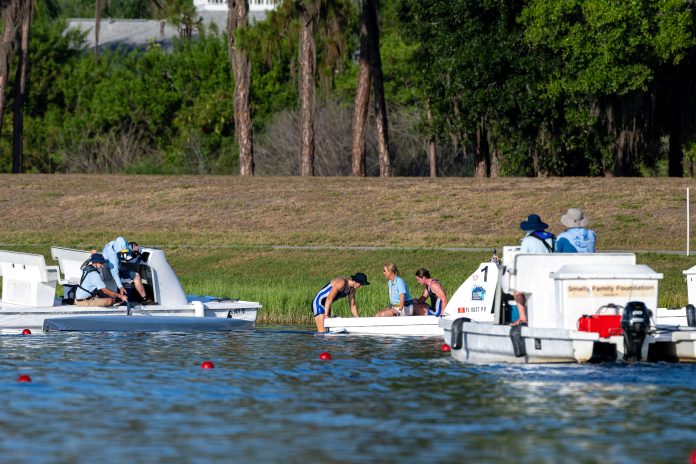
Ideally, safety should never be an exciting topic for a rowing coach, but it does still need consistent attention. Any time there is a transition—the start of the new season or school year, moving from land training back to the water, the arrival of new novices or coaches—is an ideal time to re-examine and emphasize safety.

It all begins with a well-understood safety plan. This is a practical plan that may addresses how to avoid dangerous situations but focuses on how to react if danger occurs. Plan it in advance, communicate it to all new rowers and coaches, reiterate it regularly, and post it clearly where all can see it. The plan will have different characteristics depending on the local situation, but it typically addresses what to do when there is serious trouble. Athletes and coaches need to understand their responsibilities—especially how to summon professional help—when confronted with an emergency. Start today by making sure everyone knows where the AED and first-aid kits are located.

In addition to a rowing safety plan, policies and procedures must be in place to keep everyone safe. These include having everyone pass a swim test; learn drown-proofing and other rules of rowing; receive proper training in CPR and use of an AED; and more. It also includes the trickier tasks of educating coaches on how to drive a launch and possibly driving athletes and hauling trailers. SafeSport standards, which outline how coaches behave around young athletes, must be articulated and adhered to by all adults. USRowing has resources to help with these topics.

Safety is both a collective and individual responsibility. Some safety considerations don’t rise to the level of emergencies but still need personal attention to mitigate long-term trouble. For coaches, simple steps like putting on sunscreen and using hearing protection around outboard engines can make a difference. Athletes, especially younger ones and those new to rowing, need to learn about the importance of warming up properly, dressing for the weather, hydration, and basic hygiene with shared oars and ergs. Older coaches all know how to treat blisters, but they don’t. Safety cannot afford assumptions.

There is a lot to consider, and the time to do so is now—before an incident. Safety must be an attitude shared by all involved. Questioning the relative safety of any activity before undertaking it should be a given. There are no short cuts. There can never be the exception of  “just this one time.” One hundred-percent adherence to the safety plan and policies is the minimum expectation.

Texas Rowing’s Doonan promoted to associate head coach, Nitsch added as assistant coach

texas rowing gia doonan
Story and photo courtesy of Texas Athletics.

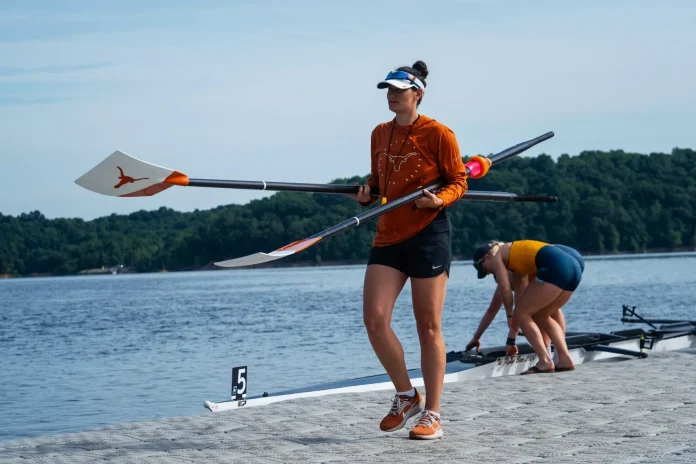
AUSTIN, Texas – Texas Rowing head coach Dave O’Neill announced the promotion of Gia Doonan to associate head coach and the addition of Lanie Nitsch as assistant coach.

Doonan, who is entering her fourth season with the Longhorns, was first hired as a volunteer assistant coach with the program in 2021 and then promoted to a full-time assistant coaching role in 2022. Doonan has helped guide Texas to dominance during her span on staff, including three national titles over the last four years and three Big 12 Championships. Under her tutelage, the Fours have captured back-to-back national championships in 2023-24.

“This program would not be where it is today without Gia Doonan, and the impact she’s made as a coach these last few years has been tremendous,” said O’Neill. “As the lead coach of our Fours group, she led that crew to a national championship, and her influence is felt by everyone in the program. She’s taken the lead on a number of projects that have made a real difference, so this promotion is very well deserved.”

The Rochester, Mass., native rowed four seasons with the Longhorns (2013-17) and is a former member of the USRowing Senior National Team. She helped Team USA to a fourth-place finish with the Eight at the Tokyo 2020 Olympic Games. As a student-athlete at Texas, Doonan was a two-time Big 12 Rower of the Year (2015, 2017), three-time CRCA All-American (2015-17) and a four-time All-Big 12 First-Team selection (2014-17). She won three Big 12 Championships (2015-17) and competed in three NCAA Championships in the first varsity eight with the Longhorns.

With the national team in 2019, Doonan placed third in the Eight at the World Rowing Championships, second in the Eight at the World Rowing Cup II, and second in the Four at the World Rowing Cup I. In 2018, she won gold at the World Championships after earning a first-place finish with the Eight. She also finished ninth in the pair at the 2018 World Championships. She served as an alternate for the senior team at the 2017 World Rowing Championships. As a member of the USRowing U-23 team, she won gold in the Four and Eight at the 2016 World Rowing Under 23 Championships.

Nitsch joins the staff after a dominant four-year career with the Longhorns from 2021-24. Nitsch, a three-time National Champion, helped Texas capture its third national crown over a four-year stretch in June 2024. As a graduate senior, Nitsch was named to the CRCA First-Team All-America to go along with being tabbed to the All-Big 12 team. Nitsch rowed at the seven-seat in the First Varsity Eight victory, guiding UT to the national crown, winning with a time of 6:09.920. The McAllen, Texas, product also rowed at the seven-seat in the First Eight’s victory at the Big 12 Championship, clocking in with a final time of 6:08.714. Nitsch helped the Longhorns capture four Big 12 Championships during her time on the 40 Acres while also participating in four NCAA Championships.

“I’m thrilled that Lanie Nitsch is joining our staff for the fall semester,” said O’Neill. “We have a temporary need, and Lanie is the perfect person for this role right now. Her leadership, attention to detail and work ethic made her an outstanding teammate, and she will continue to move our program forward as a valued member of our coaching staff. I’m really looking forward to working with her in this new capacity.”

Ohio State Adds Three Assistant Rowing Coaches

ohio state rowing assistant coaches
Story and photo courtesy of Ohio State Athletics.

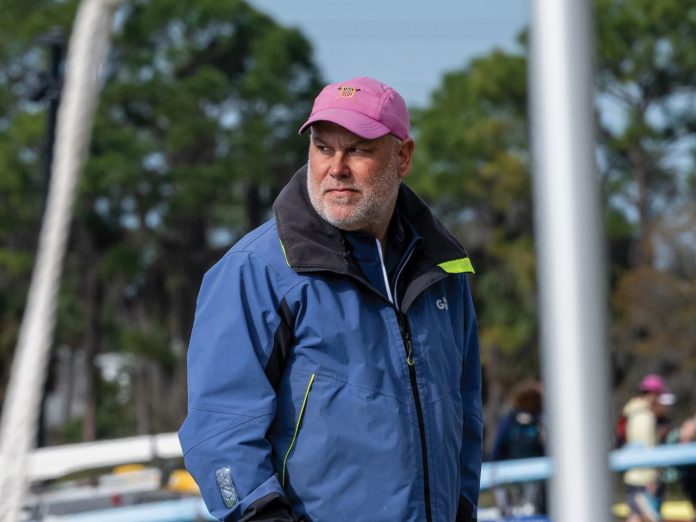
COLUMBUS, Ohio – Emily Gackowski first-year head coach of the Ohio State Buckeyes, announced the hiring of three assistant rowing coaches.

Former Buckeyes Mandy Merritt (2011) and Bridget Schodorf (2018) along with University of Minnesota graduate Mari Sundbo join the Buckeyes for the 2025 season.

Gackowski said the new additions provide the Buckeyes with the necessary tools for a winning program.

“Words cannot express how excited I am to have Mari, Mandy and Bridget joining the staff this year,” Gackowski said. “Each coach brings their own perspective and expertise to a staff. “Any head coach that brings in a new assistant should be excited – but these three are special. They each bring skills, experience and knowledge that are difficult to come by. We are lucky to have them.”

Merritt coached the Clemson Tigers from 2016-24. During her time with Clemson, she led the novice program and coached the four boats. Merritt joined the Tigers after three seasons at West Virginia.

Merritt was a three-year letterwinner and three-time Academic All-Big Ten performer at Ohio State. As a senior, she was a member of the Second Varsity Eight that won a gold medal at the Big Ten Championships and went on to place fourth at the NCAA Championships

Schodorf joins the Buckeyes rowing program after coaching with the Craftsury (Vermont) Rowing/Green Racing project.

The Craftsbury Green Racing Project fills the gap that exists after collegiate athletics for the outdoor, endurance sports of biathlon, nordic skiing, rowing, and running. It serves as a bridge from collegiate racing to national and international level competition

Schodorf began rowing in Columbus at the age of 11. She went on to row for Ohio State for four years and helped the team to a national championship her freshman year, and four Big Ten Championship titles.

Sundbo returned to her alma mater in July of 2023 as a member of the Golden Gopher staff when she was hired as a varsity assistant coach and also served as the recruiting coordinator.

“Mandy and Bridget are both former Buckeyes so they know the legacy of success here,” Gackowski said. “Through their experiences here and outside of Ohio State, they have amassed a wealth of knowledge that will help us build on that legacy. Mandy has a personality that draws you in and that coupled with her rowing IQ and background in the sport made it a no-brainer to hire her. I had the chance to work with Bridget briefly when she was a student-athlete. She is incredibly dedicated to this sport and this team. Through her years of training and coaching after graduating, she has developed a deep understanding of this sport that we, coaches and student-athletes alike, can learn from.”

In her first season at Minnesota, Sundbo helped guide the team to its highest finish at the Big Ten Championship since 2015 as the team placed fifth, highlighted by the First Novice Eight boat earning a bronze medal.

“When I was looking for an assistant coach and recruiting coordinator, Mari stood out to me as the ideal candidate,” Gackowski said. “A recruiting coordinator has a huge responsibility because they are bringing in the athletes that will eventually be the foundation of the program while also coaching the more than 80 women who are currently on the team. This is a role that requires clear communication, an enormous amount of trust, and leadership. Mari embodies all of those things while also having incredible people skills and a great technical knowledge of the sport.

“I am so happy to have all three of them on the staff this year,” Gackowksi said. “I am looking forward to announcing our other two assistant coaches in the near future and cannot wait to get started this fall.”

Casey Galvanek Awarded the Order of Ikkos from USOPC

Casey Galvanek sarasota crew olympic rowing order of ikkos
Photo by Lisa Worthy.

Casey Galvanek, coach of the U.S. men’s Olympic four and head coach of Sarasota Crew, was awarded the Order of Ikkos from the United States Olympic and Paralympic Committee (USOPC). The Order of Ikkos recognizes the efforts of America’s finest coaches and is awarded by Olympic medal-winning athletes to acknowledge a coach for their leadership in achieving world-class success. Each medal-winning team may give the award to one coach or mentor. The award is named for Ikkos, the first recorded coach in Ancient Greece who coached two athletes to gold in the pentathlon.

Previous Order of Ikkos recipients from USRowing:

Tokyo Paralympics 2020
– Shelagh Donohoe

Rio Olympics 2016
– Tom Terhaar
– Gregg Stone

Rio Paralympics 2016
– Ellen Minzner

London Olympics 2012
– Tom Terhaar
– Laurel Korholz

London Paralympics 2012
– Brad Lewis

Beijing Olympics 2008
– Charlie Butt
– Mike Teti
-Tom Terhaar

Beijing Paralympics 2008
– Karen Lewis

Sport Science: Making Time by Keeping Busy

rowing students carrying boat regatta
Photo by Lisa Worthy.

The rowing season at Canadian universities takes place in the fall during the first semester of the school year. As the head coach of the rowing program at the University of Western Ontario, I received an overview of the academic performance of the rowing students after the second semester.

One fact always surprised me: Grades were consistently better during the rowing season! In other words, better grades were achieved when the students were busiest. Besides classes, lectures, and coursework, my rowers had to cope with daily training sessions and weekend regattas.

One would think it would be more difficult for students to meet all their commitments than during the offseason, when training sessions are less frequent and they have more latitude for their activities.

My hunch is that during busy times students benefit from the chronological structure of training sessions and regattas. When you have a lot to do, there’s not much time to procrastinate. Students realize that they need to take care of coursework, meal prep, and recreation and get them done. Completing schoolwork and making athletic progress simultaneously are motivating, which further reinforces the habit. Paradoxically, it’s during such hectic times that athletes manage their time best.

Time management involves organizing and planning the time available to complete various activities. If you do it right and work smarter instead of harder, you can get things done in less time, even when you’re short on time and under pressure.

Most coaches talk about time management at the beginning of the school year, and more experienced team members help new rowers get on the right track. Time management is important for everyone, however; it’s always helpful to know what you need to accomplish in the time allotted so you can make plans accordingly.

It’s best to put things on paper. Write down the tasks that need to be done in a day, prioritize them, and estimate the time each will take to complete. Then decide what time of day you want to begin each task. Fixed times that can’t be changed will help you structure your day.

The first thing you’ll find is that there are usually enough hours in a day to do what you want to do, as long as you put in the right effort for each task. On those rare occasions when there aren’t enough hours in a day, you can break a task into smaller chunks that you can complete the next day.

Major detriments to good time management are things that eat up your time but don’t help you get the necessary tasks done. Not only do they take valuable time away from the task at hand but also getting back on task consumes more time. Among such time-eating distractions are social media, video games, email, phone calls, and frequent breaks to snack. The best way to deal with such time robbers is to ignore them when you’re supposed to be concentrating. Turn off your smartphone and put it in another room. Eat and drink before you begin the task.

The time-multiplying power of switching off distractions is clear when we are out on the water training. The smartphones stay on land, and the fridge is far away. This allows us to focus on rowing.

Coxswain Development: The Time to Listen and Observe

coxswain coach henley
Photo by Lisa Worthy.

In a few short weeks, rowers and coxswains from all over the country will pack their bags and arrive at a boathouse for the first time. Whether switching high-school teams for a better commute, heading off to college, or joining a new masters team, it’s time for coxswains to take their talents and wrenches to a new team. If you’re headed back to a familiar boathouse, you’ll still find yourself with new teammates and possibly a new coach.

In rowing, as in life, first impressions matter. Of course, you want to put your best foot forward upon arriving at the boathouse. But how?

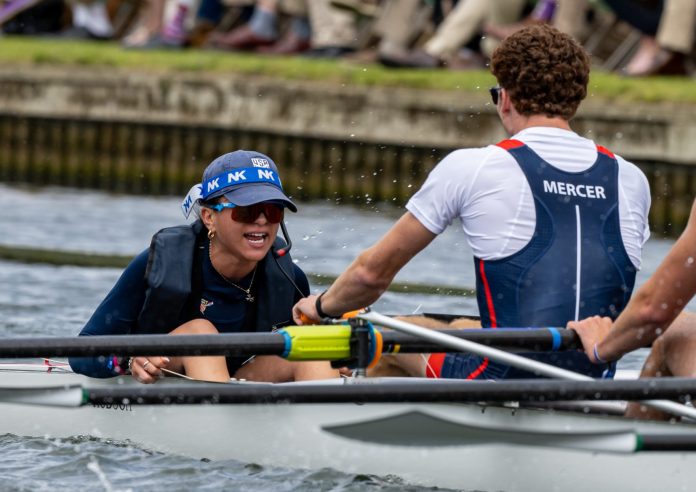
The most important thing a coxswain on a new team or with a new coach can do is listen. The vocabulary of rowing can differ among coaches and boathouses. Do you “weigh enough” or “let it run”? Drills, landmarks, and even shells in the boathouse can have multiple names. Listen and observe. You don’t need to parrot the other coxswains, but it’s important to understand the team’s vernacular.

Next, listen to your new coach. Beyond listening to direct instructions to you, listen to how your coach gives feedback to rowers and how she or he breaks down the rowing stroke. Before you try to be a step ahead, make sure that you’re in step with the person at the helm of your program.

“Your coach is going to tell you everything they want you to say to the crew. It’s not a complicated process, but sometimes we [as coxswains] forget to listen and absorb that, because we’re so set on trying to do it ourselves,” said Ariel Handler, assistant coach at Northeastern University and a former coxswain at UCLA.

Listening to your coach and getting a good sense of his or her vocabulary, rhythm, and priorities will make you a great asset and is the first step toward anticipating the coach’s needs.

“What makes the coxswain really good is when they can predict what needs to be done without asking the question,” said Handler.

If you’re an experienced coxswain with a new coach, the same advice applies. Remember, your coach is trying to assess the new team and establish clear expectations. You can help by being a steady presence and by translating the coach’s needs to the crew effectively. Being a good bridge between your teammates and new coach can help you build credibility with the coach and the crew.

Perhaps most important is the power of a fresh start.

“You can reinvent yourself. You don’t have to be the same coxswain you were the season before or the year before,” said Handler. Arriving at—or returning to—the boathouse with a different mentality is powerful.

Do some honest introspection about your weaknesses but regard addressing them as learning new skills as a coxswain, not shifting who you are as a person. That can help break changes into smaller, doable chunks that you can achieve this fall. Be professional, confident, and resilient, and remember that your successes this year can be built one practice at a time beginning in September.

U.S. Men’s Eight Wins Bronze in Paris

Story and photo courtesy of USRowing.

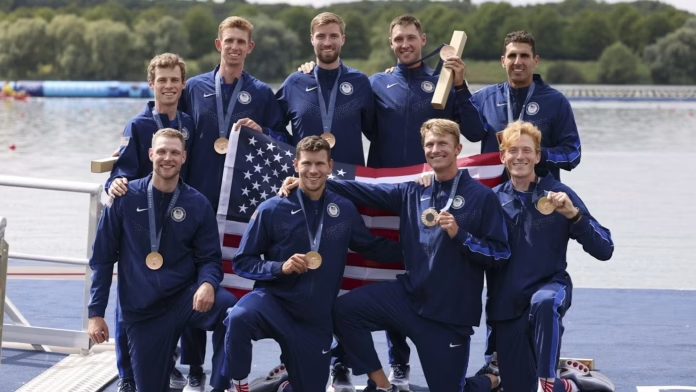
The U.S. men’s eight won the bronze medal on Saturday at the Vaires-sur-Marne Nautical Stadium, giving the U.S. two medals at the Olympic Games Paris 2024 regatta.

The men’s eight crew of Rielly Milne (Woodinville, Wash./University of Washington/California Rowing Club), Pieter Quinton (Portland, Ore./Harvard University/California Rowing Club), Evan Olson (Bothell, Wash./University of Washington/Seattle Scullers/Penn AC), Peter Chatain (Winnetka, Ill./Stanford University/California Rowing Club), Chris Carlson (Bedford, N.H./University of Washington/New York Athletic Club), Clark Dean (Sarasota, Fla./Harvard University/Boston Rowing Federation), Christian Tabash (Alexandria, Va./Harvard University/University of California, Berkeley/USRowing Training Center – Sarasota), Nick Rusher (West Bend, Wis./Yale University/California Rowing Club), and Henry Hollingsworth (Dover, Mass./Brown University/California Rowing Club) moved into bronze-medal position as the crews approached the 500-meter mark, just off the pace being set by Great Britain and the Netherlands. The Dutch crew was able to inch its bowball ahead in the second quarter of the race before the British boat took the lead back in the third 500 meters. Entering the final 500 meters, the U.S. had cut almost a second off the Netherlands’ lead for the silver medal position, but the Dutch crew was able to hold off the challenge during the sprint.

“We had a good start,” Tabash said. “We were aggressive. I think there was a strong tailwind, which compresses a lot of margins, and I think that one of our strengths is our ability to change speeds. In hindsight, we found it a bit more difficult to close in at the very end. The speeds were quicker; the margins were tighter, and we just left a little too much for too late.”

Great Britain won the race in a 5:22.88, with the Netherlands clocking a 5:23.92. The U.S. finished with a time of 5:25.28. For the U.S., it was the first medal in the event since 2008, when the crew also won bronze. It was the 17th time in Olympic history that the U.S. has won a medal in the event.

“We’ve said it before every race, but we’ve never really had a flat piece, and we’ve been training for not a super long time compared to some of these other crews, but for an American eight, we’ve been together for a long time,” Dean said. “We all knew if we went out there and had something that was around the level that we’ve done in practice, we’d have a good result. It wasn’t gold. It wasn’t silver, but it got us on the podium, and I think that I speak for everyone when I say that we’re really proud of what we did. It was a super-fast, competitive race, and I think that we were in it the whole time.”

Women’s single sculler Kara Kohler (Clayton, Calif./University of California, Berkeley/USRowing Training Center – Princeton), a three-time Olympian, finished fifth in today’s final. The Netherlands’ Karolien Florijn, the defending world champion, and New Zealand’s Emma Twigg, the defending Olympic champion, took the race out fast to establish themselves at the head of the field just 500 meters into the race. Kohler got off the line in sixth place but moved into fourth place in the second 500 meters, just behind Australia’s Tara Rigney in third. Kohler and Lithuania’s Viktorija Senkute began to push Rigney in the third 500 meters and as the scullers entered the final quarter of the race, Senkute had pulled ahead of Kohler and was closing on Rigney. Florijn was able to hold off Twigg’s sprint to win the gold medal in a 7:17.28, with Twigg taking silver in a 7:19.14. Senkute passed Rigney to earn the bronze medal in a 7:20.85. Kohler finished with a time of 7:25.07.

“I would say that I appreciate (racing in the A final) a lot more and the sacrifice and work that goes into getting into an A final,” Kohler said. “To be off the medal stand is obviously disappointing, but those are some fast women’s singles out there, and it’s an honor to get the chance to race with them. I’m very happy for them.”

The women’s eight of coxswain Nina Castagna (Cincinnati, Ohio/University of Washington/USRowing Training Center – Princeton), Charlotte Buck(Nyack, N.Y./Columbia University/USRowing Training Center – Princeton), Olivia Coffey (Watkins Glen, N.Y./Harvard University/USRowing Training Center – Princeton), Claire Collins (McLean, Va./Princeton University/USRowing Training Center – Princeton), Meghan Musnicki (Naples, N.Y./Ithaca College/California Rowing Club), Regina Salmons (Methuen, Mass./University of Pennsylvania/USRowing Training Center – Princeton), Madeleine Wanamaker (Neenah, Wis./University of Wisconsin/USRowing Training Center – Princeton), Margaret Hedeman (Concord, Mass./Yale University/USRowing Training Center – Princeton), and Molly Bruggeman (Dayton, Ohio/University of Notre Dame/USRowing Training Center – Princeton) also finished fifth in the final. The U.S. sat in fourth position at the midway point, just off the medal pace, and was still within striking distance coming into the final 500 meters. However, the Americans were unable to chase down one of the medal spots. Romania won the race in a 5:54.39, finishing over four seconds ahead of Canada, which took the silver in a 5:58.84. Great Britain won bronze in a 5:59.51. The U.S. finished with a time of 6:01.73.

“It was a dogfight all the way down the course,” Musnicki said. “The women’s eight field is deep and formidable, and we went into it after our rep with concrete things that we wanted to work on and execute, and I think we did those things and just fought the entire way all the way down the course. The nature of sport is that you don’t always win, and that’s kind of the harsh reality of it. We ended up on the back side of it today, but I’m really proud of what this boat put together and the campaign that we did, and we stayed together, all nine of us, through it all. It’s obviously very disappointing but, again, that is the nature of elite sports.”

After just missing the A/B semifinal after finishing fourth in his quarterfinal, first-time Olympian Jacob Plihal (Vashon Island, Wash./Northeastern University/Craftsbury Green Racing Project) wanted to make a statement in Saturday’s C final of the men’s single sculls, and he was able to do that with an open-water win to finish 13th overall. Plihal took the lead one minute into the race and continued to row away from the field the rest of the race. The American held a half-deck lead at 500 meters and a three-quarters length lead at the halfway point. Plihal continued to extend his advantage to open water with 500 meters to go and held that over the final stretch of the race. Plihal clocked a 6:41.97 to win the race by nearly three second over Bulgaria’s Kristian Vasilev. Brazil’s Lucas Verthein Ferreira, who raced in second for the first three quarters of the race, finished third. Plihal’s 13th-place finish is the best for an American in the event since an 11th-place finishing at the 2008 Olympics in Beijing.

“The Pan Am development, that was really helpful for me,” Plihal said. “That gave me two opportunities between the qualifier and the actual Games to get three races a piece down in Chile and somewhat of a whole of international field. That experience and world cup last year has been really good for getting me primed to race the single at this level, and I don’t think that I would have made it through (Final Olympic Qualification Regatta) had I not had that experience. To be able to have a bit of a ‘statement win’ was great, and I think that was the best race that I’ve put together.”

For the U.S., the two overall medals equaled the medal count from 2016 Rio, after getting shut out in Tokyo. In total, the U.S. has now won 91 medals in Olympic rowing.

In total, the U.S. qualified 12 crews for the Olympics including the women’s single sculls, men’s single sculls, women’s double sculls, men’s double sculls, lightweight women’s double sculls, women’s quadruple sculls, women’s pair, men’s pair, women’s four, men’s four, women’s eight and men’s eight. The U.S. led the way with Romania in qualifying the most boats to race in Paris.

Of the 42 athletes who will be competing in Paris, 17 are returning Olympians with three Olympic medals amongst them. Thirty-eight have competed on previous senior national teams, while four will be making their senior team debuts.

USRowing would like to thank our national team sponsors including our Official Boat Supplier for the U.S. Senior, Under 23, and Para Rowing National Teams, Filippi Lido; our Official Apparel Provider, 776BC; our Official Partner, Broadridge Financial Solutions Inc., our Exclusive Supplement Supplier, Thorne HealthTech; our Official Performance Electronics Outfitter, Nielsen-Kellerman; the National Rowing Foundation; and TrainingPeaks, the Official Training and Coaching Software of USRowing’s High Performance Team.


Canada’s Women’s Eight Wins Silver, U.S. Men Bronze as Olympic Rowing Ends

The Romanian women’s eight continued their Olympic dominance, winning the gold on the last day of racing here at the Paris Games in the Vaires-sur-Marne Nautical Stadium. Doubling up in the pairs and double sculls, the Romanian women won silver medals in both events earlier in the week while the other half of the eight finished fourth in the fours. Only three nations, excluding Romania, won more Olympic rowing medals than the Romanian women’s eight: The Netherlands (eight, including four gold), Great Britain (eight, including three gold), and New Zealand (four, one gold). Romania also won gold the men’s double and silver in the lightweight women’s double, for five medals, total.

North American sweep rowers continued a successful Games as Canada won silver in the women’s eight and the U.S. men’s eight won bronze.

“It’s been a childhood dream of mine growing up, seeing Olympic paraphernalia from Seoul and Barcelona,” said Nick Rusher, who parents both rowed in the Olympics. “Just seeing my parents in the stands, cheering me on, when I got my medal, it’s the proudest moment of my life.”

The U.S. men had a quick start, but the Netherlands and Great Britain got their bow balls ahead after a minute. The U.S. was third after 500 meters, and a second and a half behind the leaders across the 1,000 meter mark. Great Britain took over for good in the third 500 as the U.S. men rowed a bit shorter than they needed to in order to catch them or the Dutch, who won silver. Germany, Australia, and Romania finished more than a length back.

The women’s eights final was all Romania as the reigning World and European champions won by open water. Canada, with half the boat back from the Tokyo Olympic gold medal crew, rowed calmly and in second place.

“I saw an opportunity, and anything can happen in an Olympic final. We knew that going into the race and we seized that opportunity,” said Canadian coxswain Kristen Kit. “Hats off to them (Romania) because they are so dominant, but you know we are coming next quad.”

The U.S. women spent most of the race in fourth place before falling to fifth behind Australia at the line. Great Britain won the bronze.

Jacob Plihal raced in the C final after winnng the C/D semi, where he ended up after finishing fourth in the fastest quarterfinal, with two eventual A finalists. The Craftsbury Green Racing Project sculler stretched a slight early lead to a full length in third 500 and finished in a time of 6:41, the fastest ever by a U.S. men’s single at the Olympics.

World Champion Oliver Zeidler added Olympic gold to his growing collection of accolades, leading start to finish, in a time of 6:37. He lowered the Olympic record by five seconds to 6:35 in the A/B semifinal.

“The crowd was there and I was just flying over the water,” said Zeidler, who nearly quit sculling after the disappointment of missing the A final in Tokyo. “It was such a cool race. I put everything together over the last three years with my team, and now I have a gold medal which we have worked for since the very beginning.”

U.S. single sculler Kara Kohler finished fifth in the women’s single final, in which Karolien Florijn took a length in the first minute and only defending Olympic rowing champion Emma Twigg, racing in her fifth Games, could go with her. They were the only two scullers to break five meters per second off of the start and Florijn seemed to have the race won with a length lead at halfway. But Twigg, 37, with a young son watching in the stands, made a huge charge in the third 500 and closed to within a second.

“Just super proud that I could go out there and execute when it counted,” said Twigg afterwards. “To have the race of my life and be there with Karolien, who I’ve been chasing for the last three years, was equally as special and sharing it with her as well was pretty cool. We’ve formed an awesome friendship over the last three years, so, it’s really cool.”

Florijn, the daughter of a two-time Olympic rowing champion and a member of the Dutch rowing machine that dominated these Games, pulled away for the win in the end.

“I just executed my plan. I have a great team around me and I’m really thankful.”