Home Blog Page 49

Longtime Brown Rowing Coaches John & Phoebe Murphy Announce Retirement

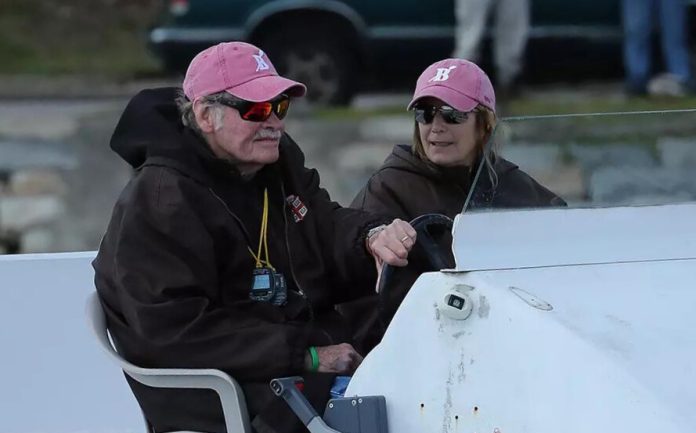
brown rowing murphy
Photo courtesy of Brown Athletics.

PROVIDENCE, R.I. – After 40 seasons and seven NCAA national championships, longtime Brown University Loyalty Chair for Women’s Rowing John Murphy and Gratitude Chair Associate Head Coach Phoebe Murphy (38 seasons) have announced their retirement.

“Over four decades, John and Phoebe Murphy have had a profound impact on our campus and in the world of rowing,” Mencoff Vice President for Athletics and Recreation Dr. M. Grace Calhoun ’92 said. “Their sporting achievements are extraordinary, but they pale in comparison to their invaluable role in shaping generations of student-athletes who have graduated to lives of meaning and success. We could not be more grateful for their leadership.”

The Murphys led Brown to 27 consecutive NCAA Championship appearances, making it one of just three programs to appear in every NCAA postseason since its inception in 1997.

“Being part of Brown Women’s Crew has been a huge part of our lives, but the time has come to retire and give others a chance to lead this incredible team,” John and Phoebe Murphy said. “We will miss the great racing and all the exceptional people we raced with and against who made our job so exciting. While we will certainly look back, we also look forward to cheering on future teams’ accomplishments. We will miss the Boathouse, the Seekonk, and most of all, all the Brown students we have had the privilege to coach. We are always rooting for you.”

They added, “Our thanks go out to the decades of administrators, staff, alumnae, parents, and friends whose generosity and support have played a significant part in the development of this program. You have made many good things possible, and you are, and always will be, most truly appreciated.”

Calhoun announced today that John Murphy will be succeeded by Tessa Gobbo ’13, a 2024 Brown Athletic Hall of Famer and Olympic Gold Medalist (2016 Rio Olympic Games). Gobbo has spent the previous three seasons as an assistant coach for the Bears and will be introduced as the new Loyalty Chair for Women’s Crew later this week.

The Bears have won seven NCAA championships. After winning the program’s first NCAA Championship in 1999, the Murphys and the Bears went on to win again in 2000, 2002, 2004, 2007, 2008, and 2011, an astonishing run of seven titles in 13 years. John Murphy is also a six-time winner of the EAWRC Coach of the Year award, taking home the honor in 1988, 1996, 1999, 2000, 2002, and 2008. Phoebe was the EAWRC Novice Coach of the Year in 1999, 2000, 2003, 2005, and 2007, and the Assistant Coach of the Year in 2010.

The Bears have captured the Eastern Sprints Championship 12 times, including three-peating in 2022, 2023, and 2024. At the 2024 NCAA Championships, the Bears finished sixth as a team, with the Varsity 8 finishing fifth.

In 2022, the Bears became the first American team to win the Island Cup at the Henley Royal Regatta in England.

In 2015, the Bears came in third at the NCAA Championships for the second straight season. Brown captured the first varsity eight race and the team trophy at the 2015 Ivy Championship for its ninth Ivy title all-time and first since 2008. Murphy won the honors of Ivy League Coach of the Year and CRCA Regional Coach of the Year. The Murphys’ crew competed at the Henley Women’s Regatta and the Henley Royal Regatta in the summer of 2015.

The Bears won their third and fourth straight Ivy team points trophies in 2016 and 2017.

Brown placed third at the 2014 NCAA Championships on the strength of a silver medal finish in the varsity eight race. The Bears swept Ivy League competition during the regular season to secure the team’s first No. 1 national ranking since 2007, a position the crew maintained for five weeks. Brown won the team trophy at the Ivy Championship, accumulating the most overall points and finishing second in the varsity eight race. The successful season earned Murphy his fourth CRCA New England Region Coach of the Year award and an induction into the CRCA Hall of Fame.

In 2011, the Bears showed a true team effort, coming from behind to end in a virtual tie with Stanford in the final event. Thanks to Brown’s higher finish in the varsity eight race (less than a second difference), the Bears were awarded their seventh national championship crown under the tutelage of the Murphys.

U.S. Rowing recognized John Murphy with the Fan’s Choice Award for the National Collegiate Coach of the Year 2011, presented at the inaugural Golden Oars Awards Dinner at the New York Athletic Club.

In 2008, the Bears easily won the NCAA team title with an impressive eight-point margin over second-place Washington. The second varsity eight led the way for Bruno, winning a gold medal with a time of 6:42, more than two seconds ahead of the next boat. The varsity eight and varsity four each took the bronze, illustrating Brown’s depth and team approach. The combination was enough to give the Bears 67 points, well ahead of the rest of the field.

At the 2007 NCAA Championships in Oak Ridge, Tenn., all three of Bruno’s crews made it into the grand finals and captured their fifth NCAA Championship in 10 years. After the season, Murphy guided the crew to a semifinal appearance at the Henley Royal Regatta in London, England. To top off the successful 2007 season, Murphy also had one student-athlete named to the First Team of the District I ESPN The Magazine Academic All-America team.

In 2004, the second varsity eight went undefeated as Brown captured first place in both the varsity and second varsity eight races at the national championships in Gold River, Calif. Brown finished its 2002 season undefeated in the regular season and ended with a record of 10-1, earning its third national title. In 2001, the Bears finished third in the NCAA Championships at Lake Lanier in Gainesville, Ga. The team compiled an 11-1 overall record and captured its fourth straight Eastern Championship on Cooper River in Pennsauken, N.J.

In 2000, Murphy was named the Division I Rowing Coach of the Year by the CRCA after his crew captured its second consecutive NCAA Championship with victories in the varsity and second varsity races at Cooper River. In addition to a second consecutive NCAA title, the Bears’ won the 2000 Eastern Sprints title and an Ivy League championship. In 1999, Murphy led his crew to the first NCAA Division I Championship in Brown University history after defeating the University of Virginia by a three-second margin at the NCAA Championships at Lake Natoma in Gold River, Calif. The Bears also captured the Eastern Sprints and Ivy Championships while setting a new course record.

Murphy coached the 1998 women’s crew in the prestigious Henley Royal Regatta in London. In 1997, he guided the crew to a third-place finish at the inaugural NCAA Women’s Rowing Championships on Lake Natoma in Gold River, Calif. That year, his varsity four won the first gold medals ever awarded at the NCAA Championship. After finishing the 1996 season undefeated, Coach Murphy’s crew became the first women’s crew to capture the “Triple Crown” of collegiate racing – the Eastern Sprints, the IRAs, and the National Collegiate Rowing Championship. Murphy coached his crew to back-to-back IRA Championships in 1993 and 1994.

The Bears also won an EAWRC team Championship in 1990, capturing the Charles G. Willing trophy after winning gold medals in the first and second varsity. Coach Murphy was recognized in 1988 as the EAWRC Coach of the Year after his varsity eight captured the Women’s Eastern Sprints Championship for the first time in Brown history. Murphy began his coaching career in 1976 at Cal-Berkeley, where he was responsible for the men’s novice crew. He continued to coach the men’s novice crew in 1977 and 1978.

In 1979-80, Murphy coached the women’s novice crew at the University of Washington, with the first novice eight going undefeated in the Pac-10 and claiming the West Coast Championship. Murphy returned to Cal-Berkeley as the novice women’s coach in 1980, winning the Pac-10 West Coast Championship in 1981. His 1982 and 1983 crews were silver medal winners, and his 1984 crew were undefeated national champions.

John and Phoebe have three children, Jack ’11, Penelope, and the late Patrick D. Murphy, and reside in Barrington, R.I.

Murphy’s Career Awards

  • NCAA Division I National Coach of the Year: 2000, 2004
  • EAWRC Coach of the Year: 1988, 1996, 1999, 2000, 2002, 2008
  • CRCA National Coach of the Year: 2000, 2004, 2008
  • CRCA Regional Coach of the Year: 2000, 2002, 2008, 2014, 2015
  • Ivy League Coach of the Year: 2015
  • Words Unlimited Coach of the Year: 1999
  • Words Unlimited Co-Coach of the Year (with Phoebe): 2007, 2008, 2009, 2011
  • CRCA Hall of Fame (with Phoebe): 2014
  • U.S. Rowing Ernestine Bayer Award for significant contributions to women’s rowing: 2007
  • Duffy Dwyer Memorial Award: 2004
  • Words Unlimited Team of the Year: 2004
  • Outstanding Athletic Achievement in Intercollegiate Athletics Award: 2002, 2004
  • U.S. Rowing Golden Oars National Collegiate Coach of the Year: 2011

Murphy’s Career Highlights

  • Nine Ivy League Championships: 1988, 1996, 1998, 1999, 2000, 2001, 2002, 2008, 2015
  • Four Ivy League Team Championships (Ivy Championship Era): 2014, 2015, 2016, 2017
  • 10 Eastern Varsity Eight Championships: 1988, 1996, 1998, 1999, 2000, 2001, 2002, 2008, 2022, 2023, 2024
  • 12 Eastern Team Championships: 1990, 1998, 1999, 2000, 2001, 2004, 2005, 2006, 2008, 2022, 2023, 2024
  • Three IRA Championships: 1993, 1994, 1996
  • One Collegiate National Championship: 1996
  • Seven NCAA National Championships: 1999, 2000, 2002, 2004, 2007, 2008, 2011
  • Two-time NCAA Division I National Coach of the Year (2000, 2004)
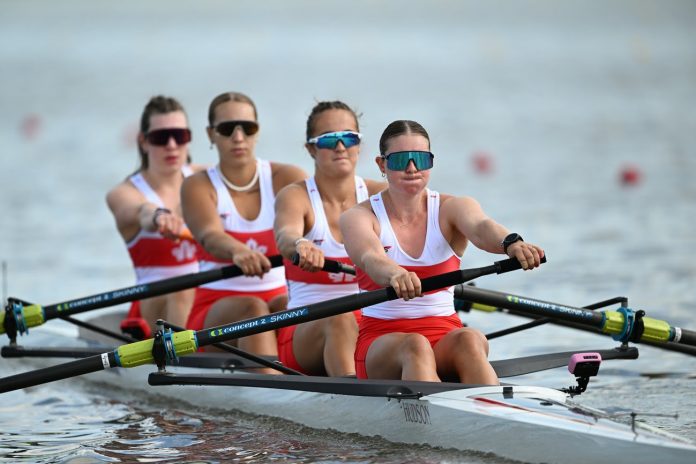
Fast Times on Day 1 of the 2024 World Rowing Championships

2024 world rowing championships canada
Story and photo courtesy of World Rowing.

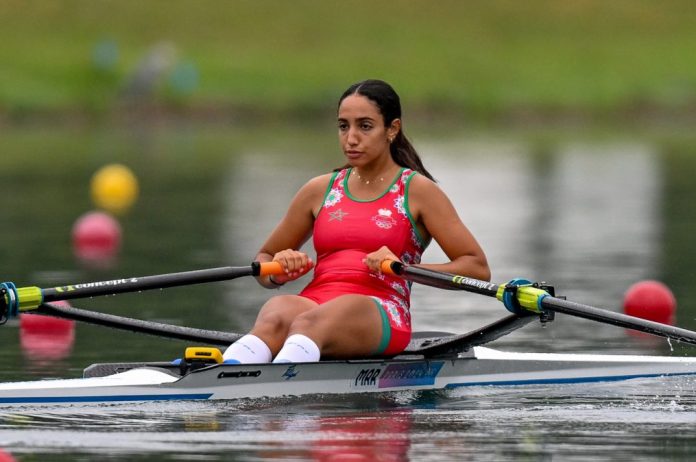
Small Wonder: Moroccan Olympic Single Sculler Majdouline El Allaoui

Majdouline El Allaoui morocco single sculler
Photo by Julia Kowacic.

When Majdouline El Allaoui glided to the finish line in the second heat of the women’s single-scull heat in Paris, she didn’t feel like much of an Olympian. The 23-year-old finished 53 seconds—nearly a minute—behind the victorious Karolien Florijn of The Netherlands. The sympathy applause pained her.

“It was not easy at all,” she said that evening. “I’ll try to do better tomorrow.”

After the race, El Allaoui trained, had a massage, and met with her mental coach. Despite facing her repechage at 9:24 the next morning, she didn’t get around to an ice bath and dinner until after 11 p.m.

It was only her second time using a competition-standard rowing shell—a Filippi purchased after she was qualified by the Moroccan Olympic Committee. Despite being a six-time Moroccan champion, she lacked experience rowing at the top level, and it showed in her performance. Even the Parisian weather was a surprise.

“It was really cold,” she said. “I didn’t expect it.”

Florijn is nine inches taller and 36 pounds heavier than El Allaoui. And whereas Florijn is the daughter of two Olympic rowers, El Allaoui’s parents are divorced, a rare and difficult circumstance in conservative Morocco. Her father wasn’t around much after the split, and her mother couldn’t get a passport to watch her in Paris.

Given her circumstances, coming within a minute of the Dutch Olympic medalist was a triumph, one that warrants a celebration of El Allaoui’s defiant journey to the Games. In many ways, she epitomizes the creed of Baron Pierre de Coubertin, who is credited with launching the modern Olympics: “The important thing in the Olympic Games is not winning but taking part; the essential thing in life is not conquering but fighting well.”

Her accomplishment also should persuade the rowing community to protect and preserve the 32-field single-sculls event. As the only category with more than 16 boats competing, single sculls had a distinctly global feel, owing to the breadth of countries represented. The presence of athletes from emerging rowing nations reminded viewers that there are more than just medals at stake in the Olympics.

After all, on the start line, the two women didn’t look so different. From 2,000 meters away, they both looked like Olympians.

It was difficult to picture El Allaoui, as she sipped orange juice in a marina-side cafe in Salé, Morocco, two days before she left for Paris, lining up in an Olympic regatta.

“I’m a little bit stressed, to be honest,” El Allaoui sighed, smiling. “When you see the boats, you’ll say ‘How did you qualify!’”

She glanced down as she rearranged the ice cubes in her glass with a straw. Overhearing her talk, you’d be forgiven for wondering if it was an upcoming college exam that was weighing on her mind.

“I’m not actually thinking about the podium,” El Allaoui admitted. She was realistic about her chances against the likes of Florijn and her rowing hero, Emma Twigg. But she also recognized that showing well in Paris could make a big difference for Moroccan rowing.

“The little girls who train every day, expecting nothing,” she said. Her voice rose as she gestured to the rowing club where she trains. “I’m doing it for them.”

Club Royal Marine, the home of the Moroccan rowing team, consists of a trailer of singles, an inflatable dinghy, and a gazebo providing shade to seven rusting Concept2 ergs. Three curtains have been fashioned into changing rooms at the side of the gazebo, and a restroom is provided by a friendly cafe owner a hundred yards away. Only three of the shells are serviceable, two with the help of duct tape. The rest are kept in the hope, rather than expectation, that they might be repaired someday.

A mix of 10 to 15 junior and senior athletes turns out usually for national-team training sessions, which take place on the Bouregreg River, in the shadow of Salé’s middle-class marina and Rabat’s 17th-century Andalusian walls. The river reflects the emergence of modern Morocco, passing the newly constructed Mohammed VI tower, the third tallest building in Africa, before partitioning Rabat and Salé and emptying into the Atlantic.

Since the club has only three functional boats, half the rowers train on the ergs while the rest go out on the Zodiac with the coach, taking turns swapping in and out of the working shells.

This routine means practice takes three times as long as it should, but with five or six athletes huddling in the Zodiac, there’s plenty of joking around to pass the time. Comic relief sweetens the bitterness of equipment-caused frustrations.

When African competitions bring the group to the Tunisian Club Nautique, the so-called home of African rowing, the Moroccan team marvels at the facilities on Lake Tunis. Other African squads notice the Moroccans for their spirit.

“We just have fun together, laughing at each other,” El Allaoui said. “We are just like a little family.”

It was her parents’ divorce that turned El Allaoui into a sportswoman. Their separation forced her mother, Nawal Daoudi, to move back to Oujda, her ancestral home 300 miles away in eastern Morocco. Daoudi decided that her daughter would benefit from better schooling if she remained in Rabat, so from the age of five El Allaoui lived with Daoudi’s sister, Samia, in a suburb outside the capital. El Allaoui saw her mother only sporadically, when Daoudi could make the nine-hour train journey to the coast.

El Allaoui discovered athletics through school and found that sport distracted her from the loneliness and stigma of coming from a broken home. She showed potential in the 400-meter hurdles and tae kwon do.

“I did athletics as a way to not think,” she said. “I became obsessed with sport.”

It was Daoudi’s brother, Abdellatif, who brought El Allaoui to Club Royal Marine for the first time. Abdellatif was born in Oujda with his siblings but was adopted as a boy by a Belgian family as his family struggled to make ends meet. He grew up as Abel in Belgium before moving back to Morocco in 2013 and opening Abel Restaurant Belge, a Belgian restaurant in Salé Marina. He got to know the coaches at Club Royal Marine from living and working around the marina and brought his niece to the boat club for the first time in 2016 after a fight with some other girls left El Allaoui unable to continue with athletics.

Within a month, the 15-year-old was selected for the women’s national team, and within a year, El Allaoui was crowned Moroccan champion for the first time.

El Allaoui qualified for the Paris Olympics at the World Rowing African Olympic and Paralympic qualifier in Tunisia in October 2023, winning her B final with a two-kilometer time of 8:34:46. Her qualification depended on the disqualification of a faster athlete from the A final, Sarra Zameli of Tunisia, based on World Rowing rules.

Of the 502 rowers who competed at the Paris Olympic Games, 18 represented African countries. That amounted to 15 African boats, with 12 qualifying through the single-sculls category.

Among these African athletes, El Allaoui’s story isn’t unique. Akoko Komlanvi grew up around Lake Togo without training facilities or proper equipment. The Togolese athlete relocated to Tunisia to benefit from technical support, proper training, and international competition, with the assistance of an Olympic Solidarity Scholarship.

“When I was chosen for the Olympic Solidarity program, it was a great joy for me and my family,” Komlanvi told the International Olympic Committee. “My housing, recovery, travel, everything is paid for by the scholarship, and it has also allowed me to take part in many international competitions.”

Six of the 18 African athletes represented were white: three from South Africa, and three who rowed at colleges in the United States. Kathleen Noble, the daughter of Irish missionaries who was raised in Uganda, credited representing the country with consolidating her Ugandan identity. She first represented her country as a swimmer, before walking onto the Princeton rowing team as a sophomore.

“Why’d you show me this? Do you want me to cry?” El Allaoui teased when I showed her pictures of an Ivy League boathouse. A week before the Olympics, she had never heard of Henley Royal Regatta or the Oxford-Cambridge Boat Race.

“We don’t do that here,” she smiled, as she studied a photograph of the crew of a women’s eight at Henley hoisting oars above their blazers.

While rowing is a pathway to education for many athletes in the U.S., El Allaoui’s pursuit of the sport cost her a high-school diploma. After missing a month of her final year to attend an international competition in Tunisia, her high school prohibited her from taking the baccalaureate exam. So she dropped out and moved in with Abdellatif to live as close as possible to the rowing club and began training twice a day, every day, between coaching kids, working behind the desk at her gym, and waiting tables at her uncle’s restaurant.

She was awarded a stipend by the Moroccan Olympic Committee after qualifying, which enabled her to cut back hours and orient her time around training. It also funded the purchase of an NK SpeedCoach GPS, which remains an object of great fascination to her teammates.

There was nothing noteworthy about El Allaoui’s final practice before leaving for Paris, because her training had not been designed to build to the Olympics. The team begins each week with distance training on Monday. Wednesday is a blend of strong and long, and her final session was a 5 x 500-meter sprint, as it is most Fridays.

A good amount of time was wasted adjusting and readjusting foot stretchers. Dodging jet skis and commercial traffic created another distraction.

El Allaoui stopped after her fourth sprint, complaining of a mild cramp in her hamstring. She climbed out of the scull and displaced some teammates so she could stretch out across the width of the Zodiac.

“I feel good,” she said, flashing a smile that was betrayed by the concern in her eyes.

Only after everyone had their turn on the water and the Zodiac headed back to the marina did anyone mention the Olympics.

“We are so proud of her,” said Iliass Chafik, a 19-year-old on the men’s national team and El Allaoui’s cousin on her father’s side. “Because of her, rowing in Morocco will be famous.”

El Allaoui’s repechage race on July 28 played out almost identically to her heat the previous day. She broke ahead of the pack with a stroke rate of 48 in the initial moments, but the field caught up within 300 meters. By the halfway mark, she was 18 seconds behind the leader, Alejandra Alonso Alderete of Paraguay. Her inexperience was evident.

Her E/F semifinal, which featured three African scullers, was a similar story, with El Allaoui falling several lengths behind after 500 meters. At the halfway mark, she showed considerable grit by clawing back to within a length and a half of the third-place rower, Nicaraguan Evidelia Gonzalez Jarquin. But the gap reverted to three lengths by the time the pair reached the finish line.

“A lot of these women are racing normally at world championships—like El Allaoui, the Moroccan sculler—in the lightweight category,” said Olympic gold medalist Martin Cross as he called the race on Peacock for U.S. viewers. “They’re not big tall women you would expect to see in the quarterfinals going for places in the A and B semifinals.”

Cross was astute in making note of El Allaoui’s unusual size. At just under five feet, four inches, she is five inches shorter than the average female single sculler who competed at the Olympics and two inches shorter than the average lightweight women’s double sculler. While she has a suitable build for lightweight competition, she had neither the teammates nor access to double scull boats to train for the lightweight double sculls, the only Olympic category for lightweight rowers.

El Allaoui’s first thought after meeting Emma Twigg at the 2022 Coastal Championships in Saundersfoot, Wales, was to marvel at her stature.

“She’s a really big woman,” El Allaoui laughed, elongating the adverb as she rolled back her head.

After so many years at the top of Moroccan rowing, El Allaoui didn’t know whether she could get better. She entered the Welsh competition debating whether to try for LA 2028 if she should make it to Paris or whether she should give up on rowing and begin a new life.

Twigg’s career has been a model of longevity and passion for the sport. Witnessing her approach to rowing had a profound impact on El Allaoui.

“Why won’t I qualify two, three, four, or five times for the Olympic Games? Why won’t I someday bring home a medal?” she asked rhetorically. “That’s why I’m following this path. Her path.”

Despite practicing in coastal shells that are handmade in Morocco, El Allaoui and her mixed-doubles partner, Ibrahim Mraghi, posted the fastest Beach Sprint time in Africa at the 2023 African Beach Games. This qualified them for the canceled World Beach Games, which would have been held in Bali, Indonesia, that same year.

With the Beach Sprints making their debut at LA 2028, the pair hopes to recreate that performance next time out to secure a place.

“We are going to train hard for it,” El Allaoui said. “I’m pretty sure that we will qualify.”

Mraghi lives and trains in Dubai in the United Arab Emirates. El Allaoui has come to accept, reluctantly, that her dreams require her to move abroad, too.

She has World Rowing coaching qualifications, which she hopes will land her a coaching job and a visa to support a professional training regimen. She also hopes to get her high-school diploma through Morocco’s free baccalaureate program, which is commonly used by prisoners to accelerate their rehabilitation by qualifying them for work and further study.

Discussing where to go next has become a favorite way to pass time on the Zodiac. Everyone shares their opinions about different countries, which, since English comprehension in Morocco is low, originate from French and Arabic media as well as personal experience.

“Poland is an amazing country,” El Allaoui asserted. “I was there, and it’s not expensive.”

The team’s chief perception of the United States is that it’s extremely pricey, and the Moroccans were unaware of rowing scholarships. Although El Allaoui is now an Olympic rower, she’s never been contacted by a U.S. college coach.

“France is expensive,” offered Chafik. “It’s a racist and very expensive country.”

El Allaoui lined up against Akoko Komlanvi, the Togolese recipient of the Olympic Solidarity Scholarship, on Aug. 2 in the Single Sculls Final F.

With only two boats in the race, the final made for an intimate contest. The pair knew each other well, since Moroccan training camps tend to take place at Lake Tunis, where Komlanvi is now based.

“She’s such a good athlete, and her muscles are so strong,” El Allaoui said. “If she can grow her confidence, she’ll be a champion.”

El Allaoui pulled into clear water early, settling into a rhythm of 30 strokes per minute. Komlanvi closed the gap to half a length in the second 500 meters, outstroking El Allaoui by five strokes a minute, but El Allaoui’s longer strokes took command of the race eventually, and she won the final convincingly, posting a time of 8:20:81, her fastest of the competition by almost 10 seconds.

Nevertheless, the result meant she finished 31 of the 32 female single scullers competing in Paris.

As she got off the water, she was deflated.

“I didn’t do well at all. I’m going to work so hard so that next time I do better,” she vowed. “I want to show that short girls can do it, that African girls can do it.”

The disappointment was exacerbated by comments on social media suggesting that she wasn’t worth sending to the Olympics and congratulating her sarcastically for managing not to capsize.

Criticism from within the sport she can shoulder; rarely is it more severe than the criticism to which she subjects herself. Negativity from outside the sport, however, can be a more bitter pill.

“They don’t know me,” she said, her voice rising for emphasis. “And they don’t know rowing.”

Many of the rowing enthusiasts in attendance towered over El Allaoui as she meandered behind the grandstand after her race. Fans nudged elbows and pointed discreetly as their heroes walked by, while El Allaoui went unnoticed.

Until a man ran up behind her and tapped her on the shoulder.

“Excuse me,” he said. “I’m Moroccan. Would you mind taking a photo with me?”

She stood in stunned silence for a moment before posing for the picture.

“Wow,” she said afterward, her eyes widening. “I’ve never felt anything like that before.”

Emma Twigg Goes Coastal

emma twigg rowing olympics
Photo by Julia Kowacic.

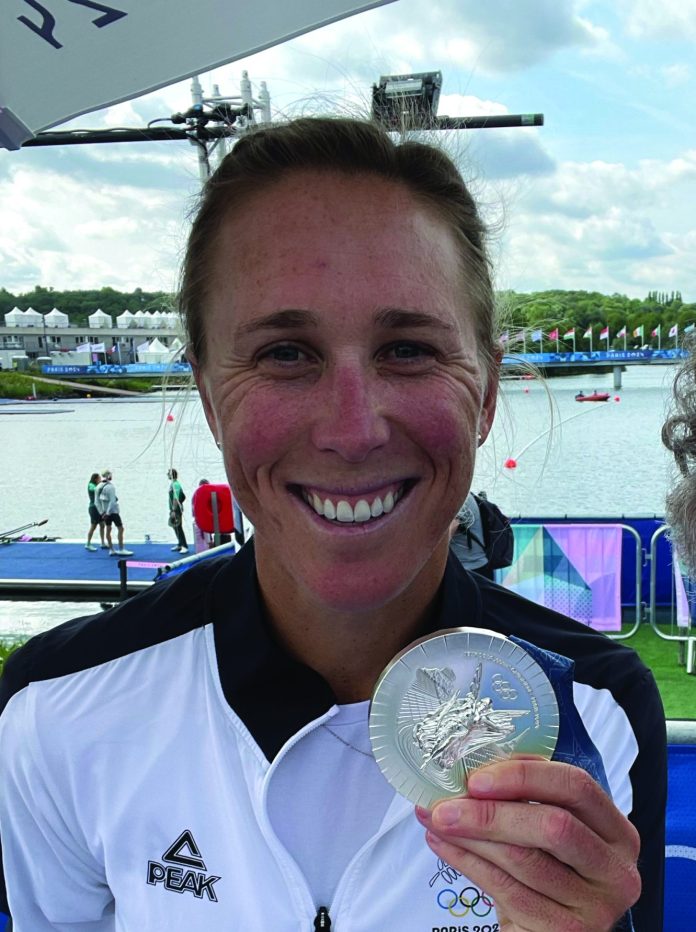
Emma Twigg, New Zealand’s five-time Olympian, will race again in the World Rowing Coastal Championships and World Rowing Beach Sprint Finals after the flat-water season.

In 2022, Twigg won the coastal women’s solo CW1x class and finished second in the mixed quadruple sculls at the Coastal Worlds in Saundersfoot, Wales, a month after the World Rowing Championships.

Twigg won silver in the women’s single at the Paris Olympics to go with her gold from Tokyo.

“Tokyo for me was redemption of my belief that I could be an Olympic champion and that I always had it in me and that the results in London and Rio [fourth at both] were not me,” said Twigg, who was the only sculler to challenge Olympic champion Karolien Florijn in the final, closing the gap in the third 500 before being outsprinted to the finish.

“That was the plan. I executed everything up until the last 250, when I ran out of gas. I left it out there and didn’t quite make it, but that’s sport, and I’m happy.”

Twigg, 37, is done with elite-level flat-water racing and will turn now to coastal rowing—for fun.

“I’m going to go and do the Coastal Worlds but I can safely say that my flat-water career is done. Coastal is an amazing sport but it’s probably not an old ladies’ game, so yeah, I’m just going to enjoy retirement and row for the sake of loving what I do.”

Olympic Coverage: The Winning Formula

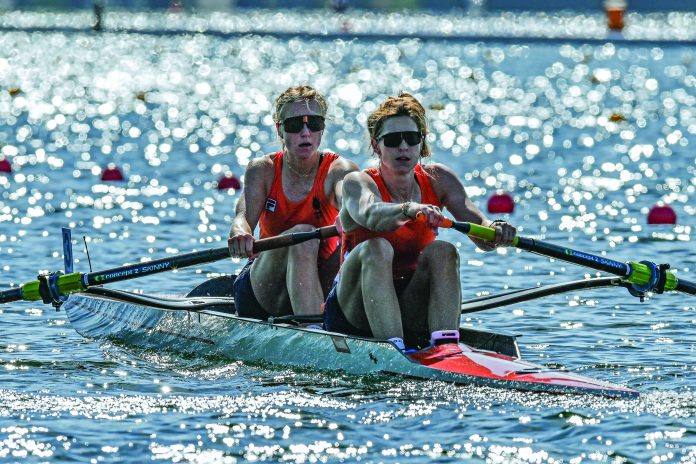
netherlands rowing women's pair
“We started off in 2016 and the last three years in pairs,” said The Netherlands’ bowseat Ymkje Clevering of the years of experience she and Veronique Meester have rowing together. “We joined actually the national team by winning the national championships in the pair.” They won the Olympic final by more than four seconds over Romania. Australia won the bronze, and the U.S. finished fourth. Photo by Julia Kowacic.

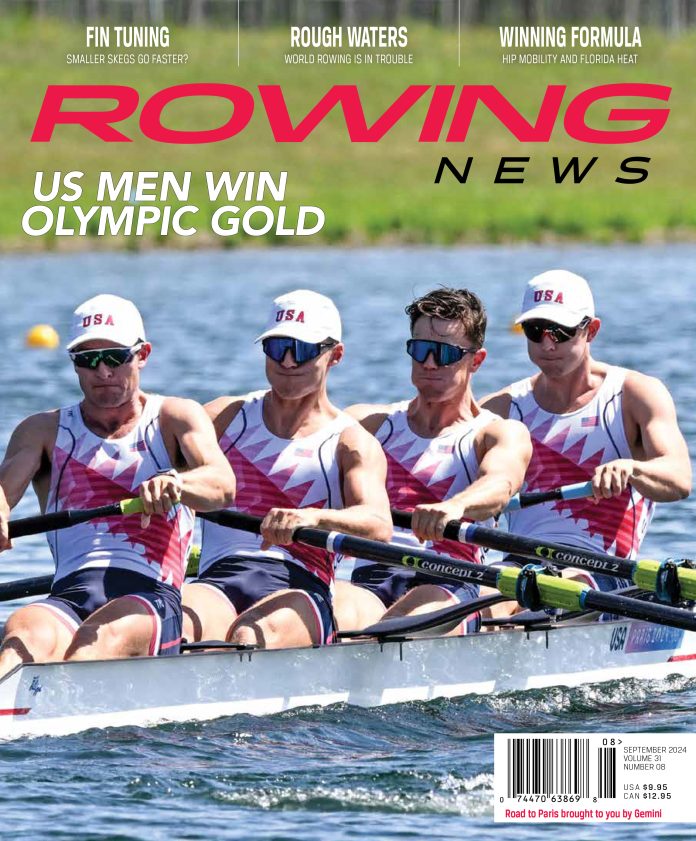
The Olympic gold won by the U.S. men’s four was the product of more than just four great collegiate oarsmen rowing together for several years. Coach Casey Galvanek used his sharp eye, available technology, and sales skills to get already successful athletes to make the little changes that reaped the ultimate result.

The loose, relaxed length evident in the four’s rowing was “the number-one thing we worked on at first,” said Galvanek after the Olympic victory. “It caused a little stress between us.”

“A lot of it was hip mobility,” said Galvanek. “They’re sitting in chairs a lot more. Work is in a chair. They’re sitting at a computer and in the classroom. Over the years, their mobility is less and less because they’re locked in place and they’re not stretching. Every 10 degrees of hip angle gives you a certain amount of length in the stroke.”

Galvanek identified hip mobility as a key early, talked to the strength and conditioning coach, and the next day they were working on it.

“They committed to it, and we saw the results right away. And then we just kept working on it, keeping a strong but more usable position that gives you more length and duration in the water. It changes the drive rhythm.”

Galvanek and his fellow Olympic coaches, including Brian de Regt and Michael Callahan, used the Peach system that measure forces, angles, and speeds in the shell while rowing. The technology showed them what they couldn’t see with their eyes.

“One degree here and there is pretty tough to see,” said Galvanek. “A little bit of timing differences are really hard to see.”

The recorded measurements also enabled Galvanek to sell the changes to the oarsmen, even if they didn’t feel right.

“I would show them reports, ‘Here’s a video of you doing it before I said, and here’s a video after I said, and then when you went back.’ And they can see it in the data. So it does help them agree and be convinced a bit more than just saying, ‘Hey, this is what I’m looking for.’

“If you look at the video of the boat from when we first started working together for World Cup II last year till now, it looks like a wholly different boat.“

After more than 20 years of coaching in Florida, the Sarasota Crew CEO (like Washington’s Callahan, Galvanek receives the majority of his compensation from outside USRowing) had his crew ready for the heat at the Paris Olympics.

“One of the other things we worked on a lot was not avoiding the heat in training. It’s not like it’s magic. But just being accustomed to it is a big help.”

Again, Galvanek wanted his crew to eschew comfort for improvement by meeting the challenge of hot conditions in training.

“I asked them if they would do that, and they said yes. And so for the past two years, any time it was hot, we didn’t shy away from it.”

The preparations paid off in the Olympic final, as the U.S. men won gold in the four for the first time since 1960.

“It’s an incredible experience,” said Galvanek after the biggest win of his career. “I don’t know if there could be anything better.”

World Rowing is in Trouble

olympic rowing great britain lightweight women
Emily Craig and Imogen Grant raced in the closest race in Olympic rowing history, the Tokyo Games final of the women’s lightweight double, when the top five crews finished within a single second, and the British duo missed a medal by one one-hundredth of a second. They kept at it, going undefeated for the Olympic cycle leading up to Paris, and won the last Olympic lightweight rowing gold medal to be awarded. “This was the only result left for us to achieve, and we did it,” said Grant. Photo by Julia Kowacic.

World Rowing is in trouble.

The international governing body of the sport, formerly known as FISA, relies almost entirely on financial support from the International Olympic Committee and faces the same challenges of rising costs, waning relevancy, and shrinking revenue that’s affecting everything else in the sports-business landscape—from the NFL to cornhole.

Competing for attention—and the sponsorship, attendance, and broadcast-rights fees that come with it—has proven “very difficult, very competitive” said the president of World Rowing, Jean-Christophe Rolland, at the Olympics.

Earlier this year, Executive Director Vincent Gaillard stated frankly that World Rowing is “not in a good situation” and “going in the wrong direction.”

Rowing is flourishing in America, with record entries and crowds at the heads of the Charles, Schuylkill, and Hooch in the fall and ACRA, IRA, and Youth National championships in the spring. Rowing succeeds also when presented well, as at Henley Royal Regatta, which attracted record entries, 300,000 spectators, and almost 100,000 viewers per day over its YouTube livestream this year.

Those numbers approach Formula 1’s average U.S. viewership on ESPN of 1.1 million per race. Last year’s Las Vegas Grand Prix drew 315,000 spectators over four days.

But World Rowing operates elite-level rowing in the same old Eurocentric way the sport has functioned since the turn of the millennium, with World Rowing Cups that almost no one attends (except in Lucerne), World Rowing Championships always in Europe except for the post-Olympic year, and regatta programs that could be held in a few days stretched over more than a week.

It’s expensive and unproductive for all but the small handful of European national teams that dominate the medal tables. European countries won 70 of the 87 medals awarded at last year’s Worlds in Belgrade. In Paris, three European countries—The Netherlands, Great Britain, and Romania—won nine of the 14 events.

Pressure to reduce costs and the number of athletes has reduced Olympic rowing events to fields that are farcically small. Only seven boats qualify for the eights, and only nine for the fours and quads. With eight-lane courses the international standard, heats and semifinals are practically unnecessary. The current Olympic program could be run in a long weekend by the volunteers who make Canadian Henley such a success.

But people love rowing, as evidenced by ticket sales of 97 percent in Paris, where nearly 20,000 cheering fans filled the stands every day. Swimming, track & field, and cycling capture public attention with stars winning multiple medals every Games. Romania’s women’s eight proved it can be done in rowing, winning two silvers and a gold.

Why not run all the small-boat events the first four days of the Olympics and Worlds and big boats the last four (or fewer) days to facilitate it? Nations, instead of individual boats, could qualify for the Games, and contest all the rowing events—bring back the coxed four and pair!—with a team of 20 men and women racing as many events as possible.

The sport could certainly use a Michael Phelps or Simone Biles. Twenty national teams of 20 rowers is only 400 athletes, fewer than rowing’s current allotment of 502, allowing plenty of room for international inclusion spots.

The Head of the Charles added events for pairs, and elite international crews already compete in it and Henley, so why not make popular regattas like those part of the World Rowing Cup series?

European national teams already spend on remote training camps, so why not have them in places like Aiken County, South Carolina, and Oak Ridge, Tenn., in the lead-up to an early-spring World Rowing Cup at Nathan Benderson Park in Sarasota?

The choice between Florida and central Europe in early spring is an easy one. World Rowing could join the rowing party where it’s already rocking instead of continuing the failing practice of expecting the world to come to them.

To its credit, World Rowing has hired outside consultants to study the problem and offer possible solutions. Meanwhile, its leaders point to indoor rowing, coastal rowing, and e-sports as “exciting” new branches of the sport, but participation and attention on the same level as real rowing have yet to materialize.

The leaders of elite-level rowing have their heads and hearts in the right places. They’re just slow.

And slow doesn’t succeed in rowing.   

Oxlade Elevated to Associate Head Coach at Louisville

Story and photo courtesy of Louisville Athletics.

University of Louisville head rowing coach Derek Copeland has announced that Ed Oxlade has been elevated to associate head coach after serving as the Cardinals’ assistant coach and rigger/boathouse manager since July 2013.

“Ed has contributed to this program on many different levels over the past decade,” said Copeland. “He continues to grow his abilities and impact the growth of more and more athletes each year. This promotion makes perfect sense to everyone involved with the program and I am excited for Ed and the team.”

A native of the United Kingdom, Oxlade is entering his 29th season as a coach and has built an impressive resume which spans three countries in junior and collegiate rowing.

“I am very grateful to Derek Copeland and the administration for their faith in me to continue to drive and develop the rowing program here at the University of Louisville,” said Oxlade. “I have been proud to work with this team for the past 11 seasons, and I am excited at the prospect and opportunity presented by this new role.”

During his time at Louisville, Oxlade has predominantly worked with the varsity fours. His role as a developmental coach has been important in progressing student athletes through the system as they gain experience and expertise in collegiate rowing over their careers.

In 2024, Oxlade coached the second varsity 8 boat to a sixth-place finish in the 2024 ACC Championship. His most notable successes came in 2018, when the varsity 4 boat earned silver and second varsity 4 took home the bronze medal at the ACC Championship.

“I believe wholeheartedly that we have all the tools necessary to deliver an outstanding student-athlete experience,” said Oxlade. “We will continue to drive and encourage our student athletes to even greater success in the classroom and onto their career paths. However, I am mindful that our performance on the water is paramount to our athletes feeling truly fulfilled in their experience – I am steadfast in forging a dedicated path forward with Derek’s vision to deliver on the considerable promise our athletes show daily.”

Prior to arriving in Louisville, Oxlade coached the Jacksonville University Dolphins from 2007-11 following his emigration to the United States from the United Kingdom.

In his first season stateside at Jacksonville, Oxlade’s freshmen/novice crews became state champions in men’s and women’s eights at the FIRA state championships. He also worked with the women’s varsity team as assistant coach, which culminated in the varsity four winning the Margaret McNiff trophy on the Schuylkill at the Dad Vail Regatta.

In 2009, he coached the men’s novice eight to a repeat win at the FIRA state championship and a semi-final appearance at SIRA. He served as assistant coach to the JU varsity men’s team, which repeated as FIRA state champions and won silver medals at both SIRA and Dad Vail in the Junior Varsity eight.

Oxlade played an integral role in the historic run of the men’s varsity eight to the 2010 IRA Championships for the first time in the program’s 54-year history. He assisted in the coaching of the varsity crews to repeat wins at the Murphy Cup (V8) and the FIRA state championships.

His coaching career started at Geelong Grammar School, in Victoria, Australia, where he was responsible for coaching the girls’ second varsity 4. The crew had a stellar year, winning at Australian Henley, finishing second at the Head of the River and the Head of the Schoolgirls’. The crew combined with the girls’ first varsity 4 to create a girls’ first 8, winning the Head of the Schoolgirls’ regatta.

While pursuing his master’s degree, he led the rowing program at Claires Court School, helping develop the club to a solid foundation before moving to Oundle School, where he served as director of rowing for five years. While there, Oxlade oversaw Henley Women’s Regatta finalists, Henley Royal Regatta appearances, three national championship medals, the 2005 national title along with two athletes selected to represent GB and England internationally.

He enjoyed success while coaching England’s Junior Men’s eight, guiding them to a gold medal each year from 2005-07.

As an athlete, Oxlade won multiple national championships medals, including gold in 1993. While studying for his bachelor’s degree, he became Northern Universities Champion in the single scull, and was a trialist for the GB national team. He competed at Henley Royal Regatta multiple times, closing his competitive career at Maidenhead Rowing Club. He also served as president of the Northumbria University Boat Club from 1996-99 and coached the women’s team at Newcastle University.

He earned his bachelor’s degree in sport and exercise science from the University of Northumbria in 1999 and went on to complete his master’s degree in physical education from the University of Surrey, Roehampton in 2002. In 2022, he earned a master’s degree in sport administration for the University of Louisville.

CURRENT ISSUE OF THE MAGAZINE