Home Blog Page 42

Recruiting Pet Peeves

rowing students carrying boat regatta
Photo by Lisa Worthy.

Even with all that has been written about recruiting, college coaches still find many things they wish every prospect understood. Here are a few behaviors that frustrate coaches across the country. Consider these recruiting pet peeves and do yourself a favor by avoiding them.

When emailing a coach, sign your first and last name to every message you send. Even better, include your graduation year (2025, 2026) and affiliation (school or club). You’re not the only Isabelle or Jimmy they’re hearing from.

If the coach asks you to submit the university’s recruiting questionnaire, do so immediately. You can always email new information or update the questionnaire. Never refer a college coach to your beRecruited/CaptainU/NCSA online profile as a substitute for submitting the school’s questionnaire. Many athletic departments require coaches to communicate with prospects through their recruiting software and need the questionnaire to do so.

If a coach requests your unofficial academic transcript and/or test scores, make sure your name is visible on what you provide. Sometimes what you may download as a grade report doesn’t show your name. If you send this information as a link to a school website, make certain that it’s not password-protected and the coach can access it. Also, send the materials to the coach; college coaches typically cannot review what goes directly to the admissions office.

If a coach requests video, send footage of you pulling hard, not paddling around. Coaches want to see how you behave at race pressure and race rates. The ideal: you and your blade(s) fill the video screen. If the video shows you in a team boat, identify clearly which seat you’re rowing. Keep video clips to less than 30 seconds.

And of course, everyone’s favorite: Do not make excuses for your erg time. Telling a coach that you “didn’t get the chance to test” or “can’t find an erg” makes you come across as unmotivated. Your peers who find ways to get more fit and demonstrate their fitness are getting the attention you seek.

You don’t need to pull a 2K. Most college coaches will accept the results of any erg test that your team does. When sharing erg times, send a picture of the monitor showing your time and splits. Coaches like this verification and seeing how you paced your piece.

Finally, ask questions rather than make assumptions. College coaches appreciate direct questions about the team, recruiting standards, and timeline. “What do I need to do to earn a scholarship/admissions support?” is much better received than “Will you give me a scholarship/support?”

The coaches also know more about the recruiting and admissions process than anything you’ll read on message boards. If you rely on internet gossip, you’ll get exactly what you deserve. The opinion of your peers is valuable, but it should not stand alone when evaluating your options.

Good luck with your college search and selection process!

Oxford, Ukraine, Duke, Old Dominion, High Point race ‘Round the Duck’

High Point Autumn Rowing Festival
Photo courtesy of High Point University

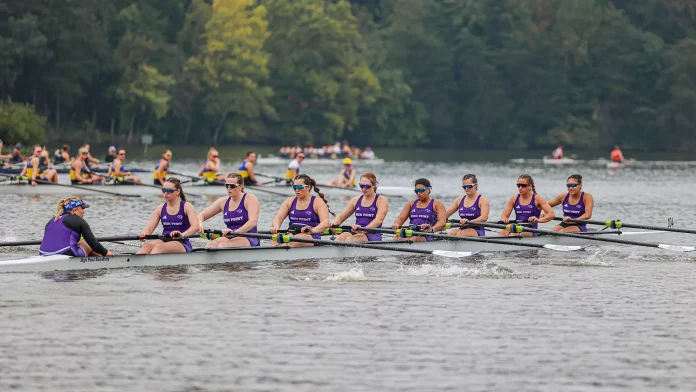
High school teams all the way up to national team squads competed at the High Point Autumn Rowing Festival presented by Bethany Medical on Sunday, October 6, in High Point, North Carolina for the opportunity to see who could turn around the regatta’s renowned inflatable ducks.

“We have three ducks out there,” shared race director and Triad United’s head coach Gene Kininmonth. “I’ve driven way too many miles with boat trailers behind me. You arrive at regattas tired, having drank too much coffee, and a bit grumpy. I wanted something that people saw when they first arrived to put a smile on their face and the duck was what I came up with years ago. ‘Round the duck’ became the slogan.”

This year, among the competitors was Oxford University’s lightweight women and the Ukrainian national team, who went up against colligate teams, Duke, Old Dominion, and High Point. The High Point Autumn Rowing Festival served as the Panthers inaugural race as a varsity team.

“I think they had a wonderful weekend,” noted Kininmonth about HPU’s performance. “Their varsity eight put on a really fantastic performance in their first race with Old Dominion and Oxford. They took the lead early off the start. Oxford pushed through them. When they got to the duck, High Point actually took the lead on the turn and had almost a length before Oxford fought back. On the last turn Old Dominion snuck in on the corner and got past High Point but couldn’t pass Oxford. It was one of the best races I think I’ve ever seen.”

Full results from the regatta can be found here. Since its inception in 2012 the Autumn Rowing Festival has continued to grow over the years and feature a slate of varying experience levels with the goal of inclusivity.

“When I first started High Point Rowing Club in 2012 we had to leave the state to race,” said Kininmonth. “I realized at Festival Park in High Point we’ve got a gem. We can park 1,000 cars and can get in up to 35 boat trailers or more. We’ve got a natural viewing grass stadium on the hill at the finish line that can fit 5,000 people comfortably. It’s a real perfect place. It’s just grown and grown. This year it was 30% bigger than last year.”

Kininmonth hopes the event keeps gaining traction and the more crews have the opportunity to nail the turn around the storied High Point duck.

Doctor Rowing: The First Family of Rowing

rusher olympics
Photo courtesy of the Rusher family.

In 2022, I attended a social event at the Cambridge Boat Club, and the talk, not surprisingly, turned to rowing. A stone’s throw from Harvard, a number of members remarked on the terrific crews that Yale had been boating.

“Sure, but isn’t it true that none of them are Americans,” said one old oar.

Grumbling ensued about the sorry state of collegiate rowing in the USA. You’ve heard it before: We are a training center for other country’s national teams.

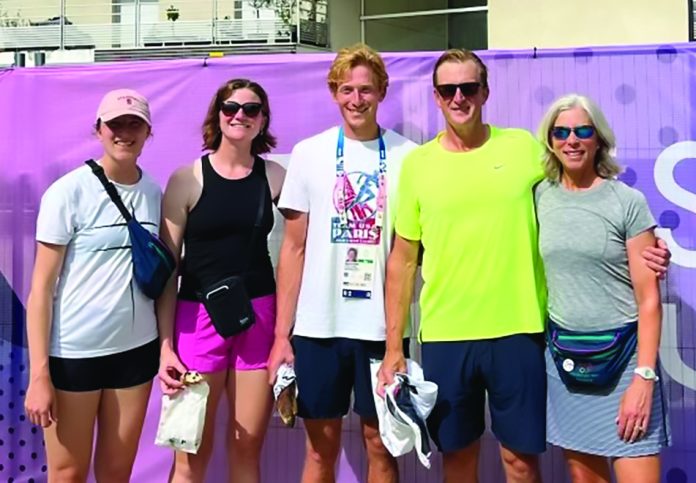
“I know of at least one American in that Yale boat,” I said. “Nick Rusher, whose parents are both Olympians. He rowed at St. Paul’s School in New Hampshire and is now at Yale.”

While this didn’t exactly calm the roiling waters of dissatisfaction, it did get me thinking about a column.

I met Cindy Eckert and Jack Rusher back in the ’80s when both of them were National Team members. Cindy rowed at Wisconsin as part of their national-champion 1986 eight, and Jack had rowed in national-championship boats at Harvard in 1987, 1988, and 1989. Cindy won a silver medal in the coxless four at the Barcelona Olympics in 1992, and Jack had won a bronze in 1988 in Seoul in the eight.

That same evening at CBC, their daughter Alie was in the room, having returned from racing in the quad at the Tokyo Olympics, adding fuel to the fire of my column about the Rushers. I asked her if she would be willing to talk about her family and their rowing. “You’d better ask my mom,” she said.

I emailed Cindy, who said they’d prefer to wait until Nick had finished his rowing career. I put the idea on hold. But with Nick’s own bronze medal in hand from Paris—he was two-man in the USA eight—the time seemed right to talk about this extraordinary family.

“We didn’t want to jinx Nick by talking about his quest for the Olympics,” Cindy explained. Nick had rowed in the U23 eight in 2021 and the Senior National Team eight the next year and still had a couple of years to go at Yale. Beyond that was a hope to go to Paris.

There’s a third accomplished rower among the children— Kay, the oldest child, who rowed at St. Paul’s and Stanford.

How did all three take to rowing?

“We never pushed any of them to follow in our footsteps,” Cindy and Jack agreed.

“All three of them went to St. Paul’s and fell in love with the sport.” Jack said, “The coaches there were very inspirational, and our kids loved rowing for them as much as I did.” (Jack rowed for Chip Morgan and Rich Davis, father of my boss at Rowing News.)

At home, the Rushers kept their medals in a drawer, and Nick says as a kid he never realized how rare it was to have both parents be Olympians.

“It was great having them both understand just how hard rowing is,” Nick said, “and how hard it is to make a team.”

I asked them to reflect on the highlights of their years as über rowing parents.

“It started with the excitement of running down the beach, watching Kay and Alie’s St. Paul’s boat win at the [New England Interscholastic Rowing Association regatta] in Worcester. Later, they also rowed together at Stanford. It was thrilling to see them together in the bow pair of Stanford’s varsity in the 2016 NCAA championships. They didn’t win, but they led the field for quite a while, and on the video monitor which focused on the bows, there they were up in the bow, leading the pack.”

Alie chimed in: “There is no one that I would pull harder for. Kay was my idol growing up, and while we may have had our little sibling spats—she flipped me out of the pair once— I wanted nothing more than to row as well as she could.”

“Alie raced in Tokyo,” Cindy said, “but there were no spectators allowed; it was heartbreaking not to get to be there to support her. But Paris was a dream come true. I was more nervous for Nick’s race than I was for any of mine. As we sat in the stands, we just savored the 15 years of watching them row.”

The Rushers live on Big Cedar Lake in West Bend, Wisconsin.

“We loved seeing the girls out rowing together in a pair as they used to go back and forth,” Jack said. The neighbors would get excited about it, too. When they started to row, we had a Peinert single, and Cindy started a friendly family competition, timing who could row out to Penny Island and back. I thought they would think it was fun, but I later found out that they said it totally stressed them out.”

When I spoke to Nick, he was still high from the Olympics. “I can hardly put it into words; there’s a great sense of fulfillment. And having my whole family there and knowing what it means—fantastic!”

Nick wanted to take issue with the whole “why not more Americans in college crews?”

“I probably see it differently than some people; I got to row with and against Olympians in college. If I hadn’t been rowing with international oarsmen at Yale, I never would have improved the way I did. When I took my first 2K test freshman year at Yale, it was 6:23.”

In his years at Yale, Nick rowed in all five varsity boats, moving up through the ranks.

“Rowing with a gold medalist from New Zealand at stroke, me at seven, and an Australian medalist from the straight four behind me at six—well, those guys taught me as much about rowing as my coaches did.”

And how much did his erg improve while rowing at Yale?

To 5:58 at Yale, and now, with the help of the California Rowing Club, to 5:54.

What has rowing meant to the Rushers?

“It totally changed our lives,” Jack said. “For one thing, we would never have met.”

Cindy echoed this: “The people I have met and the traveling I have done—I never would have done any of that without rowing. It has been a really healthy focus for our family.”

“I’m so proud of both of them,” Kay said. “There’s never been a doubt in my mind that Alie and Nick would achieve their Olympic dreams, and it’s been one of my life’s highlights to watch and support that journey.

“I’ll never forget the day each of them made the team and called me. Nick’s is fresh in my mind because it was so recent—I started jumping up and down and screaming YESSS! It was amazing to watch Nick win a bronze medal, while sitting next to Alie and my parents. I remember grabbing Alie’s hand after the 1,500 and screaming that they were going to medal. I just knew it.”

Not that many families have four Olympians. Rowing has woven the Rushers together. There is a lot of love here—for rowing and for each other.


Washington Adds four to Coaching Staff

quinn klocke grady washington rowing wannamaker mooney
Photos courtesy of Washington Athletics.

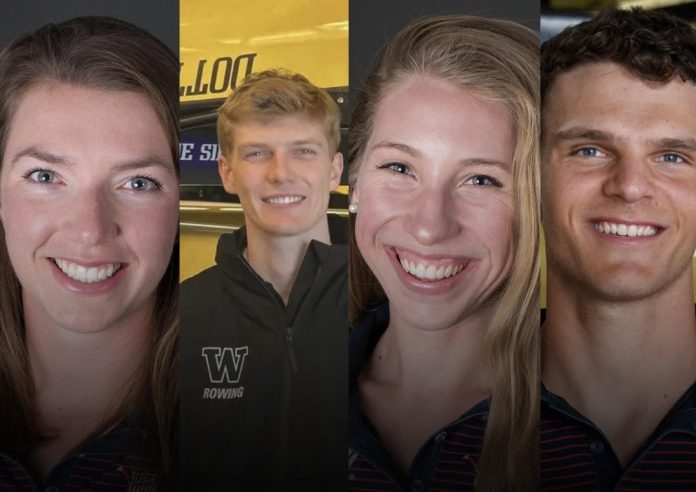
The University of Washington Huskies have added Quinn Klocke and Michael Grady as assistant coaches for the men’s rowing team and Brooke Mooney and Maddie Wanamaker as assistants on the women’s team beginning with the 2024-25 season.

On the men’s side, Klocke comes to Washington after three seasons as head coach of the Notre Dame men’s club rowing team. Klocke coached the Fighting Irish to their first ever ACRA National Championship in 2024. While at Notre Dame, Klocke coached seven ACRA All-Americans and three ACRA All-Freshman athletes. He was named ACRA Great Lake Regional Coach of the Year in 2023.

Grady joins the Husky men’s rowing coaching staff as a Cornell University 2019 graduate, the 2024 USRowing Male Senior Athlete of the Year, a two-time Olympian, and a Paris Olympic Gold medalist in the men’s four.

“I actually started coaching at Oakland Strokes shortly after the pandemic,” said Grady. “I really enjoyed working with the athletes. For me getting into coaching now is a pretty easy transition. I want everyone to recognized that they have more in them. If you can realize your potential and break through limits, it does something special to an athlete’s brain.”

On the women’s side Wanamaker knows all about breaking limits as a two-time Olympian who made her first senior national team in 2018 in the women’s four that won gold at the World Championships.

“I’ve known I wanted to coach for a long time,” recalled Wanamaker. “In college I fell in love with rowing, and I’ve always loved working with young people so it’s kind of a no-brainer for me to go into coaching and stay around the sport to give back some of the opportunities that I had. It’s exciting to be at Washington because they have such a robust walk on team, and I walked on to the University of Wisconsin when I was a freshman in college. It’s great to be at a program where I can help other people have that opportunity.”

Mooney, who began rowing as a senior in high school, graduated from Washington in 2018 and was named first-team All-America and Pac-12 Rower of the Year her senior year. She is the current overall women’s heavyweight 2,000-meter world record holder on the C2 erg with a time of 6:21.1 and was in the U.S. eight that finished fourth at the 2020 Olympics.

Brooke Mooney Huskies coach
Photo provided by Brooke Mooney

“A couple of years ago I was training with the national team in Princeton, New Jersey,” remembered Mooney. “I’d just gotten back from the Tokyo Olympics, and I had just injured my shoulder. I was really wanting something else to do. I reached out to one of the local high schools and I ended up starting to coach them. I was talking to Yaz [head Washington women’s rowing coach, Yasmin Farooq] and heard of the opening. I’m really excited to be back and coaching the athletes that are the next generation of Huskies. I’m hoping I can share some wisdom and help them learn to love rowing in college and for the University of Washington.”

Wanamaker, Mooney and Grady are focused on making the Huskies faster. When it comes to their own rowing careers and trying for another national team as Grady puts it, “never say never.”

How to Eat Like the Champions

tour de france cycling

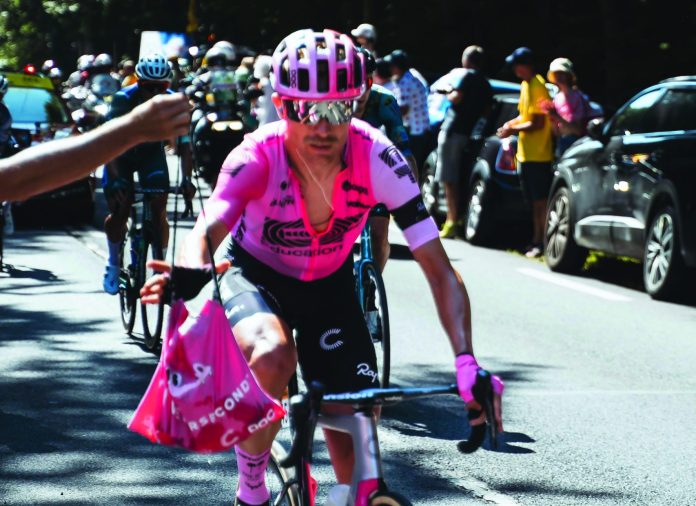
If you’re like me, you’ve been enthralled watching the Tour de France and the Paris Olympics. I found myself wondering about the strategies these high-performing athletes use to fuel their bodies before, during, and after extremely hard training sessions and competitions.

The webinar Fueling the Tour de France addressed my curiosity and solidified my observation that sports nutrition has indeed evolved into being a central component of the training and competing strategies of elite athletes.

In the past, Tour de France riders refueled minimally—perhaps a protein shake—soon after the day’s race. They waited until they got back to the hotel to eat three to four hours later. Today’s riders consume a significant amount of carbs right after each stage to speed up their recovery. Compared to their peers of 10 to 20 years ago, they also eat significantly more carbs. Result: They experience fewer episodes of hitting the wall, bonking, and becoming depleted completely. This hastens recovery; if you don’t dig yourself into a hole, you don’t need to dig yourself out of one.

Here are some interesting takeaways from the webinar that may inspire you to take a closer look at your fueling patterns, carbohydrate intake in particular. While you may not be a Tour de France cyclist, it’s likely you have the similar goal of becoming the best athlete possible.

• Tour de France losses are linked commonly to inadequate carbohydrate intake. While a cyclist may not win the tour in a single stage, he can lose it in a single stage.

• Fatigue related to training hard vs. fatigue related to underfueling is difficult to distinguish. Experimenting with eating more grains can help identify and resolve an underfueling problem.

• To optimize the availability of fuel (carbs) for muscles and the brain, rowers who train intensely should:

—carb-load a day or two before the endurance event.

—consume adequate carbs during the endurance event.

This will reduce the risk of bonking/hitting the wall and will improve stamina, endurance, and overall performance.

• Ideally, each competitive rower has a meal-by-meal plan and day-by-day approach that offers high-, medium-, or lower-carb meals according to the demands of the day. That is, not every day requires a high-carb intake. For a Tour de France cyclist, flat stages require fewer carbs compared to mountain climbs, with further adjustments needed for heat, wind, and rain.

• While some high-level endurance athletes have a support crew that helps provide food and fluids during long training sessions and events, the cycling Team Sky has its own kitchen truck with three performance chefs who guide food intake during the Tour. The four main meals are breakfast, on-bike fueling, post-bike fueling, and dinner. For rowers, the strategy is to surround your workouts with food.

• Overall daily targets are 2.5 to nine grams of carbohydrate per pound (five to 20 grams of carbohydrate per kilogram) per day to fuel muscles, more than 0.9 grams of protein per pound (two grams per kilogram) per day to preserve muscle mass, and minimal dietary fat intake (so athletes fill up on carbs, not fat).

• During hard efforts that last longer than 2.5 hours, the goal is to consume 90 to 120 grams of carbohydrate per hour. That’s about 350 to 500 calories from carbohydrates per hour—a lot more than most endurance athletes consume.

• Endurance rowers, take note: For a 150-pound (69 kilogram) Tour cyclist doing extreme work, nine grams of carbohydrate per pound (20 grams of carbohydrate per kilogram) translates to 1,350 grams of carbohydrate. That’s 5,400 calories just from carbohydrate alone—about the amount in a two-pound bag of uncooked white rice. No wonder Tour de France cyclists consume bowls of white rice for a pre-race breakfast!

• Consuming that much carb from food can be difficult. Hence, concentrated sources of carbs such as gels and chews can help athletes hit their carb goals.

• During endurance exercise, sports drinks facilitate the ability to consume 120 grams of carbohydrate per hour. Tour de France riders rarely go below 80 grams per hour. Endurance runners should choose hydration fluids that offer more than just plain water.

• Consuming a variety of carb sources enhances their transport out of the GI tract and reduces the risk of intestinal distress. Carb blends (such as sports drinks made with glucose + fructose) have limited variety, so don’t eat too much of the same commercial sports food. Standard carb-rich foods (banana, granola bar) offer a wider variety of carbs.

• Tour de France cyclists must train their guts to be able to  digest and absorb up to 120 grams of carbohydrate (around 500 calories) per hour comfortably. In training camps, they do not only on-bike training but also gut/digestive training. They practice eating as they would for a race. Gut training can take years as cyclists increase their intake of carbs per hour gradually. Simultaneously, they test different products they might want to use.

• Cyclists should plan to begin feeding early and for as long as they can manage if they know they’ll be unable to ingest much during the upcoming mountain climbs. Similarly, rowers who can’t eat much on race day should consider eating extra the day before.

• In the first 60 to 90 minutes of recovery, a Tour cyclist may consume cherry juice (carbs + antioxidants), quickly absorbed carbs, and a whey + carb recovery shake. When traveling back to the hotel, they eat a meal (such as salmon and pasta with extra salt) and sweets (cake, fruit).  If they have a hard ride the next day, they eat and refuel as much as possible. At the hotel, they snack, have a massage, eat another dinner, and go to bed with a full belly.

• At the elite level, some endurance athletes practice carbohydrate periodization (training with depleted muscle and/or liver glycogen stores some of the time) for selected workouts at the start of a training block. “Sleeping low” (with low glycogen stores) and then training on empty (no pre-exercise carbs) a few times a week can enhance cell signaling and induce adaptations that can improve performance. These train-low sessions get phased out as training intensity increases. (Note: Athletes not at the elite level should focus on the fundamentals of fueling adequately. No need to train low when there are easier ways to enhance performance.)Conclusion: Food is more powerful than many rowers think. If you have a hit-or-miss sports diet, think again. A sports dietitian can help you eat to win!

USRowing names Senior, Beach Sprints and Para Athletes of the Year

Musniski rowing Paris Olympics
Photo courtesy of Meghan Musniski.

USRowing has named six more athletes as 2024 Athletes of the Year to be honored on Attager Row at the prestigious Head of the Charles Regatta on Saturday, October 19, at 5 p.m.

Todd Vogt (Rochester, N.Y./University of Buffalo) and Gemma Wollenschlaeger (St. Augustine, Fla./Temple University) earned the Para National Team Athletes of the Year. Chris Bak (Cincinnati, Ohio/University of Cinncinati) and Annelise Hahl (Cary, N.C./Triangle Rowing) are the Beach Sprint National Team Athletes of the Year. Finally, Michael Grady (Pittsburgh, Pa./Cornell University) and Meghan Musniski (Naples, N.Y./Ithaca College) have been titled the Senior Team Athletes of the Year.

Vogt has been a part of four national teams, and he competed at his first Paralympics in 2024 where he saw a seventh-place finish in Paris in the PR3 mixed double. Wollenschlaeger, along with her boat mates, won silver in the PR3 four with coxswain at the 2024 Paralympic Games. At the 2023 World Championships Vogt and Wollenschlaeger raced together in the PR3 mixed double sculls and won a silver medal.

On the beach sprints side Bak and Hahl, both four-time national team members, notched gold medals in their respective events in 2024 on the international stage. Bak raced to a first-place finish at the World Beach Sprint Finals in the men’s solo and Hahl won the junior women’s solo and junior women’s double sculls events.

Grady, who recently joined the Washington Huskies men’s rowing team as an assistant coach, is a two-time Olympian and a gold medalist in the men’s four at the Paris Olympics.

“It was certainly a big year for me,” said Grady. “It’s been a lot of work and finally seeing the success of it all. My contribution to the team—the energy, culture, drive, and mission we had being fulfilled is incredible. I really didn’t anticipate this was the way things would go. I knew we had a chance to win based on how we performed last year and the time we were together in the boat but it’s been a long journey.”

The Carie Graves Female Athlete of the Year, Meghan Musniski, is a four-time Olympian. She has competed at five world championships and holds two Olympic gold medals. Musniski has represented the United States on the national stage for over 14 years.

“Sara Hendershot who is on one of the USRowing athlete committees,” remembered Musniski. “She told me that the men and women on the senior team had voted me as the female athlete of the year. I was surprised and really honored because it’s an award that has nothing to do with your immediate results and is all to do with what your teammates think about you as a teammate—your work ethic, drive, and you as an overall person. That’s really special because I’ve trained with a lot of people who are incredibly hard working and deserving of the award.”

Musniski is one of the most decorated rowers on the women’s senior team. However, she never could have predicted her success. This year’s Olympics was especially meaningful for her, getting to experience it with her husband, Skip Kielt, who coached the senior men’s 2x.

Musnicki and Kielt
Photo provided by Meghan Musnicki

“If you told 25-year-old Meghan that in the next 15 years she would have five world titles, two Olympic golds, and four appearances at an Olympics I would have laughed at you. It’s amazing. The athletes that I train with make it such a special experience. It’s a pretty unique experience to be at my fourth and final Olympics with Skip’s hopefully first of many Olympics. Getting to experience that as a couple is not something that a lot of people can say.”

Musniski, Grady, Vogt, Wollenschlaeger, Bak and Hahl will be honored for their incredible success along with the USRowing Under 19 and Under 23 Athletes of the Year at the 2024 Head of the Charles.

Healing Through Rowing: Cancer Survivors Meet at HOCR

Survivor Rowing Network
Photo courtesy of Beth Kohl.

In order to bring attention to Survivor Rowing Network and their service to those recovering from cancer, this story is not behind the paywall.

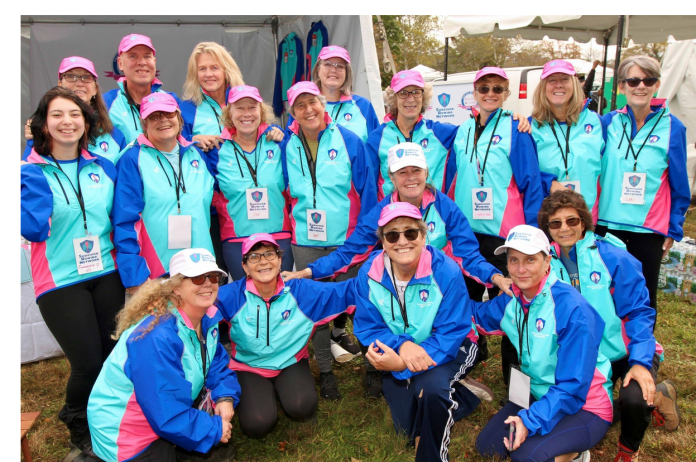
Survivor Rowing Network unites over 27 programs nationally, and plenty more internationally, behind a shared goal of bringing a sense of community, support and passion to those recovering from any form of cancer. In less than two weeks, a group of 11 boats will cruse down the Head of the Charles 2024 course at approximately 3:26 p.m. as part of the regatta’s first ever Survivor Row.

Survivor Rowing Network began in 2019 when its founder and executive director Beth Kohl met the Saugatuck SurviveOars at a Rowing Cares race in Poughkeepsie, N.Y.

“I was blown away by their passion and community. They had overcome so much but were so positive about finding rowing as part of their rehabilitation,” recalled Kohl. “I wanted more cancer survivors to find the joy that these ladies had found.”

Kohl, who had recently taken over as president of Rowing Cares, met with other teams who had programs already in place for cancer survivors such as Recovery on Water, ROC Crew, and several We Can Row programs in in Boston, Mass. Philadelphia, Pa. and Washington, D.C.

“I started thinking, how can we help more survivors find rowing,” said Kohl. “Our simple goal was to introduce rowing to more survivors either on the water or on the erg. We got a few more people together started having zoom calls every month with the survivor programs and very quickly a passionate, strong community was formed.”

Fast forward to 2023, Survivor Rowing Network had 15 active clubs, many of which had interest in racing. Together, the programs entered boats in the Grand Masters 8+ and 4+ in the 2023 Head of the Charles. The network has nearly doubled in size, so much so that 27 teams are now involved and will be sending 99 rowers and 11 coaches to participate in the Survivor Row at the 2024 Head of the Charles.

“Overwhelming is the word we use almost every day–sometimes multiple times in a day,” said Kohl. “I’ve had many great jobs but never one where the doors always opened, where positivity prevails, where many conversations and meetings include tears. We are building a global community of women and men united by their love of the sport.”

The Upper Valley Rowing Foundation, an active member of Survivor Rowing Network, started CReW or Cancer Recovery Through RoWing in June of 2019.

“My daughter was diagnosed with cancer when she was a freshman in high school—this was 2012,” said UVRF CReW coach Carin Reynolds. “She stayed on the team all through her treatment. It was the one place where she wasn’t ‘the kid with cancer,’ she was just another part of the team. When CReW was starting in 2019, I instinctively knew that this program would be a great thing. It’s so important to have a team at your back.”

What started at UVRF as a six-week program turned into a 45-person team open to survivors of all forms of cancer who meet three times a week to do a mixture of rowing on the water and virtual erg workouts.

CReW is just one of many programs making the trip to the Head of the Charles to come down the course as part of the Survivor Row.

“Exercise it the greatest deterrent to recurrence and in 2025 we are on a mission to educate the medical community around the world on the benefits of rowing for recovery and rehabilitation,” said Kohl. “We can’t even imagine what it will be like when we all meet for the first time at HOCR. For most it is their first Head of the Charles and for many it is their first regatta of their lives. There will be many tears, I’m sure, and I can’t wait.”

Coxswain Development: Fall Housekeeping and Other Chores

coxswain equipment coxorb

Whether your winter season is indoors or out, the end of fall racing is a great time to take care of your equipment so that it serves you well on the water.

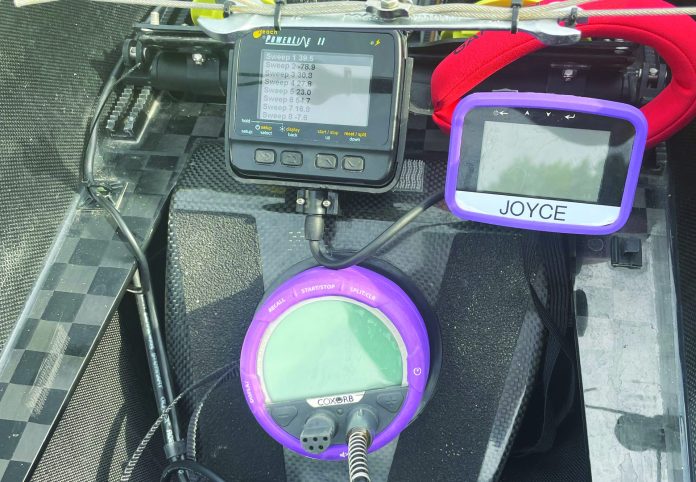
First and foremost is the care and maintenance of your CoxOrb, CoxBox, and other electronic devices, like SpeedCoaches. Problems with your CoxBox may not be your fault, but they can irritate your rowers and interfere with your ability to run a practice safely and effectively. Take steps to ensure that your equipment functions properly.

“Make sure you’re regularly charging but not keeping it plugged in the whole winter,” said Jun Jeon, sports-performance sales manager at Nielsen-Kellerman. A good rule is not to charge the CoxBox or SpeedCoach continuously for more than two days.

Conversely, you also don’t want your electronics to sit untouched for months with the battery drained. Regularly charging and discharging the battery will help preserve its life.

“A lot of the troubleshooting or repair calls that come in are unfortunately the result of not keeping up with that charging,” said Jeon.

It’s also best practice to clean your CoxBox at least once a month (or biweekly if you row in salt water) and before it’s put away for any extended period. NK sells maintenance kits for the CoxBox, and you can also assemble your own. If your CoxBox is the newer style with three ports on the front, make sure to use the protective cap that came with the box whenever you’re on the water to prevent moisture from entering through the right-side Smart Connector port. Keep the cap on for storage as well.

Make sure your headset and wiring are coiled loosely and neatly for storage and travel and that you don’t lift or carry the box by the microphone cord when it’s in use.

“Be careful with where the microphone jack is,” said Jeon. “It’s where we handle it the most when we plug it into the CoxBox.”

When the microphone jack is handled gently, “there will be less static, and people will be more pleased with how the CoxBox sounds.”

Other coxswain housekeeping tasks worth mentioning:

Empty out the rest of your coxswain bag and replace wrenches, hardware, and tape that were used up (or went for a swim) during your fall season.

Clean and air out your waterproof gear and flotation suit, if you use one.

If you recorded your coxing throughout the fall season, label and organize your recordings digitally.

If your boats are de-rigged for the winter, note how each shell was rigged so you can help your coach and team re-rig efficiently.

With these tasks done, you’ve set yourself up to help yourself and your team get on the water smoothly when racing resumes.