The heart of the fall racing season is approaching and juniors all the way up to national teams have their schedules set for the fall slate. Among the nationally recognized regattas on October 12-13 are the Head of the Housatonic, the New Hampshire Championships George Dirth Regatta and the 15th Annual Northeast Fall Championship Regatta.
The Northeast Fall Championship, held on Lake Quinsigamond in Worcester, Mass. on Sunday, October 13, is geared toward competitive juniors middle school, high school and masters racing.
“We’re really looking forward to a great Regatta again this year,” said race director Kara White. “We have 46 clubs coming and about 350 entries. The field is looking really competitive. We have a lot of returning crews and a few new ones that we’re excited to host. There’s always some great competition between Wayland Weston Rowing Association, Community Rowing Inc., Simsbury high school and St. John’s Preparatory School.”
The New Hampshire Championships was first established in 1986 and ever since 1996 it has been held at Memorial Park in Pembroke, N.H. The event adopted the ‘Dirth Cup’ in 2016 after George Powers Dirth, a former rower at the Derryfield School and Amoskeag Rowing Club.
“We’re looking forward to a really fun and exciting day of racing. We have over 270 entries and we’re expecting about 2,000 spectators. It’s a beautiful spot on the Merrimack River. The Jr 4+ A Flight is always highly competitive and it’s a great event to check out and watch.”
On the colligate racing side many college teams will be traveling to the Head of the Housatonic. The event is hosted by New Haven Rowing Club. The DI and IRA college eights are among the most competitive races of the day and include crews from Yale University, Brown University, Columbia University, Trinity College, Williams College and Massachusetts Maritime Academy. Crews will be looking to guage their speed early on in the fall racing season.
On the horizon is the quintessential Northeast fall rowing event, the Head of the Charles running Friday, October 18- Sunday, October 20.
Two-time Olympians and legends in the men’s single, Simon van Dorp and Oliver Zeidler will go head-to-head in a dual style race in Berlin starting at the Mühlendamm Bridge and finishing at the Reichstag building on Saturday, October 12, for the World Sculling Finalist title.
The race will be modeled after the “World Sculling Championship” which dates back to 1863. There are no heats or qualifying rounds—just one all-or-nothing battle. The vision for the event is to grow to have a global presence, incorporate a women’s race and offer prize money for winning athletes and their respective clubs.
“I was always trying to find new ways to promote rowing,” said Oliver Palme, founder of German rowing newspaper Rowing1.com who proposed the idea to the Berlin State Rowing Association. “I started with this idea three years ago to showcase scullers exceptional endurance and strength. The idea was to bring back history.”
Zeidler and van Dorp have met several times this past summer. At 2024 World Rowing Cup II van Dorp took away a gold in the men’s single finishing 2,000 meters in 06:48.29, a second faster than Zeidler. However, at the Paris 2024 Olympics Zeidler claimed the gold, a full seven seconds ahead of van Dorp, who won bronze.
Photo provided by Oliver Palme.
“Whoever is the trophy holder—next season we want to give out a ranking so you can earn points if you participate at the World Cup and World Championships and the guy who has the highest ranking after the season is allowed to challenge the trophy holder. The idea is to promote the rowing clubs and the rowers and showcase what kind of exceptional athletes they are and bring this kind of race to Berlin. We try to promote rowing a little bit out of the box.”
The race not only invokes sculling from the past, but it will make history itself as one of the few races to be held right in the center of Berlin. Additionally, it has taken lots of effort from a planning perspective due to the increased security for Ukrainian President Volodymyr Zelenskyy’s visit to the city.
“We had to overcome some organizational problems because [Joe] Biden was planning to come to Berlin. When Biden comes to Berlin the whole city is blocked and there’s a very high security level. He moved his visit because of the hurricane [Milton] but now Zelenskyy is coming and it’s also the highest security level. We will be impacted by the visit, but we are in close contact with the administration and police forces and have permission for the race. It’s really historic and unique to get this regatta in the middle of Berlin.”
The race will be broadcast on worldsculling.com on Saturday, October 12 starting at 12 p.m. CEST/6 a.m. EST.
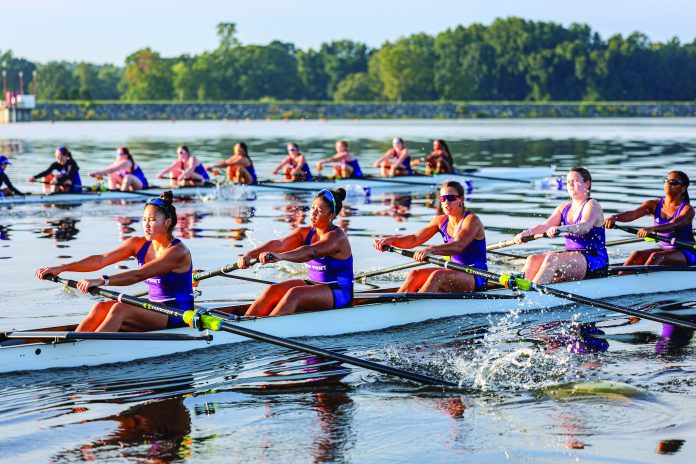
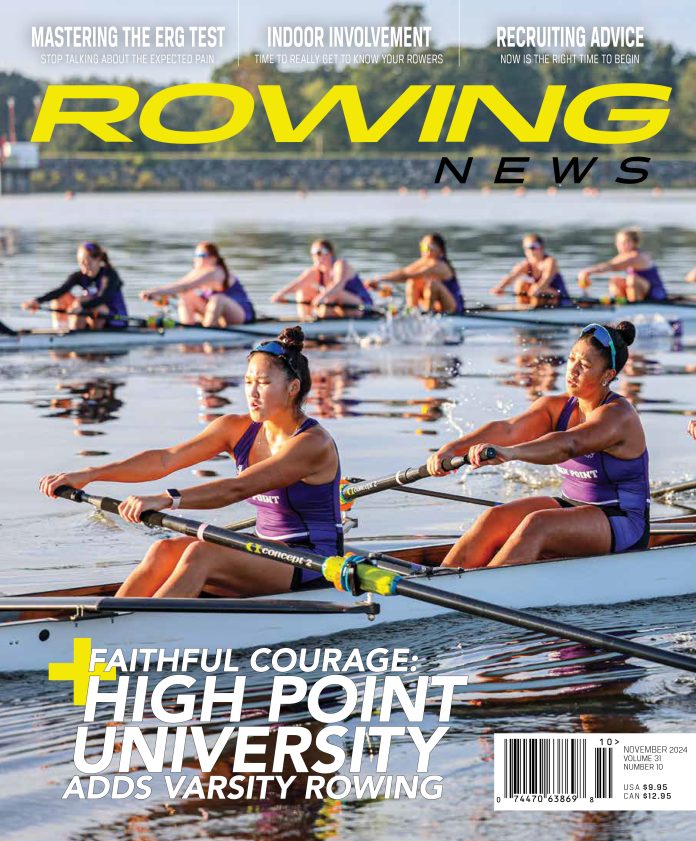
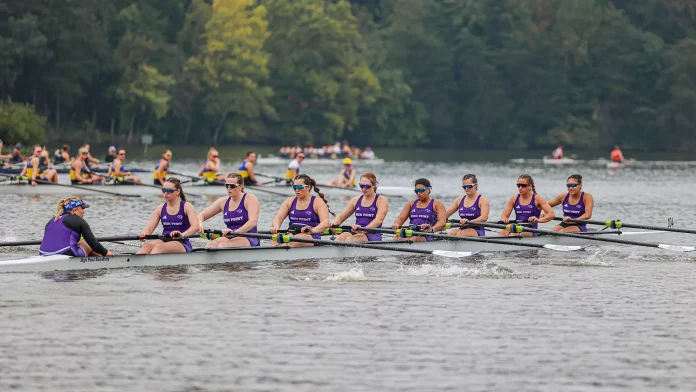
On a clear warm morning in late August, 35 women donned fresh purple team kit, picked up newly painted oars, and took to the waters of Oak Hollow Lake in North Carolina for the first practice of the High Point University varsity women’s rowing team.
For head coach Jessica Deitrick, this day had been a long time coming. A decade, to be precise. Named the head coach for the newly established team in May 2023, Deitrick began her journey to that August morning when she arrived in High Point, N.C., in 2014 to coach the then-club rowing team and serve as the director of club sports.
In her two years with the Panthers club team, she oversaw both the men’s and women’s squads, winning an ACRA national championship and securing a silver medal at Dad Vails in 2015.
The athletic department at that time had added lacrosse and was considering adding another varsity sport. In 2014, Dan Hauser, HPU’s athletic director, approached Deitrick to ask about elevating the club rowing team to varsity status, but she believed the time wasn’t right.
“I don’t think you’re ready for it yet,” Deitrick remembers telling Hauser. “Could it happen down the road? Yes, but I don’t think you have the resources for it quite yet.”
The university was not in a position then to provide the funding necessary to compete on the national level, and Deitrick knew she had her own development to tend to as well.
In 2016, she made the move to Division I rowing, taking on an assistant-coaching role with the Naval Academy women and in 2019 becoming the head women’s coach at Colgate University.
But she never forgot the potential that beckoned in North Carolina.
“I never stopped watching High Point.”
High Point University introduces Jessica Deitrick as the head coach of women’s rowing, alongside Athletic Director Dan Hauser, at a press conference at HPU in High Point, N.C., Wednesday, May 24, 2023. (Nell Redmond photo)
At a time when the future of college athletics is in flux and some universities may reduce financial support for Olympic sports or cut them outright, High Point made the decision to add a varsity women’s rowing team in 2023.
“We want to win in everything,” Hauser, still HPU’s athletic director, declared. “It pains me when—and I’m not disparaging Ohio State—I hear their leadership say recently that they may have tiers of teams. That’s just sad to me.”
The decision to add rowing is very much in keeping with the character and culture of the university, he asserted.
“We have made a ton of decisions with faithful courage, meaning that we aren’t afraid to add rowing. We’re adding a law school. We’re adding a school of dentistry. It takes faithful courage to start programs from scratch.”
That “faithful courage” has paid dividends over the past two decades on the picture-perfect ever-expanding campus.
When Nido Qubein, a successful businessman, motivational speaker, and High Point alum, became president of the university in 2005, HPU was a small, struggling, tuition-dependent liberal-arts college. Since then, HPU has transformed its campus and culture, investing nearly $3 billion in facilities and academic programs, according to the Princeton Review (Rowing News was not able to verify that figure independently). HPU has opened or is in the process of opening five new graduate schools (law, dental medicine, nursing, entrepreneurship, and optometry), and the campus has grown from 91 acres to 530. In addition to rowing, the university added men’s and women’s lacrosse.
Perhaps the only aspect of life at High Point that’s not better now than it was 20 years ago is financial aid. In 2021, about 30 percent of financial need was covered, down from nearly 50 percent in 2005. In 2020, only 11.5 percent of HPU’s first-year students were recipients of federal Pell grants, awarded to students with exceptional financial need, and of 1,658 institutions ranked by Education Reform Now, a non-partisan K-16 education think tank and advocacy organization, High Point came in at 1,629.
Nevertheless, enrollment has grown from fewer than 2,000 students to 6,000, while the operating budget has swelled from $40 million 20 years ago to $350 million this year.
Hauser credits Qubein for the dramatic change in fortune.
“President Qubein came from the business world, not the academic world, and his knowledge of business has been very powerful in helping this university make sound business decisions.”
High Point’s rank in the Princeton Review’s survey of the best-run colleges in America: No. 1.
Photo courtesy of High Point Athletics.
The dramatic growth and a concomitant focus on an upscale experience are evident in every aspect of campus life. Classical music is piped into outdoor spaces, and snacks and coffee are available for free at gazebos as students hurry to class. Dorms offer a nail salon and barber shop. Fine-dining campus restaurants, included in meal plans, require reservations, business attire, and proper etiquette and are designed to prepare students for future business and networking meals. A concierge advises students and their families about the best amenities both within and beyond the university’s gated walls.
So when time came to add another sport, High Point wanted to make a splash.
“Our leadership team has done a lot of unique things on our campus, and we continue to try to find unique ways we can expand and brand the university,” Hauser explained. “We looked at rowing as one of those unique ways to continue the growth and exposure of the university.”
After adding women’s and men’s lacrosse in 2011 and 2013, respectively, and achieving success quickly, the HPU athletic department knew what it was looking for in its next sport.
For starters, rowing enables the university to differentiate itself from peer institutions while appealing to its core demographic (60 percent of students come from Virginia and points north, where rowing is relatively popular). Like lacrosse, rowing has a “heavily Northeast footprint,” Hauser said, “which is where our students are coming from.”
High Point is only the third DI rowing program in North Carolina, in addition to Duke and the University of North Carolina. By adding rowing, High Point figured it could “create uniqueness,” Hauser said, “and differentiate High Point University from our peer competitors in the state and in the region.”
The ability to be competitive in the sport nationally was also a significant factor. While there are nearly 300 DI softball programs across the country, there are only about 90 DI women’s rowing teams. For a department seeking success on a larger stage, this smaller pond was appealing. Rather than having to surpass 250 teams, HPU’s rowers need to better only 70 teams to be ranked nationally, Hauser noted.
Logistical matters also made rowing the right choice. Oak Hollow Lake is just 10 minutes from campus and features protected water, a buoyed racecourse, and a vibrant local rowing scene. A boathouse is being built, and HPU has a successful club team already, a promising seedbed for the new varsity squad.
Title IX also played a role, of course. The last sport added, men’s lacrosse, has a roster of 50 to 60 athletes, so the school was looking for a counterbalance. When considering the necessary financial investment, rowing came out on top compared to other sports that require more money for equipment and facilities, even with a full slate of 20 athletic scholarships, which the team will build up to over three years.
For example, the cost of adding rowing was much lower than a “full-out softball stadium that has to match our current baseball stadium, from club suites to lights to video boards and the amenities,” Hauser said. “We couldn’t have an inferior Title IX facility relative to what we already had.
“Our university’s message is ‘choose to be extraordinary,’ so we want to try to be extraordinary in everything we’re choosing to do.”
From the start of her return to High Point, Dietrick felt that extraordinary commitment. There was a press conference to announce her hiring and introduce her to the High Point community, an uncommon amount of fanfare for a rowing coach, even among the flashiest athletic departments. Newly designed team unisuits were on hand, and the website had been updated already to reflect the addition of the newest team.
Most meaningful to Deitrick: Signs around the athletic department that had read “16 teams, One family” had been revised.
“At other places, they’re like, ‘Oh, it’s the rowing coach. Whatever. We don’t even need to do a press conference.’But here the signs had already been changed to ‘17 teams. One family.’
“I felt appreciated and welcomed into the community.”
Since her hiring, Deitrick has been working to create a team that also will be extraordinary. Her focus is on recruiting athletes who are a good fit for what the team needs now.
“It’s got to be someone really gritty. This is a fight. We’re an underdog and we’re going to be an underdog for a while,” Deitrick tells recruits.
She’s realistic and is looking for diamonds in the rough, knowing that she can develop their rowing skills but that their character is what’s most important.
“It’s not going to be the prettiest of rowing. I can make it prettier, but I can’t teach grit and determination.”
It’s a tough ask of 18-year-olds. The team has no track record, no boathouse (yet), no alumni, and its future success is far from guaranteed. But Deitrick leans into the opportunity to build a legacy. She asks recruits to look 15 years into the future.
“This team is going to be at NCAAs, and they’re going to be in an A or B final. And you can say, ‘I did that. They are there because I laid the groundwork for it.’”
She admits that the current team is unlikely to attain those heights, but the group is excited about erecting the foundation for rowers in the future.
Hauser echoed the sentiment.
“This first class of women rowers who walked in the door in fall of 2024 have courage to believe in the university, to believe that a boathouse is going to get constructed. That’s a testament to their character.”
Photo courtesy of High Point Athletics.
In late September, High Point was training for its first varsity contest, an early-October appearance at the High Point Autumn Rowing Festival, where the crew would vie against Duke, Old Dominion, the Oxford University lightweights, and the Ukrainian national-team eight.
“That High Point University’s first race as the newest university team in the country, or maybe in the world, will be against Oxford, the oldest university, is kind of interesting,” understated Gene Kininmonth, the festival’s director and the head coach of local club Triad United.
Yes, High Point has no past; it has yet to write its history and establish its pedigree. But teams like High Point are the future of collegiate rowing in America.
“We’re thrilled with rowing,” Hauser said. “It’s a wonderful opportunity!” —one other athletic departments should consider.
“I have encouraged other ADs—if you have a body of water and could potentially bring this on, you’re foolish not to look at rowing.”
Even with all that has been written about recruiting, college coaches still find many things they wish every prospect understood. Here are a few behaviors that frustrate coaches across the country. Consider these recruiting pet peeves and do yourself a favor by avoiding them.
When emailing a coach, sign your first and last name to every message you send. Even better, include your graduation year (2025, 2026) and affiliation (school or club). You’re not the only Isabelle or Jimmy they’re hearing from.
If the coach asks you to submit the university’s recruiting questionnaire, do so immediately. You can always email new information or update the questionnaire. Never refer a college coach to your beRecruited/CaptainU/NCSA online profile as a substitute for submitting the school’s questionnaire. Many athletic departments require coaches to communicate with prospects through their recruiting software and need the questionnaire to do so.
If a coach requests your unofficial academic transcript and/or test scores, make sure your name is visible on what you provide. Sometimes what you may download as a grade report doesn’t show your name. If you send this information as a link to a school website, make certain that it’s not password-protected and the coach can access it. Also, send the materials to the coach; college coaches typically cannot review what goes directly to the admissions office.
If a coach requests video, send footage of you pulling hard, not paddling around. Coaches want to see how you behave at race pressure and race rates. The ideal: you and your blade(s) fill the video screen. If the video shows you in a team boat, identify clearly which seat you’re rowing. Keep video clips to less than 30 seconds.
And of course, everyone’s favorite: Do not make excuses for your erg time. Telling a coach that you “didn’t get the chance to test” or “can’t find an erg” makes you come across as unmotivated. Your peers who find ways to get more fit and demonstrate their fitness are getting the attention you seek.
You don’t need to pull a 2K. Most college coaches will accept the results of any erg test that your team does. When sharing erg times, send a picture of the monitor showing your time and splits. Coaches like this verification and seeing how you paced your piece.
Finally, ask questions rather than make assumptions. College coaches appreciate direct questions about the team, recruiting standards, and timeline. “What do I need to do to earn a scholarship/admissions support?” is much better received than “Will you give me a scholarship/support?”
The coaches also know more about the recruiting and admissions process than anything you’ll read on message boards. If you rely on internet gossip, you’ll get exactly what you deserve. The opinion of your peers is valuable, but it should not stand alone when evaluating your options.
Good luck with your college search and selection process!
High school teams all the way up to national team squads competed at the High Point Autumn Rowing Festival presented by Bethany Medical on Sunday, October 6, in High Point, North Carolina for the opportunity to see who could turn around the regatta’s renowned inflatable ducks.
“We have three ducks out there,” shared race director and Triad United’s head coach Gene Kininmonth. “I’ve driven way too many miles with boat trailers behind me. You arrive at regattas tired, having drank too much coffee, and a bit grumpy. I wanted something that people saw when they first arrived to put a smile on their face and the duck was what I came up with years ago. ‘Round the duck’ became the slogan.”
This year, among the competitors was Oxford University’s lightweight women and the Ukrainian national team, who went up against colligate teams, Duke, Old Dominion, and High Point. The High Point Autumn Rowing Festival served as the Panthers inaugural race as a varsity team.
“I think they had a wonderful weekend,” noted Kininmonth about HPU’s performance. “Their varsity eight put on a really fantastic performance in their first race with Old Dominion and Oxford. They took the lead early off the start. Oxford pushed through them. When they got to the duck, High Point actually took the lead on the turn and had almost a length before Oxford fought back. On the last turn Old Dominion snuck in on the corner and got past High Point but couldn’t pass Oxford. It was one of the best races I think I’ve ever seen.”
Full results from the regatta can be found here. Since its inception in 2012 the Autumn Rowing Festival has continued to grow over the years and feature a slate of varying experience levels with the goal of inclusivity.
“When I first started High Point Rowing Club in 2012 we had to leave the state to race,” said Kininmonth. “I realized at Festival Park in High Point we’ve got a gem. We can park 1,000 cars and can get in up to 35 boat trailers or more. We’ve got a natural viewing grass stadium on the hill at the finish line that can fit 5,000 people comfortably. It’s a real perfect place. It’s just grown and grown. This year it was 30% bigger than last year.”
Kininmonth hopes the event keeps gaining traction and the more crews have the opportunity to nail the turn around the storied High Point duck.
In 2022, I attended a social event at the Cambridge Boat Club, and the talk, not surprisingly, turned to rowing. A stone’s throw from Harvard, a number of members remarked on the terrific crews that Yale had been boating.
“Sure, but isn’t it true that none of them are Americans,” said one old oar.
Grumbling ensued about the sorry state of collegiate rowing in the USA. You’ve heard it before: We are a training center for other country’s national teams.
“I know of at least one American in that Yale boat,” I said. “Nick Rusher, whose parents are both Olympians. He rowed at St. Paul’s School in New Hampshire and is now at Yale.”
While this didn’t exactly calm the roiling waters of dissatisfaction, it did get me thinking about a column.
I met Cindy Eckert and Jack Rusher back in the ’80s when both of them were National Team members. Cindy rowed at Wisconsin as part of their national-champion 1986 eight, and Jack had rowed in national-championship boats at Harvard in 1987, 1988, and 1989. Cindy won a silver medal in the coxless four at the Barcelona Olympics in 1992, and Jack had won a bronze in 1988 in Seoul in the eight.
That same evening at CBC, their daughter Alie was in the room, having returned from racing in the quad at the Tokyo Olympics, adding fuel to the fire of my column about the Rushers. I asked her if she would be willing to talk about her family and their rowing. “You’d better ask my mom,” she said.
I emailed Cindy, who said they’d prefer to wait until Nick had finished his rowing career. I put the idea on hold. But with Nick’s own bronze medal in hand from Paris—he was two-man in the USA eight—the time seemed right to talk about this extraordinary family.
“We didn’t want to jinx Nick by talking about his quest for the Olympics,” Cindy explained. Nick had rowed in the U23 eight in 2021 and the Senior National Team eight the next year and still had a couple of years to go at Yale. Beyond that was a hope to go to Paris.
There’s a third accomplished rower among the children— Kay, the oldest child, who rowed at St. Paul’s and Stanford.
How did all three take to rowing?
“We never pushed any of them to follow in our footsteps,” Cindy and Jack agreed.
“All three of them went to St. Paul’s and fell in love with the sport.” Jack said, “The coaches there were very inspirational, and our kids loved rowing for them as much as I did.” (Jack rowed for Chip Morgan and Rich Davis, father of my boss at Rowing News.)
At home, the Rushers kept their medals in a drawer, and Nick says as a kid he never realized how rare it was to have both parents be Olympians.
“It was great having them both understand just how hard rowing is,” Nick said, “and how hard it is to make a team.”
I asked them to reflect on the highlights of their years as über rowing parents.
“It started with the excitement of running down the beach, watching Kay and Alie’s St. Paul’s boat win at the [New England Interscholastic Rowing Association regatta] in Worcester. Later, they also rowed together at Stanford. It was thrilling to see them together in the bow pair of Stanford’s varsity in the 2016 NCAA championships. They didn’t win, but they led the field for quite a while, and on the video monitor which focused on the bows, there they were up in the bow, leading the pack.”
Alie chimed in: “There is no one that I would pull harder for. Kay was my idol growing up, and while we may have had our little sibling spats—she flipped me out of the pair once— I wanted nothing more than to row as well as she could.”
“Alie raced in Tokyo,” Cindy said, “but there were no spectators allowed; it was heartbreaking not to get to be there to support her. But Paris was a dream come true. I was more nervous for Nick’s race than I was for any of mine. As we sat in the stands, we just savored the 15 years of watching them row.”
The Rushers live on Big Cedar Lake in West Bend, Wisconsin.
“We loved seeing the girls out rowing together in a pair as they used to go back and forth,” Jack said. The neighbors would get excited about it, too. When they started to row, we had a Peinert single, and Cindy started a friendly family competition, timing who could row out to Penny Island and back. I thought they would think it was fun, but I later found out that they said it totally stressed them out.”
When I spoke to Nick, he was still high from the Olympics. “I can hardly put it into words; there’s a great sense of fulfillment. And having my whole family there and knowing what it means—fantastic!”
Nick wanted to take issue with the whole “why not more Americans in college crews?”
“I probably see it differently than some people; I got to row with and against Olympians in college. If I hadn’t been rowing with international oarsmen at Yale, I never would have improved the way I did. When I took my first 2K test freshman year at Yale, it was 6:23.”
In his years at Yale, Nick rowed in all five varsity boats, moving up through the ranks.
“Rowing with a gold medalist from New Zealand at stroke, me at seven, and an Australian medalist from the straight four behind me at six—well, those guys taught me as much about rowing as my coaches did.”
And how much did his erg improve while rowing at Yale?
To 5:58 at Yale, and now, with the help of the California Rowing Club, to 5:54.
What has rowing meant to the Rushers?
“It totally changed our lives,” Jack said. “For one thing, we would never have met.”
Cindy echoed this: “The people I have met and the traveling I have done—I never would have done any of that without rowing. It has been a really healthy focus for our family.”
“I’m so proud of both of them,” Kay said. “There’s never been a doubt in my mind that Alie and Nick would achieve their Olympic dreams, and it’s been one of my life’s highlights to watch and support that journey.
“I’ll never forget the day each of them made the team and called me. Nick’s is fresh in my mind because it was so recent—I started jumping up and down and screaming YESSS! It was amazing to watch Nick win a bronze medal, while sitting next to Alie and my parents. I remember grabbing Alie’s hand after the 1,500 and screaming that they were going to medal. I just knew it.”
Not that many families have four Olympians. Rowing has woven the Rushers together. There is a lot of love here—for rowing and for each other.
On the men’s side, Klocke comes to Washington after three seasons as head coach of the Notre Dame men’s club rowing team. Klocke coached the Fighting Irish to their first ever ACRA National Championship in 2024. While at Notre Dame, Klocke coached seven ACRA All-Americans and three ACRA All-Freshman athletes. He was named ACRA Great Lake Regional Coach of the Year in 2023.
Grady joins the Husky men’s rowing coaching staff as a Cornell University 2019 graduate, the 2024 USRowing Male Senior Athlete of the Year, a two-time Olympian, and a Paris Olympic Gold medalist in the men’s four.
“I actually started coaching at Oakland Strokes shortly after the pandemic,” said Grady. “I really enjoyed working with the athletes. For me getting into coaching now is a pretty easy transition. I want everyone to recognized that they have more in them. If you can realize your potential and break through limits, it does something special to an athlete’s brain.”
On the women’s side Wanamaker knows all about breaking limits as a two-time Olympian who made her first senior national team in 2018 in the women’s four that won gold at the World Championships.
“I’ve known I wanted to coach for a long time,” recalled Wanamaker. “In college I fell in love with rowing, and I’ve always loved working with young people so it’s kind of a no-brainer for me to go into coaching and stay around the sport to give back some of the opportunities that I had. It’s exciting to be at Washington because they have such a robust walk on team, and I walked on to the University of Wisconsin when I was a freshman in college. It’s great to be at a program where I can help other people have that opportunity.”
Mooney, who began rowing as a senior in high school, graduated from Washington in 2018 and was named first-team All-America and Pac-12 Rower of the Year her senior year. She is the current overall women’s heavyweight 2,000-meter world record holder on the C2 erg with a time of 6:21.1 and was in the U.S. eight that finished fourth at the 2020 Olympics.
Photo provided by Brooke Mooney
“A couple of years ago I was training with the national team in Princeton, New Jersey,” remembered Mooney. “I’d just gotten back from the Tokyo Olympics, and I had just injured my shoulder. I was really wanting something else to do. I reached out to one of the local high schools and I ended up starting to coach them. I was talking to Yaz [head Washington women’s rowing coach, Yasmin Farooq] and heard of the opening. I’m really excited to be back and coaching the athletes that are the next generation of Huskies. I’m hoping I can share some wisdom and help them learn to love rowing in college and for the University of Washington.”
Wanamaker, Mooney and Grady are focused on making the Huskies faster. When it comes to their own rowing careers and trying for another national team as Grady puts it, “never say never.”