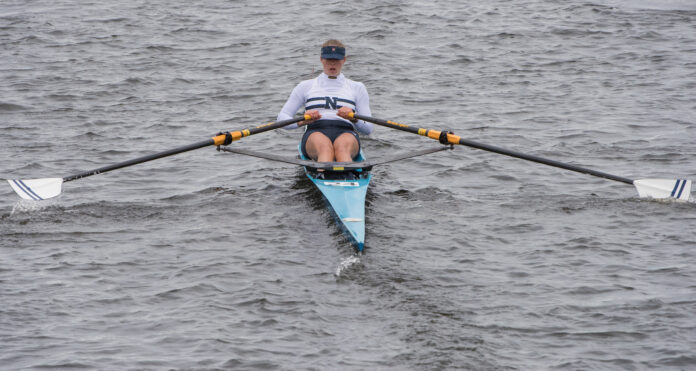
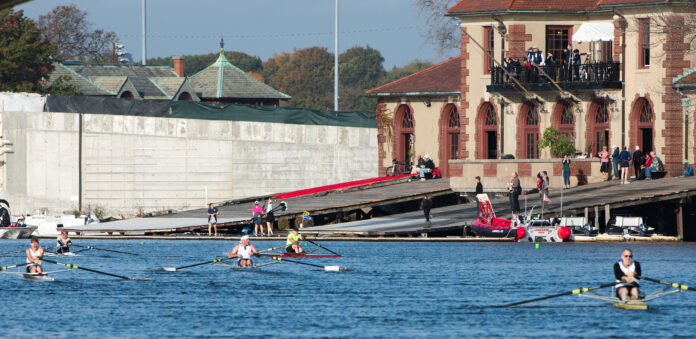
Cambridge. Mass, USA. General view. Youth women's Singles JW1X. Emily KALIFETZ. 2014 Head of the Charles Regatta. Charles River. Boston. 09:01:27 Sunday 19/10/2014 [Mandatory Credit; Peter Spurrier/Intersport-images] 2014. HOCR, 50 Years, anniversary
BY RICH DAVIS PHOTO BY PETER SPURRIER
The best way to learn to row is in a single. It’s better than the erg, the tanks, or even a larger boat. The single tells you faster than a coach can vocalize what you need to improve. Like a bicycle, a small boat requires balance.
However, introducing athletes to the single comes with logistical challenges, not the least of which is needing more coaches to ensure safety and the right amount of coaching. A typical ratio of coach-to-sculler is one to five, but clubs seldom have the coaches and singles available to accommodate this ratio.
I do not recommend teaching novices in pairs—the boat is simply too unstable to allow for proper learning. Coxed or straight fours are a better alternative. Just don’t forget to train your coxswains alongside your rowers. Land training also helps to accelerate the learning process.
Going over the rowing stroke on the erg, a simulator, or a tank can be extremely helpful before sending your novices on the water. Make sure your rowers can swim, are aware of boating practices, and know the traffic pattern on the water. If smaller boats are not an option, rowing by pairs or fours in an eight is a suitable solution.
Remind your rowers who are sitting out that it’s their job to keep the boat level for the rest of the crew. Instruct them to hold the feathered blade on the water with one hand on top of the handle and the other beneath it. Eventually move to sixes, rotating out a new pair every eight strokes.
I like to end long technical rows with a little competition just to keep things fun. Check-in with your novices afterward to be sure they understood what you were saying to them out on the water.
For those having difficulty, coach them on the erg until they are comfortable with the rowing movement. Stay patient. Chances are you tried the patience of a coach somewhere along the way as you were learning to row.
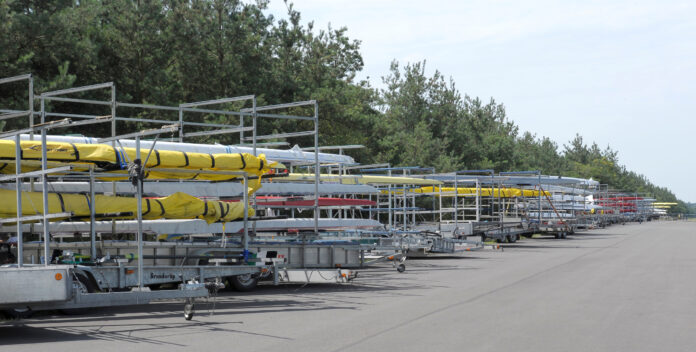
Racice CZECH REPUBLIC. Boat Trailers parked up, FISA World U23 Championships, held on the Racice Rowing Course, Wednesday 22/07/2009, [Mandatory Credit Peter Spurrier/ Intersport Images]
STAFF REPORTS PHOTO BY PETER SPURRIER
New regulations for USRowing-registered regattas have been released including requiring local organizing committees (LOCs) to appoint a “chief health officer” and keeping regattas to singles-only.
Additionally, USRowing requires LOCs to produce a “risk mitigation plan” during the process of preparing for a regatta.
Other guidelines include:
No team boats should be allowed until social distancing guidelines are lifted.
Masks should be worn at the venue until athletes are in their respective singles.
Participation should be limited to local participants with limited overnight travel required.
Regattas should be limited to one day.
Limiting attendees.
Providing adequate space for trailers to allow for social distancing.
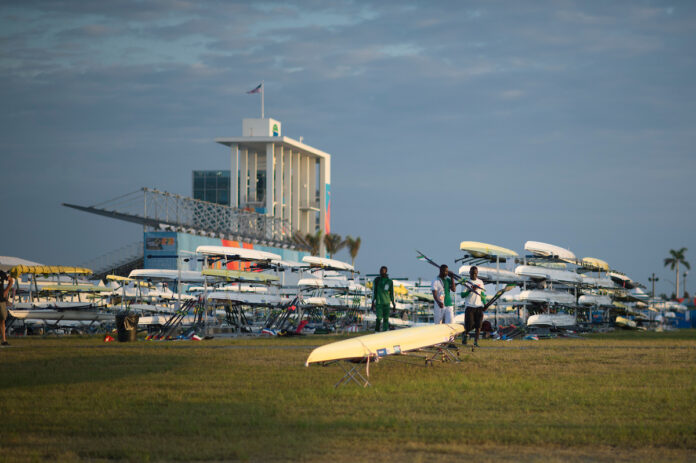
Sarasota. Florida USA. General View, Boat Park at the World Rowing Championships, Nathan Benderson Park
Monday 25.09.17
[Mandatory Credit. Peter SPURRIER/Intersport Images].
NIKON CORPORATION - NIKON D4S lens AF 85mm f/1.4G mm. 200 ISO 1/4000/sec. f 1.4
STAFF REPORTS PHOTO BY PETER SPURRIER
After more than eight years with Suncoast Aquatic Nature Center Associates, Inc./Nathan Benderson Park, Bob Whitford, director of facilities and operations, is returning to Lake Natoma and the Sacramento State Aquatic Center to fill the role of Sac State Aquatic Center facilities manager.
Whitford previously served as the director of rowing and facilities manager at Sacramento State for 23 years.
The Newport Beach, California, native attended Orange Coast College, the University of California, Berkeley, and graduated from the University of California, Irvine. Whitford founded the Newport School Boys rowing program while he was in high school and currently is a chief referee with USRowing.
As director of rowing and facilities manager Whitford will manage the Sacramento State Aquatic center’s programming and events.
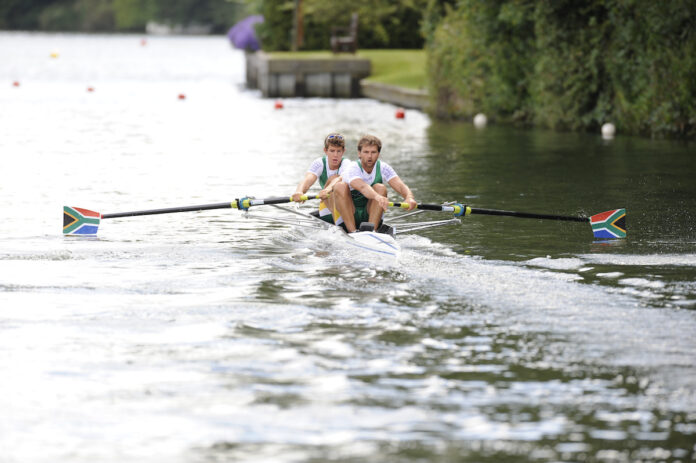
Henley, GREAT BRITAIN, Silver Goblets and Nickalls' Challenge Cup, Trident Rowing Club,South Africa, RSA M2-. Bow Shaun KEELING and Ramon DI CLEMENTE. 2008 Henley Royal Regatta, on Thursday, 03/07/2008, Henley on Thames. ENGLAND. [Mandatory Credit: Peter SPURRIER / Intersport Images] Rowing Courses, Henley Reach, Henley, ENGLAND . HRR
STAFF REPORTS PHOTO BY PETER SPURRIER
For the first time in the history of the 127-year-old organization, a FISA rowing event will be hosted in Africa.
FISA announced the 2023 World Rowing Masters Regatta will be held in Tshwane, South Africa, September 21-24. The four-day event will take place at Roodeplaat Dam, a South African national team training location.
The FISA logo for the event, which prominently displays a kudu, a type of spiral-horned antelope, was designed by South African national team sculler Ursula Grobler.
The event website will be live in June, according to the announcement.
Oarlocks have more control than a piece of plastic probably should. They cradle your blade, encouraging you to complete each stroke before taking the next one. They provide a platform for your oars, keeping them properly in place as you propel your boat forward. They act as the fulcrum from which all movement happens—that single point of contact that allows you to become bigger than you are, more powerful and more complete. And yet each stroke must be finished before you can take another, each arc of the blade must be allowed to yield its fullest potential before you release it from the water to begin again.
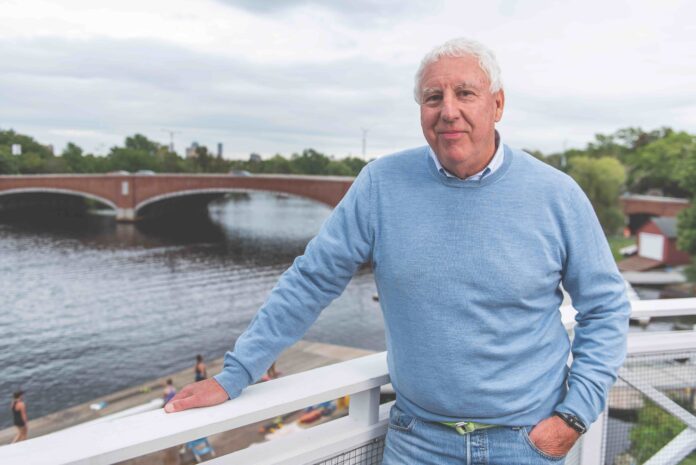
This rule of completing one stroke before starting another is often true in life, too. Many times, one door doesn’t open until you’ve completely closed another, leaving you suspended on the drive, so to speak, as you wait for your blade’s momentum to create that feeling of “send” as it releases from the water. For Fred Schoch—“Pronounced like shock, as in electric shock,” he says with a smile—the long-running executive director of the Head of the Charles Regatta, this rule of completing one thing before starting another has been absolutely true, and it led him to where he is now.
On a Sunday afternoon in September—the Sunday in September when the Head of the Charles Regatta entries are due—I asked Schoch how he got to where he is now, leading the ultimate destination event for thousands of rowers around the world. He smiles and says, “How long do you have?” It’s early in the interview, but already he’s chuckling, a round, full laugh that fills the room and is entirely humble. “You have to know where I’m from to understand why I’m here.” I nod, encouraging him, “I’ve got time.”
“I’m from a long line of rowers,” he begins. “My father was at the University of Washington in the 1930s. He rowed in the “Boys in the Boat” boat for his first two years. He went to the 1936 Olympics as the spare man. He was born and raised in Washington, like so many of those guys.” Schoch keeps going, the story spilling out. “I was recruited to row at Washington, but I’m getting ahead of myself. First, my father, after finishing college at Washington, coached at Princeton. I was born in the Princeton hospital and grew up, essentially, at the university’s boathouse. I coxed for my father’s crews when I was 10, 11 years old.” As Schoch talks, I wonder what today’s college crews would think of an 11-year-old coxswain. “Then I learned to scull. I went to the Kent School—that’s a great rowing school. Steve Gladstone went there a few years ahead of me.” He pauses for a moment. “That’s how I came to be in rowing.”
“I’m from a long line of rowers. My father was at the University of Washington in the 1930s. He rowed in the “Boys in the Boat” boat for his first two years. He went to the 1936 Olympics as the spare man.”
–Fred Schoch
At the University of Washington, Schoch majored in English literature. “Never has a day passed that I regret majoring in English literature. It taught me how to write.” Schoch completed a master’s degree in English in Colorado and then taught high school English for four years at the Kent School and the Belmont Hill School. “While I was teaching, I got the bug to get in the coach’s launch” he says. “I first coached at the Kent School, under Hart Perry, who had been my coach when I was a student there. Then I migrated to Boston and taught and coached at Belmont Hill.”
At this point in the story, I assume Schoch gets involved with the Head of the Charles Regatta and then rises through the ranks to become its executive director over time. I was wrong. Schoch’s oarlock hadn’t yet completed its swing; he would have to finish one stroke completely and trust that he’d find the water again, before coming into the job he calls “my perfect job.”
“I wanted to try coaching, to see what else was out there.” Schoch chuckles again, remembering, “When you have an English literature degree, you have to figure out how to make it. Up until then, when I asked myself how I was going to share my love of Victorian literature with the world, I taught—I loved the classroom. That’s also what made me a good coach. I was passionate. I communicated that passion.”
Schoch transitioned into the world of coaching, doing one-year stints at Connecticut College and Princeton University. “When Korzo [Kris Korzeniowski] left Princeton to coach internationally in 1981, I got the chance to go home, as it were. I coached the Princeton women for a year. We won the Ivy champs that year. Korzo was supposed to come back after one year, so I took a job on campus in admissions at Princeton. I learned how to read applications and was on the road for 10 weeks in the fall, visiting high schools.” Schoch explains that he felt out of place in the admissions office. “I felt like a turnstile. I wasn’t teaching. In the spring, I’d sneak down to the boathouse every afternoon and coach the 3V boat for Larry Gluckman, the men’s heavy[weight] coach at the time. I thought, ‘This is nuts. I have to get back to coaching.’”
Schoch and his wife then went to the Naval Academy for two years. “I had two really great years as the Plebe coach—winning back-to-back silvers at the IRAs. Then the head coach position for Georgetown opened up and I got it. I coached there for two years and also coached for the national team in the summers.” Schoch clearly is at home in a coach’s launch. “During the summers, I got to hang out with Curtis Jordan, Larry Gluckman, Korzo. It was really a rewarding experience.”
In 1987, Schoch coached the U.S. junior men to gold in Koln, Germany, the first world title in the eight for the U.S. junior men’s team. In 1988, Schoch coached the Olympic development team in Lake Placid, N.Y., and in 1989, Korzeniowski asked Schoch to coach the women’s eight at the world championships. “I gave Yaz [Farooq] her first job coxing the U.S. eight,” he recalls, “and now she’s coaching at my alma mater.” At the end of Schoch’s second year as head coach at Georgetown, he was planning to coach for the national team during the summer again, but his athletic director objected to Schoch’s summer schedule. “If I coached the national team that summer, I would be late getting back for the fall swim test for the crew team before the semester started. The AD didn’t like that too much.”
And it’s here that the oarlock comes through its swing and releases the blade from the water. Schoch quit Georgetown. “If he didn’t value what I was doing, I knew I had to make a change. I quit and went to Bled for the summer to coach the national team.” Schoch takes a breath. “My wife wasn’t very happy with me.” Schoch and his wife had two young children by this time and he had just walked away from a salaried coaching position. The weight of the blade on the recovery can feel heavy sometimes, especially if you’re not sure where it will catch the water next.
“When I got back from the world championships, I started looking for a job,” Schoch says. “One day, I got a call from Bill Miller in Boston. He told me that a New York nonprofit, Scenic Hudson, wanted to create a regatta on the Hudson River in Peekskill Bay to promote the environment. They hired me to put it together. That’s where I started to get experience running an event.” Schoch is still a few years away from being hired as the executive director of the Head of the Charles, but already his speech is changing a bit; there’s a sense of completeness as he talks about running a rowing event. I know, from the intensity that has just been amped up, that he sees it as more than an event that spans a few days in people’s lives. Regattas are ideas, goals to train for, the ultimate competitive stage on which to prove oneself.
“You know who was on the steering committee of that first regatta?” Schoch asks. “George Pataki. He was an assemblyman then. We used to sit on the back porch of his farm in Peekskill making plans for the regatta, the Challenge of the Hudson.” Schoch goes on, “That’s where I cut my teeth—selling sponsorships, learning how to deliver value to corporations, learning how to support an event.” The Challenge of the Hudson lasted for two years before poor water and current conditions brought it to an end. Then, in the summer of 1991, the Head of the Charles Regatta, which has its offices in the Cambridge Boat Club (CBC), just next to the Eliot Bridge, was looking for a new executive director. The English literature major who was a passionate coach and who had begun to understand event support and sponsorship, applied for it. “The rest has been 29 years of fun,” Schoch says. Sometimes quitting one job is the only way to find the job that will become 29 years of fun.
The Head of the Charles Regatta began in 1965 as the brainchild of three members of CBC and the new head coach at Northeastern University, Briton Ernie Arlett. The race was modeled after the Head of the River race in England. Schoch explains that the phrase “Head of the Charles” originally meant the winner of the race became the head of the Charles River, not the style of racing (long distances in a time-trial start). The inaugural regatta had 82 boats and 228 competitors.
“Over the years I’ve been here [since 1991], we’ve doubled the boats and tripled the number of athletes. We’ve created new boat categories. We’ve added a second day.” I ask him if it was the growth of the event that perpetuated the addition of Sunday to the schedule. “Yes, some, but mostly it was because in 1996 we had the 100-year storm. That was the worst day of my professional life.”
“Over the years I’ve been here [since 1991], we’ve doubled the boats and tripled the number of athletes. We’ve created new boat categories. We’ve added a second day.”
–Fred Schoch
Indeed, in 1996, the entire regatta was cancelled due to a storm that rolled through Boston. “It was almost a hurricane. Magazine Beach, which was, at the time, the total staging area for the regatta, was a mud pit. We had to winch trucks out of there. We cancelled the races one at a time until 11 a.m. I knew then it wasn’t safe to put boats on the water.” I asked him what he did next. “I called Harry Parker,” Schoch says. “We got the coaches together and decided we needed to cancel everything. They were pumping two million gallons of water per minute out of the [Charles River] Basin. The Green Line subway flooded. The water was going through the arches like crazy. We knew it wasn’t safe. The next year, we added a second day to the schedule.”
I ask Schoch what it is about the Head of the Charles Regatta that makes it so important to so many rowers. “It’s the confluence of many things,” he says. “It’s the way the regatta has been run: prudently, carefully, creatively. My board of directors is awesome. My staff and all the volunteers are amazing. And it’s the idea: this river, seven bridges, two reverse turns.”
Schoch explains that his job is bifurcated. “I’m the event director as well as the executive director responsible for the business side of the regatta. I’ve had quite a run developing the corporate presence, but we’re victims of our own success and people think it’s easy,” he says, “much like the [Boston] Marathon.” Here he pauses and reflects. “They have over $7 million in entry fees and another $8 million from sponsors. The Head of the Charles Regatta runs on a $3 million budget.” Every year, Schoch says he and Mason Cox, his assistant director, cold-call over 500 companies, just to convert a few to sponsors. “It took me three years to secure Brooks Brothers. Now they are a major sponsor and give us not only support but $200,000 worth of jackets for our volunteers.” Schoch laughs a bit, “Our volunteers used to get a T-shirt.” The Head of the Charles Regatta volunteer jackets are highly coveted, and only able to be earned through volunteer work before, during, and after the regatta.
The regatta is run by a full-time staff of five, a 15-person board of directors, 12 race committee members, and more than 90 race ops volunteers who make up myriad race committees that in turn oversee hundreds of volunteers on-site during the event. Schoch is the executive director, Mason Cox is the assistant director, Priscilla Livingston is the director of operations, Annalise Routenberg is the operations assistant and volunteer coordinator, and Tom Martin is the chief financial officer. “Tom’s invaluable and has been here longer than I have,” Schoch says.
Schoch explains that selling sponsorships and attracting companies to support the regatta is what he and his team have worked on consistently. “We have a specific demographic. We are what we are,” he says, directly. “Our stripes are pronounced. We’re an affluent sport and we’ve done well with affluent brands.” Schoch and his team manage a regatta that is continually over-subscribed, with more entries than the schedule can accommodate. “We’re trying to squeeze in time next year for an under-17 youth eight event. We currently turn away 70 percent of our youth entries.” I ask Schoch what he does during the regatta itself. Without hesitation, he says, “I race.” A quick laugh follows, but it’s true. Schoch will be racing in a 70+ men’s eight this year. Without my team, I couldn’t do that.”
I can hear the rest of his team moving around the office on this Sunday afternoon and know his time is limited. “What’s next?” I ask. A deep laugh fills the air between us.
“Twenty-nine years ago I fell into the job that is perfect for me—passion, sport, connection. I’m having fun. My board of directors, the staff, the race committees—everybody—we’re so committed and connected. We’ve just got such a great group of people. I don’t know what I’d do if I stopped.” Schoch hums a bit under his breath, almost unnoticeable. “There’s some travel my Katie and I want to do, some health issues to deal with, maybe New Zealand for the holidays, a return to coaching would be something…” He trails off here, but I can tell he’s not done with his thought.
“This article can’t be my swan song,” he says. “I’m not done yet.”
Cambridge. Mass, USA. GV. General View. of the Veteran Men's Singles 60+. passing Weld Boathouse. 2014 Head of the Charles Regatta. Charles River. Boston. 09:13:21 Saturday 18/10/2014. [Mandatory Credit; Peter Spurrier/Intersport-images] 2014. HOCR, 50 Years, anniversary
STAFF REPORTS PHOTO BY PETER SPURRIER
USRowing has published a five-page guide to help clubs as they move to reopen and get athletes back on the water.
The document, released Tuesday afternoon, is titled “USRowing Re-opening the Boathouse/Return to Training Considerations Post-COVID-19” and contains five core principles intended to “provide member organizations, coaches and athletes with information they can use to help develop protocols for the re-opening of their boathouses and their return to training programs in the context of COVID-19,” according to the guide.
The five core principles include following state and local rules and regulation regarding group size, minimizing contact between individuals, maintaining six feet between individuals whenever possible, training in singles only (unless those who live together wish to take out doubles, pairs, fours, and quads), and that no team boats shall be allowed until social distancing regulations are lifted.
The guidelines stop short of being a one-size-fits-all approach and “is meant to guide both large and small organizations in varied locations with differing resources, it should be used to help each organization develop a plan that is specific to their situation.”
Additional information outlined in the document includes return to training and athlete health monitoring, outdoor facility use, indoor facility use, and guidance from Assured Partners, USRowing’s insurance partner.
USRowing is expected to publish guidelines for registered USRowing regattas later in the week.
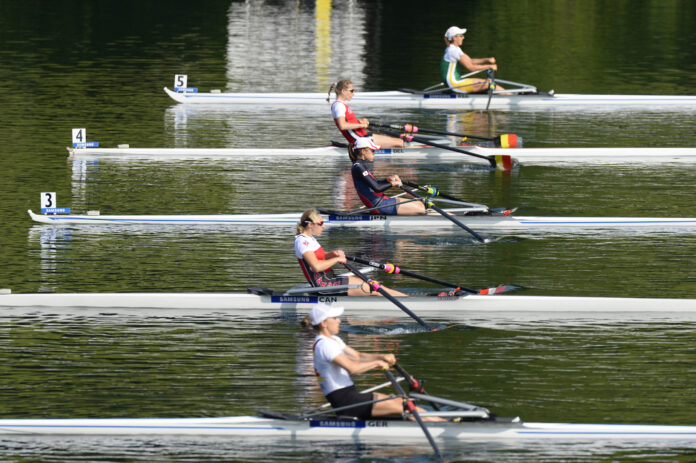
Lucerne. Switzerland. Lightweight Single women move away from the start in heir heat , at the 2013 FISA WC. III. 09:54:04 Friday 12/07/2013 [Mandatory Credit, Peter Spurrier/ Intersport Images] Lake Rotsee,
BY ED MORAN AND LUKE REYNOLDS PHOTO BY PETER SPURRIER
Some are seeing shifts in demand, some are witnessing increasing demand, and others still are hardly seeing a change at all.
In April, erg-manufacturer and industry bellwether Concept2 sold out of machines within days of shutting down production on March 25. They were not the only ones who saw a sales bump as athletes hunkered down in their homes. Hydrow, industry newcomer, has seen an increase as well.
“We’re at four times the volume of sales,” Bruce Smith, Hydrow CEO and founder, said. “There is definitely a big-Covid effect . . . but it’s definitely accelerating the adoption of at-home fitness.
“We’re at four times the volume of sales,” Bruce Smith, Hydrow CEO and founder, said. “There is definitely a big-covid effect…but it’s definitely accelerating the adoption of at-home fitness.”
“We’re incredibly fortunate that we produce Hydrows in Taiwan and they have not been very severely impacted by the Coronavirus,” he said. “So, we’re incredibly lucky that we’re still able to produce and deliver Hydrows.”
Some shell manufacturers including Hudson and Wintech also began to see a change in the status quo. Demand for team boats diminished and shifted to demand for small boats.
“I think we’ve had three orders of ten [singles] come through,” said Dave Dickison, director of business development at RowAmerica. “I’ve given the directive to manufacturing ‘just keep making singles.’”
Hudson Atlantic sales manager Matt Muffleman, said that the overall volume of boat sales is down but their single sales volume and inquiries have tripled. With the shift in demand from team boats to singles, Muffleman said he has noticed a change in the motivation behind shell purchases and is taking time to talk with customers to determine what their needs actually are.
“It’s been hard to gauge,” Muffleman said. “I would say (singles inquires) have more than tripled, significantly higher. Our overall volume is down because nobody is buying big boats, we don’t typically deal in a lot of small boats, but it’s up there.
“But, you don’t need an elite level racing shell for a small boats program at a junior program where cost-benefit is a concern,” he said. “They need more bang for the buck. They need more butts in seats and I think it’s going to be an interesting trade-off in that there are programs that are so used to a certain quality of product or service, and then similarly, you are getting people who are entering the field for the first time, you’re getting parents whose first sentence is, ‘I just have to tell you, I don’t know anything about rowing but I want to buy my child a boat.’
“In a couple of years the used, small boat market is going to be inundated because programs will be back to big boats and won’t need all these singles and will want to sell them,” Muffleman said.
Similar to Hudson, Fluidesign has seen a decrease in overall new boat volume. Inquiries for pairs, doubles, quads and fours have almost completely stopped, and request for new singles has fallen. But sales of used boats that they have in stock have gone up.
“Sales are really interesting,” said Gord Henry, president of Fluidesign. “New boats sales are down, used boat sales are up. The inquiries for new boats are definitely down, like half. The inquiries for used boats are doubled.
“We’re not going to sell a four or a quad. We haven’t had one inquiry for a four or quad. Before this, we were averaging one a week. We’re getting little to no inquiries on pairs or doubles, which we would normally have two a week,” he said.
Henry said that with many new boats customers trade in their old boats and they had a lot available. “So far, we’re selling, on average, three or four used boats a week.”
Swift Racing, which manufactures ocean shells in addition to flatwater shells, echoed some of the same sentiments of Fluidesign.
“(Business) has changed,” Christian Hawkins, vice president of operations for Swift Racing, said. “We have some containers coming in from some previous orders. We have some interest as well but it’s slow with people pulling the trigger.”
Not all companies saw a shift to an increase in demand, or shift in interest, however. Durham Boat Company is on pace to retain around the same level of business as years’ previous.
“It’s about comparable to last year,” Colleen Fuerst, President of Durham Boat Company, said. “We’re still getting indoor tank inquiries, but the time from when we get the inquiry until they actually get the tank is about a year.”
Despite all the changes, the picture remains clear that when athletes return to the water the industry will be ready. Regardless of how different it may look.
“The best thing the rowers could do is get a single, and you know, try not to launch from a boathouse,” she said.
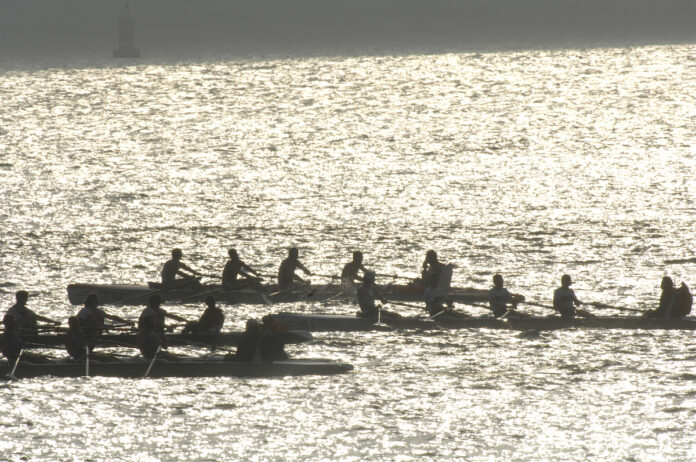
Le Havre, FRANCE, competing at the French and International, Coastal Rowing Championships. 14/10/2006. [Photo, Peter Spurrier/Intersport-images].....[Mandatory Credit Peter Spurrier/ Intersport Images] French, National and International Coastal Rowing Championships, Le Havre. FRANCE , Sunrise, Sunsets, Silhouettes
BY JOSH CROSBY PHOTO BY PETER SPURRIER
It’s pretty funny when you realize that one of your least athletic high school friends (Ben Saunders, I am calling you out) has recently become one of the fastest Ironman age-group athletes in the world. This guy, who used to give me grief at St. Paul’s for rowing three hours a day and sleeping a solid eight, now consistently puts more than that time and focus into his impressive Ironman triathlon training schedule.
Complete irony hit when Ben invited me to join him in a “swimrun” race called ÖTILLÖ (“island to island” in Swedish) this August in Maine’s chilly Casco Bay. Swimrun is the fastest growing sport in the world, I am told. Participating in teams of two, you alternate between trail running across islands and open-water swimming along marked courses.
We’ll be covering a total of 17 miles of running and four of swimming, so the training needs to start now. Trying to keep up with Ben will be the tougher challenge. In preparation, my wisdom (age) will have me start training early and slowly this time. Often, we are too eager to ramp up our speed and distance at the risk of injury or nagging pain. Below I have mapped out my first three weeks, which features a slow and steady run progression. As you embark on our own running journey, remember to land softly on the mid-foot rather than the heels or toes. Also, keep your body tall and “proud.” Imagine your head stacked atop your shoulders, and your shoulders on top of your hips, leaning forward slightly. Don’t forget to build in time for active recovery such as trigger point work, foam rolling, and assisted stretching. Need some ideas on how to reset your muscles and mind? Check out my new project www.gobodysquad.com.
Week 1
Start with 3 times a week for 20 minutes as follows: 3 min. jog; 1 min. run; 1 min. walk. (Repeat 3 times for a total of 20 min.)
Week 2
Run 3 times a week as follows: 3 min. jog; 2 min. run; 1 min. walk. (Repeat 4 times for a total of 24 min.)
Week 3
Run 1: jog 3 min.; run 3 min.; walk 1 min. (Repeat 4 times for a total of 28 min.) Run 2: jog 4 min; run 4 min.; walk 1 min. (Repeat 3 times for a total of 24 min.) Run 3: jog 5 min.; run 5 min.; walk 1 min.; run 5 min.; jog 8 min.; walk 1 min.; run 5 min. (For 30 min. total.)