BY LUKE REYNOLDS
PHOTOS PROVIDED BY ROWING IN COLOR
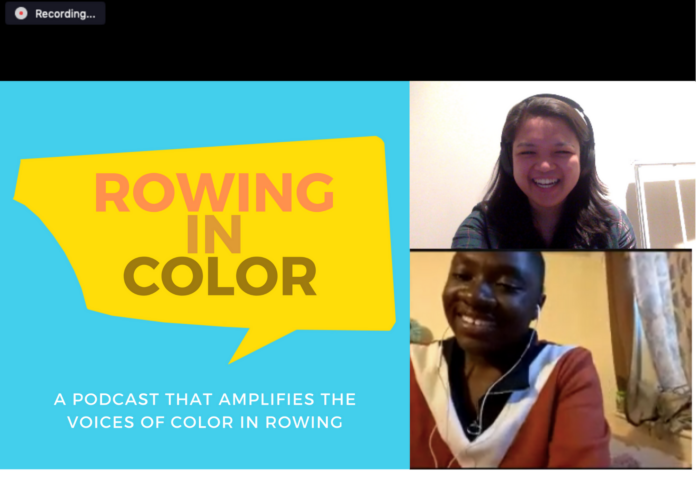
Rowing in Color, a podcast “dedicated to promoting diversity within the sport of rowing” has received attention in recent weeks for the work it does to promote voices across the rowing community. Rowing News caught up with Denise Aquino, founder and co-host of the podcast to discuss diversity in the sport of rowing and the motivation behind creating the podcast.
Q: What prompted you to create Rowing in Color?
A: It started out as an idea that we had last year. I think I was talking to Arshay Cooper at the time. The conversations that we have on the podcast are no different from the conversations that I’ve been having with either white or non-white people, but people of color in the community especially, for the past six or seven years or even the past 14 years that I have been a part of rowing. The podcast is just to address the question of ‘why other people aren’t hearing these stories and conversations?’
Podcasting came to mind because I took some sound classes in college and have basic, rudimentary audio editing skills. That mixed with the fact I didn’t grow up with cable, I grew up with radio. So knowing the impact of hearing someone’s voice and how intimate each pause, intonation, and especially when you hear a story that resonates with you, made podcasting the perfect medium.
Q: Can you tell me a little bit about your relationship with Patricia (Destine) and how you all came to be co-hosts?
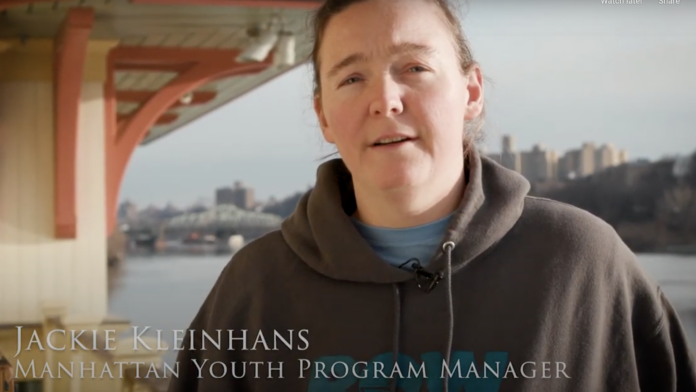
A: I have been working at Row New York for seven years and part of my interview process was to go to the boathouse and coach a practice for the coaching part of the interview. One of the youth athletes who were there was Patricia. Essentially she was judging me as to whether or not I should get the job so I must’ve done something right because I got the job.

“But I was able to be her supervisor and one thing that I loved about her is that she would speak her mind. And do so in a way that highlighted the needs of the participant not just ‘this is what my opinion is and this is what I think.’”
-Denise Aquino on co-host Patricia Destine
She and I didn’t really cross paths at first, I wasn’t her coach, but years later she helped with the middle school program I was coaching at the time and later she became the assistant coach so she was on my coaching staff. Actually, fun fact, we were the all-minority coaching staff at Row New York for one of their programs. But I was able to be her supervisor and one thing that I loved about her is that she would speak her mind. And do so in a way that highlighted the needs of the participant not just ‘this is what my opinion is and this is what I think.’ She also disagreed with me which, when you can find someone to tell you that you’re wrong, that’s someone you want to keep around. They’ll tell you you’re wrong and help you find the right solution. She is that person.
When I was planning a learn to row event in Brooklyn, like deep-Brooklyn, there was no one else I wanted to involve in the project. I knew that involving her in the project would make it a success and we had over 200 people – mostly black – to come to learn to row and I credit that all to Patricia.
Adding that combination to the podcast it’s been the same if not a bigger level of success.
Q: A lot of clubs and organizations across the United States look to programs like Row New York and Philadelphia City Rowing as programs that have been really successful in finding ways to connect with the community. You and Patricia are sort of a dynamic duo that has created a community around the podcast that obviously people want more of. Within that, can you tell me about any policies that Row New York or USRowing has instituted that really help to bring more of the community into the sport?
A: One thing that has been a work in progress in my seven-year arc at Row New York has been continually revising the attendance policy. Row New York, I mean it’s a program that integrates both white and non-white students, both low-income, and middle-income and the 1% so it’s complete socio-economic integration and within that, how someone views anothers’ attendance, for example, is something I have been working on.
If a kid misses practice are you going to call them and call their parents and find out they got evicted? Or are you just going to call it an unexcused absence and move on? And that’s something that I think a lot of rowing coaches who are coming either from a collegiate rowing background or somewhere else are not used to. I mean you’re held accountable for your attendance. If you show up, you show up, and if you don’t, it’s on you.
Sometimes, and I’m not going to give any specifics, but it can be the worst news you could expect to come out of a 12-year-old’s mouth. And it’s not something you’d ever expect to come out of the mouth of a 12-year-old and when it does you start to ask: are these policies barriers to the people we are trying to serve? How can we build bridges so that we can hold each other accountable but also open up the channels of communication for folks to ask for help or to say what’s going on in their family?
Q: Are there any policies you’d like to see from clubs or national governing bodies?
A: I think there are so many to package it into a single policy or several policies would be difficult. In the rowing world, I think especially with what’s been happening after the murder of George Floyd, there needs to be a mindset change. If you’re not sure how to handle it, there still needs to be something said. You need to acknowledge it. Otherwise, we’re just going to keep the 1% as the primary rowers and it’s just a mindset change as the rowing world seems a little antiquated. I’m not sure what the exact policy would be.
Q: How would you suggest coaches talk to their athletes about the protests and the systemic racism in our country, how should they bring that up to their athletes? Should they bring that up to their athletes?
A: I think that’s the million-dollar question right now. It’s absolutely important. Yesterday I was texting Patricia that we need to do a webinar. I told her ‘we need to do a webinar right now.’ Just because we don’t know all the answers doesn’t mean we can’t look into what has worked in the past, what has worked in other sports, and what like after-school programs and what works in educational settings. And what works in sectors similar to ours and what trainings can we take and apply them to us.
It would take a long time to do the research but I come from a science and math background and I need that data in order to get to that answer.
I’m drawing back to the memory right after the election I had practice with the middle schoolers and my philosophy is that ‘I’m not here to project my political philosophy on you.’ I mean, they’re middle schoolers and I feel like that would be taking advantage of their growing stage. Despite what happened, or because of what happened rather, we just took some time and sat in a circle and acknowledged like ‘does anyone want to talk about the election?’ ‘How is everyone feeling? Give me a thumbs up, medium thumbs, thumbs down.’ ‘Do you want to talk about it? We can if you want. We can go on with practice if you want. If there’s something you want to say, say it.’
Acknowledge it. Give your team the opportunity to either use that space to talk about it or just use that space to row away from it. I think you need to give the athletes the opportunity.
I had a team that is really, really diverse and it’s not common but let’s say you have a team with one or two black people on it if any, and taking them aside and saying ‘hey I’m going to bring this up if you want to talk about it. If you want to talk about it another time or if you want to talk about it during team time. I want to know what makes you feel safe.’
It’s not the guidebook for a perfect answer but I think coming from the ‘what will make everyone feel safe’ approach is a step towards there.
Maybe after a month of research, I’ll have a better answer.
Q: Do you think rowing is an accessible sport?
A: When you take the price tag out of it, rowing is a very accessible sport. I’ve had the luxury of being in an environment when the majority of people don’t pay but I can’t think of a more accessible sport for people with disabilities or who come from a low-income background. It’s the ultimate vehicle to bring you from who you are to who you want to be.
Unfortunately, the price tag is a reality. Also, water accessibility is a reality, and people who know how to swim and those who don’t. All of those are barriers many of which are related to income.
Q: What would you say to any athlete thinking about joining a program?
A: I’d say go for it. A lot of people who start rowing never leave it.
Q: In your episode, “Things You Wish You Could Tell Your White Coach,” you describe diversity as an amalgamation of many things. What’s your definition of diversity? Why do we need diversity in the sport?
A: I have so many different vantage points of working in rowing as being the only diverse person or the only person of color in some scenarios but also as being the only Asian-American in an all-Dominican boathouse. I have had such a weird trajectory with regard to diversity in that lens.
I’ll say this: when diversity is used as a codeword for black and brown people, that’s when I will just cringe and like throw my hands up and walk away. Unfortunately, I think that’s the understanding.
I’ve been fortunate to be a part of some rowing conferences like Joy of Sculling and I’ve seen the diversity and inclusion track at the USRowing conference and it’s interchangeable like a codeword. Our society uses codewords. When we say ‘law and order’ what do we really mean there?
Language is so coded and everything is so covert. So when I hear the word ‘diversity’ it’s just a codeword for black and brown but really diversity is just trying to get the population of the sport to reflect the population of the country. I think Megan O’Leary has said it. I think Arshay (Cooper), Arshay definitely said it. Just to have the sport reflect the population of the country.
Q: Obviously we’re coming into pride month so what would you say to an athlete who identifies as a member of the gay community? Is rowing accessible to queer athletes?
A: As a member of the queer community I would say ‘What up, fam!’ I would say you absolutely belong here. There is absolutely a space for you here.
We really just need to understand where the ignorance is, where the fear is, maybe there is an amazing opportunity that we haven’t even thought of. Even though I am a queer person there is still so much I don’t know. With that being said, we have to talk about it.
You can listen to the Rowing in Color podcast here. Those interested in making donations to support the Rowing in Color mission can do so at these places: