Home Blog Page 250

USRowing Announces Cancellation of the 2020 USRowing National Championship and Masters National Championship Regattas

STAFF REPORTS
PHOTO BY LUKE REYNOLDS

USRowing announced Thursday afternoon the cancellation of the 2020 National Championship and the 2020 Masters National Championship.

The 2020 USRowing National Championship was scheduled for mid-July in Camden County, New Jersey, and the 2020 USRowing Masters National Championship, was originally scheduled for August in Oakland, California.

USRowing announced in April that Masters Nationals would not be able to be hosted in Oakland as originally planned, however, the event was not canceled until Thursday’s announcement.

“Between the phased approach laid out in the Opening of America Again protocols, social distancing requirements, recommendations regarding team boat participation and mass gathering event planning, limited training options, travel considerations and the national scope of these events, USRowing has decided that there is no way to run safe, fair and representative national championship regattas this summer,” USRowing wrote in the announcement.

USRowing will be publishing new guidance for clubs next week in addition to “exploring virtual options” to stand in place of the two events.

Into the Wild

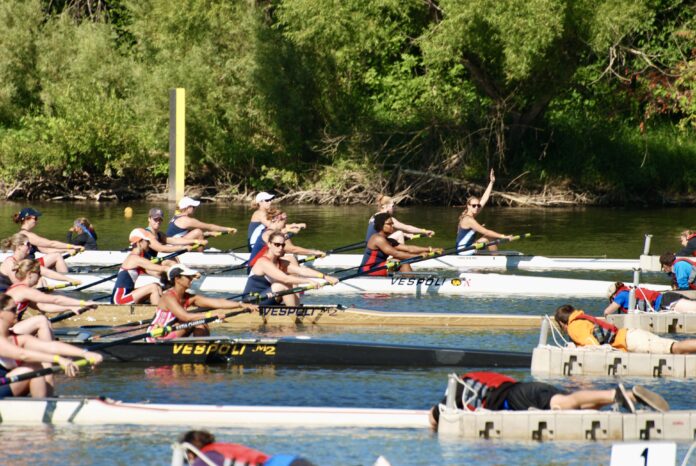
The 22nd Annual Presidents Cup Regatta held at Bates College's Boat House on the Androscoggin River in Greene. Men's Novice 4 Men's 2Varsity 8 Men's Varsity 8 Women's Varsity 8 And other scenes not the river including ice, water reflections, and bald eagles.

BY JEN WHITING
PHOTO COURTESY BATES COLLEGE

If you can picture the coast of Maine, where the trees meet the water and the mist rises during sunrise, that will get you close. If you can let that image in—the peace that comes when water and earth become one and the sky cradles even your darkest fears—then you might just begin to feel what it’s like to be in the erg room at Bates College as winter turns to spring.

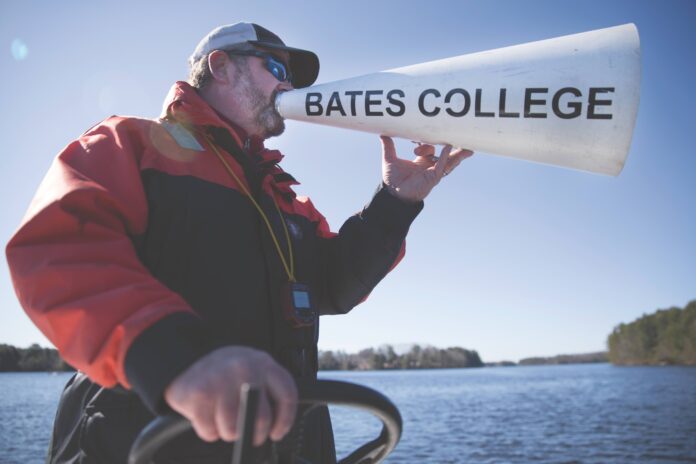
Peter Steenstra, once a captain of sailboats, is the head coach of the rowing program at Bates College; he has a calmness that belies his burly laugh. As the coach of a rowing program that’s in Lewiston, Maine, almost as far north as one can get on the East Coast of the United States, Steenstra’s athletes spend a lot of time in the erg room. “In the erg room, we don’t use the monitors, we push them up, out of the way. We leave the music off and sometimes I turn off the lights.”

Steenstra describes an erg room that I’ve never witnessed: no monitors, no music, no lights. This odd scene stays in my mind as I ask Steenstra about the results the Bates rowing program has achieved since he took over as head coach in the fall of 2008. “Bates has been at the NCAA [championships] since 2007.” Steenstra smiles a soft smile, one that highlights his love of the sport. “Since 2009, we’ve been first or second, except for 2014, when we took third to Williams [College]. They had a powerhouse of a program, Williams,” he says of one of his fiercest competitors.

I ask Steenstra about the powerhouse he’s built in his own backyard, at Bates. “We’re getting there, yes, but don’t tell anyone,” he says, with a chuckle. A Division III program, Bates College’s rowing program has grown, with Steenstra as the head coach of both the men’s and women’s program and two assistant coaches. I ask him about the erg room, and the unconventional way he and his coaches run it. “I’ve realized,” he begins, settling into what I can feel is a story that only a sailing captain can tell, “that I don’t create the culture that’s here, I just provide an atmosphere. From that, the team is able to create their own culture. It’s moving. It’s organic. And it changes every year.” 

“I don’t create the culture that’s here, I just provide an atmosphere. From that, the team is able to create their own culture. It’s moving. It’s organic. And it changes every year.” – Peter Steenstra

Steenstra arrived at Bates as an assistant coach in the fall of 2007 and spent one year in that role. “I left Bates at the end of the academic year,” he explains. “It just wasn’t the right fit for me as an assistant.” Steenstra and his wife had spent that year apart as she finished graduate school in upstate New York. “It was a big decision,” he explains, to live two states away from his wife for a year. “Taking the assistant job at Bates was a bit of a risk,” Steenstra goes on, “but my wife and I are both from Maine and we knew we wanted to move back home.” Steenstra pauses briefly, “There are only three coaching jobs in Maine: Bates, Bowdoin, and Colby.” 

Steenstra had begun his coaching career at Colby College, as an assistant under Mark Davis, then led the club teams at The Ohio State University, and also spent a year as an assistant coach at Cornell University, while he earned his master’s degree in sports management at Ithaca College.

In August 2008, three months after Steenstra had left Bates, the head coach position became available. “When the athletic director called, offering me the head coach position,” Steenstra recalls, “I was driving a forklift in a lumberyard in upstate New York to pay the rent while my wife was in residency.” He grows serious, and I lean in. “I aged a lot that summer. To have gone 10 years in coaching, invested in a master’s degree—that’s what’s needed these days as a coach—to be driving a forklift in July, when what I wanted to be doing was setting up a boathouse…” Steenstra trails off a bit. “I realized I might not be a coach anymore.”

I ask Steenstra what his response was when he got the job offer from Bates that day. “That was the easiest negotiation of that AD’s life, that’s for sure” he laughs. “It was a 10-second phone call. I said, ‘Yes, I’ll be there tomorrow.’ I didn’t even ask about the salary.” 

Once at Bates as the head coach, Steenstra began growing the team. “I knew that I had something,” he says, when I ask him about the success he’s seen his crews achieve, “that I understood how the boat goes. But it wasn’t until I got to Bates that I…” and here he stops, searching for the right words. He looks up and I pay attention. “I never felt like I was really good at anything until I started coaching.” He stops again, trying to explain himself to me.

“Rowing is simple. You sit down, you go back and forth, you hit repeat. But it really comes down to the people. What I’ve learned is that you have to give them as much as you can, so you can then stand aside, in the shadows. You have to give them the ownership so they can go as far as possible. From that ownership, they get control. The athletes themselves are in control of the program.”

I ask him if his rowers know this about him, that his goal is to hand over the control to them. “Yes,” he says, matter-of-factly, “I tell them all the time. I tell them that if they need me in order to be successful, that’s a problem. I say, ‘You guys have to be able to run with it.’ We put a lot into the leadership of the team. The captains are elected by the athletes, the coxswains have a very distinct role, and within the team, everyone has a responsibility. My assistants—every one of them over the years could be a head coach.” Steenstra stops and rewinds a bit. “I can definitely say that I’ve been blessed with good mentors: Jim Joy, Mark Davis, Dan Roock. I’ve worked in programs that taught me the importance of a good relationship with the athletic department and what it can mean to a rowing team. When I ran the club program at The Ohio State University, it was the good old-fashioned, hard-knock kind of education, old-school learning. I look back now and I’m glad I did it—it was hard on my retirement account and it didn’t necessarily move me forward because it wasn’t a varsity program—but I learned so much there.”

Steenstra doesn’t mince words. He tousles with the lessons he’s carried from each coaching job and they all seem to careen into his approach to making the Bates rowing program as successful as it can be. Specifically, Steenstra has led the women’s rowing program at Bates to the top of the Division III podium, winning the NCAA championships four of the past five years. Over the past 11 years, they’ve placed either first or second every year, except in 2014. It was in 2014 that they stood on the third step of the podium, finishing behind Trinity College and Williams College.

I ask Steenstra if he talks with his athletes about winning. “Never,” he says, without missing a beat. “Never ever.” He catches himself then, and rewinds. “I talked about it for one year. Can you guess which one?” he quips. “From 2009 to 2013, we were second behind Williams,” he explains. “They were getting faster and we were getting faster. They were beating us by open water and we were beating everyone else [in our region] by open water. In 2014, I made a conscious decision to talk about winning. I wanted my rowers to face that demon. We were having a remarkable year. Then, when we went to NCAAs, of course, it all piled on top of them.” Steenstra tells this story as if he’s explaining a perfect storm forming out at sea, and he knows a course adjustment is the only thing that will protect his sailboat.

“In the NCAA finals, it was all in their hands. I told them, ‘We have every reason to win this race.’ But we had spent so much time talking about winning, and not about the final step of their performance, that it just crumbled. During the race, once winning was out of reach, it all came crashing down and we fell to fourth.” The silver lining that day? Bates’ junior varsity won their race. This brought Bates to third in the NCAA points race in 2014. Since then, Bates’ second varsity eight has won six consecutive NCAA championships. “Never before have I felt so pulled in two completely different emotions as a coach.” Steenstra pauses again, reflecting on the role a coach has when working with multiple teams at championship races.

“So that was my experiment with talking about winning head on. It’s too bad the 1V boat suffered that on my account.” Steenstra’s voice conveys the regret coaches often have about the losses they feel directly responsible for. “Now the focus is on another place. Now it’s all about caring for the people.” Steenstra sits back and his boat captain’s manner shines through. “I just sent out an email to my team—56 women—asking them to answer this question in five words or less: ‘Why are we strong?’ Here’s what I got back: ‘We care about each other,’ ‘love,’ ‘trust,’ but the word ‘rowing’ was not anywhere in their answers. This is how they are together. They understand the commitment they have to each other. This monster that is Bates Rowing is here to help whoever wants to be a part of it to succeed.” 

Steenstra slows down, as if the energy to let go of the control sometimes circles back on him, too. “When we’re on the water, we end at the 4k point, when we’re 4,000 meters from the dock, and we end the day’s workout there. All my rowers have heard us say that if you practice a bad stroke, the result is a bad stroke. We take every opportunity on the water to produce a good stroke because we have so little time on the water. They know that at the 4k point—from that point back to the dock—they will be deciding what the standard of their boat, their team, is going to be. The coaches go silent with 4,000 meters to go and they have to decide what kind of work they’re going to put in on the way home. We tell them, if you have a low standard, that’s the kind of program we’ll have.”

I ask Steenstra how directly he explains to his rowers this idea of setting standards. “We discuss it all the time,” he says. “I say it during every session. I say it on the water, in the boathouse, and in the erg room—and we spend a lot of time in the erg room.” And here it is: that room with no erg monitors revealing the work each rower is putting in and no music blaring from the speakers. There are just rowers, doing the work. “You’ve just got to know that you’re putting everything into it,” Steenstra explains, when I ask him about not using monitors or music to guide the rowers. “You can hear it in the room. During an erg piece I generally don’t say anything until the piece is over.” And it’s at that moment that Steenstra stands in front of them and says, “You’re at the 4k point, you’re going to the dock.” He pauses as he explains the moment. “Then, as they finish the last 4,000 meters of the day, they’re doing a whole other workout.” He lets his words slow. “They know they’re a part of something.”

Steenstra circles back to his idea of what a coach can—and can’t—do. “Good coaches know they can’t motivate people. It’s also true that coaches can’t provide culture. All you can do as a coach is to provide an atmosphere and opportunities for athletes to self-motivate and for them to create the team’s culture. My assistants, Elizabeth (Lizzie) Kinney and Haley Eovine, know this, too. Lizzie rowed at Vermont and coaches the men’s side. She does an outstanding job. The guys respect her so much. And Haley joined the women’s team mid-year and we feel like we hit the jackpot. She was a coxswain at the University of Massachusetts; often good coxes make good coaches.”

Steenstra’s work this spring, like so many coaches’, has shifted to supporting his team through an unprecedented season due to the cancellation of competition. Something he said stays with me as I watch from a distance how his team is responding. “I tell my athletes that to be rowers they have to think like a farmer. Get up tomorrow and do the job you did today. It’s hard work that makes you successful. That may offend some people, but we find this sport because we like hard work.”

“I tell my athletes that to be rowers they have to think like a farmer. Get up tomorrow and do the job you did today. It’s hard work that makes you successful. That may offend some people, but we find this sport because we like hard work.” – Peter Steenstra

While working on this piece, I reached out to Steenstra again, after his athletes had left campus and returned to their homes for social distancing. “It’s been a transition,” he says, of having his athletes still be Bates rowers, albeit from all parts of the country. “But, you know, it’s letting us focus on the things that we say we always wish we had to time to focus on. Haley Eovine is leading Zoom-ga sessions for the team. She launches Zoom, has the team log on, and runs a yoga session. That’s a foundational area we’ve always wished we could do more of, so now we are.” Steenstra mentions how this strange spring season has his oars getting a fresh coat of paint and the boathouse getting the kind of attention coaches always wish they had the time for.

“One thing hasn’t changed for us, though,” he sits back in his chair and explains. “Quiet sitting. This is something I learned from [coach] Jim Joy when I was rowing at Hobart. Quiet sitting is one of our more valuable tools.” I look at him with a puzzled look. “What we strive to do through quiet sitting is to strengthen our emotional durability. Today’s athlete is bombarded with noise and information all the time—someone’s always trying to sell them something. We end every practice with 10 minutes of quiet sitting.” Steenstra is engaged in a way that makes me think of him on a sailboat far out at sea, as if the idea he wants me to understand is a key to understanding his work. 

“We’re lucky because we’re up here [in Maine] surrounded by fields and sky, the wind in the trees. At the end of every practice, the team will get into a giant circle on the apron in front of the boathouse and just sit—with good posture—for 10 minutes.” He shows me the apron, a typical paver-covered apron between boathouse and dock. “It’s far more valuable than even they realize. It’s usually once they’ve graduated that I’ll get an email or a phone call or a letter thanking me for that.”And so now, when the team is connected only digitally, Eovine ends each of her Zoom-ga sessions with a few minutes of quiet sitting. “We remind them that there’s great value in continuing to strengthen their emotional resolves.” Steenstra releases a bit, letting the weight drop from between his shoulder blades. “There’s nothing that we’re doing at Bates that others aren’t doing, but our approach may be different.” Different indeed: he might just turn out the lights and send you on a 4,000-meter erg piece with only your team’s compass to guide you.

Steward of the Sport

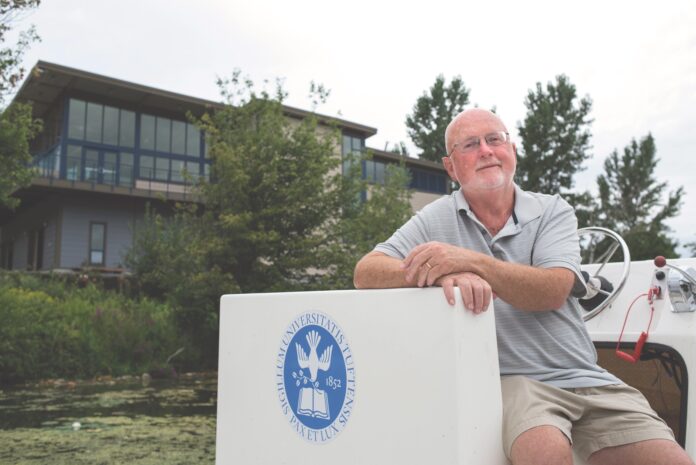
08/16/2016 - Medford, Mass. - Recently retired crew coach Gary Caldwell photographed at the Tufts Shoemaker Boathouse on August 16, 2016. (Alonso Nichols/Tufts University)

BY JEN WHITING
PHOTOS COURTESY TUFTS UNIVERSITY/GARY CALDWELL

Picture, for a moment, bleachers affixed to a flatbed railroad car. You’re standing on the banks of the Hudson River in late June, a sodden picnic basket at your feet. Even though it’s been raining all day, thousands of spectators have descended on a three-mile stretch of the river, as you have, to watch one of the biggest sporting events in America: the Intercollegiate Rowing Association’s national championship race. As the freshman eight race gets underway, the train with the fans on board follows the boats down the course. 

Throughout the day, as the rain continues to soak through your coat, two more races will be held: the junior varsity eight and then the ultimate test, the varsity eight. Crews from Cornell University, Columbia University, and the University of Pennsylvania have been racing on this river since 1895, when the first IRA national championship was won by Columbia.

This year, though, as you stand on the rain-soaked banks of the Hudson River, it’s 1923 and an upset is underway. Lanky boys from the University of Washington are racing against what has typically been an East Coast event between crews from Penn, Cornell, Columbia, Syracuse, and the Naval Academy. Wisconsin has been traveling East on and off since 1899 to compete, but this is only the second year that a West Coast school has competed. Washington earned the right to be here after beating California in their annual race. 

The varsity eight race is now underway. Your perch—at the beginning of the last 500 meters of the course—is prime viewing territory. As the railroad car with spectators in open-air seats passes behind you, the crews of Washington, Navy, Columbia, Syracuse, Cornell, and Penn come into view. The river is straight here, so you’ve been watching them approach for a few minutes, but now they come into full view. Washington had finished second the year before, in 1922, chasing Navy all the way. The Huskies had overtaken Navy near the finish but ultimately faltered in the final sprint. The presence of the crew from Seattle was upending sport, in a way. If they could muster a victory here, it would change everything. The wooden shells pass in front of you, and Washington looks strong. Navy is in pursuit, but, ultimately, this will be the year that a West Coast team will expand rowing’s reach across the country, taking home the Varsity Challenge Cup for the first time.

This scene, featured in grainy sepia photos of the crews and their wooden shells and oars, was a common one as rowing grew in a country that craved grueling competition and appreciated a day spent at the races. The Intercollegiate Rowing Association, formally founded in 1898, has been the organization that has stewarded these historic competitions while also evolving with the times; now, the IRA is home to men’s rowing, men’s lightweight rowing, and women’s lightweight rowing. The national championship that the IRA stewards has been run every year since 1895, and has only been cancelled during wartime or, as is the case this year, pandemic.

At the helm of the IRA is its commissioner, Gary Caldwell. Caldwell has, of course, grown up around rowing. He watched the Harvard-Yale Race, often known simply as “The Race,” while visiting his grandparents’ house near the course in New London, Connecticut. In the fall of 1968, when Caldwell was a freshman at Yale University, he was approached by, as he describes it, “very large upperclassmen who asked how much I weighed.” Caldwell was an easy target for rowers looking for coxswains; he was 125 pounds.

The Yale University varsity squad in 1972.

“I had at least a passing knowledge of rowing,” Caldwell explains, as we settle into conversation. “In the late ‘60s, the newspapers ran articles every day leading up to The Race, and the radio stations regularly aired dispatches from reporters at the Yale and Harvard encampments. That was going on through my youth.” So when Caldwell went to the crew information meeting at Yale in the fall of 1968, it wasn’t a stretch for him to begin a career in the sport—one that would ultimately span more than 50 years.

“In 1969, both my parents were still alive and watched me in the two-mile freshman race. My father passed on that year, but my mother kept coming to every race, religiously. She’d watch from the shore—for the 30 seconds she could see us as we passed by.” Caldwell has a round voice, one that fills the room when he talks. As I listen, I feel like I can hear his coxswain calls as he races past the spot on the shore where his parents once stood. A four-year coxing career at Yale took him past that spot four times: in the freshman race, the JV race, and twice in the varsity contest.

After college, Caldwell began coaching at Trinity College, where he coached the lightweight men and was tapped to start the women’s crew program. What transpired was nearly a constant assignment as a crew coach—first at Trinity building the women’s program, then at Marist College, then again at Trinity, and, after a brief stint in industry, at Northeastern. Finally, in the fall of 1990, Caldwell took the head coaching position at Tufts University. “I coached the varsity men, the varsity women, the novice women, and then the varsity women again,” Caldwell explains, as he goes through his 26 years of experience at Tufts. “The reason for jumping from one team to the other when I was at Tufts is that I was the only full-time coach, so I would move around depending on the assistant coaches I could attract.”

Caldwell, now the commissioner of the oldest rowing organization in the country, was at the beginning of many of the programs that now are powerhouses in the rowing world. Indeed, in his 26 years as the head coach at Tufts, he developed the rowing programs there into powerhouses themselves, while also developing an alumni support base that allowed Tufts to build one of the most handsome boathouses in the country, the William A. Shoemaker Boathouse. Although the architecture is more modern, the perch the Shoemaker Boathouse has on the Malden River reminds me of the location of the training facilities early IRA competitors often had on the Hudson River. Rowing shells flow easily across the apron that links the boat bays to the dock, just as they did more than a century ago.

Caldwell’s involvement with the IRA began in the 1990s. He became involved in the administration of events and ultimately was appointed commissioner. When he retired from his coaching position at Tufts in 2016, he remained the commissioner. “Now I only do one job,” he smiles, “not two.”

Caldwell details the role the IRA plays in rowing today this way: “Because men’s rowing and [men’s and women’s] lightweight rowing are not NCAA sports, the IRA acts as the regulating body, much like the NCAA does for women’s rowing. We oversee the eligibility rules, the operating regulations, an athlete’s ability to transfer between schools. We’re a parallel organization.” 

The IRA began with five member schools—the University of Pennsylvania, Syracuse, Cornell, Columbia, and the Naval Academy. But in 2011, the organization restructured, authoring a new constitution and set of by-laws, and now is governed by a board of 51 member schools. “The financial pinch that institutions felt in 2009 and 2010 during the recession accelerated the change. Before restructuring, the five founding schools bore all fiduciary responsibility. Under Clayton’s leadership [Clayton Chapman was the commissioner of the IRA before Caldwell], we managed to balance the budget every year—we never had to go back to those original five schools—but it became evident that putting the financial burden on just those five schools wasn’t sustainable. We are deeply entwined with the NCAA. All of the 51 IRA member schools are also NCAA members. The IRA sets itself up to follow the rules of the NCAA, except where we do it differently.” 

“We are deeply entwined with the NCAA. All of the 51 IRA member schools are also NCAA members. The IRA sets itself up to follow the rules of the NCAA, except where we do it differently.” – Gary Caldwell

And here is where the spirit of the IRA shines through. Perhaps it’s from being the original governing body of the sport, or from staying true to the roots that began along the banks of a river near Poughkeepsie, New York (the IRA National Championship Regatta was held on the Poughkeepsie for most of the first 50 years of the event). Or that the IRA sees itself as the steward of rowing for so much of the rowing population in the United States (at the collegiate level, only women’s open-weight rowing is an NCAA sport). Whatever the source of the spirit pervading the IRA, Caldwell is an able commissioner

“The nuances of the differences [between the IRA and the NCAA] are slight in varsity rowing. When you look at the differences now, there aren’t that many. The biggest is perhaps international travel. For NCAA sports, athletes can only have international competition in one year out of four. The IRA allows athletes to compete internationally every year. We also have different season days [the number of days that are allowed for training in each season].” Caldwell slows down a bit, making sure I get the details right.

“As we’ve moved through the last nine years, since writing the new constitution and expanding the member schools, we’ve worked very hard to make the differences as few or as small as possible. Our compliance officers, many of whom are lawyers, spend 98 percent of their time on NCAA regulations. Any time we make a change to the operating regulations, we go through a legislative process, a comment period, and then an association vote. We really are a member institution. The IRA stewards, those are the people I really work for. They formulate policy and are responsible for the direction the organization takes.”

As we talk, I hear Caldwell’s coxswain voice come out again, that tone that all good coxswains have: they understand they don’t have a hand on an oar, but they can help move the boat, nonetheless. “I don’t make policy,” he says, “I run the regattas.” Caldwell’s grasp of the history of rowing in the United States over the past 50 years—as well as his role in its evolution—has given him a unique perspective from which to lead the regatta that has a longer history in the United States than all others, save for the Yale-Harvard race.

“At Trinity, in the first few years I was there, the women only rowed in the fall. Women’s rowing at Trinity became a varsity sport in the fall of 1978. I remember, every year I would talk about Patsy Mink and all the underclass women would know who I was talking about.” Mink was a congresswoman from Hawaii and one of the authors of Title IX. “By 1990, most didn’t know who Mink was.” Caldwell pauses, assessing. “That’s a testament to how far the world of women’s sports—high school and college—has come. I mean, there are pockets where women aren’t treated as the men are, but the number of schools at the college level…” Again, he pauses just a bit, remembering, “There’s an equal amount of pride for what the teams of both genders are doing.”

And it’s here that I realize that the commissioner of the IRA—the organization that has stewarded the development of rowing in the United States since 1895, and continues to be the governing body for all of collegiate rowing except for women’s open-weight rowing—began his career, after four years of coxing at Yale, coaching women and men on level terms. Caldwell’s first year as a student at Yale was the final year of single-sex education there. He lived through the stormy years of women’s sports gaining a foothold on college campuses throughout the 1970s and ‘80s. He coached men and women to successful seasons, sharing the coaching duties with his assistants so each team could get the input they needed, equally.

Caldwell was in his current role as the IRA went through a restructuring, one intended to protect the institution and its members—indeed, to protect the sport itself—as the financial world came crashing down during the recession. I ask him, as he looks at the future, if he’ll stay in his role as IRA commissioner. “I think so,” he says, unabashedly. “I’m 69. I told a few coaches I trust and respect that if at any point in time they think I’m losing my metaphorical fastball, they need to tell me. I’ve had two bouts with cancer. If my health remains, this is still the work I want to be doing.”

Weathering the most recent storm—the pandemic that caused the IRA to cancel the national championships—will be navigated not just by Caldwell, but also by the stewards of the IRA and the representatives of the 51 member schools. “I get to work with really good people. Katie Boldvich, Laura Kunkemueller, Tom Sullivan, the organizers we get to work with at Lake Mercer and Lake Natoma, they are invaluable. This is not a one-man band by any stroke of the imagination.” For rowers and coxswains, Caldwell’s point is familiar: every good race is won by a team.

Rowing the Web

BY ED MORAN
PHOTO COURTESY THE STROKE MASTER

This is the time of year when doing pieces on the erg is usually reserved for warmups, extra work, or when the weather forces athletes off the water. But with the spring regatta season no more, virtual erg competitions and online resources have become an easy-to-access alternative.

One erg challenge began April 6, and is being run by Concept2. The Vermont-based company’s 2020 Spring VIII Series is set to last a total of five weeks and consists of five different workouts. Results are submitted to the Concept2 Online Logbook. 

Another erg challenge is the U.S. Virtual National Championship run by USRowing in partnership with Rowers Choice. Information on that event can be found on the USRowing website.

In addition to the erg challenges, there are multiple online resources offering virtual workouts and information on training and dealing with the emotional impact of the COVID-19 crisis.

A few good places to start are the Association for Applied Sport Phycology’s COVID-19 blog; Community Rowing, Inc’s CRI Upstream blog; and the USRowing webinar series.

The 48-session USRowing membership benefit series is being run six days a week and features expert advice for members of the rowing community on training, nutrition, and sport psychology. Each session is recorded and past webinars are listed and archived. 

“When COVID-19 hit, we wrote up a list of speakers,” said Chris Chase, director of youth rowing at USRowing. “We have 48 sessions planned, and we have speakers confirmed for almost all of them. And for the ones we don’t have confirmed, we have speakers who have said they would speak if needed.

“So far, no one has declined, and the response has been awesome,” added Chase. “Our hope is this is a way to make the bond of our community tighter and stronger and give a lot of value to people.”

Two Boathouses Begin Conditional Reopening

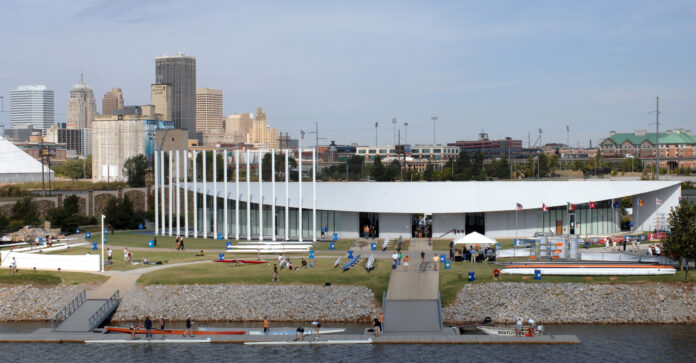
Oklahoma, USA, Chesapeake Boathouse used by the international crews competing in the in the USA World Rowing Challenge, held on The Oklahoma River, Oklohoma City, Fri. 12.10.2007 [Mandatory Credit. Peter Spurrier/Intersport Images].....

BY LUKE REYNOLDS
PHOTO BY PETER SPURRIER

After nearly seven weeks of oars on racks and shells sitting listlessly in storage, boathouses in California and Oklahoma City are beginning to welcome rowers back to the boathouse on a conditional basis with a phased-in process.

Newport Aquatic Center (NAC), one of the first clubs to reopen, has opened its doors to “adult private boat owners” exclusively. According to an April 27 NAC news bulletin, the reopening will be “dependent on effective social distancing being observed.” 

The reopening of the club comes during the continuation of a California statewide stay-at-home order. The order will remain until further notice according to the state health department website

Additionally, the RIVERSPORT Foundation’s rowing program in Oklahoma City will begin a phased resumption of programming Saturday, May 9 according to head coach and high performance program coordinator, Reilly Dampeer. The initial phase of reopening will allow masters athletes to come back with restrictions. 

Prior to the May 9 soft open, the staff will practice the logistics of getting rowers on the water with minimal contact Dampeer said. That will include having slings out, boat bay doors open, and practicing sanitation protocol all while minimizing contact between individuals. 

“Starting the 9th we will let adult qualified rowers and kayakers get back on the water,” Dampeer said. 

“We’re going to hold off until phase two to let juniors back on the water. A maximum number of eight masters at a time would go out at a time in a scheduled time-block. They will go out, come back in, clean their equipment using supplies they bring from home. 

“We’re not going to bring the hose out, even. The staff members will open the bay doors and set up the slings but from that point on there should be no opportunity to cross-contaminate.” 

Oklahoma announced its plan for the reopening of the state’s business on Monday, April 27. According to the Oklahoma Open Up and Recover Safely Plan gyms and health centers can reopen beginning May 1

Dr. Shon Cook, a neurosurgeon, and OKC masters rower plans on returning to his practice schedule whenever possible.

“I plan to return to rowing my single as soon as the boathouse is open again,” Cook said. “I will take the usual precautions of washing my hands and disinfecting equipment, just as always.”

According to Cook common sense remains the best way to protect himself and teammates from the virus.

“The advice I have for everybody is to do what we were all taught when I was a child decades ago to prevent the spread of infections: wash your hands, don’t cough on each other, don’t touch your face,” Cook said. “Don’t chance spreading your infection to anyone else.”

While most other boat clubs around the country remain closed while individual state-enforced stay at home orders remain in place, the USOPC this week issued guidance about how to proceed to a return to practice and racing guidelines. 

“In addition to state, local and CDC guidelines, the Oklahoma City National High Performance Center, as a USOPC Training Site, will be following the USOPC Training Site guidelines,” Dampeer said.

The Talented Yaz Farooq

BY JEN WHITING
PHOTOS COURTESY YAZ FAROOQ, BY PETER SPURRIER

Originally published in the February 2017 issue of Rowing News

This story starts with an MG convertible, a “For Sale” sign, and a decision. You know this kind of decision. It’s the kind that requires everything you have to embark on a path with an uncertain outcome. It’s the kind of decision that stops you, but only for a moment. 

When the moment has passed, you sell your MG, take the $3,000 you got for it, move to Boston, and rent a room in a ramshackle house with five other girls. Every morning and every afternoon of the summer of 1989 your voice crackles through the coxswain’s microphone. After every practice on the Charles River, you stand on the dock of Weld Boathouse, rowers towering over you as the boat is hoisted from the water. You’re 100 pounds and committed. You’re trying to make the national team and your $3,000 is running out. 

“I had an MG convertible,” recalls Yaz Farooq, now the head coach of women’s rowing at the University of Washington. “I sold it because I needed the money to try to make the Olympics.” There isn’t a shred of doubt in her voice as she explains what she did the summer after she graduated from the University of Wisconsin. “As I was trying to make the team, I was so broke I didn’t even have the $25 to pay for my USRowing membership. I said to myself, ‘If I make it [the team], I’ll be able to afford to pay my dues. If not, that’s it. It’ll be over.’”

Farooq made the national team, and coxed the women’s eight from 1989 to 1996, taking sixth in the 1992 Olympics and fourth in Atlanta four years later. Along the way, she coxed the 1995 world champion U.S. eight, the first American women’s eight to win a world title in the 2,000-meter era. I ask her about the culture of women’s rowing in the 1980s and ‘90s, and how it’s changed since then.

“There wasn’t a tradition yet,” she says. “Hartmut [Buschbacher, the U.S. women’s head coach from 1991 to 2000] came in. He’d just coached the German boats to Olympic gold and we all just wanted to win. When Hartmut was hired it was the first time USRowing committed to a full-time coach for the women. He brought a new method of training. We embraced it because we wanted to win. I still use some of his workouts. He went to bat for us, got us better boats, did fundraising. He helped establish the training center for the women.

“I think he’s always been under-appreciated,” she continues. “What is most important is that he established a system whereby college kids had something to aspire to in an organized way. If you were to ask Tom [Terhaar, the women’s coach and an assistant coach under Buschbacher], there are key parts of his training that he took from that time.” Farooq is contemplative, but with a rapid-fire delivery, and she leaves nothing left unsaid, it seems. “When we came up short, we learned lessons that are used to teach athletes today.”

A journalist by training, Farooq was a walk-on coxswain for the University of Wisconsin Badgers. It’s no wonder, then, that after her eight years as the national team coxswain she would receive a call from NBC asking her to do commentary for the 2000 Olympics. “I was a sports intern at a television station in Madison my senior year of college,” she says. “I was always behind the scenes—not on the mic—and after the 1992 Olympics I started doing production at a station in Chattanooga. I moved into station management and sales, and did voiceovers when they needed different people’s voices. I did my time in TV.” 

She keeps explaining, not missing a beat to see if I’ve gotten her Midwestern humor. “When NBC called me, I essentially auditioned for it. That’s why I got into coaching.” I do a quick double-take and she backs up a bit. “I thought I was going to go into TV management. By then, my husband and I were living in Eugene, Oregon, and after the 1996 Olympics we were driving by Dexter Lake and saw some rowing. We pulled over, someone recognized me, and they asked if I’d be interested in coaching their club.”

As Farooq started coaching again, her work with NBC kept her at the elite rowing events. “I studied our sport like hell. I knew I needed to be immersed in it. I went to at least one World Rowing Cup or world championship event every year. I love elite rowing. I’m a student of the sport. That’s why I became a college coach.”

Farooq was named the head women’s coach at Stanford University in 2006. In her time at Stanford, she led her team to the NCAA championships, winning silver in the varsity eight in 2008 and the NCAA team title in 2009. Stanford became a rowing powerhouse, routinely winning on both coasts. She talks about her coaching style, and how it’s changed in the past 10 years.

“The way I coach now is entirely different. It’s a different generation and you’ve got to communicate to the generation you’re coaching. In my generation, we followed a little more blindly,” says Farooq. “First off, most of us walked onto the teams we rowed on in college. There was no recruiting and there weren’t any scholarships back then. When I got to Wisco in 1984, Kris Thorsness and Carie Graves had just won gold at the 1984 Olympics—they were from Wisco. I thought, ‘Oh my gosh, you can learn to row in college and make the Olympics.’ That was kind of how that generation operated.

“Now, as college students, they’re focused on development for the under-23 team, then there’s development for the senior team. It’s just different.” She reaches back for a story to illustrate what she’s explaining. “When I was a sophomore in college, I went to a national team camp. Even though I was ‘development,’ I was working with people who had just won the Olympics.”

Farooq has been incredibly successful as a Division I coach, not only in creating crews that win but in the development of her athletes. In her 10 seasons as the Stanford head coach, 14 of her athletes went on to the under-23 team; two became Olympians. Farooq replays her memory from the 2008 Olympics when Elle Logan, a former Cardinal rower, was in the U.S. women’s eight.

“NBC rules are that you can’t be a cheerleader when you’re calling a race. But after Elle’s race [the U.S. won], they played the national anthem and the emotion caught up with me.” I’m not surprised by this but Farooq explains the significance of it. “At the world championships [in 1995], they didn’t play the national anthems of the winners. So at the 2008 Olympics, in Beijing, when the national anthem started playing, I felt it. To be a part of Elle’s journey—to see her succeed—all the lessons I learned along the way let me contribute, to be a part of her success.” She stops, surprising me.

“In my career as an athlete, winning the world championship was a peak for me. Finishing fourth at the Olympics [in 1996] after all that hard work with that group of women… you could walk away and be crushed or recognize that you’d been on an incredible journey. The people I’ve had the opportunity to race with are amazing. I’ve had my glory.”

There’s a pause, like when the wind carries sound across the lake you’re rowing on, almost caressing your boat as it glides through a still morning. “I love teaching,” Farooq says, breaking the silence. “I love coaching. Teaching athletes how to be great teammates, especially when the championship is built on points from multiple boats.” Farooq segues into her feelings about the NCAA points system, awarding the team title to the team that wins the most races, and places highest on the podium across all of the boats.

“It makes for such a fun team dynamic—top to bottom, everybody playing their part. I love that: bringing a team together. When they think there’s something impossible, if they chip away at it, a little at a time, when they achieve it together it makes it so much more special.”

In the 20 years that rowing has had an NCAA championship (1997 to 2016), only seven schools have won the Division I team title: Washington, Brown, Harvard, California, Stanford, Virginia, and Ohio State. I ask Farooq her thoughts on this statistic, and why breaking into the top tier is so difficult. “All I ever think about is the team I’m coaching,” she says. “What do we have to do to be in the hunt? It’s really important to have depth to win the NCAAs. You’ve got to medal in the V8 to get there. You definitely have to get [the first and second varsity eights] into the grand final. I feel like I’ve been very fortunate. I’ve been exposed to a lot of fantastic coaches and had the opportunity to work with highly-motivated athletes.” 

I ask Farooq about moving from one Division I rowing powerhouse Stanford to another, the University of Washington. “I’m so grateful to everybody at Stanford who helped me develop as a coach. When I went to Stanford my husband asked me, ‘Is this it?’ We had landed in Oregon for 10 years [both were working in television] and loved it. The only other place I would consider was Washington.”

Farooq leads me through what she found when she interviewed with the Huskies. “The support and love of the sport, I saw it at Wisconsin. The team we always had to get through was UW. The history, the legacy, not just “The Boys in the Boat,” but the women, too. They were always first.” I assume Farooq is talking about the results the UW crews created, but I’m wrong.

“UW was the first to give out scholarships. Washington loves rowing more than anything. The program is embraced equally by the university and the city. Jen Cohen, our athletic director, made it very clear that rowing is important to the university, to the school’s identity.”

I ask her if she’s coxed her Husky crews since arriving in Seattle last summer. “I haven’t gotten in the boat with the Dawgs yet, but the day is coming.” She explains, “It really does help me. As a coach you have to develop your eye. I spend a lot of time following the boat from behind, because that was always my angle as a coxswain. Sometimes it just helps me to be in that seat. I can feel what needs to be fixed.”

Farooq still coxes the occasional race, and recommends that any coxswain looking to improve their skills not only cox their high school or college team, but spend some time coxing masters rowers. “I coxed masters for 10 years. I recommend it. Coxing at a masters regatta—when you’re in such demand—makes you learn how to operate on the fly.”

I ask her if she’s coxed crews from her national team days since her departure from the eight. “At the Olympic level you’re flying the fastest jet. You’re a fighter pilot at the highest level. You’re Top Gun. That said, when I get back into a boat with my teammates, we fall right back into it. Not for all the strokes,” she chuckles, “but we can still find that rhythm.”

“Would you jump into the women’s eight if you could?” I ask. “I love coxing,” she answers, “but I have immense respect for the sacrifice it takes to compete at the elite level. It’s the 10,000-hour rule. All of the finesse things that you’ve developed. I look back and say that was the peak of my career. You remember what it felt like to go fast. I’m really grateful I got to do it.” There’s a pause, and I nudge the question toward her again, “Would you get in the eight?”

Farooq’s laughter rises, and I can hear the deep, resonant tone that many coxswains develop in their voice. “I would never ask it. Every practice they have is so valuable. It would be amazing, but I don’t want to waste their time and they don’t want to be hauling this old lady around in their boat!”

Asking Farooq to think about her time with the national team brings us to her time developing rowers. She tells me that when an athlete comes to her saying she wants to try to make it to the next level of rowing after college she encourages them. “I’m always overjoyed when an athlete wants to make a commitment beyond college. If you make it or you don’t, if you take your shot to see how far you can go, that’s the commitment. The road is rough more often than it’s smooth and fast, but I know they’re going to have lessons for the rest of their lives.”

I ask her if it’s the same with athletes who express an interest in coaching. “I think it’s awesome. Thanks to Title IX and the increasing number of women in the sport, you can actually have a career at a university and work with incredible women and men. I get to work with Jen Cohen, our amazing athletic director, Erin O’Connell, the former USRowing president and UW coxswain—and now my sport administrator—and with Michael Callahan [the UW men’s head coach], who is one of the most creative coaches I’ve met and a brilliant guy.”

In every interview, there’s always the last question. I always use the same one. “Is there something I should have asked you that I didn’t?” Usually after I pose this question there’s a pause, a bit of silence, a moment when the person I’m interviewing reflects on their life, their experiences, their approach to the topic we’re discussing. For Yaz Farooq, however, there was no silence. Instead, she laughed out loud. “You’re funny,” she says. “I would always ask that same question.” Farooq harkens back to her days in radio and television. “Sometimes you uncover some really interesting stuff. There are the things you know about a person, and then there are the things you don’t know.”


Three Books, Three Great Coaches

Cambridge; USA; Harvard Coach, Harry PARKER returns after a training session in preperation for the HOCR; Head of the Charles River; Cambridge/Boston; Massachusetts; Mandatory Credit Karon PHILLIPS/Intersport Images]

BY ANDY ANDERSON
PHOTO BY PETER SPURRIER

During the ongoing COVID-19 pandemic, we are all sheltering in place, observing social distancing, and putting in long hours on the erg, right? To maintain our sanity, why not read about rowing? I decided to work my way through a few of the rowing books that have piled up bedside. Thank goodness Amazon still delivers.

Over the years, I’ve had a number of conversations about what is the most important factor in having fast crews. The consensus among people who know is that the most important thing is having good athletes. But what about coaching? In rowing, the coach is the person who puts all the elements together, who gives the athletes the tools they need to go fast. If you want to learn more about how to make boats go faster, you should be studying what successful coaches do. So why not use this period away from the water to learn more about some of the most successful coaches?

First up for me was Hugh Matheson and Christopher Dodd’s More Power: The story of Jürgen Gröbler: The Most Successful Olympic Coach of All Time, a book that has been bedside for the past year. If you read about rowing, you are probably familiar with Mr. Dodd; this is his 10th rowing book. He is a trustee of the River and Rowing Museum and a longtime rowing correspondent for British newspapers as well as this magazine. Matheson was a giant in British rowing circles, winning a silver medal in the eight in the 1976 Olympics. Four years later he rowed the single in the Moscow Olympics.

Jurgen Gröbler cut his teeth in East Germany, where he rose rapidly to be the coach entrusted with the all-important Olympic boats. After the fall of the Berlin Wall, he moved to Great Britain where he became the chief coach of the national team. Matheson and Dodd do not sidestep the issue of East Germany’s reliance on performance enhancing drugs and Gröbler’s part in their use. Gröbler admits that they were used extensively, but he says, “Some things that were going on at that time might not have been correct, but I can look everybody in the eye and not feel guilty.” The authors make a controversial statement when they write, “In the morality of that place and time he did no wrong.” That may well have been true if you were living and working in East Germany, but try telling that to athletes in the West. 

If Gröbler’s career had ended after East Germany, we might question his achievements, but his work in Great Britain, where there have not been any allegations of doping, shows the quality of his coaching. He inherited a GB program that was on the upswing since the mid-seventies. But after taking over as Steve Redgrave’s coach in 1992 and pairing him with Matthew Pinsent, Gröbler pushed the GB team to dominating performances.

He has now coached GB athletes to gold medals in seven consecutive Olympic games. More Power follows Gröbler’s path up to the present; it is a great read if you want to know more about coaching at the highest level. If Gröbler is the most successful contemporary coach, Thor Nilsen, the subject of Christopher Dodd’s latest book Thor Nilsen, Rowing’s Global Coach, is probably the coach who has had the most influence on other high-level coaches.

Full disclosure: In a feature article for this magazine seven years ago called “Game Changers,” I neglected to include Nilsen, an omission that I regret (I didn’t research thoroughly enough). I was quickly brought to task by several of Nilsen’s proteges, among them veteran international coach Kris Korzeniowski.

Although Nilsen had considerable success coaching elite crews, most notably his Norwegian countrymen and Olympic gold medalists the Hansen brothers in the double, it was as a teacher that he has had his greatest impact.

Nilsen is an unselfish teacher, a man who has always shared knowledge about every aspect of rowing with others. First at Banyoles, Spain, and later at Piediluco, Italy, he created what might be thought of as a college for coaches and gave other coaches the tools to be successful. More than any other person, he worked to make coaching education a real thing.

Dodd’s biography makes it clear that without Nilsen, knowledge about coaching rowing would be significantly diminished. And it wasn’t just Nilsen who shared physiological, technical, and training plans with others.

Those who drank from the Nilsen fountain of knowledge emulated him by sharing and spreading the word in their own way. In the United States, Nilsen’s foremost student, Korzeniowski, has worked tirelessly to help coaches learn from each other.

FISA’s development program was largely Nilsen’s creation. Dodd shows us why rowing world owes such a great debt to Thor Nilsen. The third book about an important coach is The Sphinx of the Charles, A Year at Harvard with Harry Parker by Toby Ayer.

I highly recommend this inside look at Parker and a year inside the Harvard boathouse. Ayer does not purport to write a history of Harry’s 51 years of coaching, or his 22 undefeated seasons, or 24 varsity titles at the Eastern Sprints, or 44 victories in the Harvard-Yale Race.

Ayer does not analyze Parker’s coaching; he shows it. Instead of explaining or pondering, this is a “fly on the wall” look at what went on inside Newell boathouse and on the Charles River. Besides presenting us with an account of the 2007-08 season, Ayer lets former Harvard oarsmen talk about what rowing and Harry meant to them.

Their comments are a moving tribute to the man one of his oarsmen called “the best teacher I ever had at Harvard.” Harry Parker has been gone seven years now, but reading this makes it seem like he is still with us. Ayer gets his subject just right.

Decisions, Decisions

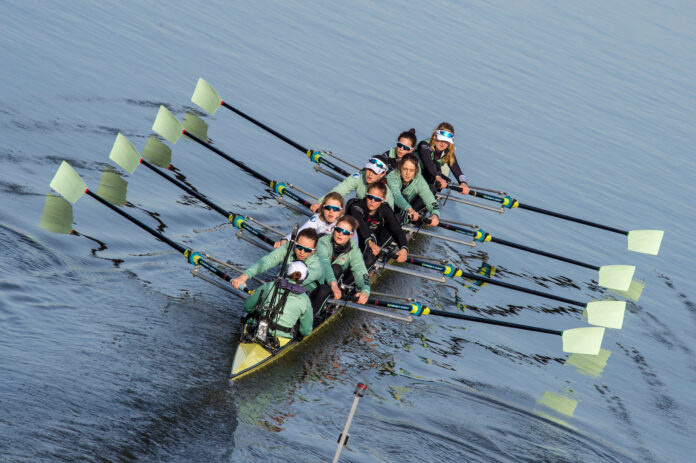
Putney Greater London. United Kingdom, CUWBC Bow.Tricia Smith, 2. Imogen Grant, 3.Kelsey Barolak, 4. Thea Zabell, 5. Paula Wesselmann, 6. Alice White, 7. Myriam Goudet-Boukhatmi, Stroke, Olivia Coffey, Cox Sophie Shapter. after passing through, Hammersmith Bridge, Tideway Week, preparation for the 2018 Varsity Boat Race, Putney Hard, Championship Course, Putney to Mortlake. River Thames, Thursday 22/03/2018 [Mandatory Credit: Peter SPURRIER:Intersport Images]

BY RICH DAVIS
PHOTO BY PETER SPURRIER

Strokes are mostly born, not made, so my first concern is identifying the rhythm-setter of the crew. When rowing by sixes early in the season, try putting potential strokes in the lead seat as a way to see who is the most natural in that position. During seat racing, I watch the strokes almost as much as I watch all of the other rowers I am evaluating. After stroke seat, I focus on the size and technical ability of the remaining rowers. Naturally, the largest athletes end up sitting in the engine room. The middle of the boat is often wider than the stern and bow sections, and placing the bigger athletes there minimizes the effects of their movements. I put the lighter and higher-skilled rowers in the bow to keep the boat running straight. Seven seat is a second stroke of sorts and it is crucial that he or she conveys the proper timing to their side of the boat. Races are won or lost depending on who you have sitting in the coxswain’s seat, so choose wisely there. Try to spend as much time with them off the water as you can—talking, coaching, and sizing them up. Finally, I always make sure to tell my rowers that where they sit has no bearing on who would be first to be demoted to a lower boat. I have found that most young rowers mistakenly believe the seat to which they are assigned represents their ranking as athletes. That is simply not the case.