Home Blog Page 242

August: From the Editor

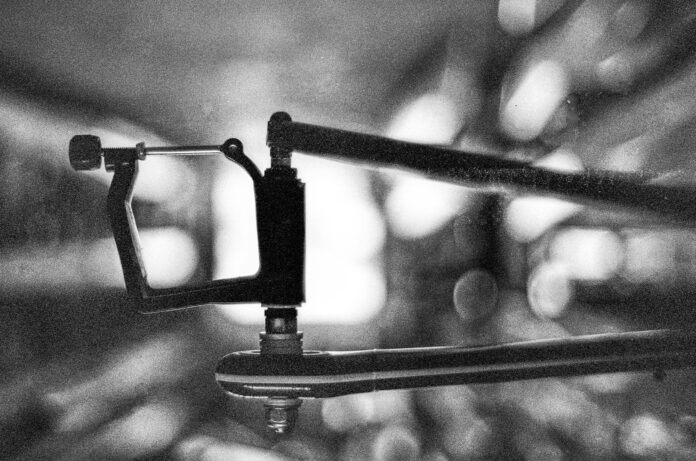
Caversham. Berkshire. UK Oarlock mounted, 2016 GBRowing U23 Trials at the GBRowing Training base near Reading, Berkshire. Monday 11/04/2016 [Mandatory Credit; Peter SPURRIER/Intersport-images]

BY CHIP DAVIS
PHOTO BY PETER SPURRIER

For more than 100 years, this time of year has featured rowing’s summer party: the Royal Canadian Henley Regatta. Crews from both sides of the border, plus more from farther away, gather for a week of hundreds of races on Martindale Pond’s historic racecourse. Racing “The Henley” is a rite of passage no rower should miss. But this year, of course, it’s something we’re all going to miss, and perhaps the fall season as well.

This is not our sport’s first brush with global adversity, however. As the world’s original intercollegiate athletic event (the Oxford-Cambridge Boat Race began in 1829), and America’s first as well (Harvard-Yale, 1852), rowing has lasted through a succession of historic crises: the 1918 pandemic, two world wars, the Great Depression and Recession. As always, we’ll come back and race on. We’ll do it the same way we do our sport–with hard, cooperative work over the long term that focuses on future reward in the face of current suffering. From the pain cave of the third 500, we emerge to cross the line, every time.

During this terrible pandemic, we are coping by adapting. Single sculling and erging are booming, and athletes in other sports are turning to rowing because it’s safer than football and soccer, basketball and ice hockey. Clark Dean, the two-time world rowing junior champion, began rowing because he wasn’t having fun playing lacrosse. The appeal of our sport never dies.

In his last editor’s letter, the late Ed Winchester spoke of   “rowing’s inherent optimism” and sounded a note of hope. “If I’m certain of one thing,” he declared, “it’s that we’ll keep moving forward, one optimistic stroke at a time.”

He was right.

Former National Team Athlete Finds Closure on Ultra-Row

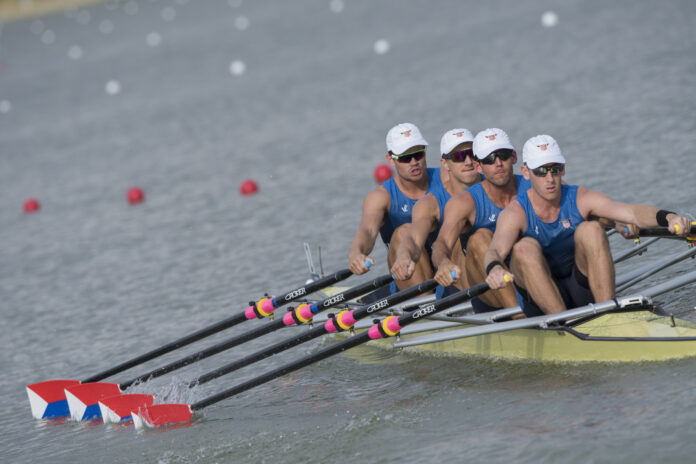
Plovdiv, Bulgaria, Sunday, 9th September 2018. FISA, World Rowing Championships, USA M4X, Bow, Erik FRID, Michael KNIPPEN, Gregory ANSOLABEHERE and Justin KEEN, Men's Quadruple sculls, © Peter SPURRIER, Alamy Live News,

BY LUKE REYNOLDS
PHOTO BY PETER SPURRIER, PROVIDED BY ERIK FRID

Four-time U.S. National Team member Erik Frid recently completed a 318-mile row along the Erie Canal as a way to find closure upon retiring from the sport. Frid’s row consisted of eight-days of rowing, camping, portages, and locks. Rowing News talked with Frid to find out more about his row and why he challenged himself to such a journey.  

Q: What inspired you to undertake this challenge?

A: It’s something that I’ve been thinking about for a while. Obviously, training to qualify for the Olympics during the year, and then that got delayed for a year. And, for a variety of reasons, I’m not going to continue rowing after this year so I wanted something to kind of end things on a positive note.

I’ve always thought of doing a canal row as something to end my career on. Even if trials didn’t go well I was considering it. I got the idea for it from college. I went to Ithaca College and my senior year we did a 60km row on the canal through Rochester and it was just a lot of fun. I just feel like it’s unique for rowing to have a body of water where you can go from point A to point B over several days and the water — for the most part — is safe enough and you don’t have to worry about having to run up on rocks or anything. I’ve always had an adventurous spirit to go out and do stuff like that. I’m a big history buff so the Erie Canal is definitely a historical body of water and it just felt like the right thing. Definitely challenging enough to be somewhat rewarding at the end.

Q: Tell me a little bit about the logistics of it all. You were by yourself the majority of the time, what was like that? 

A: My plan was to do the whole thing unassisted and camp every night. I abandoned the camping thing after about three nights of camping and started staying in hotels. Then my fiance came Thursday and took my stuff for Friday and Saturday which made a huge difference. I was lucky enough to have a Fluid Max single, which accommodates 243 lbs (according to the label) and since the winter when we were training I lost a lot of weight so I had a good amount to work with in terms of the boat class. So I probably had like 30lbs give or take to put gear in. I bought a waterproof bag from Amazon so I was able to put a bag in front of my feet and behind me. My fiance and I have done a lot of backpacking this summer which was great because we accumulated a lot of gear which transferred over to the row so in terms of gear it was pretty straightforward. My biggest worry was just fitting it all in. 

I definitely underestimated how much the deadweight would affect the speed. I mean singles are already somewhat heavy boats in terms of the pickup so having an extra 30-40lbs depending on how much water was in the boat definitely was killer. I don’t think I would do it unassisted again.

Q: As far day-to-day camping when did you row? Did you just pull over to the shore and pitch a tent?

A: The state of New York and the Canal Heritage Way definitely encourages people to kayak and recreate on the lake and canal, besides pleasure boaters, there isn’t really much traffic through there so they definitely like people to get their money’s worth with kayaks. They have a guidebook that kind of breaks down different parks along the way, camping sites, and points of interest. So using those materials was really helpful. I mapped out different areas where I could camp so the first night I just camped on the side of the canal – it’s pretty grassy there. And I definitely had a certain amount of meters I wanted to hit but honestly, it just got to the point — especially on the first day — where I took too long of a break so it was like 9:00p and I thought ‘I should probably stop.’ I definitely underestimated how long it would take especially when you’re going 2:50-3:00 splits. 

Most days I would start rowing around 8 AM and then stop around 8 PM with an hour or two break in the middle. I kind of realized that if you’re not rowing — very slowly — you’re wasting your time. You’re not going to crush 35km or 40km and then hang out for a couple of hours and then crush another 40km at the end of the day. You just have to take it slow and steady.

The most worrisome logistical thing was definitely ‘am I going to find a place to launch?’ and then ‘am I going to find a place to dock.’ Most of the time I could just go up on the rocks and wet launch but you know kayak docks are too high to launch from. I think it’s great that all of these communities are putting in these docks, but they’re definitely not all inclusive docks. Finding an accessible place to dock was not easy.

Q: Did you know there would be safe places to dock and launch from? Or did you just wing it?

A: I mean, honestly, the rocky shores were the best so you wouldn’t get muddy. 

Q: Were you worried about puncturing the hull?

A:
No, more just worried about scratching it. Overall, the boat looks pretty good. I mean I would definitely not suggest this to anyone who is not extremely proficient in a single. The rocks were the best unless I wasn’t wearing sandals. In that case, it was pretty easy to cut up my feet. When you get around Syracuse you start getting Zebra mussels and I definitely sliced my foot pretty bad on one of those. 

The third night I was planning on camping somewhere and then I realized that I needed to do more meters that day because the next day was just going to be too much. I was in the Montezuma Swamp and it was very muddy and there were just not a lot of great places to stop. Plus, I was in somewhat of a residential area so I was like ‘oh I can’t just camp anywhere.’ So I went on Google Maps on my phone in my boat and found a field and was like ‘okay hopefully this is a good place to stop.’ And it was okay, it was pretty muddy, and another invasive species, the water chestnut, is very thorny and I stepped on one of those in the muck. Then there was a 10ft embankment so I had to de-rig my boat. A great feature of the Fluidesign is how easy it is to de-rig so I didn’t need a sling, I’d just put my boat down in the grass. But I had to get the boat up the 10ft embankment and stagger up the embankment and pull it up. It was a real testament to Fluids. 

Q: Tell me a little more about the safety aspect of things. You mentioned you cut your foot a few times. Were you worried at all during the row? 

A: I never felt too worried. I mean the canal overall is pretty narrow and unless I were to pass out I wasn’t really worried about flipping. I think I would’ve been able to stay with my shell and wade it to shore. There were a few days where there were a few boaters around. The only dangerous part is Lake Oneida which is about 20 miles long and pretty wide. You can’t see the other side from where you start so I definitely planned the whole trip to get up early, get on the water, and take advantage of the three-hours of good water that you’ll get on it. 

It’s a western prevailing wind so I started on the west side going east but that morning I woke up and it was an eastern wind, so a headwind. So I was launching that morning and a guy, Gary, who helped others in similar situations on Oneida was there and I said ‘Welp, we’ll just see!’ 

It was windy and there were pretty light rollers and then the wind picked up and there were white caps and my boat was swamped after about a minute of rowing so I had to take it in after about 1km. Luckily, Gary was able to cartop my boat around the lake. 

So, I say I did 318 miles but I actually set out to do 338 but Lake Oneida was hit or miss so I just had to adjust. 

Aside from that, I had a stand-up paddleboard type life vest that has a CO2 cartridge in it or you can blow it up manually, and I had to wear that when I was in the locks. Overall though, I never felt unsafe. Aside from the first day where I might’ve gotten some minor dehydration and heat exhaustion it wasn’t too bad.

Q: How much water were you carrying? Did you have a hydration pack? 

A: Well, I was kind of dumb. I started out with two water bottles and then I was just going to use a Sawyer water filter but I quickly realized that it was still murky after filtering it. And those things are really only made for like mountain springs so I just started getting bottles of water and distributing them throughout the boat. Finding water was definitely a bit stressful. When I would stop I would just hope there was a water spigot. I found that sometimes they would be closed due to Covid so that would mean I’d have to walk a mile or so to the gas station. 

Q: When you stopped or pulled over for the night did you check-in with someone? 

A: Other than texting my girlfriend and parents that was pretty much it. Friday, when my family showed up, my fiance was there and then the same for the half-day I did on Saturday, it was a luxury. Not carrying stuff, having someone bring you lunch, seeing a friendly face. 

Q: What was it like transitioning from camping to staying in hotels. Did you ever think about just quitting the row altogether? 

A: Only the first or second day. It’s kind of like the first time you’re away from home where you just want your mom or your girlfriend or something like that. It was like ‘you know I could definitely always ask someone to do the eight-hour drive or whatever to come to pick me up.’  But honestly, it was probably the fact that I wasn’t going to make someone drive all the way to pick me up. At the very least, I’ll just lower my ambitions and make it three-quarters of the way or something. I also had a day built in so I could at least row into the Sunday at the end, but I didn’t have to do that thankfully. 

Q: Did you feel like you were ready physically?

A: I probably should’ve done more training, to be honest.

I would say my training was pretty laughable. I was definitely tapping into all the work I was doing in the winter and all the work of years and years of training before that. I was probably rowing about four times per week in the months leading up to it. I was working out pretty much every day just doing cardio. I probably would have faired better if I had done some training plan but that was also part of the fun of it — part of the misery.

The hardest things were just mentally getting through it. The first day or two I got like 15 or 20 blisters on my hand. So I ended up buying gloves at a gas station the third day. I have never rowed with gloves before but it was like, ‘I have to do this.’ You can only go as hard as your hands can take it and then my legs never really hurt because I was going slow enough. Your legs can go forever. It was really just my butt hurt and my back hurt pretty bad which was another benefit of going into the hotel. Just being on a mattress is worth it for your back. 

Q: You said you’re retiring from rowing. What are your plans for the future?

A: I was definitely planning on being done this year and then the pandemic started. I wanted to finish out the quadrennial. It’s kind of a sensible time to stop. 

Once the pandemic happened we had to postpone our wedding, and that wasn’t really a factor anymore but it’s just sort of tough doing the training lifestyle and just feeling like you’re putting your life on hold. My fiance and I really wanted to move to the west coast so I don’t know, it just felt like I was putting things off personally and professionally. 

If the pandemic shows you anything it’s really that you can’t mortgage your future and your personal life and, in a lot of ways, your happiness because can’t just wait for that stuff. It would’ve been great to have the Olympics, and hopefully qualify and go but sometimes you kind of realize when the finish line is extended further you have to ask ‘is this the best thing for me?’ 

I definitely knew this was the right decision but I wasn’t settled or hadn’t really emotionally processed it all and this row kind of made me feel like it was absolutely the right decision.

Lucas WILHELM and Erik FRID at the 2017 World Cup III.

Hydrow and IRA Announce Three-Year Sponsorship Commitment

BY ED MORAN
PHOTOS BY LUKE REYNOLDS AND COURTESY HYDROW

When collegiate rowing was shut down this spring as a result of the Covid-19 pandemic, the Intercollegiate Rowing Association was forced to look at not just if there would be a regatta in 2021, but how the extreme loss of revenues to participating schools would impact the ability to hold future championships.

While there is no way of predicting if the pandemic will be controlled enough to allow the regatta to be held in 2021, a large part of the funding issues have been solved for at least the next three seasons with a new sponsorship agreement between the IRA and Hydrow, makers of the Live Outdoor Reality™ (LOR) rower.

The sponsorship, which was officially announced Monday morning, will fund “a good portion,” of the cost of running the next three regattas and enable the IRA to not significantly increase the cost of competing to schools who want to participate, according to IRA Commissioner Gary Caldwell.

“This is a three-year partnership for the next three IRAs that we run,” said Caldwell, who added that the sponsorship will remain in place for three consecutive championship regattas regardless of when the IRA is next run.

“Who the heck knows if we are going to have a regatta next spring,” Caldwell said. “We don’t even know who is going to be at school. Right now, the sponsorship goes from 2021, through 2023, and if it doesn’t begin in 2021, it will roll over and go from 2022 to 2024.

“What this provides us, at least initially in the first year, is a budget backstop,” Caldwell said. “It gives us budget relief when we don’t know how many schools are going to be able to show up if we do run a regatta,” he said. Caldwell pointed to the economic loss schools have experienced since the beginning of the pandemic, and the fact that those losses are being made even more extreme by the cancellation of collegiate football schedules being announced in many of the biggest conferences over the past several weeks.

“Right now, with everything that is happening in college football, it’s a pretty good indication of what college sports might be experiencing in the spring. We just don’t know yet,” Caldwell said. “We’re going to have to feel our way through this, but when we release this news to the college community, and the coaches and administrators and sports information directors, the most important message to them is that this really puts us in a position where we have flexibility with a significant increase in our financial state that will allow us to not have to go to the colleges and say it cost you X amount to be at the regatta last year and it’s going to cost you double that this year.”

“Unlike the NCAA, we are a cost share championship, where the membership shares in the enterprise and there is no mother organization that is coming with a big check so that nobody has to pay for their participation in this sport,” he said.

For Hydrow, the sponsorship an extension of a relationship the company has had with the IRA dating back to when the company was founded in 2018. Hydrow has been a sponsor of the regatta since then, and has had plans to expand the level of support since.

According to company CEO and founder Bruce Smith, Hydrow is excited to partner with the IRA because it will help the company not just to support the sport but spread the story of rowing throughout its customer base.

According to Smith, most customers who purchase the live virtual reality rower the company produces have no background in rowing. “Ninety-six percent of the people who buy Hydrows have never even touched a rowing shell, or even owned a rowing machine before,” Smith said.

“They are all brand new to the sport, and for us, this partnership is a great opportunity to share with non-rowers one of the coolest stories in our sport. It allows us to share the extraordinary history of the Intercollegiate Rowing Association, and the beautiful trophy, and the constant competition and the longevity of the event, and the role that it has played in the sport in the United States.

“Nobody knows about that among our customers, and it’s a great opportunity to share the story of rowing.”

Smith said that since getting started in the rowing machine and wellness product market, the company has been thriving. But, unlike what the pandemic has done to the economy of collegiate athletics and associations like the IRA, sales of the Hydrow rower have ballooned since the spread of the virus forced people to find ways to stay fit on their own.

“Sales were crazy before the pandemic, but then the pandemic made them literally explode by seven times in the month of July over January,” Smith said. “For a wellness product to sell seven times what it sold in the doldrums than what it sold in the middle of the year is just crazy.”

Smith said Hydrow has always had plans to increase their sponsorship level with the IRA, but the increase in sales has allowed them to do just that now when the need is greatest.

“The pandemic has helped accelerate our business to the place where are able to continue to invest in marketing and use some of those resources to not just pay it back but really to share the history of rowing with people who have never had an opportunity to learn about it, and we’re really excited about that,” he said.

The Big Bang Theory

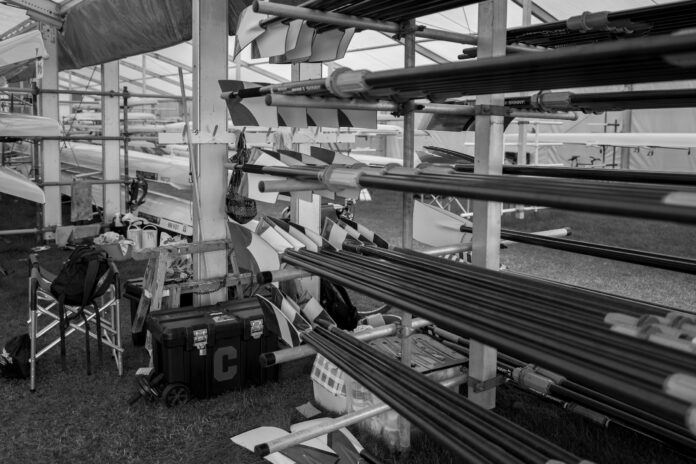
Henley-on-Thames. United Kingdom. "Cornell Corner" Cornell University `USA. Oars racked and surronded by Boatman and coaches equipment. 2017 Henley Royal Regatta, Henley Reach, River Thames. 07:00:05 Tuesday 27/06/2017 [Mandatory Credit. Peter SPURRIER/Intersport Images.

BY ANDY ANDERSON
PHOTO BY PETER SPURRIER

Dear Doctor Rowing,

A couple of months ago, upon entering the musty, comfortably disheveled boathouse that I love, I noticed a poster board with birthday greetings attached. Happy 150th Birthday Potomac Boat Club! It was sent from FRG Germania of Frankfurt am Main, Germany, and mentioned other clubs around the world that were all founded in the same year:1869. What was going on in 1869 that produced so many new rowing clubs?

Yer Pal,
Stu

An excellent question, Stu. Just why are so many clubs celebrating their sesquicentennials? Let’s see: In 1869 the country was still recovering from the Civil War, the industrial revolution was in full swing, the Cincinnati Redlegs, the first professional baseball team, were organized, and Rutgers played Princeton in the first game of American football. Harvard and Yale had initiated their rowing rivalry, the first American intercollegiate athletic competition, 17 years earlier. Organized sport was obviously catching on. But was there a spark that ignited so many rowing clubs?

By 1869, there were already approximately 90 American rowing clubs and rowing was probably the top spectator sport in the land. But what really kicked the formation of rowing clubs into high gear was the first transatlantic dual competition. Harvard took a coxed four to London to race against their counterparts from Oxford in The Great International Boat Race. Called the most important race in history, it was the Ali-Frazier fight of its day. People sat up and took notice.  

The intercontinental challenge had been brewing for a while. In 1867, Harvard had hoped to enter a regatta at the Paris International Exposition where they might have raced Oxford and Cambridge, London Rowing Club, and boats from France, Holland, Germany, and the fearsome victors from Saint John, New Brunswick, Canada.  But only seven oarsmen could be mustered, and Harvard stayed home. The next year was spent squabbling over whether to race in a four with or without coxswain. Finally, in April of 1869, William Simmons sent a challenge to the president of the Oxford University Boat Club. Harvard “hereby challenges the OUBC to row a race in outrigger boats from Putney to Mortlake, some time between the middle of August and the 1st of September, 1869, each boat to carry four rowers and a coxswain… This challenge to remain open for acceptance one week after date of reception.”

Harvard, with about 1,100 students, chose a coxed four to compete against the larger 2,000-strong Oxford. They also sent a challenge to Cambridge. Oxford accepted, although there was grumbling that the OUBC existed for the sole purpose of racing Cambridge, not some upstart Americans. But accept they did. (Cambridge delayed answering until it was too late.) Oxford went into training on May 19. Harvard had been together a month longer. 

The course that was stipulated, was, of course, the already-famous four-and-a-half-mile Boat Race course on the Thames in London. Harvard rowed a series of tune-up races throughout the early summer, culminating in the Boston City Regatta on July 5, which featured a large prize and drew boats from all over the East Coast.

The press jumped into the ring with the British papers giving Harvard no chance of winning. National pride bloomed, Americans claiming that Harvard would have to change its rowing style in order to deal with the “turbid, muddy, chemical mixture of the Thames.” There was genuine admiration on both sides of the Atlantic for the courage of Harvard and their willingness to embrace such manly competition. With the laying of the first transatlantic telegraph cable in 1858, news traveled between Europe and North America with unprecedented speed. 

Harvard student theatrical performances raised some money and alumni kicked in. On July 10, the crew boarded the steamer City of Paris in New York and set sail, landing in Liverpool 10 days later. They moved into a house in Putney and began to prepare. Harvard tried out six different shells before settling on their racing craft. Every detail of their training, their diet, their moods, was mentioned and debated. 

There was probably no greater difference between the crews than in their technique. Oxford sat up “almost painfully straight” as Harper’s Magazine described it. “The Harvard men…had longer outriggers proportionately. They did not seem to be trying to look so grand as their rivals.”

The race itself on August 27 was said to have been viewed from along the river banks by as many as a million spectators. The carnival atmosphere and prodigious betting that spilled out from pubs made it the greatest sporting event of its time. Harvard took an early lead, but with a couple lengths of open water, the Harvard coxswain, Arthur Burnham, made an inexplicable gaffe: on the winding course he did not move to the inside of the Surrey turn, staying wide. Oxford caught Harvard in the second half of the race and won by about “half a length of clear (open) water.” The British press lambasted the poor coxswain, but he said that the habit of moving in front of your opponent and taking their water was a professional’s tactic and something that gentlemen should refrain from.

The race was reported on throughout the world, and rowing, already popular in Europe, spread quickly, as the host of boat clubs that were founded in 1869 shows. In the United States, the number of boat clubs went from 90 in 1869 to 289 in 1873. American colleges started to row and the first governing body of college sports, the Rowing Association of American Colleges, was founded in 1871. Let’s raise a glass to the nine clubs celebrating their 150th year: our very own Riverside Boat Club; Grosvenor Rowing Club in Chester, England; Scarborough Rowing Club in Scarborough, England; Auckland Rowing Club in New Zealand; FRG Germania from Frankfurt am Main, Germany; Canottieri Armida in Torino, Italy; Clonmel Rowing Club from Ireland; and Koninklijke Roeivereniging in Brugge, Belgium. Ready all, row!

Supporting the Protests

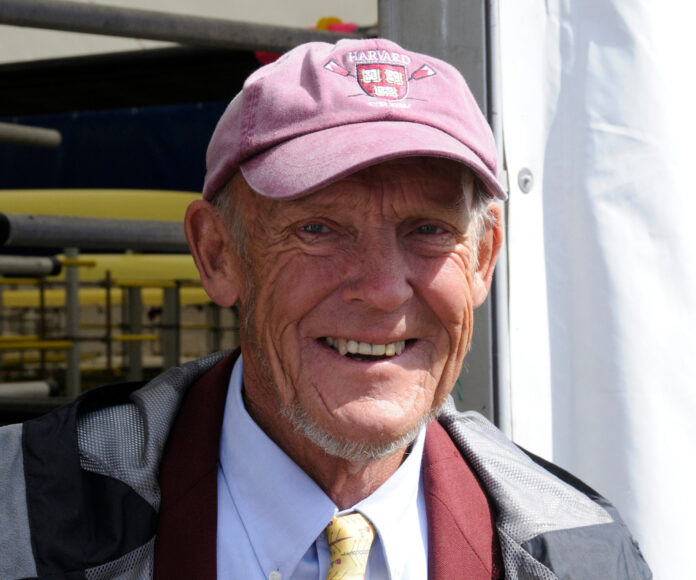
Henley, GREAT BRITAIN, 2012 Henley Royal Regatta. Harry PARKER, Head Coach, Harvard University. Sunday 15:33:53 01/07/2012 [Mandatory Credit, Intersport-images] ..Rowing Courses, Henley Reach, Henley, ENGLAND . HRR.

BY ANDY ANDERSON
PHOTO BY PETER SPURRIER

In the wake of the murder of George Floyd and the protests that have happened all across the country, people have remembered the protests and marches of the summer of 1968. In any photographic history of 1968, you will find the iconic photographic image of American track athletes Tommie Smith and John Carlos standing on the Olympic podium with upraised clenched fists in black gloves. Today, there is renewed interest in that moment and in their gesture.

Smith and Carlos were inspired to protest the social issues that were sweeping the country. Like many Black Americans, they saw the lack of progress of the civil rights movement, epitomized by Dr. Martin Luther King, Jr.’s assassination the previous March. Harry Edwards, a Black sociology professor at San Jose State, had founded the Olympic Project for Human Rights, which demanded that more Black coaches be hired and threatened a boycott of the Mexico City Olympics if South Africa and Rhodesia were permitted to compete. Their gesture promoting Black Pride and social justice has become the most famous image of that, or arguably, any Olympics.

A post that has been making the rounds on Facebook shows a copy of a letter that Harry Parker, coach of the Harvard eight that competed in the 1968 Games, received from the president of the U.S. Olympic Committee. It reads:

 “Upon my return from Mexico, I noticed on my desk a mimeographed letter…signed by eight of your crew members. What I have not been able to understand is why, with the selection of the Harvard Eight-Oared Crew to represent the United States at the Olympic Games, most of those crew members immediately expelled from their minds the purpose and the objective for which they were selected and embarked on a rather strenuous program of civil rights and social justice with other members of our Olympic delegation to Mexico City. Civil rights and the promotion of social justice may have their place in various facets of society, but certainly this sort of promotion has no place in the Olympic Games.”

Perhaps most infuriating, Douglas Roby, the USOC president, went on to lambaste Coach Parker.

 “After meeting with you in Mexico City and having held a brief examination of some of your athletes, it is my feeling that you are probably the one most responsible for taking the Harvard crew, and possibly their minds, away from the purpose for which we took this group to Mexico City to represent the United States.

“At one time I, personally, was in favor of disqualifying you and your crew for acts grossly unbecoming to members of our Olympic Team. I am now glad that I did not encourage such a harsh action, for I feel that the miserable performance of you and your crew at Mexico City will stand as a permanent record against you and the athletes which you led.

“As a boy I had great admiration and respect for Harvard and the men it produced. Certainly serious intellectual degeneration has taken place in this once great university if you and several members of your crew are examples of the type of men that are within its walls.”

Sincerely yours,

Douglas F. Roby

This was more than just a “shut up and row” letter. The venom unleashed on Parker, who had the gall to defend his athletes and their right to have opinions about social justice and to express them in letters to their teammates, can have come only from a deep well of racism.

Why blast the Harvard oarsmen? I spoke with Paul Hoffman, the coxswain, and the one who more than anyone else was in deep trouble with the USOC.

 “You have to remember that the summer of 1968 was a time of unprecedented chaos. Martin Luther King, Jr. and Bobby Kennedy had been assassinated. There were violent protests in most American cities. We were mired in Vietnam. The Democratic Convention in Chicago produced what was officially called a ‘police riot.’ Protesters were beaten and tear-gassed by the aggressive policing that Mayor Richard J. Daley unleashed.

“It seemed like the world was coming apart, and here we were, nine white guys going up and down the river all summer. [The Olympics were held in mid-October.] Most of the guys in the crew wondered if we shouldn’t be doing more. We decided that if we won the Olympic trials, we would speak to Professor Harry Edwards and learn about the Olympic Project for Human Rights.”

In July, after the closest, most exciting Olympic trials race in history–Harvard beat Penn by .05 of a second–the oarsmen invited Edwards to Cambridge to meet with them. Before the meeting was to take place, the oarsmen realized they had not informed their coach. They met with Parker the night before Edwards’ visit and told him Edwards was coming to the boathouse to speak to them. Parker turned to them and said, “I trust that by now you know me well enough to know that I, too, support these views and goals. You also know that I’m a rowing coach, and we need to be sure that nothing interferes with our training together.” They agreed.

They didn’t quit rowing and devote themselves to the cause, of course. They had put in far too much work to let themselves be distracted from their goal of an Olympic medal. But they did hold a press conference with Edwards, where they announced their support of the Olympic Project for Human Rights and sent a letter to every Olympic-team athlete asking them to begin a dialogue with their teammates, especially Black athletes.

 And what blasphemous things did the letter that so outraged Mr. Roby say?

“It is not our intention or desire to embarrass our country or to use athletics for ulterior purposes. But we feel strongly that the racial crisis is a total cultural crisis. The position of the black athlete cannot be separated from his position as a black man or woman in America. America can only acquire greater dignity and greater hope by facing its most grievous problem openly and before the world…Surely the spirit of the Olympic Games requires us, as white participants, to explore all means at our disposal to further the cause of brotherhood and the claims of equality of our black colleagues.”

You owe it to yourself to watch the video of the 200-meter men’s track finals. Carlos, the world record holder, looks strong, and then Smith finds an extra gear and is gone. Carlos looks over at him, the cardinal sin of sprinting – think of looking out of the boat – and Australian Peter Norman noses out Carlos for the silver. It’s a beautiful race. Later that afternoon, on their way out to the awards ceremony, coxswain Paul Hoffman congratulated Smith and Carlos as they prepared to walk into the stadium. Norman asked Hoffman if he had another Olympic Project button for him to wear because “Australia also has racism; it also needs human rights.”

 Hoffman didn’t have another but he invited Norman to wear his button on the podium. When he said yes, he gave it to him. Smith and Carlos mounted the podium in black socks, holding their shoes in a gesture meant to draw attention to how many Black people were impoverished. They received their medals and proudly and defiantly raised their black-gloved hands.

Immediately, the firestorm began. Olympic officials were outraged. The purity of the Olympics was despoiled in their eyes. Men in power never see irony, and the International Olympic Committee members were no exception. The professed Olympic ideals of excellence, respect, and friendship apparently did not include open support of social justice or human rights.

Someone saw Hoffman give Norman his button, He returned to the press box, where he had been sitting, and was introduced to Smith and Carlos’ wives.

 “Coxswains have a lot of down time at the Olympics,” Hoffman says, “and I enjoyed track and had just seen a great race. I thought ‘If an Australian wants to join our guys by wearing a Project button, why not?’”

Three days later, the night before the finals, Hoffman and Parker were summoned by U.S. Olympic officials to a fancy hotel in Mexico City, where they were grilled for hours about their part, meager though it was, in the protest. Hoffman had heard that he might not be allowed to race and feared that if that were the case, his crew would not get in the boat. According to Kathy Keeler, Parker’s widow, Harry had said that if the coxswain was not in the boat, the crew would not race. Finally, grudgingly, the officials allowed them to return late at night to the Olympic Village to let the crew know that they could race the next day.

The race did not go well. The 7,000-foot altitude and various GI problems had dogged the oarsmen since arrival. For the finals, they had to rearrange the boat, including the stroke. Their sixth place was crushing.

Parker received the letter a few days after arriving home. He didn’t share it with the crew for several years, most likely thinking he should shield them from its damaging words. Roby had copied the president of Harvard, Nathan Pusey. When the president and Harry met, Parker asked how he proposed to respond. Pusey said, “I don’t think it deserves a reply.” Parker concurred, and the matter ended. You can find the full letters in My Life in Boats, Fast and Slow, the 2018 book by six man Andy Larkin.

In recent months, as Black Lives Matter has come to the forefront, the media have once again focused on the Smith/Carlos protest. As a nation, we are much more diverse, but money and power still reside disproportionately in the hands of white Americans. Not all that was hoped for has changed after 1968. The Harvard crew’s efforts didn’t effect the change that they, too, sought, but they did give us an example of trying to do the right thing. The conversation has changed from not being racist to how to be anti-racist. Action, not words, is what a younger generation is demanding. This time, let’s get it right.

Wild for Salmon

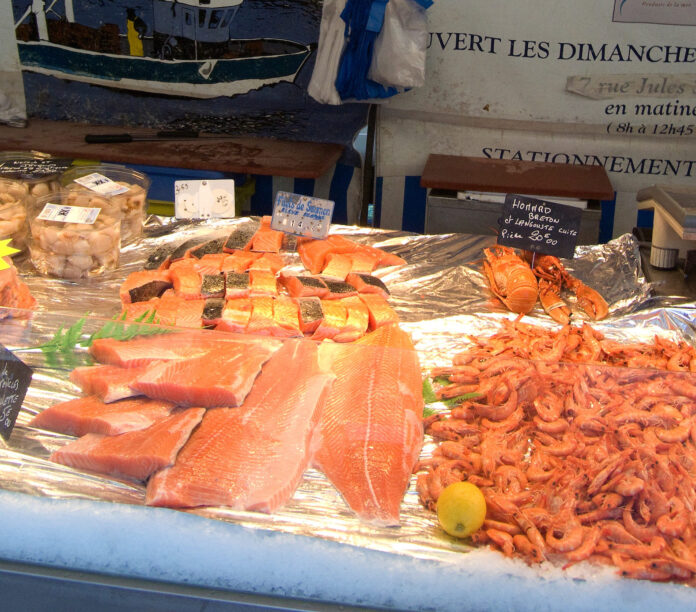
Rennes, FRANCE, General View, GV, produce, Fish and Seafood on display, stall at Rennes Market, Saturday morning market, Brittany. [2009 Boxing day Market] Saturday 26/12/2009 [Mandatory Credit Peter Spurrier Intersport Images]

STAFF REPORTS
PHOTO BY PETER SPURRIER

Salmon may not be your first choice as a post-workout recovery food, but it should be.

Wild salmon is loaded with heart-healthy omega-3 fatty acids—the so-called “good” fat that reduces inflammation and lowers the risk of heart disease.

It’s also protein-rich and a powerful source of bone-strengthening Vitamin D, which we could all use more of during this season of shortened daylight hours. 

A Rower Unbroken

Andrew Todd rows at Elk Lake in Victoria British Columbia Canada.

BY JEN WHITING
PHOTOS BY KEVIN LIGHT

What is it that defines you as a rower? Is it wins, or the drive for continuous improvement? Is it the quest for the perfect stroke, or the pain at the end of a 2000-meter erg test? What if, at the height of your rowing career, all that defined you suddenly went away. Who would you be? Would you still be a rower?

This story begins after a telephone call. It begins after a school bus goes through a stop sign without stopping. It begins after Canadian national team training ride ends in an ambulance, the siren squealing as it careens toward Victoria Hospital in London, Ontario. The voice on the other saying simply, “Come quickly. There’s been an accident.”

Andrew Todd has the body of a natural lightweight. His tousled hair and sometimes-beard welcome you in, as if he’s been waiting to talk with you. He has the kind of openness that is usually reserved for the untested, but this lithe rower has passed more tests than a national team rower typically has to.

In May 2013, Todd received the invitation he’d been hoping for—to try out for the Canadian lightweight men’s national team. Todd jumped at the chance. His girlfriend, Jenna Pelham, saw him off on a bus to London, Ontario. Three days later, a school bus blew through a stop sign and hit Todd as he and his new teammates were cycling on the back roads outside of London; he was pinned under the back wheels. The bus came to a stop 20 feet later. Todd’s pelvic bone was crushed. A large chunk of his right knee was gone, and the paramedics in the ambulance gave him a 50 percent shot at making it to the hospital alive.

To most people, this would be the end of the story, or the rowing part of the story at least. But for Todd, this was just the beginning. Even in his hospital bed, as his leg was in a splint awaiting surgeries for skin grafts and bone transplants, he kept a dumbbell for lifting. 

Twenty-eight months later Todd stroked the Canadian adaptive national team’s leg-trunk-and arms coxed four (LTAMix4+) to a bronze medal at the 2015 world rowing championships in Aiguebelette, France, qualifying the boat for the 2016 Paralympic Games. It wasn’t the boat he was trying out for when he arrived at the national training center all those months ago, but the road to the starting line isn’t always a straight one.

Todd started rowing in 2007 as a novice at the University of Ottawa and progressed rapidly during his time as a student. “In the summer of 2009, I started to take it seriously. I thought, ‘Maybe I can actually go somewhere with this.’”

Todd has an affable way about him. He pauses slightly while telling me the beginning of his story, and I find myself looking forward to the soft chuckle that often ends his sentences. “I figured out that the formula wasn’t complicated. The more work you put in, the faster you’re going to get.” 

In 2011, while still at the University of Ottawa, Todd tried out for the under-23 lightweight pair. “I’d gotten through selection, but my time trial wasn’t fast enough.” No longer eligible as an under-23 athlete, Todd stayed in school and continued training.

“I took 2012 to refocus my training. I knew it would take at least a year—maybe a year and a half—to get to the level I needed to be at to even try out for the senior team. Partway through that year I started communicating with Al Morrow [the Canadian lightweight men’s coach].” Todd shares his story freely, but like all of the elite rowers I’ve spoken with, he is cautious when it comes to the details of his training. 

“I got added to his mailing list for the training program of the guys at the [national training] center. I was in school, I started doing what they were doing.” He draws his thoughts back from the edge of memory. “I ended up doing more training and less racing that year to make sure I got myself to where I needed to be.”

That spring, after the national development trials, Todd received his invite to join the squad in London. This was the path he knew rowers took to a get a chance to make the national team. This was his path now. “To be honest, I don’t remember how many days after arriving at the center the accident happened.” 

After the accident, Todd spent three months in the hospital. His pelvic bone had healed, but it left him with diminished power and range of motion. His right ankle mobility was all but gone. He was put on a waiting list for a bone transplant for what remained of his right knee.

While he waited, he made up a small training program that he could do in his hospital bed. Gord Henry, the founder and owner of Fluidesign, visited Todd in his room. “I knew this kid wasn’t done,” Henry told me. “I told him I’d give him a boat to train in when he got out. He wasn’t done rowing.”

Todd’s soft laugh again captures my attention, as if he’s shy about the details, “I’d wake up every morning and try to make sure I was one step closer to getting back in a boat. After the first month, I didn’t need the nurses to help me roll over. After six weeks, I could get into a wheelchair with help. I spent the first year just trying to get moving again.” He hesitates for a moment. “Sitting up for the first time was probably one of the hardest parts of the entire recovery. After lying down for that long, when you first sit up, it feels like you’re upside down.”

After his release from hospital, Todd continued his recovery at an assisted living home. A full year after the accident, in May 2014, he met with a prosthetic manufacturer who designed an “off-loader” brace for his right leg to divert the load from the medial side of his right knee.

“I still hadn’t gotten the bone donor surgery, but my surgeon cleared me to row.”

I stop him here. “Wait, how mobile were you at this point?” I ask.

“I was able to start walking. I’d started training in the eight and pair. I’d lost power and mobility in my knee and my right ankle, and my quadricep was—still is—partially detached from my knee, but I could row.”

Like every elite athlete, if he could row, he did the next natural thing: he entered a regatta. “I went to the Independence Day Regatta in Philadelphia in July 2014 to row the lightweight single. I wanted to feel it, to test it a bit. I was about to bring my boat down to the river when I got the call.” Telephone calls seem to figure prominently in Andrew Todd’s story. “The call came from Mount Sinai Hospital in Toronto. I had 24 hours to get back to Toronto for my bone transplant.”

Todd’s surgery would be, he knew, a potential game-changer: it would rebuild a portion of his knee. “The medial femoral condyle, the tibial plateau,” he ticks off the details. “My surgeon tried to put some of the meniscus in, tried to give me the MCL from the donor.” He trails off, then breathes in deeply.

“Dr. Alan Gross, my surgeon—if he wasn’t around to do this kind of surgery I wouldn’t be able to row. My knee would be fused straight or I would have lost the lower half of my leg. As far as I know, those were the two options.” In the short term, however, it started his recovery all over again. 

“I’ve had lots of experience with recovery. Each time after a surgery, my knee has absolutely no bend and I always think it may never bend again. But with hard work and physical therapy, it does. It always does.”

It’s here that I begin to see how the next chapter unfolded. Todd recovered from the bone transplant surgery, resumed training, went through selection for the adaptive four that was headed to worlds, and stroked the crew onto the medal stand. 

I ask Pelham for more details on Todd’s journey from the hospital bed to the podium. Pelham has been with Todd every step of the way. The two met in the novice program at Ottawa two years before the accident. It was Pelham who got the first call from the hospital, who has been with Todd throughout each surgery, and who now heads out in a double with him as he continues his remarkable return. 

“He was in rough shape,” she says, recalling the first time she saw him in the hospital. “Maybe not immediately, but I quickly switched to, ‘Well, it is what it is, and we have to move forward.’ We tried to approach it as,” she pauses, searching for the right word, “logically as possible. It was easy for me to have a positive attitude because Andrew’s attitude was out of this world.”

I had noticed this. Not once in my conversations with Todd had I ever detected even the slightest hint of negativity. It was as if he knew what he had to do, and he went about getting it done. At the end of one conversation with him, he shared with me that, after the world championships, an infection had developed around some of the hardware of the bone transplant. As we spoke, he was receiving an intravenous course of antibiotics. He’d been restricted from upper-body training because of the drip bag he had to keep attached to his arm for six weeks. “On the bright side,” he says, “it’s been four-and-a-half weeks. And I’ve been cleared for the spin bike.” He laughs again, that sincere laugh of a man who has seen the best of himself and yet still seeks better.

And it was here that I wanted to dig deeper. Andrew Todd had been at the height of his rowing career when one moment changed it all. The success he’d had racing against his peers had won him an opportunity to try for a seat on the Canadian team. When it changed, and he found himself as a fully-classified para rower, did it feel the same to him?

“Ever since I started rowing, I’ve preferred [rowing] port. Most of my results, however, pre- and post-accident, have been on starboard.” I struggled to see how this was answering my question. “Now the fact that my left leg is stronger than my right, it makes sense to row starboard, to rely on the inside leg, which has better compression.” Leg press tests of his injured leg show it has 70 percent strength. “Port still feels more comfortable, but biomechanically I’m stronger on starboard.”

This was an elite athlete talking. I ask about a life-changing event—a near-fatal accident—and he answers with an analysis of port versus starboard.

Amanda Schweinbenz, the coach who took the Canadian para four to worlds, watched Todd as he trained in an adaptive boat when, after his bone transplant surgery, he couldn’t walk well, but he could row trunk-and-arms. 

I ask Schweinbenz about Todd’s injury manifests itself in his rowing. “You notice Andrew’s injury when he’s standing beside you. They shaved off a bit of his knee and that gave it a different angle, so he stands on the side of his foot to relieve the pressure. But in a boat, no, you don’t see it when he’s rowing. We lowered his foot stretchers a bit, to get him more reach at the catch, but we didn’t change anything else.”

Todd talks about rowing para, referencing the Paralympics he hopes to qualify for. “I got into it to show people that para-rowing should be taken seriously. It’s why I compete against able-bodies in regattas. This is a sport to be taken seriously. My intent is to make the four for 2016 Rio Paralympics. Moving forward, if my body will allow it—if my knee will allow it—I’ll give able-bodied rowing another go. But I have to give Amanda a lot of credit. She understands people with disabilities. She doesn’t back off. She says, ‘We’re going to tackle the necessary training.’” He smiles, “You get some coaches—through no fault of their own—who are hesitant to push para athletes because they don’t want to hurt them or make their disabilities worse. She knows when to push people and when to back off because of their disabilities.

“I’ve learned how to train through recovery. When the surgeon says I can hit it hard, I hit it hard. When he tells me to ease off, I listen. The biggest thing I’ve learned is that when you can hit it hard, make it count.”

I ask Pelham if the accident changed Todd’s rowing. “One thing changed,” she says. “Before the accident he wasn’t afraid to take risks. Now he has an ‘I have nothing to lose’ mindset. He finds ways to get around the problems.” A beat passes. “He has no fear now.”

I ask Todd one last question. Where does he get his resolve, his tenacity? He answers it as most rowers probably would.

“The stubborn part of me is one of the few cards I have. I’m not the fittest guy. I’m not necessarily the strongest guy. It was just the training mentality I took from Day 1. Just battle it out. On the Ottawa River, where we started rowing, you row down 12 kilometers, spin, and row another 12k back. I learned there what ‘battle paddle’ really means. It’s supposed to be steady state, 18 to 20 strokes per minute, but you go all out to make sure your bow is one foot in front of all the others.”

Maybe that’s what defines this rower. When everything is taken away, fight to take it back.

Andrew Todd rows at Elk Lake in Victoria British Columbia Canada.

Pandemic Shutdown Could be a U.S. Sculling Plus

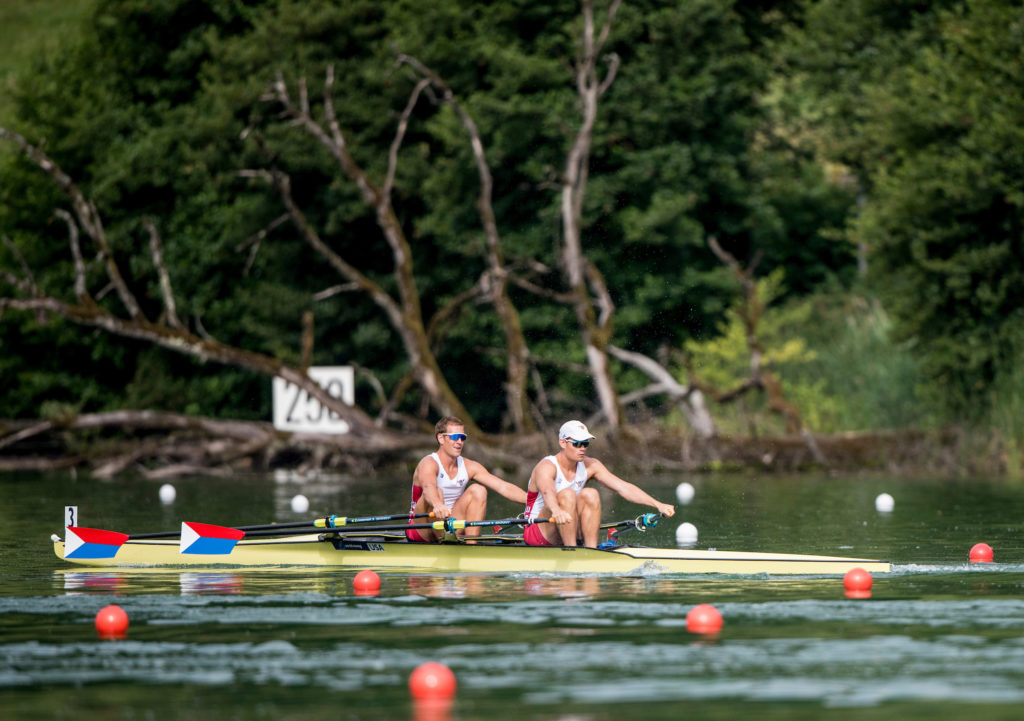
Lucerne, SWITZERLAND. USA 4X winning the men's Quad Sculls, at the 2008 FISA World Cup Regatta, Round 2. Lake Rotsee, on Sunday, 01/06/2008. [Mandatory Credit: Peter Spurrier/Intersport Images].Lucerne International Regatta..Crew Bow, Matthew HUGHES, Samuel STITT, Jameie SCHROEDER and Scott GAULT. Rowing Course, Lake Rottsee, Lucerne, SWITZERLAND.

BY ED MORAN
PHOTO BY PETER SPURRIER

Months of being off the water through the Covid-19 shutdown finally ended for U.S. Olympic hopefuls across the country. Gradually making their way back to the U.S. national training-center locations and high-performance clubs, athletes are patiently restarting preparations for the postponed Tokyo Olympic Games.

Still, the scene everywhere remains very different from what it would be if the world were back to normal. The virus that forced the loss of an entire rowing season is still very much a threat. Mitigation guidelines that include social-distancing mandates remain in place, and the only rowing being done is in singles. And that will probably be the reality through the summer and into the fall.

But with the Olympics now 14 months away, no races or regattas in view–and even the fall head-racing season in doubt–most coaches believe this is more an opportunity than hindrance.

“I’m kind of excited about it. I think it will be really good for us,” said U.S. women’s head coach Tom Terhaar. “In the past, when we did row singles, it really helped. We haven’t used the singles very much in the past four years, so this is a really good opportunity to kind of balance some bodies out and get a better foundation for moving back into sweep down the line.”

Across the country, at the men’s training center in Oakland, California, men’s head coach Mike Teti says much the same thing.

“It’s fun because it’s something new, and I’m all for it,” Teti said. “It’s good they’re rowing singles, and I think they are getting better. When you get into a sculling boat, just because it’s new, you’re going to be getting a little bit better almost on a daily basis.”

It’s not only the national team and Olympic aspirants being brought back to the sport in singles only. Junior crews across the country are also going out in singles only, and will continue mostly likely through the summer and possibly the fall, developing skills they might not have had a chance to embrace in team sweep boats.

There is no debate among coaches at every level that rowing in singles improves technical ability, and that when junior rowers are introduced to sculling at younger ages, they develop into better rowers in both sweep and sculling.

One question that can be asked now that clubs and the national-team training centers are being forced into singles exclusively is: Can it have an immediate impact on U.S. success in international sculling competition?

The most frequent answer: yes, but probably not in time for the Tokyo Games.

“Do I think it’s going to have an immediate transformational effect on sculling in the U.S. on the [senior] international side?” asked Matt Imes, USRowing director of high performance. “That transformational effect starts at the younger [junior and under 23] levels,” 

Looking Toward Tokyo

At the conclusion of the 2019 World Championships, U.S. women scullers had qualified crews for the Tokyo Olympics in three of the four available boat classes. All but the women’s lightweight double earned qualification.

That was not the case for the men. No sculling crew is currently qualified. That’s not because there are no U.S. men capable of sculling at the highest level. Rather, it’s because the focus among most of the best athletes hoping to win a medal in Tokyo has been on making one of the sweep boats and training at the men’s national-team training center under Teti.

Qualifying the men’s eight and four was the priority for the U.S. throughout the 2020 quadrennial, and that was accomplished at the 2019 world championships.

The group now rowing at the men’s national-team training center has several young experienced scullers in the selection mix, including two-time men’s junior single world champion Clark Dean, along with Ben Davison, who has raced in sculling crews in multiple international regattas and world championships. The training center also has a number of veteran athletes who have experience racing in sculling boats.

Dean and Davison could be legitimate possibilities to help qualify a sculling boat in the Final Olympic Qualification Regatta next spring, but their intentions for Tokyo are currently centered on making either the eight or four.

“For now, the goal is Tokyo in a sweep boat–an eight, four or pair, however that works,” said Davison.

For Dean, the year is more complicated. He took off time  from Harvard University after his freshman year to join the men’s training center and try for a seat in one of the sweep crews. He rowed in the four and helped qualify that boat in 2019 and was on track to make the Tokyo team before the Games were postponed to next year. With the possibility the pandemic could impact the collegiate season again next year, Dean is unsure exactly what 2021 will bring. But he continues to train in Oakland and will again likely be in the mix for a seat in Tokyo.

“I obviously love rowing the single, and I love rowing team boats. Before all this stuff happened with Covid, I went to camp and was in the team boat for 2019, and that was my best shot at going to Tokyo,” Dean said. 

“Now with the postponement, and so many things up in the air, I’ve no idea what making a boat, team or individual, would even look like for 2021. There is nothing set in stone. I’m just trying to do everything that I can to stay in shape, and keep in touch with all possible avenues that I’m going to have to follow as things fall into place and some variables get sorted out.”

One certainty is that as long as social-distancing guidelines are in effect in cities where national-team athletes are training, all rowing will be in singles. National-team training centers will also be guided by recommendations issued in April that include considering the rate of Covid-19 transmission, and if the risk of infection is low enough, to allow group training.

That can be complicated for rowers training in team boats where there is a constant risk of respiratory transmission, Imes said. “They classify it as moderate, but it’s a pretty direct contact opportunity for the virus. You have to absolutely minimize the risk to train in team boats. How does that happen? You would have to hold down a full quarantine of your training group.

“And if testing is widespread, they would all have to be tested negative, and then you would have to quarantine them where they would have no contact with anyone else, food service, cleaning service, nothing. Everyone that is in there is tested, so you know no one is bringing in anything from their training location to their living location.

“We can do that, but that’s incredibility expensive. We can only do that for a small period of time here or there. Other clubs can’t do that. So that gets down to, we can row singles. And we are prepared for the next couple of months to row a lot of singles.”

Immediate Impact vs. Future Impact

With all but one of the available sculling crews already qualified, the impact of being in singles for U.S. women will not change much. U.S. women athletes have performed well in sculling crews over the last two Olympic quadrennials, and produced world-championship and Olympic medals. The success of the women stems in part from the achievements of the training-center crews, including three straight Olympic championships in the eight.

That has not been the case for the U.S. men in the last two cycles. Under Teti, the U.S. program has improved and is well positioned to contend for medals in the eight and four in Tokyo. Teti has long-term plans and hopes that he can continue to improve the training center and make it a place where athletes can work, train and stay in the system longer.

Over the next two Olympic campaigns, Teti wants to develop enough athletes to fill up to six crews that can contend for medals in 2028 in Los Angeles, and that, he has said, could include sculling crews.

For these coming Games in Tokyo, crews that hope to go to the Final Qualification Regatta will come from club programs that can win at trials. And having athletes in singles for the next several months could help if athletes who come out of collegiate sweep programs discover they can be fast in sculling boats.

National Rowing Foundation co-chair Jamie Koven, the last U.S. athlete to win a world championship in the men’s single, said that’s what happened with his training group in 1996 under Mike Spracklen, who was preparing the U.S. men’s sweep team for the 1996 Olympics in Atlanta.

Spracklen had arranged for the team to train at the Olympic Training Center in Chula Vista, California, where he was also coaching Silken Laumann, the Canadian Olympic women’s single sculler.

“Mike wanted us in singles, but there were no boats around,” said Koven. “So what he did was he had us row six by 2K every Monday morning at seven. And then had us come back down at 10 to do six by 2K again.

“If you didn’t have a single, you had to row in pairs,” said Koven, who did have a single. Spracklen made the pairs row on opposite sides during each of the practices. “You had to row on one side at 7 o’clock and then go back down at 10 o’clock and go back in pairs on the opposite side. Nobody wanted to switch sides and do 2,000-meter pieces, so everybody got a single.

“Silken Laumann was training with us, and we got to row with her. At first she was the same speed as us. Then we started getting better and we would have 12 competitive singles across Lower Otay Reservoir.”

Koven made the U.S. men’s eight that finished eighth in Atlanta. Laumann took the silver in the Canadian women’s single, and the U.S. men’s quad that was training at a different location under the late Igor Grinko won a silver medal. The next year, Koven won the men’s single at the world championships.

The result, Koven said, was that single sales rose in the U.S., and other athletes began sculling. “I was working with Hudson because they were supplying boats, and the next year they had a 140-person waiting list in the U.S. Everybody thought if Jamie can win the world championship, anybody can. I’m serious; that’s what people were saying. And a lot of people rowed the single.

“We had all these really good singles in the U.S., all the elite athletes got their own singles. That really helped. A bunch of people had easy access to high-quality equipment, and that made a difference.”

Penn AC head coach and U.S. Olympian Sean Hall is hoping there will be a similar impact on the U.S. men as a result of being forced into singles all summer. Hall’s crews, which are part of a sculling collaborative among the boat clubs in Philadelphia, raced in the quad and double at last year’s world championships. But they did not qualify for Tokyo, and he is hoping to pull together crews that can qualify in the spring.

“This is a good opportunity to get more talent into sculling, and I would love to see that, for the sake of the discipline, and athlete development,” Hall said. He is hoping that some of the athletes training with Teti in Oakland who are not in the mix to make sweep crews for Tokyo are encouraged to move to a high-performance sculling camp.

“If we are ever going to see international results in sculling–results we are absolutely capable of–USRowing needs to take a more active role in directing and managing our athlete resource. If we as a nation can effectively take advantage of key resources currently available, including athletes, coaching, equipment, venues, we will begin to paint a much brighter rowing future.

“I am excited because [the pandemic] may force more people into sculling, and that is going to be a big benefit for the athletes, and the system as well. The athletes should come out of this better rowers, regardless. That’s good for the athletes, that’s good for sculling, and it will be good for sweep also.” 

The reality, however, is that most of the top athletes in the senior U.S. men’s scene are taking their chances in Oakland and hoping to develop under Teti to make a sweep crew, if not for this cycle then the coming cycles, and they are not easily convinced to leave Oakland. So qualifying sculling crews for Tokyo remains a significant uncertainty.

That doesn’t mean there won’t be chances for U.S. sculling medals in the 2024 and 2028 Games.

“We know we have some very good scullers,” Imes said of the athletes training in Oakland now. “But we know their potential impact on the sweep side. That’s where they have a better opportunity to medal now. 

“Those guys, like Clark and Ben, are going to go do this for this cycle, and then you are going to see those guys possibly sculling in Paris. And that success will drive other athletes down that pathway.” 

Both Dean and Davison agree.

“I do think this opportunity, this time we have, is getting a lot of people to row the single,” Davison said. “I know there are guys on our team who through their rowing careers haven’t had a massive amount of time to row singles and scull, so those guys on the team now are spending more time in singles, which is great to see.

“After [Tokyo], I will reassess, see how I am feeling, and I think I’ll be quite interested in trying a single. I haven’t given the single the respect it deserves since the junior level. But that  depends on a lot of things and what Mike Teti’s vision is, where the team is headed.”

“The idea is exciting,” said Dean, “and I’m not ruling out rowing in the single, or racing and following through with a campaign at the senior level.

“In 2020, I knew I was going to be at school, and I wasn’t going to be able go to any of the initial trials and races in the single for the senior team, and talking to Mike, talking to [Harvard coach Charlie Butt], it just made the most sense to me to follow through the 2020 cycle in a team boat in the camp system. 

“That’s not to say that in 2024 or 2028 I’m going to stick to sweeping. I’m always keeping in touch with the single, trying to stay well rounded in what boats I’m rowing, keeping my options open, because the idea of rowing the single at the highest level and being successful at the highest level is definitely an exciting thing to think about.”