Home Blog Page 243

Head of the Hooch Canceled, Moved to Online Format

STAFF REPORTS
PHOTO PROVIDED

The 2020 Head of the Hooch regatta in Chattanooga, Tennessee, has been canceled due to concerns over Covid-19.

“After carefully reviewing the local health situation and the USRowing Guidelines for registered regattas, the LOC made the difficult decision to make this year’s event a virtual regatta,” regatta organizers said in an August 1 announcement.

In the absence of the in-person event, a virtual format will take its place over the course of the weekend November 7 and 8.

More details on the virtual event will be released later this month.

Tips to Step in Your Single

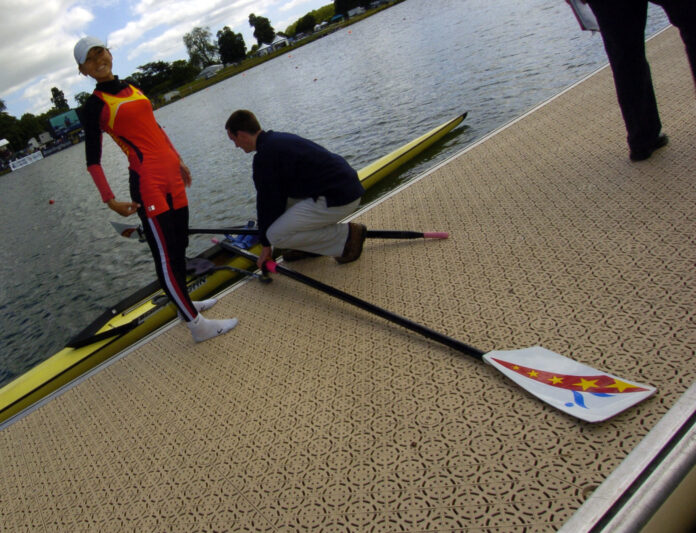
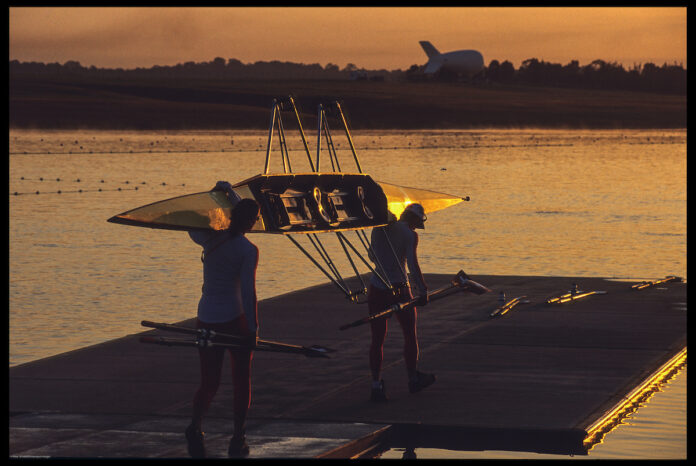
2005 FISA World Cup, Dorney Lake, Eton, ENGLAND, 28.05.05. GV's around the finish area and presentation boating dock and awards dock and backdrop..Photo Peter Spurrier. .email images@intersport-images....[Mandatory Credit Peter Spurrier/ Intersport Images] , Rowing Courses, Dorney Lake, Eton. ENGLAND

BY MARLENE ROYLE
PHOTO BY PETER SPURRIER

Stepping into a single is one of the more difficult tasks a newbie sculler encounters. Entering your shell from a dock should be done gracefully. Here are tips to practice getting into your single safely:

 First, check that both oars are in the oarlocks, gates closed, and collars pushed against the pins. Feather the blade.

Push your handles toward the foot stretchers until you can touch the tips of the handles together. Butt the ends of the handles together, then draw them back firmly against the oarlocks to stabilize the hull.

 Stand alongside your boat near the sternward end of the seat deck. Bring the seat to the three-quarter slide position, so it will be where you can sit on it. Place your outside hand over the ends of the handles, then, with one foot step onto the seat deck between the tracks. 

Standing on one leg, use the handles to support your body weight by pulling toward you and slightly up. Your other hand can hold the dockside rigger. Bring the other foot into the boat and place it in the shoe as you lower your weight down to the seat, as if doing a one-legged squat.

 You can also step in with both feet and then sit down on the seat. Lower yourself gently.

 To get out, push your handles sternward, butt the handles together again, scoot up the slide, take your feet out of the shoes, put one foot back, stand up on the water’s side leg, and step out on to the dock.

If you are saying to yourself, “That sounds pretty tricky,” begin a land program to improve your coordination, balance, and flexibility to squat. 

Marlene Royle is the author of Faster Masters and Tip of the Blade: Notes on Rowing. She is a specialist in masters training, and her coaching service, Roylerow Performance Training Programs, provides support to improve your competitive edge. For information, email Marlene at roylerow@aol.com or visit www.roylerow.com

A Blessing in Disguise

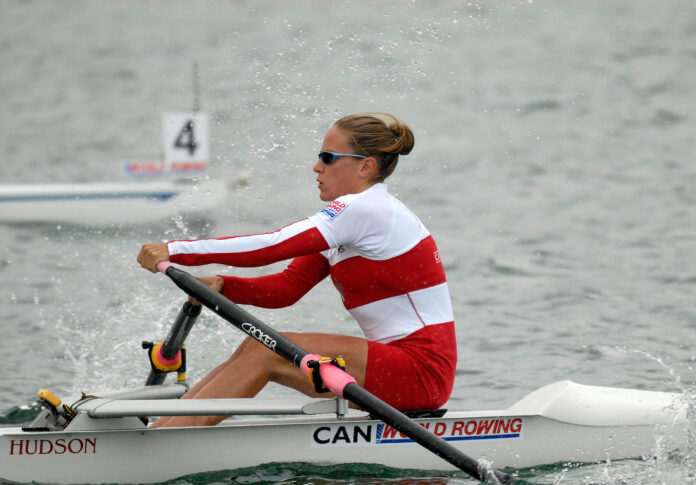
Munich, GERMANY, 30.08.2007, Start of the women's Lightweight Single Sculls Semi-Final, CAN LW1X, Melenie KOK. Fifth day, at the 2007 World Rowing Championships, taking place on the Munich Olympic Regatta Course, Bavaria. [Mandatory Credit. Peter Spurrier/Intersport Images]..... , Rowing Course, Olympic Regatta Rowing Course, Munich, GERMANY

BY VOLKER NOLTE
PHOTO BY PETER SPURRIER

We continue to live in interesting times, although we should realize how small our rowing-related challenges are in the big picture. The safety measures put in place by government agencies and sport organizations are aimed at keeping us healthy and alive. 

Being able to row a single well is undoubtedly a major advantage, and the circumstances now are forcing this upon us. The major benefit of rowing the single is that it’s a form of self-coaching, since the boat gives you immediate feedback about what you, and only you, are doing. 

Everything begins with balance. Whether you’re a beginner or expert, you balance a single in basic ways:

 Sit in the middle of the boat, control your hand levels, and practice good blade work. Beginners will have to put their feathered blades back on the water to stabilize the boat after the finish. As long as they keep their hands at the same level, the boat will stay balanced. In addition, they need to make sure the blades are properly squared before placing them in the water at the next entry, kept at the proper depth in the water, and then released together at the end of the drive. 

As rowers become more adept, they can take the blades off the water more and more on the recovery, apply more effort during the drive, put their blades in the water and release them out of the water with less and less interference–and gain more speed in the process. A single will reveal every little technical misstep to the rower, fostering further improvement. The process of learning to row a single well is neverending, since one can always achieve a higher level of proficiency. Even Olympic champions are constantly striving for the perfect stroke.

Think about all you learn by rowing a single. Your balance will be much more refined, and you’ll know exactly how to improve it. 

Training in a single is one of the best ways to enhance crew-boat performance. Many national-team programs recognize this fact by practicing in singles, knowing there is no negative impact on crew-boat rowing and racing.

We should view the need to row singles because of the pandemic as an opportunity and embrace it. Learning to row the single more skillfully will help you become a better rower.

A Single, Patient Approach to Reentry

BY ED MORAN
PHOTO BY ED MORAN

Like most everyone else in the country this spring, Liz Trond, head coach of the Connecticut Boat Club, was following the early news of the spread of Covid-19, and the idea that her crews would soon be forced off the water was lingering in her thoughts as she was wrapping up a pre-San Diego Crew Classic practice March 12.

“We had practice that Thursday, and we were planning to have practice Friday and Saturday and take a week off to evaluate what was going on. But I just had a feeling when I was on the water that day. We were in two eights, and getting ready for Crew Classic.

“It was kind of a cold and gray day, and we had just finished some pieces, and I said, ‘All right seniors, everybody look around. Give each other a high five.’ I didn’t mean to be dramatic, but I said, ‘Guys, this might be the last time we’re on the water together, ever.’ And I remember two of my seniors, Heidi Jacobson and Kat Lynch, looked at each other and leaned back and hugged. We were planning to come back for Friday and Saturday practice. But when I got home, the news was on, and it was about somebody in Westport who tested positive.”

Westport, in Fairfield County, Connecticut, is not far from where Trond coaches junior women in Norwalk, and to Trond, the news that one person in the county was now infected with Covid-19 was a sure indication that there would be more. So after consulting with her coaching staff and other coaches in the area, Trond emailed her team that CBC was “taking a pause.”

A week later, Connecticut governor Ned Lamont issued a stay-at-home order that lasted into mid-May. During that time, the entire rowing season through the spring and summer was canceled across the country. Boat clubs were shuttered, and coaches and club executives wondered what they could do to hold their membership together, what rowing might look like when it came back, and what had to happen to ensure a safe reentry.

The planning for that began almost immediately. Weekly Zoom conference calls–initiated by Matt Logue, executive director of Pittsburgh’s Three Rivers Rowing, and Ted Benford, executive director of Boston’s Community Rowing Inc. (CRI)–grew in attendance every week until the sessions included up to 20 representatives from clubs everywhere in the US.

Ultimately, the picture that emerged did not include rowing in team boats, not as long as social distancing was still a barrier to the spread of the virus. And so, coaches and club leaders focused on how to create safe environments where they could bring members back to the water in singles. For some clubs, like CRI and Three Rivers, that first phase meant members could row in privately owned singles, but not in team or organized group practices. CRI later opened to include adult sculling classes.

For others, particularly youth-based clubs like CBC, that meant finding ways to get juniors on the water in the limited number of singles that organizations owned or could afford to buy after experiencing significant revenue loss because of the closure. And it would have to be done safely and according to   government-mandated guidelines and regulations, which would vary from state to state, and even county to county.

 But when the restrictions did begin to ease, and some form of practice could take place, Trond had a plan ready. For her team of mostly sweep rowers, that would mean a patient approach to learning how to scull, and figuring out a way to come to the boathouse while staying socially distant.

It would mean adhering to safety rules and regulations intended to mitigate the spread of the virus by limiting practice to groups of six girls rowing in singles, and stretching on private mats on green dots chalked on the pavement 12 feet apart. 

       It would also mean limited access to the boathouse, athletes bringing hand sanitizer and wipes from home, and club staff stocking the boathouse with disinfectants. It would require athletes to wear masks until afloat, and then to put them on again when docking. Some would even opt to keep the protective face coverings on for the full practice.

It was, and remains today, a daunting exercise in patience that will likely change very little through the next few months, but after 67 days of being away from each other and rowing, the effort has brought back smiles to CBC’s young athletes.

“I’ve been really antsy since this started,” said 16-year-old sophomore coxswain Mia Khamish, following an afternoon practice in late May. “I wish I could race with the team, but it’s nice that we’re all back at practice now because not many clubs are getting to do what we’re doing here.”

Under the current singles-only program that Trond and the CBC coaches are running, everyone rows, including the coxswains. Most have never been in a single.

 “It’s interesting, it’s fun, I like it.” Khamish said.

She was surprised when she learned practices would resume. “I thought the quarantine was going to last longer. I wondered how we were going to maintain being six feet apart, how we were going to do any of it, but I realized I missed rowing a lot, and I am glad that we are back, even though our racing got canceled. Hopefully, over the summer everything opens up more and we will be able to do more.”

Executive Action

From the very beginning of the pandemic shutdown, the sharing of information about its impact on rowing clubs, and the planning for an eventual reopening, have been helped by the creation of a weekly Friday-afternoon Zoom call begun by Logue and Benford, and embraced by club executives from across the country.

What started as a call between two of the largest rowing organizations on the East Coast–CRI and Three Rivers Rowing Association–caught on and has been joined by up to 20 club executives every week.

“It’s definitely worked out really well,” said Logue. “It started in late February and early March on the organic side. Ted Benford and I just happened to be on a phone call, and then Mark Davis from Sammamish [Rowing Association, in Redmond, Wash.] joined in, and it has slowly grown from there. They have been a weekly staple on everybody’s schedule ever since.”

The meetings run Friday afternoons from 4 to 5, and the sessions enable club leaders to talk about what is going on in their areas and how each club is dealing with being closed and how they are planning to reopen. Early talk was about staying connected and providing virtual services and workouts to members, how to keep staff working, and dealing with the enormous financial losses the shutdown was causing for each club.

As the pandemic stretched into May and an easing of restrictions appeared to herald the return of some form of on-water activity, discussion shifted to how to open safely and what kind of rowing could take place.

It became clear that because restrictions and guidelines would differ from state to state, and county to county, each club would be facing varying regulations about social distancing and how many members could gather at a time. But it also became clear that when rowing did return, it would be done mostly in singles, with exceptions made only for family members living in the same house who could row in doubles or pairs.

Team boats would be off limits, and likely will remain so through most of the summer. The planning and exchange of information focused on best practices for keeping equipment and common areas clean and free of contamination, and then on ways to get as many rowers back on the water as possible. For some clubs, including CRI and Three Rivers, that meant opening first to private boat owners. And for others it meant finding enough singles and coaches to get junior rowers back on the water.

The sharing of ideas has been invaluable.

“It’s been a very collaborative and thorough process to the degree that people just put out their questions, or put out ideas, and get feedback in response,” Logue said. “It’s part crowdsourcing, and part support group, in the sense that ideas are put out there, and people say that’s a good idea, we’re doing the same thing here, and it becomes very reassuring that nobody is operating in a vacuum.”

The group Zoom calls will continue through the summer, fall and beyond, Logue believes, given the rapid changes in the state of the pandemic and the effort to develop a vaccine.

“The information is changing so rapidly, even what is coming from the CDC. I feel like half of the time is spent just keeping up with the new information, and the other half is trying to act on it before it changes,” Logue said.

Some clubs could see an easing of restrictions that would allow team boats to return, possibly in the fall. Many states have stages of phased-in reopenings, but the stages vary so widely that Logue believes his club will determine for itself when it’s safe to return to a more organized team approach.

“The way this virus is impacting the country, it’s very state and county specific. In Georgia, the way they opened so early and so quickly, they still had regattas on the May calendar. They have since been canceled, but they were still on the calendar,” Logue said.

“Florida just released their summer camp guidelines, and they had no social-distancing restrictions in them. On last Friday’s call, in that one hour, five or six different states released their summer camp guidelines, so people were getting messages about it on the call. It just shows how quickly the information is changing, and how we are trying to adapt to it.

“I had aligned my reopening with Pennsylvania’s three-stage color system of red, yellow and green. Now I am thinking the state is moving faster than is safe and practicable for our operation. So I am thinking of separating from the state system and keeping our rowing reopening phases more aligned with the information from the medical advisors.

“I would like to believe that we’re going to get to a point where we are going to start doing team boats later in the fall, but there are so many external factors out of our control. We could just as easily go back to red as green.”

Uniform Guidelines–Single Solutions  

Given the constant changes in the level of infection in differing locations, and the restrictions driven by those fluctuations, USRowing released in May a specific set of guidelines that clubs will have to follow for at least the remainder of the year.

One constant in the published guidelines is that where social distancing is being enforced, only rowing in singles will be permitted. The only exceptions are people living in the same house; they can row in a double or pair.

The move to sculling and rowing in singles became an immediate challenge. There are safety concerns and protocols that should be followed. USRowing has an entire page dedicated to this, and a key line in the lengthy list of rules reads, in bold: “Under no circumstances should athletes who are minors be allowed or left unsupervised on the water.”

Chris Chase, USRowing’s director of youth rowing, says the ideal ratio of athletes to coaches and launches on the water can vary according to experience and skill level, weather conditions, the body of water, and traffic patterns. While there are no hard-and-fast rules, “common sense goes a long way.”

Chase’s biggest concern as the restrictions ease: “Everybody is in a hurry to get back on the water, and corners will be cut. My worry is that in our rush back to what we love, we won’t think about those things as much as we think about how can I get back.”

Before joining the USRowing staff, Chase coached and was the regatta director at the Saratoga Rowing Association in upstate New York. He and SRA have always embraced teaching single sculling and recognized the differences in skill levels and safety concerns.

“You can only get better by doing it more often, but at the same time, in the early stages of your learning curve, it can be dangerous to be out there alone with no guidance and no safety net. The benefits of sculling are great. The logistics of sculling are a nightmare. I can take two eights and get 18 people on the water. I can’t take 18 singles with my one launch.”

Then there is the problem of equipment. Most clubs have a limited number of singles available. Clubs that have large team practices for juniors through competitive adult and masters rely on having eights, fours, quads, doubles and pairs to achieve the maximum level of participation.

While sculling in the U.S. is popular and thriving in some clubs, team boats provide the most availability and the best way to conduct a safe coached practice. There are clubs that focus on sculling and are used to groups of sculling boats on the water at the same time, but even those clubs row quads and doubles in addition to singles.

But since rowing in team boats in a time of social distancing is forbidden in the early stages of state-regulated   reopening, sculling in singles is what most of the U.S. rowing community will be doing through the summer and into the fall.

The upside: Getting young athletes into singles early on will mean a more skilled junior base ultimately. Any coach in any club will tell you that kids who start in singles ultimately become confident and capable boat movers in both sweep and sculling team boats.

It has long been a criticism of U.S. junior rowing that not enough kids get the opportunity to row in singles, that European countries start their juniors in singles, and as a result, do far better across the board in senior international sculling competition.

That is not entirely true for U.S. women, who have produced Olympic and world-championship medal results over the last few Olympic cycles, but it is for the men, who had only the lightweight men’s double rowing in Rio, and have so far not qualified a single sculling crew for the Tokyo Games.

More than a few U.S. coaches acknowledge that while it is expensive and difficult to get large teams on the water in sculling boats, rowing in singles results in more technically skilled athletes. One of those coaches is Tom Terharr, head coach of the U.S. national women’s team.

“Every row is a technical row, and every row is a physiological row, and every row is a mental row, and there is no one to blame except yourself. It gives you feedback right away,” he said.

Terhaar believes this is an opportunity, if it is embraced. 

“The only way it will have a big impact on our country’s development in both sculling and in sweep is if we decide to use either sculling, or rowing the single, a lot more at a younger level instead of just junior programs in eights.

“I realize it’s expensive and hard to do, and it requires a lot more coaches. But if we could do it, it would be fantastic. Everyone knows it’s a good thing. But before we never had the time. We never had the freedom. Now we do.”

Taking the Time


        In the meantime, with so many unknowns, the weekly meetings will continue, Logue says. Three Rivers will watch the progression of re-opening measures in the hope that they, and other clubs, will be able to bring team rowing back to their communities and find ways to endure the financial losses and keep from going under.

If Pittsburgh continues to move forward easing restrictions, and Logue believes his club can safely bring back juniors for summer instruction, he has a plan for that–going out in groups of four at a time with a coach and a launch. He calls them “pods.”

“However long that goes, we feel confident that that is going to be a safe system, and if we need to employ it during the fall, we will still be able to get some good rowing in and training opportunities beyond that.

“I want to be the optimist. I want to have hope that everybody is going to act socially responsible, and wear masks, and really flatten the curve. But at the same time, I am preparing for a situation where we are not able to row team boats until there is a vaccine, whether that is next spring or next summer, or whenever.”

In Connecticut, Trond and her team are all in and moving patiently. There is time. There are no regattas on the schedule through the rest of the summer, and the possibility that fall racing will be held is also a huge question mark. Many see it as more of a long shot.

So she is in no hurry, and her attitude is that if they are going to row in singles, they are going to take the time with the equipment they now have to teach proper sculling technique.

“It’s a slow and steady approach to learn how to function with what we have and not just get more physical boats,” she said. “It’s more about how do we structure it so that we can have as many people rowing and provide a quality experience and quality instruction and pay the bills. We’re in that same balancing act that everybody is in.

“Having 25 boats wouldn’t help me because we’re never going to have 25 people on the water at the same time. So now it’s just, how can we effectively have enough people on the water? It’s going to take a long time for our sweep rowers to learn to row the single well. We want them to learn. We don’t want them just slapping around out there.”


Ontario Performance Centre Names Boat Vendor

Plovdiv, Bulgaria, Thursday, 13th September 2018, CAN., LW1X, Jill MOFFATT, competing in the Semi Final A/B's, Lightweight Women's Single Sculls, at the FISA, World Rowing Championships, © Peter SPURRIER,

STAFF REPORTS
PHOTO BY PETER SPURRIER

A partnership has been formed between Hudson Boat Works and Row Ontario and the Ontario Academy of Rowing.

The agreement, fitting for 2020, centers around Hudson providing a fleet of singles for the high-performance rowing center.

“We are very proud to announce our new partnership with Hudson to become our official boat supplier,” Andrew Backer, executive director of Row Ontario said.

“HUDSON has a demonstrated track record of success in providing the top quality of boats for all levels of rowing and the bid they submitted to us to become our official supplier was extremely impressive. We are ecstatic to start a partnership with such an outstanding company and we can’t wait to see our Academy athletes rowing in HUDSON boats in the Fall.”

The Ontario Performance Centre is scheduled to open in the Fall of 2020 in Welland, Ontario.

Friend or Faux

Plovdiv, Bulgaria, 16th May 2019, Streets, Bars, Restaurants, Old Town, Recreational Area © Peter SPURRIER

BY NANCY CLARK
PHOTO BY PETER SPURRIER

The rise of plant-based protein appeals to many health-conscious athletes who want to reduce their intake of saturated fat as well stand up for the environment and animal welfare concerns.  As a result, more and more athletes are trending towards a vegetarian diet. Two types of non-meat eaters seem to be emerging: traditional vegetarians and those who choose ultra-processed almond milk, Beyond Burgers, and Impossible Burgers, which offer a way to enjoy a tasty plant-based burger without feeling denied or deprived of the real thing. But are these burgers a step in a nutritionally positive direction in terms of the environment and our health? Regarding environmental concerns, both the Impossible Burger and Beyond Burger report an estimated 89 to 90 percent smaller carbon footprint than a burger made from beef. Faux meat production requires less land and water and creates less methane and manure. Nutritionally speaking, faux meat is a reasonable match for real beef, but without the bioactive compounds that naturally occur in standard food. As for me, I’ll stick with an occasional all-natural lean beef burger when desired, and choose plant-based foods more often than not. While the Impossible Whopper pleases my palate, I can’t help but wonder if Mother Nature knows best.

Talent Needs Trauma

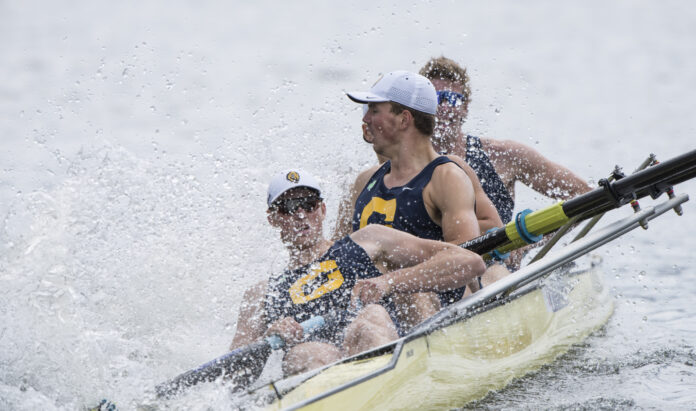
Henley on Thames. United Kingdom. Final of the Vistors' Challange Cup. University of California. Berkley USA catch's a boat stopping crab allowing Thames RC to go through and win the final. Sunday, 03/07/2016, 2016 Henley Royal Regatta, Henley Reach. [Mandatory Credit Peter Spurrier/

BY BILL MANNING
PHOTO BY PETER SPURRIER

Some coaches operate like the “snowplow parents” we increasingly hear about. They attempt to clear the road of all obstacles so that their athletes can achieve success as easily as possible. Though well intentioned, this is shortsighted. Coddling and excessively protecting athletes prevents them from learning to overcome adversity and develop their own resourcefulness.

As Annie Vernon highlights in her insightful book Mind Games, “talent needs trauma.” The best athletes are made partly through exposure to hardship and even failure. It’s in facing and overcoming setbacks and all manner of difficult situations that athletes grow stronger. Motivation is questioned and reaffirmed.

Success too early, or acquired too easily, develops expectations of immediate achievement. It creates the dangerous belief that talent alone will yield desired results without the application of sustained effort. Success based on talent alone is temporary at best. Eventually you run up against someone with more talent.

Overprotected athletes are underprepared athletes, and it falls on the coach to safely ready one’s rowers for the rigors of competition. Practice in rough water, don’t hide from it. Row through wakes. Start the top boat behind the lower boats and make them earn the win. Race faster teams. Row mixed lineups rather than having the best athletes always row together. Challenge them to go fast when they’re tired, not just when the conditions line up perfectly.

This learned resourcefulness is similar to how we learn a foreign language. You don’t learn to speak a new language in a classroom. You get introduced to it in a classroom. You learn to speak it when you’re immersed in it and required to speak it correctly. When there is an imperative need, you’re far more motivated than when everything is comfortable, routine, and predictable.

Those who prevail in competition often do so not in spite of the hurdles they’ve overcome, but because of them. These setbacks provide the stimulus for building confidence. We learn through adversity. Unmitigated success gives one confidence as long as the success continues uninterrupted. But the confidence that comes from prevailing under difficult conditions is deeper rooted and instills the belief in oneself that future, unknown obstacles can also be overcome. It’s no coincidence that what civilians call an “obstacle course” the military calls a “confidence course.”

Too many obstacles and rowing isn’t fun. Too few athletes do not mature, lack earned confidence, and are not capable of dealing with the inevitable adversity inherent in competition. Coaches need to strike the appropriate balance to best prepare their athletes.

The Upstart

BY JEN WHITING
IMAGE BY ADAM REIST

What if you truly don’t yet know how fast you are? Rowers, coxswains, coaches—everyone in our sport. What if there’s the possibility that you aren’t quite sure what kind of speed your effort can generate? If you’re a rower, is there another inch of arc you can find at the end of your stroke? Coxswains, can you intuit the needs of your rowers more closely, sensing exactly the call they need to override the desire to stop and turn their power over to the boat? Coaches, can you explain the rhythm—the demands of this sport—more succinctly, more deliberately, and with more patience. Can your megaphone become a bugler’s call moving the army forward?

Olli Zeidler knew how fast he was in the pool. Since he was seven years old, the tall, blond-haired German had trained as a swimmer, winning the 2014 and 2015 German national championships. “My events were sprints,” Zeidler says, in crisp English, as we begin our interview. “The 50, the 100-meter,” he smiles. “In no way do they compare to a 2k race.” Zeidler is 24 years old, stands two meters and three centimeters tall (nearly 6’ 8”), and has a soft smile that shows up even when he speaks. 

“I didn’t make the 2016 Olympic team so I had a tick behind the Olympic dream. In swimming, we trained really hard and a lot—even more than I train today.” Zeidler settles easily into the rhythm of our talk. “The switch to rowing was not that complicated. I had to train for the six-to-seven-minute race. In swimming, I had been a sprinter. That’s a one- or two-minute race. But the quantity of training in rowing is actually less.” When Zeidler sat on the starting line of the first World Rowing Cup of 2018, it was only his fourth time on a racecourse. “I started sculling in 2016,” Zeidler explains, as we go through the timeline of his short but steep career in rowing. “My father is my trainer.” 

Olli’s father, Heino Zeidler, stands even taller than his son. He was a member of the German national team in the 1990s, competing in the men’s pair. Olli’s grandfather was also a rower, competing in the men’s double in the 1972 and 1976 Olympics. His aunt, Judith, rowed on the German national team in the 1980s and ‘90s, and Olli’s sister, Marie-Sophie Zeidler, rows alongside her brother on the German national team, most recently in the women’s eight. To say the Zeidler family is a rowing powerhouse in Germany is a wild understatement.

When Zeidler was competing as a swimmer, he asked his father to teach him how to row. “I just wanted to learn it to have something next to swimming,” he says. Zeidler used erging as cross-training for swimming and found he could create speed on the rowing machine. He started rowing the single not long after. “It took some time, of course,” he smiles, “about half a year. Then I learned the flow. I had a good feeling.” Zeidler’s family always supported his swimming, “My father and grandfather were always there by the poolside,” he says, “but it was natural for me to row. It’s in our family.”

“My father and grandfather were always there by the poolside, but it was natural for me to row. It’s in our family.”

-Oliver Zeidler

Zeidler waits for a beat and then goes on. “My grandfather is very proud, of course.” It is in this moment that I first hear the meter of his accent come through. The downbeat in his sentence is on the last two words, an inflection that would be unnatural for a native-born English speaker. Or maybe it’s simply the truth, the inevitability of Zeidler becoming a successful rower. “My grandfather always wants a bit more,” he laughs to himself, “considering the technique and the training.” Zeidler laughs again when I ask him about dinner in his house; he lives with his parents, grandparents, and sister. “Big meals,” he says, “always a lot of food.”

After his laughter fades, Zeidler grows serious—as if he wants to explain something I’ve missed. “I don’t remember my first success as a swimmer. There was a process going on, physically. After two years I became pretty successful so I stayed with swimming. It was really fun just to push ourselves—it was a great time. Those years were some of the best years of my life.” Zeidler’s first rowing race was an under-23 competition in Germany. Three races later, Zeidler found himself in Belgrade at World Rowing Cup I, where he won a bronze medal. 

“I definitely didn’t expect that result. It was a big surprise. I was rowing against my role model, Ondrej Synek. Passing him was unbelievable for me.” Synek came back to win the gold medal during that first meeting with the young German in 2018. “In Belgrade, I realized I could do something special in this sport. After the race, people came up to me and talked about it. Something magical happened on the water that day.”

One year later, Zeidler would pass Synek in the final of the 2019 world championships and go on to win the race in a photo finish. The finishing times of the top three boats of that race—Germany, Denmark, Norway—were separated by three-tenths of a second; Zeidler won by 0.03 seconds.

I ask him about his training and selection for the 2020 Olympics. “Ninety percent of my training is on my own,” he says. “If there are other boats on the course with the same speed, we’ll row together, but regularly it’s just me against the boat.” He stops for a moment then smiles, “It’s easier to train in the single than in the pool, but I miss the trash talking and laughter we used to have in swimming.” I can picture this tall man, his blonde tuft peeking out from underneath a swim cap, laughing with his teammates as they hang on the end of the pool waiting for the next set of intervals to begin. Something about the intimacy of that moment, that regard for speed that is often hidden away by elite athletes as they load hours of training into their bodies, resonates with the calm Zeidler seems to have about his own accomplishments.

Zeidler explains that the German national team selection process changed in 2019: they selected Zeidler as the Olympic men’s single sculler without requiring a selection process in the year leading up to the Tokyo Olympics. “This is an unusual situation for me,” he explains. “Usually we have to go against each other in the single and then erg scores set the other boats. This year, the [German rowing] federation was more open, more transparent. Now the other scullers are vying for the double and the quad,” he says, adding, “there’s a big benefit to this. I don’t have to concentrate on the national selection process. I don’t have to worry about getting to the Olympics, but I have to find my speed and test it before the [World Rowing] Cups.” To Zeidler, those competitions are discussed on a first-name basis. “Right now I don’t have a benchmark.”

And here it is: that question of speed. Is it possible to know how fast you can go, how much speed a body that grew up swimming at the elite level can generate? It’s likely that Zeidler’s success in rowing is as more a product of his swimming than his family’s legacy. After we finish talking, I watch the races that Zeidler has done so far. The three  World Rowing Cup regattas in 2018, where he went bronze, bronze, and silver, respectively. The 2018 World Rowing Championships, where he had a near-miss with a blade in the opening strokes but delivered a solid row after that, taking sixth. And then, the next year, the 2019 European Rowing Championships, where he snuck across the line, matching the leader stroke for stroke but winning the race with a kick that reminded me of a swimmer’s race, with that last surge swimmers make when lunging their hand to be the first one to tap the wall at the end of the lane. Next, the second World Rowing Cup of 2019, where he placed fifth, followed by World Rowing Cup III, and his first-place showing in the C final. And then, finally, the 2019 worlds.

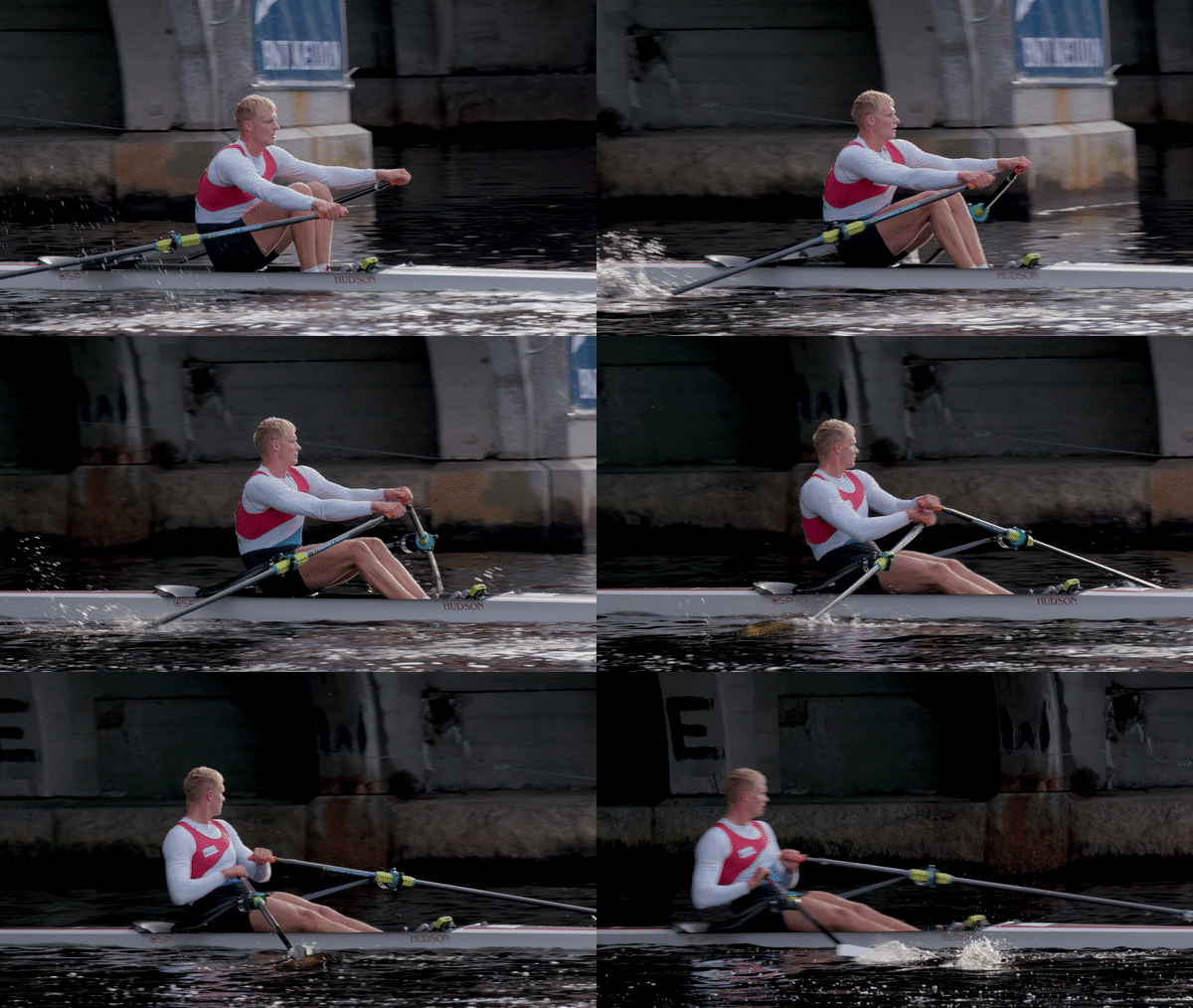
Watching these races, and specifically watching his stroke—a three-quarter-slide stroke, where he winds up just enough to get a full stroke but doesn’t compress past the point his frame can leverage full power from—I begin to see a pattern. Zeidler, a swimmer since age seven, seems comfortable with the last 5 percent of the race being the determiner of the outcome. It’s as if he understands that the race doesn’t really start until the last 200 meters; you just need to be in the pack at that point to have a shot. I think back to the swim meets I’ve watched, everything from summer camp meets, to high school meets, to those crazy sprints during the Olympics, and I realize he seems to treat the 2,000-meter rowing course like a swimming pool. He has a kick at the end of his race that is typical for swimmers, but perhaps not so typical for rowers. Every rower wants that final kick—a sprint to cap off a solid race—but to deliver time and again, to win by such small margins, seemingly drawn toward the line by instinct, it makes me think that Zeidler is mixing his sports—using the techniques of moving through water and the race management he learned as a swimmer to win rowing races.

“I’ve always liked being around water, moving through it. It’s the same as it was with swimming,” Zeidler says to me when I ask him about crossing over from swimming to rowing. “The movement techniques are the same.” He pauses, “The 2k is six times longer than my swimming races, which has taken some adjusting.” Zeidler, who has been performing at the elite level as an athlete for many years, knows that his trajectory in rowing—at such a young age and with so much water still ahead of him—affects people. “When I go to a regatta, many people ask me for a selfie or tips.” He chuckles a bit about the selfies. “I have the chance to inspire people. It’s the best feeling I’ve ever had in sport.”

Zeidler’s training for Tokyo was simplified when he declined the invitation to go to the national team training center in Hamburg. “They told us to go to Hamburg one year before the Olympics to train, self-supported. We declined. I know that in the single we will make this work, no problem, living at home in Munich and focusing here.” The Zeidler household has two national team rowers eating under one roof. “We eat a lot of food,” he smiles. “Bananas, cereals, meats, and carbs for lunch, of course, and every evening something warm or just meat and bread. I’m lucky that I can eat everything I want.”

I ask this Olympic-bound rower what his focus has been in his recent training. With only two years of racing a single under his belt, his response reminds me not to be fooled; this rower has been training and competing at the highest level, even if it was in a different sport, for more than two years. His response gave nothing away, “Oh, we have a few points we can improve. Technique, fitness.” 

Zeidler has a smile that seems to surface without effort. Every race he’s been in, he wears a white ball cap flipped backward, the bill of the cap grazing the back of his neck as he completes each stroke. In several of his races, the announcers mention the cap, and specifically, that he wears it backward, like a kid on a college campus or in a pick-up basketball game. 

This image—that of the athlete who has won championships now in two sports, but keeps a casualness about himself—is perhaps the one that brings Olli Zeidler to life for so many athletes who are chasing how fast they, themselves, can go. 

At 24, it is clear he is just getting started, just pushing off the wall to position himself at the top of the pack. I wonder if Zeidler knows how fast he can be yet, or if his training is still revealing it to him. “Is it interesting being so early in your career and being successful?” I ask. “It is. It is.” Zeidler, all at once, is as open as a book and as guarded as a castle.