

VIDEO BY ADAM REIST
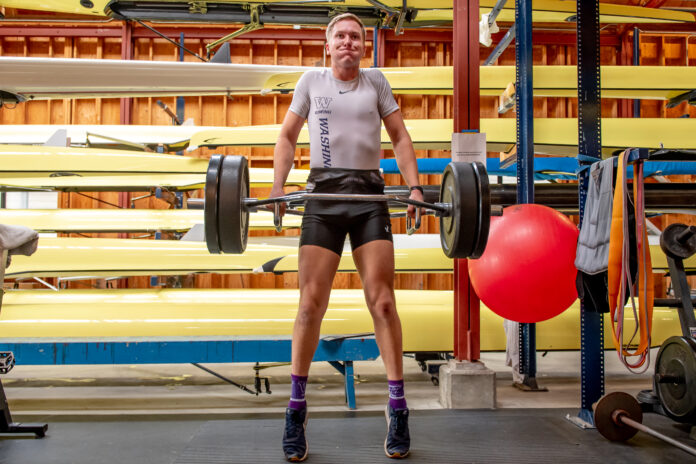
Training Outside the Boat
BY VOLKER NOLTE
PHOTO BY ED MORAN
The cancellation of the famous Head of the Charles Regatta is the latest bad news for competitive rowers. Although it was absolutely the right call, it deprived rowers of the sort of goal so essential for training. Speaking from experience, it’s much easier to train when you have a date in mind for putting your boat in the starting gates.
This means finding other goals to sustain a training plan and provide motivation for strenuous workout sessions. With immediate competitive goals unavailable, I suggest you set more general long-term goals, such as gaining overall physical and mental health that leads to life satisfaction, or expanding the base for later increases in performance. Such an approach gives you incentives to plan ahead for a longer time period and offers promising opportunities for future success.
The pandemic has restricted not only our competitive ambitions but also our access to organized rowing programs on the water. Therefore, we have to find training alternatives that will bridge the competition down time and build toward later improvement. One excellent option is cross-training.
In simplest terms, cross-training is training in athletic activities other than your usual sport. The goal is to improve your overall performance by exploiting the advantages of one training method to compensate for the shortcomings of another. For rowing, that might mean running, bicycling, cross-country skiing or weightlifting.
We know that top athletes such as Mahe Drysdale perform much of their training on bikes and that national-team rowers regularly strength-train in the gym. Although high-performance athletes must train for their sport to improve significantly, cross-training offers benefits for athletes of all levels, whether the goal is preventing injury or developing a skill.
Numerous studies have shown the benefits of cross-training. For example, long-distance runners who swim and cycle while preparing for a triathlon, become better runners–the so-called “crossover benefit.”
Studies show also that cross-training, which includes stretching and resistance and agility exercise, helps prevent injury and hasten rehabilitation. By reducing psychological fatigue, it can enable athletes to train longer and harder. By offering variety, cross-training can be exciting and entertaining. For reasons both mental and physical, we rowers should seek ways to train outside the boat.
Whether you’re an ambitious college rower or a masters or recreational rower, cross training is how you can use the time advantageously between now and your return to the water to practice and compete. Fitness gains now will put you in a better position when training resumes next spring.
Worth It

BY CHIP DAVIS
PHOTO BY PETER SPURRIER
As I re-rig my single scull with a smart oarlock and SpeedCoach in order to race virtually in regattas like the Head of the Hooch—I’ve always wanted to race in it, and now I don’t have to travel to do it—I’m fully aware of how hard we’re all looking for silver linings in this ongoing pandemic. And unlike my bicycles, hockey equipment, and climbing gear, my rowing shell has lasted decades. I’ve replaced only the oarlocks and foot stretchers. And you should, too—I bet your old shoes are disgusting.
If you can find one, now is the best time to buy a single scull or erg. It’s not just because single sculling is the perfect pandemic exercise (it’s just about impossible to get within six feet of a sculler on the water). It’s not just because sculling makes you a better all-around athlete (and not just a sweep rower). It’s because you’ll love it. To row a single is to experience our sport in its purest form. If the set is off, you know who needs to fix hand heights or releases. If it’s feeling sluggish, you know who needs to pick it up. And when it’s going well and feeling magical, you know who earned that great feeling.
The erg is the pure fitness version of the single. You’re not counting on anyone else to show up on time. You don’t need to check the weather. You get on it and you’re working out. And when your splits go down without your effort going up, you have yourself to thank and reward.
You also can’t go wrong financially with a single or an erg. My Van Dusen Advantage single might fetch its 1997 list price today. And the erg I bought in 1994 would go for a large portion of its new price if I put it up for sale, more than 25 years later. Rowing equipment, including apparel, is built to last. I still row in my college trou.
On a good day, we spend more time in our shells or on our ergs than in our cars. The rowing equipment, at least, is worth it.
Italian Women’s Rowing on the Rise
BY ALAN OLDHAM
PHOTO BY PETER SPURRIER
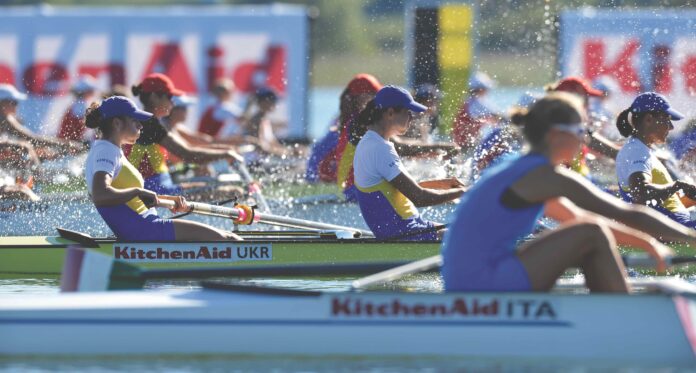
Once upon a time in Italy, only men rowed. That’s not exactly true, but for as long as anyone can remember, it has been Italian men and–until recently–almost exclusively men who have dominated in their nation’s significant presence in international rowing.
In the last 10 Olympics alone, spanning nearly half a century since women’s rowing was added to the Games program in 1976, Italian men’s crews have won 17 medals (eight gold, three silver, six bronze).
Lisa Bertini and Martina Orzan came close to the podium on Georgia’s Lake Lanier in 1996, when Italian women made their first appearance at a Games regatta. Ranked second out of the heats in the lightweight women’s doubles, the duo finished a mere 0.27 seconds shy of the medals in the final.
That was the nearest any Italian woman has come to the Olympic podium. In fact, right through to today, Bertini and Orzan are two of only 10 Italian women to row at the Olympics and remain the only ones to reach an A final.
Yet change is in the air–or water–as Italy’s Olympic rowers set their sights on the Tokyo Games of 2020 and more recently readjusted their focus on Tokyo “2020one” with the Games’ postponement amid the global pandemic.
The Olympic Dream
With Italy an early epicenter of the novel coronavirus outbreak, training on her own at home has become the new reality for Sara Bertolasi. “I feel lucky to have a small gym at home and direct access to my wonderful Lake Varese,” she told me in early May, almost two months into Italy’s lockdown measures. “I wish the world will get back to normal life soon.”
For Bertolasi, a normal life means getting back to full-time training for the Tokyo Games. If she can get there, she’ll be the first female Italian rower to race at three Games.
Competing at the Olympics has been a driving force in her life. When she transferred to rowing from elite cycling in the late 2000s, “the dream was exactly the same: the Olympic Games,” she said.
Since her first international start for Italy in 2008, Bertolasi has represented her country in almost every boat class, sweep and sculling, at no fewer than 30 elite regattas, including the women’s pair at the London 2012 and Rio 2016 Olympics.
“Following the historical qualification for London 2012 in the women’s pair–the first time for Italy–and the second time for Rio 2016, I decided to stop rowing and focus on new challenges in the real world,” she said of her short-lived retirement following the last Olympics. “A year later, my heart called me back to rowing to catch my third Olympics. The postponement to 2021 made me think about the future.”
With a record four berths (pairs, double sculls, quadruple sculls and lightweight doubles) qualified so far for the Tokyo Games, women are on track to make up almost half of Italy’s rowing contingent for the first time in history.
For Bertolasi, who has spent over a decade on the front lines of pushing Italian women’s success in rowing, one of the biggest changes is one she herself has helped inspire: more Italian women rowing, and rowing faster than ever before.
The current depth of rowers on the team means that the final decision about who will claim the seats still up for grabs has yet to be made. It also means that there is a chance that Italy may yet qualify another boat–the coxless four–Bertolasi’s most recent event.
Regardless of the present difficulties posed by the pandemic lockdown, Bertolasi intends to be on the start line in Tokyo to make her Olympic dream a reality one more time. She may even make history in another way, too–as the first female Italian rower to step onto an Olympic podium.
Moving Past the Past
Globally, the longtime lack of emphasis on developing female athletes throughout history has sidelined generations of potential.
It is hard to understate the significant changes required to empower women within sport at all levels, from grassroots to elite. In Italy, changing the culture within sport has gone hand in hand with a gradual shift in Italian society more broadly–a shift that has continued to accelerate.
“Let’s talk about football or women,” quipped Italy’s longtime populist prime minister, Silvio Berlusconi, as he sought to change the topic of conversation during an important European Union summit in 2003. Although the idea of elite sport as a man’s realm was certainly one not shared by all Italians, Berlusconi’s remarks were especially pernicious, given not only his political status but also his role as owner of Italy’s top soccer club, AC Milan, and his controlling stake in Italian media.
A broadly dismissive attitude toward women in sport was nothing new, according to Giuseppe Abbagnale, president of the Italian Rowing Federation (Federazione Italiana Canottaggio). “The reasons are primarily historical. It is, unfortunately, due to a distorted vision from the 20 years of the fascist period, during which men’s sport only was encouraged and exalted.”
The toppling of Benito Mussolini in World War II did not, however, end the struggle. Recent progress has been the work of generations. “Women finally achieved access to competitive sport only very recently, and to rowing in particular in a properly organized way only around the end of the ’70s,” continued Abbagnale, who at that time was taking the first strokes in his own illustrious rowing career.
“Since London 2012, the vision of women’s rowing has substantially changed within the Italian federation,” he said. “The women’s team was included along with the men’s competitive team in training programs, which gave special attention to diversified physiology for women but always with equal consideration.”
Claudio Tranquilli, Italian Rowing’s head of communications, informed me: “Thanks to his vision of Olympic sport and world rowing, Giuseppe Abbagnale believes strongly in the potential of the Italian women. Through his determination to make them more competitive, the technical area has developed and expanded the women’s team and, in this way, the base from which to draw potential female rowers has grown.”
“This is part of the vision of the IOC’s Olympic Agenda 2020 that is the strategic roadmap for the future of the Olympic Movement,” said Abbagnale, who was quick to acknowledge the broader factors that support gender equality. “The Italian National Olympic Committee encourages it. Italian society is ready to achieve gender equality in all areas and therefore also in sport. More and more young women are asking to practice rowing in clubs, and this bodes well for the future.”
Coming to America
The issue of sport needing to engage with more than half of the population has been addressed in different ways in different places over the years. Title IX is the most familiar example in the U.S. This decades-old legislation, aimed squarely at addressing gender imbalance in college sport, has had a transformative effect on rowing in North America. International athletes’ coming to the U.S. to study and row at NCAA colleges is a familiar sight.
This was the pathway to success that Alessandra Montesano chose when she arrived at Ohio State University to major in strategic communication and row with the Buckeyes.
“My rowing career started with the only other girl at my club in the double,” Montesano told me, of her first season in 2012 at the age of 14.
“We always finished among the last boats, until we won our first regional title together. After that, she got injured and quit, leaving me the only girl at my club. So I have always had to train by myself, alone on the erg and alone in the single, but I started to enjoy that pretty soon.”
Far from being put off by the challenge of improving with no female peers or mentors in her home club, and coming to the sport later than most Italians–the usual age of entry is around 10 to 12 years old–Montesano persevered.
“I wanted to improve and become fast,” she said. “The full sessions of training–the fatigue, the pain, all the races–it motivated me even more, because I was aware I was behind, technically speaking.”
After years of training on her own, including recovering from a back injury, Montesano began training camp with the Italian Junior National Team. In 2016, she won her first Italian National Championship in the single and represented Italy in the quadruple sculls at the World Rowing Junior Championships.
In 2017, she moved to the U.S. “I decided to go study and row in the United States, where training three times a day helped me make a big leap forward.”
Domestic Development Pathway
Creating opportunities for women within the Italian rowing system has been a top priority in recent years.
Introducing young people to the sport and promoting their rise to the national team are part and parcel of the same effort, says Francesco Cattaneo, the Italian Rowing Federation’s technical director, who serves as overall head coach for Italy’s national rowing teams.
Unlike in North America, where the usual entry point is school or college, in Italy the targeted age for beginning to row is as young as 10 years old, Cattaneo said. The clubs take the lead in developing athletes, with a focus on noncompetitive events before the age of 15.
“Starting at 15 years of age, they are followed in their clubs by the federation’s coaches,” he said. “Gradually, they participate in federation-organized training camps, national regattas and can attempt selection to be part of the junior, under-23 and senior teams.”
When it comes to opening up greater opportunities for women in sport, an issue is the funds used to support men. Italy has faced no such pushback, said Cattaneo. “The male rowers haven’t been affected in a negative way by the greater financial support required by women. The men have the same funds and support as they had previously, modulated according to the size of the men’s national team.”
Whatever the funding formula, there is no question that, when it comes to numerous women progressing through the sport and to success internationally, the system is working.
“In recent years, the number of women rowers has significantly increased as a result of the investment made,” Cattaneo said. “The women are coached by a dedicated staff, with a head coach who follows the entire technical training process. So we can say that the national team is made up of a homogeneous group, with potential expressed by men, women and para-rowing.”
Para-rowing, with crews equally divided between women and men, has benefited from this approach. After a dazzling gold-medal performance in the legs-trunk-arms mixed coxed four (now known as the PR3 Mix4+) at the inaugural Paralympic Games Regatta in Beijing 2008, the next two Games saw the Italians fall to fifth in London 2012 and to 10th in Rio 2016. Yet podium performances in two of the last three years are giving new hope for success in Tokyo and seem to reflect a strong focus from Italian Rowing.
For all the support and increased participation of women in all forms of rowing, Cattaneo believes that past psychological barriers persist. “We are still overcoming the cultural gap of women’s [lack of representation in] high-level competitive sport,” he said. “All the athletes who want to be part of the national team–both men and women–are followed in the same way. Participating in an Olympic Games is the highest goal of every athlete.”
Italian Homecoming
Montesano’s Olympic dream began to take shape on her return to Italy following her first year at Ohio State.
“I came back home in June 2018, training for a couple of weeks in the single after spending the whole winter and spring in the eight,” she recalled. “I came in second at the senior Italian championship. After a couple of weeks, I won the U23 Italian championship in the single.”
“After those races, I was looking forward to joining the U23 national team and prepared for the U23 world championships, where I came in third in the double with Valentina Iseppi, and it was one of the best days in my life. The coaches of the national team, excited about the race we had, wanted to see how we could do at the European Rowing Championships. We came in fourth, with four boats coming together in less than half of a second: we were 0.06 from the bronze and 0.6 from the gold–one of my favorite races ever.”
Forced to turn down a chance to race with Iseppi at the 2018 World Rowing Championships because of the start of the 2018-19 school year, Montesano headed back to Buckeye training camp.
Yet the successes of that summer left a lasting impression, especially the European Rowing Championships photo finish. “That race motivated me even more,” she said. “I knew from that moment that if I kept working hard and with perseverance, I could compete with the world.”
Within days of returning home the following spring, Montesano had won her first senior national championship in the single. “That, among other things, allowed me to be considered for the Olympic team and train at a different level,” she said. That’s when she decided to take some time away from her studies to focus on training for the Olympic Games.
“The dream and goal of the Olympics are always there and motivated me every single day,” she said. “When you have such an important thing motivating you and that you want to pursue, you start caring about all the little details that before you didn’t pay attention to.
“All the little details, at this level, make the difference,” she continued. “So now, I follow a diet that allows me to get the best out of my ability and strength. I keep doing rehabilitation exercises from the Italian national-team medical staff to stay healthy and in shape and prevent any injury that could lead me to lose time and opportunity to train. I have to make every detail count, to make every stroke efficient.”
Supports such as this–now in place at the same level for both women and men on the Italian national team–will certainly fuel the future success of Italy’s top female rowers.
Most of all, though, it is the personal connections that shine through in a system built on respect for the contributions of all athletes, regardless of gender.
“I have a beautiful team, where I found my best friends and amazing coaches,” said Montesano. “They are able to make training camps so much better and funnier.”
As for the Tokyo Games, now scheduled for 2021, like many of her teammates, she isn’t sure yet what seat–if any–she’ll ultimately sit in. Despite the Games’ postponement and Covid-19-related lockdown restrictions on full-time training, she’s holding on to her dream.
“I’ve been working to be there,” she said with resolve.
Kate Sweeney’s Remarkable Start

BY CONNOR WALTERS
PHOTO COURTESY IU ATHLETICS
Kate Sweeney looks around at the Ohio State University women’s rowing coaches, her eyes meeting theirs, and she knows that they are in this moment together.
In the office suite that the Buckeye coaching staff occupies, deputy director of athletics Janine Oman informs Sweeney and her peers that 24-year head coach Andy Teitelbaum has been fired from his position. He had been Sweeney’s coach and had led the program from relative obscurity to national prominence, with a string of three consecutive NCAA Division I team championships to his name.
The news stuns the staff. Then Oman announces that Sweeney is to become the interim head coach, effective immediately. With these words, at barely over 30 years old, Sweeney becomes one of the youngest collegiate head rowing coaches and assumes leadership of one of the nation’s most prominent and respected programs. It is her first job as a head coach.
“Obviously it was a lot of things–emotional, surprising, confusing, all of these expected feelings,” Sweeney says. “It was nice to look around the room at the rest of the staff and know that we were going to be OK.
“It was shocking, but at the same time comforting to know that I had those people around me.”
The date is March 10. The university is on spring break, and the Buckeye women have water practice scheduled for that afternoon. Sweeney gathers the squad in their team lounge to process the news. It is her first act as the leader of her alma mater. She lets the women speak their thoughts and feelings. She listens. She directs the team leaders to find out what the athletes want to do next. She listens some more.
“They came back out and said, ‘We want to train because we have goals and we’re not moving away from those goals,’” Sweeney says. “To me I was like, ‘OK, we can do this.’ Their conclusion was we want to keep moving. We’re going to be OK.
“We trained, and then we got up the next day and we trained again.”
That next day is filled with bursts of sunshine and 50-degree temperatures suggesting that spring is on its way. Sweeney is working out on a Concept2 bike erg after the team’s first practice of the day. She learns that the Patriot League is suspending spring athletics because of the rapidly emerging coronavirus pandemic, after the Ivy League has already done so.
Her father-in-law, an administrator at Santa Clara University in California, texts her to say that if the NCAA basketball tournament is canceled, then there’s no hope for the rest of spring sports.
Before Sweeney leaves for the boathouse that afternoon, she receives a message from Oman that more news may soon arrive. Waiting at the office becomes waiting at the boathouse, but with no official word, the Buckeyes launch for their afternoon row on Griggs Reservoir.
They practice, logging well over 12,000 meters, and all the while Sweeney is anticipating the call that seems inevitable. If this is their last practice for the year, she wants to know it–and she knows the rowers do, too. She and the coaches stall, even as they approach the boathouse docks. Let’s go for another 2K loop, they say to the athletes.
Then, Sweeney gets the call. Instinctively, she knows what to do.
“We pulled everybody together on the water,” she says. “Novices and varsity. There were a couple people on land on the erg, so we got them on launches and brought them out. In hindsight, with social distancing, that maybe was not the best idea.”
Sweeney tells the team that this is their last practice. Their season is over. A southeast wind blows across the half-dozen or so racing shells clustered together on the water. Tears flow from senior athletes, whose final months of racing are abruptly erased. Sweeney grants the crews a few final minutes together on the Scioto River.
The eights and fours row away from the dock, heading up river for one final go-round. Strokes and coxswains trade seats; might as well have a little fun. The women paddle up and back, reluctantly returning to the dock.
They carry their boats up the ramp on the western shore of the reservoir, toward the gorgeous stone façade of the boathouse, and lay the shells to rest on the racks inside, storing with them their long-held dreams of championship races in May.
Whenever the athletes return, these dreams will be ready for re-awakening. Sweeney will aim to lead her team to making these dreams come true. They are dreams she has known before.
Sweeney’s rowing story begins like many do–with a completely different sport: basketball. She hooped it up around Pittsburgh in AAU with her Oakland Catholic High School classmate, Amanda Polk. If that name sounds familiar, it’s because Polk won an Olympic gold medal with the U.S. women’s eight in Rio de Janeiro in 2016, adding to five world championship titles.
“She was speaking so highly of the sport, she sort of convinced me to give it a go,” Sweeney says. “When a senior tells me to do it, you do it.”
Though she was a little late to the rowing game, Sweeney immediately knew what Polk was talking about.
“The people who were involved in the sport in high school were just tremendous,” she says. “I clicked with them really quickly and enjoyed being around them. When you’re in a team boat, it really is the ultimate team sport. There’s nothing more uniting than trying to propel a shell with one, three or seven other rowers and a cox, and that’s what really hooked me.”
Initially, Sweeney sought a different college than Ohio State. “It had kind of been in my face my whole life,” she says. Her parents, grandfather and other family members attended, and even after her granddad took her on a tour, she wasn’t sold.
“Then I started getting recruited for rowing,” she says. “I went on a visit, met the team and met the coaches and said, ‘Yeah, this is where I want to be.’”
Her four years of rowing under Teitelbaum were critical building years for the program. From 2009 to 2012, the Buckeyes began climbing the team points rankings at the NCAA Championship. Sweeney finished in the top five twice in her events at the regatta. She graduated the year right before the program’s historic string of three consecutive team points titles.
But despite a successful collegiate rowing career, coaching was not in the plan; law school was. Before starting down that path, Sweeney elected to do a year of service through the AmeriCorps City Year program. She was placed in an underserved Columbus high school, tutoring and mentoring ninth graders.
“That fall, I started coaching with the local high school. I coached the novice boys,” she says. “It was really cool because I was working with ninth graders during the day in a very different part of the city and then coming to work with ninth graders in the afternoon to coach rowing.
“I really enjoyed the coaching aspect of everything I was doing–mentoring during the day and coaching in the afternoon,” Sweeney adds. “They’re like, ‘You should really consider giving coaching a shot.’ That led me to think that maybe this is something I’d like to pursue as a career.”
She applied for an assistant coach position at Indiana University, where veteran head coach Steve Peterson hired her and helped her hone her fledgling coaching skills.
“Whenever I have an opening, I write down my ideal candidate. What are they going to have?” Peterson says. “I had this list of things; Kate had everything with the exception of one thing: experience.
“It was very obvious from the first conversation I had with her that she loved the sport, she loved working with student-athletes,” he adds. “She came from a good program. She has a good understanding of the sport. It was pretty obvious from the word go that she has the drive and love of the sport that every successful coach has to have.”
Says Sweeney, “I didn’t know what I didn’t know. I had little to no experience on my end, but [Peterson] was willing to let us learn and make mistakes and that sort of thing. Looking back, wow, he was a great teacher.”
The Hoosier coaches during Sweeney’s two years on board guided the program to its first NCAA championship appearance and were named the 2014 CRCA National Coaching Staff of the Year.
After the 2015 season, Sweeney’s wife took a job in California, and so Kate joined Cal-Berkeley as a volunteer working under Al Acosta for the 2016 campaign, during which the Bears won the NCAA title.
Unlike the high school version of herself, the coaching version of Kate Sweeney dreamed of ending up at Ohio State. When a position opened up on Teitelbaum’s staff in 2015, she applied and was hired. “There’s nowhere I’d rather be than Ohio State,” she says.
Even if it weren’t her alma mater, Ohio State would be an attractive place for any young assistant coach. Not only has the rowing program earned championship status but also the university is practically unmatched in terms of athletic resources, competition and success.
Sweeney’s assistant coaching years were learning years, and she absorbed the myriad lessons offered by some of the sport’s biggest head coaching names: Peterson, Acosta and Teitelbaum. She also credits a long line of her former fellow assistant coaches with walking alongside her on this coaching journey.
“I have been incredibly lucky to have worked with some great coaches throughout the last seven years,” she says. “That has been the most impactful thing on me.
“The most important things that you learn are the impact we have on student-athletes, and we need to make sure that we’re intentional about how we engage with them. It really is about the student-athlete experience and what can we do as coaches to support them in their endeavor as rowers, students and good stewards of society. That’s the most important why as to why we’re here. Winning boat races is important, but the most important stuff is those intangibles that they take away with them when they go.”
In the months following Sweeney’s sudden ascension to the helm and the abrupt end of the rowing season, it becomes clear that her interim title may be short-lived.
“It was a series of conversations between my boss and me, because obviously I was not expecting to be in that role at that time,” Sweeney says. “It wasn’t on my radar as something that I was going to be jumping into, a head coaching role. I wasn’t out there applying for head coach roles.”
She continues her conversations with Oman. She meets with Ohio State athletic director Gene Smith. They encourage her to take her time and reflect on what it would mean for her to take over the program.
Sweeney mulls it over with friends and family. She discusses it with coaching colleagues at other schools. The opportunity is hers for the taking. She says yes. Speaking about this decision, she already sounds like a head coach, projecting confidence despite professing not to know exactly what comes next.
But for the moment, what does she think it will take for Ohio State to return to national-champion status? Sweeney responds with a lightheartedness that reflects the resilience she has already developed.
“Having a season would be helpful,” she says, laughing.
She returns to the question the way a humble leader does, acknowledging that she still has much to learn, but well aware of the hard work, commitment and sacrifice it will take. She uses that classic coaching line: “We can control only what we can control.” No time like the present quite reinforces this lesson.
Her former mentor and now Big 10 rival, Peterson, is eager to see what Sweeney will do.
“I’m psyched for her,” he says. “I’ve had a ton of former assistants go on to great positions. I take a little bit of pride when I look across and see people [who were] on my staff or that I coached that are doing well as coaches. I want to beat her, and I’m sure she wants to beat me, but I’m very psyched for her.”
After unexpectedly taking over the team at the start of a once-in-a-lifetime pandemic, Sweeney has had a little time to begin dreaming of her vision for where Ohio State rowing might go. No doubt she knows what it’s capable of; it set her off on the path she’s on today.
She talks about recruiting and training and championships and the Big 10 and everything else she will always be expected to talk about as the head coach at Ohio State. And then she rhapsodizes about what she hopes the outcome of those things might be.
“The most important thing is to create an environment where our athletes can thrive. How can we create more opportunities for our young women to grow in the leadership space while they’re here at Ohio State? How can they develop leadership skills so they can take that as they move forward into the workforce?”
Her questions sound like the result of some introspection. What is it that Kate Sweeney gained from her years rowing for the Scarlet and Gray that has prepared her to be the head coach at Ohio State? How might she pass that on? How might those lessons that she honed in the weight room, on the erg, and up and down the Scioto River inform what she does as the leader of nearly 50 high-performing, ambitious and determined women?
“I’m learning more and more about myself in this space,” she says.
It’s easy to focus on all the unknowns, all the things she still has yet to learn, all the uncertainty with the school year and seasons that seem to hang in the balance. Sweeney acknowledges that it’s all a little intimidating, but she doesn’t dwell on it for a second. She directs the conversation to what she already does know.
“I have the luxury of knowing the school and department and team. I’m not walking into a new environment in the head coach role. I know the student-athletes. I know the administrators, the trainers, the strength coaches and staff. That provides a level of comfort.”
She also knows that Ohio State has climbed to the peak of collegiate rowing success before. She knows that the journey to this summit is full of steep challenges and frustrating setbacks. She knows that the way to go far is to go together. She knows how to listen and how to work hard.
She knows more than one might think.
When One Improbable Win Inspired Another
BY ANDY ANDERSON
PHOTO COURTESY EMORY CLARK
Conn Findlay recently celebrated his 90th birthday. He is one of the most decorated American Olympic athletes, two gold medals and one bronze in the coxed pair and a bronze medal in sailing after giving up his oar. A coxed pair, you say? If you’re under the age of 40, you may be surprised to hear that this event was one of the backbones of traditional men’s rowing. Popular especially for rowing wherever visibility and steering were challenging, it was an Olympic event from 1900 to 1992. Although it was sometimes derided as being more like moving a piano than moving a boat, some of history’s greatest oarsmen rowed the boat.
Findlay won gold in 1956, bronze in 1960, and returned to the top step of the podium in Tokyo in 1964, each time rowing with a different partner. That’s where this story takes place. Emory Clark, a friend and loyal correspondent of Doctor Rowing, as well as a gold medalist in the 1964 USA eight, reminded me of Findlay’s birthday. Clark told this story:
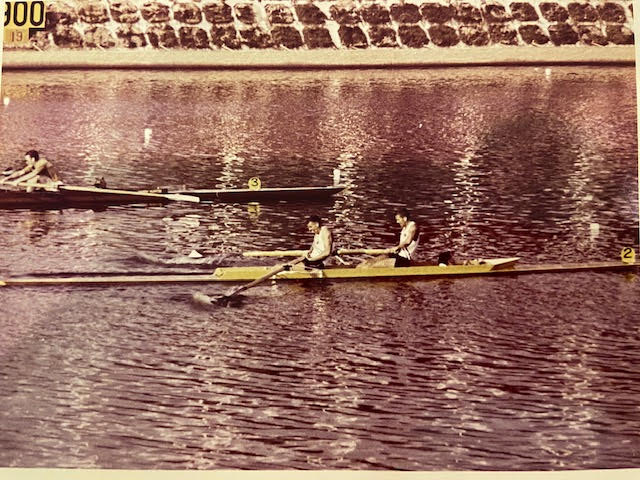
“In the run-up to the Tokyo games, Boyce Budd, who was a year behind me at Yale, and I were training in a coxed pair out of the Vesper Boat Club in Philadelphia with the idea of winning the Olympic trials in August. What made us think we could beat Conn and whomever he was rowing with I don’t know, but before we had a chance to try, we found ourselves under considerable pressure from Jack Kelly, Grace’s brother and the power behind Vesper Boat Club, to row in the Vesper eight in the July trials. While we weren’t very optimistic–the Vesper eight hadn’t been fast that spring–two shots at the Games were better than one, so we told Kell we would get in his eight, but before committing, we made him promise that even if we won in the eight we could race the coxed pair, and thus Conn, in the U.S. nationals two weeks later. After winning the eight trials in July, when we beat Harvard, racing the coxed pair was less necessary, however.
“Why we thought we needed to race Conn in the nationals I’m not sure, but Kelly was good to his word. We beat Conn’s pair by a heartbeat and found ourselves a week later in Amsterdam at the European championships, where we finished seventh, not even making the finals.
“Fast forward 56 years, when Kent Mitchell, Conn’s coxswain in all three of those Olympics all those years ago, invited me and a good many other oarsmen of that era to Conn’s 90th birthday party on Zoom. Lacking the technical expertise to Zoom, I wrote Conn a note for Kent to pass on. It read:
Happy Birthday, Conn. You don’t know it but you featured in one of the more memorable moments in my experience at the ’64 Games in Tokyo, a moment, however brief, that has stayed with me through the years.
You will recall that the finals were postponed until almost dark, leaving the oarsmen (me anyway) to cope any way they could with their ravaged nerves. Finally, we got the word to put our eight in the water and, as we were lifting it off the rack, I heard the “Star-Spangled Banner” playing over in front of the stands. While I thought I knew who that must be for, I wasn’t sure (being otherwise focused on my boat, my fears, my determination, and the Ratzeburg crew that had beaten us by less than a second in the first heat).
As we walked down the dock with the boat on our shoulders to put it in the water, we passed you and Ed Ferry and Kent coming the other way with your gold medals around your necks. For just that poignant moment I thought, ‘Damn, we beat those guys. Why do I have to go out (in what was then twilight) and try to beat the Germans?’
It passed, that second in time, as I had to focus on the Germans already on the course, but that fleeting second still resonates. I am glad to have the chance to tell you about it now.
Yours for the last ten,
Emory
Kent Mitchell added in a note to Clark, “As Ed (Ferry, bowman) and I were driving back to Seattle after the nationals with our tails between our legs, we were in North Dakota, and for some reason heard on the car radio that you had not made it to the finals in Amsterdam. We knew then we must have been pretty slow in Orchard Beach (site of the U.S. nationals). We thought, ‘Oh shoot, we’re screwed even if we get to Tokyo.’
“In Tokyo in our heat we drew the Germans, two other finalists from Amsterdam, and the Czech pair that was not in Amsterdam but had beaten the German European champions a week or two later. We knew we were now much faster, having spent two months cleaning up our releases, and then we won our heat. Up to that time there had been ‘no pressure.’ I remember standing in the shower after we won the heat when Conn turned to Ed and said simply, ‘We can win this thing,’ and then it all became so tense, especially having to wait five days before the final with nothing but wind and rain in between. All of which makes a good story with a fairy-tale ending.”
Clark closed his correspondence with me by writing, “It is amazing to me how rowing stays in my life, one way or another. I’m grateful.”
Aren’t we all?
USRowing Announces Committee

STAFF REPORTS
PHOTO BY PETER SPURRIER
USRowing has announced the members of its newly formed Diversity, Equity & Inclusion Committee.
The committee, formed in a response to members’ calls for greater efforts to make the sport of rowing more accessible and reflective of the United States’ demographics, has 17 members ranging from collegiate coaches to Olympians including two-time Olympian and five-time national team member, David Banks (pictured above.)
“This is an incredible group of community leaders, matched only by the strength of the over 70 nominees that came forward to be a part of this process,” said Meghan O’Leary, chair of the USRowing Board of Directors’ Nominating Committee.
“The USRowing DEI Committee’s work will be some of the organization’s most important as we look to grow and improve the sport and to build a stronger, more inclusive community. We have a long way to go to get there, but I’m excited about the potential of this group and what can be accomplished.”
Click here for the full list of members and the USRowing release.
Row New York to Break Ground on New Facility

BY LUKE REYNOLDS
PHOTO COURTESY FOSTER+PARTNERS
Another boathouse will soon rise in New York City.
Row New York is in the process of designing and raising money for a new boathouse in northern Manhattan. The boathouse will serve not only as a place for athletes to come and learn the sport but also as a community center.
“To us, it’s a realization of combining and co-locating rowing and academics at Row New York,” said Amanda Kraus, CEO, founder and project lead. “We’re not just rowing; we’re very much an academic prep program as well.”
The organization tries also to serve the local community outside of rowing.
“We’re already talking to other nonprofits and the school that’s right in front of the boathouse–P.S. 5–to see if they want to use the classrooms for science programming or if they want to use the rooms when we’re not during the school day. We don’t want the building to sit empty. We want it to be a vibrant, active park and building,” Kraus said.
Row New York has partnered with world-renowned architect Lord Norman Foster, in association with the architectural firm Bade Stageberg Cox.
“The design is a response to the mission of Row New York,” Foster told Architectural Digest. “A new building would be able to cater to five times the existing intake and improve the lives of so many more young people.”
The program currently operates out of three locations, including the Peter Jay Sharp Boathouse on the northwest side of Manhattan, the World’s Fair Boathouse in Queens, and the Paerdegat Basin Boathouse in Brooklyn.
The project’s estimated cost is more than $35 million, which includes marine infrastructure, the physical boathouse, and more than $5 million in improvements in the park where it will be built.
For Kraus, the project, which will break ground next year, has been a tremendous undertaking and one she hopes will serve future generations of rowers for decades to come.
“It’s being designed by a world-famous architect and it’s going to live on forever,” Kraus said. “There’s been some feedback that this is a building that belongs at Princeton or Yale or Harvard, but I’ve started leaning into it and feeling like, ‘This is a building that belongs in New York City.’
“Our kids at Row New York deserve this boathouse, and we should be building something beautiful and important for them and for the kids who follow behind them.”
The boathouse is expected to be completed in early 2023.
