BY ALAN OLDHAM
PHOTO PROVIDED
For so many in our sport, the global pandemic has placed connectivity front and center, forcing a rethink of the traditional ways things are done in the rowing business.
From the development of online communities large and small to the mass adoption of apps and video conferencing technology like Zoom, rowers are connecting virtually like never before.
To find out the extent of these changes, I spoke to a number of people whose business is rowing–a sport-science communicator and masters rowing guru; the founder of a sleek new ergometer company; an app developer; a junior rowing coach; small business owners and personal trainers–and what connects their stories is a shared desire to bring people together through rowing in even the most difficult times.
Making Connections
I started with a call to New Zealand.
“I’m definitely seeing mammoth change,” said Rebecca Caroe, of the rise in connective technologies in our sport. “Rowing is rarely a leader in adopting, but it’s a fast follower.”
As a self-styled “early adopter,” Caroe was a keen witness to the pandemic-charged pace of change over the last year.
“The big hurdle to adoption [of anything new] is people asking, ‘What is the new thing I must learn how to do?’ After you have tried Zoom once or twice, you are familiar with it, and then doing your rowing practice on it is a minimal step.
“Covid has accelerated people’s uptake and also launched new tools and new businesses. For example, in the UK there is a business called ZoomErgos. It is free at the moment and it is exactly as it sounds.”
I decided to visit ZoomErgos.com. With sessions led by British world champions, Olympic rowers, clubs and coaches, it is a good example of the creative ways people are using existing technologies to keep connected through rowing and stay motivated while erging at home.
“I suspect that people suffering in lockdown are making themselves available and looking for things to sign up for online,” Caroe said. “Rowing-machine companies are struggling to keep up with demand.”
That increased demand for connection in the rowing world is something Caroe has seen firsthand in her role as moderator for the Masters Rowing International Facebook group. “I started the group a few years ago. It now has 12,000 members and is growing fast.”
Caroe also founded Faster Masters Rowing, a company she operates in partnership with Rowing News contributor Marlene Royle. The duo also hosts the popular Rowing Chat podcast, which has increased from once a month before the pandemic to a weekly livestreamed show to meet the needs of an increasingly online rowing community.
“Once a week, we are talking about what is happening in the sport and then we pick a topic,” she said. “Today, we talked about how to manage your schedules and what you can do to avoid getting injured off the water. We get lots of people to engage in the discussion because we do it at the same time every week.”
Mass appeal
The pandemic was not on many people’s radar when Rowing News contributor Colleen Saville interviewed Bruce Smith about his innovative Hydro rower for an article in the February 2020 issue. Smith’s company is unique in its attempt to provide an on-water experience for indoor rowers through a large monitor displaying cinematic video footage of on-water rowers on actual courses.
“There is a powerful connection that people have to water,” Smith said then. Rowers know the strength of that connection. How much stronger, then, has the need to connect with nature–with water–become during a pandemic year of lockdowns and stay-at-home orders in so many places?
It was something I asked Smith about when we spoke in January 2021. “There has been a huge increase in demand,” he said, which Hydro’s patented “Live Outdoor Reality” technology has helped meet.
“When we started, no one thought that broadcasting rowing from the water would be as exciting as it has turned out to be. We wanted to capture the beauty and ethos of rowing on the water and deliver that into people’s homes.”
As for the future, Smith has an ambitious goal for when the final pandemic waves subside and things gradually return to a new normal where rowing could be more popular than ever.
“In the U.S., there is this gym ratio of 10-7-1–ten treadmills, seven bikes, and one rowing machine. Our goal is to make that 10-10-7–treadmills-ergs-bikes.”
Upward trajectory
LiveRowing is another company that has noticed a sharp increase in demand from rowers seeking connectivity.
“Our goal [in starting the company] was to reduce isolation, increase engagement, and connect people when exercising on indoor machines,” LiveRowing founder and CEO Nick Sheedy told me, referring to the Concept2 Indoor Rower-compatible app that connects erg users to data analysis and a virtual community of other rowers.
“The pandemic completely changed the trajectory of this segment. It forced gym users into their homes.”
The result seems to be that these lonely ergers are reaching out to feel connected to something bigger.
“People are using our tech to save and analyze their workouts, to create and share custom workouts,” said Sheedy, whose company will soon be transitioning to the new brand KREW. “They also love to compete against others and themselves.”
While Smith, Sheedy, and Caroe are experienced hands at using technology in various ways to connect people to and within our sport, the pandemic has also forced a digital pivot that has transformed how people connect at the grassroots level of the rowing business.
Getting creative
For Kristin Hedstrom, government-mandated restrictions on in-person gatherings have meant a rethink of how she runs her business.
Speaking on Zoom from her home studio, the former U.S. Olympic lightweight rower and two-time world- championship silver medalist told me about her work as a personal trainer and weight-loss coach with a small number of female clients.
“I went into personal training because I needed something flexible between workouts. Seeing clients for four hours a day, I was hooked by the transformation I could help women make.
“It has evolved a lot over the years, but has always been mostly hands on, one-on-one.”
When it comes to the pandemic’s impact, the Bay Area entrepreneur, like everyone else, has had to move online.
“It has completely changed everything,” said Hedstrom. “We went online in March 2020.
She credits the success she’s had to an adaptable approach and building a team focused on her community members’ needs.
“The online community is built on the idea of a rowing team. I was thinking, Why doesn’t this exist in the fitness industry? That’s weird. I started by asking my community of women what they want, and not just building it on what I think they want or what they ‘should want.’
“What it really opened up for us was an opportunity to meet more than in the workout class. For example, I had clients who came to only one class a week because that is all I had space for. Now I have clients who move across the country and are still able to be part of the community.
“Connecting online has allowed us to achieve something together in a way we were not able pre-pandemic. It has challenged us to get more creative.”
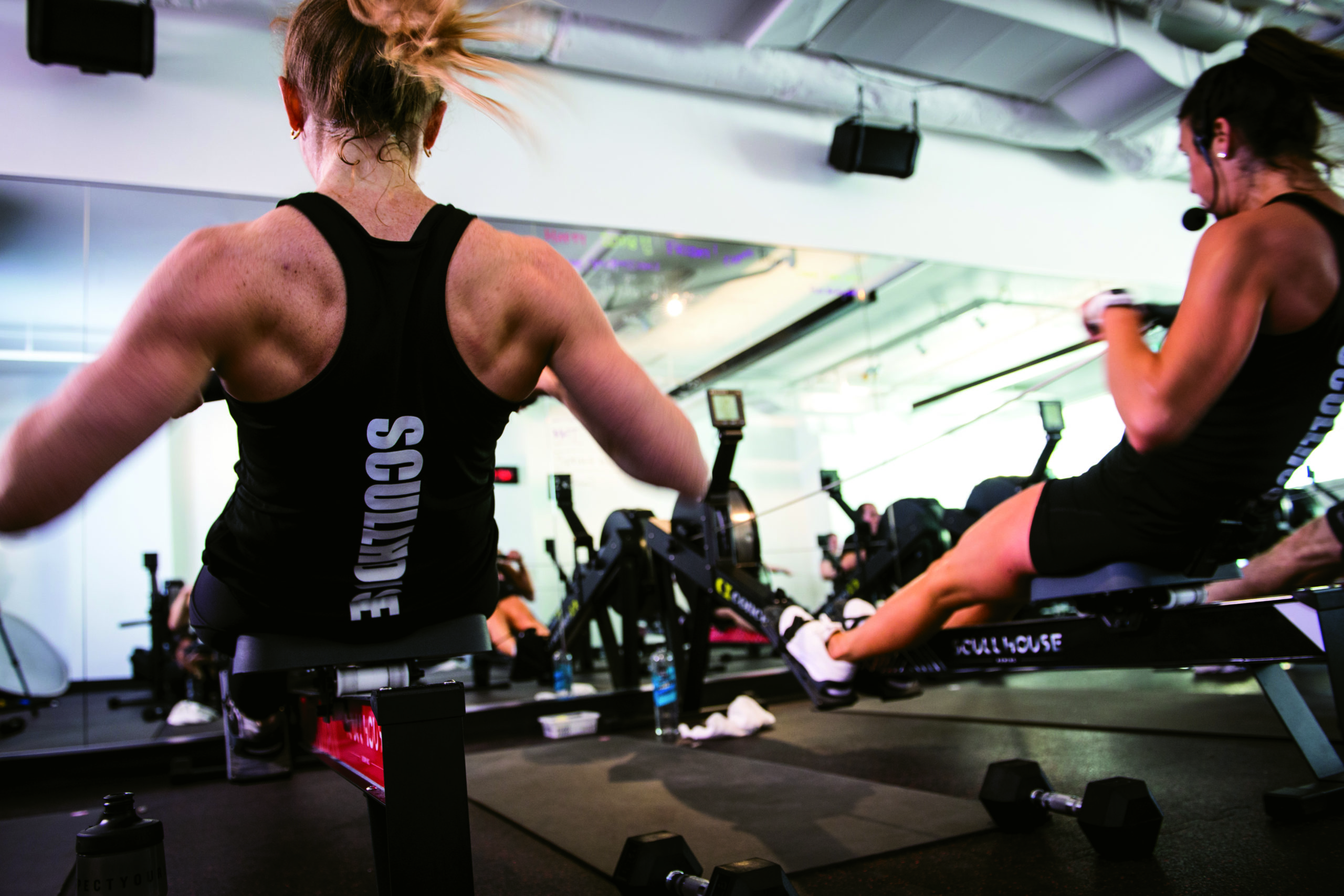
Scullhouse
Meanwhile, in Canada, Kristin Jeffery has had many of the same experiences while successfully steering her business through 2020 from bricks and mortar into virtual waters.
“Everything has changed,” said Jeffery, who transitioned out of a post-rowing career in law to start, in 2017, Canada’s first dedicated indoor rowing gym, Scullhouse Rowing in Toronto.
“I wasn’t satisfied with what I was doing. I was working 15-, 16-, 17-hour days, and so was everyone around me.” As Jeffery began to develop back pain, she found a cure in movement, specifically rowing.
While hopping on an erg was second nature to her and helped with the back pain, Jeffery recognized that most of her time-crunched colleagues didn’t have easy access to such transformative exercise.
“I was thinking of people who are sitting all day and don’t have time to do a long workout. I opened Scullhouse to help fight the sitting epidemic.”
Now, in the midst of a global pandemic, the need for exercise and connecting to others is greater than ever.
“Normally when we are open, we have five classes a day, seven days a week. We had eight instructors when we closed down in March. For us, it was all about the atmosphere. When people walk in, we know everyone’s name, everyone is connected, part of a community. That has been difficult to capture [online].
“The week after we shut down, we were having classes on Zoom. It started with a laptop and no special effects. People were just grateful. We rented all of our 23 ergs out. I knew that there would be a few people interested, but people wanted them as soon as they found out that they were available.”
As the first wave of lockdowns dragged on, Jeffery realized that the “new normal” was not going away any time soon.
“We invested in a camera and a mic,” she said. “Now we record our classes so people can do them on their own or in different time zones. But most people try to use the live classes. They feel that they get more out of the live classes.”
Those classes have helped preserve a sense of community, Jeffery says–“the saving grace through this.”
“It’s the highlight of my day, and for many others, too. I’ve received notes that when they have otherwise been feeling pretty defeated, the class was what got them out of bed in the morning.
“You are doing it to make someone’s life better and make them feel better. Knowing that we are still having that impact, even though not in person, is pretty great.
“At Christmastime, there were 26 members who all sent in messages of what this online community has meant to them. It brought me to tears, because sometimes you don’t know [the impact of what you do]. To understand how important it was to them was special.”
That sense of community
It’s a similar story for Anna-Marie de Zwager, owner and operator of Amaze Active Health in Victoria, British Columbia.
“I started in kinesiology before I discovered rowing,” said the former Olympic rower. “When I finished rowing and came back to it, I realized that kinesiology is all about the breakdown of human movement in a rehab setting. I also felt that in my time with the national team, everything I was being taught was about breaking down the rowing stroke. It seemed like a neat marriage to combine the kinesiology piece with the other thing I knew–how to row.”
For de Zwager, who has built her business by focusing on in-home exercise therapy and group ergometer fitness classes, developing her virtual options through 2020 was straightforward in some areas, challenging in others.
“I have a small enough business that it has been relatively easier to pivot,” she said. “A colleague at the University of Victoria told me, ‘It isn’t easy to pivot a frigate.’”
For all that, de Zwager noted the importance of recognizing that for some people there are barriers to connecting virtually.
“It has been more difficult with some of the rehab aspects of my business–say, with people who have dementia. Meeting virtually on a screen just won’t work for some of them. I’ve also lost a number of clients who prefer to work out in person or don’t want to have a Zoom account. Also, sometimes the technology just doesn’t work.”
While her client numbers are down overall from this time last year, de Zwager has seen growth in a promising new direction and believes many of the changes in how people connect in the rowing business are here to stay.
“I have one new client logging in from England for a stretching class at the end of her working day, the start of ours. I don’t think the online piece is going anywhere; even when we get back to in-person, there will be people who want to attend from their homes.
“Whatever happens, I don’t want to lose that sense of community that people have.”
A ray of hope
Holding on to that feeling of community in the face of Covid-19 is exactly what Allison Ray is trying to do for her rowers at San Francisco’s Oakland Strokes.
The club’s director of women’s rowing has become a deft hand at connecting virtually. Fortunately for Ray and her rowers, current pandemic restrictions in her area allow for on-water rowing to continue, but there have, of course, been some big adjustments.
“The primary change is when we have them at practice in their cohorts of eight, I let them talk to each other. Instead of driving an intense jam-packed session, I let them socialize. I have altered my ‘style’ somewhat too.”
Although Ray has continued to maintain high expectations, as well as structure, organization, and consistency, her approach has relaxed.
“As coaches and rowers, we love a goal to train for – competitions, going fast – but in this phase we have spent more time learning to train, taking time to get deeper into technique, enjoying the power of the single and sculling and how that is something you are in control of, at a time when we have so little control over anything.”
Especially within competitive training groups, where seriousness is the norm, Ray hopes this new perspective on what matters can carry forward into a better work-life balance for both her and her rowers.
“The truth is the kids are struggling,” she said. “They are more in need of support. They are struggling mentally and emotionally, and coming to the boathouse is their only social in-person outlet beyond their families. Rowing is the vehicle for this. What we are doing is more meaningful to them than ever.”
Ray’s words reminded me that even the most advanced or widely adopted connective technology is really just a proxy for what we rowers have always enjoyed in abundance yet often taken for granted–in-person, real-life connection to others. Maybe what the pandemic is teaching us is that enabling people to develop and experience deep social connection is one of the best uses of our precious time together.