Home Blog Page 91

Minnesota Opens 2024 with Dual Win over Gonzaga

Minnestoa Women's Rowing
Story courtesy of Minnesota Athletics. Photo courtesy of Minnesota Athletics and Christopher Mitchell.

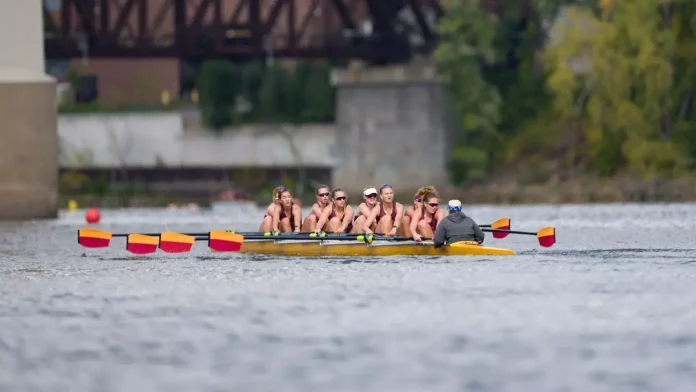
CHULA VISTA, Calif. – Minnesota rowing opened its 2024 spring schedule with a dual victory over Gonzaga Sunday morning at the Chula Vista Elite Athlete Training Center. The Golden Gophers won three of the five official races versus the Bulldogs.

The Maroon and Gold’s 2V8 boat tallied the largest victory of the day as it won by nearly six full seconds. The V8 squad completed Minnesota’s sweep in the eights, pushing past Gonzaga by more than three seconds. The Gophers also won the 2V4 battle versus the Bulldogs, the eight-time defending West Coast Conference champion and an NCAA Tournament participant from 2023.

Results
Varsity Eights
1. Minnesota – 6:36.46
2. Gonzaga – 6:39.52

Second Varsity Eights
1. Minnesota – 6:55.91
2. Gonzaga – 7:01.73

Novice Eights (Exhibition)
1. Minnesota – 7:24.05

Varsity Fours
1. Gonzaga – 7:46.59
2. Minnesota – 7:49.55

Second Varsity Fours
1. Minnesota – 7:54.63
2. Gonzaga – 7:57.94

Third Varsity Fours
1. Gonzaga – 8:00.23
2. Minnesota – 8:00.95

Minnesota Lineup
V8 –Isabella Bejaran (cox), Cecilie ChristensenNena PapaterpouTallulah SweetAlexa MuellerJosefine FreltoftManon FieldMadeline LangeElla Saunders

2V8 –Wren Wodek (cox), Nathalie MüllerGrace LoescherMeg MesserAnnie MoenHaley CampainMartyna RzeznikAnna StephensonEleni Charalampidou-Layton

N8 –Claire Willey (cox), Abby SchroederEllison Northrop-KielJaden DeutscherJackie WethingtonPaige KellerZara AbstonEmilie RishAlexandra Balcome

V4 –Radhika Ajmera (cox), Kat JohannsCady IsomPeyton MillerNuala Macfarlane

2V4 –Ashley Ohlemacher (cox), Emily FrankeMia ForouhariSophia PirigyiChloe Kremnitzer

3V4 –Misha Shah (cox), Madeline CleverlyArianna HawkinsJackie WethingtonMarina Filas

From Captain Isabella Bejaran
“It is super exciting to begin the season with a solid performance from all boat classes, including a few solid wins,” Bejaran said. “Our team has been preparing for this and we knew that this season would be different from one’s past. I am excited to keep the momentum pushing.”

Up Next
The Gophers continue the spring season March 30 in a dual at Tennessee, a team ranked No. 17 in the 2024 Preseason Pocock CRCA Division I Coaches Poll. The action will take place at Melton Hill Lake in Oak Ridge, Tenn.

The Greatest Rowing Stories Ever Told

Photo courtesy the Author. Story by Andy Anderson/Doctor Rowing.

Over the summer of 2022, I got an email from Göran Buckhorn, a Swede living in Connecticut. He was working on an anthology of rowing stories and asked me if I would contribute a piece from my 30 years of the Ask Doctor Rowing column. Of course, I said yes. A colleague of mine tells his students that seeing your name in print is the second most exciting thing that can happen to you. The most exciting? Falling in love. I’m lucky. I get to see my name every month right here. Falling in love? It happened a long time ago but still burns bright.

Göran has supplied the rowing world with Hear The Boat Sing, a website that produces something rowing-related, amazingly, nearly every single day. “It would be an honor to be represented,” I told him. I sent him a favorite column and promptly forgot about his project. One day in October, two copies of The Greatest Rowing Stories Ever Told, published by Lyons Press, arrived.

What an eclectic mix of writings are contained within its soft covers. There’s fiction—an excerpt from Captain of the Crew (1901) in which the boys of Hillton School, desperate to fill their eight for a race against their archrival, ignore the fact that the boy who rows in the four seat is sick. How does he fare? No spoilers here.

In a short story from Mark Helprin that’s one of my favorites, “Palais de Justice,” a Boston judge slams down his gavel, and the courtroom empties out. The defense attorney heads to the Charles River on the hottest day of the year to take out his single. “There won’t be a single soul on the river,” he thinks. “I’ll have it all to myself, and it’ll be as smooth as glass.” How many of us have experienced the same escape?

His solitary workout is spoiled when a much younger man appears around the Eliot Bridge turn and begins to catch him. “I’m a fool for racing in this heat. I have nothing to prove. I’ll let him pass, and I’ll let him sneer. I don’t care,” he says to himself. But once a competitor always a competitor, and he can’t find it in him to let the younger man pass him. Who will win? The veteran of the Charles or the younger, fitter sculler? I’m reminded of a friend who says, “It doesn’t matter whether you’ve agreed beforehand to compete or not. You are always racing.”

There’s a science-fiction piece about The Boat Race in the year 2107. And “The Boat Race Murder.” With not a butler in sight, whodunit?

The fiction is fun, but it’s difficult to develop characters and plot in just under 10 pages. It’s the nonfiction pieces that stand out. In “The Pineapple Cup,” Aquil Abdullah reflects on the heartbreak of losing the 2000 Olympic trials by 0.33 of a second. “I will never ‘get over’ losing the Olympic Trials, but I will move past it. By not making the 2000 U.S. Olympic rowing team, I gained a better understanding of who I am.…It occurred to me, given some time to reflect, that growing as a person is the most important victory we can ever achieve in our lives.”

Stephen Kiesling’s “The Shell Game” has an excerpt about seat racing to make the 1979 world championships. Kiesling is a Yale oarsman; his opponent, a Harvard man. Brad Lewis, whose “Olympian” is the gold standard for “How I won an Olympic gold medal” stories, has a selection about the first time he went sculling. After his first time on the water, Lewis writes, “I’d found my escape vehicle of choice, the perfect solution for a young man, not yet old enough to drive, but already searching for his freedom.”

Although the book is not intended to be a rowing history, there are numerous contributions by rowing historians. Many of the authors choose to write about specific races. Thomas Mendenhall writes of Yale’s 1956 Olympic gold-medal race in Australia. Bill Miller dives into John B. Kelly’s 1920 Olympic victory in the single. In a chapter from his book The Red Rose Crew, Dan Boyne captures the excitement of the trailblazing U.S. women’s eight finishing second at the 1975 world championships, the first women’s National Team boat to medal at Worlds. William Lanouette writes about the great professional sculling races between Courtney and Hanlan. Thomas Weil is in the launch for the finals of a school-eights championship at the Henley Women’s Regatta. Rick Rinehart, a Henley victor with Kent School in 1972, adds a brief history of this most famous regatta. 

There are some biographical pieces, among them one by Lucy Pocock Stillwell, a sister of George and a contributor to rowing in Washington state in her own right. There are also poems and a few songs.

It’s quite a comprehensive gathering of rowing stories, but inevitably one asks “What is missing?” Many readers will probably say, “Why no Boys in the Boat?” Buckhorn reached out to other sources, but publishers wanted outrageous sums apparently to reprint certain popular works.

This isn’t a complete collection of the greatest rowing stories. There are certainly others waiting to be told (I wish there were more contributions from women). But it’s a fine beginning, and I hope it will spark more in this genre. Dip in to it and you will be rewarded.


OARS Youth Invitational Regatta

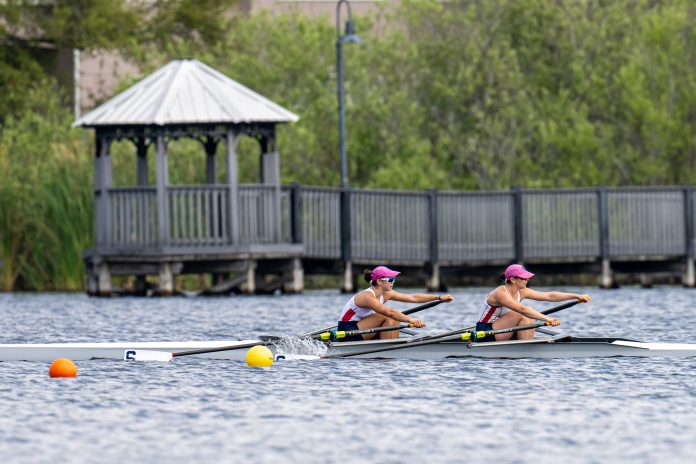
Pictured: Sarasota Crew's Gwen Hazel, stroke, and Maya Schultz, bow. Photo: Lisa Worthy.

Orlando Area Rowing Society has hosted the OARS Invitational Regatta for 26 years in central Florida, welcoming 28 clubs and 1,500-plus rowers and thousands of spectators from Florida, Georgia, and beyond.

High school races took place on Saturday, March 9. Masters and middle school took place on Sunday, March 10. This year’s regatta featured additional racing opportunities for middle school, including sculling events.

Pictured: Sarasota Crew’s Gwen Hazel, stroke, and Maya Schultz, bow. Photo: Lisa Worthy.

RESULTS and TEAM POINTS TOTALS

Indiana Rowing Aims to Win Big Ten Championship

Indiana Rowing 2023 NCAA Championships
Photo courtesy of IU Athletics / The Indiana Daily Student

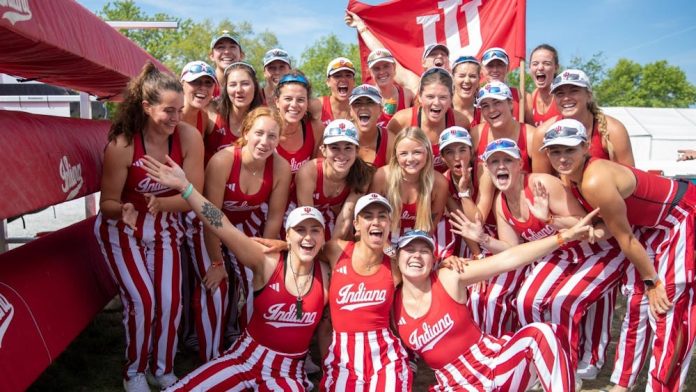
The Indiana Women’s Rowing team has set its sights on winning the Big Ten Championship this spring, the Indiana Daily Student reports. After a program-best third place finish last year, with a first-ever silver medal in the V8, the Hoosiers went on to finish 17th at the 2023 NCAA Championship. The team is returning seven rowers from last year’s V8 and 15 seniors.

Senior and returning V8 rower Sophie Bowden told the student newspaper that the team has a poster in the locker room that clearly reminds them of their focus for the season. “Our big goal that we’re working towards right now is winning Big Tens, then after that, going to NCAAs and hopefully getting a Top 10 finish,” Bowden said.  

The Hoosiers kick off their season March 14-17 in Oak Ridge, Tennessee at the Cardinal Invitational hosted by the University of Louisville.  

The Limits of Criticism

Varese, Lombardy, ITALY. Tuesday, 26/07/22, USA Blades/Oars, World Rowing, U23 World Rowing Championships, Venue, Lago, Lake Varese, [Mandatory Credit: Peter Spurrier/Intersport-images.com] , Ella BARRY,

BY BILL MANNING 

Like many others, I’m a Ted Lasso fan. My favorite scene is the dart game where Ted says, “Be curious, not judgmental.”  It’s some of the best coaching advice imaginable.

It’s a coach’s duty to critique athletes, but rarely is criticism helpful. Telling rowers all the things they’re doing wrong does not move them closer to doing things right. It’s like a game of Whac-A-Mole; they may stop making that mistake, but not knowing what should be done, they just make a new mistake.

Better to ask yourself why they’re doing what they’re doing. (In business school, they would tell us, “Start with why?”). A fundamentally curious approach can get to the root of the problem and help your rowers make the necessary corrections. Leaning away from the rigger at the release? Perhaps they’re rigged too low and are accommodating an uncomfortable mechanical position. Not rowing full slide? Maybe they’re unable to get compressed because their shoes are too high. A coach barking “Don’t lean away!” or “Get up the slide!” isn’t going to fix the problem and will only frustrate everyone.

This is true equally off the water. When behavioral issues interfere, ask, “What’s going on here?” Sometimes it’s young people (or not so young) just being immature and selfish.  Calling them out privately can right this wrong. More often, there’s an underlying issue causing the problem. If one or more of your rowers is consistently late, it may be for reasons beyond their control. When does class get out? Who’s in charge of the carpool? More serious misbehavior may stem from more serious underlying problems. Ask questions. Showing concern and framing the discussion in terms of helping athletes perform their best can elicit a fuller understanding of what needs to change for them to succeed. Better to begin with the assumption that all your rowers want to perform correctly and get things right. If they’re not, then ask yourself and them what’s interfering with their doing so?

Often, the most difficult people to avoid judging are our peers. When fellow and/or opposing coaches create difficulties, it’s harder to stay curious, but the benefits of doing so are just as great. Giving them the benefit of the doubt—by being inquisitive—also will be reciprocated (as will judging harshly).

Too often, we assume rowers know more than they do. Having coached for years, we take things for granted. College rowers are relatively new to the sport and possess neither the experience nor knowledge of us veterans in the launch. Consequently, it’s easy for us to get frustrated and for our frustration to boil over. Better to stay curious and appreciate how much we don’t know and how much we can learn from our athletes with an approach that’s open and inquiring.

Doing so makes coaching much more fun, too.

I Quit!

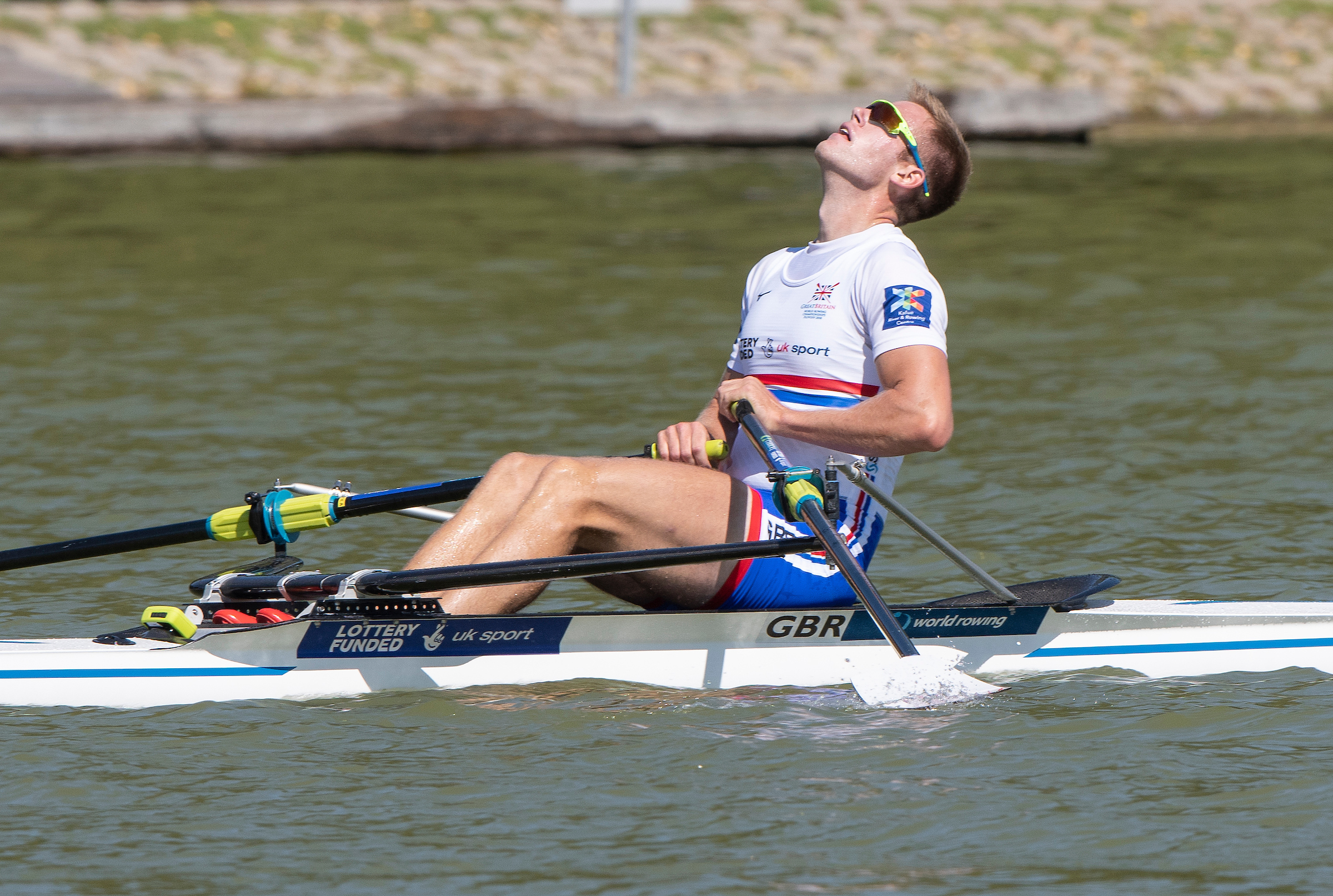
Plovdiv, Bulgaria, Sunday, 16th September 2018. FISA, World Rowing Championships, Men's Single Sculls Final, GBR M1X, Harry LEASK, finishing Fourth, © Peter SPURRIER, 16.09.18

BY TAYLOR BROWN
PHOTO BY PETER SPURRIER

Think of a time in rowing when you wanted to quit. 

It’s OK. We’ve all had them. 

Maybe you were in the middle of a grueling winter erg workout or three lengths down to a crew during a spring dual race. You looked over your shoulder and realized the competition was out of reach, your stomach sunk, and the thought crossed your mind, “I quit.” 

Traditionally, quitting means to resign or discontinue, but this is not true for everyone, and in fact, experiences of quitting can vary significantly. 

A coach of mine once said, “If all else fails, just pull harder.” What I found out later in my career was that pulling hard and putting myself in a lot of physical discomfort was, in fact, my comfort zone. 

I was very comfortable being uncomfortable, as the saying goes. Whenever things were going poorly in a race, I reverted to my comfort zone, threw all technique to the wind, and began pulling as hard as I could. In essence, this reaction was my way of “quitting” because continuing to give full focus and effort would mean maintaining good technique and pulling hard. 

If I could say I still pulled hard, even if we lost, then I could hold my head high and keep my ego intact. Pulling hard didn’t mean much, however,  if I  lost focus completely. It takes a lot more to win a race than pulling hard. 

One’s comfort zone and what it means to quit are often very different. Your version of quitting could be feeling sorry for yourself, easing the pressure, or thinking, “What’s the point?” Another person’s version of quitting may be letting go of technical focus and just pulling hard.

What is your version of quitting? 

What does it look like when you check out? Quitting comes in many forms, such as disengagement, frustration, anger, or even, counterintuitively, perfectionism. It’s much easier to keep chasing perfection than to accept the reality of mistakes or failures. Therefore, “quitting” while trying to achieve perfection becomes a shield to protect you. 

Not all of us have developed the awareness to recognize our own version of quitting. So here are some steps to help figure it out:

  1. Identify someone who knows you well and will be honest. This could be someone on your team, your coach, or perhaps a family member. 
  2. Ask him or her, “How do I act when I give up, quit, or check out?” 
  3. Listen with an open mind. 

It’s hard to hear how other people perceive you, but it may lead to an important breakthrough in how you handle situations when you’re tempted to give up. Becoming more aware of how you respond in these situations will prepare you to handle them better in the future and perhaps make  behavioral choices that are more productive.

Cal Women’s Rowing Starts 2024 Campaign Saturday

Cal Women's Rowing
Photo and story courtesy of Cal Athletics

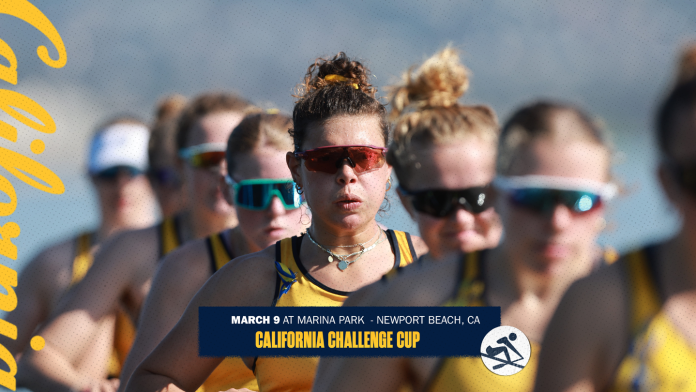
The California women’s rowing team, ranked No. 8 in the first Collegiate Rowing Coaches Association (CRCA) Preseason Poll released Wednesday, will compete in its first race of the 2024 season at the California Challenge Cup in Newport Beach on Saturday. The Golden Bears swept each race they competed in at last year’s event.

The team will send its 4V8+ and 5V8+ to the meet and both will take on top boats from competing teams. This will mark the first race for many of the Golden Bears, as the more veteran rowers will make their debut at the San Diego Crew Classic in April.

“It’s a great opportunity for the mostly younger group to get some racing experience before the season starts,” Cal head coach Al Acosta said. “Basically, they’ll be working on getting the boat up to speed, establishing good rhythm, and executing various technical points throughout the races. Obviously the races are about 600 meters shorter than a normal race, so it should be a fun and fast event.”

Each boat will race twice throughout the day and the two boats with the fastest combined times will compete for the California Challenge Cup trophy.

Results from all races will be posted here.

Race Schedule (all times PT)

7:20 a.m. – Cal 4V8+ vs. UC Santa Barbara 1V8+
7:25 a.m. – Cal 5V8+ vs. UC Irvine 2V8+
8:40 a.m. – Cal 4V8+ vs. UC Irvine 1V8+
8:45 a.m. – Cal 5V8+ vs. UC Santa Barbara 2V8+

STAY POSTED
For further coverage of Cal women’s rowing, follow the Bears on Instagram (@calwrowing) and Facebook (Cal Crew).

Will Russian Athletes Compete in the 2024 Olympics?

Russian rowers at Tokyo Olympics
Photo by Ed Moran

Inside the Games is reporting that World Rowing may allow Russian and Belarusian athletes to qualify for the 2024 Olympic Games in Paris. The president of the Russian Rowing Federation, Alexey Svirin, announced yesterday via TASS, a state-sponsored news agency, “A week ago we received information from World Rowing that men’s and women’s singles and coxless doubles could compete in the European qualifying regatta.” He continued to explain that athletes will be required to undergo anti-doping and background checks, though it remains uncertain if athletes applying for neutral status will need to sign any declarations. 

Svirin seems optimistic about the chance for Russian and Belarusian athletes to participate in the Paris Olympics. He said, ”The likelihood of our athletes taking part in the Olympic qualifying regatta is increasing, but we do not yet have a full understanding of the issue. We are trying to get in touch with the international federation, we have offered to hold a video conference, but we have not yet received an answer.”

World Rowing did permit neutral athletes with a Russian or Belarusian passport to compete in the 2023 World Rowing Championships, but has not yet publicly commented on the process for the Olympics. Last year, the International Olympic Committee announced guidelines for international federations on how to allow the reinstatement of athletes carrying Russian and Belarusian passports under strict conditions. Those guidelines include the recommendations that neutral athletes may not compete if they actively support the war in Ukraine or are contracted to the Russian or Belarusian military or national security agencies. 

It is worth noting that, according to New York Times reporting, a series of websites have popped up in recent weeks, appearing to be established, local American news sources. In reality, these sites are Russian creations pushing Kremlin propaganda. They represent “a technological leap in [Russia’s] efforts to find new platforms to dupe unsuspecting American readers.” 

World Rowing did not respond to a request for comment from Rowing News.