Home Blog Page 90

Washington Rowing Season Starts Saturday With 123rd Annual Class Day Regatta

University of Washington Rowing
Story and photo courtesy of UW Athletics.

The traditional start to the Washington rowing season comes this Saturday, March 16, as the UW hosts the 123rd annual Class Day Regatta on Montlake Cut.

Fans are encouraged to line the Cut to watch the races. For those unable to make it in person, however, there will be a live video feed (see link at top-right of this page).

Class Day events are centered around the main men’s and women’s races, which pit an eight-oared crew each of freshmen, sophomores, juniors and seniors against each other in a standard, 2,000-meter race that ends in the Montlake Cut.

Last year, for the first time since 2004, the seniors won both the men’s and women’s races, meaning that no class will have a chance to win a second in a row. Prior to last year, and for nearly a decade, the juniors and seniors had won both the men’s and women’s races in alternating years, but now the senior men have won four straight. On the women’s side, last year’s win by the seniors broke a streak of three straight for the junior class.

Saturday’s schedule includes four races: men’s and women’s freshman/varsity challenge races, followed by The Seattle Times Women’s Eight and the George M. Varnell Men’s Eight.

10:00 a.m. PT – Women’s Freshman/Varsity Challenge
10:15 a.m. PT – Men’s Freshman/Varsity Challenge
10:30 a.m. PT – The Seattle Times Women’s Eight
10:45 a.m. PT – George M. Varnell Men’s Eight

Along with the live video stream, fans can follow live results at HereNow.com.

Class Day was first held in 1901 for the men and in 1907 for the women (after a long period of dormancy, the women’s races returned in 1976).

Following Class Day, the UW men will travel to Chula Vista, Calif., for a spring break camp, where they’ll also take on UC San Diego (March 20) and the University of San Diego (March 23) in dual regattas. The women will open their season in earnest at the San Diego Crew Classic April 6-7.

The Thrill of Six Boats Across

Lucerne, SWITZERLAND, Saturday, 09/07/2022, {FISA}, Rowing World Cup III, Venue Lake Rotsee, [Mandatory Credit; Peter SPURRIER/Intersport-images] , LANE 4 GBR LW2X, b Emily Craig s Madeleine Fiona Arlett,

BY BILL MANNING
PHOTO BY PETER SPURRIER

Major regattas increasingly begin with time trials. World Rowing has done so at World Cups, USRowing uses them at Youth Nationals, and the IRA, the men’s collegiate national championship, did this last year. A time trial eliminates the need to seed heats—always subjective—and conduct repechages. Unless conditions change during the running of the time trial, it is extremely fair.

Time trials typically seed semifinals and determine lane allocation, which can be consequential if there is adverse weather. If some or all subsequent racing is canceled, a time trial may advance boats directly to the final or determine final placing.

Because of the stakes, it is almost always best to race a time trial at maximum speed. Otherwise, it’s gambling, with too much risk for too little reward. If racing multiple events—and conserving energy is a higher priority—row full pressure, but do so at lower rates. Above all else, be certain that everyone in the boat agrees 100 percent on the approach. Nothing is worse than some racing full throttle while others hold back.

Time trials share similarities with head racing but lack the complexity of turns and, one hopes, passing. In both, fractions of a second often determine outcomes, just as when racing side by side. All three formats reward racing intensity equally.

Give the boat plenty of room before the line to achieve maximum speed and room behind the boat starting ahead to avoid getting stuck in a wake. A couple of extra strokes before the line are far better than beginning the race at less than full speed. Rehearse doing this ahead of time; it’s a skill just like a standing start and deserves attention. 

Develop a race plan that isn’t based upon having other boats alongside. Mature crews should prepare, discuss, practice, and execute a race plan using a SpeedCoach.  Know the desired pace for the conditions and how to achieve this—not just the average split but where the boat plans to go faster and where slower-than-average may be necessary.

All coxed crews can chase the boat starting immediately ahead. Set out to close the gap and get as close as possible. Similarly, all rowers can push off the boat behind, attempting to increase the distance. Row away if possible. Stubbornly hold it off as long as possible if it’s faster. Either way, if moving on another boat, the coxswain should always share this with the rowers. There is no more powerful call than “We’re moving!”

Know where the finish line is. Predetermine where to lift and sprint for the line.  Race through the finish line. If in doubt, keep going.

The time trial is the beginning of the regatta, not the end. Immediately after crossing the finish line, begin preparations for the upcoming side-by-side racing. Project confidence, hydrate, cool down to flush the lactate, eat, and get excited for the thrill of six boats across.

Syracuse Alumni named Coxswain in The 2024 Gemini Boat Race

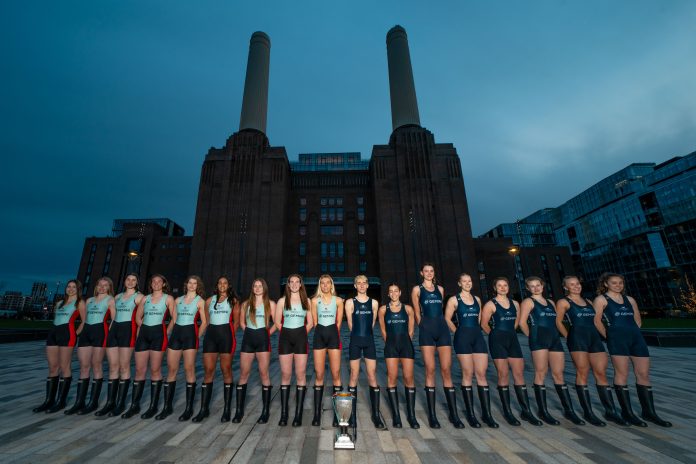
The men’s and women’s crews of Oxford and Cambridge University Boat Clubs were officially announced at a spectacular public event at the iconic Battersea Power Station this evening. Credit: BRCL/Row360

STORY BY SKYLAR RIVERA

Former Syracuse coxswain Hannah Murphy will make her Boat Race debut on March 30, coxing Cambridge University women as crew announcements were finalized for The 2024 Gemini Boat Race today at the Battersea Power Station in London, England. 

“We’re super thrilled that she’s over there and going to represent herself, Syracuse University and Cambridge University in this amazing event.” said Lucas McGee, Syracuse women’s rowing head coach. “[It] really speaks to her skills to be able to go over there in her first year and earn this seat.”

Murphy led Syracuse to the program’s first ACC Championship victory in the Varisty 8 last season. In the same season, she coxed the Varsity 8 to an eighth overall finish at the NCAA Championship and competed in the Island Challenge at the Henley Royal Regatta.

Through rough conditions, Murphy coxed the Cambridge Women in Fixture Series 2 to a clean win over Thames Rowing Club in February to further her campaign to cox Cambridge in the Boat Race. 

“To learn The Tideway and Boat racing on the Tideway, a lot of times you see those coxswain are ones that grew up on that [Thames] and really have an understanding of the stream and the stations and the turns. “McGee said. “To go over there and unseat the coxswain who was in the blue boat last year, and being able to at this year is no small feat.”

McGee raced the Boat Race during the 2001-02 season for Oxford, in a riveting race that saw Oxford defeat Cambridge by three-quarters of a length after being down on the last turn.

“It ended up being a really historical and incredibly painful race.” McGee remarked. “It’s a four and a quarter mile race that goes off dead level, full start, full ratings, just like it’s a 2k and for us that meant we went the entire way.”

McGee spoke to Murphy throughout the racing season where Cambridge has seen promising results. 

“She’s really stepped in and embraced it, and is making them go fast. So it’s gonna be exciting.”

The 78th annual Women’s Boat Race will occur on the famous Championship Course — a 4.25-mile stretch on the Thames in Putney. The record time for the course of 18 minutes 33 seconds was set by Cambridge in 2017. 

Cambridge Women (coached by Paddy Ryan): Gemma King (bow), Jo Matthews, Clare Hole, Jenna Armstrong (President), Carina Graf, Carys Earl, Iris Powell, Megan Lee (stroke), Hannah Murphy (cox).

UCF ROWING 2024 SEASON PREVIEW

University of Central Florida Rowing
Story and photo courtesy of UCF Athletics

ORLANDO – Beginning on Friday, the Big 12 era for UCF rowing will officially launch.

The Knights will race in four regattas before their inaugural Big 12 Conference Championship appearance at Nathan Benderson Park in Sarasota, Florida, on May 19. Three of the team’s regular-season regattas will take place in the state of Florida, at its home racecourse on Lake Pickett with two more at Nathan Benderson Park. UCF’s only out-of-state regatta will be the Lake Wheeler Invite in Raleigh, North Carolina. If the Knights earn a bid to the NCAA Championships, they will travel north to Bethel, Ohio from May 31-June 2.

Head coach Mara Allen said having most of the team’s regattas in its home state will play as an advantage for the team.

“Getting to race on our Big 12 racecourse multiple times before we get there is really helpful,” Allen said. “To have most of our races in literally our own backyard on Lake Pickett or at Nathan Benderson Park is huge.”

On March 15, UCF will begin its season on the water with a Senior Day regatta against the Jacksonville Dolphins and the UConn Huskies at the UCF Intercollegiate Rowing Center on Lake Pickett at 9:30 a.m. Last season, the Knights hosted the Dolphins and Huskies in their season opener on Lake Pickett.

Jacksonville is coming off its second-consecutive Metro Atlantic Athletic Conference Championship and its seventh all-time. Last season, Jacksonville competed at the NCAA Championships at Cooper River Park in Pennsauken, New Jersey. UConn comes into the season after a fifth-place finish last spring at the Colonial Athletic Association Championship.

“I’m really excited that JU and UConn are coming over to race,” Allen said. “JU had a great season last year and UConn has been clearly investing in their rowing program the last few years. I don’t know what to expect, but I am hopeful that we are going to put down six great races and it will be a learning experience regardless.”

Just weeks later, the Knights will make their way to the west side of the state for their seventh Sunshine State Invite appearance at Nathan Benderson Park. Racing will commence at 3:20 p.m. on March 29 and will end at 10:50 a.m. on March 30. UCF took home two medals last season, a first-place grand final finish by the II Eight and a second-place grand final finish by the I Four. Along with Jacksonville, the Knights will host Miami, Stetson, Michigan State, North Carolina, Iowa (Receiving Votes for the top 25), UMass, Louisville, Boston College and Drexel.

UCF will also get its chance to show off against current Big 12 competitors Kansas, Kansas State and West Virginia and 2025 conference affiliates Tulsa (RV) and Old Dominion.

“There’s incredible competition that we are going up against,” Allen said. “I love being able to race against six, seven or eight boats across because that is what Big 12s will feel like. This will give everyone in the boat their first chance to manage the distractions on the racecourse just like they would at conference championships.”

The Knights will return to Sarasota for the Big 10 Invite on April 19 and 20 for the second year in a row. UCF will be met with some heavy competition with every team at the regatta placing in the preseason Pocock Collegiate Rowing Coaches Association rankings. At UCF’s second Nathan Benderson Park competition, the team will face No. 6 Brown, No. 9 Michigan, No. 11 Syracuse, No. 12 Ohio State, No. 14 Rutgers, No. 16 Indiana, Notre Dame (RV) and Wisconsin (RV). The Knights will also compete against Big 12 opponents No. 17 Tennessee and Alabama (RV).

“Realizing there’s going to be a depth to this regatta that we can’t hide is huge,” Allen said. “We are going to see how fast we are against these really good teams. Going against these teams will give us a good sense of our speed and what we need to fix as we close in on conference.”

Rounding out the regular season just a week later, UCF will make its way up to Raleigh for the Lake Wheeler Invite on April 26 and 27. The Knights will make the trip for the fifth time to the No. 13 Duke and North Carolina-hosted regatta.

Teams joining UCF on Lake Wheeler consist of Washington State (RV), Iowa, Louisville, Miami, Boston, Boston College, Navy, Clemson Georgetown, Syracuse, Tulsa. Big 12 affiliates Alabama and Tennessee.

“Going back-to-back from Big 10 Invite to Lake Wheeler is going to be stressful but we need to go up against good teams if we are going to be good,” Allen said. “We can’t hide from talent and speed from the other teams. We need to be able to test ourselves to put us in the best position for Big 12s in May.”

The Allen-led Knights will wrap up the season with hopes of an NCAA Championship berth at the Big 12, a setting Allen is familiar with.

After winning five conference titles at Texas, Allen is in the driver’s seat of her own program and is confident in UCF’s future in the Big 12.

“Our goal is to be on the medal stand at Big 12s,” Allen said. “I am confident in this team and how they will reach that goal as the season progresses.”


University of Michigan Club Purchases New Indoor Training Center

Bandemer Park Ann Arbor
Photo courtesy of MLive

The University of Michigan men’s club rowing team is purchasing a new indoor training space near Bandemer Park on the Huron River. Dan Brock, president of the Michigan Rowing Association, told MLive/The Ann Arbor News that the club expects to close on the existing building at the end of March. The club is purchasing the whole building but will predominantly occupy the first floor, renting out the first floor to generate revenue.

Brock cites “very, very good donor engagement” as the primary reason the club was able to purchase the property, which was valued at $1.34 million in 2023, according to city tax records.

Michigan has won 14 consecutive team points championships at the American Collegiate Rowing Association National Championships (ACRAs). 

The club plans to continue to support rowing in the area, sharing the water with high school teams and the Ann Arbor Rowing Club. “Our purpose is to foster and support rowing with the local high schools and clubs,” Brock said.

Give Them the Slip

London, Great Britain, Cambridge UWBC. The Newton Women's Boat Race Tideway Week, Putney to Mortlake. ENGLAND. Tuesday 07/04/2015 [Mandatory Credit; Peter Spurrier/Intersport-images] Crew, CUWBC Fanny BELAIS, Ashton BROWN, Caroline REID, Clare WATKINS, Melissa WILSON, Holly HILL, Daphne MARTSCHENKO,Hannah EVANS, Cox Rosemary OSTFELD Blade - In The Water. Splashing. Puddles. , Cambridge Women's Blue Boat, Blade Oar, Technical technique drills, Splashy as spoon enterers the water,

BY VOLKER NOLTE
PHOTO BY PETER SPURRIER

Many associate the term “slip” with the blade moving backward against the direction of travel. This comes from the perception that the blade is placed in the water and pushed backward through it. The more the blade moved backward, or slipped, the thinking went, the worse it would be for speed generated by the drive.

If only the blade just moved backward. In reality, after it touches the water it moves at first forward, in the direction of travel, and outward away from the boat. This lasts for one third of the drive before the blade then moves first backward-outward, then backward, and then backward-inward. Though perhaps not intuitive, this movement is well-documented and accepted as scientific fact. So does the blade actually need to move at all in the water?

The answer is yes; it has to in order to produce force, which is connected with the magnitude of the speed of the blade in the water. It can also generate lift force depending on how the water flows relative to the blade.

The trick is to place the blade properly in the water and then produce just the right amount of rotation with our pull on the handle, which requires covering the blade quickly to take advantage of its big surface area and accelerating the rotation delicately to get the most out of the lift.

CRCA Athletes to Watch

Collegiate Rowing Coachs Association
Story and image courtesy of CRCA
Division I Coxswains
I Rutgers University Victoria Grieder
I University of Tennessee Sasha Radovanovic
I University of Washington Grace Murdock
Division I Rowers
I Brown University Olivia Vavasour
I Brown University Dahlia Levine
I Harvard University Isabel Llabres Diaz
I Ohio State University Olli Clotten
I Oregon State University Evan Park
I Princeton University Katherine George
I Syracuse University Kami Kralikaite
I Syracuse University Emmie Frederico
I University of California, Berkeley Antonia Galland
I University of California, Berkeley Fien van Westreenen
I University of Michigan Zara Collisson
I University of Michigan Katie Easton
I University of Notre Dame Natalie Hoefer
I University of Tennessee Alice Fahey
I University of Texas Anna Jensen
I University of Texas Lanie Nitsch
I University of Virginia Kate Kelly
I University of Washington Angharad Broughton
I University of Washington Elena Collier-Hezel
I US Naval Academy Lauren Day
Division II Coxswains
II Central Oklahoma Emily Overholt
II Nova Southeastern University Lauren Gray
Division II Rowers
II Barry University Josephine Wiles
II Cal Poly Humboldt Dana Foley
II Cal Poly Humboldt Kealey Scott
II Central Oklahoma Faith Brooks
II Central Oklahoma Victoria Petschnig
II Embry Riddle Aeronautical University Shelby Ernst
II Embry Riddle Aeronautical University Sofia Lorenzini
II Jefferson University Cecily Fritz
II Jefferson University Nomeda Nazarenkaite
II Mercyhurst University Maclain Zajicek
II Rollins College Grace Oelrich
II Seattle Pacific University Natalie Korolenko
Division III Coxswains
III Smith College Sofia Trotta
III Tufts University Hannah Jiang
Division III Rowers
III Coast Guard Katharine Morgan
III Ithaca College Laura Trainor
III Ithaca College Taylor Volmrich
III Rochester Institute of Technology Margaret (Maggie) Carey
III Skidmore College Maddie Aho
III Skidmore College Molly Sullivan
III Smith College Megan Holm
III Smith College Linnea Schultz
III Tufts University Emma Lyle
III Washington College Jordan Hyde
III Wellesley College Hannah Bates
III Wellesley College Anya Hanitchak
III Wesleyan University Shayna McCarthy
III Wesleyan University Anna Merrifield
III Wesleyan University Ruby Roberts
III William Smith Elisa Faiola
Lightweight Coxswain
Lightweight MIT Mishael Quraishi
Lightweight Rowers
Lightweight Stanford University Juliette Lermusiaux
Lightweight University of Wisconsin Rianne Wagner
Lightweight University of Wisconsin Falcon Jaacks
Lightweight Georgetown University Emily Bertanzetti
Lightweight Georgetown University Alice Padula
Lightweight Princeton University Sarah Fry
Lightweight Boston University Zoey Goodness
Lightweight Boston University Ela Ersan

Full story here.

The 365-Day Pursuit 

Photo by Ed Moran. Story by Volker Nolte.

The first to promote year-round training consistently was the famous German coach Karl Adam way back in the 1950s. His motto was “Technique brings seconds; physiology, minutes!” So he focused on improving the physical fitness of his athletes.

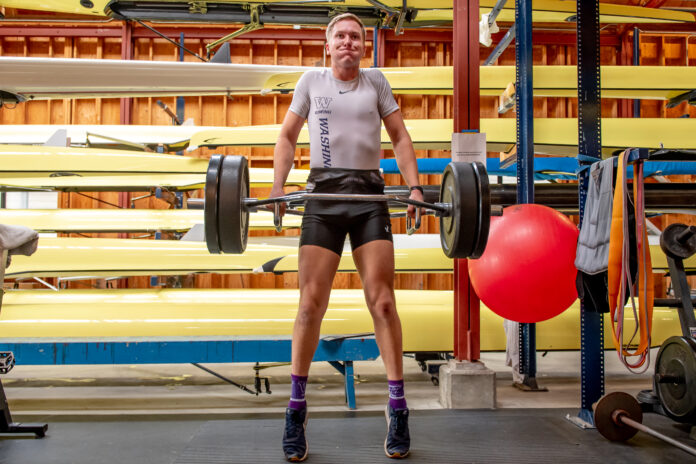
The way to achieve that goal, he believed, was year-round training that included periods of specific focus on overall fitness. To that end, he emphasized strength-training and other forms of indoor training during the preparation period. The success of his approach was proved by his crews, which, in 1960, became the first ever to beat an American men’s eight in an Olympic final.

Although such practices are now standard, it’s worth citing the benefits of year-round training. A continuous training load is better for the body than alternating between heavy training and no training. Training adaptation takes time, and gains recede quickly when the training stimulus is removed. It takes a considerable amount of time also for training to result in improved performance, especially in the realm of endurance, and that improvement vanishes when training ceases. The aim of training always is to improve performance, building on previously achieved fitness. 

Rowers who train five times a week all year will perform better than those who train 12 times a week for only six months, as long as the training methods and loads are chosen correctly. Similarly, a person exercising for health is better off doing something for 15 minutes every day than exercising for two hours only on weekends. 

In rowing, this applies crucially because performance is based primarily on endurance. About 70 percent to 75 percent  of the energy required to complete a 1,000-meter race is generated aerobically. In longer races, athletes expend even more aerobic energy, and building that enormous aerobic capacity requires long training sessions over long periods of time. For optimal training, endurance gains are achieved most effectively through low-intensity sessions of 20 to 120 minutes, with duration increasing as the rower develops. 

Rather than performing the training mindlessly, rowers should execute movements deliberately at an intensity that’s controlled precisely. This will enable rowers to get the most out of the long hours they spend repeating the same motion, thus enhancing not only speed and stamina but also balance and a sense of the boat.