Home Blog Page 55

Mid-American Conference (MAC) to Add Women’s Rowing

Story and photo courtesy of the MAC.

CLEVELAND, Ohio – The Mid-American Conference (MAC) announced today an addition to its sports lineup as women’s rowing will be added beginning with the 2025-26 academic year, increasing the MAC’s sponsored championships 23 (13 women / 10 men). With the addition, the MAC will sponsor the third most sports of any FBS Conference (ACC 28, Big Ten 28, Big 12 Conference 23).

The MAC will begin the 2025-26 academic year with six programs competing in women’s rowing as Eastern Michigan, Toledo and UMass will be joined by new affiliate members Delaware, High Point and Temple.

“The member institutions of the Mid-American Conference take great pride in offering a broad array of sports offerings for our students,” said MAC Commissioner, Dr. Jon A. Steinbrecher.  “Women’s rowing is a great addition to our sports sponsorship line-up.  This is a sport that continues to grow in popularity, and I am already looking forward to awarding our first championship in May 2026.

The addition of women’s rowing as a spring sponsored sport continues to enhance the MAC’s stature as one of the leading Division I Conferences in the nation. The first MAC Championship will be held in the spring of 2026, while the Conference plans to host an Invitational event in the spring of 2025.  The MAC Championships will be hosted by Eastern Michigan at Lakeside Park on Ford Lake for at least the first three seasons.

What head coaches and administrators are saying about the MAC adding women’s rowing

Delaware Head Rowing Coach Asiya Mahmud

“We are excited to join the MAC. The decision to sponsor women’s rowing in the MAC is one that shows support for not only Delaware athletics, but also the sport of women’s rowing. We are thrilled to forge forward in the MAC with other universities and rowing programs that share aspirations of bringing both regional and national relevance to the conference as well as a high level of competition.”

Eastern Michigan Head Rowing Coach Kemp Savage

“The Mid-American Conference taking a leading role in the expansion of Women’s Rowing represents a significant investment in women’s athletics and the future of NCAA Rowing. All the future MAC coaches are enthusiastic about crowning the first conference champion at the new course in Ypsilanti, and we are honored to be the inaugural hosts at Eastern Michigan University.”

High Point Head Rowing Coach Jessica Deitrick

“I am thrilled to have our new women’s rowing program join the Mid-American Conference. I believe the addition of women’s rowing to the MAC is great for the sport of rowing and for the programs involved. Together we will make a competitive field that enhances our student-athlete’s experiences. For High Point University, this is a great place for us to be and develop into a highly-competitive program and nationally-recognized name. We are looking forward to the first conference championship in May 2026!”

University of Massachusetts Head Rowing Coach Eric Carcich

“We’re extremely excited about the creation of the MAC Rowing Championships, beginning in the Spring of 2026. After experiencing the loss of two of our rowing conferences where auto bids were drawn from this past year, to be on the other side in creation mode is exciting. We’re also excited to compete at the state-of-the-art course Coach Savage has built at Eastern Michigan, which will attract the best crews from all over the country to invitational regattas and our annual conference championship. The energy surrounding the creation of the MAC Rowing Championships is massive and it is exciting for UMass and EMU to be part of that foundation.”

Temple Head Rowing Coach Rebecca Grzybowski

We are thrilled to finally share that we will be part of the MAC’s brand-new women’s rowing championship!  Providing a competitive championship opportunity for our student-athletes is important for our team and also vital for the continued growth of women’s rowing around the country. We are grateful for all the hard work to make this a reality and proud to be part of the inaugural class of women’s rowing in the MAC.

Toledo Vice President and Director of Athletics Bryan B. Blair

“We are very excited that women’s rowing will be added as a Mid-American Conference sport in 2025-26, the inaugural season of Toledo Women’s Rowing. A conference home is important to the growth and development of our rowing program. Today’s announcement further adds to the excitement surrounding the addition of the sport at The University of Toledo as we look to grow and nurture new relationships in our community, and better serve our University.”

MID-AMERICAN CONFERENCE

The Mid-American Conference office is based in Cleveland, Ohio as the Conference office serves 12 full-time members and offer championships in 22 sports.

Founded in 1946, the Mid-American Conference is an NCAA Division I, 12-member conference that sponsors 22 championships and is one of ten members of the Football Bowl Subdivison (FBS). With total enrollment of nearly 300,000 students, the league represents institutions of higher learning in five (5) states – Illinois, Indiana, Michigan, New York, and Ohio.

Women’s Rowing Becomes Varsity Sport at Toledo

Graphic courtesy of Toledo Athletics.

The University of Toledo will add women’s rowing as a varsity sport beginning in the 2025-26 school year.

Women’s rowing, which will compete at the NCAA Division I level, will be the 17th varsity sport at Toledo and the first addition to the athletics program since women’s soccer in 1995.

A head coach is expected to be hired later this year, with a full year of acclimation before regular-season competition in the fall of 2025. The full squad will consist of about 50 to 60 student-athletes.

“We are excited about the many opportunities that adding women’s rowing brings to the University of Toledo,” said Matt Schroeder, the university’s interim president, “including attracting new students to our campus, supporting the growth of our excellent Rocket athletics program with a 17th varsity sport, partnering more closely with Metroparks Toledo, and strengthening our presence in downtown Toledo.”

Blair added that no resources would be reallocated from any of Toledo’s current varsity sports, and infrastructure and other start-up costs will be relatively low. The team will practice and compete on the Maumee River and will utilize the Philip LeBoutillier, Jr. Memorial Boathouse in International Park in downtown Toledo. The boathouse is owned by Metroparks Toledo and is operated by the Toledo Rowing Foundation.

The Philip LeBoutillier, Jr. Memorial Boathouse in International Park is part of the Glass City Metropark and Riverwalk project. The $200 million public-private initiative will build a waterfront Metropark and riverfront destination, including 300 acres of new and revitalized green space, and a five-mile, multi-purpose trail conneciting six downtown and East Toledo neighborhoods.

RowFest Crowns Youth, U23, Open, and Masters Champions in OKC

Photo by Riversport OKC.

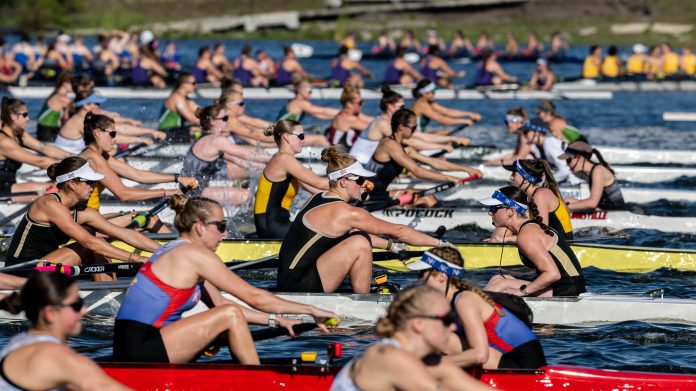
USRowing’s RowFest is in full swing on the North Canadian River in Oklahoma City, O.K. The nine-day regatta combines the USRowing Summer National Championships, formerly and colloquially called Club Nationals, and the USRowing Masters National Championships.

Nearly 3,000 athletes from 107 clubs are competing in 1,981 boats across 356 events. For context, last year’s Summer Nationals, featuring youth, under-23, and open events, had 938 entries from 74 clubs while the Masters Nationals hosted 1,720 entries from 125 clubs. That’s a total of 2,658 entries from 199 clubs.

Racing kicked off on Saturday, July 13, with under-23 and open events, while junior events commenced on Monday and Masters racing will start on Thursday. The most subscribed event of the regatta is the women’s youth single sculls with 28 entries, won by Shannon Breimer of Albany Rowing Center. Of the first 62 under-23 and open events, though, only 11 had double digit entries and none more than 12.

Some familiar names have been seen atop the medals podium. Penn AC claimed the first medal of the event, winning the men’s U23 double by nearly 15 seconds. Ready Set Row, a junior summer camp, claimed the first, second, and third spots in the women’s U23 eight. Meanwhile, local club Oklahoma City High Performance Center took gold in both the men’s and women’s U23 singles.

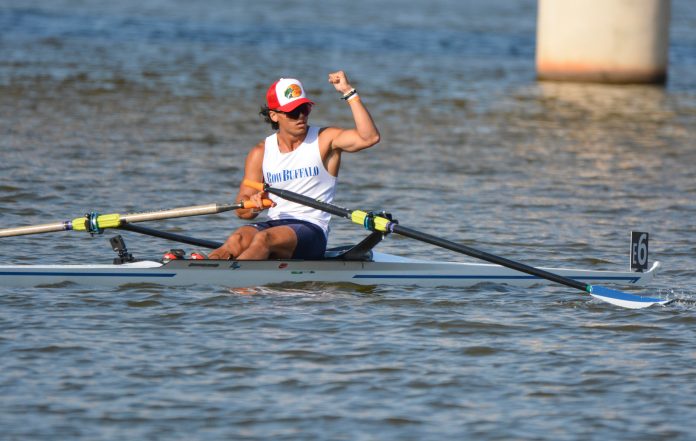
On the junior side, 24 national champions were named in the youth and Under-17 events. Ready Set Row once again claimed the top spot in the women’s youth eight while RowBuffalo did the same in the men’s event. The men’s eight champion crew featured Liam Feeney and Isaiah Aljuwani of Canisius High School who won the men’s youth pair at Youth Nationals as well as James Dodman and Max Burget, who finished second in the same event, also for Canisius. Penn AC finished second in both men’s and women’s eights. Penn AC did find victory in the women’s youth quad, while Ready Set Row’s Skye Luebbe Davidson won the men’s youth single by over 14 seconds.

Racing at RowFest continues Thursday with masters events and runs through Sunday. Racing is live streaming on Overnght. Full results are on Time Team.

CURRENT ISSUE OF THE MAGAZINE


Coxswain Development: Getting Back Into It

Photo by Lisa Worthy.

When you’re behind in a race (e.g., one length back), there are three things you, as a coxswain, can do to get back into it.

Before we get into that, though, let’s dispel the myth of the magical call. There isn’t one, because it doesn’t exist. You can have some motivational calls tucked away for moments such as this, but you can’t rely on them to be the game changer when you’re down by a length on the field or open water back. And no, I can’t tell you what those great motivational calls are because I’m not coxing your boat. In my experience, they’ve always been specific to my crew and the people in it, which is why knowing your teammates is so important to the calls you make.

Skipping the process outlined below and resorting to spouting platitudes for the rest of the race is akin to putting Band-Aids on a bullet wound; they’re not going to stop the hemorrhaging. It’s your responsibility going into race day to be confident in your Plan A but just as confident, if not more so, and comfortable pivoting to your Plan B when necessary.

Fix the rowing. If you’ve fallen off the pack, then it’s safe to assume that the quality of the rowing has begun falling off, too, particularly as the crew fatigues in the latter half of the race. Your first task is to reunify the crew by getting everyone to take the same stroke at the same time. Assuming you have a solid understanding of basic technique and the stroke your coach teaches, you should apply your knowledge of both to what you’re seeing and feeling to get the rowing back on track.

“900 meters in, one length back on Saugatuck. Let’s tighten up the timing and complete the strokes—we got this! The race starts right … NOW! Squeeeze through … squeeeze through—that’s it! Hold the back ends and breeeathe through the recovery … now. In our rhythm … let’s accelerate and swing together. Squeeeze swing … hands out together now … hands now … hands now … accelerate swing—there it is … accelerate swing…”

Match the speed of the crews in front of you. It’s hard to move on a crew that’s moving away from you, so before you can begin closing the gap, you first have to stop them from advancing farther. This is where you need to watch the rate and make sure you’re at the pace you want to be. One tactic I’ve used in the past is raising our rate a beat to match the other crew(s) if it looks like they’re rowing higher than we are effectively. The risk-reward here is very high, so you have to make a quick assessment (mainly, can you raise the rate without spinning your wheels and then sustain that speed/pace for the next few hundred meters?) and then commit to executing it.

“11 hundred meters in, time to shut ’em down. We’re at 35 right now, we’re taking it up to a 36 … pick it up together … on this one! LEGS commit, LEGS 36–right here, stay in this rhythm now and attack … legs loose … legs loose … get stubborn now, hold on to them … legs yeah middle four! Trust our rhythm, trust our speed … holding our margin now, that’s it…”

Make your move. The second you sense that the margin is holding, you have to capitalize on it and go. You can’t waste time or meters, because by this point you’re probably well into the third 500, which means you’ve got time for maybe one last 20 before it’s time to sprint. My crews tend to respond well to calls for commitment, so I work that word into a lot of my calls throughout the piece, largely to emphasize whatever broader thing I’m trying to accomplish.

“Four seats back now, guys, let’s close the gap and even it up over the next 10 … ready in two in one … commit NOW! One go! Two go! Three commit! Load together send  that’s it, WALKING! Two seats back now … it’s yours, take it! Strong with the legs, together in two … one … two, GO NOW! Legs go! Legs go! Do not sit, do not quit … together go! Bow to stern now, bow pair, reel it in! Six bend ’em! Seven break ’em! Eight break them! Nine last 500 … ten stay on it!”

If you find yourself falling off the pace of the other crews, evaluate the situation, make a smooth transition to your Plan B, and aim to keep the energy high. Making a successful comeback might not always be possible, but at the very least you should aspire to cross the line with pride, and the strategic calls you make are your best resource to facilitate that. 

World Rowing Records: When the Stars Align

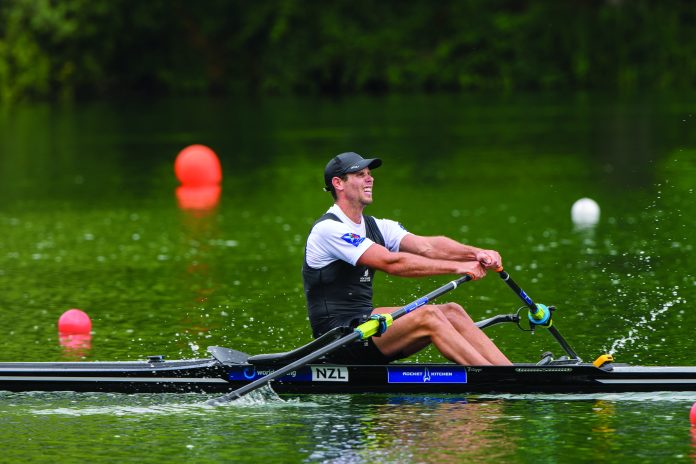
Lucerne, SWITZERLAND, Sunday, 09/07/2017, General view, NZL M1X. Robert MANSON. approaches the finishing line to take Gold in the Men's Single Sculls. Rotsee Rowing Lake [Mandatory Credit. Peter SPURRIER/Intersport Images] 12:54:48

World-best times fascinate us. They signify a performance that no one has ever achieved before and that is unattainable by 99.9 percent of ordinary rowers. They are special also because, once set, they get only better.

What can we learn from them? Not much (except that they’re amazing and inspire us to wonder about who accomplishes such feats). The reason is that they are so random. In fact, all the stars have to align: You need an outstanding team that is either challenged to perform at its best or in the mood to go crazy. And you need an internationally recognized event in the right place.

Record performances are recognized only on courses sanctioned by World Rowing, and of these, world-best times have been set at only a few: Amsterdam in The Netherlands, Lucerne in Switzerland, Poznan in Poland, and Eton in the United Kingdom.

There are other places that offer the right conditions for fast times but for one reason or another they’re not on the international race list. The Olympic courses in Athens and Tokyo come to mind, and Indianapolis has a regatta course where best times were once set but that is no longer used for international competition.

Although courses in Munich and Bled (Slovenia) often host international events, they cannot boast world-best times since the right conditions are needed for fast runs. Warm water and air temperatures are crucial, but above all the wind must blow intensively from the right direction at exactly the right speed for exactly the right duration and without piling up too many waves.

If the wind speed or waves are too high, rowing is impeded rather than accelerated, or races will be postponed for safety reasons. The ideal: an increasing straight tailwind lasting long enough to move the water into a small current toward the finish line and then a big gust for the length of the race that delivers a push before there’s time to create big waves.

Because such favorable conditions combine only briefly, world-best times are set in individual races and not during the entire regatta. And because such conditions occur haphazardly, world-best times are achieved often in preliminary rounds, such as the record rows of both U.S. Olympic eights as well as the Kiwi pair in their heats at the Athens and London Games, respectively, or the Sincovic brothers in their semifinal of the 2014 world championships in Amsterdam. These teams probably didn’t race at top speed in those races, which means they could have set even higher marks if they’d been pushed to the limit under the same conditions in their finals.

The random nature of world-best times is illustrated by the longest-standing record in any current Olympic boat class. Rumyana Neykova of Bulgaria rowed the fastest time ever in the women’s single sculls in 2002, and no woman has come close in the years since. Neykova hit the jackpot of favorable circumstances when she flew over the course in Seville.

World-best times have been set by rowers who were not the best in their boat class that year. New Zealander Robbie Manson, for example, set a world record in the single sculls at the 2017 World Rowing Cup but finished only fifth at the world championships a few weeks later. Could the world champion have achieved an even better time?

The bottom line: World-best times should be taken with a boulder-size grain of salt. Although they improve with each new record and indicate how fast a team can row in a particular boat class, they’re not suitable for a longitudinal analysis of how the sport of rowing is developing or for national standards to compare different boat classes.

Considering all the advances in boats, oars, and equipment, the improvements in training and physiological and biomechanical science, and the increased athlete support that all national teams bring to international regattas, you’d expect more frequent and more significant world-best times in recent years.

Looking at world-best times, one gets the impression that rowing is getting faster. This is not the case. An in-depth analysis of world championships and Olympic finals undertaken with my friend and colleague Valery Kleshnev shows that since 2007 the performances of world-best crews have stagnated, even declined.

Using data from all boat classes every year paints a more reliable picture and should be used to set national and international standards for training and selection.                                     Volker Nolte

The Etiquette of Selection Camp

Photo by Lisa Worthy.

Congratulations! You’ve been invited to selection camp. Whether for the Olympic team, the U19/U23 team, or pre-season tryouts for high school or college, how athletes approach the opportunity can determine their success.

Success at camp requires arriving prepared. This means being physically fit, healthy, rested, and enthusiastic. Find out ahead of time whether or not there will be erg tests at camp and, if so, prepare for them. 

The erg test at selection camp is like a free throw in basketball; the pressure is on but it’s a golden opportunity to score some points. Balance training with good rest, since showing up exhausted or burned out is a quick way to miss out on selection. Same with an injury; get this addressed before camp.

Once at camp, recognize this fundamental disconnect: The coach wants to pick the fastest boat, but you, the athlete, want to make the boat. The more you can adopt the coach’s perspective of “how can I make this boat/team faster?” the better you’ll do in the selection process. If all you do is focus on trying to make the boat, rather than on making the boat better, you’ll be at odds with the selector and less likely to provide what the coach is looking for. Yes, you must be somewhat selfish, but by focusing on the greater good of boat speed, you help yourself best.

Camp requires flexibility and, ideally, curiosity. Things will be done differently than at home. Do not assume otherwise. It’s your responsibility to adapt and understand the purpose of what’s being asked of you. Why this training? Why this drill? If something doesn’t make sense, ask about it. It’s nearly certain that what confuses you is also confusing others (who may be too shy to inquire and attempt mistakenly to fake their way through). If something is unsafe—physically or emotionally—speak up, but otherwise save any concerns for after training.

Selection camp is a full-time endeavor. Behave like a professional athlete. Prioritize rest and recovery. Get to bed early, take naps, take care to warm up and cool down properly, and eat right.

Camp can be rough, so have someone to talk to outside of camp—a “rowing therapist.” It may be a coach at home, a teammate, a sibling, or significant other. It helps if they know rowing, but what really matters is that they’re willing to listen and support.

Beware of cliques. It’s valuable learning from those who’ve been to previous camps. Pay attention to their behavior if they’ve made the team previously, but don’t assume they have  all the answers. Frequently, the “returners” will coalesce around each other and, intentionally or unintentionally, freeze others out. 

This is destructive to boat speed because it hinders finding better boat-movers from among the newer athletes. Returners who do this may make the team but find themselves in a slower boat than they could have raced had they been open to others.  New athletes can assume, mistakenly, that everything the returners do is worthy of emulating and the key to being fast; it’s not. Younger and newer athletes have to discern what’s worth imitating and what’s for show, and thus forgettable. New, unsure athletes can ask the coach who sets the best example and follow him or her.

Finally, don’t take it personally. Selection camp is designed to find the current best boat-movers, not the best people or the rowers with the brightest futures. If you make the boat, it means only that the coach thinks you’re a better boat-mover than others. If you’re cut, it means only that the coach thinks that today you’re not as good a boat-mover as others.

Tomorrow is another day, and there’s a lot more to life than rowing.

Better Rowing Through Food Science

Photo by Ed Moran.

The American College of Sports Medicine is a professional organization for sport-science researchers, educators, exercise physiologists, sports dietitians and doctors. At its annual meeting in May, more than 4,500 members from around the globe presented their latest research.

Here are some highlights of the session hosted by the Professionals in Nutrition for Exercise & Sport:

Fueling endurance: How much carb is enough?

When athletes consume the recommended 30 to 90 grams of carbohydrate every hour during endurance exercise, they tend to perform better than athletes who fail to maximize their carb intake. Given that muscle might be able to take up 120 to 140 grams of carbohydrate per hour if the carbs can get through the gut, the question arises: Would more than 100 grams of carbohydrate per hour be even more beneficial, despite the risk of gastrointestinal distress?

Training the gut to tolerate a higher carb intake might take about a month or more. Hence, endurance athletes should practice their fueling strategies during training sessions to figure out their individual fueling and hydration sweet spot. The type of carb (liquid, solid, sports drink, energy bar) used for fuel doesn’t matter as long as you’re drinking enough fluid.

Caffeine for performance: How much is enough?

Caffeine is a popular pre-exercise energy booster, with some athletes being more sensitive to caffeine’s effects than others. About 45 percent of athletes have genes that metabolize caffeine quickly; 45 percent, moderately; and 10 percent, slowly, meaning it stays in the system longer.

Despite this, caffeine’s rate of metabolism doesn’t dictate its ergogenic effect. Caffeine stays in the system for hours, even among fast metabolizers. There’s no solid evidence to suggest that other genotypes influence caffeine’s performance-enhancing effects. Given that caffeine’s benefits appear unrelated to a specific gene, athletes needn’t spend money getting “caffeine genotyped.”

Athletes can take caffeine in the form of pills (three to six grams of caffeine per kilogram of body weight; 200 to 400 milligrams for a 150-pound athlete) or drink some coffee (about 150 to 200 milligrams per 12-ounce cup) an hour before exercise—though be aware that coffee’s caffeine content is highly variable.

For a quicker fix, caffeinated gum (developed by the military) gets caffeine into the system within 15 minutes. Words of wisdom: More caffeine is not better; high doses can hurt performance, so plan to keep that upper limit to six grams per kilogram.

Placebos are powerful.

When translated from Latin, placebo means I shall please.  A placebo offers a pleasing effect and can enhance performance in its own right. For example, if you take a supplement that you believe in (it pleases you), chances are good you’ll be able to perform better, even if research suggests the supplement doesn’t work. The stronger your belief, the larger the effect.

The supplement industry commonly exploits the placebo effect. Some companies make a lot of money from supplements proven not to work. That said, all supplements come with risks. Just because it works doesn’t mean it’s safe. Use supplements wisely.

Collagen supplements for tendons—questionable!

Collagen supplements are supposed to strengthen tendons and ligaments so such connective tissue is less prone to injury. Research suggests tendons can get bigger and stiffer with collagen supplements, but this has been shown to happen also with whey supplements. In muscle connective tissue, whey and collagen supplements are equally effective. Using collagen supplements to enhance skin, hair, knees, joints, and other collagen-dense tissues is also questionable. If any small effect is seen, it’s more likely from having boosted your protein intake. Consuming adequate protein is essential for proper muscle, tendon, ligament, and joint health.

Hydration for performance

Several studies suggest that over 50 percent of NBA players start games under-hydrated, as well as 50 to 80 percent of other athletes. Does this impact performance? No doubt—just as it’s quite plausible that athletes would improve their performance if they were better hydrated. Most important: drinking enough water in hot weather.

  Some athletes test their urine routinely to determine hydration status based on the concentration of metabolites. Given that each athlete is an experiment of one, having concentrated urine doesn’t mean necessarily that an athlete is dehydrated. For example, muscular athletes, like rugby players, tend to have darker, more concentrated urine than runners. Urine tests should be adjusted according to each individual’s baseline measurement.

Effect of menstrual cycle on performance

Empowering a woman to track her cycle and monitor how it affects her is a big step forward for the sports world; only recently has menstruation been discussed by coaches and trainers.

Although recent research has found no definitive impact of the menstrual cycle on the ability of female athletes to perform, some women talk about symptoms, ranging from mild to very severe, that can lead to suboptimal results.

Cycle syncing—tailoring food and exercise to menstrual-cycle phase—is practiced currently by some athletes and teams, but there’s no strong evidence to support it, nor are there any firm physiological reasons to do it. Since belief is so powerful, we don’t want athletes to believe that at certain times of their cycle, they’ll perform worse.

If a team believes cycle-syncing offers benefits, it will.