Home Blog Page 52

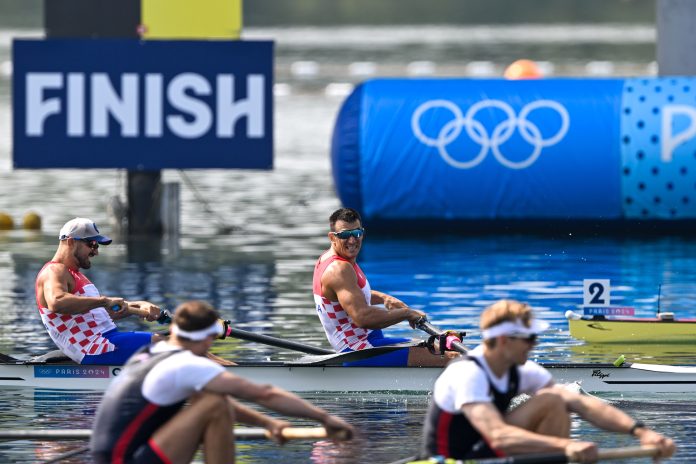
Sinkovic Brothers Win Olympic Gold Medals, Again

Sinkovic Brothers paris olympic medals
Photo by Julia Kowacic.

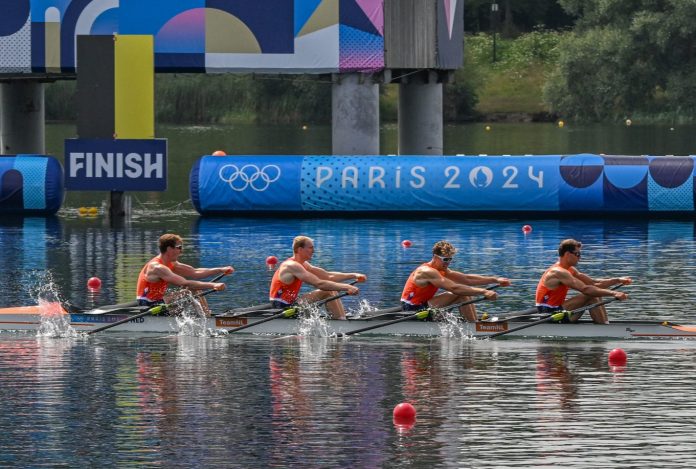
Valent and Martin Sinkovic sprinted to victory, catching Great Britain’s Oliver Wynne-Griffith and Tom George at the line, earning the Croatian pair their third Olympic gold medals, in yet another incredibly tight finish at these Olympic Games. Cow bells rang out in the stands for the Swiss pair, winners of the bronze.

The Netherlands, Great Britain, and Romania, combined, have now won half—15 of 30—of all Olympic rowing medals so far here at the Vaires-sur-Marne Nautical Stadium at the Paris Games.

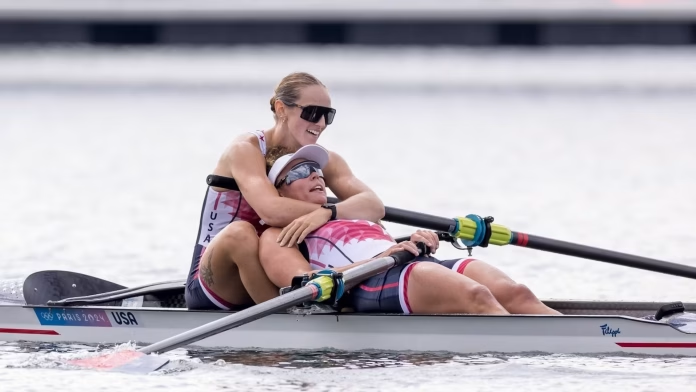
The Netherlands won the women’s pair going away, leading by more than a length of open water going into the last 500. The U.S. women’s pair of Jess Thoeness and Ajza Czajkowski put on a mad sprint to pip Lithuania by three one-hundreds of a second for fourth place. Romania won the silver and Australia the bronze.

“We are very close, but we need to make the final step,” said chief U.S. Olympic coach Josy Verdonkschot at the the end of the day. “Not just to train in the events and be competitive in the events, but also to medal in the events.”

Ireland’s Fintan McCarthy and Paul O’Donovan won the men’s lightweight double.

“The Greeks [bronze] got off to a really good start and hung in there and put in a burst right at the end,” said O’Donovan. “Italy [silver] are always up there in the medals and Switzerland [fourth]were pushing all the way.”

Great Britain’s Imogen Grant and Emily Craig completed their perfect Olympic cycle by winning the last lightweight women’s double sculls gold medal, as the Olympics cut lightweight events after this year. Romania won the silver and Greece took the bronze. The U.S. double of Michelle Sechser and Molly Reckford finished sixth.

“We knew it was going to be hard, it’s a lightweight women’s race, that was never in doubt,” said bowseat Reckford. “We also knew we have very good base speed and have to stay with the pack. We did a better job of that in this race than we did earlier in the regatta. We kept it higher than we normally rate, we gave it all in that first one k to stay with the pack, but you pay for that. It meant we couldn’t get to that final gear. These women are fast.”

Canada finished second in the B final of the women’s lightweight double, for eighth place overall.

Morocco’s Majdouline El Allaoui took an early lead, held off a mid-race charge from Togo’s Akoko Komlanvi, and cruised across the line first to win the F final of the women’s single sculls final.

The U.S. men’s pair of Oliver Bubb and Billy Bender finished fourth in the B final. They’ve been together as a pair only since final cuts from the eight were made in March and earned the right to represent the U.S. in these Games by winning U.S. Olympic trials in April. Bender, paired with Evan Olson, qualified the U.S. for a spot in the Olympics by finishing fifth at last year’s Worlds.

Despite those remarkable accomplishments, the 22-year-old took the pair’s sub-par heat and semifinal racing performances at the Olympic regatta hard.

“Obviously it’s special to be here, especially as young as I am, but, you beat people back home and you hope to show the rest of the world that the people you beat were also good,” said Bender after a disappointing sixth in the A/B semifinal. “You’re representing yourself and your country, but also those guys, so it’s tough to not perform in the way that you hoped.”

Bender and Bubb are both Dartmouth oarsmen, but didn’t overlap in college. Their 10th place is far better than the last Olympics—the U.S. didn’t even qualify a men’s pair for Tokyo—and also an improvement over the one before, when the U.S. finished 11th overall in Rio.

Just like the women’s four (fifth place, here in Paris), women’s pair (fourth), and the quad (seventh), the men’s pair is a relatively new combination of talented and skilled college rowers racing against international competition that has trained and raced together for many years, even decades. The Sinkovic brothers, winners of Bubb and Bender’s semifinal and the gold medal, being the prime example: they’ve won over 50 elite international events, while the U.S. pair hasn’t even raced in five.

“Yeah, I think we all learned a lot because it was all our first Games,” said Daisy Mazzio-Manson of the women’s four after the final. “It’s a different caliber out there. Coming off a world champs you think you know, but it’s definitely a different ball game.”

“This just gives us even more tangible things to work for in the future,” said stroke Kate Knifton.

The Romanian four that finished one place ahead of the U.S. four will race against the U.S. again on Saturday, this time in the eight. After playing games with their entries, the Romanian team made changes to their line-ups resulting in their eight being comprised entirely of doubling-up athletes from their double, pair, and four. The Romanian double won silver on Thursday and the pair won silver on Friday.

In Monday’s three-boat heat of the women’s eight, the U.S. and Italy missed the opportunity to force Romania to row in the Thursday repechage by winning the heat, which would have forced the Romanian double to hot-seat two Olympic races within an hour.

“We didn’t plan to lose against the Romanians,” said Verndonkschot. “We wanted to make them pay, and we couldn’t. So blame us, because now you give them a free ride to the finals. We were not good enough that day. We have to be better.”

U.S. Men Row to Gold at Paris Olympics

u.s. olympic rowing gold men's four
Photo by Julia Kowacic.

The U.S. won Olympic rowing gold, leading from the start and surviving New Zealand’s closing charge in the men’s four. Great Britain won the bronze.

“I don’t think ‘special’ does it justice,” said Drexel grad Justin Best after the win, the first in the four for the U.S. since 1960, “because of the amount of meters, hours, days with each other, away from our loved ones, the funerals you have to miss, the weddings you have to miss, the social events you have to miss, the fiancé’s that are put on hold—it’s all encompassing, what it takes to get to this moment.”

“I want to shout out Casey Galvanek,” said bowman Nick Mead. “We four had the competitiveness and the willpower to do whatever it takes. But we didn’t necessarily know what that is. And he came in and guided us through the steps we needed to do.”

The Netherlands added another gold and silver, in the women’s four and men’s double, to the gold and silver won yesterday, to top the medal table so far, with two days of finals to come.

U.S. single sculler Kara Kohler will race for medals on Saturday, August 3 after advancing in the semi. Kohler was second through the first 500, slipped to third behind Lithuania’s Viktorija Senkute in the second 500, but held an open-water lead over the trailing last three, in the three-to-A final semi. Kohler punched the air after crossing the line, having achieved her goal of making it into the medals race.

“The big thing to overcome for me was to get into the A final,” said Kohler afterwards. “It’s been 12 years since my last Olympic A final in 2012 when I was 21 and rowed in the quad with Adrienne Martelli who’s now here as a coach. So it’s been a while, to claw my way back. I would love to be right in the mix for a medal.”

The Netherland’s Simon Van Dorp, who rowed at the University of Washington and is the only sculler to beat Oliver Zeidler this year, won the first semifinal in 6:42. Kiwi Thomas Mackintosh outsprinted Belgium’s Tim Brys for second and the better lane in final that comes with it.

Zeidler led the other semi, most of it by open water, from start to finish, establishing a new Olympic-best time of 6:35, nearly five seconds faster than the old mark. setting up a grand final side-by-side match-up with Van Dorp

“Today the competition was high and it was for the A final. You could tell that a lot of people really wanted to make it through,” said Van Dorp. “To finally be in the position to race for the real race is very nice, so I’m excited for Saturday.”

“I will of course fight for this title. I’m not the [defending] Olympic champion so I have nothing to lose in the final,” said Zeidler. “We have a race plan. I’m pretty confident that this race plan will bring me a medal. So we’ll not go home without anything and yeah, then I will be very, very happy. We work over all the years and now it’s time to get the result for all of that.”

In the repechage for the women’s eight, Denmark got dropped by a length in the first minute and crossed the finish line last, ending their Olympic Games as only the top six in the seven-boat event race in the final. Canada and Australia were one-two across the 500 in what became a race for remaining lanes outside heat-winners Romania and Great Britain. Canada had almost a full-length lead at the 1,000, which the U.S. closed down in the third 500, before putting their bow ahead in the last 500 to win the repechage.

“We had some goals going out in today’s race, and I think we executed those goals,” said four-seat Regina Salmons. “I am excited for the positive trajectory of the crew.”

The U.S. women’s double finished their Olympic regatta in the B final, crossing the line third, for ninth place overall.

In the men’s double, Ben Davison and Sorin Koszyk were right in the thick of the racing in the A final for medals, going as fast as eventual winners Romania across the 1,000-meter mark, and staying in third through the middle of the race. But they had spent all that they had to stay in it and were passed by the Irish in the final 500 to finish fourth.

“We needed to put ourselves in position to be in it in the sprint,” said Davison after the race. “We lost it in that last minute unfortunately, but I have no regrets.”

“I’m gonna keep training,” was Koszyk’s response to ‘What’s next?’, “I gotta take care of my back this next year and then keep training.”

Dutch Men’s Quad Wins First Rowing Gold of Paris Olympic Games

Dutch men's quad paris olympics 2024
Photo by Julia Kowacic.

The Netherlands won the first rowing medals awarded at these Paris Olympic Games, with the first-(men) and second-seeded (women) Dutch quads racing to gold and silver at the Vaires-sur-Marne Nautical Stadium. Great Britain’s women’s quad lead on only one stroke—the last —in an exciting, come-from-behind victory at the line.

“It’s not over until you cross the finish line,” said Great Britain’s Lola Anderson through tears of joy after the win.

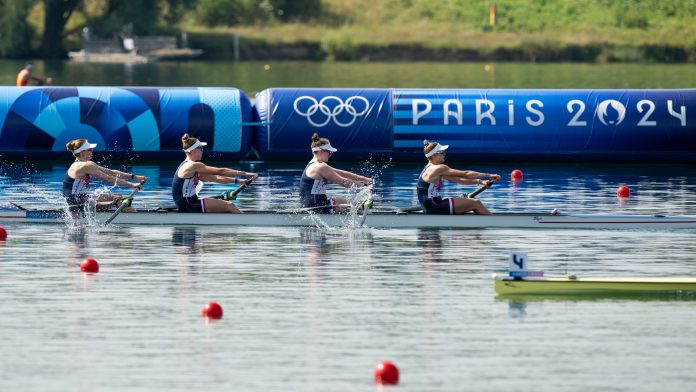
The U.S. women’s quad finished third in the B final, a race in which all three crews sculled nearly dead-level through the middle thousand, with more than a deck spread between them. They crossed the finish each a second apart, Romania, Australia, and the U.S.

“They raced their hearts out, they went for it,” said U.S. chief coach Josy Verdonkschot of the quad’s efforts throughout the Olympic regatta. “And it’s not big margins.” Every quad, four, and eight competing at the Olympics is top-10 in the world, having qualified to be here. “This is Paris.”

The U.S. men’s pair of Billy Bender and Oliver Bubb raced in an elite rowing who’s who A/B semifinal, featuring the two-time Olympic pairs champion Sinkovic brothers, South African Olympic champion John Smith, the defending world champion Swiss pair, and the Spanish pair seeded second in these Games. Bubb and Bender finished sixth and will race in the B final, on the pairs and lightweight doubles final day, Friday, Aug. 2.

The U.S. women’s pair led much of their A/B semifinal before the Australia pair passed them in the last 500. Azja Czajkowski (bow) and Jess Thoennes (stroke) rowed the lowest rate but highest speed off of the start, catching effectively into the light headwind, as they, Australia, and Lithuania advanced to the A final, where they’ll race the Netherlands, Romania, and Greece for medals.

Great Britain’s Emily Craig and Imogen Grant, clear favorites in the lightweight women’s double after winning both world championships this Olympic cycle as well as sculling the fastest time ever (6:40) in the event (Varese, 2023), continued their winning streak through their A/B semifinal, where the U.S. was third, and Canada fifth, in the three-to-final A race.

U.S. single sculler Jacob Plihal won his C/D semifinal and will race in a preferred lane in the C final, on Saturday, Aug. 3, the last day of the regatta, barring weather or other postponements.

Women’s Pair, Lightweight Women’s Double Qualify for Finals at 2024 Olympic Games

U.S. Women's Pair Olympics Paris 2024
Story and photo courtesy of USRowing.

The U.S. women’s pair and lightweight women’s double sculls advanced to the finals on Wednesday at the Vaires-sur-Marne Nautical Stadium at the Olympic Games Paris 2024.

The women’s pair of Jessica Thoennes (Highlands Ranch, Colo./University of Washington/USRowing Training Center – Princeton) and Azja Czajkowski (Imperial Beach, Calif./Stanford University/USRowing Training Center – Princeton) advanced to Friday’s final thanks to a second-place finish in the second semifinal. With the top three to advance, Thoennes and Czajkowski jumped to the front of the field ahead of Australia’s Annabelle McIntyre and Jess Morrison in the opening quarter of the race. The American boat continued to extend its advantage over the second 500 meters, pulling out to nearly a two-second lead at the halfway point of the race.

“Honestly, we were just focused on having a clean start and having a really aggressive first (1,000 meters),” Czajkowski said. “For us, it’s more about executing our race. We know we can do it.  I was a little surprised to look over and see we were up after 500 (meters), but it was good. We just did our thing. I think the heat shook some of the (nerves) out, and we’re in a good spot.”

Over the third 500 meters, the Australians, the reigning world silver medalists, began to reel in the U.S. boat, but the Americans entered the final quarter of the race still in the lead. While Australia was able to overtake the U.S. boat in the final sprint, the Americans finished in a comfortable second place ahead of Lithuania. Australia crossed the line in a 7:14.14, with the U.S. clocking a 7:15.59. The Netherlands won the first heat with a time of 7:10.16. Romania and Greece grabbed the other two spots in the final.

“I didn’t look once this race,” Thoennes said. “Azja said, ‘up,’ and I said, ‘sounds good.’ I trust her to be my eyes, ears, and otherwise. I think we did a really good job of staying internal and executing what we needed to.”

The U.S. last won an Olympic medal in the pair in 2000 and finished 10th in Tokyo.

“Medals are on the line, but it’s not about racing for a medal. It’s just about racing,” said Czajkowski about the final. “If we throw down our hardest piece that we can, we’re going to feel good about the way it turns out. Our fast is really fast and other people’s fast is also really fast. But, I think the best thing about the position we are in is that we can race freely, and we have absolutely nothing to lose. I’m just really stoked to go out there and give it a shot.”

In the lightweight women’s double sculls, Michelle Sechser (Folsom, Calif./University of Tulsa/Cambridge Boat Club) and Molly Reckford (Short Hills, N.J./Dartmouth College/New York Athletic Club) finished third in their semifinal to advance to the medal race on Friday. Racing in the first semifinal, the U.S. got off the line even with Canada in third position, trailing Great Britain and New Zealand. The two lead crews continued to battle through the 1,000-meter mark before the two-time defending world champion British boat began to get some separation. The U.S. moved away from Canada in the second 500 meters to stake its claim the final qualification spot. Poland tried to make a late charge on the U.S., but Sechser and Reckford were able to take third by about a boat length.

“We went into the race with the right attitude today,” Reckford said. “We were there trying to get into the A final and I said to Michelle, ‘live or die, we’re fighting for the line.’ We were able to smile and keep it light on the start line, and I always love it when we are able to do that as a double. I think it can boost a lot of our speed. It was a dogfight out there. This is the sort of race where people go crazy out there and pull out moves that you’ve never seen before, but we stayed calm and trusted each other and when I said, ‘go,’ Michelle went. Love that.”

Great Britain won the race in a 6:59.79, with New Zealand clocking a 7:02.86. The U.S. finished with a time of 7:05.03. The three crews will take on Romania, Greece, and Ireland in the final. Sechser and Reckford finished fifth in Tokyo. The U.S. last won a medal in the event in 2000.

“We didn’t have our best performance in the heat, so being able to show up and have a better run down the track today meant a lot,” Sechser said. “I’ve been dreaming about the opportunity to race in this lightweight double Olympic final since Tokyo.”

After just missing a spot in the A/B semifinals, first-time Olympian Jacob Plihal (Vashon Island, Wash./Northeastern University/Craftsbury Green Racing Project) came back to win his C/D semifinal to advance to Saturday’s C final for overall places 13-18. With three to advance, Plihal got off the line in fourth position but quickly moved into second place behind Serbia’s Isak Ivan Zvegeli in the second quarter of the race. Plihal then began his attack on the leader, overtaking the Serbian with about 750 meters to go. Zvegeli began to drop off the pace as Bulgaria’s Kristian Vasilev and Paraguay’s Javier Insfran moved into the qualifying positions. Plihal held about a three-quarters-length lead on Vasilev as the boats entered the final 500 meters. Vasilev cut into Plihal’s advantage with about 250 to go before the American took his rate up and extended his lead to about a length. Vasilev responded, but Plihal crossed the line about a half-length ahead of the Bulgarian. Plihal finished with a time of 6:56.95, with Vasilev crossing in a 6:57.75. Insfran finished third in a 7:00.93. The three qualifiers will take on scullers from Brazil, Hungary, and Algeria in the C final.

“Yesterday was probably the best race I’ve done, and I just felt that a bit today in the legs and in the cardio,” Plihal said. “Just getting out there and executing and getting the job done, experimenting with a few little things here and there. Now we get two days to rest and recover and get ready for Saturday’s piece. A statement piece, hopefully.”

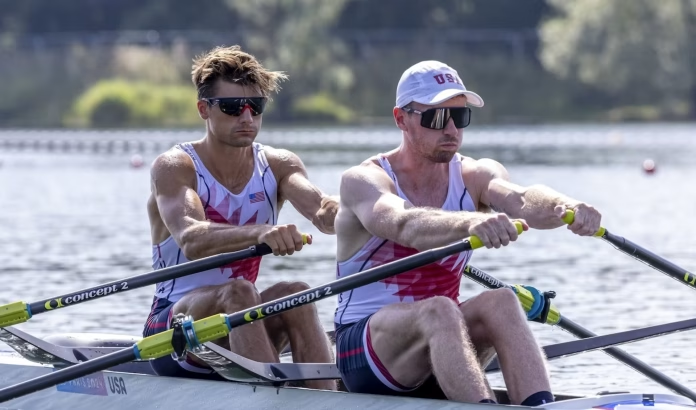
Racing in the first semifinal, the U.S. men’s pair of Oliver Bub (Westport, Conn./Dartmouth College/California Rowing Club) and Billy Bender (Norwich, Vt./Dartmouth College/California Rowing Club) finished sixth and will now compete in Friday’s B final for overall places 7-12. Bub and Bender dropped to fifth off the start and were never able to contend for a top-three qualification spot for the medal race. Croatia’s Valent and Martin Sinkovic, the defending Olympic champions, won the race in a 6:29.98, finishing 2.2 seconds ahead of Switzerland’s Andrin Gulich and Roman Roeoesli, the defending world champions. Spain finished third. The U.S. crossed the finish line with a time of 6:46.11 and will take on South Africa, Lithuania, New Zealand, Italy, and Germany in the B final.

“Obviously, it’s special to be here, especially as young as I am, but you beat people back home and you hope to show the rest of the world … It’s obviously great to be here, but you want to do well. You’re representing yourself and your country, but also those guys, so it’s tough to not perform the way you had hoped,” Bender said.

The U.S. women’s quadruple sculls crew of Lauren O’Connor (Belleville, Wis./University of Wisconsin/ARION), Teal Cohen (Dallas, Texas/ University of Washington/USRowing Training Center – Princeton), Emily Delleman (Davenport, Iowa/Stanford University/Craftsbury Green Racing Project), and Grace Joyce (Northfield, Ill./University of Wisconsin/Craftsbury Green Racing Project) finished third in the B final to take ninth-place overall. Australia took the lead off the start, with the U.S. and Romania sitting just off the pace 500 meters into the race. The Romanians were able to push their bowball ahead as the crews hit the halfway point, just 0.19 seconds ahead of the Americans. As Romania began to increase its lead, the U.S. continued to hold a narrow advantage over the Australians heading into the final 500 meters. At the line, Romania clocked a 6:29.64 to win the race by 1.21 seconds over Australia. The U.S. finished in a 6:31.71.

Six U.S. crews will be in action on Thursday including three in medals races.

The men’s four of Liam Corrigan (Old Lyme, Conn./Harvard University/California Rowing Club), Michael Grady (Pittsburgh, Pa./Cornell University/California Rowing Club), Justin Best (Kennett Square, Pa./Drexel University/California Rowing Club), and Nick Mead (Strafford, Pa./Princeton University/New York Athletic Club) advanced to the final off a dominant performance in their heat. The crew will take on Italy, Great Britain, New Zealand, Australia, and Romania in the medal race. New Zealand won the other heat. The U.S. finished fifth in the event in Tokyo and last won a medal at the 2012 Olympic Games in London, taking home a bronze.

The men’s double sculls crew of Ben Davison (Inverness, Fla./University of Washington/California Rowing Club) and Sorin Koszyk (Grosse Pointe Park, Mich./Cornell University/California Rowing Club) finished second in its semifinal to advance to Thursday’s race for the medals. Davison and Koszyk will take on crews from the Netherlands, Ireland, New Zealand, Spain, and Romania. The Dutch and Irish boats won the two semifinals. The U.S. reached the final in the event for the first time since the 2004 Olympics in Athens. The U.S. last won a medal in the event in 1984.

The women’s four of Kaitlin Knifton (Austin, Texas/University of Texas/USRowing Training Center – Princeton), Mary Mazzio-Manson (Wellesley, Mass./Yale University/Craftsbury Green Racing Project), Kelsey Reelick (Brookfield, Conn./Princeton University/USRowing Training Center – Princeton), and Emily Kallfelz (Jamestown, R.I./Princeton University/Cambridge Boat Club) won their repechage to advance to Thursday’s final. The Americans will take on crews from China, New Zealand, Great Britain, the Netherlands, and Romania in the final. Great Britain and the Netherlands won the opening round heats to advance to the final. The U.S. finished seventh in the event in Tokyo in its return to the Olympic program.

Women’s single sculler Kara Kohler (Clayton, Calif./University of California, Berkeley/USRowing Training Center – Princeton), a three-time Olympian who finished fourth in the event at the 2023 World Rowing Championships, will race in the second of two semifinals on Thursday, with the top three moving to Saturday’s final. Kohler finished second in her semifinal behind Australia’s Tara Rigney to reach the semis. Kohler will take on scullers from New Zealand, Lithuania, Germany, Austria, and Individual Neutral Athlete in the second semifinal.  New Zealand’s Emma Twigg, the defending Olympic champion, and Lithuania’s Viktorija Senkute won their quarterfinals.

The women’s eight of coxswain Nina Castagna (Cincinnati, Ohio/University of Washington/USRowing Training Center – Princeton), Charlotte Buck(Nyack, N.Y./Columbia University/USRowing Training Center – Princeton), Olivia Coffey (Watkins Glen, N.Y./Harvard University/USRowing Training Center – Princeton), Claire Collins(McLean, Va./Princeton University/USRowing Training Center – Princeton), Meghan Musnicki(Naples, N.Y./Ithaca College/California Rowing Club), Regina Salmons(Methuen, Mass./University of Pennsylvania/USRowing Training Center – Princeton), Madeleine Wanamaker(Neenah, Wis./University of Wisconsin/USRowing Training Center – Princeton), Margaret Hedeman(Concord, Mass./Yale University/USRowing Training Center – Princeton), and Molly Bruggeman(Dayton, Ohio/University of Notre Dame/USRowing Training Center – Princeton) finished second in its heat behind Romania and now will race in the repechage on Thursday against Italy, Australia, Canada, and Denmark, with the top four finishers moving on to Saturday’s final.

In the women’s double sculls, Kristi Wagner (Weston, Mass./Yale University/ARION) and Sophia Vitas (Franklin, Wis./University of Wisconsin/USRowing Training Center – Sarasota) finished fifth in their semifinal and now will race in the B final for overall places 7-12. Wagner and Vitas will take on Italy, Ireland, Australia, Czech Republic, and China.

Rowing at the Olympic Games Paris 2024 will take place July 27-August 3. Medal races in the men’s and women’s pairs and lightweight double sculls will be held on Friday. Click here for a complete race schedule.

In total, the U.S. qualified 12 crews for the Olympics including the women’s single sculls, men’s single sculls, women’s double sculls, men’s double sculls, lightweight women’s double sculls, women’s quadruple sculls, women’s pair, men’s pair, women’s four, men’s four, women’s eight and men’s eight. The U.S. leads the way with Romania in qualifying the most boats to race in Paris.

Of the 42 athletes who will be competing in Paris, 17 are returning Olympians with three Olympic medals amongst them. Thirty-eight have competed on previous senior national teams, while four will be making their senior team debuts.


U.S. Women’s Four, Men’s Double into Finals for Medals

Photo by Julia Kowacic.

“Everything today went to plan, and we’re going to keep pressing forward in the final,” said Ben Davison, stroke of the U.S. men’s double that had a good start, raced a half-length down to Germany for most of the race, and then raced past them to advance to the Thursday, Aug. 1 final.

Earlier on Tuesday, Kara Kohler advanced out of the quarter finals to the A/B semi of the women’s single, three seconds behind Australia’s Tara Rigney. U.S. single sculler Jacob Phlihal had less of a result, finishing fourth, but sculled the best race of his life.

“Just looking at my StrokeCoach, just seeing numbers I didn’t think I should be seeing,” said Plihal afterwards, “It was definitely the fastest race I’ve ever put together. So, despite not making it into the top-12 A/B semis, I’m proud of going sub 6:50 for the first time.”

Also proud of the best race of their short history together, the U.S. women’s four rowed through China in the last 500 to win the repechage—which was more like a semifinal in the nine-boat field, with the top two advancing to the Thursday A final.

A disappointing semifinal for the top-seeded U.S. women’s double lands them in the B final.

“They didn’t go straight, so they just couldn’t deliver on the power they would be able normally to deliver,” explained chief U.S. Olympic coach Josy Verdonkschot (Isabelle Jacobs coaches the double). “It’s very unfortunate for them because I think they’re much better than this.”

The first races for medals take place Wednesday, July 31 for the quads, and continue daily through Saturday, Aug. 3, concluding with the eights, featuring both U.S. men’s and women’s crews.

Four U.S. Crews Advance on Day Four of Rowing at the Olympics

Story and photo courtesy of USRowing.

The U.S. men’s double sculls and women’s four advanced to the finals, while the women’s single sculls advanced to the semifinals on Tuesday at the Vaires-sur-Marne Nautical Stadium at the Olympic Games Paris 2024.

Racing in the second semifinal of the men’s double sculls, Ben Davison (Inverness, Fla./University of Washington/California Rowing Club) and Sorin Koszyk (Grosse Pointe Park, Mich./Cornell University/California Rowing Club) finished second to advance to Thursday’s race for the medals. Davison and Koszyk got off the line in fourth position before moving into second place in the second quarter of the race, just behind Germany’s Marc Weber and Jonas Gelsen and just ahead of Ireland’s Philip Doyle and Daire Lynch, who won bronze at last year’s world championships.

“We talked it back last night and this morning,” said Koszyk about the Germans’ quick start and if it changed their plan. “We have our potential speed and don’t care what anyone else is doing. We’re going to make sure we’re hitting 100 percent of our potential. We’re not going to get flustered by what other people are doing. We believe that we are good enough to make it to the final.”

The Irish crew moved into the lead in the third 500 meters with the U.S. keeping pace as both crews overtook Germany. Meanwhile, New Zealand’s Jordan Parry and Robbie Manson were keeping the pressure on the leaders, sitting just over a half-second back of a qualifying spot as the crews hit 500 meters to go. Over the final 500, Ireland was able to inch away from the U.S. to win by just over a second, while Davison and Koszyk were able to hold off New Zealand to take second. Germany dropped off the pace and finished fourth. Ireland crossed the line with a time of 6:13.14, followed by the U.S. in a 6:14.19. New Zealand took third in a 6:14.30. The three crews will be joined by the Netherlands, Spain, and Romania in Thursday’s final. New Zealand won the first semifinal in a 6:13.60. This is the first time the U.S. men’s double has made the Olympic final since 2004 in Athens.

“Everything is going to plan,” Davison said. “Everything we did in the heat went to plan. Everything we did today went to plan, and we’re going to keep pressing forward in the final.”

“I’ve made a lot of mistakes in the past in my rowing career getting sucked into the race and getting distracted by what everyone else is doing, so my goal today was just to keep my head down and listen to what Sorin was telling me and when I needed to do it. I knew if we did that, we’d put ourselves in the best position.”

Women’s single sculler Kara Kohler (Clayton, Calif./University of California, Berkeley/USRowing Training Center – Princeton), a three-time Olympian who finished fourth in the event at the 2023 World Rowing Championships, had no trouble advancing to the semifinals, finishing second in her quarterfinal behind Australia’s Tara Rigney, the 2023 World Championships’ bronze medalist in the event. With three to advance, Rigney, Kohler, and Bulgaria’s Desislava Angelova (fifth at last year’s world championships) took control of the qualifying spots in the first 500 meters, a gap that they would continue to extend all the way down the 2,000-meter course. Rigney took a two-second lead in the opening quarter of the race, ahead of Kohler with Angelova another 0.69-seconds behind. Rigney extended her advantage on Kohler to nearly three seconds at the halfway point, with Kohler moving about a length ahead of Angelova. The three scullers were never challenged over the back half of the race, with Rigney crossing the finish line in a 7:30.57. Kohler took second in a 7:34.96, with Angelova earning the other spot in the semifinals with a time of 7:41.25.

“Got the job done and on to the A/B semis,” Kohler said. “That’s where the real games start, trying to get into the medal round. This is where I fell a little short in Tokyo, so that will be on my mind for sure. It’s a once in a four-year opportunity, so everyone is going to be racing at their best, so going in you really can’t underestimate anyone, including myself.”

The women’s four of Kaitlin Knifton (Austin, Texas/University of Texas/USRowing Training Center – Princeton), Mary Mazzio-Manson (Wellesley, Mass./Yale University/Craftsbury Green Racing Project), Kelsey Reelick (Brookfield, Conn./Princeton University/USRowing Training Center – Princeton), and Emily Kallfelz (Jamestown, R.I./Princeton University/Cambridge Boat Club) won their repechage to advance to Thursday’s final. With two to advance to the medal race, the U.S. boat got off the line in third position behind China and Ireland before moving into the second spot by the 1,000-meter mark. China and the U.S. walked away from Ireland in the third 500 meters to secure the qualifying spots, with the Americans trailing by less than one second heading into the final 500 meters. The U.S. was able to power through China in the sprint, clocking a 6:32.48 to win by 1.12 seconds. The U.S. and China will race against Great Britain, the Netherlands, Romania, and New Zealand in the final.

“I feel like we were pretty internal this race,” Mazzio-Manson said. “I think we wanted to make some changes from our heat, and I think that we were more focused on the type of race that we wanted to have inside the gunnels as opposed to what was going on around us.”

First-time Olympian Jacob Plihal (Vashon Island, Wash./Northeastern University/Craftsbury Green Racing Project) just missed a spot in the semifinals, finishing fourth in the second quarterfinal by less than one second. With three to advance, Plihal got off the line in fifth position before moving into fourth at the midway point, a little over one second off a qualification spot. Germany’s Oliver Zeidler, who won the world title in 2022 and 2023, grabbed the lead off the start with Belgium’s Tim Brys and Romania’s Mihai Chiruta battling for second and third positions. During the third quarter of the race, the top four boats maintained their margins, with no one being able to really extend their advantages heading into the final 500 meters. In the final sprint, Plihal made his charge on Chiruta but came up just short of the Romanian. Zeidler won the race in a 6:45.32. Brys took second with a time of 6:46.26, with Chiruta finishing third in a 6:46.32. Plihal crossed in a 6:47.03 and now will race in tomorrow’s C/D semifinals.

“I was a little bit slower to the (1,000 meters) than those guys. I think they had a better first half,” Plihal said. “I just tried to hunt them down. It was definitely the fastest race I’ve ever put together, so despite not making it to the top 12 A/B semis, I’m proud of going sub 6:50 for the first time, and I would say that’s the best race I’ve put together, so there’s a silver lining in that, and we can still fight for that 13th place.”

In the women’s double sculls, Kristi Wagner (Weston, Mass./Yale University/ARION) and Sophia Vitas (Franklin, Wis./University of Wisconsin/USRowing Training Center – Sarasota) finished fifth in their semifinal and now will race in the B final for overall places 7-12. In what turned into a four-boat race for the three qualifying spots, the U.S. duo dropped to fifth off the line and was never able to work their way back into contention. Great Britain’s Rebecca Wilde and Mathilda Hodgkins Byrne took the lead off the start ahead of Australia’s Harriet Hudson and Amanda Bateman. The Brits continued to lead through the 1,500-meter mark before Romania’s Ancuta Bodnar and Simona Radis, the defending Olympic champions and 2023 world champs, inched their bowball ahead in the final 250 meters. Romania won the race in a 6:51.41, with Great Britain taking second in a 6:51.82. Norway’s Inger Seim Kavlie and Thea Helseth passed the Aussies in the sprint to take third in a 6:52.47. The U.S. finished with a time of 7:04.12 and will face Australia, China, Ireland, Italy, and Czech Republic in Thursday’s B final.

“I think that we will be ready to race on Thursday,” Wagner said. “Right now, this feels pretty devastating and nothing that we did in training predicted that this was what should happen. I wish there was an explanation because that would make sense in my mind. We both have done a lot to get here, and this was not the result that we wanted, but it’s okay to not achieve your goals sometimes and be upset about it.”

Four additional U.S. crews will be in action on Wednesday including the men’s pair, women’s pair, and lightweight women’s double sculls, which will be racing in semifinals.

The U.S. men’s pair of Oliver Bub (Westport, Conn./Dartmouth College/California Rowing Club) and Billy Bender (Norwich, Vt./Dartmouth College/California Rowing Club) advanced to the semifinal off of a third-place finish in the repechage. The duo will take on Lithuania, Croatia, Spain, South Africa, and Switzerland in Wednesday’s first semifinal, with the top three finishers advancing to the final. Spain and Croatia won their heats, while South Africa finished second in its heat.

In the women’s pair, Jessica Thoennes (Highlands Ranch, Colo./University of Washington/USRowing Training Center – Princeton) and Azja Czajkowski (Imperial Beach, Calif./Stanford University/USRowing Training Center – Princeton) advanced to the semifinals thanks to a third-place finish in their heat. The duo will take on Spain, Chile, Lithuania, Australia, and Ireland in the second of two semifinals, with the top three finishers advancing to the final. Australia won its heat, while Ireland and Lithuania were second in their heats.

In the lightweight women’s double sculls, Michelle Sechser (Folsom, Calif./University of Tulsa/Cambridge Boat Club) and Molly Reckford (Short Hills, N.J./Dartmouth College/New York Athletic Club) finished second in the second of three heats to advance to Wednesday’s semifinals. The duo will take on crews from Canada, Great Britain, New Zealand, Poland, and Argentina in the first of two semifinals. Great Britain, the defending world champions, won its heat as did New Zealand. The top three finishers will move on to the final.

The U.S. women’s quadruple sculls crew of Lauren O’Connor (Belleville, Wis./University of Wisconsin/ARION), Teal Cohen (Dallas, Texas/ University of Washington/USRowing Training Center – Princeton), Emily Delleman (Davenport, Iowa/Stanford University/Craftsbury Green Racing Project), and Grace Joyce (Northfield, Ill./University of Wisconsin/Craftsbury Green Racing Project) will take on Australia and Romania in the B final for overall places 7-12. The U.S. finished fifth in the repechage.

Rowing at the Olympic Games Paris 2024 will take place July 27-August 3. Medal races in the men’s and women’s double sculls and fours will be held on Thursday, along with semifinals in the singles and repechages in the eights. Click here for a complete race schedule.

In total, the U.S. qualified 12 crews for the Olympics including the women’s single sculls, men’s single sculls, women’s double sculls, men’s double sculls, lightweight women’s double sculls, women’s quadruple sculls, women’s pair, men’s pair, women’s four, men’s four, women’s eight and men’s eight. The U.S. leads the way with Romania in qualifying the most boats to race in Paris.

Of the 42 athletes who will be competing in Paris, 17 are returning Olympians with three Olympic medals amongst them. Thirty-eight have competed on previous senior national teams, while four will be making their senior team debuts.
IRA and Overnght Extend Live Streaming Partnership To 2030

Graphic courtesy of Overnght.

The Intercollegiate Rowing Association (IRA) and streaming platform Overnght announced the extension of their partnership through 2030, both organizations announced on July 25. Overnght has, in just a few months, become the de facto streaming partner of choice for rowing after securing partnerships with the IRA and USRowing.

This year, the platform streamed not only the 2024 IRA National Championship regatta, but also all IRA sponsored events, including Men’s and Women’s Sprints and the National Invitational Rowing Championships.

Overnght charges $9.99 per month or $95 per year to view any of its live video streams of rowing, water polo, gymnastics, swimming, and other sports. This approach is a new one in rowing which has been accustomed to free live streams for major events such as the NCAA Championship and Henley Royal Regatta.

“The IRA is thrilled to continue our partnership with Overnght,” said IRA Commissioner Gary Caldwell. “Their dedication to delivering outstanding content and enhancing the viewer experience aligns perfectly with our mission to promote collegiate rowing. Our extended partnership is a testament to the success we’ve achieved together and our commitment to furthering the sport.”

One to watch: Majdouline El Allaoui in the Olympic Women’s Single Final F

Photo by Majdouline El Allaoui.

Although Majdouline El Allaoui has struggled in her first taste of the Olympics, the 23-year-old Moroccan’s performances have yielded much for her country to be proud of given the hurdles she cleared to make it to the Games in Paris.

After coming last in her heat, repechage, and E/F semifinal, El Allaoui will face off against Akoko Komlanvi, a Togolese recipient of the Olympic Solidarity Scholarship, in the Women’s Single Sculls Final F on Friday.

El Allaoui’s heat was only her second time using a competition-standard rowing shell – a Filippi purchased by the Moroccan Olympic Committee after she secured her place at Paris through the African Olympic and Paralympic qualifier in Tunisia in October 2023

The rowing club used as a training base by the Moroccan National Team has only three functional single scull shells, meaning the seven or eight athletes selected to train on water spend most of their time in the coach’s zodiac, waiting to be swapped into a boat. The other half of the squad are relegated to one of the clubs’ seven rusting Concept 2s.

Even the Parisian weather was a surprise. “It was really cold,” El Allaoui said. “I didn’t expect it, actually.”

Physically, she stands out against the competition. Her rowing hero and medalist hopeful Emma Twigg towers eight inches over El Allaoui, who is two inches shorter than the average lightweight women’s double sculler competing in Paris. She has a good build for the lightweight competition, but had neither the teammates, nor access to double scull boats, to train for the Lightweight Double Sculls event. 

Yet a fierce competitive streak, inspired by her parent’s divorce when she was five, has inspired outsized performances throughout her career. Divorce remains a rare and uncomfortable circumstance in conservative Morocco, and El Allaoui found that sport distracted her from the loneliness and stigma caused by coming from a broken home. She showed potential in the 400-meter hurdles and taekwondo before discovering rowing. 

“I did athletics as a way to not think,” she said. “I became obsessed with sport.”

El Allaoui was selected for the women’s national team less than a month after her first strokes. Within a year, she was crowned Moroccan champion for the first time – a title she has retained ever since. 

As with most African rowers, Majdouline El Allaoui is very much a beneficiary of single sculls remaining a 32-entry category. Coming into the contest, she was realistic about her chances against the likes of Twigg and the Dutch medalist Karolien Florijn. “I’m not actually thinking about the podium,” she admitted.

But she recognized that showing well in Paris could make a big difference for Moroccan rowing. Not for reasons of prestige: El Allaoui had never heard of Henley Royal Regatta, or the Oxford-Cambridge Boat Race. For her, doing well in Paris was all about raising awareness of Moroccan rowing in the hope of improved facilities and equipment. 

“Why’d you show me this? Do you want me to cry?” El Allaoui teased when shown pictures of an Ivy League boathouse. “When you see the boats, you’ll ask…” she laughed. “How did you qualify!” 

Despite having only handmade coastal sculls to practice in, El Allaoui is also an accomplished beach sprint competitor. Her and her mixed doubles partner, Ibrahim Mraghi, posted the fastest time at the 2023 African Beach Games and are optimistic about qualifying for LA 2028 where beach sprints will make its Olympic debut.

“We are going to train hard for it,” El Allaoui said. “I’m pretty sure that we will qualify.” 

Chasing future Olympic ambitions in classic and coastal rowing events, Majdouline hopes to move to Europe or North America later this year to begin training professionally. Although she’s an Olympic rower, she’s never been contacted by a collegiate coach. 

So, Friday likely won’t be the last time we see Majdouline El Allaoui in action at the Olympic Games. 

The Women’s Single Sculls Final F takes place on Friday, August 2nd at 9:42 a.m. in Paris (3:42 a.m. EDT / 12:42 a.m. PDT)

See the September issue of Rowing News magazine for more details on El Allaoui’s story and her experience of the Olympic Games.