Home Blog Page 46

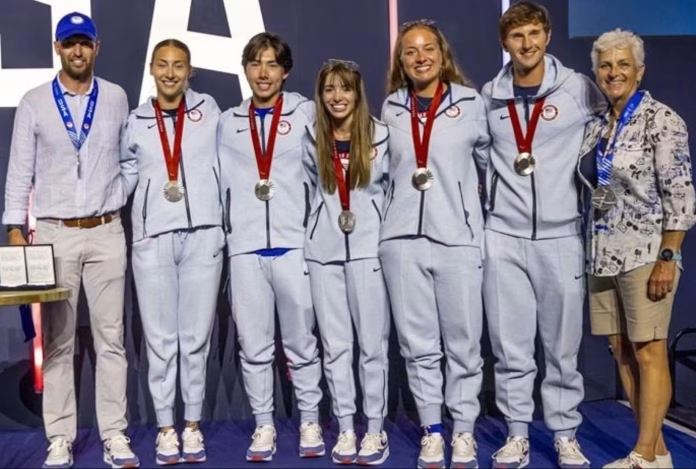
Ellen Minzner and Tom Siddall Awarded Order of Ikkos

usrowing paralympics ellen minzner tom siddal ikkos
Photo courtesy of USRowing.

Ellen Minzner, the Para High Performance Director and 2023 USOPC Paralympic Coach of the Year, was awarded the Order of Ikkos from the United States Olympic and Paralympic Committee (USOPC). Tom Siddall, coach of the silver medal-winning PR3 Mixed four and assistant for the Harvard heavyweight men, also received the honor. Additionally, Rebecca Newman and Bob Arsenault were awarded the Order of Ikkos.  Each coach was nominated by the athletes of the PR3 mixed four with coxswain.

The Order of Ikkos recognizes the efforts of America’s finest coaches and is awarded by Olympic medal-winning athletes to acknowledge a coach for their leadership in achieving world-class success. Each medal-winning team may give the award to a coach or mentor. The award is named for Ikkos, the first recorded coach in Ancient Greece who coached two athletes to gold in the pentathlon.

Previous Order of Ikkos recipients from USRowing:

Paris Olympics 2024
– Michael Callahan
– Casey Galvanek
– Kris Korzeniowski
– Mike Teti
– Tim McLaren

Tokyo Paralympics 2020
– Shelagh Donohoe

Rio Olympics 2016
– Tom Terhaar
– Gregg Stone

Rio Paralympics 2016
– Ellen Minzner

London Olympics 2012
– Tom Terhaar
– Laurel Korholz

London Paralympics 2012
– Brad Lewis

Beijing Olympics 2008
– Charlie Butt
– Mike Teti
– Tom Terhaar

Beijing Paralympics 2008
– Karen Lewis

Fall: Rebuilding Season

Dartmouth, USA, Afternoon training session with Dartmouth College Ladies BC, on the Connecticut River. Hanover New Hampshire Tuesday 06/10/2009 Autumn/Fall foliage, boat Class, Women's coxed fours. W4+ [Mandatory Credit Peter Spurrier Intersport Images].

Traditionally, the fall season is the “non-traditional” season for rowing. It’s a time when the serious spring racing feels distant and what racing occurs is head-style and less consequential. While the racing results may not be as important, the opportunity to prepare for the spring is hugely so. Used wisely, the fall season sets up a team for spring success.

As soon as the athletes get going in the fall, begin to establish team culture. Doing so constructs a foundation to build upon all year long. Some think of culture as a list of rules and procedures. This is a good start but ultimately limiting because rules can’t cover everything, nor are rules always enforceable.

Culture consists of values, not just policies. It’s about how teammates respect one another, their opponents, and the challenge of racing. Ben Hunt Davis, an Olympic gold medalist, distills “culture” to “Will it make the boat go faster?” However you define it, be sure to communicate it at the beginning of the year and reinforce it all year long.

The fall season allows for building a base of endurance focused on aerobic conditioning. This means lots of lower-intensity work (U1) that trains the body to utilize oxygen, build more capillaries, and become more efficient.  Keep the rate low enough (less than 21strokes per minute) that the stroke requires some power and ratio. It’s wise to mix in about 15 percent of high-intensity interval training (HIIT). While this is beneficial physiologically, it’s even more important for teaching athletes to pull harder. The value of learning to row harder can never be overstated.

Every fall, the temptation is to focus on head races and do lots of simulated races in practice at higher rates. Too much of this threshold training at the expense of basic endurance will handicap the aerobic development needed for spring racing. It can hinder rowers also from learning to row a long stroke. Be careful of achieving fall speed at the expense of spring success.

Lower-intensity rowing allows also for more teaching of the rowing stroke. The fall is the best time for technical development. Take it slower and get it right. Teach everyone how you want them to row. Make sure each athlete knows how to take a stroke and move the boat.  Better still, help them understand why. Total team understanding is achievable in the fall, even if perfect execution is lacking, but without first understanding, you’ll never get sustained execution.

The fall should be less intense and a time for more overt fun. Get athletes hooked on rowing so they’re willing to do the arduous winter training. Alternating between sweep and sculling and across different boat sizes will help. Cross training—team hikes, soccer games, water-polo matches, running races—all serve the dual purpose of general conditioning and having fun.

So too will internal competition. It’s fun to race, and athletes become better racers doing so. Train and teach them all week and set up squad racing at the end of the week. This is standard practice in many collegiate rowing programs, and whether called “You-Pick-’Ems,” “PBR races,” “Friday Race Day,” or some other name, it generates terrific competition, good training, and great fun.

Programs that row in the fall typically have about 10 weeks of water time to work with. Used wisely, these weeks will help athletes build fitness, row better, learn to compete, have fun, and, most of all, set the team up for spring racing.

Come racing season, we all wish we had more time. That time exists in September, October, and November.

Sports Medicine Hot Topics for Rowers

sunshine state invitational sarasota closeup kansas rowing
Photo by Lisa Worthy.

The American College of Sports Medicine (ACSM) is a professional organization for sport-science researchers, exercise physiologists, dietitians, doctors, and athlete-care providers. Each year, at ACSM’s annual meeting, more than 3,000 sports-medicine professionals and scientists from around the globe gather to present their latest research.

At this year’s meeting in Denver, a lively session hosted by Professionals in Nutrition for Exercise and Science, a worldwide organization for sport nutritionists, addressed several topics that are currently hot, including some that may interest rowers:

Continuous Glucose Monitors

Continuous glucose monitors (CGM) can help athletes determine the best fueling tactics to maintain blood glucose levels within an energizing range and reduce needless bonking. This can be very helpful during endurance exercise such as long rows. Unfortunately, CGMs have yet to be perfected for athletes. The monitors can get dislodged from the body easily, and some studies show a failure rate of greater than 15 percent. The sport of cycling has banned CGMs during races, but many cyclists use them during training to learn how to “read” their body signals.

Pre-sleep protein

While extra evening protein is unlikely to offer a winning edge, it also will not cause harm or convert into body fat. Research to date shows that pre-sleep protein provides another opportunity to meet daily protein goals. More research is needed to determine if consuming pre-sleep protein will help enhance muscle recovery, tissue repair, sleep, or performance.

Free amino acids and bioactive peptides

When compared to the protein in whole foods, free amino acids are slightly less effective for muscle-protein synthesis. Consuming protein within its natural food matrix is best. Plus, free amino acids taste terrible (although they have improved over the years). Bioactive peptides (two to three amino acids linked together) are available for purchase but lack research to validate potential benefits. So why bother?

Bicarbonate supplementation

With high-intensity sports, sodium bicarbonate might offer a one-percent to two-percent improvement in performance. The standard dose is a third to a half gram per kilogram (2.2 pounds) of body weight; the higher the dose, the greater the increase in performance—so long as the athlete can tolerate it. Capsules that bypass the gut help resolve gastrointestinal issues, and sodium bicarbonate encapsulated in a gel may provide further protection from side effects. Another option that bypasses the gut is sodium bicarbonate in lotion form. The athlete applies it 20 minutes before high-intensity exercise. The lotion feels nice, but how much gets absorbed specifically is unknown.

The lightest athlete is the best athlete.

While lighter and leaner enhances performance to a certain extent, being too light and lean can take a toll. The less food a rower consumes, the less protein, carbohydrate, fat, vitamins, and minerals the rower consumes. This can hurt performance and recovery while enhancing the risk of getting injured.

A study with elite race walkers reported no performance advantage, or disadvantage, among dieting athletes in a training camp who lost two kilograms (about four and a half pounds) during the two weeks before a 10K race. The dieters and the non-dieting control group carb-loaded during the 24 hours before the race, and both performed similarly, with no significant benefit gained by having lost about four to five pounds pre-race. The ideal:  Rowers should fuel well to support optimal performance instead of dieting to become lighter.

Carbohydrates 

Despite popular belief, hungry rowers who consume a sports diet rich in quality carbohydrates do not get fat or become diabetic. The advice to limit carbs might be appropriate for unfit people, but fit rowers metabolize carbs preferentially and convert them into a winning source of muscle fuel.

Iron supplements

Iron supplements are absorbed better at 6 a.m. than 11a.m.; ergo, taking iron on an empty stomach is best. That said, iron can upset the stomach, and some rowers cannot tolerate iron if taken without food. For them, the best time to take iron is either before or 30 minutes after exercise, before the post-exercise elevation in hepcidin (a hormone that hinders iron absorption) diminishes its effectiveness. If a rower takes an iron supplement two hours after a hard exercise session, elevated hepcidin levels can reduce iron absorption by about 36 percent.

Sustainable sports diets

To perform well, rowers need access to good food and clean water, both of which depend on a healthy biosphere. We all need to honor the global dietary guidelines that integrate the UN Sustainable Development Goals. Living a sustainable lifestyle means eating adequate—but not excessive—protein; consuming at least one-third of protein from plants; minimizing food waste (for example, after team buffets, take home leftovers for the next day’s lunch); eating locally grown food (to reduce transportation emissions); and choosing food with minimal and biodegradable packaging (no Styrofoam!). A rower who advocates for a sustainable environment need not be vegan but should be mindful about dietary choices.

Vegetarians

Do vegetarians have a reduced risk of chronic disease because they eat less red meat and eat more plants? Plants are rich in phytochemicals (which reduce inflammation), dietary nitrates (which improve blood flow), and many other performance-enhancing nutrients. A vegetarian diet imparts no obvious advantage, or disadvantage, for athletic performance. Meat eaters looking for a path toward vegetarianism can honor Meatless Mondays and enjoy a plant-based diet with smaller meat portions the rest of the week. Small steps can indeed have an environmental impact.

Alcohol

BORG drinking (Black-Out Rage Gallon drinking, in case you’re unfamiliar with the fad), is a mixture of water, alcohol, sweet flavorings, and electrolytes, which supposedly offer hangover protection, in a one-gallon plastic jug. The concoction is popular on some college campuses because it’s easy to drink and over-consume. An ounce of alcohol takes about an hour to break down, and too many ounces can hinder training and performance as well as sleep. When it comes to conferring a competitive edge, BORG drinking is good only if the other team is doing the indulging. 

PR3 Mixed Four Wins Silver at 2024 Paralympic Games

paralympics 2024 paris pr3 silver medal
Photo courtesy of USRowing.

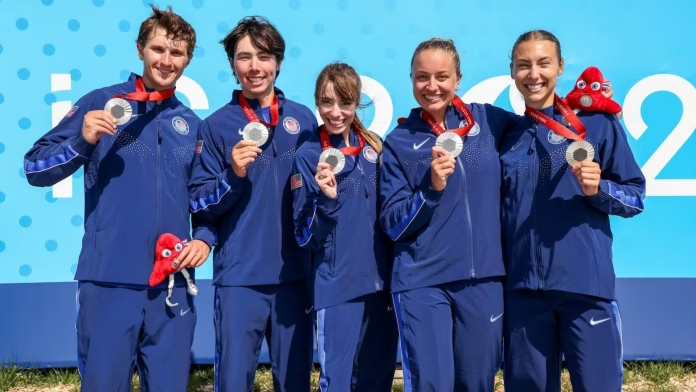
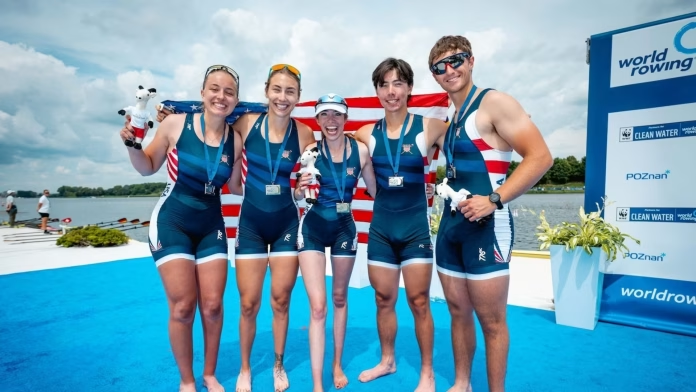
The U.S. PR3 mixed four with coxswain brought home a silver medal Sunday from the Vaires-sur-Marne Nautical Stadium at the Paralympic Games Paris 2024.

The crew of Emelie Eldracher (Andover, Mass./Massachusetts Institute of Technology), Ben Washburne (Madison, Conn./Williams College), Alex Flynn (Wilmington, Mass./Tufts University), Gemma Wollenschlaeger (St. Augustine Beach, Fla./Temple University), and Skylar Dahl (Minneapolis, Minn./University of Virginia) finished three seconds behind Great Britain to earn the U.S. a third consecutive silver medal in the mixed four with coxswain event.

“Throughout the summer, it’s been amazing – getting to know each other even better,” said Flynn of the young boat of first-time Paralympians. “I’ve known Emelie since the 2022 world’s team, and it’s been crazy to see the program and the boat just grow and change. We’ve come a long way. It’s been really amazing to have these guys with me. We all have each other’s backs, and we know it.”

The American boat took an early lead, inching its bowball ahead in the first 250 meters, and was a bowball behind at the 500-meter split. The U.S. continued to maintain contact with the British boat into the second half of the race, trailing by a half-length at the midway point and just four seats with 500 meters to go.

“This boat went out with a plan, and if this boat is anything, it’s professional and mature despite our average age being 21, and so this boat went out and executed,” Eldracher said. “Everything that we said that we set out to do, we just attacked it each and every stroke. We were willing to make changes, we were willing to be brave, and I’m so grateful that we got to do it together.”

At the line, Great Britain won the race in a 6:55.30, extending their winning streak in the event at the Paralympic and world championships level to 14 straight. The U.S. finished 3.29 seconds behind in a 6:58.59. France took the bronze medal by 0.06 seconds over Germany, clocking a 7:03.11 to round out the podium.

“I don’t think age has ever been a factor that we even think about,” said Dahl about racing the experienced British boat. “We really try to capitalize on what we do have, and we’re trying to use our age to our advantage. We all are either in college or are recent graduates. We have a lot of intense training all the time, so we try to use that on the water.”

“We saw the British boat set the world record two days ago, so you know that if you want to get a medal here, you’ve got to be the best of the best and the best potentially ever. I think that was something that drove us this summer. It’s a really cool feeling to now have a medal ourselves and know that we really did something very special this summer, the last couple of weeks, and then today.”

Earlier in the day, the PR3 mixed double sculls crew of Todd Vogt (Rochester, N.Y./University of Buffalo/Portland Boat Club) and Saige Harper (Easthampton, Mass./Sacred Heart University) dominated the B final, winning the race by more than 28 seconds to claim seventh place overall.

“As soon as we crossed and made sure that (we) weren’t going to pass out and we were good, Todd said, ‘Wait, take a second and soak it in.’ He literally said that. I was cheering for the other teams. We were just so excited to watch them cross the finish line, too. It’s India’s first Paralympic rowing race ever, which is so awesome, and they killed it out there. It’s a monumental moment for us and everyone else, and we’re just going to soak it in for a little bit.”

The U.S. boat got off the line quickly, taking the lead within the first few strokes, and were never challenged. By the 500-meter mark, the Americans held more than a length of open water on India, and they extended that advantage to over three lengths of open water at the midway point of the race. Vogt and Harper didn’t let up over the back half of the course, continuing to pull away each stroke.

“I think we executed a full race,” Vogt said. “Yesterday, we basically did 1,000 meters all out and then hung on. Today, I thought we did everything. We had a nice start. We were pretty fast in our high strokes. We shifted down to base pace. We made our moves throughout the race and then we brought the rate up at the end. The whole enchilada.”

The U.S. crossed the line with a time of 7:48.38, with India taking second in an 8:16.96. Mexico finished third in an 8:28.23.

“It was great that we finally had a race that represented us as a team, as a boat” Harper said. “We talked yesterday about how it’s hard to rally after a race like that, and we were going to set new goals. I think today we met those goals and that’s really exciting.”

“In 20 years, I’m not going to remember what place we came in,” Harper said. “I’m going to remember that feeling of coming across that finish line and coming across the whole racecourse the way that we did. I think that’s how I put it all into perspective.”

Click here for a complete race schedule and results.

PR3 Mixed Double Advances to B Final at Paralympic Games

paralympics rowing pr3 paris 2024
Story and photo courtesy of USRowing.

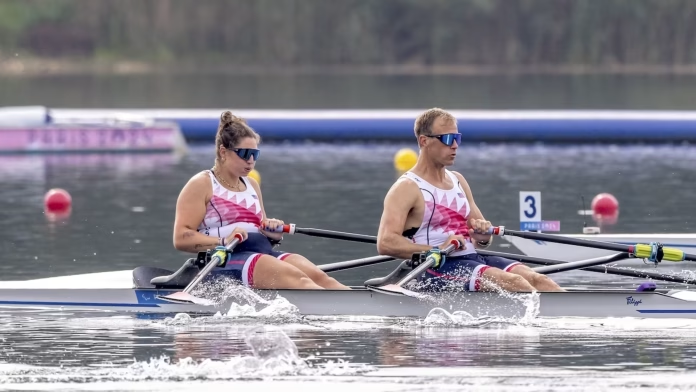
The U.S. PR3 mixed double sculls finished third in its repechage Saturday morning and will now race in the rowing B final at the Paralympic Games Paris 2024.

With two to advance to the medal race, the U.S. crew of Todd Vogt (Rochester, N.Y./University of Buffalo/Portland Boat Club) and Saige Harper (Easthampton, Mass./Sacred Heart University) got off the line in third position behind Brazil and France but was unable to stay with the leading crews and challenge for a spot in the A final.

“I think it’s incredible how many fast crews are out there, and this being the first Paralympics with this (boat) category, it’s so exciting to see so many fast crews and to be in the mix with them,” Harper said. “That was a really gutsy, gritty race. We tried to just put it all out there, and obviously (we) didn’t come up with the result that we wanted, but we’re just going to shift our goal for tomorrow.”

France took the lead off the line, but Brazil was able to move into the top spot as the boats rowed towards the 500-meter mark. The top two crews stayed in contact through the midway point of the race before Brazil began to extend its advantage in the third 500 meters. Brazil continued to pull away from the host country during the final sprint, winning by 8.66 seconds in a 7:24.24. France finished second in a 7:32.90, with the American boat clocking a 7:50.99.

“The depth of the double – there’s a lot of competitive teams there. It’s impressive,” said Vogt, who is celebrating his 50th birthday today. “I should say congratulations to France and Brazil for throwing down a really fast race. We didn’t have the outcome that we wanted, but we went all out from the get-go. That tempers my disappointment, I guess you would say. I don’t know what else we could have done. I feel very happy with the effort we put out.”

The U.S. will now race in Sunday’s B final against Egypt, Thailand, India, and Mexico for overall places 7-11.

In addition to the PR3 mixed double, the PR3 mixed four with coxswain will be in action on Sunday with medals on the line.

The crew of Emelie Eldracher (Andover, Mass./Massachusetts Institute of Technology), Ben Washburne (Madison, Conn./Williams College), Alex Flynn (Wilmington, Mass./Tufts University), Gemma Wollenschlaeger (St. Augustine Beach, Fla./Temple University), and Skylar Dahl (Minneapolis, Minn./University of Virginia) won their heat on Friday to advance directly to Sunday’s final. The crew took control of the race in the second 500 meters and walked away from the field over the back half of the course to finish nearly five seconds ahead of France. Great Britain set a world record in winning the other heat ahead of Germany. The four crews will be joined by Australia and Italy, who advanced from today’s repechage, in tomorrow’s final.

“We’re really not worried about anyone else,” said Dahl of what they are trying to ‘bring’ in the final. “At the end of the day, we’re going to do what we’re going to do. It’s our plan, and it’s our race. We’re just going to do what we can do, and we’re going to have a lot of fun doing it.”

Click here for a complete race schedule and results. The U.S. has two boats racing in Paris. All seven athletes are first-time Paralympians.

PR3 Mixed Four Wins Heat, Advances to Final at Paralympic Games

usrowing paralympics
Story and photo courtesy of USRowing.

The U.S. PR3 mixed four with coxswain easily won its heat Friday afternoon to advance to the final at the Paralympic Games Paris 2024.

Racing in the second of two heats, the crew of coxswain Emelie Eldracher (Andover, Mass./Massachusetts Institute of Technology), Ben Washburne (Madison, Conn./Williams College), Alex Flynn (Wilmington, Mass./Tufts University), Gemma Wollenschlaeger (St. Augustine Beach, Fla./Temple University), and Skylar Dahl (Minneapolis, Minn./University of Virginia) took control during the second 500 meters, walking away from the field to win the race by nearly five seconds at the Vaires-sur-Marne Nautical Stadium.

“It feels pretty exciting,” said Dahl of the heat victory. “It feels like what we wanted to do. We accomplished our goal in the first step of this regatta. Overall, we’re feeling pretty good about it. We have a lot of fun together. We get along really well because we’re all so young. We’re actually friends, too, not just teammates, and I think that makes a big difference. I think that translates onto the water a lot of the time.”

With the top two boats advancing to the final, Australia took an early lead and held a half-second advantage at the 500-meter mark. That’s when the American crew made its move, turning a half-canvas deficit into a length lead at the midway point of the race. The U.S. continued to power away from the rest of the crews, taking more than a boat-length of open water with 500 meters to go. At the line, the American boat clocked a 6:57.18, with France overtaking Australia to claim the other spot in the final. France finished with a time of 7:02.13.

“We didn’t really know what anybody was going to do. We just focused on our race,” Washburne said about Australia’s start. “We had a plan, and I think we stuck to it. They went for it in the beginning. I’m just happy we could execute our plan.”

“I think the call is just, as a boat, we’re unified and ready to go,” said Eldracher about their move in the second 500 meters. “This is a boat that has a unified purpose, and so whether it’s me saying it or not, this boat will go together, and they’ll make that happen every stroke down the course.”

In the first heat, Great Britain, which has won the event 13 years in a row at the world and Paralympic levels, won the race in a world’s best time of 6:43.68. Germany took second place to also advance to the final, finishing in a 6:56.84.

The PR3 mixed double sculls crew of Todd Vogt (Rochester, N.Y./University of Buffalo/Portland Boat Club) and Saige Harper (Easthampton, Mass./Sacred Heart University) will race in tomorrow’s repechage for a second chance to advance to the final after finishing fourth in its opening race on Friday. Rowing in the first of two heats, Vogt and Harper got off the line in fourth position and raced in fourth the entire way down the course. With only one to advance, Australia’s Jed Altschwager and Nikki Ayers, the reigning world champions, took the lead on France’s Laurent Cadot and Guylaine Marchand as the boats approached the 500-meter mark and rowed away from the field to earn a spot in the final. The Australian’s clocked a 7:11.30 to win by nearly 13 seconds. France took second in a 7:24.25, with Ukraine finishing third. The U.S. crossed the finish line in a 7:44.38.

“I think we feel like we rowed a clean race and did what we wanted to do, but I think our first 500 was not as aggressive as it could have been, wasn’t as fast as it could have been,” Vogt said. “I think both of us thought that was a good piece, but we need to be more aggressive in the first 750 (meters).”

Germany’s Hermine Krumbein and Jan Helmich won the second heat, finishing with a time of 7:12.07 to claim the other automatic qualifying spot for the finals. Vogt and Harper will race in the first of two repechages on Saturday against boats from France, Egypt, Brazil, and Thailand, with the top two finishers advancing to the medal race.

“I think we had clean execution (today). Tomorrow, we have a chance to make it even cleaner,” Harper said.

Rowing at the Paralympic Games concludes Saturday with finals. Click here for a complete race schedule.

The U.S. has two boats – the PR3 mixed double sculls and PR3 mixed four with coxswain – racing in Paris. All seven athletes are first-time Paralympians.

2024 Paralympic Games: Boat-By-Boat Preview

Story and photo courtesy of USRowing.

The U.S. will have two boats competing in rowing at the Paralympic Games Paris 2024 including the PR3 mixed double sculls and PR3 mixed four with coxswain.

Last year, the U.S. won two Para medals at the 2023 World Rowing Championships including silver in the PR3 mixed double sculls and silver in the PR3 mixed four with coxswain.

All seven athletes who will be competing in Paris are first-time Paralympians and are all coming off silver-medal performances at the 2023 World Rowing Championships in Belgrade, Serbia.

At the Paralympic Games Tokyo 2020, the U.S. won the silver medal in the PR3 mixed four with coxswain.

Photo courtesy of USRowing.

PR3 Mixed Double Sculls

The PR3 mixed double sculls crew of Saige Harper and Todd Vogt finished fourth at the 2024 World Rowing Cup III in Poznan, Poland. Vogt won a silver medal in the event with Gemma Wollenschlaeger at the 2023 World Rowing Championships, while Harper was part of the silver-medal four at last year’s world championships. Australia’s Jed Altschwager and Nikki Ayers won the race in Poznan in June, with Great Britain’s Annabel Caddick and Samuel Murray taking silver and Germany’s Hermine Krumbein and Jan Helmich winning  bronze. Altschwager and Ayers also won gold at the 2023 World Rowing Championships, with France taking third. This will be the first year that the event will be contested at the Paralympic Games.

Photo courtesy of USRowing.

PR3 Mixed Four with Coxswain

The PR3 four with coxswain of Emelie EldracherBen WashburneAlex FlynnSkylar Dahl, and Gemma Wollenschlaeger recently won a silver medal at the 2024 World Rowing Cup III in Poznan, Poland. All but Wollenschlaeger were part of the crew that won silver at the 2023 World Rowing Championships last year in Belgrade, Serbia. In both cases, the U.S. finished behind Great Britain. The British boat has won the event 13 years in a row at the world and Paralympic levels including in Tokyo in 2021. France finished third at World Cup III earlier this year, while Germany took the bronze medal at last year’s world championships and finished fourth in Poznan. The U.S. won silver in the event at the Tokyo 2020 Paralympic Games.

Coxswain Development: The Art of Making a Pass

head of the charles coxswain
Photo by Lisa Worthy.

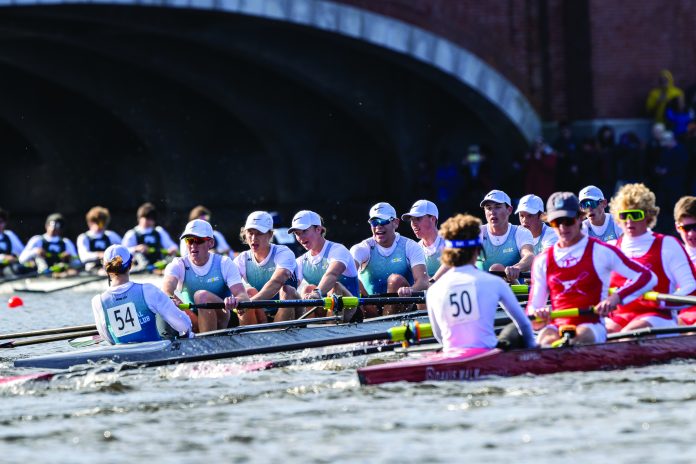
Head-racing season is upon us, and with it a new set of challenges to manage and skills to perfect. While it’s fun to focus on the perfect line down a course or the ideal angle to approach a bridge, it’s important to remember the basics, especially if you’re newer to head racing.

This fall, don’t take the humble skill of passing for granted. Any seasoned watcher of head races can tell you that a surprising variety of clashes and collisions is caused each year by coxswains and crews not executing a pass cleanly.

The foundational element of passing is understanding how your boat is traveling through the water—how fast and how predictably it moves and how easily it turns.

First, you need to assess how fast you’re approaching the boat ahead of you. To overtake cleanly, you need to anticipate both how quickly you’ll be able to overtake as well as where on the course the pass will occur so that you can account for any obstacles—buoys, boats, or the left-hand abutment of Weeks Bridge. You also need to know what kind of pressure that passed boat is going to be able to apply to you once you’re ahead of them.

As the overtaking boat, you get to select the line you want. Make sure as you approach that you keep your bow pointed to the side you want to take. Once you’re a length and closing in, make the call to the coxswain in front of you to yield off the racing line, preferably using the team’s name. There’s a lot going on during races, so you might have to repeat yourself. Ensure that you’re projecting confidence to your rowers, even if the other coxswain doesn’t respond immediately.

Remember your earlier assessment of any potential obstacles? This is to ensure that you won’t make the mistake of asking the other coxswain to yield off the course or into a bridge. No matter how much you may want a particular line, the other boat can’t disappear into thin air. Leave enough room for the blades of both boats; clashes slow you down. If you’re passing around a turn, make sure you know your rudder and your rowers so that you can make your inside turn confidently. It’s always best to leave a margin for error between the boats in case your opponent’s turn is sharper or shallower than you anticipate.

If you’ve come off your preferred line to make the pass, make sure that your stern is clear of your competitor’s blades and bow before you pull back directly in front. Awareness of where your stern ends and how much it swings is more challenging in a bowloader, so this is a skill worth practicing if you’re coxing a four.

Once you’ve completed the pass and established yourself fully on the racing line you want, be sure to continue moving away from the boat behind you. Every opportunity to pass should be fun, so let that shine through in your coxing. Use that momentum to help keep up boat speed after you’ve completed the pass to shut the door firmly.

Sometimes in life you’re the passing boat and sometimes you’re the yielding boat. If you must yield, do it quickly, quietly, and with minimal disruption to your race plan or rhythm. Don’t let the speed of the boat fall off after the pass. Give your boat a goal and a focus, and provide the crew with the feedback and energy to reach that goal.