Home Blog Page 47

Sport Science: Fin Tuning

head of the charles 2024 flip rowing
Photo by Lisa Worthy.

Fins on our boats make taking a boat on and off the racks more difficult, require special attention so they don’t hit the dock when we launch, and, last but not least, cause resistance in the water. So it’s no wonder we want to get rid of them—until we lose them because we hit a log we didn’t see. Then we realize how well they serve us.

I remember a situation like this when we were in an eight a few years ago. The crew had done well in previous regattas, and we were preparing for the big race at the end of the summer sprint season. Because our experienced cox couldn’t make practice, one of the lightweights offered to step in and help.

All went well until the boat began swaying side to side suddenly and making long, violent turns, throwing off our rhythm, balance, and, of course, speed. I could see the coxswain’s desperate attempts to steer as I stroked the boat; she was moving erratically and pulling on the rudder lines frantically. The poor volunteer coxswain lost her confidence quickly, and so we cut the practice short, went back to the boathouse, hauled the boat out of the water, and discovered…our fin was gone!

Even the best coxswain in the world can’t keep a boat straight without a fin, and so our replacement coxswain was redeemed.

We need fins to steer our boats, obviously, but why not make them smaller? The advantages: less risk of bumping the fin in the racks or on the docks and less drag, which would make our boats faster.

It’s not that simple, however. If a fin is too small, the boat will not track well, and crosswinds will disturb its directional stability. Finless rowing requires more steering effort, which increases drag and decreases speed. The fin also helps balance and stabilize the boat; the larger the fin, the more stable the boat.

Because a smaller fin doesn’t always make a boat faster, what’s called for is compromise, tailored to the situation for which the fin is needed. A straight sprint race requires a larger fin than a winding head race. A less experienced rower would benefit from a larger fin. A larger fin is useful also when racing on a sprint course known for its strong crosswinds. For all these reasons, it would be nice to have a boat design that allows fins to be changed easily.

The efficacy of a fin depends on two factors: depth and surface. Since surface area is the most important drag factor, boat designers like to make fins deeper, as reflected in all modern fin shapes. Hydrodynamically shaped fins also increase the function of a fin, but here, too, compromise is necessary. A thicker fin increases its efficiency, but also its resistance. In addition, such shapes can be achieved only with special plastics, which are more expensive than aluminum.

For boats used to train beginners, the choice of fin hardly matters, but for highly competitive crews, the right fin can make all the difference.
Finals Conclude at the 2024 World Rowing Championships

world rowing championships 2024
Story and photo courtesy of World Rowing.
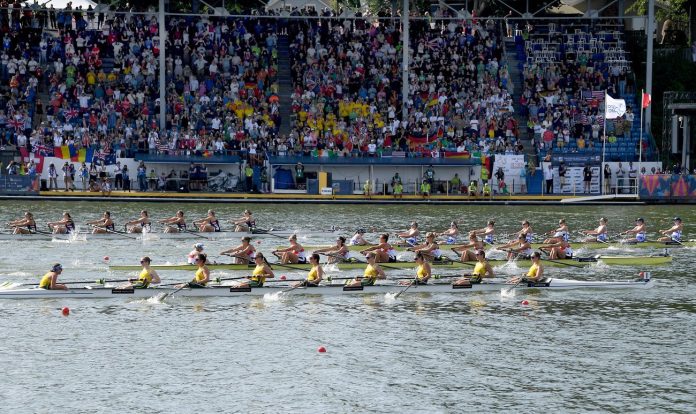
The curtain came down on an incredible combined World Rowing Senior, Under 23 and Under 19 Championships today, August 25, as the finals took place for the fourteen Under 19 boat classes.

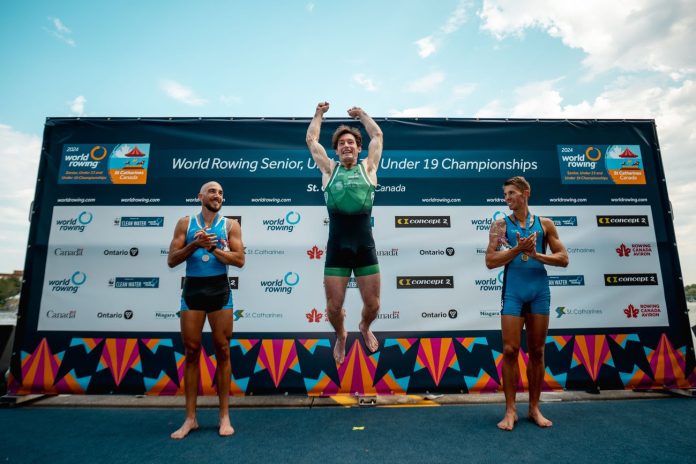
During an epic set of races in front of a packed grandstand, seven nations took home new World Under 19 Championship titles with a total of 13 nations picking up medals. Romania topped the medal table with an impressive four gold medals, while Germany picked up the highest number of medals; one gold, two silver and four bronze.

The first gold of the day went to Italy in the women’s coxed four who crossed the line almost ten seconds ahead of the rest of field. Australia prevented Italy from doing the double and defending their title in the men’s coxed four.

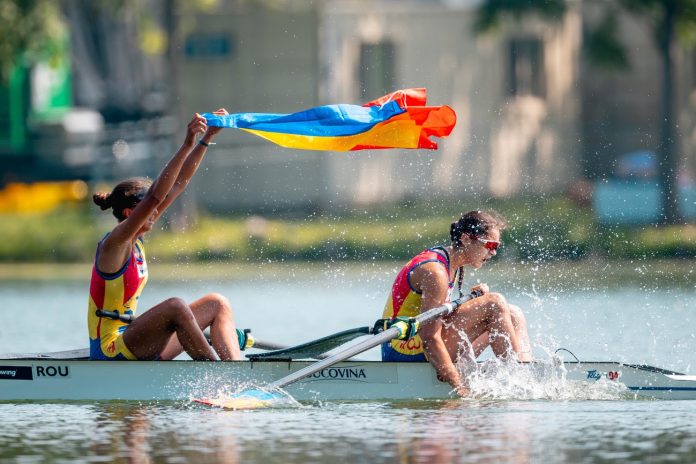
The Romanian National Anthem was played out three times in a row after wins in the women’s and men’s pair, and the women’s four. Their women’s pair of Iulica Maria Ursu and Gabriela Tivodariu absolutely dominated their race, crossing the line over nine seconds ahead of Greece. It was the second consecutive World Champion title in this boat class for Tivodariu.

After three consecutive wins for Romania, it was the turn of the Italians! Italy beat Great Britain to take gold in both the men’s four and the women’s quadruple sculls, while Germany were victorious in the men’s quadruple sculls, breaking Italy’s winning streak – Italy taking silver.

It was a double for Greece in the double sculls. Gavriela Lioliou and Varvara Lykomitrou overhauled Great Britain, who had led for the majority of the race, in the final sprint to become champions in the women’s double sculls. In the men’s double sculls, it was a dominating performance from Konstantinos Giannoulis and Nikolaos Cholopoulos, who led from the start.

Despite the best attempts of Great Britain to defend their title in the women’s eight, a dominant looking USA crew controlled the race from the start. It was silver for Great Britain and bronze for Italy.

In the single sculls, an epic final sprint from Greece’s Panagiotis Makrygiannis allowed him to steal the gold in the closing stages. In the women’s single sculls, the fourth gold came for Romania when Bianca Ifteni defended her title from last year – beating South Africa’s Danelia Price-Hughes.

In the last race of the day, an impressive looking men’s eight from Great Britain led throughout the entire race crossing the line over two seconds ahead of the USA. For GB, it completed the hat trick of medals for the men’s eight across the Olympic Games, U23 and U19 Championships. The USA took silver and Germany bronze.

Next year, the Senior, U23 and U19 Championships will go to three separate venues, Shanghai, Poznan and Trakai respectively.

For race reports, results and photos go to www.worldrowing.com

History Made at the 2024 World Rowing Senior, U23, and U19 Championships

world rowing championships 2024
Story and photo by World Rowing.

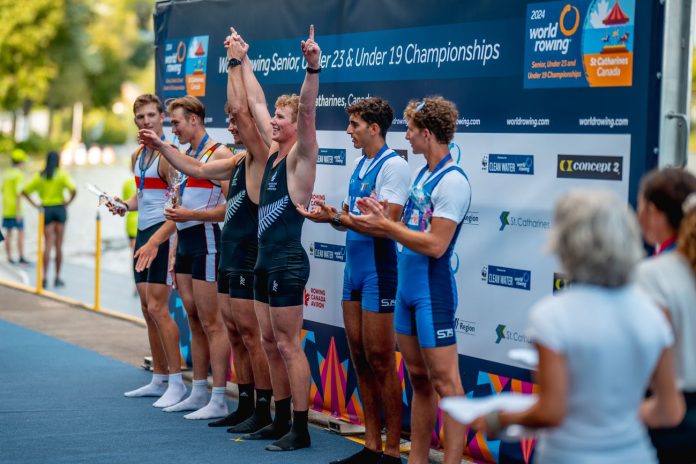
The penultimate day of racing at the 2024 World Rowing Senior, Under 23 and Under 19 Championships on Martindale Pond saw the finals of the senior boat classes. Across the six boat classes, 11 nations picked up medals with all six titles going to different nations.

The first 2024 World Rowing Champions to be crowned on Saturday 24 August were in the PR3 men’s pair when Luca Conti and Igor Zappa of Italy got out fast and continued to open up their lead over Japan.

The finals of the lightweight single sculls were absolutely stacked – with Paris 2024 Olympians, and reigning World Champions.

In the lightweight women’s single sculls, it was a wonderful finish to the international career for Ionela Cozmiuc of Romania. Having won silver in Paris just a few weeks ago in the lightweight women’s double sculls, Cozmiuc announced this would be her last international race, and she will now retire as a World Champion. Silver went to Zoi Fitsiou of Greece, and last year’s World Champion, Ireland’s Siobhan McCrohan, took bronze.

The lightweight men’s single sculls was equally as epic. Eyes were on Italy’s Niels Torre after he had set a new World Best Time earlier in the week, but it was Greece’s Antonios Papakonstantinou that got out fast and led for more than half of the race. However, the double Olympic Champion from Ireland, Paul O’Donovan was on a mission. O’Donovan worked his way through the field and added another World Champion title to his incredible record.

The lightweight pairs were filled with history. In the women’s event, it was domination for Poland’s Jessika Sobocinska and Katarzyna Welna with a new World Best Time and World Championship Best Time, but it was history for Peru who took silver – their second World Championship medal. It was gold for Austrian’s Konrad Hultsch and Paul Ruttmann in the lightweight men’s pair with Paraguay making history when they claimed silver – a first World Championship medal for the nation.

More history was made in the last race of the day when Mexico sculled to a win in the lightweight men’s quadruple sculls, the first ever World Championship title for the nation.

Sunday 25 August is the last day of racing in St Catharines, Canada, and will be dedicated to the U19 boat classes. Racing will start at 09:35 EST and the medal finals will commence at 11:30 EST and run through until 14:55.

For start lists, race reports, results and photos go to www.worldrowing.com

Fast Finishes and World Best Times for U23 Finals at Worlds

Story and photo courtesy of World Rowing.

With the first eight titles having been awarded on Thursday, the remaining thirteen World U23 Championship titles were awarded on Friday August 23 after a series of incredible finals on Martindale Pond where multiple World Championship Best Times were broken.

At the conclusion of the U23 racing, eighteen nations had won medals with eleven of them claiming a gold. Germany topped the table with four gold, one silver and three bronze while Great Britain matched the number of golds and also secured one bronze.

The lightweight single scullers were the first to race for medals. For Australia’s Grace Sypher, it was a third World U23 Championships; she has finished sixth in 2022, fourth in 2023 and today it was gold. In the lightweight men’s single sculls, Spain’s double Olympian Caetano Hora Pombo prevented Italy’s Giovanni Borgonovo from defending his World U23 champion title.

There were two consecutive gold medals for Great Britain when they won both the women’s and men’s coxless fours. An impressive race for their women allowed them set a new World Championship Best Time. Meanwhile, for the men, despite the challenge from Australia, the British were able to defend their title in this boat class.

The Greek lightweight women’s double sculls was absolutely dominant; both Dimitra Kontou and Evangelia Anastasiadou had raced separately at the recent Paris 2024 Olympic Games with Kontou having claimed bronze in this boat class. They crossed the line nearly eight seconds ahead of Italy. Meanwhile, perhaps taking inspiration from Paul O’Donovan (who will race in the single sculls on saturday) and Fintan McCarthy, who won Olympic gold a couple of weeks ago, Ireland’s Ciaran Purdy and Donnacha Keeley claimed gold in the lightweight men’s double sculls.

Great Britain’s women completed the clean sweep of wins in the Olympic sweep events when their women’s eight led from the start and finished nearly two seconds clear of the defending champions, the USA.

The German anthem was heard twice when they won gold in both of the single sculls. Timo Strache had won bronze in the men’s U23 double sculls last year but today it was gold in the single sculls. His time of 6:42.08 set a new World Championship Best Time by 0.89 seconds.

Shortly later, Alexandra Foester matched her performance from the 2021 and 2022 World U23 Championships by winning gold and preventing Switzerland’s Auerlia-Maxima Janzen from defending her title from last year. It was another World Championship Best Time for Foester, beating the time she set earlier this week by a further 5.83 seconds.

It was a fourth gold of the day for Great Britain in the last of the U23 finals when their men’s eight led from the start. The USA kept them under pressure throughout – sitting just 0.37 seconds behind at both the 500m and 1,000m timing markers, but in the second half, the British were able to move further away and crossed the line first to defend their title.

The U23s may have finished their racing but the finals for the seniors (in the non-Olympic and Paralympic boat classes) and U19s are still to come. Finals across the six senior boat classes will be held tomorrow, Saturday 24 August from 14:30 EST with the U19 finals being held on Sunday 25 August from 11:30 EST.

For start lists, race reports, results and photos go to www.worldrowing.com

SEC Sponsors Women’s Rowing Championship Beginning in 2025

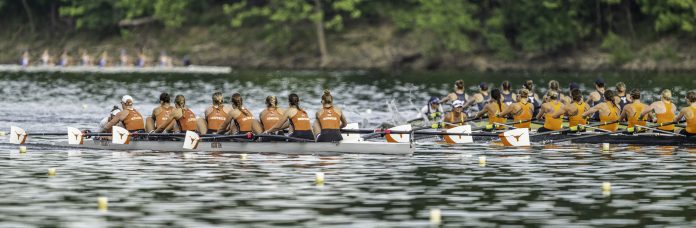
Texas wins NCAA Championship
Photo by Tom Walsh.

BIRMINGHAM, Alabama (August 23, 2024) – Rowing has been approved as the 22nd sport to be sponsored by the Southeastern Conference and the 13th women’s sport in which an SEC Championship will be conducted, it was announced Friday August 23 following a unanimous vote of the SEC’s athletics directors.

Four SEC universities currently sponsor the sport of rowing — Alabama, Oklahoma, Tennessee and Texas. According to SEC Bylaws, a conference championship may be conducted when a minimum of 25 percent of the Conference members sponsor a sport, and upon approval by Conference athletics directors.

“The addition of Oklahoma and Texas provides the opportunity to support a new SEC championship experience for rowing student-athletes,” said SEC Commissioner Greg Sankey. “We look forward to providing support to the growth of the sport of rowing in the Southeastern Conference.”

The first SEC Rowing Championship will be held May 2025, at a site to be determined.

Because the SEC has not previously sponsored a championship in the sport of rowing, the Alabama and Tennessee rowing programs have competed in Big 12 championships since the 2014-15 athletic year, having competed in Conference USA prior to their Big 12 participation.

Six Nations Claim World Rowing U23 Championship Titles in St. Catherine’s

Story and photo courtesy of World Rowing.

On day five of the combined World Rowing Senior, U23 and U19 Championships in St Catharines, Canada, the first eight sets of medals were awarded in the U23 boat classes.

The morning session saw the last of the U19 heats and preliminary races with a series of repechages in the afternoon. Medal finals for the U19s will all take place on the last day of competition, Sunday 25 August.

After the conclusion of the U19 racing for the day, a full house at the Craig Swayze Memorial Grandstand were treated to eight fantastic finals in the U23 boat classes in which six nations won World U23 Championship titles and two World Championship Best Times were broken.

New Zealand was the first nation to pick up a gold medal when they beat USA to the line in the women’s coxed four but there was redemption for the USA in the U23 men’s coxed four straight after when they prevented Italy from defending their title.

The lightweight men’s pair saw a fantastic gold for Manuel Fernandez Antri and Felipe Guerra from Chile while Germany beat host nation Canada in both the lightweight women’s and men’s quadruple sculls.

Great Britain took gold in the U23 women’s pair when Anna Grace and Holly Youd got out fast at 45 strokes per minute, established an early lead and maintained that position throughout. Spain took silver while France, who were in fifth with less than 500m to go, came through to claim bronze.

It was a second gold medal of the day for New Zealand when Joshua Vodanovich and Oliver Welch held off the challenge from Germany’s Tobias Stangemann and Johannes Benien throughout the 2,000m course. The crews were never separated by more than a second and the intensity of the race allowed New Zealand to set a new World Championship Best Time by 0.29 seconds when they crossed the line 0.92 seconds ahead of Germany.

The last race of the day was the U23 women’s quadruple sculls. Despite a very fast start from Poland, defending champions Romania drew exactly level at 1,000m and then started to move away. Romania held on to the lead to claim gold, retaining the World Champion title and their incredible sprint to the line allowed them to claim a new World Championship Best Time, beating the previous time by 2.33 seconds. Poland took the silver while Great Britain held off a challenge from Germany to claim bronze.

There’s plenty more action to come in St Catharines with three days of racing still to be completed. Friday’s schedule, which starts at 09:30 EST will conclude with the medal races in the remaining 13 U23 boat classes, which will start at 14:00 local time.

For start lists, race reports, results and photos go to www.worldrowing.com

Doctor Rowing: Meditations on the Micropause

rowing national championship iras cal
Photo by Lisa Worthy.

Three years ago, one of my high-school oarsmen who had rowed in England before rowing for me returned from vacation talking about a new thing that was spreading through the UK—the micropause at the finish. He wanted us to adopt it.

“It gets everyone together at the finish,” he said.

I could see that it would do that, but my concept of the rowing stroke was the metaphor of the bicycle chain; the more you can keep the motion moving constantly, the less chance for a break in the rhythm of the rowing stroke. We did not adopt a micropause.

Since that time, I’ve watched as numerous crews have glommed on to this British innovation. Many of them have been good crews. Maybe I should take another look. Mrs. Dr. Rowing and I decided that we needed to take a look first hand at some superb crews and see what they did. I got in touch with Bobby Thatcher, the super-successful coach at St. Paul’s School in London and asked whether we could spend a week in his launch.

I had seen videos of SPS at steady state; to my eye they did practice the micropause. Bobby was welcoming. On the Tideway, that section of the Thames River that flows through the heart of London, it did, in fact, look like his crew paused.

SPS was the winner of the 2023 Head of the Charles by a whopping 20 seconds, a race in which the crew passed 14 boats despite starting way back at number 74 of 90 eights. More recently, SPS won the first two legs of the Schools Triple Crown—the Schools Head in London and the National Schools Regatta at the 2012 Olympic course at Dorney.

I asked Bobby about the micropause.

“We are not pausing,” he said. “We are finishing the stroke and organizing the next stroke.”

At rate 22, it sure looked to me like there was a distinct pause. It may be a matter of semantics; Thatcher was certainly not coaching them to pause, but he was insistent that they needed to organize at the finish in preparation for the next catch. It was also clear that at low rates, the oarsmen were feeling the boat run out, a desirable result.

As Volker Nolte explained in the January issue of this magazine, “With most training done at lower stroke rates and corresponding lower boat velocity, the best way to engrain this movement is to row with a slow recovery followed by a quick motion into the catch. This is the source of the so-called micro-pause.”

I’d add that there is a danger in coaching a pause because this “gather” at the finish may lead to a rush down the slide. If the crew is not skilled at catching the water, a coach may be encouraging a technique that will produce hanging and missing water.

I was fortunate to be at Henley this summer and get a launch ticket for the premier high school race of the year, the semifinal between St. Paul’s and its rival and last year’s Henley winner, St. Edward’s. It was a terrific race, with both crews rowing very well.

St. Paul’s took a very aggressive move early on and won by a length and a quarter. The team followed up by winning the Princess Elizabeth Challenge Cup the next day against Shiplake. Rowing at 36 and 37, they showed not a trace of a pause in their rhythm. They celebrated their triple—a quadruple if we add the Head of the Charles to the year’s big regattas.

I spoke with a fellow coach at Henley, Bill Manning of Penn AC, who said that he does pause drills at the finish to get the crew to prepare and feel the boat run. But after that conscious pause, he shifts them to “now pause for half that amount of time, now half of that,” so that before they know it, there is no pause at all.

“The micropause is a teaching device that functions well at lower rates and intensities and then disappears when the rate comes up,” Manning elaborated. “When I teach pause at the release, this is what I do. It helps them complete the drive rather than cut the finish when the rate increases, but I never expect any pause at race rates.”

We agreed that the bicycle chain analogy still holds water. Will I try a micropause next spring? I like Manning’s pause drill, so we’ll see.

Overheard at Henley:

One of the pleasures of being at Henley is being surrounded by so much rowing over the six days of the regatta. I like to keep my ears open.

I asked a friend how his daughter’s season had gone.

“She didn’t row this year because of a back problem, but she is rowing now at Henley.”

“And her back?”

“Well, she’s at bow, so not really straining.”

Spoken like the true five man that he was.

The showers at Henley are famed for their frigid water. There is no hot-water faucet, and rowers have been known to scream when the icy blast hits them. But this year, to the disappointment of many, athletes were reporting that the showers didn’t seem so bad.

One vet shared a memory: “In the old days, you could always tell a rookie because he’d put his palm under the water waiting for it to warm up. I loved to see it slowly dawn on him that it’s not going to get any warmer.”

Requiem for Lightweight Rowing

great britain lightweight rowing olympics medals
Photo by Chip Davis.

Like many of you reading this, I have spent many hours watching the Olympic rowing in Paris. So much great stuff! How on Earth do the Romanians row so high? How have some boats been able to improve upon their results from last year’s world championships or this year’s World Cup racing?

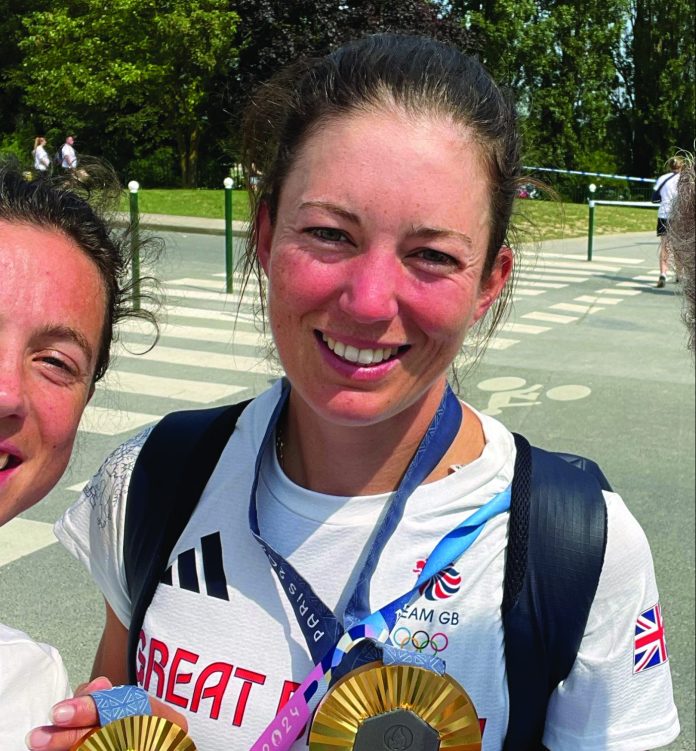
As exhilarating as the racing has been—what about the USA men’s four, the men’s pairs, the British men’s eight, the Dutch women’s pair, and Oli Zeidler’s taking control of the singles field right from the first stroke?—I also feel sadness creeping in when I watch the magnificent racing of the lightweight doubles.

We are watching lightweights for the last time in the Olympics. In a move to cut down on the number of rowing athletes in the Games, and to make room for new, flashier, more TV-friendly events, the two lightweight events that have been a part of the Olympics since 1996 will be dropped from future Olympics.

I spent 11 years coaching lightweight women on the national and international level. In 1974, FISA, the precursor to World Rowing, introduced lightweight events for men at the championship level. They were called the FISA Lightweight Championships. The medals were smaller (“because you are smaller” was the joke), and they weren’t called world champions officially like their bigger brethren. Through much of the ’80s and ’90s, there was a big push to include also lightweight events for women, first at the world championships, then at the Olympics. In 1985, lightweight events for women were added to the world-championship program.

In international racing, both world-championship and Olympic rowing, the maximum weight for each male competitor is 72.5 kilograms (159.8 pounds), and the average weight of the rowers cannot exceed 70 kilograms (154.3 pounds). For the female rowers, the maximum individual weight is 59 kilograms (130 pounds), and the average weight cannot be more than 57 kilograms (125.6 pounds).

Perhaps Beach Sprint rowing, the event that will supplant the lightweight doubles at the LA Olympics in 2028, will be exciting. It certainly seems to have been created with an eye to television. Competitors will sprint 50 meters on the beach toward the water, jump into their boats, row out into the ocean to a buoy 250 meters off shore, spin and then sprint 50 meters again to the finish line on land. It sounds like something created for television, like some of those reality shows like The Superstars.

I suppose “real rowers” will cross over to the new event to have a shot at Olympic glory. But 100 meters total of running on sand? 250 meters of rowing? It sounds like a joke, an event created for Baywatch.

I won’t get into all the political discussions here. The IOC wants weight divisions only in combat sports—boxing, wrestling, judo—where the threat of someone getting seriously injured by a bigger opponent needs to be taken seriously. The argument also goes that lightweights can compete with openweight athletes. In Paris, the times for lightweight medalists in the double sculls were faster than those of the openweight doubles. But wind conditions on any racecourse are never the same from day to day. The success of fast lightweight crews may have undermined their best argument for being—that bigger people have a significant advantage in sports.

To make lightweight crews fly, they must be very precise, because they don’t have extra power at their disposal. Ask lightweights what it’s like to row with other people their size, and you’ll hear passionate defenses of how right a boat with people the same size feels. From what I saw coaching lightweights and watching them push themselves in their training, they certainly were just as intense and just as motivated as openweight athletes. Probably more so in many cases because they were always fighting to show that they belong in a sport that celebrates the Olympic motto of Citius, Altius, Fortius (Swifter, Higher, Stronger).

Those early lightweights were fighters because it was an uphill battle to be included. They heard that they were like “midget basketball.” They were called “oxygen thieves.” In many boathouses, the refrain was “men, women, and lightweights.” Most of the time, these nicknames were accepted with humor. I loved their trailblazing, their determination.

I’m not at all anti-openweight. The absolute fury with which our men’s four blasted off from the start and then kept going gave me goose bumps and still does as I watch the replays. Karolien Florijn, the Dutch woman’s sculler, had the same kind of race. That’s what a gold medal is all about. But it makes me sad that we won’t see that awesome Irish light double or the British light women rowing so beautifully again.

Farewell lightweights. Hello Beach Sprints.