Home Blog Page 40

Coach Development: Managing the Managers

coach boat maintenance rigging hocr
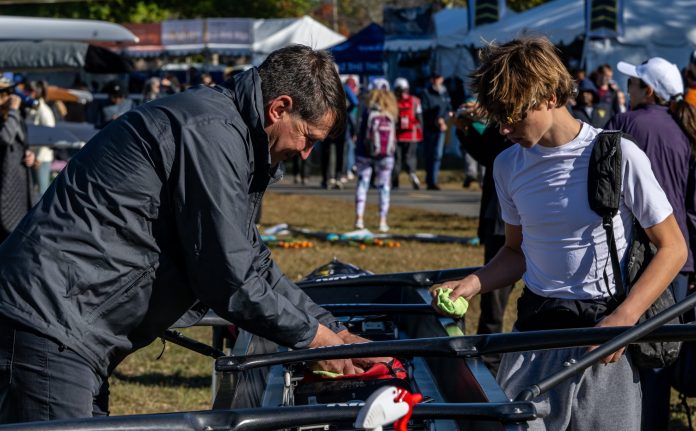
Photo by Lisa Worthy.

I have often heard college coaches complain about working for administrators who have no first-hand knowledge of what it’s like to be a varsity athlete, let alone a coach. I’ve been one of them at times. They don’t understand what it takes to win. They’re too sensitive to the student-athletes’ complaints. This is supposed to be hard!

Sometimes, this is undoubtedly the case, and working under a supervisor like that can be exceedingly frustrating. Other times, though, coaches are coming into the relationship with their admins with preconceived notions of what to expect. But what would happen if we approached those relationships with a more open mindset?  If we viewed our admins as partners with a different set of experiences from our own rather than adversaries or obstacles?

This fall, I had the opportunity to speak with a sports-management class at UMass Amherst about the current college- athletics landscape and the experiences of collegiate coaches.

The students, all sports-management majors, were engaged, curious, and thoughtful in our conversations as they sought to understand the collegiate coach’s experience within the larger athletics landscape. They asked about how coaches balanced the sometimes conflicting pressures to drive elite performance while still receiving positive student-athlete reviews at the end of the season. They brainstormed about the challenges coaches face in recruiting effectively from the increasingly necessary transfer portal.

Listening to them, I wondered what their future careers might be. None of the students there was a varsity athlete. It’s highly unlikely any would become coaches. Some, though, will likely go on to administrative roles within college athletic departments. Indeed, several were already working at internships in compliance and elsewhere in their own department. They may go on to be administrators who oversee sports directly and even athletic directors.

Though they have not been in the trenches, these students were approaching the work of sports management with curiosity about and empathy for coaches. Do they need to be educated about the realities of life on or leading a team? Sure. But that will be the responsibility of the coaches they lead. If that is done with care and honesty, there’s no reason they won’t develop into positive and productive partners for the coaches and teams they one day oversee.

As coaches, it’s our responsibility to get those around our teams on board with what we’re doing. Assume that others are coming into the situation with the best of intentions—until proven otherwise—and you stand a much better chance of building a lasting, beneficial partnership.

Benderson Park recovers from Hurricane Milton, Prepares to Host Youth Nationals

nathan benderson youth nationals
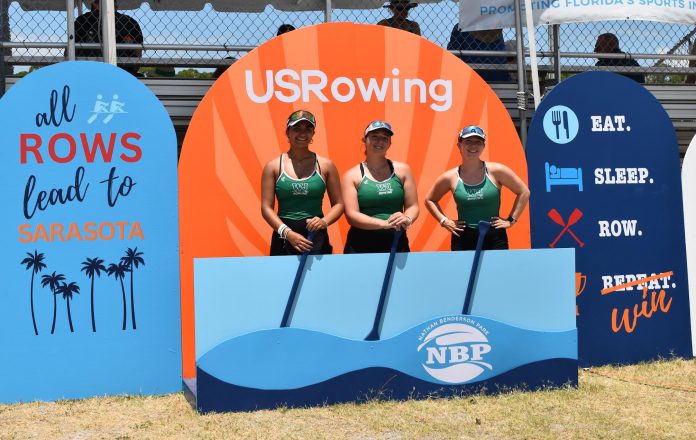
Photo courtesy of Marnie Buchsbaum.

Nathan Benderson Park, in Sarasota, Florida, has partnered with USRowing to host a series of rowing events in the spring of 2025 starting with the Youth National Championships June 12-15. Amidst the excitement, however, Nathan Benderson Park’s hard-working staff is focused on making necessary repairs to the site after Hurricane Milton.

“The entire area was hit by a category three storm,” said the park’s marketing director, Marnie Buchsbaum. “We had some damage to bleachers and some of the shells were broken. We’re in the process of getting all our docks reset, doing some debris pick up, getting signage back up and getting ready for the season. We’re actually in pretty good shape—just putting everything back. It’s not to the level of the devastation that we thought we might encounter.”

The Benderson staff is currently working to reset everything and help the rowing community by taking over events that cannot be hosted at their original location due to more extensive damage.

“Our goal is to get more people out to see what an amazing sport rowing is and how passionate and excited people are,” said Buchsbaum. “Hearing teammates cheer each other on by the shoreline is such an incredible thing to be part of. We’re trying to do our best to support clubs and facilities that need it.”

While Benderson aims to give back to the rowing community and support others through this difficult time of recovery from Hurricane Milton, the park also has its efforts set on preparing for spring racing.

nathan benderson youth nationals racing
Photo courtesy of Marnie Buchsbaum.

“Working with USRowing has been such an amazing partnership,” stated Buchsbaum. “Last year hosting the Olympic Trials and Youth Nationals was great for the park. We’re so delighted to be part of these large events that bring in spectators from all over. It helps to support youth rowing and hopefully many of these youth go on to continue their rowing careers. It’s nice to be the first place that they come to that they know is their place for rowing and they can go on to grow and develop in their skill level and go on to achieve great things.”

Following the Youth National Championships, the park will be the site of the U19 National Team Trials for the single sculls, pair, and double sculls from June 16-17.

Thoughts on the Micro-Pause from Josy Verdonkschot

josy verdonkshot
Photo by Lisa Worthy.

From Doctor Rowing: Responding to the debate about whether a micro-pause is a good idea in a rowing stroke, reader Bill Pickard suggested that I ask USRowing Chief High Performance Officer Josy Verdonkschot what he thinks. I got a quick answer:

As an exercise, a micro-pause can be helpful as a collection point for the crew and, if executed well, for working on a clean exit and proper bladework. When extracting, there should be no pull into the body, just a vertical motion of the blade. The body should be relaxed in the shoulders and strong in the core, ready to continue the pendular motion to initiate the recovery.

From a biomechanical standpoint, the rower’s force and weight go down at the finish. This interrupts the acceleration of the boat and is detrimental to speed. That’s why I don’t support a micro-pause in a regular row. I want the rower to feel how the boat moves around the finish with as little interruption as possible.

To me, the finish includes the initiation of change of direction; therefore, I prefer a more natural moment to a micro-pause—when the knees begin opening, around quarter slide. The rower develops more feeling for the boat and boat speed in this way.

Mead, Best, Grady, Corrigan Named World Rowing Crew of the Year Finalists

men's four world rowing
Photo courtesy of Casey Galvanek.

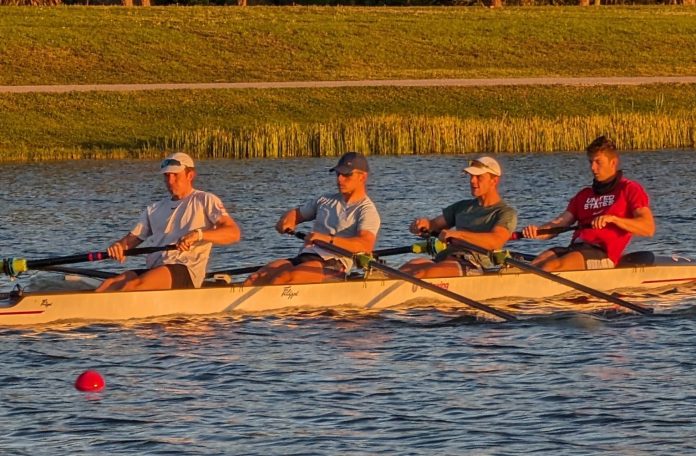
The U.S. men’s four that won gold at the Paris Olympics, consisting of Nicholas Mead, Justin Best, Michael Grady, Liam Corrigan, has been named a finalist for World Rowing Crew of the Year.

“My expectations were that those guys would do everything that they possibly could to win,” recalled Casey Galvanek, coach of the men’s four. “What I talked to them about was having to go certain speeds and hitting those numbers over the course would increase the probably of getting a medal. Everything on the day has to go perfectly for you to win a gold and that’s not solely up to you. Everything can go perfectly for you but you just never know what a competitors ultimate speed is.”

Galvanek had the privilege of watching Mead, Best, Grady and Corrigan progress through the USRowing development system all the way up to Olympic gold medalists.

“The first time I ever interacted with Justin his parents had asked USRowing about where they could send him to get coaching in the single,” laughed Galvanek. “I didn’t know the kid—I had him do some drills and had him flip which was hilarious. He went on to the Junior team and then the U23 team and had such amazing success which is pretty exciting.”

The crew competed together at the 2023 World Rowing Championships and won a silver medal after falling short of the gold medal Great Britain crew by two seconds went on to win gold at the Paris Olympics by .85 margin over New Zealand and a three second margin over Great Britain.

“They’re a good group of guys—willing to make changes, which is always the number one thing, and willing to do anything necessary to increase the probability of an opportunity to win a gold,” said Galvanek. “There are differing levels of push back from different athletes—not these ones. The athletes that are willing to put everything on the line and take risks have the greatest rewards and these guys certainly did that.”

The Paris gold medal men’s quadruple sculls from the Netherlands and the gold medal men’s eight from Great Britain have also been named finalists in the category. The 2024 World Rowing Awards will take place during a gala dinner on Sunday, November 9, 2024, in Seville, Spain.

HOCR Wraps Up: Sechser, Hamill Claim Champ Singles Titles

michelle secsher head of the charles 2024
Photo by Lisa Worthy.

Another Head of the Charles Regatta has come to a close in Boston, Mass. and with it the 2024 HOCR champions return to their respective training facilities with impressive hardware.

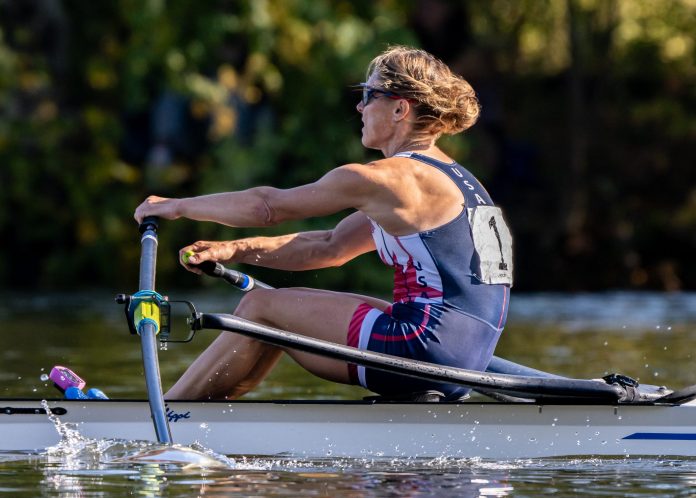
Saturday’s racing included the acclaimed championship singles races with Michelle Sechser (18:54.711), Paris Olympian in the women’s lightweight double that advanced to the A final, finishing first followed by Kara Kohler (18:59.714), who saw a fifth-place finish in Paris. 2024 Olympic silver medalist, and 2020 gold medalist Emma Twigg crossed the line in ninth place with a time of 19:21.452.

Finn Hamill, competing for Waikato Rowing Club in New Zealand, took first place in the men’s single in 17:05.470.

“It’s pretty amazing,” Hamill told Rowing New Zealand in an interview on Sunday. “I’m still struggling to believe it’s real. It’s my first time here and I know that your course is a big part of your end result so I’ve been studying up on that. It basically went as good as it could have.”

Hamill recalls rowing with Twigg in the Coastal Mixed Quadruple Sculls at the 2024 World Rowing Beach Sprint Finals. With Twigg’s suggestion Hamill decided to submit an entry at the Charles.

HOCR also offers a unique opportunity for alumni across the globe to return to their glory days for a race down the course with their past teammates. In the men’s alumni eights the University of Washington alumnus claimed first in 14:07.670 and on the women’s side Stanford University placed first in 16:00.465.

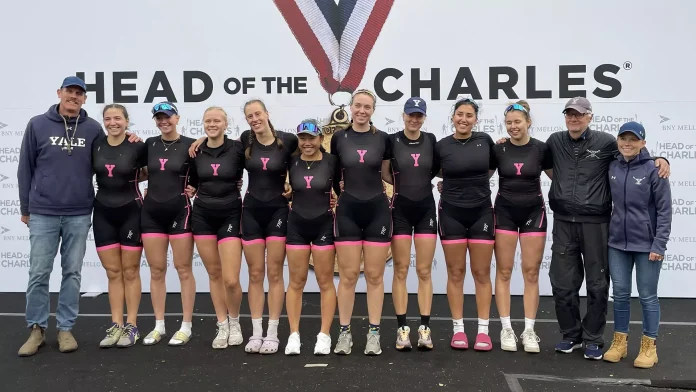
The club eights, which also took place on Saturday, featured a mixture of clubs, collegiate clubs, DIII teams, DI teams, and others. Yale University won the women’s club eight in 15:57.855 after winning gold in the same event in 2023 with a time of 16:10.900. Radcliffe finished second in 16:31.298. For the men, Dartmouth College had the fastest time (14:18.752) and Riverside Boat Club out of Cambridge, Mass. finished second in 14:36.761.

In the women’s championship eights, Leander Club, one of the oldest rowing clubs in the world from Henley-on-Thames, UK, saw a three-second win (15:30.452) over collegiate Yale (15:33.627). The lightweight “great eight” with Sechser in the six seat and Paris Olympic gold medalist in the lightweight women’s double sculls Imogen Grant in the stroke seat came in fifth in a time of 15:46.199.

Cambridge University Boat Club won the men’s championship eights in a blistering 13:46.333. Harvard was the top collegiate crew with a time of 13:49.053.

“Competition and pushing yourself is good for people,” said the Bolles-Parker Head Coach for Harvard Men’s Heavyweight Crew, Charley Butt, regarding HOCR as a whole. “To put yourself on the line and to put yourself on the line for your teammates when you’re trying to do something difficult—it’s great to have other people to do it with. It is a huge alumni event for us, like it is for every school. Across the collegiate eights and the alumni eights, we have guys who’ve rowed here 40 and 50 years ago and guys who rowed here a decade ago.”

Olympic Postmortem

The Olympic champion U.S. men’s four of stroke Liam Corrigan, Michael Grady, Justin Best, and bow Nick Mead. Photo by Julia Kowacic.

The Olympic rowing gold, silver, and bronze medals won by the men’s four, PR3 mixed coxed four, and men’s eight, respectively, highlighted U.S. National Team racing in Paris but fell short of USRowing’s stated goal of four total medals, and well short of expectations, which were as high as 10 medals leading into the Olympic and Paralympic regattas.

“We’re proud of our athletes’ performance in Paris, and the overall results signify a critical turning point for our high-performance program,” said USRowing CEO Amanda Kraus. “The three medals earned, and improved finishes across six additional boats, indicate that we’ve made significant progress since Tokyo 2020,” when U.S. crews failed to win a single medal.

“Beyond the medals, we qualified the most Olympic boats since 2012 (12 of 14 Olympic events), all women’s boats qualified for a fifth consecutive Olympics, eight boats qualified for the A finals (the most since 2000), and with a gold and a bronze, it’s the best medal results for men’s boats since LA 1984,” Kraus continued.

She’s right about U.S. crews earning spots at the Olympics and reaching the A finals more often than not. In this, the qualification age, the fact that countries must earn one of the limited spots in the Olympic regatta (further reduced after London 2012 and again after Rio 2016) has turned international rowing into a small pond with a few big fish. At the Olympics, where half the remaining events are limited to nine or fewer entries, making a six-boat A final is statistically likely, while just making it to the Games is a real accomplishment.

“We made a nice first step,” said USRowing’s chief high performance officer, Josy Verdonkschot, who intends to remain in his position. “I enjoy what I do. As long as people believe in what I’m doing, I’ll continue.”

The U.S. has managed to join the battle with the elite few countries that win Olympic medals but struggles in competition against the current best. Just three countries—The Netherlands, Great Britain, and Romania—combined to win nine of the 14 golds, and 21 of the 42 medals awarded at the Paris Olympics.

Great Britain dominated the Paralympic regatta, winning three of the five events, and taking silver in a fourth. The U.S. is one of five countries to win two Olympic medals, and one of nine to have won a Paralympic medal in Paris. Canada’s lone medal was the silver in the women’s eight.

The top European performers are essentially professional athletes, training full-time with government support, including health care, while U.S. rowers rely on stipends and charity, mostly treating Olympic rowing as something they do after college and before getting on with the rest of their lives.

The Romanian men’s gold-medal double of Marian Florian Enache and Andrei Sebastian Cornea have been racing internationally for 12 and eight years, respectively. The Dutch women’s pair of Ymkje Clevering and Veronique Meester, who also won gold, made their first senior national team in 2017 and raced in 32 international elite regattas, including Olympics, before Paris. Of the 42 rowers on the U.S. Olympic squad in Paris, 25 were appearing at their first Games.

Money—specifically, a shortage of it—is “definitely” part of it, said Stephen Hap Whelpley, chair of USRowing’s High Performance Committee. “It’s still a challenging situation.”

USRowing lacks a major commercial sponsor, although numerous smaller ones support the association. Charitable giving from the National Rowing Foundation exceeded $2.5 million for the Paris quadrennium, and in the lead-up to the Games, the USRowing Foundation, which operates in roughly the same space as the NRF, announced gifts totaling over a million dollars. In October, USRowing announced a $1 million gift made by Katie and Bill McNabb, the USRowing Foundation chair, in support of the LA 2028 Olympic and Paralympic efforts.

USRowing hired Verdonkschot from Europe as the Olympic and National Team boss to change how the U.S. prepares for and competes at the highest level. By virtue of winning Olympic medals, it’s been a success, but the stated desire to get American rowers to scull and row small boats as proficiently as their international rivals is yet to be realized.

The Olympic and Paralympic medals all came from sweep-rowing big boats—fours and eights. At the 2024 under-19, under-23, and senior World Rowing Championships held on the Canadian Henley course in St. Catherines, all but one of the medals won by the U.S. were in big boats, and all but one of the medals came from sweep-rowing events. The U23 lightweight men’s pair and senior lightweight men’s quad won silver medals, but the rest of 10 medals all came from fours and eights.

The United States is a nation of eights, and some fours. Three of the four collegiate varsity national championships are decided by the varsity eight alone, and all three divisions of the NCAA championships are decided by points scored exclusively in eights and fours. At the American Collegiate Rowing Association, USRowing Youth National Championships, and pretty much every other student-athlete regatta, the premier events are the eights. When American kids dream of making the National Team, it’s in the eight.

Verdonkschot has some ideas for changing that, including making Youth Nationals the qualifier for certain U19 National Team boats or selection-camp spots. Speed orders, on the senior and Olympic level, are already singles and pairs races, and results figure prominently in who gets invited to selection camp. But once there, athletes are put into the boats they’re most likely to make fastest, rather than just priority boats, which explains this summer’s sweep big-boat successes.

USRowing’s attention, like that of much of the rest of the rowing world, now turns to Beach Sprints, as the new form of rowing makes its Olympic debut in LA28, replacing the lightweight events. In September, Verdonkschot and other upper-level staff members of USRowing were in Genoa, Italy, for the hastily relocated World Rowing Coastal Championships and World Rowing Beach Sprint Finals—two separate events held on consecutive weekends in the same place.

Break dancing’s infamous debut at the Paris Games isn’t the reason it’s one-and-done as an Olympic sport—LA28 hadn’t planned on including it even before this summer—but it’s still a cautionary tale of how easily a sport, especially a new one with a limited base, can be left out of the Olympics.

The flip side of the exciting break-zone crashes and pileups of Beach Sprints is the potential for injury, possibly serious or even fatal. USRowing officials know they have to thread the needle of developing this new version of rowing in time for the LA Olympics while also avoiding accidents that could be fatal—to both a participant and the sport.

One thing the national governing body can’t do as it prepares for a home Olympics with higher expectations—at least one more medal than Paris from rowing, per Verdonkschot—is to stand still. Despite falling short of its goals, for a second consecutive Olympics, Kraus believes that USRowing still has the same support from the United States Olympic and Paralympic Committee.

“We don’t foresee the results in Paris negatively impacting funding from them in 2025.”

Collegiate Champ 8+ Victors Return to the Head of the Charles

Yale 2023 2V
Photo courtesy of Yale Athletics.

The Head of the Charles, the world’s largest three-day rowing regatta featuring a winding 4,702 course down Boston’s Charles River, begins on Friday, October 18, and will feature everything from youth athletes to defending collegiate champions and Olympians.

As the 2023 women’s championship eights collegiate champion with a time of 16:25.277, only falling short of a pair of USRowing and European national teams, Yale women’s crew has two entries in the championship eights and one in the club eights.

“We don’t think too much about who’s in the events,” said Will Porter, Friends of YWC Head Coach. “We just go up there and run the course. As a coach there are some bucket list events in rowing—Henley and Head of the Charles are certainly on the bucket list so I’d like to think 90% of everybody who rows for us for four years gets a chance to go race at the Charles and that’s a fun thing for them to do. We train a lot so it’s nice to have some fun.”

In addition to the Bulldog’s impressive varsity eight performance at the 2023 Head of the Charles, the second varsity earned a bronze medal in the championship eight collegiate category in 16:58.163 as the third fastest 2V in the event and Yale’s club eight won gold in 16:10.900.

“We did a spreadsheet last year because we won the champ eight.,” remarked Porter. “It was our sixth time winning and since ’98 there’s only been three teams—Yale, Princeton and UVA— that have won the Head of the Charles and the NCAAs in one year. It’s hard to do both—win the Champ 8+ in the collegiate division and win the NCAAs. It’s not something we gear up on from an NCAA perspective but that’s an interesting fact on the Charles.”

Harvard is no stranger to the Charles and the Crimson will be looking for another chance for success after the men’s heavyweight varsity eight clocked the fastest collegiate time in the men’s championship eight with a time of 14:26.413 in 2023.

“It was a terrific outcome last year and rowing and racing always takes some luck— whether it’s 2K or three miles,” said Charley Butt, the Bolles-Parker Head Coach for Harvard Men’s Heavyweight Crew. “It is the world’s biggest regatta. It’s three days so while we have to work hard at hosting, we enjoy it because there are people from around our own country and from around the world. It’s a great sport because it’s universal in its appeal and at all ages I see people I’ve known for 40 years in competitive rowing. And I also see young people showing up at their first regatta and getting a taste of it.”

On the international side, among boats to look out for at this year’s Head of the Charles is the women’s lightweight “great eight,” bow number two in the women’s championship eights. The Skibbereen Rowing Club boat includes Imogen Grant from the gold medal Great Brittain lightweight women’s double sculls at the Paris Olympics and Michelle Sechser, from the sixth place United States crew in the same event. Sechser will also be racing the women’s championship single.

From the Editor: The High Point of Competence

Photo courtesy of High Point Athletics.

Hanlon’s Razor is an adage that tells us never to attribute to malice that which can be explained adequately by incompetence.

Neither side of the kerfuffle between referees and USRowing is malicious. Their communication and conflict-resolution skills, however, are less than what you’d expect of race officials and the administrators of our sport’s national governing body. You can decide for yourself by reading the latest.

For demonstrated competence in coaching, nobody had a year quite like Michael Callahan. The Olympic and University of Washington coach took the U.S. men’s eight to Lucerne to win last-chance Olympic qualification, then turned around and led his Huskies to a sweep of the heavyweight men’s events at the IRA National Championship.

Then his year got even better.

It was more than a case of bringing the best talent together. Callahan, in collaboration with his Washington staff, club coaches, and the U.S. National Team coaches, employed the latest measurement technology to prepare crews to perform their best in the biggest events of their lives. Don’t take my word for it. Read Callahan’s in the exclusive Rowing News interview.

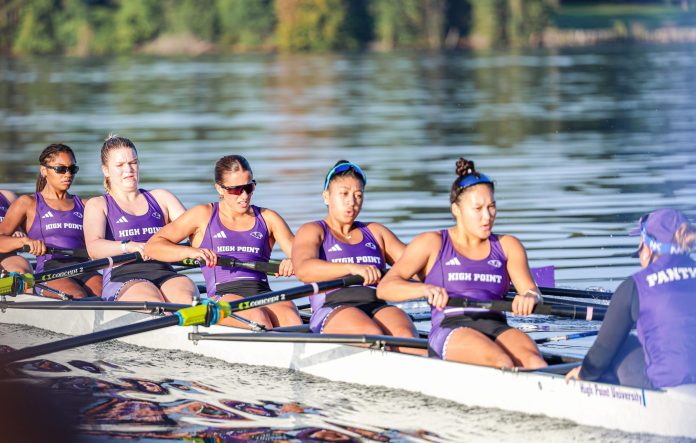
At High Point University in North Carolina, aspiring rowers now have a chance to reach their figurative high point thanks to the latest NCAA Division I varsity program. It’s another courageous move by the non-traditional school that’s been making waves in the staid world of higher education. In coming years, we’ll see where on the spectrum of competence they land.