Home Blog Page 38

Head of the Hooch Sees 2,200 Entries

Head of the Hooch fall regatta
Image courtesy of the Head of the Hooch.

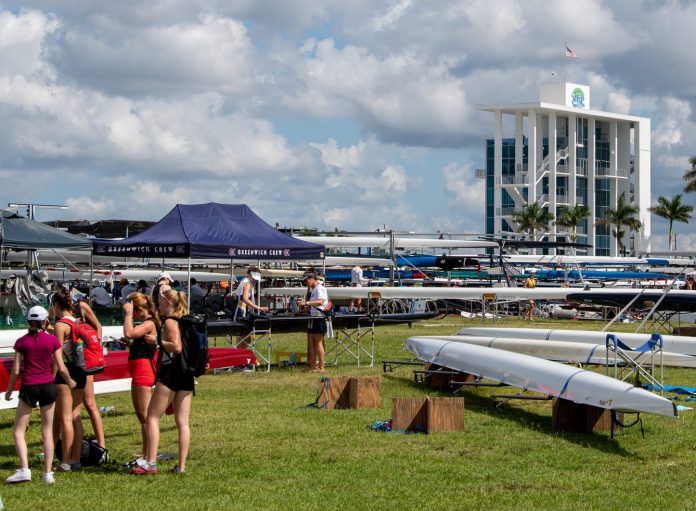
The Head of the Hooch in Chattanooga, Tennessee, which was originally the Head of the Chattahoochee when it debuted in 1982, will see 2,200 entries speeding down the Tennessee River on Saturday and Sunday, November 2-3, 2024.

“We’re one of the friendliest regattas—we want to make sure everyone has a great weekend and a fun time,” said Hooch registrar, Chris Lemcke. “We have 1,200 youth entries this year so there will definitely be some great racing in those events. Fours and eights are the two big ones to watch. We have them combined for the age groups this year so they will come down the course as U17 and U19 mixed together but there will be great racing in both those divisions. It’s about 2,200 entries total—we run about 1,250 Saturday and 950 on Sunday.”

Atlanta Rowing Club started the then 200 boat race in the 1980s. It was a 5,000 meter up-river course on the Chattahoochee River until 1996 when it moved to Lake Lanier, in Gainesville, Georgia. In 2005, with over 1300 competitors the year prior, the regatta needed a bigger venue and transitioned to the Tennessee River, in Chattanooga. Although it no longer takes place on the Chattahoochee, the event has since been known as “the Hooch” as a nod to its origins.

“It’s a unique regatta,” said Lemcke. “It’s just great to be another single venue regatta. It’s walking distance into the city and fans can see everything there is to offer from restaurants to the aquarium. It keeps everyone together—sponsors, vendors, spectators, and families. It’s all in one spot and everyone can watch the racing.”

Lemcke has been involved with the event ever since he was born, and he seen the regatta evolve into what it is today.

“I’ve been doing registration for round ten years, but I’ve been at every Hooch since I’ve been alive. My dad Ulrich Lemcke was president of ARC in the 90s for a while. He’s now currently chairman of the board for Friends of the Hooch. My mom spent time as regatta secretary. She also was ARC president for a while. My first Hooch racing experience was around ’04 and ’05.”

Head of the Hooch continues to cater to those, like the Lemckes, for whom the regatta is a family tradition, and to those who will be competing for the first time in 2024.

University of Victoria hosts Canadian University Rowing Championship

Canadian University Rowing Championship
Photo courtesy of University of Victoria Athletics.

Beginning on Saturday, November 2, Elk Lake in Victoria, British Columbia will be the site of the two-day Canadian University Rowing Championship hosted by University of Victoria Rowing Club.

“The first Canadian University Rowing Championships were held on Elk Lake in 1997,” commented regatta chair Samantha Heron. “Any time that we have a chance to host at Elk Lake is always exciting for University of Victoria. We look forward to welcoming the university crews from across the country. This event has evolved over the past decades and we’re seeing an increase in the skill and competitiveness between the university programs.”

Time trials of the 1,850M course will start on Saturday at 9 a.m. PT with the women’s single. Events will run through 4 p.m. PT, with the last event of the day the men’s double.

“The singles events—men, women and lightweight— are always competitive. The eight on both the men’s and women’s side is the marquee event of this regatta. We have a tight lightweight field here in Canada even though that’s a changing event on the world circuit. People should pay special attention to those events.”

In 2023 the event was held on Burnaby Lake in Burnaby, British Columbia. University of Victoria claimed the women’s eight title, finishing 2K in 6:31.062. The second place University of British Columbia crossed the line in 6:34.109. It was the inverse for the men with British Columbia bringing home the hardware in 5:45.198 and University of Victoria in second with a time of 5:48.914.

The regatta features six lightweight events, the double, four with coxswain, and single in both the men’s and women’s categories. In 2023, Giancarlo DiPompeo from University of Victoria won the men’s lightweight single in 7:21.756. Kennedy Burrows from University of Ottawa was the fastest women’s lightweight single sculler in 8:05.025.

PRF Adds Ross as Newest Board Member

PRF Kathryn Ross
Photo courtesy of Para Rowing Foundation.

Para Rowing Foundation has appointed Kathryn Ross, Based in Canberra, Australia, to the nonprofit’s board effective immediately.

PRF was established in 2018 and aims to reduce barriers for rowers with disabilities by providing resources and global connections. The organization makes rowing accessible to all and gives novice all the way up to world class rowers the opportunity to participate and train to reach their goals to get #everyBODYrowing. Five Paralympians were able to compete at Head of the Charles 2024 thanks to grants from PRF, as covered by Rowing News.

Ross brings with her more than 20 years of competitive experience as a four-time world champion who has participated at four Paralympic Games—Beijing, London, Rio and Tokyo. At the 2008 Paralympic Ross brought home a silver medal and has won three consecutive gold medals in the PR2 category of mixed double sculls at the World Championships.

“I am deeply honored to join PRF’s Board,” said Ross. “My passion for athlete development and community engagement fundamentally align with the foundation’s strategic plan. I wholeheartedly believe in its vision to expand access to para-rowing and create a more inclusive environment for athletes of all abilities.”

Ross is a registered nurse who dedicates her efforts to emergency medicine, metal health, and suicide prevention. She is a member of Rowing Australia’s Athlete Commission and Paralympics Australia’s community engagement sub-committee. She also on the Disability Sports Australia Advisory Committee.

‘We are thrilled to have Kat’s expertise on the PRF Board,” Steven Dowd, PRF executive Chair, commented. “Her experience and network as a seasoned and decorated rower will support our growth ambitions in Asia Pacific. This is our first appointment in the region, which underlines PRF’s commitment to supporting athletes internationally by having a physical presence across the globe.”

Mastering the Erg Test

erg test speed order sarasota
Photo by Lisa Worthy.

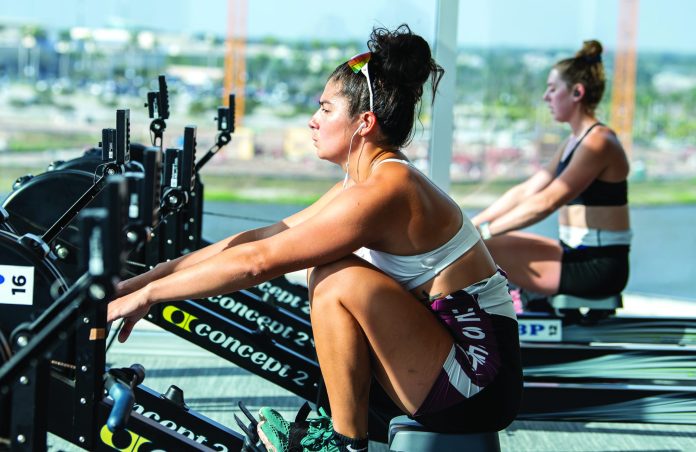
Erg tests and races are used in every rowing program in the world. They are used to select, train at a specific intensity, or satisfy the urge to compete. They can show what you can achieve as an individual and whether your training is translating into improvement.

Erg tests cause more anxiety in athletes often than a hard training session or even a race on the water, although they’re actually not that different. In a hard training session, you should push yourself to the limit, and in a satisfying race, you should do the best you can. In an erg race, you can’t do more than that. So why do erg tests feel so different and why do you worry so much in anticipation?

First, many people talk about erg tests negatively, as exhausting lung-busting ordeals that push athletes to the brink of human endurance. After hearing their tales, it’s natural to feel dread and think you’d better prepare for the worst.

Second, with each stroke, you get immediate feedback on exactly what you did, and you can’t hide. You get very objective information about what you’re doing and where you are in relation to your expectations and plan. You can reach your goal in a workout or a race without pushing yourself to the limit. You can reach a certain training intensity or win a race without going all out and still achieve a satisfactory result.

But the erg test is unforgiving. If you don’t push yourself to your absolute limit, the result will be clear, undeniable, and disappointing.

Third, we begin an erg test typically expecting to achieve a personal best. You know what you did last time and want to do better, which is perfectly natural. Combine this with the wrong race plan and you make life difficult for yourself.

Many people talk about the pain one experiences during such tests, although the physical feedback is just an unpleasant sensation caused by acidic buildup in the muscles from the incomplete breakdown of glycogen, which provides the necessary energy to pull hard. The amount of acid depends on the intensity of the work.

Despite the discomfort, you can and will persevere; it just takes plenty of motivation. You know the test lasts only a few minutes and that afterward you’ll feel better. Even if you do nothing after the test, your body will take care of the by-products and break down the acid.

But if you injure your back during an erg test, you’ll be in severe pain and will have to stop. Such pain does not go away on its own and must be treated by a doctor. Being uncomfortable and being in pain are two different things.

To reduce the anxiety of an erg test and prepare for a successful performance, I suggest the following:

Stop talking about the expected pain. What’s to be expected is discomfort, and if you’re not experiencing it, you’re not working at full capacity. Use your body’s feedback to guide your efforts and interpret it in a positive way. Learn to use it to control your performance, resisting the urge to stop too early and staying strong enough mentally to stay on target and complete the challenge. Push yourself the same way you would in a tough race on the water.

Set a realistic but challenging goal. Based on previous training sessions, you should have a firm idea of how fast you can go. Do some prep sessions to assess your current fitness. Be honest with yourself and heed the advice of your coach. Be positive about the upcoming test. Embrace the nervousness that everyone has before a test.

Set process goals that you can work on to keep yourself positive and motivated. Such goals begin with a plan for how you’ll organize your time and activities before the test, such as when you’ll go to bed, when you’ll eat, what you’ll eat, how you’ll get to the venue, how you’ll warm up, etc.

Then, how you’ll begin the test, how many strokes and at what intensity, what stroke rate you’ll try to reach and when, how you’ll feel at different points of the race. Make sure you talk positively to yourself the whole time before and during the test. Pat yourself on the back for every process goal you achieve, even the smallest and easiest ones.

Plan your race strategy. This includes the performance target, measured by average splits, and the three phases of the race—start, middle, and finishing sprint. The target average times must be based on previous experience. Then, plan the length of the individual race phases and the targeted splits. 

The start of an erg race should be about 250 meters. It’s helpful to set a stroke sequence that you can count down. Each sequence should have a focus—the first five strokes to get the fan going, then five strokes at maximum intensity to get your energy system fired up, then 15 strokes to stretch out and transition to your medium race pace while making the most of the fast-spinning fan. As an experienced rower, you can extend the length of the start by 50 meters.

The middle of the race is the longest part and also the most important for reaching your goal. Be aware that your split times need to be two to three seconds slower than your target splits for the whole race. The challenge here is to race very efficiently.

Research has shown that it’s important to maintain a sufficiently high individual stroke rate so that you achieve the desired intensity with a good rhythm and a certain ease. Since you breathe twice per stroke, an appropriate stroke rate allows more air to circulate in your lungs. Too low a stroke rate requires higher force per stroke, which tends to produce more lactate.

At what point you begin your finishing sprint depends on how hard you’ve worked and how motivated you are. If you’re happy with your performance and want to approach the finish conservatively, begin your sprint 250 meters before the finish. If you’re highly motivated and want to challenge yourself, begin at 750 meters before the finish.

In either case, you need to increase your stroke rate and power output. At this point, it helps to count strokes again and to lower your split for each stroke sequence you begin counting. The ideal is to have tried out a particular sequence in training so you know the stroke rate and power output you need to achieve.

When you realize your process and achieve your goals, the feeling of accomplishment will be amazing.


Penn Wins Men’s and Women’s Eights at the Schuylkill

penn women's rowing head of the schuylkill 2024
Photo courtesy of Penn Athletics.

Over 8,000 rowers competing in 155 events at the 2024 Head of the Schuylkill Regatta enjoyed sunny warmth with challenging winds over the weekend.

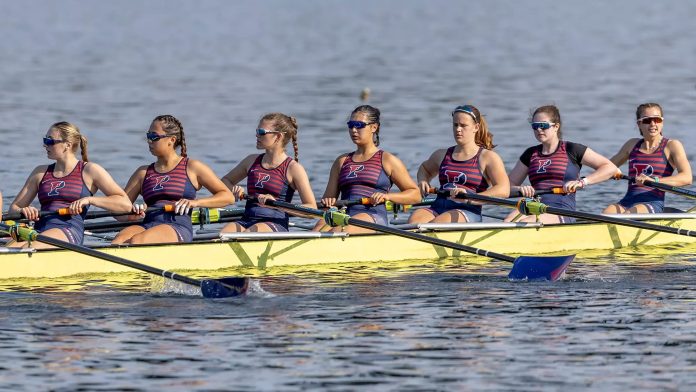
The University of Pennsylvania won both the women’s and men’s championship eights, finished first and second in the club eights, and won the championship fours and frosh/novice eights.

The Penn women also went one-two in the championship coxed four, and won the college frosh/novice eight

“It was a good learning event for us. Progress is our focus,” said new Penn women’s coach Bill Manning. “We all know that everyone will get faster so we don’t keep score until April.”

University of Pennsylvania men also won the championship pair, frosh/novice coxed four, championship coxed four, alumni quads.

Riverside Boat Club’s Elizabeth Martin won the women’s championship single and Whitemarsh Boat Club’s Claire Friedlander won the women’s championship lightweight singles. Head of the Charles men’s single winner Finn Hamill, from New Zealand’s Waikato Rowing Club, won the champ single, men’s double with Justin Schmidt, and mixed double with Olympic champion Karolien Florijn. Schmidt cemented Whitemarsh’s dominance of lightweight singles by winning the men’s event.

Clete Graham, who led the Schuylkill Navy and Stotesbury Cup Regatta through their greatest growth, has kept busy in so-called retirement.  Graham finished fifth of eleven in the men’s masters lightweight single (60+), won by Malta’s Ted Trocky, before coaching two Notre Dame women’s masters eights on Saturday, and then came back to coach seven sculling boats from Concord High School (Delaware) on Sunday.

“I was pretty tired by the end of the day Sunday,” Graham admitted, “but had a great time all weekend. A very well-run regatta, with a very nicely buoyed course, and beautiful weather.”

Racing Gets Spooky at Pumpkinhead

Pumpkinhead
Photo courtesy of Austin Rowing Club.

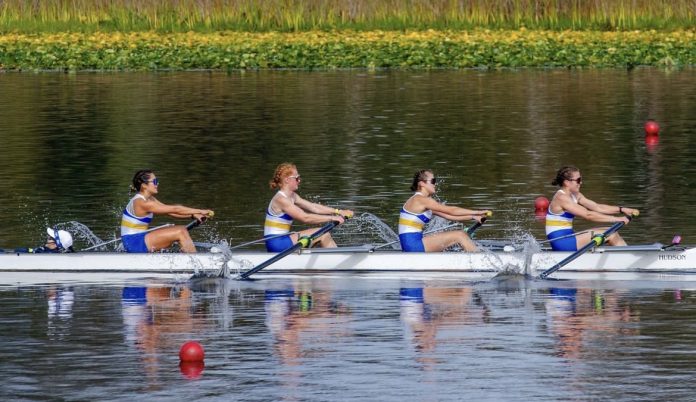
Across the United States, rowers embraced the fall rowing conditions and some even dressed up for the occasion in the case of Pumpkinhead in Austin, Texas.

Pumpkinhead – Head of the Colorado, which Austin Rowing Club has hosted since the mid-1980s on Lady Bird Lake, saw a myriad or rowers in costume as part of regatta tradition on Saturday.

“We have a 3K racecourse that runs from ARC east towards the Longhorn dam,” said regatta director Megan Getman. “Because the regatta is around Halloween we encourage costumes. The teams in big boats create themed costumes and they are expected to race in costume. They have to put some thought into the costume to make it rowable.”

The regatta now offers an Adaptive 1x race, allowing racing to be available and accessible to everyone. This year Texas Rowing for All had six entries.

“We had clubs from all over Texas, Louisiana, and Oklahoma,” Getman stated. “We also had a few international clubs this year— a few from Mexico that started coming. They’re very much fun to row with. We have juniors, collegiate, and masters. Texas Rowing Center and Austin Rowing Club usually do really well.”

In Gold Lake, California at the Head of the American, California Rowing Club took the top nine spots in the Men’s Open Single and the top two spots in the Women’s Open Single In the Women’s Collegiate Eight University of California-Berkeley claimed first and second place. On the men’s side Gonzaga University finished first in 15:51.3, over 20 seconds faster than second place Santa Clara University.

The 8th annual Music City Head Race took place on Saturday in Nashville, Tennessee on the Cumberland River. University of Louisville Rowing finished first in the Women’s Collegiate Eight in 17:46.5 with Vanderbilt Rowing Club coming in second in 18:10.9. Michigan Rowing Association, who had four entries in the Men’s Collegiate Eight, took the top two spots with Virginia Tech placing third.

“Fall racing is a different game altogether and it’ll be fun to see the team participate in these races,” said Louisville coach Derek Copeland. “They had a pretty good summer and have welcomed 22 newcomers and a dozen novices from campus. The upperclassmen have done a great job showing this young group the way as we’ve nearly doubled our squad size from last year.”

Recruiting: The Timeliness of Now

sarasota youth nationals
The top junior and high school school crews qualify for the USRowing Youth National Championships at Nathan Benderson Park in Sarasota, Fla. PHOTO: Lisa Worthy.

The best time to begin considering your university choice is now, regardless of where you are in high school.

If you’re in the ninth or 10th grade, begin by assessing both your athletic and academic abilities. Understanding your strengths and weaknesses will help you set realistic goals for your academics and rowing.

As you approach the summer before your junior year, it’s time to refine those goals. This is an ideal time to think about the type of school you’d like to attend. Do you envision yourself at a large state university, a smaller liberal-arts college, or something in between? With so many options, the process can feel overwhelming. There are also great club programs that offer attractive opportunities to keep rowing.

For rowers, official (paid) visits are allowed in both the junior and senior years. Many athletes take advantage of early visits, even before they’re ready to decide. While early visits can be helpful, it’s important not to rush your choices.

So when is the right time to begin the process of selecting a university? Again: now. Wherever you are in the process, there’s always a productive next step. Even if it’s the fall of your senior year and you’ve just decided you want to row in college, it’s not too late. Begin by expressing your interest to university coaches. Your current coach or a recruiting expert can guide you through the next steps.

Whether early in high school or nearing the end, it’s never too soon—or too late—to begin preparing for your university rowing careeer   

Robbie Tenenbaum coached at the NCAA level for over 30 years and with the U.S. Junior National Team for eight. He now helps parents and families navigate the university recruiting process. 

Haxton, American, and Pumpkinhead Regattas Commence Racing October 26

Upper Arlington Crew columbus ohio
Photo courtesy of Upper Arlington Crew.

The Head of the American, Pumpkinhead – Head of the Colorado, and Blake Haxton Fall Regatta are all scheduled for Saturday, October 26. Racers from the middle school all the way up to masters will be competing.

Upper Arlington Crew from Columbus, Ohio will be the host of the Blake Haxton Fall Regatta held on Griggs Reservoir.

“We have over 480 entries right now, and we’re very excited,” said race director Lisa Osborne. “It’s looking like we’ll have great weather, not like a typical October regatta. Also, this year we are going to have an extra launch dock. The regatta has grown significantly in the last few years, so we needed to accommodate our growth, entry, and team sizes.”

The dock purchase was a collaboration between Upper Arlington Crew, Washtenaw Rowing Center and the Kathryn Bennett Race Course.

“The men’s and women’s varsity eights have some really fast teams,” said Osborne regarding races to look out for. “We also have a good number of quads and doubles. We’re also happy to have some middle school racing at the very end of the day to get those kids excited about rowing. It’s a composite race for teams that don’t have enough to fill a boat and it’s just 1,000 meters. For many of them it will be their first race so it’s exciting to see them be able to participate and see what an actual race is like from launching, to crossing the finish line and hearing the horn.”

The Head of the American regatta is hosted by the Sacramento State Aquatic Center on Lake Natoma in Gold Lake, California and invites high school, college and master rowing programs to race the 5K course, which snakes along the river’s north shore.

In addition to the California and Ohio regattas, Austin, Texas and Austin Rowing Club will be the site of the 40th annual Pumpkinhead – Head of the Colorado which features a 3K race starting at ARC’s dock on Lady Bird Lake. Junior, collegiate, adaptive, and masters rowers will all have the opportunity to compete.