Home Blog Page 37

Redwood Scullers to host Head of the Lagoon

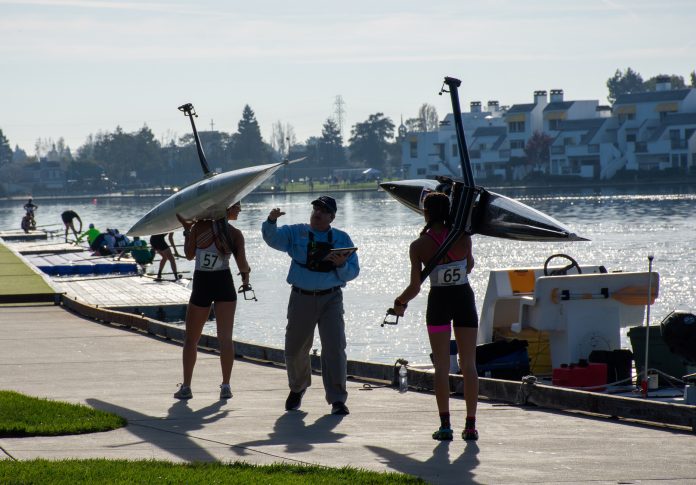
head of the lagoon referee boat check
Photo by Josh Hoidn.

Redwood Scullers will take advantage of the temperate fall California weather to host Head of the Lagoon. The two-day regatta on Saturday and Sunday, November 9-10, 2024, draws a significant fleet of small boats to the San Francisco Bay Peninsula.

“Saturday is all about masters and juniors singles,” noted race director Monica Hilcu. “We have around 205 entries on Saturday and 83 of those are all junior singles from under 19 singles down to under 15 singles. There are a couple of middle schoolers in there that will be doing their first 5K. It’s great that we have so many junior singles entries—it will be fun to watch all of them. It’s supposed to be beautiful weather here in California.”

This year marks the 27th year of the event that draws masters, colleges, and juniors and has been credited by referees for best practices. The extremely curved course offers an advantage to those who add steering to their race plans. Shaped like the number two, the race path traverses under three bridges along the boardwalk at Central Lake.

“We’re excited to watch our youngsters row,” said Hilcu, who in addition to being race director is the head coach of Redwood Scullers. “We’ve got some strong under 17 men and women on both sides and then our under 19 kids have been training in singles since August. There’s going to be a rematch on the men’s and women’s side with the under 19 quads between Redwood Scullers and Los Gatos Rowing Club. River City Rowing Club is going to be in there too. It’s going to be some good racing in the quads as well as the doubles.”

Several clubs will be returning in an attempt to defend last year’s victories as well as vie with old rivalries. In addition, several new faces will join the excitement in 2024.

“Los Gatos is a bigger club and they’ve done really well on the nOkational stage,” said Hilcu. “We’ll have some smaller clubs that will really start popping up on the medal stand like River City Rowing Club and North Bay Rowing Club. We’ve got a couple of teams coming down from Seattle, Washington.”

Race day information and results can be found at RegattaCentral.

USRowing Stays the Course with Coaches

Varese, Lombardy, ITALY. Thursday, 28.07. 2022, USA Coach Jesse FOGLIA, , World Rowing Championships, Venue, Lago, Lake Varese, [Mandatory Credit: Peter Spurrier/Intersport-images.com]

USRowing’s head men’s sweep coach Casey Galvanek and head women’s sweep coach Jesse Foglia signed full-time contracts with the national governing body before the Paris Games.

Foglia signed a four-year deal as women’s sweep head coach in January 2023, Rowing News has learned. Despite the U.S. failure to win a medal in any women’s events for the second Olympic Games in a row, Foglia, the boat coach for the women’s four and eight—both fifth at the Olympics—continues to coach the women’s sweep squad in Mercer, N.J.

Only two pairs are training there now, but a full group of 12 to 16 athletes is expected in the new year.

Galvanek, who coached the U.S. men’s four to Olympic gold in Paris and selected the men’s eight, which, coached by Washington coach Michael Callahan, qualified for the Games in May and won the Olympic bronze medal, was elevated to a full-time position with USRowing in July.

Galvanek continues to work with Sarasota Crew, currently cleaning up and rebuilding after hurricanes caused over $500,000 of damage to docks and ramps.

USRowing high-performance chief Josy Verdonkschot is expected to sign a four-year deal to continue leading Olympic, Paralympic, and world-championship rowing programs when he returns to the United States from The Netherlands in mid-November.

Verdonkschot hired both Foglia and Galvanek as the head coaches of the sweep training groups but waits until specific National Team line-ups are selected before naming boat coaches.

The United States Olympic and Paralympic Committee will increase funding of the U.S. National Team’s Olympic efforts by 15 percent to $2 million per year and continue funding the U.S. Paralympic rowing program at $150,000 per year, even though in Paris U.S. crews captured only three medals—Olympic gold and bronze and a silver in the PR3 mixed four.

Despite higher expectations in the rowing community, Verdonkschot had set Olympic goals with the USOPC of two to four medals, six to eight finals, and 10 to 12 qualified boats. Although the medal count was low, since U.S. Olympic crews performed at the high end of other parameters, the USOPC was pleased with the results.

For a Faster Boat, Go Naked

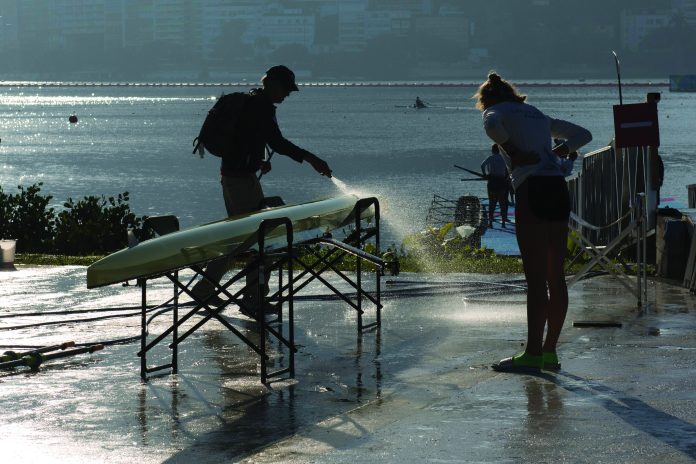
boat washing rio olympics gevvie stone gregg stone
Rio de Janeiro. BRAZIL. USA W1X Coach, Greg STONE washes down the single after an outing. 2016 Olympic Rowing Regatta. Lagoa Stadium, Copacabana, “Olympic Summer Games” Rodrigo de Freitas Lagoon, Lagoa. Saturday 13/08/2016 [Mandatory Credit; Peter SPURRIER/Intersport Images]

Dear Doctor Rowing,

I have begun to scull again recently after years away from our fair sport. I row on salt water and yes, I do spray my boat and oars after every row. But despite this, there is rust on the hardware of the sleeves of my Concept2 sculling blades. How can I get rid of that oxidation and get them looking pristine again?

Sincerely,
Rusty in more ways than one

Just when Doctor Rowing, who has noticed the same issue with both his oars and his sculling stroke, was about to surrender, (I can’t know everything), an answer came via text.

“I am happy to report that soaking the screws in vinegar for about 30 minutes completely removed the rust…. I used an old toothbrush. Nice and shiny now!”

But who was my mystery savior?

I texted back, confident that it was not a scam. I knew the number but had never added it to my contacts. The reply came quickly.

“Shelly.”

A masters sculler whom I had met over the summer.

Good for her.


Dear Doc,

Is there any speed treatment I can do to my hull?

Sincerely,
A veteran sculler

The best thing to do would be to feed and water your horses and not worry too much about your chariot. In rowing terms, don’t obsess over the boat. Get yourself as ready as you can. The boys I work with talk constantly about finding “free speed.” Unless you’re an Olympic medalist, I don’t think you’re going to find any answers looking in the “free file.” Believe me, those gold medalists who looked so great—they got there with hard work; there was nothing free about it.

But I understand. Time was, I spent hours preparing my crew’s boat to race, too. Here’s the best description of what you can do from former USA boatman Mike Davenport:

Waxing a rowing shell has benefits, such as protecting the hull from damage from the sun and from pollutants. (Of course, there are also downsides, like messing up a nice pair of pants.) However, one of the benefits of waxing is not speed. A good wax job will actually slow your hull down.

What is the best treatment for a hull when you’re looking for speed? The answer is, “Nothing!” A naked hull is usually the fastest. You see, when a hull is gliding through the water, you want to have the smoothest possible surface that you can. Smooth is fast. The smoother the hull, the less friction…and that is good.

If your hull has a good paint job and is free of dings and checks, then its maximum speed will come from being clean. Think of it in these terms: “Clean is fast.”

So waxing a rowing shell can slow you down. So how do you clean the hull? In my opinion, it’s a two-step process. [For more details on this, read “3 Steps To A Sparkling Clean Rowing Shell Hull” in Mike’s book MaxRigging.]

My first step is to use a rubbing compound. I usually treat the hull once or twice a year with the compound to remove the gunk that attaches to the hull over time. This is critical if you do wax your hull, or if you row in water that has pollution in it (and, unfortunately, today most water does have it).

Rubbing compound is an abrasive, usually in a liquid or almost-liquid form, and it comes in different levels of grit. I think of it as liquid sandpaper. There are two critical components of successfully using rubbing compound. One is selecting the correct grit (I use 1500). The other is to follow the directions, and I mean follow.

Using compound can be a mindless job, but that doesn’t mean that you should be mindless. Care needs to be taken that you only clean the hull, and don’t damage the paint. Gentle strokes, usually in a circular pattern, work fine. Some people profess that using a bow-to-stern motion is best. This does have its merits, but usually only if you are using a heavier grit.

My second step is to wash the hull prior to each race. I try to do this the day of the race, when the boat is ready to go. That means if we’ve transported the boat, I’ll wash it right at the racecourse. That’s not usually a hardship. A bucket, a sponge, a little soap (I use dishwashing detergent), a little water (which tends to be available at racecourses…hint, the river or lake), a little scrubbing, and in 10 minutes the hull is clean. I then just rinse off the soap and let the boat drip-dry.

(For what it’s worth, one thing I’ve noticed is that people love, I mean love, to help wash a racing hull. There must be something sensual to it. Almost without fail, every time I wash a hull, people flock to help.)

So if you’re thinking of waxing your rowing shell, clean off the wax before race time.

Remember: Naked is fast!

Whatever you do, don’t trade time in the boat for time cleaning your boat. As noted earlier, “it’s not the chariot, it’s the horses.”


Assessing Fatigue Resistance

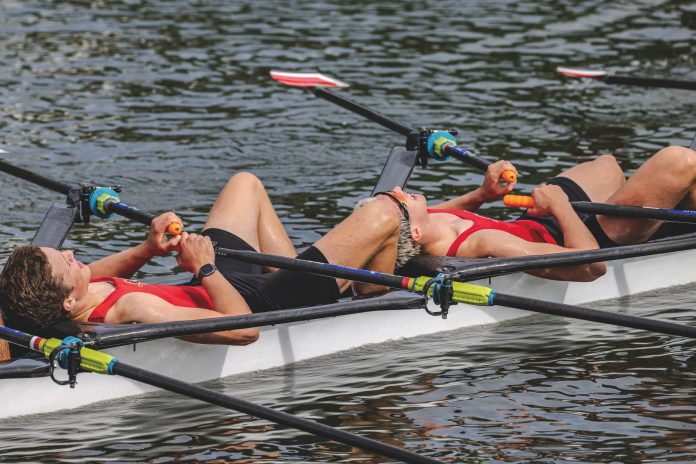
fatigue rowing laying down
Photo by Lisa Worthy.

Winning races often comes down to the final stroke. Producing high power output for the duration of an event or a multiple-race regatta requires fatigue resistance, which is another dimension of endurance.

Rowing trials are performed typically in a fresh state with minimal fatigue. The ability to produce hard effort in the late stage of a race or regatta, however, is another way to identify the potential for success when selecting crews or to determine whether you’re getting better.

Here are two ways to assess fatigue resistance as a specific ability:

Warm up 15 to 20 minutes, then perform a fresh maximal effort at the beginning of a row followed by a period of steady rowing and then a fatigued maximal effort to see how much your power has dropped between the fresh and the fatigued effort.

One approach is to row seven minutes at 30 strokes per minute, record the meters, then row 40 minutes steady at 24 s.p.m. followed by seven minutes at 30 s.p.m., and record the meters.

Another approach is to perform your fresh and fatigued efforts according to your RPE, or Rating of Perceived Effort. Row seven minutes at RPE 8/10, record the meters, then row 40 minutes steady at 24 s.p.m. followed by seven minutes at RPE 8/10, and record the meters.

If conditions on your waterway are variable, it’s better to test on an indoor rower. Make the length of your efforts race-specific and test under similar environmental conditions, such as heat, altitude, and humidity, all of which can affect your level of fatigue.

You can customize your test according to the event for which you’re preparing so that you have a basis of comparison that allows you to track changes over time. With a good level of fatigue resistance, the decline between your fresh and fatigued efforts will be less than five to eight percent.

Next month, we’ll explore how to improve fatigue resistance.

Princeton, UBC Top Their Fields in Collegiate Weekend Racing

UBC men's eight
Photo courtesy of Kevin Light.

For many collegiate rowing programs, the Princeton 3-Mile Chase caps off the fall season and this year the host, Princeton University, took home several titles. On the international scene, the University of British Columbia had several first-place finishes at the Canadian University Rowing Championship.

The morning began on Lake Carnegie in Princeton, New Jersey with Princeton’s A entry winning the men’s heavyweight eight in 12:10.95. The second-place finisher, University of Pennsylvania’s A boat came in with a time of 12:16.26. Princeton also claimed a win in round two of the event with a time of 12:57.49 ahead of University of Wisconsin, with a raw time of 12:58.56.

The Tigers also won the women’s eight. In the second flight of the event Rutgers University took the lead in 14:56.16, two seconds ahead of Princeton’s A entry.

In Victoria, British Columbia the University of Victoria hosted the Canadian University Rowing Championship on Elk Lake. In the marquee event of the regatta, the men’s and women’s eight, the visiting University of British Columbia won across the board. UBC finished 1,850M in 5:31.56, which was three seconds ahead of the second place Western University crew. The racing on the women’s side came down to a once-second margin. UBC’s winning crew with a time of 6:17.03 was just ahead of the University of Victoria second place crew.

“It was one of the most exciting races I think I’ve ever been a part of, so I’m stoked,” said Gaby Worobec, UBC’s seven seat. “We talked about getting the momentum—and that’s something that our cox is really good at asking for. When we had the momentum, we capitalized on it.”

“Historically UBC is not a sprinting crew,” added Gabby Yarema, stroke seat. “We came into this saying we’re going to show our sprint and if that wasn’t one of the best ways to do it I don’t know what is.”

Watch Sunday’s finals, medal ceremonies, and athlete interviews on the University of Victoria’s YouTube channel. Full results can be found here.

Coxswain Development: Indoor Involvement

erg warmup
Photo by Lisa Worthy.

For some of us, the time has arrived to turn our attention toward indoor training. While it’s easy to feel adrift out of the coxswain’s seat, the winter presents a fantastic opportunity to help further your team’s goals and your personal development.

The key rule of indoor practices is to be involved; don’t just stand at the back of the room. Your rowers are working hard, taking risks, and performing, and it’s time for you to do the same. The winter affords you the time to really get to know your rowers, develop your technical knowledge of the stroke, and help move your team forward.

Know how to make the most of your steady-state practices. First, watch your rowers until you have a full picture of what they’re doing. If you see your coach giving a lot of feedback to a particular athlete, check in with the coach so that you can reinforce that message. Several coaches and a group of coxswains all giving involved feedback is great, but it can also get overwhelming if a rower is getting too many corrections at once.

“We encourage the coxswains to pick one major thing about a rower that they think will make the biggest impact in that piece or on that day,” said Skye Eliot, varsity girls coach at Community Rowing, Inc. “We’ll ask them to give the rower a little bit of feedback on one thing, perhaps video it first, and then during a rest period or after the workout, they can show the video and explain the technical change.”

This real-time technical feedback can be valuable to your rowers and help you discover what technical calls and cues are effective for individual athletes.

When giving feedback, make sure to integrate the same language and focuses you and your coaches have been using on the water.

“Listen to the language we’re using, the explanations of the strokes, the drills, and the cues we add to the drills,” said Eliot.

If you’ve been paying attention, it’ll be easy for you to use the same technical language to help your rowers transition from the water to the erg. It’s also a great opportunity to clarify any coaching that you didn’t understand on the water so that you and your coach are on the same page technically. The stroke is an endless puzzle; even the very best rowers on your team will be working on refining certain elements, so you’ll never run out of feedback to give or things to look at.

When coxing pieces, know your rowers. It’s important to know goal splits and race plans so that you can encourage your rowers to stay on target. Talk with them beforehand about their plans and goals—don’t be that coxswain who is screaming at a rower to drive the split down when that rower is right on target. As with a race on the water, there’s a rhythm to an erg piece.

“In the beginning of the piece, you let the rower do their thing and focus on the execution of the piece. As the piece goes on, we do encourage the coxswains to get more aggressive and excited in their motivation,” said Eliot.

You may face the challenge of a rower who simply doesn’t react well to coxswain feedback. If you have a prickly rower, check in with her before a practice or a piece and ask her what she’s focused on and what kind of feedback is helpful.

With less receptive rowers, “you can create an agreement ahead of time that it’s OK to give feedback,” said Eliot. “Rowers who are competitive are almost always going to want to talk about what you see.”

Be confident, offer feedback, and be attentive and receptive to your rowers’ needs.  For a coxswain, the winter can be a time to be selfless. It’s not about showcasing your own abilities, but about helping your teammates row better and perform well.

Show up for your teammates, and you’ll be rewarded when you get back on the water.

Saint Andrew Women, Belen Jesuit Men Win U19 Eights at Head of the Hooch

hooch y quad cities
Y Quad Cities finished second in the 107-boat youth doubles field at the 2024 Head of the Hooch. PHOTO: Ed Moran | SportGraphics.com

Near-perfect conditions greeted 2,200 crews as Saint Andrew Rowing Club won the women’s U19 eights and Belen Jesuit won the men’s U19 eights event on the first day of the 2024 Head of the Hooch in Chattanooga, Tenn.

“We really wanted to win, so we went out there and won it,” said Saint Andrew four seat  Lucy Master.

“I think we came out really strong and performed really well. We haven’t done this well at Head of the Hooch since before Covid,” said Corbin Vassil,  six seat of Cincinnati Juniors’ men’s U19 eight, who like their women’s U19 eight, finished second. “It’s really fun to race teams from all over the country. We were 1.6 seconds off of Belen Jesuit and they’re a pretty solid team.”

The majority of crews racing are youth rowers at the Hooch, where the average age of a competitor is 23. Almost as many youth doubles—101 women’s and 97 men’s—as eights and fours (with 107-boat field maximums) race here, with waitlists dozens deep.

“I got to double race today,” said Virginia Tech’s enthusiastic Jack Brett. “Everyone was super energized, first race went OK, I was in the men’s four, and then got to row in the men’s eight and got fifth, which is super cool.”

Founded in 1982 on the Chattahoochee River in Roswell, Georgia by members of the Atlanta Rowing Club, the Head of the Hooch moved to the Lake Lanier Olympic venue in 1996, and then to Chattanooga in 2005, where the city and its numerous downtown hotels and restaurants have made a very welcoming home for what has become one of the largest regattas in the world. “They’ve been so good to us,” said organizer Ulrich Lemke.

Racing at the Hooch concludes Sunday with an additional 50 events, including mixed, masters, and Para racing.

Full results. Live video stream.

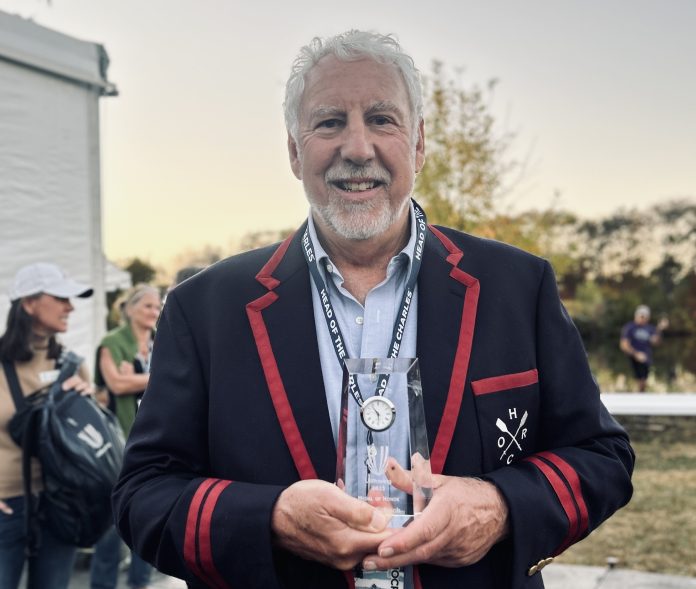
Schoch Awarded USRowing Medal of Honor

fred Schoch award head of the charles medal of honor usrowing
Photo by Gregory Zapata.

Fred Schoch, who retired recently after 33 years as president and executive director of Head of the Charles, was awarded the USRowing Medal of Honor at the 2024 regatta.

In addition to the USRowing honor, the HOCR board announced that rowers in the men’s championship eights will compete henceforth for the Fred Schoch Cup.

“It was a big surprise and very gratefully received after my 33 years behind the plow for the Head of the Charles,” said Schoch. “Both awards in the same year are as preeminent as you can get in rowing, so I was very honored.”

This was the first year Schoch was able to see the regatta from a new perspective: retirement.

“It was really odd, an out-of-body experience,” Schoch said. “All of the social aspects of the regatta were the same; I just didn’t have a hand in the organization. I was involved in running it for more than half of its life, and building up the brand worldwide has been one of my proudest achievements. It’s now a bucket-list event for rowers around the world.”

Schoch’s father, Delos “Dutch” Schoch, a legendary Princeton coach who as a young athlete was the alternate in the “Boys in the Boat” men’s eight that won gold at the 1936 Olympics, made sure that his son was involved in the sport from a young age.

“My whole life, I’ve been involved in the rowing community,” said Schoch. “I feel very fortunate to have been able to make a living in rowing. I was able to capitalize on my experience and my relationships. Being able to make a contribution to rowing following my father has been very meaningful.”

The new Fred Schoch Cup is not the first. The original Schoch Cup, named for Dutch, was presented in the 1970s and was stolen from the Washington boathouse.

“One of my board members was online looking for trophies and found it being advertised,” Schoch laughed. “We got it back, and it’s now sitting on my mantel. There was a duplicate made that’s in Seattle. I may have to negotiate a deal and give the original back to the school. The new Fred Schoch Cup will sit in the trophy case at Cambridge Boat Club.”

The Fred Schoch Cup for the Head of the Charles now will stand on the metaphorical shelf alongside the Dutch Schoch Cup, which is awarded to the winner of the California-Washington dual race race each spring.

“I look back at some of the previous winners of the USRowing Medal of Honor and I’m really humbled to be considered in that group. And I couldn’t be more thrilled to have my name on the HOCR trophy.

“I hope to present it for many years ahead.”