Home Blog Page 29

Last Year’s National Champs Face the Daunting Challenge of Repeating

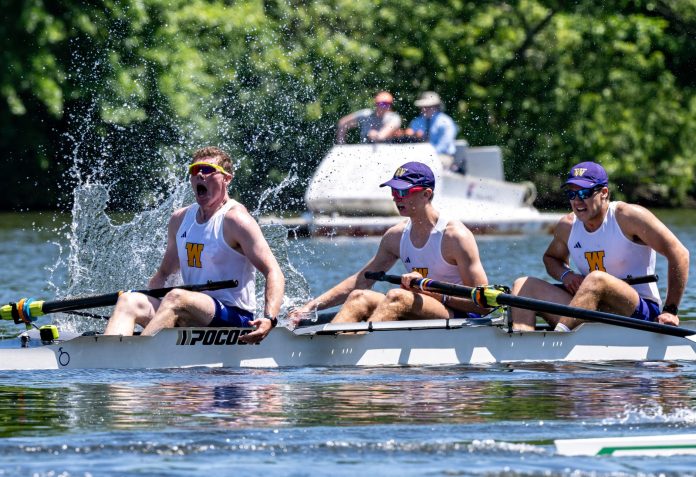
The University of Washington won the 2024 IRA men's varsity coxed four, as well as all three varsity eights, for a sweep of heavyweight events at the national championship regatta. PHOTO: Lisa Worthy.


Defending NCAA Division I national champion Texas faces one of the greatest challenges in all of sport: repeating.

The Longhorns have done it before, successfully defending their 2021 championship in 2022 (and Texas coach Dave O’Neill did it previously, in 2005 and 2006, when he was Cal’s head coach).

And they’ve won three of the last four, with Stanford winning in 2023 and finishing second (twice tied on points) the other three years.

Washington and Cal alternated as NCAA Division I national champions for four years, 2016 to 2019 (2020 was canceled because of Covid), and Ohio State won three straight before that.

On the men’s IRA side of collegiate rowing, Washington faces the same great challenge to repeat as national champions, having broken Cal’s two-year streak last year. Washington won the Covid-limited 2021 IRA after the canceled 2020 regatta. Yale ruled the regatta for three years, from 2017 to 2019. In the past decade, only Cal, Washington, and Yale have finished first or second, until Harvard finished second to Washington in 2024.

Over the past decade, the NCAA and IRA have featured little variation in who wins the championships. It takes great coaching, great recruits, and tremendous institutional support—all working hard and working together—to win the premier events.

Last year, both the IRA and NCAA champions shared something else: schedules that featured racing their closest competitors across the country before the championship regatta. Texas traveled to, and won, the 2024 San Diego Crew Classic and hosted Stanford for the Longhorn Invite before winning the NCAAs. Washington traveled to Sarasota to race, and lose to, Harvard before outdistancing the Crimson to win the IRA.

If that fourth factor—a racing schedule that includes the other best crews—is the key to a national championship in an era dominated by recruiting and institutional support, Tennessee’s Lady Vols might be the NCAA favorites, while Washington is the favorite to win the IRA.

In 2024, Tennessee’s first season under head coach Kim Cupini, Tennessee rowing recorded the best season in program history with a third-place performance at the NCAAs. Now in her second year—and first full calendar year after beginning late last year—Cupini has the most complete top-to-bottom racing schedule in college rowing this spring.

“We love racing and have a hard schedule,” Cupini said. “We’re racers.”

Tennessee will welcome Stanford to Oak Ridge’s Melton Hill Lake, its home course just west of Knoxville, on March 29. The next week, the Lady Vols host the first-ever Rocky Top Invite before heading to Sarasota for the biggest non-championship college regatta, the Big Ten Invitational.

That regatta features 23 NCAA Division I programs: 11 from the Big Ten—Washington, Michigan, Ohio State, Rutgers, Indiana, USC, UCLA, Minnesota, Wisconsin, Michigan State and Iowa—plus 12 guest schools—Tennessee, Brown, Penn, Duke, Oregon State, Alabama, Notre Dame, Harvard, Miami, SMU, Oklahoma and Clemson. The field includes 12 of last year’s top 20 and half of the top 10.

Then Tennessee goes to Princeton to race the Tigers, Ohio State, and Syracuse, before hosting the first annual SEC Championship against Texas, Alabama, and Oklahoma.

Besides racing, the winning edge comes from “the hard work that the women put in,” Cupini said. “Everyone thinks it comes down to resources, but it’s a lot about the coaches, the athletes, and the work. It takes a lot of work; it’s an endless grind.”

“Racing other fast crews helps, no question,” agreed Yale head coach Will Porter. “Ivies is good prep for NCAAs.”

Although the Yale women’s crew has had to deal with several injuries over the winter, “the team is really good as far as people, culture, and vibe,” Porter said. “They operate at a high level, they’re mature. I’m happy with where we are right now.”

The current college athletics environment, in which student-athletes can switch schools annually and take advantage of five, even six years of eligibility at programs that include graduate students, is “super-annoying,” Porter said.

“It’s a bold new world, but it doesn’t change what we do,” he continued. “We do what we do and see where we stack up. We’re good chasing great.”

In the heavyweight men’s IRA national-title chase, Washington wades into the 2025 spring season with the Husky Open and Class Day regattas at home before diving into the deep end in Sarasota at the end of March.

On Friday the 28th, the team races Harvard for the re-established Bolles Cup, honoring the legendary Tom Bolles, who attended and coached Washington in the 1920s and ’30s before moving to Harvard in 1936 to coach and serve eventually as athletic director.

The next day, Washington races Yale, Brown, and Northeastern for the Benderson Cup. The Huskies return to the West Coast for duals against Stanford, Oregon State, and bitter rival Cal, before racing the New Zealand National Team for the Windermere Cup at the Opening Day Regatta. The new Mountain Pacific Sports Federation conference championship begins their post-season, which culminates in the IRA National Championship in Camden, New Jersey.

“We hope the rhythm of the spring racing season will set up the students for success at the end of the season,” said UW men’s head coach Michael Callahan.

American Collegiate Rowing Association

With eight of nine members of the 2024 American Collegiate Rowing Association national-champion men’s eight returning for 2025, Notre Dame should be a favorite to repeat as ACRA national champions.

They’re not.

That’s no slight to the club champions from South Bend. No one has repeated as ACRA champions since 2016 (Michigan), and Notre Dame will be trying to do it after its coach, alumnus Quinn Klocke, left for Washington, where he was hired as an assistant coach to work with freshmen (Klocke was a walk-on at Notre Dame).

Notre Dame “took some lumps in the fall,” said new coach Jack Newell, who left Clemson to take the head coaching position. Notre Dame will race a gauntlet of four big regattas—no dual races—this spring, including the ACRA National Championships, May 15 to 18, in Oak Ridge, Tenn.

Club nationals, now larger than the combined NCAA and IRA national-championship regattas (exclusively for varsity programs sponsored by their athletic departments), has become at least as competitive as the NCAA and IRA, if not as fast. That’s because the top ACRA men’s programs, while not funded through their athletic departments, have more full-time coaches and tap into more alumni support than ever before.

“It’s an exciting time to be a coach at the ACRA level,” said Newell.

Like Notre Dame, Virginia, UCLA, Minnesota, Rutgers, Michigan, Orange Coast College, George Washington, Purdue, Bucknell, and others run programs that function like varsities at schools funding men’s and women’s rowing through their athletic departments.

The top ACRA programs are “club in name only,” said Newell, whose crew takes a winter training trip to Lake Lanier in Georgia and a spring training trip to Oak Ridge, Tenn., thanks in large part to Notre Dame alumni support. “We’re extremely grateful to them. They make a lot of things possible.”

Last year’s ACRA men’s favorite, Virginia, coached since 2009 by Frank Biller, could well be this year’s best bet to win.

“It’s super-competitive,” Biller said. “It’s pretty amazing. I don’t want to be anywhere else. The salaries are lower, the budgets are smaller, but down the road beyond my tenure, six-figure salaries will not be the exception.”

The ACRA coaches are “absolutely fierce competitors but all friends,” he said.

“The true spirit of competition is there. We don’t compete in recruiting. We all cook with the same water, the same ingredients. It’s a very level playing field.

“Our number-one goal is make the final. You can’t fuck up; otherwise you’re not in the final. Make the final, and anything can happen.”

Elsewhere in ACRA, Minnesota continues to build program culture and speed under Scott Armstrong, and Michigan remains a perennial favorite with depth and excellence developed by collegiate club rowing pioneer Gregg Hartsuff.

Michigan, Rutgers, Virginia, and Bucknell are scheduled to race March 29 in Pennsylvania on the Susquehanna, a contest that will be a major determinant of rankings before the Southern Intercollegiate Rowing Association regatta, April 18 and 19, in Oak Ridge, which this year will include for the first time the Columbia University lightweights.

On the women’s side, defending champion Vanderbilt returns as a favorite and will have sharpened its racing skills against NCAA Division I program Oklahoma in an April 5 scrimmage in Oklahoma City at OU’s Exchange Boathouse.

“I wouldn’t be surprised if they do it again,” said Bucknell coach Dan Wolleben. “The fall results are amazing.”

In November, the Vanderbilt women won both the collegiate eight and four at the Head of the Hooch, beating plenty of varsity programs.

Vandy rowing is led by head men’s and women’s coach Jon Miller, the 2024 ACRA Women’s Coach of the Year, who is in his 15th season leading the program. Miller began coaching at Vanderbilt in the fall of 2007 and became head coach in January 2009. Under his leadership, the team has won 14 SIRA medals and 10 ACRA medals.

In NCAA Division II, Western Washington seeks to defend its 2024 national championship, as does Tufts University in Division III. Princeton, the IRA women’s lightweight national champion, is favored to repeat, as is the defending men’s lightweight national champion, Harvard.

“To see a winning crew in action is to witness a perfect harmony in which everything is right,” George Pocock once said. At the end of the spring, for each collegiate national champion in each league—IRA, NCAA, and ACRA—everything will be right.

Chip Davis is the founder and publisher of Rowing News. An oarsman from birth, he rowed on championship crews at St. Paul’s School and Dartmouth College, where he captained the lightweights. Now he sculls in Vermont when the weather is suitable and ergs the other half of the year.

Cold Water Safety: Navigating the Risks of Cold-Water Rowing

University of Washington, approaching the Cambridge BC. during the 2009 Head of the Charles Championships Men's Eights, Sunday 18/10/2009 PHOTO: intersport-images.com


By Tom Rooks

In November, the water was cold in Bellingham Bay, Washington. Lanny “Bip” Sokol was a 48-year-old emergency-room doctor, Ironman triathlete, cross-country skier, and experienced surf-ski kayaker. He was also a devoted husband and father of two young sons.

Sokol set out for an evening paddle with a fellow accomplished kayaker, prepared with a headlamp for nightfall. Conditions were mild, with winds of five to 10 m.p.h., but the wind shifted unexpectedly, and water conditions worsened.

As the wind intensified, they turned back. Sokol capsized, and his kayak was swept away. Despite wearing a dry suit and life vest, he couldn’t overcome the tide and wind to reach the shore. His friend tried to help but after several failed attempts left to seek assistance.

After a massive search effort, including two Coast Guard motor lifeboats, two rescue boats from other agencies, two search aircraft, and a large shoreline search party, Sokol was found unresponsive three hours later.

Safety First: A Rower’s Responsibility

As rowers, we are mariners before we are athletes. Coaches bear responsibility for the safety of every individual who steps onto the water under their leadership. Our community is passionate, often volunteering countless hours to the sport, but this dedication can lead sometimes to tunnel vision, where performance goals overshadow essential safety considerations. Cold water increases the risks exponentially, and recognizing those dangers is crucial for every rowing program.

Understanding Cold-Water Risks

The National Center for Cold Water Safety and the National Weather Service caution that water temperatures below 60 degrees F. are dangerous, with risks increasing as temperatures drop. The sequence of cold-water shock includes:

· Gasp Reflex:  Sudden immersion can trigger an involuntary gasp, causing immediate drowning if underwater.

· Breathing Difficulties: Hyperventilation, lasting one to five minutes, makes basic movements challenging.

· Cardiovascular Stress: Elevated pulse and blood pressure can lead to exhaustion and impaired motor skills.

· Hypothermia: Prolonged exposure cools the body rapidly, leading to confusion, loss of motor control, and unconsciousness.

Panic can intensify each of these stages, making survival even harder.

Reevaluating Safety Standards

USRowing used to recommend, and many teams and clubs follow, a combined air and water temperature of 90 degrees F. for safe rowing, with some clubs adopting a 100-degree rule. These standards can be a decent starting point for assessing cold-temperature risk, but they fail to account for the much greater risk of cold water versus cold air. Rowing in 65-degree air with 35-degree water is far riskier than 35-degree air with 65-degree water.

In addition, safety decisions must factor in more than just temperature:

Shell Type: Are larger, more stable boats being used?

Weather: Are wind, rain, or snow in the forecast?

Current Conditions: Is the current manageable?

Experience and Skill: Are rowers prepared for cold weather and water?

Safety Drills: Has the crew practiced cold-water emergency procedures?

Protective Gear: Do coxswains have anti-exposure gear? Are rowers equipped with waterproof layers, pogies, and warm headgear?

Other Watercraft: Are there other boats that could pose a wake or capsize risk?

Cold-Water Rowing Best Practices

To mitigate cold-water risks, consider these safety strategies:

Use Stable Boats: Larger boats with more oars provide better balance.

Match Experience to Conditions: Assign crews based on skill levels.

Keep Moving: Avoid long pauses to prevent chilling.

Stay Near Shore: Loop near safe exit points rather than venturing far.

Limit Pauses at the Catch: Minimize drills that increase capsize risks.

Set Clear Cutoffs: Establish and respect conditions that warrant ending practice.

Monitor Coxswains: They’re especially vulnerable to hypothermia.

Carry Safety Gear: Use life jackets and consider wearing waist-pack inflatables when rowing without a coach.

If You Fall Into Cold Water

Stay Calm:  Avoid panic; control your breathing.

Stay Afloat: Use or put on a life jacket if available.

Plan Your Actions: Visualize and communicate your next steps.

Limit Attempts to Re-board: Set a limit for re-boarding attempts; otherwise, get on top of the boat or wait for rescue.

Call for Help: Use a VHF radio or phone to summon assistance immediately.

A Personal Reflection

As a Coast Guard cutter swimmer and boat coxswain, I worked in search and rescue in Washington, Alaska, and Maine. The priorities of cold-water immersion response are the same as they are for a rower and coach: slow down, stay calm, regain control over breathing and heart rate, make a plan before trying to execute it, and call for help early.

The night Sokol died was the most devastating of my 22 years in search and rescue. I was the command duty officer coordinating the response when our crew recovered him. Hearing “Chief, we’ve recovered the victim; there are no signs of life” over the radio, with his wife standing in front of me, was heartbreaking. Despite a small search area, expert rescuers, and his wearing the best safety gear, we couldn’t save him. He’d been in water that was too cold for too long. I vowed never to underestimate the risk of boating on cold water again.

In 2017, the rowing community lost three athletes to cold-water accidents in just two months. Last year, no USRowing members died while rowing. This progress shows our growing commitment to safety, but it’s up to all of us to maintain that momentum.

Our sport is only as safe as any rower or coach’s next decision. Each of those decisions, and the standards we follow, even when inconvenient to other goals, can be the difference between a safe practice and a tragedy. Let’s continue to make safety our first priority.

Tom Rooks is the USRowing Director of Safeguarding.

Canada Cup Regatta Returns

PHOTO: Lisa Worthy


The Canada Cup Regatta, a development event featuring the top under-21 rowers from each province will return in 2025, Rowing Canada Aviron announced. Participating provinces can bring up to 17 athletes—eight males, eight females, and a coxswain of either gender—to race singles, doubles, pairs, quads, and eights in 500-meter and 2,000-meter races. Michael Simonson of Rowing Alberta calls it “a stepping stone for the next generation of athletes, as they continue their pursuit in representing Canada on the international stage.” The last scheduled Canada Cup was canceled in 2020 because of Covid. 

Finding Your Voice as an Assistant Coach

PHOTO: Lisa Worthy

Did I say too much? Not enough? Did it even make sense?

Young assistant coaches often question everything they say, whether it’s coming through the megaphone at practice or in a staff meeting with your fellow coaches. The early years are when a young coach develops her own style, but finding your voice while working within someone else’s program can feel like walking a tightrope—lean too far one way and you’re overstepping, too far the other and you’re not contributing enough.

I remember well the feeling of being weighed down by this constant doubt—rehearsing comments before making them, second-guessing my technical feedback, keeping questions or ideas to myself. I wanted so much to maintain the established culture and back up the approach of the head coach, particularly because I was working within some very successful teams, that I found myself often keeping quiet rather than asking questions about a decision the head coach made or even trying a slightly outside-the-box drill on the water. I was playing it safe and in doing so wasn’t contributing much.

Then, at the NCAA Women Coaches Academy, I had the opportunity to do a full DISC assessment. The results showed that my natural style was “Dominance,” marked by being direct, results-oriented, and strong-willed. Sounded pretty good for a leader. However, my adapted style—how I modified my behavior in a work setting—was “Steadiness,” marked by being humble, tactful, patient, and accommodating. Good skills to have in some situations but not necessarily the makings of a coaching force to be reckoned with.

This result put into words, succinctly and objectively, the feeling that I’d been having for years–that I wasn’t bringing my true self and full strengths to coaching. It didn’t sound like who I knew myself to be. While no one style is any better or worse than another, we are all better leaders when we lead with authenticity and in our own voice rather than deferring to another’s.

Having a different perspective from your head coach isn’t a liability; it’s an asset. You might notice things she or he missed, connect with athletes in different ways, or see alternative solutions to problems they hadn’t considered. A head coach is more effective when supported by an assistant who can expand his perspective and think creatively rather than agreeing mindlessly to whatever he says. The key is learning how to contribute these insights effectively.

Build trust. If you don’t have them already, ask for specific areas of responsibility. Take ownership and be reliable. When you execute the small things well consistently (running an effective land warmup, re-rigging a boat, managing travel logistics), you create space for your voice to be heard on bigger issues.

Ask questions rather than make statements. “What did you see in that piece?” can open more doors than “The 2V is rushing the slide.” This approach shows engagement while demonstrating respect for the head coach’s expertise.

Offer solutions. Don’t just point out problems; do the preparation so you can suggest how to address them. If you’ve observed a coxswain making the same mistake in his steering consistently, give thought to how you’d like to explain it to him and what you can do on the water to give him the opportunity to practice doing it the right way before bringing it to the head coach. This transforms you from someone just piling on problems to someone contributing to solving them.

Remember that finding your voice doesn’t mean you need to be talking all the time. Sometimes your most valuable contribution might be providing a different type of presence than your head coach. If she is intense and technical, your calm encouragement might be exactly what some athletes need.

Most important, be patient with yourself. Your coaching voice, like your coaching philosophy, will develop over time. There will be some trial and error until you find what feels right to you and is therefore effective and sustainable. You don’t need to shout an impassioned locker-room speech to get the most out of your athletes. But if you are naturally a “bite a kneecap off” type of coach like the Detroit Lions’ Dan Campbell, then quiet, steely intensity is not going to be your best approach, either.

Use this time in your career to observe, learn, and gradually develop a coaching voice that will serve you, and your athletes, for years to come. 

Madeline Davis Tully competed as a lightweight rower at Princeton and on the U-23 national team before coaching at Stanford, Ohio State, Boston University, and the U-23 national team. Now a leadership and executive coach, she is the founder of the Women’s Coaching Conference.

Regattas Raise 2025 Entry Fees


USRowing announced last month that regatta entry fees will go up roughly 30 percent, after two years of no increases.

The national governing body attributed the hike to rising costs, including for improved safeguarding practices, additional referee support, and local organizing-committee expenses.

Regattas run by the Intercollegiate Rowing Association will also raise entries fees this year.

“We historically have raised them slightly every year,” said commissioner Laura Kunkemueller. “This year is similar.”

Other regattas run by organizations that have left USRowing will set 2025 entry fees after calculating new insurance costs. One of them, the SIRA regatta, will not be raising fees for 2025, according to organizer Gregory Caleca.

“Our costs this year versus previous, appear to have gone down about 16 percent,” said SIRA president Casey Baker. “SIRA has always wished to provide the best championship regatta experience for our southern members but also for those visiting teams looking to have the same kind of excellence as they prepare for their upcoming championships.”

Annual inflation rates have run between 3.2 and 8.0 percent since 2021, according to the Federal Reserve Bank. What you could buy for $100 back then will cost you $121 now, according to The U.S. Bureau of Labor Statistics’ Consumer Price Index Inflation Calculator.

Entry fees vary widely across regattas. The standard cost for eights in last month’s Sarasota Invitational was $180. Last year, the standard cost for eights at the Head of the Charles was $650, and $2,400 for Directors Challenge eights, a charitable fundraising event.

Far more crews apply to race at the Charles than can be accommodated, even after the racing schedule expanded to three days.

What Really Matters

The most critical aspect of choosing a rowing program is its culture. Find a program where you connect with the athletes, coaches, and overall environment. PHOTO: Lisa Worthy.


Rowers often debate whether stroke styles or training methods should influence their choice of a college program. Just as football players select teams based on offensive or defensive strategies, should rowers and coxswains adopt a similar approach?

The answer is both yes and no.

Training philosophies vary widely among rowing programs. Some emphasize high mileage with low intensity, while others prioritize shorter high-intensity sessions. Strength training may be a cornerstone for certain teams but less emphasized in others. Understanding these distinctions can help athletes choose programs that align with their strengths and long-term goals.

Rowing styles also differ, particularly in sweep rowing. Young athletes adapt quickly typically to a university coach’s technical approach, however, and in my experience, it’s rare for a rower’s previous stroke style to limit his or her ability to transition into a new system. College coaches often blend team styles seamlessly during the first few weeks of practice.

While training methods and rowing styles are worth considering, they shouldn’t be the deciding factor. The most critical aspect of choosing a rowing program is its culture.

Find a program where you connect with the athletes, coaches, and overall environment. A negative team culture can dampen not only your rowing experience but also your entire university journey. Conversely, a supportive and positive culture fosters both personal and athletic growth.

At its core, collegiate rowing is about more than just improving speed on the water; it’s about joining a community where you can thrive as a student-athlete. Prioritize finding the right cultural fit, and everything else will fall into place. 

Robbie Tenenbaum coached at the NCAA level for over 30 years and with the U.S. Junior National Team for eight. He now helps rowers and families navigate the university recruiting process.

Kiwis and Hoosiers on Tap for Opening Day

New Zealand's women's four of stroke Kerri Williams, Davina Waddy, Phoebe Spoors, and bow Jackie Gowler won the bronze at the 2024 Paris Olympics. PHOTO: Julia Kowacic.


The University of Washington’s rowing programs and Windermere Real Estate will host men’s and women’s crews from the New Zealand National Team and Indiana University at the 39th annual Windermere Cup and Opening Day Regatta, Saturday, May 3, on Seattle’s Montlake Cut.

“We’ve been looking forward to having New Zealand back at Opening Day for a very long time, and we’re excited to welcome fellow Big Ten team Indiana,” Washington head coach Yasmin Farooq said. “This has the potential to be an epic race for all three teams.

New Zealand will be sending men’s and women’s crews to compete in the Windermere Cup races, while Indiana’s women’s program will compete in the women’s Windermere and Cascade (second varsity eights) Cups.

Washington’s current women’s roster includes four athletes from New Zealand: Olivia Hay, Zola Kemp, Shakira Mirfin, and Madeleine Parker. The Husky men’s roster boasts seven Kiwis: Harry Fitzpatrick, Kieran Joyce, Marley King Smith, Oliver Leach, Will Milne, Ben Shortt, and Logan Ullrich, who won an Olympic silver medal in Paris as a member of the Kiwi four.

On the Friday night before the Opening Day Regatta, all of the Windermere Cup crews will race in the annual Twilight Sprints, a race from the traditional Montlake Cut finish line to the eastern end of the Montlake Cut.

Zagunis Family Donates $500K for Embedded Scientist

USRowing Chief High Performance Officer Josy Verdonkschot at Nathan Benderson Park in Sarasota, Florida. PHOTO: Lisa Worthy.


The Zagunis family has given $500,000 to pay for the embedded scientist called for in USRowing’s high performance plan for the years leading up to the 2028 LA Olympics.

“The Zagunis Family Embedded Scientist will allow the U.S. National Teams to use extensive analytics and data to develop and strengthen our athletes and help us accomplish our goals over the next four years,” USRowing Chief High Performance Officer Josy Verdonkschot said.

“We are incredibly grateful to Robert Zagunis and his family for this gift, which will provide the support our national team athletes and coaches require.”

Verdonkschot, along with U.S. Olympic coaches Casey Galvanek (men’s four) and Michael Callahan (men’s eight) used technology like Peach Innovation’s precision-measurement system as well as data and analysis from Brian deRegt to refine the performance of the two U.S. crews that won medals—gold for the four, bronze for the eight—at the Paris Olympics.

“As I experienced in missing the Olympic finals in ’76 by a bow ball, the margins are slim, and a slight improvement makes a big difference,” said Robert Zagunis, an investment manager who was a member of the U.S. Olympic coxed four at the Montréal Olympics.

USRowing advertised the position with a salary range of $90,000 to $105,000. The online job posting has closed, and Verdonkschot said he hopes to finalize a hire by the end of February or the beginning of March.