Home Blog Page 28

Perfect Vision

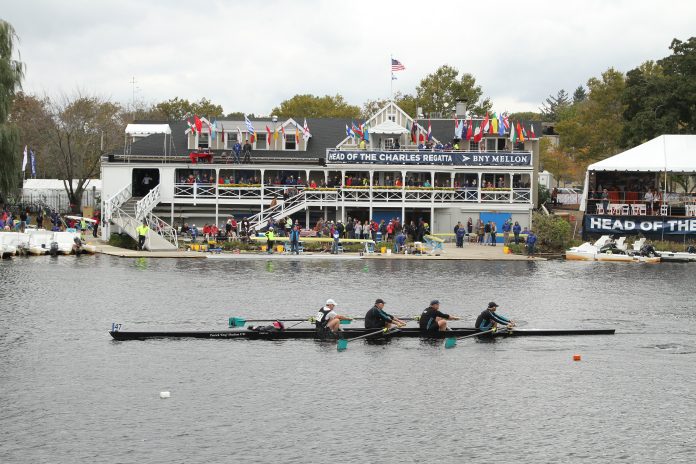
Whitemarsh Boat Club racing at the Head of the Charles. PHOTO: SportGraphics.com


“Your eyesight is like a big crayon box. I lost a lot of the crayons without even noticing because I lost my peripheral vision first. When I found out what I had, it was almost all gone.”

John Curran, who didn’t set foot in a boat or pick up an oar until after a retinitis pigmentosa diagnosis in 2002, not only learned to row with complete vision loss but also became skillful enough to race in a single at one of the premier fall regattas, the Head of the Schuylkill.

Curran’s passion for rowing, his desire to share it with others—especially those with disabilities—and his compassion, selflessness, and generosity have made him a prized and beloved member of the rowing community in Philadelphia.

Retinitis pigmentosa, which afflicted one of Curran’s sisters as well, is a rare genetic condition that affects the retina and can cause blindness. Curran, 68, began experiencing symptoms when he was in his 40s, and his eyesight became progressively worse. He had held various jobs—outpatient billing, a moving company, supermarket night crew—but his failing vision prevented him eventually from working.

He began rowing 20 years ago when, while training to use a cane, he was told about the Pennsylvania Center for Adaptive Sports, which is headquartered on Boathouse Row and is dedicated to improving the health and well-being of people with disabilities through inclusive sport and recreation programs.

Curran was handed an activity list and among such sports as cycling, skiing, and kayaking, he spotted rowing. The first time he rowed on an erg, he was on the machine for only five minutes when a coach noticed his strength and was convinced he was an experienced oarsman.

Curran went out on the water that very same day and received instruction from a coach with the U.S. National Para team. He continues to surprise rowers and coaches with his strength and power.

“I had always been a weightlifter, and I was in pretty good shape,” Curran said, “so I wanted to compete against the best.”

Curran races in a single currently with the assistance of a guide either in a scull next to him or a launch following him. Through a Bluetooth speaker, the guide gives him directions, just as a coxswain would.

Curran is active in the Philadelphia rowing community. At Whitemarsh Boat Club, where he serves on the board, coaches and members alike praise him for his involvement, his efforts to get others passionate about the sport, and his determination on the water.

“He’s done pretty well getting in the single and hammering away at it,” said Whitemarsh coach Sean Hall. “He’s a well-respected member of the club, and people take his opinions quite seriously. His back story is the stuff of Boys in the Boat.”

Curran appreciates the camaraderie and the support he receives from friends and fellow club members, such as rower Ed Fox, who demonstrated his admiration by contacting Rowing News and sharing Curran’s remarkable story.

A major beneficiary of Curran’s involvement at Whitemarsh is the annual Pumpkin Regatta, when junior and masters rowers race in Halloween costumes.

“I met Laura Olah after the Pumpkin Regatta one year,” Curran said, “and she said her son Lev was at the Pennsylvania Center for Adaptive Sports but too young to row. She told me he had a brain tumor and was losing his eyesight.

“I told her if she ever needed anyone to row with him, just look me up and I’ll find somebody.”

When Curran got home, he called the Whitemarsh president and suggested that the club invite the family to the Pumpkin Regatta. He also asked the coach of the high-school program to get the kids together to cheer for him.

“It was like a Hallmark movie,” Curran recalled. “I wanted to make it neat not only for him but also for the parents. I got two different kinds of medals and let him pick.”

“Lev is not on a crew and wouldn’t otherwise compete in this friendly regatta,” Laura Olah said. “However, John cooked up a plan to start the regatta with Lev and another athlete taking on two established rowers in a double.

“Nothing has made Lev so excited. He shared that he would be competing with every teacher, every family member, and even people in line at the grocery. Little did any of us know that John even brought medals for Lev to ‘win’ when they drove across the finish line—first, of course, because John contrived that as well.

“That day is one of the most memorable days for Lev, and it was all created by another person living with a disability knowing how much it matters to give the gift of strength and optimism.”

Lev’s rowing journey is one of many that Curran has helped launch and nurture. He has done so cheerfully despite not only dealing with blindness but also battling leukemia, which was diagnosed in 2016.

Last fall was the first time Curran has been cancer-free in nine years.

“John reached out shortly after the 2024 Pumpkin Regatta,” Laura Olah recalled. “He was checking in on Lev because we were absent [beginning treatment in Boston for Lev’s brain tumor]. This time, John offered to support Lev’s interest in the 2025 BAYADA Regatta.” Sponsored by the home health-care company, it takes place on the Schuylkill and bills itself as the world’s first Para rowing event.

“He sent details and offered to help with networking and anything needed to get Lev more support in the rowing community. John is that person always pushing and pulling to connect rowers, to foster their competitive spirit, and to encourage their determination and will over all odds.

“He’s very open about his own challenges. He repositioned my grief into something more powerful. I was more committed than ever to not allowing medical challenges to overcome Lev’s personal determination—with any sport, and anything in life.”

After Curran’s cancer diagnosis, his doctor cautioned that the disease would make him feel fatigued. When Curran informed him he rows five days a week, the doctor was speechless.

While Curran sometimes must cut back the number of days he makes it down to the boathouse, his leukemia has not kept him from the sport he loves.

“Last summer, I was going through leukemia treatments and rowing one day a week trying to stay somewhat in shape,” Curran said. “When I wasn’t feeling so good, I figured I wasn’t going to be feeling that good anyway, so I might as well try to train. May through August, it was pretty rough. I just went out with some people who didn’t mind if I wasn’t killing it.”

Curran’s last treatment was Sept. 17. Less than two weeks later, on Sept. 29, he participated in the King’s Head Regatta on the upper Schuylkill, racing in a mixed quad. His admonition to his boatmates: “I’m not really in shape, so keep the stroke rate down.”

“John never complains about anything, and it puts things in perspective,” said Whitemarsh coach Art Post. “It’s a constant reminder that the joy of rowing overrides all our little complaints. If he’s cold, he doesn’t say so. If he’s getting splashed a little bit, he’ll joke about it. We have a boat at the club named after him: Strong Curran. In spite of his limitations, he’s a pillar of strength.”

While Curran’s resume in team boats is impressive, more remarkable is his racing in a single at such events as the Head of the Schuylkill and the King’s Head Regatta.

“Being blind and going out to row a single is pretty neat,”  Curran said. “It’s like when you let a bird out to clean the cage and you can’t contain it—that’s me on the water.

“Maybe somebody sees me doing this and is encouraged. I met a girl rowing for Lower Merion, and she told me, ‘I’m rowing two-seat, same as you.’ I talked her into going to the disabled club to learn how to scull.

“Sometimes I feel like an ambassador for disabled people, letting people know we’re no different from anybody else. It’s just getting the opportunity.”

Curran has rowed the Head of the Schuylkill twice, once in a masters single and once in an open recreational single.

“It was storm conditions,” Curran recalled. “The regatta was worried because the next race was an elite race—Mahe Drysdale and those guys. They were afraid the launch guiding me would affect their race. My guide assured them we would be out of the way. I was on the water when they came by. They sounded like race cars.”

Every time Curran races in the single, he’s excited by the challenge. Navigating the Schuylkill, the Twin Bridges, the Girard Avenue Bridge, and Boathouse Row in a single is no easy feat—even for someone with perfect vision.

Racing in a single, Curran has won the BAYADA Regatta six times.

“They told me that I couldn’t do the BAYADA because they banned blind single rowers on the Schuylkill. I was like the dog that gets out of the yard all the time. I talked a couple of other blind rowers into doing it, and the race had to buy more headsets.

“The last year I did it, there were 10 men and 10 women [racing singles],” Curran said. “It became the race to do, and they thanked me for keeping the race alive.”

Curran’s determination and demonstrated ability have not gone unnoticed by coaches, athletes, and regatta directors. After he won permission to race the BAYADA and Head of the Schuylkill, races in and around Philadelphia expanded the Para and blind-rowing categories to allow more entrants.

His latest ambition: to race in a single at the Head of the Charles.

“I was in one of the first groups of disabled rowers to do The Charles in mixed fours,” Curran said. “Now they have a bunch of different races. It’s really come a long way.

“Every time someone says, ‘You can’t do this,’ I try to get it done. At the Charles, where there’s no singles race for blind people, they asked me, ‘Why don’t you row a double like everybody else?’ I don’t want to do what everybody else does.

“It’s been fun, a pretty wild adventure. Somebody offered to write my story, and I said, ‘It’s not done yet.’”

Emily Winslow works in athletic communications at Salve Regina University in Newport, R.I. She captained the women’s rowing team at the University of Rhode Island, where she also coached, when the team won multiple Atlantic 10 championships and advanced to the NCAA DI championships.

CURRENT ISSUE OF THE MAGAZINE

World Rowing Creates Mixed Eight, Nixes Coxed Four and Lightweight Events

From left: Honorary FISA President Denis Oswald, Vice President Tricia Smith, President Jean-Christophe Rolland, and Executive Director Vincent Galliard. PHOTO: Maurice Summers/World Rowing.

Get ready for the mixed eight at the LA2028 Olympics, if the International Olympic Committee approves World Rowing’s latest attempt to reverse the slide in interest and finances of international rowing.

And say goodbye to repechages and the lightweight pairs and quads at senior World Rowing Championships, and coxed fours at U23 and U19 Worlds.

Those changes, plus rewriting its rules to restrict women’s events to those born female and open men’s events to all, emerged from World Rowing’s 2025 Quadrennial Congress in Lausanne, Switzerland, in mid-March.

The mixed-eight event for elite international competition will make its debut at the 2025 World Rowing Championships in September outside Shanghai after test runs at the two World Rowing Cups in Varese, Italy, and Lucerne, Switzerland, both in June. The World Rowing Cups have been reduced from three to two this year because of declining popularity, broadcast support, and sponsorship.

The Quadrennial Congress rewrote Rule 13, regarding eligibility to compete in men’s and women’s events, to read: “World Rowing will maintain two separate sex categories for rowing events: Women, for rowers who are eligible under this Rule to compete in a women’s event, and men, for rowers who are not eligible to compete in a women’s event. This shall be an open category.”

Men’s and women’s lightweight pair and quad events were eliminated from the senior World Rowing Championship program following years of small fields. By the same rationale, coxed fours have been scrapped from U19 and U23 World Rowing Championships, as were men’s and women’s Para PR2 single-scull and PR3 pair events.

Repechage, or “second chance” heats, a unique quirk of international rowing, have also been jettisoned by the Quadrennial Congress. Now, the top two boats from each heat will advance to the next round, with next-fastest times filling out remaining spots in the next rounds.

Previously, crews that failed to advance from heats got a second chance in the repechage, while advancers rested for the next round. World Rowing’s strategic review of a combined 6,867 crews racing in the U19, U23, and senior World Rowing Championships over the past 10 years revealed that 94 percent of the same crews would have advanced under the new system as did with repechages.

World Rowing attributed about half the six-percent difference to “strategic rowing,” and competitors “not putting in full effort in their heats.” No explanation was given for the remaining three percent.

“These changes represent a significant evolution in classic rowing,” said Jean-Christophe Rolland, World Rowing president. “By updating the progression system and introducing a mixed-eight event, we are ensuring that our sport remains relevant and competitive, while also making it more exciting and accessible to fans around the world.”

World Rowing offered no proof that mixed-eight events are more exciting, accessible, relevant, or competitive than men’s and women’s eights. Nor was grassroots or popular demand cited. Currently, no major rowing regatta, from the junior to the international level, features a mixed-eight event.

“Let’s wait until April 9 for the IOC to confirm the program,” said U.S. Olympic boss Josy Verdonkschot, “but I think mixed eights would be a great addition.”

“As for elimination of reps, [it’s] not my preferred solution. But it is what it is. Especially for U19 and U23, it could have undesired effects, since there is no valid seeding for heats.”

Since Vincent Gaillard was appointed executive director three years ago, World Rowing has been open about the organization’s financial challenges and the decline in broadcast, sponsor, spectator, and competitor interest in its regattas, which take place almost exclusively in continental Europe. During the same period, other major regattas around the world—from Australia’s national championships to Henley Royal Regatta to the San Diego Crew Classic—have been attracting record fields.

At the Quadrennial Congress, World Rowing officials projected an operating loss in Swiss francs equal to about $285,000 because of inflation and the rising costs of supporting elite-level rowing (including information technology, doping controls, Para classification) and holding more events (Para, Beach Sprints, indoor erg races). Simultaneously, World Rowing’s traditional revenue sources of sponsorships and broadcast rights have declined. 

New-Look ACC Kicks off 2025 Rowing Season

PHOTO: Courtesy of the ACC.


The recently expanded—and heavily fortified—Atlantic Coast Conference kicks off its 2025 rowing season Saturday and Sunday with four member schools racing at the 13th annual Oak Ridge Cardinal Invitational on Melton Lake, in Oak Ridge, Tenn., March 15-16.

Duke, Louisville, North Carolina, and Duke will race in Oak Ridge.

As part of the rearrangement of college sports conferences, the ACC voted in 2023 to add Stanford, Cal, and SMU—all among the top NCAA Division I women’s rowing programs—effective July 1, 2024, making this spring the first rowing season for the new-look conference.

No. 2 Stanford and No. 8 Cal now represent the ACC in the top 10 of the first Pocock CRCA Coaches Poll. Defending ACC champion Syracuse (No. 10), Virginia (No. 12), Duke (No. 16), and Norte Dame (No. 18) bring the ACC’s top-20 total to six schools. Only the Ivy League, with seven of its eight member schools in the top 25, has more nationally-ranked programs at the start of the season.

Notre Dame and Cal are scheduled to race at the San Diego Crew Classic, March 29-20. The ACC’s Duke, Notre Dame, SMU, and Clemson will race in the Big Ten Invitational in Sarasota, Fla. April 18-19. The ACC Rowing Championship returns to Lake Hartwell in Clemson, South Carolina May 16-17, followed by the NCAA Rowing Championships, May 30 – June 1 on Mercer Lake in New Jersey, for programs that qualify.

CRCA March 11, 2025 Poll: NCAA Divisions I, II, and III

Tufts won its first NCAA Division III National Championship in 2024. Photo courtesy of Tufts Athletics.


The Collegiate Rowing Coaches Association (CRCA) released its first ranking poll of 2025, with defending NCAA national champions Texas and Tufts topping the Division I and III rankings, respectively. Humboldt and Seattle Pacific University tied atop the Division II poll, with 2024 NCAA Division II nation champion Western Washington ranked fourth in the poll.


CRCA March 11, 2025 Coaches Poll


Division I

1 University of Texas 2969
2 Stanford University 2874
3 University of Tennessee 2701
4 Princeton University 2598
5 University of Washington 2592
6 Brown University 2246
7 Yale University 2183
8 University of California, Berkeley 2114
9 University of Michigan 2066
10 Syracuse University 1880
11 University of Pennsylvania 1826
12 University of Virginia 1714
13 The Ohio State University 1509
14 Rutgers University 1471
15 Indiana University 1398
16 Duke University 1152
17 Oregon State University 922
18 University of Notre Dame 677
19 University of Alabama 606
20 Gonzaga University 602
21 Harvard University 482
22 University of Southern California 381
23 Washington State University 342
24 Dartmouth College 304
25 Columbia University 303


Division II

1T Humboldt University 145
1T Seattle Pacific University 145
3 Embry-Riddle Aeronautical University 117
4 Western Washington University 105
5 University of Central Oklahoma 88
6 Thomas Jefferson University 50
7 Rollins College 45
8 Barry University 25


Division III

1 Tufts University 600
2 Wesleyan University 526
3 Williams College 499
4 Trinity College 460
5 Wellesley College 419
6 Bates College 347
7 Ithaca College 331
8 Hamilton College 311
9 Smith College 293
10 U.S. Coast Guard Academy 279
11 Worcester Polytechnic Institute 263
12 Skidmore College 90
13 William Smith College 80
14 Colby College 65
15 University of Rochester 41


Safe, Fair, and Fast


The three attributes we rowers should aspire to as a sport and community are safety, fairness, and speed.

Boat speed wins races. How to achieve that race-winning boat speed is the tricky part, one we spend all year trying to solve. Or, in the case of the pinnacle of boat speed, Olympic rowing, all four years.

For the 2024 Paris Olympics, U.S. head Olympic coach Josy Verdonkschot had less than three years, owing to the Covid-caused delay of the last Games, followed by USRowing’s slow hiring. And yet he was able to lead USRowing’s Olympic efforts back to the pinnacle for one event, the men’s four.

Now he’s got the full four years to plan and prepare for America’s first home Summer Games in more than 20 years, the 2028 Los Angeles Olympics. He spells out how he intends to do so in the 2025-2028 High Performance Plan, which Rowing News covered in the February issue of the print magazine. Spoiler alert: It’s underfunded.

Meanwhile, in Canada—which won six medals at those last summer American Games in 1996—a new leader has been selected from one of the great crews of the glory days, Jeff Powell, stroke of the 2002 and 2003 world-champion men’s eights. Read the entertaining stories of how he came to be the new CEO of Rowing Canada in the Rowing News interview.

Fairness has many manifestations. Boats should start even at the beginning of a race. Coaches should give every member of the program a reasonable shot at making the first boat. But we should recognize also those who don’t have the same opportunities to row that we did, and do something to make access to our great sport more fair.

That’s exactly what the George Pocock Rowing Foundation, Hudson Boat Works, Concept2, and others are doing with the A Most Beautiful Thing Inclusion Fund. Read about their latest good work, and then read about Louisiana’s Xavier University, the latest college to add varsity rowing, partially as a result of that good work..

Safety is the most important attribute of our sport. No one should die rowing. And for the first time known to us, USRowing members achieved a zero-fatality year in 2024. As Rowing News reported, USRowing’s recent emphasis on safety and safe practices coincides with this important accomplishment. Rowing News is proud to serve the rowing community with advice about how to navigate the risks of rowing on cold water from USRowing Director of Safeguarding Tom Rooks, who also served in the United States Coast Guard.

“This progress shows our growing commitment to safety, but it’s up to all of us to maintain that momentum,” Rooks said. “Our sport is only as safe as any rower or coach’s next decision.”

High Aims and High Costs

Ben Davison and Sorin Koszyk won the right to race as the U.S. double in the Paris Olympic Games. PHOTO: Lisa Worthy.


USRowing aims to win at least six medals at the LA Olympics and Paralympics in 2028.

So declares USRowing’s High Performance Plan 2025-2028, in which the national governing body calls for three to four medals— including one gold—in classic flat-water rowing and one medal each in Beach Sprints and Paralympic rowing.

Missing from the 28-page plan is how USRowing will pay for its ambitions, which are projected to result in a deficit for the Olympic quadrennial of $17 million—the target amount for USRowing’s fundraising.

“We’re proud and excited to roll out this high-performance plan for LA2028,” said Amanda Kraus, CEO of USRowing, who called it “a vision for an elite, sustainable program.”

“This roadmap provides a clear path forward for our athletes, coaches, supporters, and fans,” she added.

Unclear is who will execute the plan. Four of the 13 positions in the staff-structure diagram are labeled “TBD,” with a fifth calling for “Independent Contractors.”

Chief High Performance Officer Josy Verdonkschot, the plan’s lead author, remains at the top, with full-time men’s and women’s head coaches Casey Galvanek and Jesse Foglia supported by operations staffers Will Daly and Wendy Wilbur.

The coaches of the West Coast training center and high-performance sculling and coastal rowing will be decided in 2025, and Brett Gorman, the director of High-Performance Pathways, will get a talent coach in 2026, according to the document.

With fewer than a dozen athletes combined training full-time at the Mercer and Sarasota training centers at the end of last year, the U.S. National Team has yet to get started on the road to LA2028, America’s first home Summer Games since Atlanta 1996, when U.S. crews won four medals.

With the elimination of lightweight events and the addition of Beach Sprints, current plans call for 12 traditional flat-water rowing events (now termed “classic” by World Rowing) on the shortened 1,500-meter Long Beach course and three Beach Sprint events at a venue yet to be named.

In March, the international governing bodies of rowing will gather for World Rowing’s 2025 Quadrennial Congress in Lausanne, where more events are expected to be eliminated from the World Rowing Championships and more changes made to the Olympic program.

At the Paris 2024 Games, three countries—The Netherlands, Great Britain, and Romania—won nine of the 14 events. U.S. men did well in big-boat sweep rowing, winning gold in the four and bronze in the eight. But U.S. women and scullers were shut out of the medals for the second consecutive Olympics; at the preceding Tokyo Games, the U.S. failed to win a single medal in any event.

From 2007 through 2016, the U.S. women’s eight won every World Rowing Cup, World Rowing Championship, and Olympics they raced. But since 2019, USRowing hasn’t won gold in a single event of the 29 contested at every regular senior World Rowing Championships. If U.S. rowers can achieve the LA2028 goal of four Olympic medals, they will equal the 1996 Atlanta record, and exceed it by winning gold.

Much of the plan is about continuing to build on the system installed by Verdonkschot leading up to Paris 2024. Larger permanent facilities have been envisioned for years at the training centers in Sarasota and at Mercer Lake in West Windsor, N.J., but construction has yet to begin.

Paralympic rowers train part-time in Boston from existing boathouses, including Community Rowing’s Harry Parker Boathouse under six-year Para head coach Ellen Minzner. The USRowing plan calls Chula Vista “ideal” for a West Coast training center and states that making a final decision and starting work on the new center this year is “a priority.”

Verdonkschot’s program relies heavily on clubs like California Rowing Club to serve as the training homes of athletes when they’re not on trips or at U.S. National Team camps. Three of the four gold medalists from the Paris four trained at CRC, as did most of the bronze-medal eight, which prepared in Seattle under Washington coach Michael Callahan for the last-chance Olympic qualifier in Lucerne two months before the Games.

In the lead-up to Paris, Verdonkschot worked cooperatively and successfully with clubs such as ARION, Craftsbury Green Racing Project, and New York Athletic Club, and the USRowing plan advocates continuing to use this “hybrid structure.”

Much of the unmet cost of the plan comes from athlete stipends, which reached $1 million dollars in 2024. For the LA2028 quadrennial, Verdonkschot’s proposal retains the previous training stipend of $1,000 per month and adds a higher “performance” stipend of $2,500 per month for 2025, which increases to $3,000 in 2026 and $3,500 in 2027 and 2028.

Aligning Olympic and Paralympic stipends, and projecting the same relative number of recipients, the cost of athlete stipends will rise to over $1.5 million dollars in 2027 and 2028, the plan estimates.

“It’s not a fundraising document,” said Verdonkschot. “But you can’t write a plan without considering budget implications. And then just do the math.”

Even with the proposed increased spending for Olympic preparation, USRowing lags behind the support leading Olympic nations Great Britain and The Netherlands provide their Olympic and Paralympic athletes.

Reported figures of $30 million and $5 million for Great Britain’s Olympic and Paralympic rowers, respectively, don’t tell the whole story, since British athletes, like most of Team USA’s competitors, benefit from government health-care funding, as well as existing training centers and lower travel costs to training and racing venues.

Verdonkschot and his fellow coaches are behind their international peers also in compensation. Earlier this century, when the U.S. women were on their historic winning streak and the men’s eight won gold in 2004 in Athens and bronze in 2008 in Beijing, both the women’s head coach, Tom Terhaar, and men’s head coach, Mike Teti, each were paid more than USRowing’s then CEO, Glenn Merry. In 2015, all of the top-five highest-paid non-officer employees of USRowing had coaching roles, and three of the coaches were paid more than the CEO.

That’s been reversed. USRowing’s 2023 tax returns (the most recent available) show that Verdonkschot was paid $227,191 and CEO Amanda Kraus $289,224. Of the other five highest-paid USRowing employees in 2023, none had a coaching role.

USRowing supplemented the grants made by the U.S. Olympic and Paralympic Committee by $300,000 in 2024 and intends to more than double that additional annual support for Olympic hopefuls in the run-up to LA2028, the plan says.

Where that money will come from remains to be seen.

Jeff Powell Opens Up

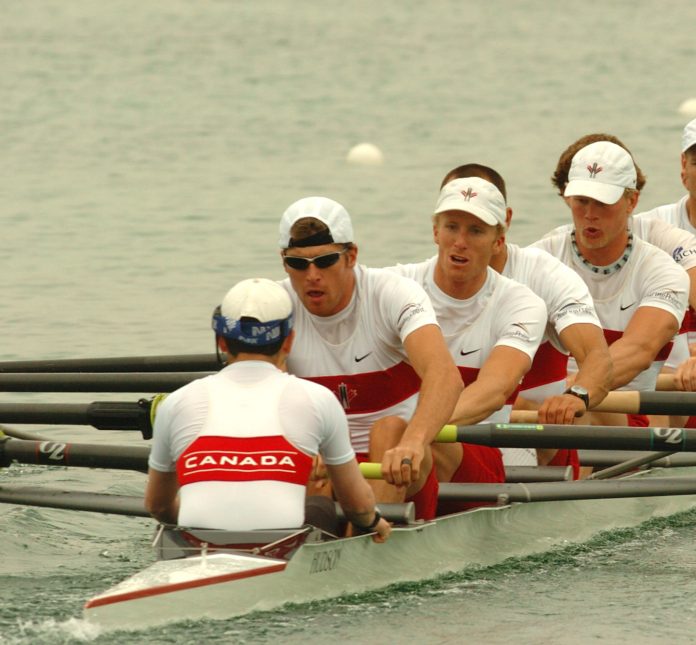
Jeff Powell stroking the Canadian men's eight to victory at the 2004 World Rowing Cup in Munich, when Canada was the two-time defending world champion in the men's eight. Photo: Peter Spurrier, Intersport Images, www.intersport-images.com


Rowing Canada Aviron, the national governing body of the sport, named Olympian and two-time world champion Jeff Powell as the next CEO this winter.

The 48-year-old native and resident of Winnipeg assumes the role this month as the organization casts a rescue net under a once-proud rowing program that won four gold medals at the 1992 Olympics, including in both the men’s and women’s eights, and another six medals at the 1996 Games.

Recently, not so much. Canada failed to qualify a men’s crew for the Paris Olympics and hasn’t raced a men’s eight in the Olympics since 2012. The women’s eight won silver in Paris, and the women’s lightweight double—the only other Canadian crew to qualify—finished eighth. Jacob Wassermann was Canada’s lone Paralympic competitor in Paris.

“Re-establishing Canada in a position where we believe it ought to be is without question a priority of the organization,” Powell said.

“He’s a man of high drive, high standards, and very confident in implementing his ideas,” said Adam Kreek, remembering his teammate of 20 years ago. “He will piss off many people, and this is exactly what the organization needs. He has the hard edge of a high performer and is willing to lean into conflict.”

Powell returns to rowing from the Canadian Sport Centre Manitoba, where he was CEO. He replaces Terry Dillon, who resigned June 30, and succeeds interim CEO Jennifer Fitzpatrick, who will be returning to her role as Director of Partnerships and Sport Development.

Rowing News: How did you get your start in rowing?

I played basketball all through high school and thought I was going to be a university basketball player. Then I went on an exchange program for a year to Japan and I came back and I wasn’t that good at basketball anymore. So I was kicking around looking for a new sport in 1996, the summer of the Atlanta Olympics.

Canada did very well in rowing in those Games, and so I and probably 50 other university-age kids were showing up at the tarmac of the Winnipeg Rowing Club at 5:30 every morning the rest of that fall. It was a great social group, with outstanding parties, and I just kind of stuck with it from there, never intending that it should reach the levels it did.

Rowing News: But it reached the highest level. You stroked the 2002 and 2003 world-champion Canadian men’s eight and competed in the 2004 Olympics. What led you to pursue elite-level rowing?

Well, I got into it. I don’t want to underweight the value of a great social group—it was just a great time and place to be rowing. We had a good coach. We had a good time, and some of the performances began to follow. It just seems like it built on itself pretty naturally.

I had some modest success on the North American circuit—the old Canada Cup that we used to have in Montreal the week after [Canadian] Henley, which was an interprovincial event. I won a few medals there and mistakenly had it in my head that I was therefore qualified to join the national training center.

I went out there, was last at everything for about six months before I got very lucky; I got to spend about three days with Kevin Light, who showed me what was required. Things really took off from there, but it was a little bit the same thing—we had a great group of guys with a great coach all dedicated to the same task and had some success with the results.

Rowing News: Tell us the story about flipping in the single. How did that get to you?

Oh man. I got up to Victoria, I was last at everything, right? Of course, no one’s coaching me and no one’s paying any attention to this guy who can barely keep up. So one day, Terry Paul and Sarah Pape took pity on me and said, “We’ll work with Powell over here.”

So he pulled me over to the side and wanted to fix my catch position. He gets me sitting there. I need to reach a little farther. I need a little longer arms and I’m inching up the slide. He says, “Right, you’re good there. I want you to take a stroke now.”

So I begin to take the stroke, but over the course of all this adjusting and moving, one of my blades has come off the square and I start rowing and it just pulls me right over, and I get partway through this roll and I can remember thinking, “This isn’t good.”

I roll over and I hit the water and it’s March in Victoria, the water is six degrees or something and blasts all the air out of me. I come up for air. I’m sputtering like a drowned rat, gasping, dog-paddle over to his Zodiac coach boat, and he looks at me, deadpan, and he’s like, “That didn’t go very well for you, did it?”

That was the first ever national-team coaching I got.

Rowing News: How do you go from flipping the single to the stroke seat of the best eight in the world?

I can’t tell you how important Kevin was in that journey. He and Joe Stankevicius, who also rowed in that eight, rowed in a pair and they were very good. Joe picked up a minor injury and sat out probably three rows—it wasn’t very long.

Kevin was looking around for a partner, “Well, I guess Powell’s here, I’ll row with him.” He could’ve taken those rows off. If we’d been slow, no one would’ve thought it was him. And I had never imagined that someone could pull as hard as he pulled when we were out there together.

You remember Mike [Spracklen] was all about the competitive work, right? We weren’t just paddling. I still have the journal I was keeping at the time: “I don’t know if I can do that, but it’s probably what I need to try to do if I want to have a go with this.”

Kevin was this model of honest, incredibly hard work, so why don’t I do that? And then I remember thinking, “I can’t do this, but I can probably do it for the first 100 meters of the first piece on Monday morning,” and then the next week I’ll try to lead to the first buoy on Elk Lake. It built from there, but it was a pretty humble beginning, to be sure.

Rowing News: Tell us about your coaching.

I retired [from elite rowing] and felt like I needed to start a real job, you know, suit-and-tie, nine to five. Turns out that some of those can be a touch on the soul-sucking side. I always had dabbled in coaching, and we ended up starting a real small high-performance program here at the club, and I had maybe five athletes in that group, three of whom ended up rowing for Canada in one capacity or another. I was doing that part-time, and eventually my wife said, “Listen, you’re working full-time at this ‘volunteer’ coaching job. You need to make a bit of a call here, buddy.”

There was an assistant-coach position at the training center in London, and I was lucky enough to get in there and had a great quadrennial working with John Keough and Michelle Darville, a brilliant coach who has just come off the success with the Dutch Olympic program [after coaching the Canadian women’s eight to gold in Tokyo].

We ended up taking a development eight over to Europe for a bit of a tour. We rowed the Holland Becker and then we actually beat the German Olympic eight at Henley that year to win the Remenham [Challenge Cup, for top women’s eights].

I know a lot of this is in and around high performance, but I coached best the year after that when I came back to Winnipeg and got a “real job” again and ended up coaching a group of masters, and the lesson I learned was about the efficiency of their coaching.

I’m seeing these guys once or twice a week, and if it took me four sessions to get something across, that’s half the month. That artificial restriction on my time with the athletes was probably the top of my coaching. It was incredibly rewarding for me. It’s not the case that the national-team stuff was the best I ever did.

Rowing News: Why are you taking the CEO job?

There are a couple of factors. Obviously, the organization and the sport have been very, very good to me. It means a great deal to me. It’s near and dear to my heart.

The second is I’ve been in my role here [Canadian Sport Centre Manitoba] for about 10 years now, and it’s probably time both for the organization and for me to look at different opportunities. I’ve moved this organization forward, and it’s for the next person to take it on its journey. And moving into a bigger organization—with a little more scope and different challenges—is a great development opportunity for me professionally.

The final thing is we’re empty nesters. Both of our girls have moved out to pursue their passions, so the time and energy are there to be able to dive in and give all of myself to a cause like this. A lot of things came together.

Rowing News: Are you planning any sort of revival of the rivalry with the USA?

There is certainly no grand plan to force a rivalry, and I don’t want to give the impression that there is. Both eights were great and I relished every bit of it. I am well aware that they got us in the race that mattered in Athens, but another story:

We went over to Henley in 2003 and we raced Mike Teti’s U.S. eight in the final. We put in a big start, got out ahead, and won pretty handily, to be totally honest.

Kreek and I are walking through the boat tent afterward, and Mike walks across and recognizes us. He comes over and sticks out his hand, and says, “You know, boys, just wanna say that was a real shit-kicking out there today.”

So that’s my memory of that rivalry, and it was great. That was a brilliant time for both countries in the big boats, and I would love, love, love to see it again. I know we’ve got our work cut out for us at home, so we’ll start getting our own house in order and move forward and go from there.

Rowing News: What do you want the North American rowing community to know about Rowing Canada and Jeff Powell?

I appreciate that the interest often is in the national-team stuff and high performance in the big competitions. I do have a lens now, particularly through one of my daughters, with more of the club-level coaching, around what it is to drive sport development, growth in sport, and build passionate members of the community.

The most basic unit of sport is the quality and frequency of the interactions with it. Whether it’s for my daughter or in my role as a volunteer club coach right now, whatever it is, in everything I do, I try to operate through the lens of “Does this increase either the frequency or the quality, or both, of the interactions that people are having with rowing?” That is critical to how we build sport systems.

The other piece—and this is a broad philosophical discussion about where we are in the world in 2025–involves how good we are at having difficult conversations. Something we need to be skilled at when we’re talking about achieving the highest performance, when we’re talking about building the kind of organizations and structures we want, is understanding that it means making tough choices and that caring, passionate, well-meaning people will disagree. I really value people around me who are able to have those hard conversations productively.

If I put those two together, that’s the system and organization that I think will have success here.