

To continue reading…
This article is exclusively for Rowing News subscribers. For as little as $5 a month, you can get access to the best quality, independent reporting on all the issues that matter to the North American rowing community.
Defending NCAA Division I national champion Texas faces one of the greatest challenges in all of sport: repeating.
The Longhorns have done it before, successfully defending their 2021 championship in 2022 (and Texas coach Dave O’Neill did it previously, in 2005 and 2006, when he was Cal’s head coach).
And they’ve won three of the last four, with Stanford winning in 2023 and finishing second (twice tied on points) the other three years.
Washington and Cal alternated as NCAA Division I national champions for four years, 2016 to 2019 (2020 was canceled because of Covid), and Ohio State won three straight before that.
On the men’s IRA side of collegiate rowing, Washington faces the same great challenge to repeat as national champions, having broken Cal’s two-year streak last year. Washington won the Covid-limited 2021 IRA after the canceled 2020 regatta. Yale ruled the regatta for three years, from 2017 to 2019. In the past decade, only Cal, Washington, and Yale have finished first or second, until Harvard finished second to Washington in 2024.
Over the past decade, the NCAA and IRA have featured little variation in who wins the championships. It takes great coaching, great recruits, and tremendous institutional support—all working hard and working together—to win the premier events.
Last year, both the IRA and NCAA champions shared something else: schedules that featured racing their closest competitors across the country before the championship regatta. Texas traveled to, and won, the 2024 San Diego Crew Classic and hosted Stanford for the Longhorn Invite before winning the NCAAs. Washington traveled to Sarasota to race, and lose to, Harvard before outdistancing the Crimson to win the IRA.
If that fourth factor—a racing schedule that includes the other best crews—is the key to a national championship in an era dominated by recruiting and institutional support, Tennessee’s Lady Vols might be the NCAA favorites, while Washington is the favorite to win the IRA.
In 2024, Tennessee’s first season under head coach Kim Cupini, Tennessee rowing recorded the best season in program history with a third-place performance at the NCAAs. Now in her second year—and first full calendar year after beginning late last year—Cupini has the most complete top-to-bottom racing schedule in college rowing this spring.
“We love racing and have a hard schedule,” Cupini said. “We’re racers.”
Tennessee will welcome Stanford to Oak Ridge’s Melton Hill Lake, its home course just west of Knoxville, on March 29. The next week, the Lady Vols host the first-ever Rocky Top Invite before heading to Sarasota for the biggest non-championship college regatta, the Big Ten Invitational.
That regatta features 23 NCAA Division I programs: 11 from the Big Ten—Washington, Michigan, Ohio State, Rutgers, Indiana, USC, UCLA, Minnesota, Wisconsin, Michigan State and Iowa—plus 12 guest schools—Tennessee, Brown, Penn, Duke, Oregon State, Alabama, Notre Dame, Harvard, Miami, SMU, Oklahoma and Clemson. The field includes 12 of last year’s top 20 and half of the top 10.
Then Tennessee goes to Princeton to race the Tigers, Ohio State, and Syracuse, before hosting the first annual SEC Championship against Texas, Alabama, and Oklahoma.
Besides racing, the winning edge comes from “the hard work that the women put in,” Cupini said. “Everyone thinks it comes down to resources, but it’s a lot about the coaches, the athletes, and the work. It takes a lot of work; it’s an endless grind.”
“Racing other fast crews helps, no question,” agreed Yale head coach Will Porter. “Ivies is good prep for NCAAs.”
Although the Yale women’s crew has had to deal with several injuries over the winter, “the team is really good as far as people, culture, and vibe,” Porter said. “They operate at a high level, they’re mature. I’m happy with where we are right now.”
The current college athletics environment, in which student-athletes can switch schools annually and take advantage of five, even six years of eligibility at programs that include graduate students, is “super-annoying,” Porter said.
“It’s a bold new world, but it doesn’t change what we do,” he continued. “We do what we do and see where we stack up. We’re good chasing great.”
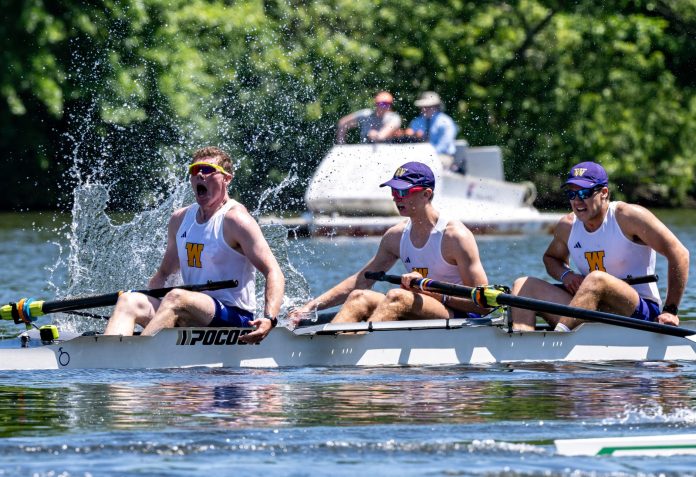
In the heavyweight men’s IRA national-title chase, Washington wades into the 2025 spring season with the Husky Open and Class Day regattas at home before diving into the deep end in Sarasota at the end of March.
On Friday the 28th, the team races Harvard for the re-established Bolles Cup, honoring the legendary Tom Bolles, who attended and coached Washington in the 1920s and ’30s before moving to Harvard in 1936 to coach and serve eventually as athletic director.
The next day, Washington races Yale, Brown, and Northeastern for the Benderson Cup. The Huskies return to the West Coast for duals against Stanford, Oregon State, and bitter rival Cal, before racing the New Zealand National Team for the Windermere Cup at the Opening Day Regatta. The new Mountain Pacific Sports Federation conference championship begins their post-season, which culminates in the IRA National Championship in Camden, New Jersey.
“We hope the rhythm of the spring racing season will set up the students for success at the end of the season,” said UW men’s head coach Michael Callahan.
American Collegiate Rowing Association
With eight of nine members of the 2024 American Collegiate Rowing Association national-champion men’s eight returning for 2025, Notre Dame should be a favorite to repeat as ACRA national champions.
They’re not.
That’s no slight to the club champions from South Bend. No one has repeated as ACRA champions since 2016 (Michigan), and Notre Dame will be trying to do it after its coach, alumnus Quinn Klocke, left for Washington, where he was hired as an assistant coach to work with freshmen (Klocke was a walk-on at Notre Dame).
Notre Dame “took some lumps in the fall,” said new coach Jack Newell, who left Clemson to take the head coaching position. Notre Dame will race a gauntlet of four big regattas—no dual races—this spring, including the ACRA National Championships, May 15 to 18, in Oak Ridge, Tenn.
Club nationals, now larger than the combined NCAA and IRA national-championship regattas (exclusively for varsity programs sponsored by their athletic departments), has become at least as competitive as the NCAA and IRA, if not as fast. That’s because the top ACRA men’s programs, while not funded through their athletic departments, have more full-time coaches and tap into more alumni support than ever before.
“It’s an exciting time to be a coach at the ACRA level,” said Newell.
Like Notre Dame, Virginia, UCLA, Minnesota, Rutgers, Michigan, Orange Coast College, George Washington, Purdue, Bucknell, and others run programs that function like varsities at schools funding men’s and women’s rowing through their athletic departments.
The top ACRA programs are “club in name only,” said Newell, whose crew takes a winter training trip to Lake Lanier in Georgia and a spring training trip to Oak Ridge, Tenn., thanks in large part to Notre Dame alumni support. “We’re extremely grateful to them. They make a lot of things possible.”
Last year’s ACRA men’s favorite, Virginia, coached since 2009 by Frank Biller, could well be this year’s best bet to win.
“It’s super-competitive,” Biller said. “It’s pretty amazing. I don’t want to be anywhere else. The salaries are lower, the budgets are smaller, but down the road beyond my tenure, six-figure salaries will not be the exception.”
The ACRA coaches are “absolutely fierce competitors but all friends,” he said.
“The true spirit of competition is there. We don’t compete in recruiting. We all cook with the same water, the same ingredients. It’s a very level playing field.
“Our number-one goal is make the final. You can’t fuck up; otherwise you’re not in the final. Make the final, and anything can happen.”
Elsewhere in ACRA, Minnesota continues to build program culture and speed under Scott Armstrong, and Michigan remains a perennial favorite with depth and excellence developed by collegiate club rowing pioneer Gregg Hartsuff.
Michigan, Rutgers, Virginia, and Bucknell are scheduled to race March 29 in Pennsylvania on the Susquehanna, a contest that will be a major determinant of rankings before the Southern Intercollegiate Rowing Association regatta, April 18 and 19, in Oak Ridge, which this year will include for the first time the Columbia University lightweights.
On the women’s side, defending champion Vanderbilt returns as a favorite and will have sharpened its racing skills against NCAA Division I program Oklahoma in an April 5 scrimmage in Oklahoma City at OU’s Exchange Boathouse.
“I wouldn’t be surprised if they do it again,” said Bucknell coach Dan Wolleben. “The fall results are amazing.”
In November, the Vanderbilt women won both the collegiate eight and four at the Head of the Hooch, beating plenty of varsity programs.
Vandy rowing is led by head men’s and women’s coach Jon Miller, the 2024 ACRA Women’s Coach of the Year, who is in his 15th season leading the program. Miller began coaching at Vanderbilt in the fall of 2007 and became head coach in January 2009. Under his leadership, the team has won 14 SIRA medals and 10 ACRA medals.
In NCAA Division II, Western Washington seeks to defend its 2024 national championship, as does Tufts University in Division III. Princeton, the IRA women’s lightweight national champion, is favored to repeat, as is the defending men’s lightweight national champion, Harvard.
“To see a winning crew in action is to witness a perfect harmony in which everything is right,” George Pocock once said. At the end of the spring, for each collegiate national champion in each league—IRA, NCAA, and ACRA—everything will be right.
Chip Davis is the founder and publisher of Rowing News. An oarsman from birth, he rowed on championship crews at St. Paul’s School and Dartmouth College, where he captained the lightweights. Now he sculls in Vermont when the weather is suitable and ergs the other half of the year.
