

Get ready for the mixed eight at the LA2028 Olympics, if the International Olympic Committee approves World Rowing’s latest attempt to reverse the slide in interest and finances of international rowing.
To continue reading…
This article is exclusively for Rowing News subscribers. For as little as $5 a month, you can get access to the best quality, independent reporting on all the issues that matter to the North American rowing community.
Already a subscriber? Login
And say goodbye to repechages and the lightweight pairs and quads at senior World Rowing Championships, and coxed fours at U23 and U19 Worlds.
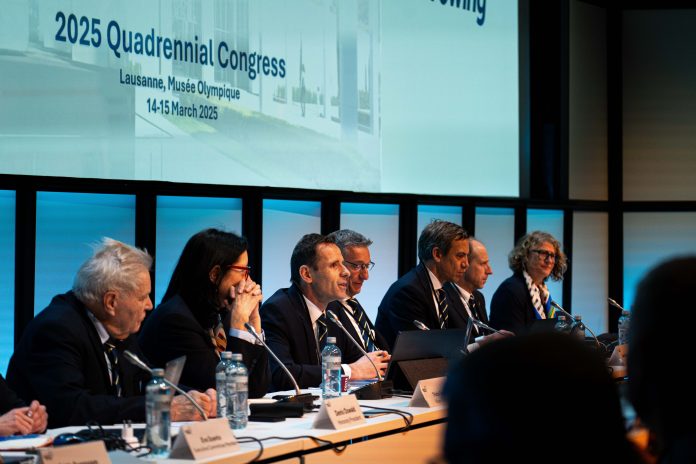
Those changes, plus rewriting its rules to restrict women’s events to those born female and open men’s events to all, emerged from World Rowing’s 2025 Quadrennial Congress in Lausanne, Switzerland, in mid-March.
The mixed-eight event for elite international competition will make its debut at the 2025 World Rowing Championships in September outside Shanghai after test runs at the two World Rowing Cups in Varese, Italy, and Lucerne, Switzerland, both in June. The World Rowing Cups have been reduced from three to two this year because of declining popularity, broadcast support, and sponsorship.
The Quadrennial Congress rewrote Rule 13, regarding eligibility to compete in men’s and women’s events, to read: “World Rowing will maintain two separate sex categories for rowing events: Women, for rowers who are eligible under this Rule to compete in a women’s event, and men, for rowers who are not eligible to compete in a women’s event. This shall be an open category.”
Men’s and women’s lightweight pair and quad events were eliminated from the senior World Rowing Championship program following years of small fields. By the same rationale, coxed fours have been scrapped from U19 and U23 World Rowing Championships, as were men’s and women’s Para PR2 single-scull and PR3 pair events.
Repechage, or “second chance” heats, a unique quirk of international rowing, have also been jettisoned by the Quadrennial Congress. Now, the top two boats from each heat will advance to the next round, with next-fastest times filling out remaining spots in the next rounds.
Previously, crews that failed to advance from heats got a second chance in the repechage, while advancers rested for the next round. World Rowing’s strategic review of a combined 6,867 crews racing in the U19, U23, and senior World Rowing Championships over the past 10 years revealed that 94 percent of the same crews would have advanced under the new system as did with repechages.
World Rowing attributed about half the six-percent difference to “strategic rowing,” and competitors “not putting in full effort in their heats.” No explanation was given for the remaining three percent.
“These changes represent a significant evolution in classic rowing,” said Jean-Christophe Rolland, World Rowing president. “By updating the progression system and introducing a mixed-eight event, we are ensuring that our sport remains relevant and competitive, while also making it more exciting and accessible to fans around the world.”
World Rowing offered no proof that mixed-eight events are more exciting, accessible, relevant, or competitive than men’s and women’s eights. Nor was grassroots or popular demand cited. Currently, no major rowing regatta, from the junior to the international level, features a mixed-eight event.
“Let’s wait until April 9 for the IOC to confirm the program,” said U.S. Olympic boss Josy Verdonkschot, “but I think mixed eights would be a great addition.”
“As for elimination of reps, [it’s] not my preferred solution. But it is what it is. Especially for U19 and U23, it could have undesired effects, since there is no valid seeding for heats.”
Since Vincent Gaillard was appointed executive director three years ago, World Rowing has been open about the organization’s financial challenges and the decline in broadcast, sponsor, spectator, and competitor interest in its regattas, which take place almost exclusively in continental Europe. During the same period, other major regattas around the world—from Australia’s national championships to Henley Royal Regatta to the San Diego Crew Classic—have been attracting record fields.
At the Quadrennial Congress, World Rowing officials projected an operating loss in Swiss francs equal to about $285,000 because of inflation and the rising costs of supporting elite-level rowing (including information technology, doping controls, Para classification) and holding more events (Para, Beach Sprints, indoor erg races). Simultaneously, World Rowing’s traditional revenue sources of sponsorships and broadcast rights have declined.
