Home Blog Page 251

The Talented Yaz Farooq

BY JEN WHITING
PHOTOS COURTESY YAZ FAROOQ, BY PETER SPURRIER

Originally published in the February 2017 issue of Rowing News

This story starts with an MG convertible, a “For Sale” sign, and a decision. You know this kind of decision. It’s the kind that requires everything you have to embark on a path with an uncertain outcome. It’s the kind of decision that stops you, but only for a moment. 

When the moment has passed, you sell your MG, take the $3,000 you got for it, move to Boston, and rent a room in a ramshackle house with five other girls. Every morning and every afternoon of the summer of 1989 your voice crackles through the coxswain’s microphone. After every practice on the Charles River, you stand on the dock of Weld Boathouse, rowers towering over you as the boat is hoisted from the water. You’re 100 pounds and committed. You’re trying to make the national team and your $3,000 is running out. 

“I had an MG convertible,” recalls Yaz Farooq, now the head coach of women’s rowing at the University of Washington. “I sold it because I needed the money to try to make the Olympics.” There isn’t a shred of doubt in her voice as she explains what she did the summer after she graduated from the University of Wisconsin. “As I was trying to make the team, I was so broke I didn’t even have the $25 to pay for my USRowing membership. I said to myself, ‘If I make it [the team], I’ll be able to afford to pay my dues. If not, that’s it. It’ll be over.’”

Farooq made the national team, and coxed the women’s eight from 1989 to 1996, taking sixth in the 1992 Olympics and fourth in Atlanta four years later. Along the way, she coxed the 1995 world champion U.S. eight, the first American women’s eight to win a world title in the 2,000-meter era. I ask her about the culture of women’s rowing in the 1980s and ‘90s, and how it’s changed since then.

“There wasn’t a tradition yet,” she says. “Hartmut [Buschbacher, the U.S. women’s head coach from 1991 to 2000] came in. He’d just coached the German boats to Olympic gold and we all just wanted to win. When Hartmut was hired it was the first time USRowing committed to a full-time coach for the women. He brought a new method of training. We embraced it because we wanted to win. I still use some of his workouts. He went to bat for us, got us better boats, did fundraising. He helped establish the training center for the women.

“I think he’s always been under-appreciated,” she continues. “What is most important is that he established a system whereby college kids had something to aspire to in an organized way. If you were to ask Tom [Terhaar, the women’s coach and an assistant coach under Buschbacher], there are key parts of his training that he took from that time.” Farooq is contemplative, but with a rapid-fire delivery, and she leaves nothing left unsaid, it seems. “When we came up short, we learned lessons that are used to teach athletes today.”

A journalist by training, Farooq was a walk-on coxswain for the University of Wisconsin Badgers. It’s no wonder, then, that after her eight years as the national team coxswain she would receive a call from NBC asking her to do commentary for the 2000 Olympics. “I was a sports intern at a television station in Madison my senior year of college,” she says. “I was always behind the scenes—not on the mic—and after the 1992 Olympics I started doing production at a station in Chattanooga. I moved into station management and sales, and did voiceovers when they needed different people’s voices. I did my time in TV.” 

She keeps explaining, not missing a beat to see if I’ve gotten her Midwestern humor. “When NBC called me, I essentially auditioned for it. That’s why I got into coaching.” I do a quick double-take and she backs up a bit. “I thought I was going to go into TV management. By then, my husband and I were living in Eugene, Oregon, and after the 1996 Olympics we were driving by Dexter Lake and saw some rowing. We pulled over, someone recognized me, and they asked if I’d be interested in coaching their club.”

As Farooq started coaching again, her work with NBC kept her at the elite rowing events. “I studied our sport like hell. I knew I needed to be immersed in it. I went to at least one World Rowing Cup or world championship event every year. I love elite rowing. I’m a student of the sport. That’s why I became a college coach.”

Farooq was named the head women’s coach at Stanford University in 2006. In her time at Stanford, she led her team to the NCAA championships, winning silver in the varsity eight in 2008 and the NCAA team title in 2009. Stanford became a rowing powerhouse, routinely winning on both coasts. She talks about her coaching style, and how it’s changed in the past 10 years.

“The way I coach now is entirely different. It’s a different generation and you’ve got to communicate to the generation you’re coaching. In my generation, we followed a little more blindly,” says Farooq. “First off, most of us walked onto the teams we rowed on in college. There was no recruiting and there weren’t any scholarships back then. When I got to Wisco in 1984, Kris Thorsness and Carie Graves had just won gold at the 1984 Olympics—they were from Wisco. I thought, ‘Oh my gosh, you can learn to row in college and make the Olympics.’ That was kind of how that generation operated.

“Now, as college students, they’re focused on development for the under-23 team, then there’s development for the senior team. It’s just different.” She reaches back for a story to illustrate what she’s explaining. “When I was a sophomore in college, I went to a national team camp. Even though I was ‘development,’ I was working with people who had just won the Olympics.”

Farooq has been incredibly successful as a Division I coach, not only in creating crews that win but in the development of her athletes. In her 10 seasons as the Stanford head coach, 14 of her athletes went on to the under-23 team; two became Olympians. Farooq replays her memory from the 2008 Olympics when Elle Logan, a former Cardinal rower, was in the U.S. women’s eight.

“NBC rules are that you can’t be a cheerleader when you’re calling a race. But after Elle’s race [the U.S. won], they played the national anthem and the emotion caught up with me.” I’m not surprised by this but Farooq explains the significance of it. “At the world championships [in 1995], they didn’t play the national anthems of the winners. So at the 2008 Olympics, in Beijing, when the national anthem started playing, I felt it. To be a part of Elle’s journey—to see her succeed—all the lessons I learned along the way let me contribute, to be a part of her success.” She stops, surprising me.

“In my career as an athlete, winning the world championship was a peak for me. Finishing fourth at the Olympics [in 1996] after all that hard work with that group of women… you could walk away and be crushed or recognize that you’d been on an incredible journey. The people I’ve had the opportunity to race with are amazing. I’ve had my glory.”

There’s a pause, like when the wind carries sound across the lake you’re rowing on, almost caressing your boat as it glides through a still morning. “I love teaching,” Farooq says, breaking the silence. “I love coaching. Teaching athletes how to be great teammates, especially when the championship is built on points from multiple boats.” Farooq segues into her feelings about the NCAA points system, awarding the team title to the team that wins the most races, and places highest on the podium across all of the boats.

“It makes for such a fun team dynamic—top to bottom, everybody playing their part. I love that: bringing a team together. When they think there’s something impossible, if they chip away at it, a little at a time, when they achieve it together it makes it so much more special.”

In the 20 years that rowing has had an NCAA championship (1997 to 2016), only seven schools have won the Division I team title: Washington, Brown, Harvard, California, Stanford, Virginia, and Ohio State. I ask Farooq her thoughts on this statistic, and why breaking into the top tier is so difficult. “All I ever think about is the team I’m coaching,” she says. “What do we have to do to be in the hunt? It’s really important to have depth to win the NCAAs. You’ve got to medal in the V8 to get there. You definitely have to get [the first and second varsity eights] into the grand final. I feel like I’ve been very fortunate. I’ve been exposed to a lot of fantastic coaches and had the opportunity to work with highly-motivated athletes.” 

I ask Farooq about moving from one Division I rowing powerhouse Stanford to another, the University of Washington. “I’m so grateful to everybody at Stanford who helped me develop as a coach. When I went to Stanford my husband asked me, ‘Is this it?’ We had landed in Oregon for 10 years [both were working in television] and loved it. The only other place I would consider was Washington.”

Farooq leads me through what she found when she interviewed with the Huskies. “The support and love of the sport, I saw it at Wisconsin. The team we always had to get through was UW. The history, the legacy, not just “The Boys in the Boat,” but the women, too. They were always first.” I assume Farooq is talking about the results the UW crews created, but I’m wrong.

“UW was the first to give out scholarships. Washington loves rowing more than anything. The program is embraced equally by the university and the city. Jen Cohen, our athletic director, made it very clear that rowing is important to the university, to the school’s identity.”

I ask her if she’s coxed her Husky crews since arriving in Seattle last summer. “I haven’t gotten in the boat with the Dawgs yet, but the day is coming.” She explains, “It really does help me. As a coach you have to develop your eye. I spend a lot of time following the boat from behind, because that was always my angle as a coxswain. Sometimes it just helps me to be in that seat. I can feel what needs to be fixed.”

Farooq still coxes the occasional race, and recommends that any coxswain looking to improve their skills not only cox their high school or college team, but spend some time coxing masters rowers. “I coxed masters for 10 years. I recommend it. Coxing at a masters regatta—when you’re in such demand—makes you learn how to operate on the fly.”

I ask her if she’s coxed crews from her national team days since her departure from the eight. “At the Olympic level you’re flying the fastest jet. You’re a fighter pilot at the highest level. You’re Top Gun. That said, when I get back into a boat with my teammates, we fall right back into it. Not for all the strokes,” she chuckles, “but we can still find that rhythm.”

“Would you jump into the women’s eight if you could?” I ask. “I love coxing,” she answers, “but I have immense respect for the sacrifice it takes to compete at the elite level. It’s the 10,000-hour rule. All of the finesse things that you’ve developed. I look back and say that was the peak of my career. You remember what it felt like to go fast. I’m really grateful I got to do it.” There’s a pause, and I nudge the question toward her again, “Would you get in the eight?”

Farooq’s laughter rises, and I can hear the deep, resonant tone that many coxswains develop in their voice. “I would never ask it. Every practice they have is so valuable. It would be amazing, but I don’t want to waste their time and they don’t want to be hauling this old lady around in their boat!”

Asking Farooq to think about her time with the national team brings us to her time developing rowers. She tells me that when an athlete comes to her saying she wants to try to make it to the next level of rowing after college she encourages them. “I’m always overjoyed when an athlete wants to make a commitment beyond college. If you make it or you don’t, if you take your shot to see how far you can go, that’s the commitment. The road is rough more often than it’s smooth and fast, but I know they’re going to have lessons for the rest of their lives.”

I ask her if it’s the same with athletes who express an interest in coaching. “I think it’s awesome. Thanks to Title IX and the increasing number of women in the sport, you can actually have a career at a university and work with incredible women and men. I get to work with Jen Cohen, our amazing athletic director, Erin O’Connell, the former USRowing president and UW coxswain—and now my sport administrator—and with Michael Callahan [the UW men’s head coach], who is one of the most creative coaches I’ve met and a brilliant guy.”

In every interview, there’s always the last question. I always use the same one. “Is there something I should have asked you that I didn’t?” Usually after I pose this question there’s a pause, a bit of silence, a moment when the person I’m interviewing reflects on their life, their experiences, their approach to the topic we’re discussing. For Yaz Farooq, however, there was no silence. Instead, she laughed out loud. “You’re funny,” she says. “I would always ask that same question.” Farooq harkens back to her days in radio and television. “Sometimes you uncover some really interesting stuff. There are the things you know about a person, and then there are the things you don’t know.”

Three Books, Three Great Coaches

Cambridge; USA; Harvard Coach, Harry PARKER returns after a training session in preperation for the HOCR; Head of the Charles River; Cambridge/Boston; Massachusetts; Mandatory Credit Karon PHILLIPS/Intersport Images]

BY ANDY ANDERSON
PHOTO BY PETER SPURRIER

During the ongoing COVID-19 pandemic, we are all sheltering in place, observing social distancing, and putting in long hours on the erg, right? To maintain our sanity, why not read about rowing? I decided to work my way through a few of the rowing books that have piled up bedside. Thank goodness Amazon still delivers.

Over the years, I’ve had a number of conversations about what is the most important factor in having fast crews. The consensus among people who know is that the most important thing is having good athletes. But what about coaching? In rowing, the coach is the person who puts all the elements together, who gives the athletes the tools they need to go fast. If you want to learn more about how to make boats go faster, you should be studying what successful coaches do. So why not use this period away from the water to learn more about some of the most successful coaches?

First up for me was Hugh Matheson and Christopher Dodd’s More Power: The story of Jürgen Gröbler: The Most Successful Olympic Coach of All Time, a book that has been bedside for the past year. If you read about rowing, you are probably familiar with Mr. Dodd; this is his 10th rowing book. He is a trustee of the River and Rowing Museum and a longtime rowing correspondent for British newspapers as well as this magazine. Matheson was a giant in British rowing circles, winning a silver medal in the eight in the 1976 Olympics. Four years later he rowed the single in the Moscow Olympics.

Jurgen Gröbler cut his teeth in East Germany, where he rose rapidly to be the coach entrusted with the all-important Olympic boats. After the fall of the Berlin Wall, he moved to Great Britain where he became the chief coach of the national team. Matheson and Dodd do not sidestep the issue of East Germany’s reliance on performance enhancing drugs and Gröbler’s part in their use. Gröbler admits that they were used extensively, but he says, “Some things that were going on at that time might not have been correct, but I can look everybody in the eye and not feel guilty.” The authors make a controversial statement when they write, “In the morality of that place and time he did no wrong.” That may well have been true if you were living and working in East Germany, but try telling that to athletes in the West. 

If Gröbler’s career had ended after East Germany, we might question his achievements, but his work in Great Britain, where there have not been any allegations of doping, shows the quality of his coaching. He inherited a GB program that was on the upswing since the mid-seventies. But after taking over as Steve Redgrave’s coach in 1992 and pairing him with Matthew Pinsent, Gröbler pushed the GB team to dominating performances.

He has now coached GB athletes to gold medals in seven consecutive Olympic games. More Power follows Gröbler’s path up to the present; it is a great read if you want to know more about coaching at the highest level. If Gröbler is the most successful contemporary coach, Thor Nilsen, the subject of Christopher Dodd’s latest book Thor Nilsen, Rowing’s Global Coach, is probably the coach who has had the most influence on other high-level coaches.

Full disclosure: In a feature article for this magazine seven years ago called “Game Changers,” I neglected to include Nilsen, an omission that I regret (I didn’t research thoroughly enough). I was quickly brought to task by several of Nilsen’s proteges, among them veteran international coach Kris Korzeniowski.

Although Nilsen had considerable success coaching elite crews, most notably his Norwegian countrymen and Olympic gold medalists the Hansen brothers in the double, it was as a teacher that he has had his greatest impact.

Nilsen is an unselfish teacher, a man who has always shared knowledge about every aspect of rowing with others. First at Banyoles, Spain, and later at Piediluco, Italy, he created what might be thought of as a college for coaches and gave other coaches the tools to be successful. More than any other person, he worked to make coaching education a real thing.

Dodd’s biography makes it clear that without Nilsen, knowledge about coaching rowing would be significantly diminished. And it wasn’t just Nilsen who shared physiological, technical, and training plans with others.

Those who drank from the Nilsen fountain of knowledge emulated him by sharing and spreading the word in their own way. In the United States, Nilsen’s foremost student, Korzeniowski, has worked tirelessly to help coaches learn from each other.

FISA’s development program was largely Nilsen’s creation. Dodd shows us why rowing world owes such a great debt to Thor Nilsen. The third book about an important coach is The Sphinx of the Charles, A Year at Harvard with Harry Parker by Toby Ayer.

I highly recommend this inside look at Parker and a year inside the Harvard boathouse. Ayer does not purport to write a history of Harry’s 51 years of coaching, or his 22 undefeated seasons, or 24 varsity titles at the Eastern Sprints, or 44 victories in the Harvard-Yale Race.

Ayer does not analyze Parker’s coaching; he shows it. Instead of explaining or pondering, this is a “fly on the wall” look at what went on inside Newell boathouse and on the Charles River. Besides presenting us with an account of the 2007-08 season, Ayer lets former Harvard oarsmen talk about what rowing and Harry meant to them.

Their comments are a moving tribute to the man one of his oarsmen called “the best teacher I ever had at Harvard.” Harry Parker has been gone seven years now, but reading this makes it seem like he is still with us. Ayer gets his subject just right.

Decisions, Decisions

Putney Greater London. United Kingdom, CUWBC Bow.Tricia Smith, 2. Imogen Grant, 3.Kelsey Barolak, 4. Thea Zabell, 5. Paula Wesselmann, 6. Alice White, 7. Myriam Goudet-Boukhatmi, Stroke, Olivia Coffey, Cox Sophie Shapter. after passing through, Hammersmith Bridge, Tideway Week, preparation for the 2018 Varsity Boat Race, Putney Hard, Championship Course, Putney to Mortlake. River Thames, Thursday 22/03/2018 [Mandatory Credit: Peter SPURRIER:Intersport Images]

BY RICH DAVIS
PHOTO BY PETER SPURRIER

Strokes are mostly born, not made, so my first concern is identifying the rhythm-setter of the crew. When rowing by sixes early in the season, try putting potential strokes in the lead seat as a way to see who is the most natural in that position. During seat racing, I watch the strokes almost as much as I watch all of the other rowers I am evaluating. After stroke seat, I focus on the size and technical ability of the remaining rowers. Naturally, the largest athletes end up sitting in the engine room. The middle of the boat is often wider than the stern and bow sections, and placing the bigger athletes there minimizes the effects of their movements. I put the lighter and higher-skilled rowers in the bow to keep the boat running straight. Seven seat is a second stroke of sorts and it is crucial that he or she conveys the proper timing to their side of the boat. Races are won or lost depending on who you have sitting in the coxswain’s seat, so choose wisely there. Try to spend as much time with them off the water as you can—talking, coaching, and sizing them up. Finally, I always make sure to tell my rowers that where they sit has no bearing on who would be first to be demoted to a lower boat. I have found that most young rowers mistakenly believe the seat to which they are assigned represents their ranking as athletes. That is simply not the case.

Edward Vincent Winchester 1970 – 2020

BY ED MORAN
PHOTO BY SPORTGRAPHICS

Just a few days ago Rowing News editor Ed Winchester was talking about the impact the loss of the regatta season was having on the rowing community. Listening to him speak, it was clear that he loved the sport and felt the void was hard to fill.

But in the face of the mounting tragedy the world has been enduring since the onset of the COVID crisis, Winchester felt there was one thing he could do; he could train, he could erg, and by rowing on his Concept2 ergometer, he could remain hopeful.

And as a journalist, he could pass that hope along.

Winchester rowed nearly 20K every day and was so buoyed by the simple act of pulling, he fiddled around with the memory capacity of his ergometer over the weekend until he found the dial that recorded every single meter he had rowed on his basement machine – 26 million meters as of Monday morning.

“And that doesn’t count the meters I rowed at the Dartmouth boathouse, or the miles I put in on the river,” he joked during an April 20 morning staff call.

“And that doesn’t count the meters I rowed at the Dartmouth boathouse or the miles I put in on the river,” he joked during an April 20 morning staff call.

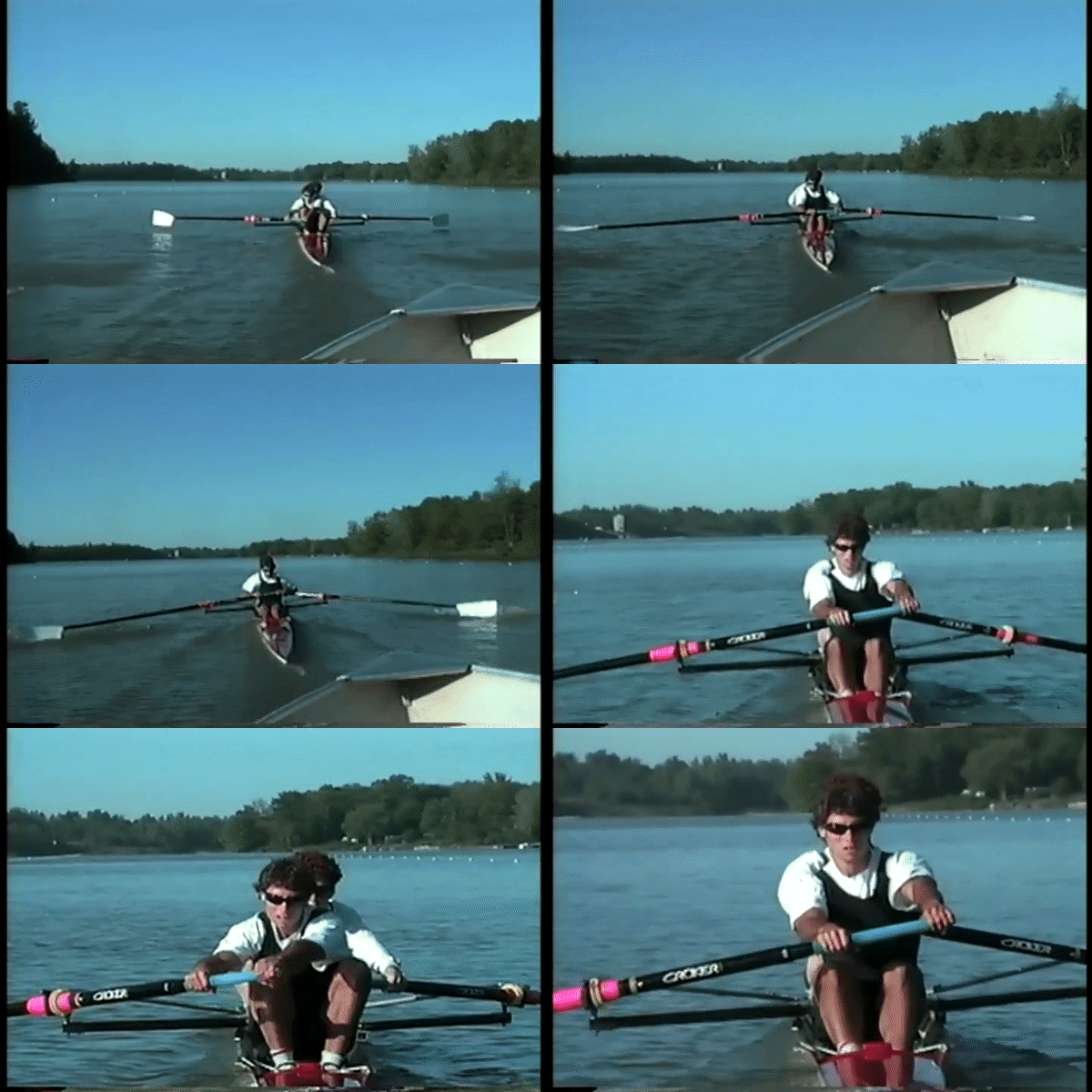
Edward Vincent Winchester loved rowing. He loved the act of rowing, the challenges it brought him, and he made it his life. He won a gold medal in the Canadian men’s lightweight pair in the senior world championship in 2000 in Zagreb, Croatia with Ben Storey, and represented his country as a spare on the men’s team at the Sydney Games that year.

And then he made rowing his career outside of competition as a journalist. He wrote one of his earliest columns for the Globe and Mail in 1999 while on the national team about having to submit a urine sample. He titled it “Giving My All for Sport Canada.” He was so proud of that piece, it hangs in a frame in the bathroom of his Hanover, New Hampshire home.

For the last 20 years, Winchester has written about rowing, covering the athletes and the regattas they rowed in. He wrote for the Canadian Broadcasting Company (CBC) web site while on the 2000 Olympic team, then the Abbotsford Times in British Columbia when he retired from rowing, and then for the Rowing News when it was a newspaper. He was later named editor when the publication became a magazine.

As editor, he helped shape the stories that are published every month, and he made sure his voice – and his love of the sport – was heard. He wrote this for the May issue that is just now being mailed to rowers all over North America:

“Training is an optimistic act. Implicit in every erg workout and weight session is the idea that you can always get better—that who you are today doesn’t have to be who you are tomorrow. This is what drew me and so many others to our sport, and what keeps me coming back year after year.

“This year, of course, is different. The loss of the rowing season is trivial in the grand scheme of what the world is facing. But it was a loss nonetheless, and it raised fundamental questions for the athletes and coaches whose seasons—and in some cases, careers—were cut short. The sudden end to on-water activities was also jarring for those of us who cover the sport. For the first time ever, we were forced to contemplate what rowing would look like without racing. 

“After a month of social distancing and stay-at-home orders, we are starting to find out. Yes, there was some initial disappointment over what could have been this season, but very quickly we summoned our collective optimism and got back to work.”

Ed Winchester, 49, died suddenly this morning of natural causes. He was in his basement in Hanover, on his erg, doing what he has done most mornings.

“We’re all in shock,” said Rowing News publisher Chip Davis. “He died at home doing what he loved. We miss him already and can’t believe it. He was more than a great oarsman and writer, he was a great guy and he brightened the day of everybody he came in contact with.

“He was a funny man, and his humor was a light for the world. He was a world champion oarsmen and a writer of equal caliber and his professionalism in journalism elevated the rowing media and everyone who worked with him,” Davis said.

The Rowing News team in January.

Born in December 1970, in Saint John and raised in Rothesay, New Brunswick, Canada, Winchester began rowing as a junior, and rose through the ranks of Canadian lightweights, racing on five Canadian national teams.

He attended the Ryerson University School of Journalism and began writing about rowing as a career. Working first for the Canadian Broadcasting Company, he wrote columns about his Olympic experience.

Winchester used his voice to share his passion for rowing – and he was always honest about how he felt and his achievements. While in Sydney, Winchester wrote about his Olympic journey and his personal experience.

“I’ll only see the light of (the competition) if there is an injury,” he wrote in one CBC column, and in which he recounted his five-year national team journey.

“Along the way, I’ve been outstanding, solid, mediocre and inconsistent,” he wrote. “Twice, I’ve stunk up the joint. I have two world championship medals and a slew of international appearances in the lightweight fours. But for the Olympics – maybe my only chance to make it on CBC without tape-delay – I’ve been named a spare.”

He was not a spare in the very small world of career rowing journalists, and under his editorship, Winchester has guided Rowing News, and the writers and photographers who work there, with passion, professionalism and always – always – with a love for the sport, its athletes, and the community that he served.

We will miss him.

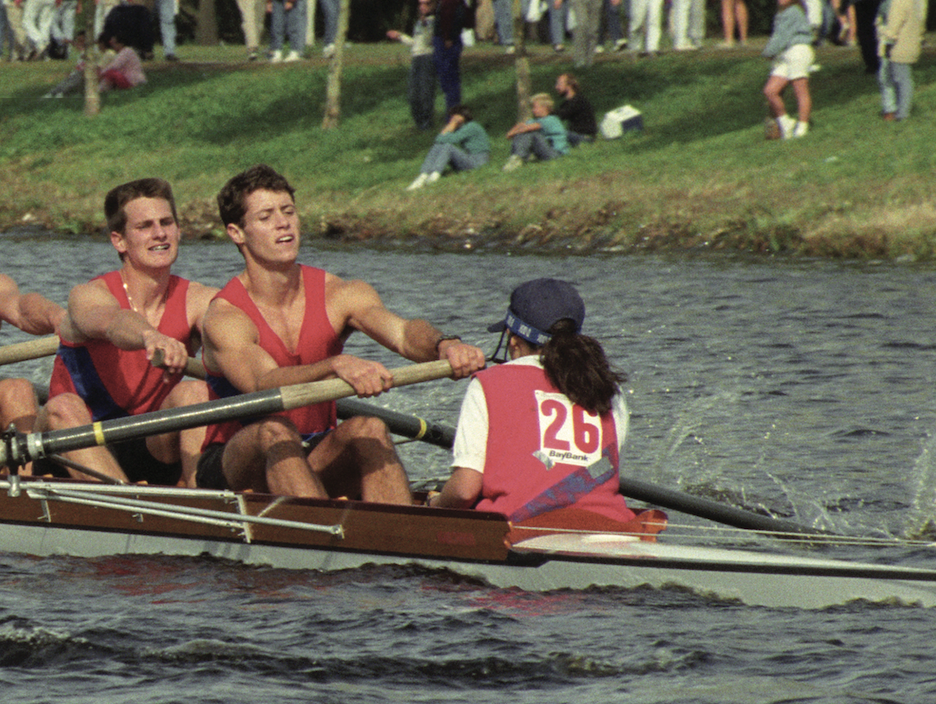
Winchester (stroke) rowing at the 1990 Head of the Charles Regatta.

From the Editor – Rowing’s Inherent Optimism

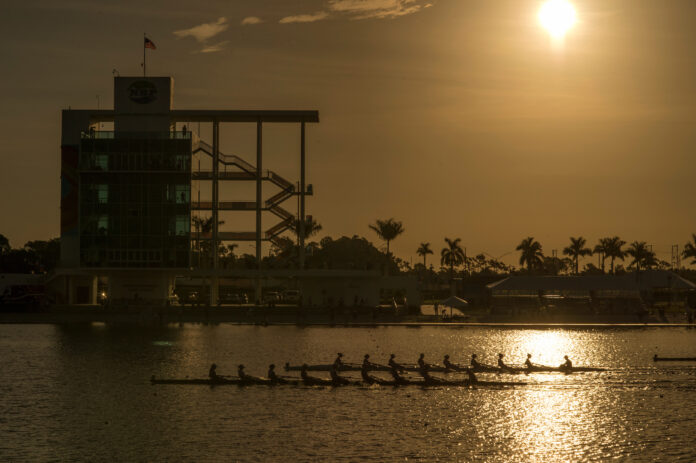
Sarasota, Florida, USA 28th September 2018, Women's Masters Eights, finishing their final, FISA, Masters World Rowing Championships, Nathan Bendersen Park. © Peter SPURRIER,

BY ED WINCHESTER
PHOTO BY PETER SPURRIER

Training is an optimistic act. Implicit in every erg workout and weight session is the idea that you can always get better—that who you are today doesn’t have to be who you are tomorrow. This is what drew me and so many others to our sport, and what keeps me coming back year after year.

This year, of course, is different. The loss of the rowing season is trivial in the grand scheme of what the world is facing. But it was a loss nonetheless, and it raised fundamental questions for the athletes and coaches whose seasons—and in some cases, careers—were cut short. The sudden end to on-water activities was also jarring for those of us who cover the sport. For the first time ever, we were forced to contemplate what rowing would look like without racing. 

After a month of social distancing and stay-at-home orders, we are starting to find out. Yes, there was some initial disappointment over what could have been this season, but very quickly we summoned our collective optimism and got back to work.

The loss of the rowing season is trivial in the grand scheme of what the world is facing.

– Ed Winchester

And work we did. Across the globe, virtual teams logged very real miles. Tokyo-bound athletes streamed backyard workouts. And on every permutation of the erg—static, dynamic, ski—indoor records continued to fall.

All of which means very little next to human tragedy that continues to unfold in communities around the world—ours included. Health worries persist, as do the strain and uncertainty that businesses and organizations across our sport continue to face.

More uncertainty surely lies ahead. But if I’m certain of one thing, it’s that we’ll keep moving forward, one optimistic stroke at a time. 

-Ed

Masters Regional Championships in June Cancelled, USRowing National Championships Still Scheduled

STAFF REPORTS
PHOTO BY SPORTGRAPHICS

The USRowing Northwest Masters Regional Championships and the USRowing Southeast Masters Regional Championships scheduled for the weekend of June 26-28, 2020 have been canceled.

The cancellation of the events leaves the 2020 USRowing National Championship as the only USRowing event still scheduled to take place this summer.

The current status of the 2020 USRowing Masters National Championship scheduled for August 13-16 is unknown. The event was originally planned to take place in Oakland, California, but USRowing announced Visit Oakland, Lake Merritt and the city of Oakland would not be able to host the event as planned.

According to a release published midday by USRowing, “USRowing is hopeful that our summer racing season can move forward. Currently, the USRowing National Championships scheduled for July 14-19 on the Cooper River in Camden County, N.J., is slated to take place as planned, and we are looking at options for the USRowing Masters National Championships later in the summer.”

Going Long for a Cause

Racing at the 2020 C.R.A.S.H.-B's is underway. Photos by Lisa Worthy.

BY CONNOR WALTERS
PHOTO BY LISA WORTHY

How fast can a team complete 100,000 meters? How much money can they raise in the process for pediatric brain cancer research? The annual Connor’s Erg Challenge in February brought a dozen teams together—virtually—in a contest held in memory of Robert “Connor” Dawes, a Wisconsin-born, Australia-raised rower who died in 2013 at 18 years old.

“Usually our training is for furthering our own interests, trying to get better as a team—but this combines that with a philanthropic aspect so it’s really nice,” University of Wisconsin senior Even Miller told WMTV. The university is where Dawes had hoped to attend for rowing, and the Badgers have been participants in the competition since it began in 2016.

The erg challenge simply requires teams to complete 100,000 meters on the erg, using whatever switches and relays they choose. It initially began as a virtual race between the University of Wisconsin, where Dawes’ parents had gone to college, and Stanford University. The coaches of the programs connected with Dawes’s parents in the months after his passing, and the idea for the erg race was born.

With 12 participating programs between the United States and Australia, this year’s contest was the largest in its five years of existence. Domestic competitors included the founding schools, plus Colgate, Duke, Princeton, Syracuse, Virginia, Marist, and MIT. Together, they raised more than $72,000.

“Each rower ended up doing at least 11 500s and a few 250s. The coaches, coxswains, our faculty liaison, and one of the assistant athletic directors jumped on to contribute meters to the challenge. It was a grueling workout, but at least it was fun,” Colgate head coach Khaled Sanad said.

Wisconsin proudly earned the title of top fundraiser, collecting more than $10,000 toward the cause. However, Marist was fastest to complete the virtual race, becoming the first team to eclipse the five-hour mark, finishing in four hours and 57 minutes.

Since 2013, the Robert Connor Dawes Foundation has raised more than $6.4 million to support research that seeks a cure for childhood brain cancer, the most fatal of all pediatric cancers.

All In

BY JEN WHITING
IMAGE BY ADAM REIST

It’s March and your son is rowing at Harvard University as a lightweight under coach Charley Butt. As part of the Harvard parents weekend festivities, you’re invited to ride along in the coach’s launch. Now, the quiz portion of this scenario: What do you wear?

For Leslie Pfeil (pronounced “file”), the president of the Philadelphia Scholastic Rowing Association (PSRA), this was a question she knew the answer to. “There we were, the parents of the lightweight rowers, and Charley Butt, the Harvard coach, offers to take us along in the launch to watch the practice. Most parents showed up in heels and a skirt.” Pfeil pauses and her voice grows perfectly proud. “I was in a survival suit. I knew.” Pfeil smiles, the years she had spent volunteering at regattas on the Schuylkill River serving her well. “Charley looked at me and said, ‘Here. Sit next to me.’ I think he could tell I’d been in a launch before.”

Pfeil started her career in rowing without touching an oar. She, like so many parents who watch their child get drawn into a sport that has few boundaries, knew that she wanted to be a part of this beast of a sport that her daughter was drawn to. “I was trained as a journalist, had worked for newspapers for many years, and then was the communications director at the Baldwin School. When my daughter went out for crew as a freshman, I went to my first regatta. I laugh about this now, but I remember being surprised by how big it was. I was used to going to middle school field hockey games.” Pfeil now runs the organization that puts on a spring regatta series in one of the most storied rowing cities in America: Philadelphia. 

The Philadelphia Scholastic Rowing Association is an 80-member organization whose programs compete in the Flick Series each spring. The Flick regattas take place over five weekends in March and April, when the Schuylkill River is populated with high school rowers from the 80 member schools, as well as rowers from smaller clubs and guest schools that may not be members. The series is followed by a sixth regatta, the City Championships, which is limited to the member schools. All six regattas are volunteer-run, bare bones affairs. “The first Flick is pretty early in March so there may only be 800 or 900 kids,” Pfeil explains. “By the second regatta, we’re at 1,300 and by the third regatta there’ll be over 2,000 rowers. The fourth and fifth regattas in the series will host over 3,000 rowers, and then the City Championship event levels off back at 2,500 participants.” All told, the regattas hosted by PSRA will see upwards of 12,000 entries racing the 1,500-meter course.

“My ‘aha’ moment happened in a launch.” Pfeil, now a full-time volunteer with PSRA, explains why she is motivated to spend her time running a regatta series for high school rowers. “From shore, I used to watch the events and say, ‘Oh, isn’t that lovely.’ But then, the first time I got into a launch and watched it up close, I saw how hard the kids are working and I really wanted to support it. Not just at Baldwin, where I was working and where my daughter was rowing, but in general, because for many of these kids, rowing really does change their lives.

“Rowing helps kids understand the value of hard work. Hard work doesn’t guarantee success, but you can’t have success without it. I watched as my daughter’s team helped her develop this mentality. And the camaraderie, there’s something special about that.” Pfeil slows down a bit as I scribble in my notebook to keep up. “Most high school teams don’t cut people so the athletes can get that experience. I hear so often from kids who have come back and greeted me long after they’ve graduated to tell me that their fondest memories are of being on the crew team. I think rowing also teaches humility. You have to depend on each other. You have to all be together. You learn a combination of humility and accountability—important lessons, especially today.”

Pfeil’s path to the position as the president of PSRA, the organization that runs what might be the largest scholastic regatta series in the world, began when she started volunteering in the late 1990s at events run by the Schuylkill Navy. “In 1996, I volunteered at the Stotesbury Regatta and then I learned how to manage a finish line in 1997. And that’s how so many of our volunteers get started. They’re parents who want to be involved, and they volunteer during the regatta their kids are in. And then, hopefully, they stick around. Without our volunteers, we simply couldn’t do this.

“PSRA has roughly 80 teams as member schools. Some schools have just a few kids. But during the Flicks, we also have what we call orphans, kids who go to an unaffiliated school that doesn’t yet have a team. They can row alongside the other crews just by paying dues. The Flicks are like scrimmages—floating starts, no medals. We try to run them fast and cheap. We attract kids from areas that don’t have a lot of rowing. Of our 80 members, about 10 of them have tiny teams [of] just a few rowers. And since we allow non-affiliated rowers to race, sometimes it’s just Mom or Dad with a single on top of their car. We try to support them because so often these folks don’t have another outlet for their kid’s rowing. 

“Some people ask us why we bother, why not just limit the scrimmages to the member schools.” Pfeil speaks quickly, as if she’s running a board meeting and knows her volunteers have families and dinners to get home to. “It’s all about getting kids to row,” she says, simply. “It’s important to promote that. Sometimes teams start with just two kids. They grow. It’s all about the kids having the opportunities. It’s easier to walk on to a high school team than a college team.” Pfeil, a mother of two rowers who rowed in high school and also in college, is passionate about scholastic rowing, likely because she witnessed her own children blossom as rowers and then, after college, as coaches themselves. “If you’re talking about spreading the word and getting people into rowing, high school is the best place.”

With such a large membership base, the competition is fierce. The Flick scrimmages turn into events that often form the bulk of a team’s season, allowing many of the local schools to compete on a regular basis without the cost of overnight travel. “When we moved to a two-day event for our City Championships to ensure we could get all the races in, that was tough on the schools that have to travel from a distance because it incurred the cost of an overnight stay,” Pfeil explains.

I ask Pfeil about the work the PSRA does outside of the Flick series, and her role in it as president. “PSRA allows our member schools to have a voice, to be heard at the national level, when it comes to scholastic rowing. One thing this job [as president of PSRA] has evolved into is being an advocate for high school rowing. I really want to be supportive of high school coaches.” Pfeil lets out a knowing exhale, “Most high school coaches have a full-time job and a family. It’s really a calling for them to do this. We try to be supportive, to advocate for them and their athletes. An organization like PSRA is able to have a voice because we represent so many schools.”

Pfeil’s background as a journalist and communications director positions her well as a coordinator of the PSRA member schools. “When I first got involved with PSRA, we were working to strengthen our relationship with USRowing. We try to keep our members informed of upcoming changes from USRowing and also to give them a chance to have a voice in the conversation. I think they appreciate that.” 

Pfeil became a member of the PSRA board in 2005. “I was asked to be on the board as secretary, or something.” Pfeil chuckles in a way that would be understood by those who have volunteered before; sometimes you wear so many hats, you forget a few of them. “When the president stepped down in 2011, I was elected president.” I ask Pfeil about her experience in what was once an all-male environment—the old days of Boathouse Row. 

“When I became president…” she slows here, looking for the right words. “In Philly there are a lot of people who have a legacy. John Kieffer, the vice president at the time, and Paul Horvat, the president and now commodore of the Schuylkill Navy, talked me into it. I asked them, ‘Will people accept me?’ I didn’t have a rowing background, my family wasn’t a part of the history of Boathouse Row. I wanted to make sure people would accept that. John and Paul assured me I would be more than welcome, and they were right. People have been very supportive. Clete Graham—the person who really got me involved in volunteering in the first place—is a very inclusive person. I always say that I blame Clete for my becoming president. 

“I was the first woman to be president of the PSRA—this is still a very male-dominated sport—but they wanted me to take the job. I was hesitant at first, which is kind of funny because I’d been involved for so long before becoming president. But everyone has always been respectful.”

Pfeil has been president of the PSRA for nearly 10 years. “My real legacy,” she says, with the ease of someone who understands the inner workings of a volunteer organization, “is that I worked to improve the operations and the governance.” She smiles, “Anyone who knows me knows that I value a good set of bylaws. Becoming a 501c3 and establishing strong bylaws is important for the future of the PSRA. It isn’t flashy, but a lot of times with volunteer organizations, those things are missed. We file tax returns, we do financial management. It’s very boring stuff but it’s critical for the future.”

While Pfeil was working to solidify the Flick series’ future by ensuring the “boring stuff” was covered, she valued the work of Dotty Brown, the author of Boathouse Row, who wrote about the history of the Flicks. “Dotty researched the history, establishing that the series started in the mid-1950s, with five or six of the Philly schools.” At that time, only the private schools were racing on Boathouse Row and the series, dubbed the Flick Horvat series [named after two founders], made it possible for other schools to begin scrimmaging against each other. The spring season then culminated in the City Championship, exactly as it does today.

“They didn’t keep records that we can find. I wish I could find the exact year it all started, so we could have an anniversary celebration.” Pfeil lets out another laugh, deeper this time. “I can’t even get it out of the men… they always just say, ‘Back in the day…’ And until the 1970s it was all boys. The girls started in the ‘70s.”

Pfeil has witnessed firsthand the evolution of Boathouse Row and Philadelphia scholastic rowing. She has seen the change in the number of athletes, the way the rowing population is now represented by a growing number of schools, and by both girls and boys. She’s seen what was once an all-male network embrace a woman at the helm of the organization that is at the heart of scholastic rowing, not just in Philadelphia but at the national level, too. 

And now, as she looks toward the future, she knows her next job as president is to find her successor. “I’m looking for a successor,” she says, without flinching. “Not that I don’t like doing this, but we need to find a new president. We need to keep going, to keep pushing forward. The challenges are nearly always financial—permits, ambulances, porta-potties, police, shuttle buses—every year the cost of those things go up and we try to keep the entry costs down. We’re no frills for a reason, and we don’t have sponsors.” She catches herself here. “Not that we wouldn’t take one, we just need a volunteer to manage that relationship.”

Pfeil stops and I can feel how passionate she is about the organization and what it does for scholastic rowing. “We are grassroots rowing,” she says, as slowly as she’s said anything all day. “It’s just rowing, just racing. Nothing fancy.”

Pfeil tells me, again, how important the “metropolis” of volunteers that run the Flicks are. She explains that the volunteers are led by an organizing committee comprised of people who wanted to do more than simply volunteer on race days. “These people meet on a regular basis throughout the year, each person managing their area of expertise. They are essential to the regattas. Dockmasters, finish line managers, transportation, the list goes on and on.” In the lightest voice I’ve heard from Pfeil, she quips, “This is going to be on my tombstone: To run a regatta, it doesn’t take a village, it takes a metropolis.” As Pfeil and the PSRA board begin looking for the next president, maybe they should label the position differently, to attract people with the skills that Pfeil has demonstrated in her tenure. Perhaps, instead of looking for the next president, they should be looking for the next mayor of scholastic rowing. 

“It truly is a metropolis of volunteers that makes the Flicks happen. I was behind the scenes for so many years, but since being president, I’ve learned a lot about managing people.” Pfeil pauses, then speaks earnestly. “It’s so important to listen. You’ll hear a good idea from the person it is most important to. I can’t just live in my own world. I need to let the people I’m leading have a voice.”

Pfeil is always at work, always thinking of the upcoming events. Since it’s spring, I can feel a sense of urgency in her voice. “You know what this is really about?” she asks me, returning to her journalistic roots. “In my background I didn’t have competitive sports. In high school, I was a ballerina and a baton twirler. When I saw rowing, I fell in love with what the sport did for kids. I love the Boathouse Row community. We are folks of all ages and we come from different walks of life.” 

“I always hear parents say that they miss the days they spent on the river when their kids were rowing. I tell them they can still have those days. Come on down to the river. We can’t exist without people who love volunteering for rowing. PSRA… the Flicks… they wouldn’t happen without our volunteers.”