Home Blog Page 231

2021 Henley Royal Regatta Postponed

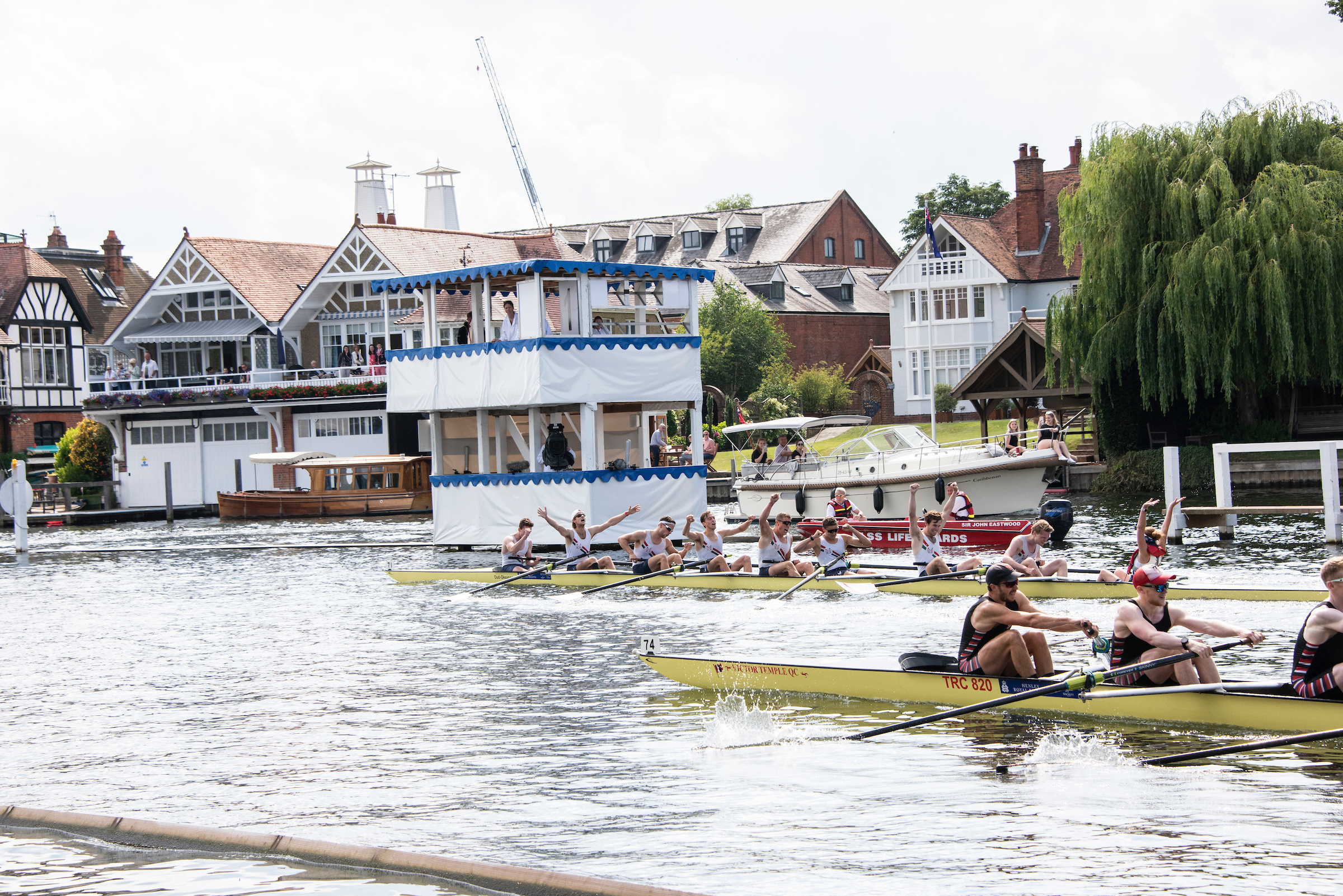
Henley on Thames, England, United Kingdom, 7th July 2019, Henley Royal Regatta, Finals Day, The Thames Challenge Cup, Roeivereeniging Studenten Vreie Universiteit Okeanos, Netherlands, start their celebratings after crossing the line ahead of Thames Rowing Club A, Henley Reach, [© Peter SPURRIER/Intersport Image] 16:07:09 1919 - 2019, Royal Henley Peace Regatta Centenary,

STAFF REPORTS
PHOTO BY PETER SPURRIER

The 2021 Henley Royal Regatta has been postponed.

In a positive turn of events, the Committee of Management of Henley Royal Regatta is looking for alternatives to canceling the event and is instead planning contingencies of running the regatta in August and, potentially, at a different location.

“As a result of the ongoing impact of the COVID-19 pandemic, the Committee of Management of Henley Royal Regatta has reluctantly concluded that the 2021 Regatta cannot now be held from 29 June to 4 July at Henley-on-Thames as originally planned,” according to an update on the regatta’s website.

“However, the Committee has decided against outright cancellation at this stage, and is instead exploring the potential to stage the Regatta in August, in Henley should conditions allow, or if not, at Dorney Lake.”

IRA Votes to Add Division III Championship

BY ED MORAN
PHOTO BY ADAM REIST

Even as the Intercollegiate Rowing Association works to determine if it can hold a championship regatta this spring, the association’s leadership has approved the addition of a Division III championship beginning in 2022.

According to IRA Commissioner Gary Caldwell, the IRA stewards voted unanimously Thursday, Feb. 10, to approve a preliminary plan to include the new DIII championship, and will finalize the details of qualification, and structure of the event, at the association’s summer meeting this August.

Caldwell said there have been talks to include a DIII championship since the IRA moved to exclude club programs and restructure the regatta in 2009, but without enough member programs able to compete beyond their regular seasons, the addition was not feasible.

That changed in 2015 when the New England Small College Athletic Conference (NESCAC) voted to remove a ban on post-season competition and provide for championship racing for both the men’s and women’s crews in the conference. Following the change, DIII membership in the IRA increased from 5 to 12 schools, making the addition of a new championship event possible.

“I’m really excited for this for two reasons,” Caldwell said. “From the IRA’s perspective, I think it’s an opportunity to be responsive to the needs and wants of a portion of our membership constituency, and an opportunity to add to the DIII membership and become a more robust advocate for DIII inclusion in the regatta.

“And, as an ex DIII program director and coach (Tufts University), I think it’s terrific, and long overdue, that DIII men’s programs have the same kind of access to post-season competition that the women’s programs do.”

According to Caldwell, the discussions within the IRA leadership to possibly add the new championship ramped up after the NESCAC schools voted to allow post-season competition, and some of those programs reached out to the IRA about the possibility of including the DIII championship.

Planning for the addition was moving forward in 2019, but was scuttled by the Covid pandemic. “We were making plans for possibly adding it into the 2021 regatta but then Covid hit and wheels came off,” Caldwell said.

Last fall, planning began again and Caldwell contacted DIII programs that were not yet IRA members to gauge their interest in participation. According to Caldwell, nine additional schools indicated they were interested.

“The response has been overwhelmingly positive.”

Preliminary plans for the new event include setting selection and qualification guidelines and establishing the initial structure for the 2022 regatta, which will limit entries to six schools and require a minimum of six programs participating.

Should the event become popular, the number of entries will be expanded over the following three championships. Historically, a small number of DIII programs have “played up,” as Eastern Association of Rowing Colleges (EARC) member schools, or competed primarily against Division I opponents.

According to Caldwell, those schools will have to decide if they want to compete as DIII schools or continue competing on the DI level by the 2021-2022 academic year.

Caldwell said that while it is still unknown if the 2021 IRA Championship can take place because of the ongoing pandemic, the new event will be added to the 2022 regatta.

“There will be a DIII event in 2022, the only thing that will happen in August will be to finalize the details for how folks will qualify for the event and the actual structure of the event. But I doubt that there will be any significant changes from what we have already planned,” Caldwell said.  “I think regardless of what happens this spring, it is important that we start out the next academic year fresh with the hopes that by 2022 we will be dealing with a set of circumstances that are more normal, and what we’re used to,” he said. “Certainly, that is everybody’s goal at the state, local and federal level.”

2021 San Diego Crew Classic to be Conducted Virtually, Remotely

STAFF REPORTS
PHOTO BY LUKE REYNOLDS

The San Diego Crew Classic will not be formally held in-person on Mission Bay this year.

The 2021 event will be conducted virtually and remotely offering participants the opportunity to row on the water with GPS time submission or to participate by rowing on the erg.

For a full list of events and rules click here.

The Hopes and Questions for the Season Ahead

BY ED MORAN
PHOTO BY SPORTGRAPHICS

For most of the last few months, Boston University women’s head coach and Collegiate Rowing Coaches Association president Madeline Davis has spent her time running practices on the Charles River and participating on Zoom calls in her office.

On the water, Davis was encouraged by the resilience of her team and the way they embraced their school’s Covid-19 protocols–the twice-weekly testing, socially distanced workouts while masked–and especially the way they embraced learning to row in singles.  

“I was pleasantly surprised by what we were able to accomplish this fall as a team and as a university,” Davis said. “We practiced most of the fall. The kids stayed healthy. We had a bunch of kids banging around in singles with no idea what they were doing, but they learned.”

Her experience left her closing the year with hope and rising certainty that there will be rowing in the spring. And she knows from her position as head of the CRCA that coaches across the country are working hard to find a way to get their teams on the water and in competition.

But Davis also knows from the endless Zoom meetings that there are more questions about what the 2021 spring season will look like than answers. Nor can she be sure that her gut sense that there will be rowing of some kind this spring won’t be scuttled ultimately by the continuing spikes in infections and hospitalizations this winter.

Every decision will depend on the course of the virus and the battle to control it, how each region of the country handles it, what restrictions are enforced on travel and social gatherings, and whether schools will open campuses and bring back students.

But there is real reason to believe that by late spring there will be racing, and maybe even before.

There is certainly hope.

With vaccines being distributed and therapies to treat the sick and reduce the severity of the illness coming with each passing month, and because professional sports and big-revenue collegiate teams demonstrated there are ways to compete by testing and eliminating spectators, race plans are being made.

The biggest decisions–the ones that will determine whether there will be conference and regional championships, an NCAA and IRA championship, a youth racing series, and a youth national championship–are still unanswered and will be made in the coming weeks.

But, in the meantime, coaches and administrators across the country are forging ahead, setting dates, making plans, and staying as upbeat as possible.

“From the conversations I’ve had, I feel more optimistic than ever before,” University of Washington women’s head coach Yaz Farooq said in December, before joining a online meeting to begin planning the May Windermere Cup and the 50th anniversary of opening day.

As for an Olympics and the summer international and domestic trials season, athletes from the Oakland and Princeton national-team training centers, both men and  women, are at the Elite Athlete Training Center in Chula Vista, Calif,, operating within a safe bubble and being  tested regularly while preparing for the postponed 2021 Tokyo Olympics.

Matt Imes, director of high performance for the U.S. national team, is confident the Games will take place. 

“The IOC is highly confident. Japan is highly confident. They’ve got multiple layers of multiple variations of what the Games could, and will, look like.” 

“Even if they have to ban all spectators, they’ve got multiple levels they would go to before they take the Games down. They’ve been living with Covid for nine months now and they feel they could bring in athletes, test them, quarantine them for five or six days, and have the Games.

“I’m not saying it’s best for swifter, higher, stronger, but I think they feel they can do it. So I feel highly confident, well above 90 percent, that it’s going to happen.”

In the year ahead, the level and type of racing will be different and evolving each month. Based on interviews with coaches and league administrators, here’s a look at what emerging from Covid-19 and the rowing season might resemble and what realities will guide decisions.

The Collegiate Outlook

From the beginning of the pandemic, university coaches and administrators across the country have been sharing information, trying to plan contingencies, and even scheduling racing.

There are no announced plans for regional and national spring championships yet. Some schools have already decided how their spring semesters will unfold, and what percentage of undergraduates will return to campus. Some have not.

Harvard University, for example, will be inviting only the senior class back to campus. For schools that have invited the entire student body back, such as Princeton University, classes and lectures will still be conducted remotely. At many schools, some student athletes are choosing not to return to preserve a year of eligibility.

The size of the returning student population and the number of available athletes will determine what schools have the ability to muster competitive teams.

“The issue is every one of these universities has a different protocol,” said Yale University men’s head coach Steve Gladstone. “Every one of these universities has a varying number of people on campus.

“The Yale undergraduate population [normally] is 6,000. We had 1,800 on campus last semester. In heavyweight rowing, we had four freshmen and five seniors. We’ll have fewer this second semester.

“So I don’t know what kind of championship we could have. So much depends on the vaccine and how it’s rolled out, but even if the university-age population was able to get vaccines by the end of March or early April, that’s not going to cut it.

“You just can’t go out on the water and race. Harvard has one class. Yale has two classes, Syracuse has four classes. It’s too cockamamie. I’m not anticipating a season. What kind of Eastern Sprints would it be, and what kind IRA would it be?

“This is just one person’s opinion, but a good alternative would be informal races. What if a group of guys from Dartmouth went down to Princeton, or a group of guys from Princeton went up to Columbia? I think that would be a good scenario.”

According to Gary Caldwell, commissioner of the Intercollegiate Rowing Association, what happens with IRA schools will depend on the decisions schools make about class size and restrictions on travel and social distancing.

As of mid-December, 21 states had implemented some form of travel restriction.

“What definitely is going to change no later than the first week of January is we’re going to learn which schools are going to decide not to bring the kids back to campus. Or do what Harvard has done and rule out, effectively, any meaningful spring sports because Harvard is bringing back only the senior class and selected juniors. You can’t run meaningful baseball, lacrosse, softball, and rowing teams if you have only a class and a half back on campus.”

But Caldwell and the IRA coaches have not given up trying to envision some form of race season.

“I feel committed to trying to do something for the kids who stuck it out. We can’t even start to plan for something like that until we know what kind of numbers we’ll have.”

What Caldwell believes can happen is what Gladstone talked about, a dual-race season within geographic regions.

“For instance, BU and Northeastern, which row out of separate boathouses in Boston, if they get permission for a full practice from their respective schools, what’s to stop them from showing up at the starting line down at the Basin at the same time, 80 feet apart, and racing?”

That doesn’t mean there’s no planning for a full season and championship regattas, Caldwell said. 

“We continue to move ahead with the assumption there will be racing. To plan any other way and wait for this to sort out would be irresponsible.”

Because of current social-distancing and travel restrictions in places where some of the major championships are hosted, such as the men’s and women’s Eastern Sprints and other conference championships in Worcester, Mass., there’s no way this early to predict whether those races can occur.

And if the regional and conference championships are restricted or not allowed, can the IRA championship take place on Mercer Lake in West Windsor, N.J.?

“The answer is, we just don’t know right now.” Caldwell said. Decision time stretches from late January to March. “We all just have to be patient.”

Among NCAA teams, coaches and administrators are also moving ahead, planning and trying to envision ways to hold safe races, which largely means no spectators and entire teams socially distancing.

According to Washington’s Farooq, planning is under way for several large regattas, including the Lake Las Vegas Collegiate Invitational on March 6 and 7, and the Windermere Cup in Seattle in May.

“Our thinking for Windermere is that there will not be a crowd on the shore. But our hope is to run the regatta, and the key would be to livestream it. We want to create a fan experience by creating awesome online coverage all through the Pac-12 network so we can include anyone who would want to be here on race day and also the huge following around the world.”

Planning among NCAA teams is not restricted to the Pac-12, and coaches across the country are coordinating and sharing information.

“If we all share knowledge, we can help one another figure out a path forward,” Farooq said. “You might find something in another conference or school you could then share with your administration and possibly find a solution for a roadblock.”

Boston University’s Davis, is also optimistic about a racing season.

“We are all working incredibly hard to try to make competition happen in some form in the spring. That could be everything from conference championships to just scrimmaging in singles and pairs.

“No competition is everybody’s worst-case scenario. There are a lot of coaches talking about how we can salvage some competitive opportunities for our athletes, even if we are still limited by boat size and travel.

“I think we’re going to be able to line up and race this spring. Is it going to be a dual-race season, then Sprints, the Patriot League championship and NCAA? I don’t know. But I feel optimistic we will be able to find some races, and some meaningful races.”

Being in Boston helps for teams like BU, Boston College, Northeastern, and Harvard, which all row on the Charles River and would not have to worry about travel restrictions.

Which is why Davis feel positive.

“If it’s us, Northeastern, BC, we can race. And if we can leave the state, that gives us a couple of more options, and if we can leave the region, that gives us a couple of more good options.”

Despite no fall racing, BU had a good few months of training, Davis said. The campus was open to both in-class and online learning, and a sizable portion of the rowing team was practicing.

 “I think racing will happen, but the NCAA [championship] is probably the hardest one to predict because it requires so much organization that is beyond the control of the rowing coaches, the rowing teams, and the universities. They’ve got to decide in February if they are going to have it.

“The real heartbreaking thing is if we are in a position in February where we don’t think we can have an NCAA and it’s canceled and then we get to May 28th and we could have held it. That’s going to be heartbreaking, but it might be unavoidable.”

Youth and Scholastic

The outlook for the youth season hinges on all the same concerns as the collegiate season: rates of infection, state and local travel and social-distancing restrictions, and the vaccine rollout timeline.

Chris Chase, who heads USRowing’s youth component, doubts there will be a full youth rowing season, given the level of infection this winter, but he’s hopeful there could be some form of a season as the vaccine rollout moves toward the late spring and early summer and infection rates come down.

Chase noted that there are states like Florida and Texas that do not have restrictions and could see a full spring schedule, but with most schools and clubs pointing to the larger regional and national championships, it could be another disappointing spring.

Chase is hoping there will be racing again by June and that there could be a season-ending youth nationals, especially since it’s scheduled to take place in Sarasota, Fla., at Nathan Benderson Park.

“I do have hope for June, July, and August, and getting a full summer season in,” Chase said. “I could also see some regional [championships] happening, maybe in different formats

Holding the Youth National Championships is a possibility, Chase said, and one variation might be to make it an open regatta instead of an invitational that requires qualifying in regional and state contests.

“I’m just throwing around ideas, but we earmark a certain number of slots per region and then fill slots with teams that want to make the trip and can make the trip.”

Olympics and International

The portion of the season that will benefit most from the vaccine timeline is the summer and the Olympics. It is expected that by the time athletes begin traveling to Japan, they will be vaccinated.

But getting to that moment safely and ready to compete at an Olympic level will take careful planning and execution.

Right now, what’s most important for the U.S. squad is winter training and staying healthy. Through most of March, the men and women from the national-team training centers will be in Chula Vista, existing in a safe and monitored bubble that will allow rowing in team boats.

While the Chula Vista Elite Athlete Training Center is a private entity, the health and sports-science component is operated by the United States Olympic and Paralympic Committee, which is overseeing all testing and housing of teams at the center.

“They run all the sports-science services there, so they are in control of how people access the facilities and how they come in and out,” said USRowing’s Imes. “The USOPC has a six-day quarantine period with two tests to come in, and once they’re in there, it’s basically like a bubble. There are other teams that come on and off site, but we don’t interact with those people.”

The plan as of December included a speed order and national selection regatta for pairs racing.

“It may happen that the events do not take place if California goes into a full stay-at-home situation, and even staying in Chula Vista could come into question depending on the rate of the current infection surges,” Imes said.

“If the numbers continue to go up, we may have to look at an alternate training option, but our best bet to train now in groups is to utilize that space at Chula Vista.”

The first step in selecting a team are the two Olympic trials. Olympic Trials l is scheduled to take place in Sarasota, Fla., February 21-25, and includes racing for the men’s and women’s singles, men’s double, and the lightweight men’s and women’s doubles. Of those five boat classes, only the women’s single is already qualified for the Olympics.

The second Olympic trials is scheduled to take place on Mercer Lake in West Windsor, N.J., April 12-16. Those trials will determine the crews in the men’s pair, women’s double, and men’s quad. Of that group, the women’s double has qualified.

Also contested at that trials will be athletes in three Paralympic crews, the men’s and women’s PR1 singles and the PR2 mixed double. All unqualified Olympic boat classes must race for a place in Tokyo at the Final Olympic Qualification Regatta in May.

“The first Olympic trials are scheduled for February in Florida, and as long as Florida is going to allow the event, we feel we can run a safe event in singles and doubles and socially distance everybody,” Imes said.

“Our biggest concern is travel and lodging. If people are living four to a hotel room, that’s a concern. But in terms of racing and being on venue, we feel we can separate everybody.”

Once the Olympic trials are completed, the next scheduled events for the national-team athletes will be the final qualifier in Lucerne, Switzerland, May 16-18, followed by World Rowing Cup II, May 21-23, also in Lucerne.

Between the qualifier and world cup, the U.S. is planning to have a large contingent of athletes traveling to Lucerne, and it’s uncertain what the situation will be in Switzerland in May.

World Rowing will begin posting updates every month beginning in January, Imes said, and is confident about conducting a safe regatta after having run the European junior, U23, and senior world championships last summer.

 “They ran the European events, but that was all travel on one continent. Having people travel from another continent makes the picture different.”

If the U.S. has the highest numbers of infections and spikes do not abate, travel from the U.S. could be restricted. Switzerland currently has a mandatory quarantine for people traveling from the U.S. It is not clear whether exceptions can be made for the two regattas.

“At this time, we are planning on going,” Imes said.

Other questions could arise if the regattas are canceled: What happens to crews that are not qualified? And how prepared will the U.S. be to compete in Japan with no international races in two years?

World Rowing has not yet addressed the contingencies if the final qualification regatta cannot be held, Imes said. One likely scenario will be to fill the available spots based on the racing results from the 2019 world championship.

As for the overall readiness of U.S. crews, the athletes are fit.

“We’ve had really good training, and our workouts have verified that we have been able to stay fit,” Imes said. “All credit to our athletes and coaches for being super-resilient and incredibly adaptable, but there’s no question it has affected how we train, and by no means has it been an ideal buildup for the Olympic Games.

“It’s not ideal at all.” 

Southern Intercollegiate Rowing Association Cancels 2021 Regatta

STAFF REPORT
PHOTO BY LUKE REYNOLDS

The 2021 Southern Intercollegiate Rowing Association’s 54th annual SIRA Championship Regatta scheduled for April 18-19 on Melton Hill Lake in Oak Ridge, Tenn., has been canceled.

In a statement posted on RegattaCentral, the SIRA Board of Directors announced the cancellation.  “The board has been attempting for weeks to determine the feasibility of conducting the event, but every news cycle over the past few days has only gotten worse,” the statement read.

“With the growing number of programs already unable to attend because of university policies, we are not able financially to hold the regatta, and potential losses could also have an effect on the quality of the event for years to come.

“Added to financial concerns is the well-being of attending squads, referee corps, and local volunteers.  With top experts in public health, professional sports leagues, and experienced administrators at the NCAA and other organizations taking drastic steps to cancel or suspend operations, we feel it is morally and ethically, as well as fiscally responsible to make this determination.

“We share the disappointment of all involved, and hope to see you all at the SIRA Championships in 2022,” the statement reads.

Black Oarsmen: Q&A with Dr. Rashid Faisal

BY LUKE REYNOLDS
PHOTO PROVIDED BY RASHID FAISAL

Rashid Faisal, a Detroit educator and historian, has written a book about early Black oarsmen and their participation in the sport. Rowing News interviewed Dr. Faisal about why he undertook the project, what he learned, and what he hopes his book will accomplish. 

Q: Tell me about yourself and why you decided to write a book about this subject.

A: I guess you could call me a local historian. My background is in education. I have a doctorate in urban education and I specialize in African American education. That takes me to a lot of different areas, from the academic to the athletic. So my research tends to cover both sides. My interest in rowing came from a couple of different pathways. I was always impressed by the elegance and beauty of the sport in general. I spent some time at Columbia University and had the opportunity to see it in action. I am not a competitive rower but more of a spectator. Also, Dr. Joseph Trigg [one of the rowers profiled in the book] is a member of my fraternity—Alpha Phi Alpha—and I was going through some of the old archives and I came across his name and found out that he was on the rowing team. That  sparked my interest, because I didn’t know of many African Americans who were participating in rowing, with the exception of Howard University in the 1960s. Rowing is what you would consider under-researched, and when you intersect that with race, talk about trying to find a needle in a haystack! 

Q: Tell me what you’ve learned about the sport as “more of a spectator.” We don’t hear a lot about the sport from the perspective of someone who isn’t directly involved.  

A: Within the sport, there is a really interesting intersection between race and class, particularly since its origins are in Anglo-English society. We [Americans] kind of looked to Europe for our intellectual, religious, and social models, and I found it interesting that once the sport came to the U.S., it was at Harvard and Yale. That intercollegiate competition is actually older than the football game, but it doesn’t get the same media play. The narrative of the history of how it came over to America, how it impacted collegiate sports, and the kind of race and class issues that evolved around it fascinated me. Also how it was rooted in muscular Christianity, where your faith was also tied to athletic success. And how that shaped collegiate athletics, because football was frowned upon because it was too barbaric, while rowing and track were considered artistic and athletic. 

Q: Have you spent much time looking at what the culture of rowing is in America now? 

A: I haven’t looked at it from a contemporary standpoint. I think it was featured in Rowing News about the high school rowers in Chicago who were considered some of the first African American rowers, but they weren’t the first, and that goes back to some of the histories that weren’t captured. I’m putting myself in the context of how can you make the connection between the past and the present so that if you have African American, non-white, minority rowers, they can begin to see that they do have a connection to the sport historically. 

Q: What do you hope the work accomplishes?

A: I see this volume as a way to serve as an entry point, because if students can see themselves in the narrative, then the likelihood of their being attracted to the sport and sticking with it will increase. We have to break down perceptions, especially in minority communities, because sometimes perception is reality, and if you think the sport is only for certain people, then you will shy away from it. I hope the book will serve to break down some of those barriers. 

Q: When will the book be released to the public? 

A: I am pushing for January or February, if not sooner. It’s not a huge volume. It’s almost like an airplane-flight read, because I wanted to tailor it to everyday people and high school students, because I want to work more closely with them and get them involved in the sport. 

Black Oarsmen: Early African American Pioneers in Collegiate Rowing will be available in April 2021. 

The Power of Belief

Munich, GERMANY, 02.09.2007, A Final,USA W8+ celebrate a Gold medal in the Women's eight final at the 2007 World Rowing Championships, taking place on the Munich Olympic Regatta Course, Bavaria. [Mandatory Credit. Peter Spurrier/Intersport Images]..Bow, Brett SICKLER, Lindsay SHOOP, Anna GOODDALE, Samantha MAGEE, Anna MICKELSON, Susanna FRANCIA, Caroline LIND stroke Caryn DAVIES and cox Mary WHIPPLE. , Rowing Course, Olympic Regatta Rowing Course, Munich, GERMANY

BY JEN WHITING
PHOTO BY PETER SPURRIER

Yes. More.

Blade in. Legs shoving as hard as possible. Spit flying from the corners of my mouth upon every exhale. My mind blank. My body mesmerized by my self-induced effort–a sensation that is both agonizing and addicting.

Yes. More.

If you’re a rower, you know what this is about already. You recognize the moment in the race when your mind goes blank and your pursuit of speed is both agonizing and addicting. It’s what brings most people to the water, to the starting line, to the “more” that Lindsay Dare Shoop writes about in her new book, Better Great Than Never: Believing It’s Possible Is Where Champions  Begin (Lioncrest Publishing, 390 pages, $27.99 hardback, $15.99 paperback), an in-depth look at elite-level training and racing.

In a richly told account of becoming a member of the women’s eight that won the first Olympic gold medal for the United States at the 2000-meter distance, Shoop pulls back the curtain to allow us to see more of the story than ever before. She tells the tale in a way that not only celebrates her victories but also illuminates the darkness of missed opportunities, stagnant training results, and the self-doubt that competing at the highest level can trigger. Through race scenes and training sessions, Shoop takes us inside the world of elite training and racing, where we see that it’s not so much a matter of genetic gifts or grand heroic feats as single steps taken deliberately, day after day, workout after workout. 

Shoop, who didn’t begin rowing until her junior year at the University of Virginia, spent six years becoming the elite athlete who would win a seat in the U.S. women’s eight that lined up at the start of world-championship and Olympic heats and finals. Her story reveals the heart and soul of a young woman who would learn to “control what you can” and develop the patience to endure and surmount the rest. In her time on the national team, Shoop and her teammates would establish a dynasty, winning every world championship and Olympic gold medal from 2006 through 2016. Shoop rowed in the boat from 2005 to 2009 and won gold four of those years.

But Shoop’s book isn’t all about glory. In fact, the final contest she writes about–the 2008 gold-medal Olympic race–doesn’t happen until the book’s pages are dog-eared and the spine creased. If you’ve ever wondered what it takes to make the national team, this book is for you. From college rowing to Olympic gold, Shoop makes it clear repeatedly what’s most important: “Believing in possibilities that are within us all.”

There wasn’t just one person, or one practice, or one day that made Shoop realize what she needed to do and who she had to become to be successful. In the middle of the book–set four years before she would win Olympic gold–Shoop writes, “Had it not been for the simple fact that I wanted to row more than anything, I would have folded. With every week that I lost and met setbacks, I would have given in and walked away from the struggle. But because rowing was helping me to become my best, I was motivated to shake off loss after loss and to return for more every single day, trusting that my results would eventually change.” 

In describing the lead-up to the Olympics, as athletes vying for a seat in the eight constantly train with new pair partners, she writes, “In order to get where you want to be, you must not compete against each other. You must compete with one another. You must help each other go as fast as possible.”

Yes. More” is the mantra Shoop repeats as she dives deeply into training, seat-racing, traveling, and international competition. But this is not a book simply about elite rowing. This is a book about internal discovery and mastering the kind of challenges each of us wrestles with in the middle of a long erg session. “One step at a time,” Shoop tells the reader, “one step at a time.”

Yes. More.

Dartmouth Reinstates Men’s Lightweight Rowing

BY LUKE REYNOLDS
PHOTO BY SPORTGRAPHICS

Nearly six months after eliminating its men’s lightweight rowing program, Dartmouth College has announced that it will be reinstating the sport.

The action appears to be a result of the College not being within Title IX compliance after eliminating five of its athletic programs last July, including men’s lightweight rowing, women’s and men’s swimming and diving, and women’s and men’s golf.

“To determine which teams would be eliminated, Director of Athletics Harry Sheehy and his team established a series of factors and considerations to be used in their assessment,” Dartmouth College President Philip Hanlon wrote in a letter to the Dartmouth community sent Friday morning.

“We have recently learned that elements of the data that Athletics used to confirm continued Title IX compliance may not have been complete. In light of this discovery, Dartmouth will immediately reinstate all five teams.”

In addition to bringing the sports back into the fold, Dartmouth has also commissioned reviews to “ensure that we are complying with the law and living up to our institutional values of diversity, equity, and inclusion.”

The news brought both relief and frustration from the students who were affected by the announcement that rowing had been cut.

“It’s a shame that it took so much time, effort, and chaos to bring the team back but I can tell you many of us are in good spirits and excited about what the future holds,” said Dartmouth lightweight Anthony Wang.

“Obviously it’s a pleasant surprise but I’m still struggling to come to terms with the decision making process.”

The reviews include a Title IX compliance audit conducted by the law firm, Holland and Knight, an Ivy League compliance review of Dartmouth varsity athletics, and a “process-and-control” review of the Dartmouth athletic department completed by PricewaterhouseCoopers.

Hanlon wrote that the reviews “will strengthen our practices and governance structures and ensure that Dartmouth Athletics is fully compliant with all Title IX, NCAA, and Ivy League policies. “

Once completed, the conclusions and recommendations will be forwarded to the Board Of Trustees Committee on Oversight and to Hanlon. “At the conclusion of the reviews, we will publish an action plan and take any steps necessary to ensure compliance with Title IX and to address institutional goals, priorities, and challenges.

“This has been a difficult year on numerous fronts. We know that many in our community have been disappointed by the decisions we have made within Athletics and across the institution. The news that the data used to confirm Title IX compliance in connection with the team eliminations may not have been complete only adds to that disappointment,” Hanlon wrote.

“We sincerely apologize that this process has been, and continues to be, so painful to our current and former student-athletes and all who support them.

“Through the actions above, we will make sure that any future decisions will be based on accurate data. Our sincere hope is that these reviews and team reinstatements will create an opportunity for us to come together as a community as we navigate the challenging times ahead,” Hanlon said.

“I realize many of you were disappointed by the July announcement. It is my hope that as we move forward with this process, we will all work together to make our Athletics program even stronger.