BY ED MORAN
PHOTO BY ED MORAN
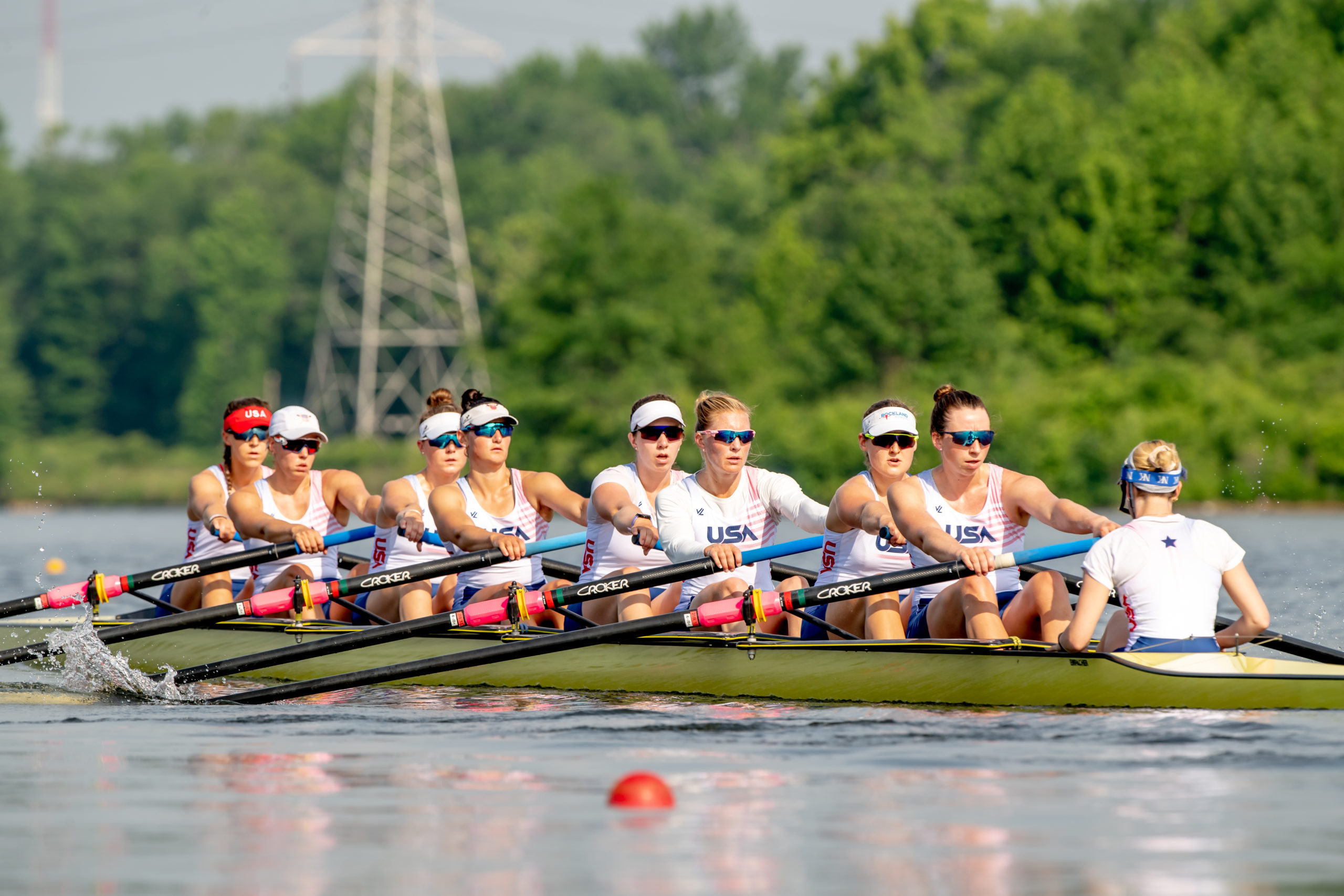
On the morning the U.S. took the wrapping off the Olympic team crews that had just been named, 38-year-old Meghan Musnicki was standing at the Finn M.W. Caspersen Rowing Center in West Windsor, N.J. among a nearly giddy group of women she will race with at the Tokyo Olympics and reflecting on the process that has led her here again.
Musnicki has been a part of a scene like this two times before, and it is always a happy moment. After months of a grueling selection process, the athletes get to relax knowing they are on the other side.
Musnicki was part of the group named to both the 2012 and 2016 Olympic women’s eight. For the veteran Olympian, it was a moment both familiar and unique—but also surreal.
This was supposed to happen last June, and by now Musnicki would have gone on to something different.
In 2019, when she rejoined the United States women’s training center in Princeton, her goal was Tokyo 2020 and then retirement from competitive rowing. But then came the pandemic, a world-halting event that forced postponement of the Games, which are still being called Tokyo 2020 even though they are happening in 2021.
When the postponement of the Games was announced 15 months before this joyous June morning, Musnicki and her training-center teammates were forced to contemplate whether they could deal with another year-plus of training and uncertainty.
On that day—March 24, 2020—Musnicki (“Moose” to her friends and family), said she was not ready to cash in.
“I’m not going to let this be the deciding factor about whether I make my third and final Olympic team. If I don’t make the Olympic team, I want it to be because I’ve been injured, or I’m not good enough, or not helping the boat go faster. I don’t want it to be because of a factor that is completely out of my control,” she said then.
“I’m not ready to walk away from this. It’s devastating, and it’s really hard to wrap my head around in some respects, but in other respects, the competitive side of me is thinking, ‘I came back a year and a half ago because I wanted to train to make the Tokyo Olympics, and that’s what I am going to continue to do.’”
And she has done that.
On this morning, Musnicki was on the apron of the rowing center she’s been on countless times reveling in the moment unfolding around her.
“It’s been quite a year, that’s for sure,” Musnicki said. “It’s going to make when we actually do line up and race super special. It’s been a hard year and a challenging year for everyone in a lot of different ways. And we’re lucky to have had each other and our friends and family to get us through it.”
Now, with selection done, with all of the various rowing trials finished, the U.S. Olympic team is set.
Thirty-five U.S. athletes will compete from July 23 to 30, joining 526 other athletes from around the world who will attempt to row their way into the record books of a Summer Games that is already historic.
The pandemic that prevented this Olympics from taking place in 2020 is not over. The suffering of nearly 175 million Covid-infected people and the 3.7 million deaths worldwide that had occurred by the time the U.S. team was named will shadow everything about these Games.
It would be nice to hope that the vaccines that have stemmed the virus and enabled a large part of the world to return to normalcy will also treat us to the kind of traditional Olympics
we have come to expect and enjoy—a festive spectacle and grand celebration of sport and global unity.
Sadly, they will not. Japan, which appeared to contain the virus early on, has not conducted a successful vaccination campaign. As of the end of May, the total number of fully vaccinated Japanese people was reported to be about 2.9 million, or about 4.4 percent of the nation’s population. In the spring, Japan was experiencing a fourth wave of infections, and part of the country was in lockdown into June.
There have been citizen protests and complaints by business leaders and politicians who want the Games scratched. Polls have shown that between 70 percent and 80 percent of the country’s citizens want the Games canceled.
But the government of Japan and the International Olympic Committee have said the Olympics will take place and that stringent mitigation measures will keep athletes, staff, organizers, and citizens safe.
How stringent?
Everyone entering the country must undergo multiple tests, before and after travel, and throughout competition. Participants must install Covid-tracking and exposure apps on their smartphones. Travel is restricted to the athlete’s village and competition venues. Participants, media, and non-competitors can move only between registered hotels and sports sites.
If that is what’s needed for the Games to take place, that’s fine with the athletes. Yes, some will miss having friends and family cheering them on. But in the end, why they came to Tokyo, what all this training and sacrifice are about, has little to do with spectators and pageantry.
“I don’t have anything to compare it to, but I know it’s going to be different from any other Olympics in terms of what happens with spectators, Covid, and all that stuff,” said first-time Olympian Clark Dean, who will stroke the U.S. men’s four.
“In terms of my personal experience, I don’t think it will be too different. It’s not like any rower goes for the spectators. That’s not the reason we’re going. We’re going to compete and win, and that’s going to be the same.
“Is there going to be less freedom to roam around and sightsee? Sure. But I would like to think that in an ordinary year, I’m also not going to be there roaming around. I’m going to be focused. It’s going to be about training and preparing and racing, and I think, if anything, the restrictions are going to make everybody more focused, because there is no alternative.
“From a racing standpoint, it doesn’t change much. From a holistic, vacation standpoint, sure, it might not be as grand or as much of a festival as it usually is, but that’s not why I wanted to be there in the first place.”
How the pandemic will affect the Games no one can predict, but there’s no doubt that it impacted the formation and selection of the U.S. rowing team.
At the men’s Oakland training center last February, there was a large group of veteran athletes alongside a bunch of younger athletes who may have needed more time to develop to crack this year’s team.
The postponement greatly benefited them and may have caused some of the veterans either to miss making the squad or to retire.
Of the men’s eight that has been named, only Austin Hack, who stroked the crew in Rio, is returning. Four others who may have been on the edge of being selected but had competed at only the under-23 level have made the team.
“Man, it’s been a long road. But it feels good for sure to be where we are,” said Hack. “We’ve done a good job trying to use the postponement to our advantage. We’ve got a pretty young crew, both in the four and the eight, and it’s given us more time to develop, and that’s showed in the quality of the rowing.
“In the pieces that we’ve been doing, we just keep getting better and better. Certainly, it’s been a mental challenge. I don’t think anybody budgeted for the whole extra year. And the uncertainty surrounding whether the Games were going to happen certainly added to the challenge. But I definitely think we’ve used it positively and I’m hopeful that we will be able to show that in July,” he said.
“The Covid situation, although very difficult for most people, really helped us,” said men’s head coach Mike Teti. “Being able to train for almost a full year without any pressure of selection, and just being able to work on technical things, which I thought was our limiting factor, has really helped us.
“Once we went to Chula Vista [for winter-camp training], getting into the fours and bigger boats, all the work they had done in the small boats seemed to transfer. Having that year to work on just technical things without racing was good. We were able to train and do a lot of base work that established a solid platform and significant technical improvement.”
Neither the women’s nor the men’s training centers sent crews to Europe to race in World Cup events. The last international race for any training-center crew was in 2019 at the world championships. But Teti said he is not concerned, that his crews are moving well, and that he experienced a similar situation before, in 2004, the last time the U.S. men’s eight won Olympic gold.
“I had five new guys in the boat in 2004, and we had one race that year in the eight. The first time Bryan Volpenhein ever stroked the eight was at the Olympics in 2004. So, hey, I guess that bodes well for us.
“All these young guys, although they haven’t raced on the senior level, they did all race at the under-23 level. They all have medals from under 23, most of them gold, and they have raced collegiately.
“I put a lot of faith in our collegiate-rowing system,” Teti said. “Men’s collegiate rowing is on a really high level, and these guys have all been in close races. Although they don’t have a lot of international races, they probably have more racing experience than some of the veterans they will be racing against. So I don’t think that’s an impediment.”
As for the competition, Teti will have to base his planning on the historic strength of his foes and the limited results of crews that raced either a four or an eight this spring, including Germany, Great Britain, and New Zealand, which had no choice but to travel to Lucerne, Switzerland, to qualify for the Games.
No other Kiwi crew left the country or ventured beyond its closed borders, and the rowers paid a price, having to quarantine for two weeks and suspend training.
Still, Teti expects this to be a hotly contested men’s-eight field.
“It’s probably the highest level of eights rowing that I’ve ever seen,” he said. “When all these countries decide to put their best people in the eight, it’s hard. It runs in waves. Some years, the four seems stacked; some years, the quad seems a little more stacked. This year, it seems like the eight is a really stacked event.
“There are no bad crews there. So, yeah, it’s going to be hard, and it’s going to be really hard to win a medal. But if I am going to go to the line with anyone, I would go to the line with these guys. They have really good character. It’s a very easy group to coach. They’re very receptive to what we say, probably more so than any crew I’ve had.
“They are very aware of the competition. They see what these other countries have, so they know it’s going to take a supreme effort to come home with a medal. But both the eight and the four have solid racers right down the line.”
As for the restrictions on movement, spectators, and the normal spectacle of an Olympics, Teti is all in.
“I like it. You’re not going to have your normal distractions. I don’t have to worry about the opening ceremonies or all the drama that goes on in the Olympic village or a lot of media attention. It’s like we’re going to the Independence Day Regatta in Philadelphia.
“You want to be able to go to the Olympics and have this overall experience, not just the racing. The opening and closing ceremonies, the parties, going to all the other events—you’re just not going to be able to do that. So it gives everyone a singular focus: Go and race, perform, and no distractions. So in that respect, it’s good.
“Another thing about this group: They’ve been able to roll with it. Any time there have been any distractions because of Covid or anything else, they’ve been able to roll with it. Whatever we face over there, they’ll be able to handle it.”
If experience in facing difficulty and overcoming adversity is a factor, the women also will be able to handle it.
The men’s squad did not escape infection, and neither did the women, who early on had up to a dozen infections, Stroking the women’s crew is Olivia Coffey, who was one of those infected. But she found the time she spent recovering at home beneficial.
“Covid was actually a good opportunity to reset and let my body recover and then come back with more energy,” Coffey said. “I wasn’t quite as fit when I got back into it, but it allowed me to get faster because I took a big break.”
Like the men, the women’s team is also young and features athletes who are rowing on the senior team for the first time.
There are veterans but also more first-time Olympians who are inexperienced in international competition. And, as happened with the men, some of the veteran athletes who may have made it to Tokyo last year had the Games not been postponed, either did not make it through selection or retired before it got going fully.
“I don’t know if it’s the youngest team,” said head women’s coach Tom Terhaar. “It’s certainly the least experienced internationally than we’ve ever had before, but they turned it on for selection. Most of the [veterans] who were sure that this was going to be their last one found it a lot harder, and the young kids just didn’t feel the same pressure.”
About the prospect of racing without first seeing the crews in international competition, Terhaar said it probably would have benefited his athletes, but not at the expense of losing some to a positive Covid test.
“An international experience would have helped, but we kind of weighed the risks, and it just wasn’t worth it if we ended up being locked down in a hotel for a couple of weeks with two athletes out of selection.
“What helps is knowing that for the women’s programs at least, New Zealand and Australia are in a similar situation. It is what it is. You can’t spend a lot of time thinking about it. We just have to do what we can do.
“In the grand scheme of things, if they hold the Olympics, that’s great. We’ll get to the competition when we get to the competition. It’s unfortunate that the experience will not be the same for the athletes, but considering what’s happened throughout the world, it will still be unique, and I’m sure it can be just as rewarding to get to the starting line finally and go.”
About being through selection and now just training for the Games, Terhaar said: “We’re still trying to process that, athletes included.
“It was a big challenge, but we had a lot of help to get us through it. Between doctors and medical commissions, board of directors, there have been so many people who have helped this year, and it was wonderful. We definitely couldn’t have done it without all of them because it was just too much.
“It feels good to be on the other side, but it’s hard to turn off the concern. We’re just thinking, ‘How do we keep our athletes healthy so we don’t end up with a false-positive test that pulls them out of competition?’
“We’re not going to relax totally until it’s over. It feels great to have gotten this far with everyone in one piece, everyone relatively healthy. We’ve gone through a few people having it and still setting a personal best on the erg. From that standpoint, we’ve been really fortunate.”
*Rowing News Olympic Coverage Brought to you by Gemini