Home Blog Page 17

Letter to the Editor: HOCR Youth Singles

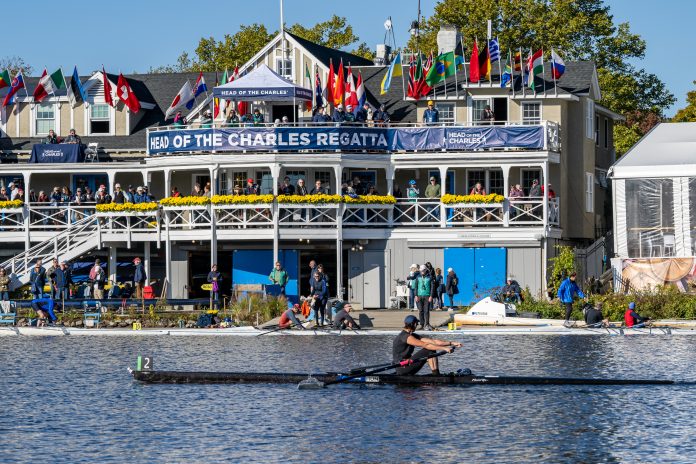
The Head of the Charles course runs past Cambridge Boat Club. PHOTO: Lisa Worthy


After two consecutive years of trying to enter one of my athletes who has proven to be one of the top youth scullers in the country into Head of the Charles, only to have her waitlisted both times, it dawned on me: Why can’t HOCR use a merit-based system for youth single events? It’s the only event in rowing where the rower represents the entry 100 percent.

In addition to “10 Ways to Save Rowing” (June issue), I suggest adding an 11th: Make singles entries based on merit. Though I’m referring specifically to Head of the Charles, this could be applied to other races where entries are at a premium, and it may make some regattas more attractive to faster single scullers.

Head of the Charles boasts of being the most prestigious regatta in the country and hosts athletes and teams from across the nation and around the world. Why wouldn’t the regatta committee want the most diverse group of fast athletes racing for medals in this event? As it stands, there are typically about 45 spots available for women’s and 50 spots for men’s youth single entries at the Charles.

The athlete at my club rows on a very small team in a part of the country where rowing isn’t well known, and she has dedicated a lot of extra effort because of her love of the sport. She has put in countless hours with the team and on her own to become the best athlete she can be. Unlike the Charles River, there are no rival boathouses on our body of water, no early-morning rows alongside other strong competitors to inspire our athletes to get faster every day. I would argue that it’s more difficult to train without a large team pushing you on.

At HOCR, there are five more entries available in the boys’ singles event than in the girls’, which are allocated specifically for local clubs along the Charles River. These club members have the opportunity to row this iconic river every day. Why not reward a well-deserving female athlete who has overcome the disadvantage of her geographic location and who may never have another chance to race in such a legendary event?

To make this a merit-based system, there’s a simple solution. The committee would gather the names of the athletes who made the grand finals at USRowing Youth Nationals in the youth and U17 singles, and the grand final from Scholastic Rowing Association of America nationals in the senior single. HOCR organizers would extend invitations to those athletes directly or wait to see who registers and make sure they are priority entries. That would mean monitoring 18 to 22 athletes of each gender.

I imagine there would be some overlap with guaranteed entries, and several athletes would have graduated to college programs or wouldn’t be interested in racing. With 10 to 15 merit-based entries for each gender, there still would be plenty of entries available for the regatta’s traditional lottery system.

HOCR invitations would be an honor to receive and a goal for which rowers could strive. The impact of such an opportunity for small-club rowers would be far-reaching. Beyond the incredible rowing experience for the athlete, it would bring attention to the rowing club, thereby motivating other young rowers to strive for such success, inspiring others to try the sport, and stirring regional interest in the sport through media coverage.

Imagine what a handful of these fast rowers from all corners of the country could do to promote this niche sport, increase participation, and help strengthen USA sculling as a whole on the national stage.

Ted Riedeburg
Director, Head Coach
Rock City Rowing and
Episcopal Collegiate School
Little Rock, Ark.

Corporate Logo Coming to College Boathouse

Texas rowers at the 2023 Henley Royal Regatta. PHOTO: Lisa Worthy.


The brand logo of Humann, maker of nutritional supplements, will appear on 11 University of Texas athletic facilities, including the Longhorns’ football field and boathouse.

“What starts at Texas changes the world,” said Texas athletic director Chris Del Conte, of Humann, which grew out of a University of Texas Health Science Center research program.

“If we were going to make the decision to put a brand on our fields, courts, and across all our athletics venues, it had to have an incredible story. What began with Texas researchers has been used by our student-athletes for over a decade to help them perform better on the field and aiding people to be at their best heart health for everyday life.”

This will be the first time that a commercial logo appears next to the iconic Texas Longhorn at the university boathouse, as well as 10 other athletic facilities.

U.S., Canadian Crews Advance at World Rowing Championships

The U.S. men’s quad of bow Nathan Phelps, Jacob Plihal, Cedar Cunningham, and stroke Chris Carlson racing at the 2025 World Rowing Championships in Shanghai, China. PHOTO: Lisa Worthy.


U.S. lightweight single sculler Michelle Sechser set the fastest time in the heats of her event at the third day of the 2025 World Rowing Championships, in Shanghai, China. The Canadian women’s quad of Shaye De Paiva, Cassidy Deane, Kristen Siermachesky, and Alizée Brien finished third in their semifinal to advance to the A final.

The U.S. men’s quad of Chris CarlsonCedar Cunningham, Olympian Jacob Plihal, and Nathan Phelps also advanced to their A final, a first for the U.S. since 2001. The crew won bronze at the Lucerne stop of the World Rowing Cup earlier this summer. Five seconds separated the six finalists’ times in the semifinals, with Italy and Great Britain each winning one. Finals are scheduled for Thursday at 3:12 am on the East Coast, 3:12 pm in Shanghai.

The 2025 World Rowing Championships run through Sunday, September 28.

Schedule  |  Livestream  |  Results

From The Editor: Essential Opportunities

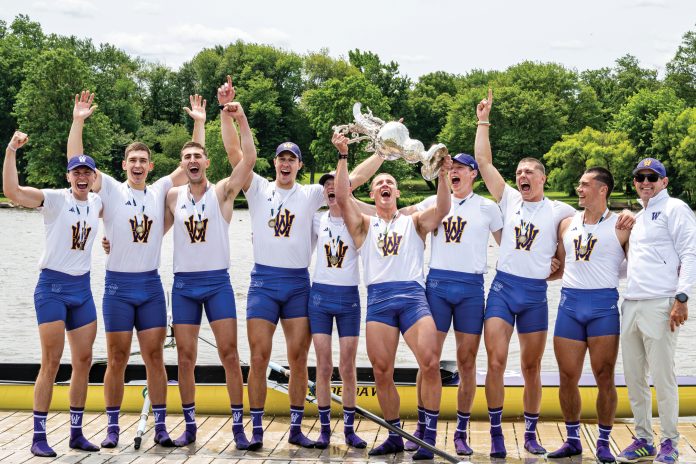
Michael Callahan (right), head coach of the two-time defending national champion University of Washington heavyweights, is the top-paid coach in men's rowing. PHOTO: Lisa Worthy.


In his column for the October edition of the print magazine, Doctor Rowing writes, “Scratch any rower and he’ll tell you who helped him rise.”

That’s certainly the case with Olympic champion Pete Cipollone, winner of eight Olympic and worlds medals (five of them gold) back in the late 1990s and early 2000s, when the U.S. National Team ruled the world in eights.

Cipollone credits coach Mike Teti with “one of the most important pieces of coaching I ever got,” which you can read in October’s Coxing column by George Kirschbaum.

Teti continues to foster U.S. Olympic success, coaching at California Rowing Club, where most of the U.S. National Team men’s four and eight that won Olympic gold and bronze in Paris trained when they weren’t in USRowing selection camps or on training and racing trips.

Clubs provide essential opportunities and support for athletes outside of the schools and universities that expose most rowers to the sport for the first time. The head coaches (if not the assistants) of the top collegiate programs benefit from better pay owing in part to the salary surveys of their coaching associations, the Collegiate Rowing Coaches Association (for women’s programs) and the Intercollegiate Rowing Coaches Association (for men’s). Read more about it in the October issue of Rowing News.

As opportunities to walk on to a college varsity program as a novice disappear, clubs become an even more important part of our sport. Also in the October issue of Rowing News, Amy Wilton tells the instructive stories of the advent of several clubs founded through the passion of rowers bent on sharing the transformative power of our great sport with others.

May it inspire you to do the same.

Coxing: The Confidence Game

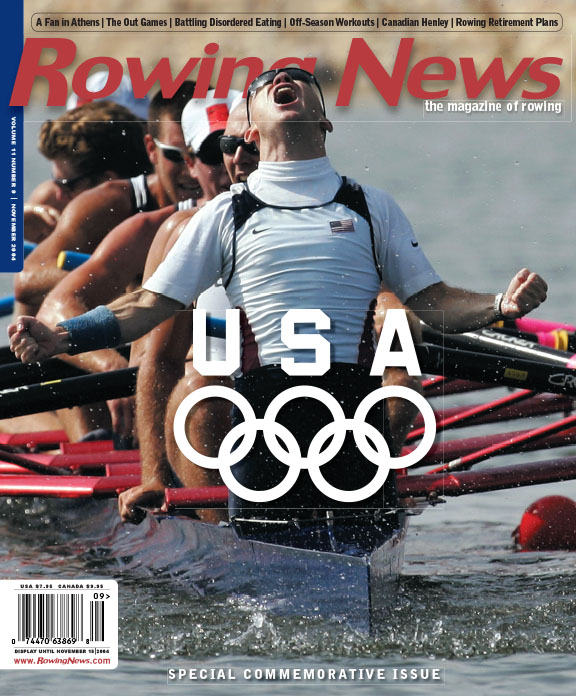
Pete Cipollone coxed the U.S. men's eight to Olympic gold in 2004.


By George Kirschbaum

The role of coxswain comes with great responsibility, and with that responsibility comes great pressure. We are not supposed to let on when we feel it but inevitably we will.

What do you do when you aren’t feeling your most confident, when the seeds of doubt creep in and you question whether you’re capable of doing the job?

First, remember that everyone goes through periods of self-doubt.

“I always had self-doubt,” said 2004 Olympic champion coxswain Pete Cipollone, who also won three world championships in the late ’90s, a silver (2003) and a bronze (2002) in the eight as well as worlds gold (1995) and silver (1994) in the coxed four. “It is an essential motivator.”

The way to head off these moments is to begin learning as much as you can about the sport and to keep learning. Knowledge is power, and that knowledge gives you the basis for acting. Sometimes the action you take leads to success, sometimes to less-than-desired outcomes, but it’s always a learning experience, and that learning experience leads to wisdom.

“My confidence was highest when I knew I had done everything in my control to prepare,” Cipollone said. “This meant practice, practice, practice—not until I got it right, but until I could not get it wrong.”

Wisdom and experience give you the self-sustaining confidence you need when things get tough. Don’t be afraid to take chances or make mistakes.

“I learned to embrace the notion that the first step to being great at something is being bad at it—and doing it anyway,” Cipollone said.

If you are unsure, turn to a trusted coach, coxswain, or other mentor for advice.

“Early in my career, Coach [Mike] Teti told me, ‘It’s only a mistake if you make it twice.’ It was one of the most important pieces of coaching I ever got.”

Ask questions and think through the answers carefully. Stay positive and know you’ll have ups and downs. Just remember to keep your bow pointed in the right direction.

George Kirschbaum, author of the Down and Dirty Guide to Coxing, is a coach and a member of the USRowing Safety Committee, serving as the Mid-Atlantic representative. When not advocating for safety, he can be found championing the building of a boathouse in Arlington, Va. He can be reached at george@thecoxguide.com

Safety: A Call for AEDs in All Rowing Clubs


Dr. Ann Redgrave, chief medical officer for Great Britain’s rowing team, has called for all rowing clubs to have automated external defibrillators (AEDs).

“It disturbs me that there remain many rowing clubs that do not have their own defibrillation equipment,” Redgrave said.

AEDs are portable devices used to treat someone experiencing sudden cardiac arrest, often found in public spaces like government buildings, schools, and airports. While training on proper use is recommended, the Mayo Clinic says someone with no training could use an AED to reset the heartbeat of someone experiencing sudden cardiac arrest. Using an AED could save a life, the Mayo Clinic advises.

“Every year, we learn of instances in which participants in our sport have unexpected events in which heart or circulatory problems have put their well-being at risk,” Redgrave said. “We know that defibrillators save lives, and relying on the chance of having access to a machine five minutes up the road from the boathouse is not good enough.”

AEDs range in price from $1,000 to $2,500, but British Rowing has a partnership with a charity that provides free defibrillators in the United Kingdom. The American Red Cross has a discount program that requires clubs to contact them directly.

CURRENT ISSUE OF THE MAGAZINE

2025 World Rowing Championships Underway

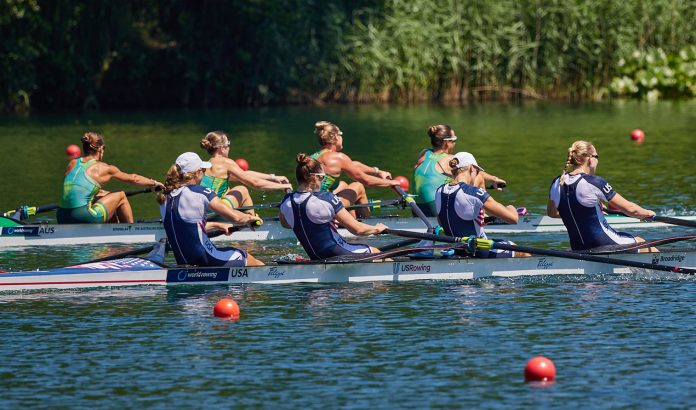
A U.S. women's four won the Lucerne World Rowing Cup ahead of Australia earlier this summer. PHOTO: Stewart Cohen.


Shanghai hosts the 2025 World Rowing Championships Sept. 21-28, the first-ever senior worlds held in China. Over 700 athletes, representing 56 nations will compete in 23 boat classes on Dianshan Lake.

Also for the first time at a World Rowing Championships, men and women will race in the same boat, in the mixed double sculls and mixed eights. All mixed-boat rowers are doubling up in other events at the regatta, with the exception of some coxswains.

The U.S., entered in 15 events, seeks to break a streak going back to 2019, the last time a USRowing crew won gold in a senior World Rowing Championship (women’s lightweight pair and PR3 women’s pair). Favorites to earn gold include the women’s four—winners, in different line-ups—of both World Rowing Cup races this summer, lightweight single sculler Michelle Sechser, and the mixed eight, winners of the three-boat Lucerne World Rowing Cup race agains Germany and Italy.

Canada sent a young squad—roughly half of whom will be racing in their first senior world championships—early to Shanghai to race in 10 events, including both the men’s and women’s eights.

“We’re basically leaving 26 to 28 degree [Celsius, 78-83 Fahrenheit] British Columbia in service of 26 to 28 degree China, factoring humidity there, but that’s why we’re going a few days earlier than a lot of people,” said Canadian Olympic coach Tom Morris. “We’re not too stressed about it. It’s year one of this [Olympic] quadrennial and so I wanted to make sure that we keep our process really strong, really simple, and able to be reviewed with robustness and thoroughly at the end rather than pulling out too many tricks too early.”

Schedule  |  Livestream  |  Results