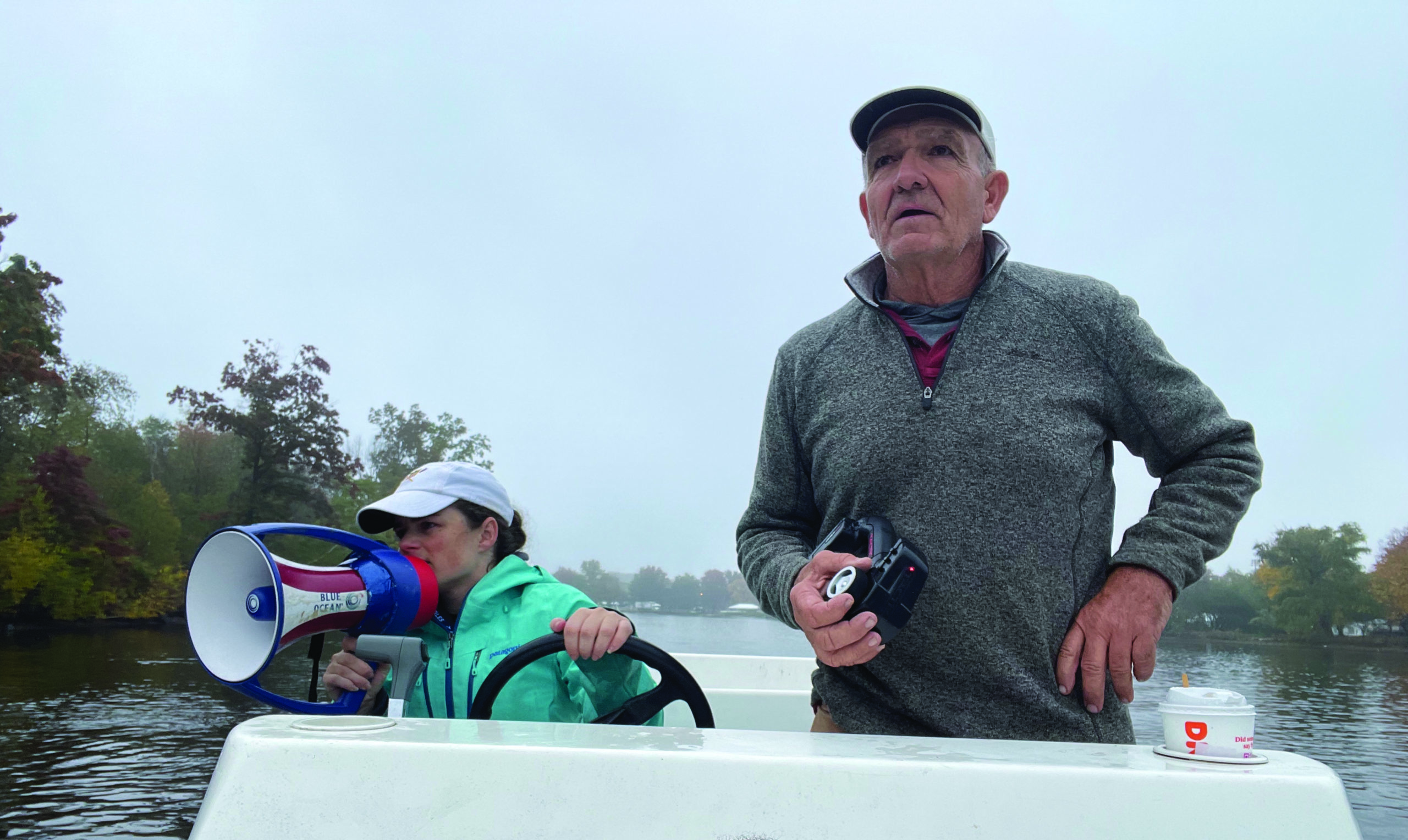
Traditionally, visually-impaired rowers row in boats with sighted people to help guide them. But Bob Berry’s experience rowing in a boat with 13-year-old Sofia Priebe, whom he was coaching at the time and who is much smaller than he, along with Berry’s love for rowing alone, prompted him to devise a way to get Priebe rowing safely in a boat by herself.
“I had this idea,” Berry said. “I’m like, well, a remote-controlled airplane has a rudder on it that steers it, why not put one on a single?”
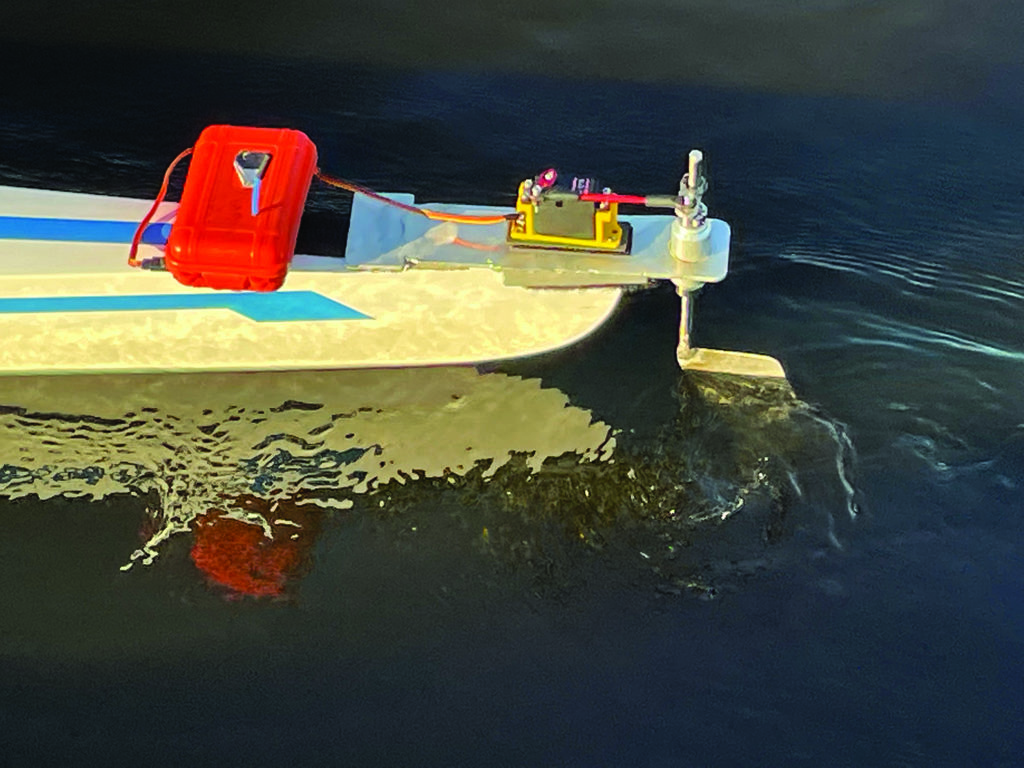
Priebe agreed to try rowing in a single —she rowed in a double usually with her brother—and Berry quickly fabricated a rudder for a scull out of a wrecked, remote-controlled car.”
“It worked perfectly,” he said.
The device, which Berry calls the “Remote Coxswain,” has been around since 2017 and is used to guide visually-impaired rowers down a course without a sighted person in the boat guiding it. Someone, typically Berry, follows behind the rower with a controller to steer the boat. The rower is tasked with keeping the boat moving, while Berry keeps the boat on the correct path.
The device has been used in numerous races over the years, although most have not been USRowing-sanctioned events. In October 2022, however, visually-impaired rower Pearl Outlaw used the remote rudder in The Gold Cup in Philadelphia. Outlaw told Row2K in December that one of the main advantages of the device was having the ability to focus solely on rowing rather than having to pay attention also to verbal commands — a method often used to communicate with visually-impaired rowers when a sighted person is in the boat.
Berry, who is the maintenance manager for Nathan Benderson Park in Sarasota, Fla., works at the park with a married couple, both of whom are blind, and has used the remote rudder for a head race in which they competed. A few other athletes on the East Coast have used the device as well, he said, and everyone who has tried it has had a great experience.
But the device has not come without controversy, particularly outside the United States.
“I sent one to a young man in South Africa who was blind, and they installed it on his boat,” Berry said. “The South African Rowing Association would not allow him to use it. They felt that he would have an unfair advantage.”
Berry remembers a situation at Benderson Park where he had phoned the race director several months before a race to let him know that a blind couple would be competing guided by remote steering. On race day, the director, who assumed the pair would be guided by a sighted person in the boat, offered to let the pair row in the adaptive race. If the pair rowed in the non-adaptive race and won, the director said, they would not get a medal because the remote rudder gave them an unfair advantage.
“I gave [the blind pair] the choice, and they were like, no we don’t care about the medal,” Berry explained, “We just want to know how we do against other sighted people.”
Berry believes the rudder does not confer an unfair advantage.
“Any time you use a rudder, it slows you down because technically it’s resistance that does the steering,” he said. “Everybody else with vision, when they go to steer, they give extra pressure on one side or the other, which leads to more speed.”
Berry envisions his technology helping sighted rowers by replacing the cable-control system that coxed boats use to steer.
The remote rudder “is like a steering wheel that you turn, and when you let go of it, it springs back to center exactly,” Berry said. “Sometimes, coxswains don’t know if they’re exactly on center with the rudder, and that creates resistance.”
Currently, his goal is to expand use of the remote rudder at USRowing-sanctioned events to continue helping visually-impaired rowers compete in non-coxed races.
Visualization is widely employed by elite athletes and high performers. Michael Phelps, Novak Djokovic, and Lindsay Vonn are among those who praise this tool for preparing mentally. There’s no doubt that visualization can help you attain your goals, but little attention is paid to the potential risks and how to minimize them.
For visualization to be effective, you must be deliberate about your intention. Most athletes visualize to build confidence in a future situation, but it’s essential to be specific.
You can visualize when you’re learning a new skill to strengthen neural connections. This applies to game play and strategy as well. The brain doesn’t know the difference between reality and something visualized, so the more you rehearse the skill or strategy in your mind, the more automatic your new learning becomes. You can also visualize how to respond in stressful, emotionally charged situations, which builds confidence when you experience those situations in the future.
If you’re unclear about the purpose of your visualization, the consequences can be counterproductive. For example, when anxious before a race, you may use visualization to reduce nervousness and increase confidence. But that can backfire if it winds up drawing more attention to the very thing you’re trying to avoid. How to prevent this? Engage first in a mindfulness practice, accepting and releasing the thoughts and emotions that are generating your anxiety. Then, when you’re in a more emotionally stable state, undertake visualization with a specific aim.
Visualization helps by creating more certainty about the future. When you can picture what’s likely to happen, as well as how to respond, it puts you at ease. One drawback: Visualization may create rigid expectations about what the future should be. If you visualize something happening a certain way, you may lack the mental flexibility to accept and adapt if reality fails to cooperate. To minimize this, hold on to your expectations loosely, keep visualizations realistic, and try to imagine how you’ll respond when real life throws a curveball.
There’s a thin line between visualization and anxiety. Like visualization, anxiety is about the future—a feared future dominated by unpleasant emotion. A handy way to distinguish between anxiety and visualization: When you visualize, you look at your thoughts; when you’re anxious, you look from your thoughts. In other words, your thoughts and emotions take over completely, warping your outlook and stoking apprehension. If anxiety begins to surface during visualization, it’s time to take a break or switch to a mindfulness practice to pacify your nervous system. If visualization creates anxiety continually, then it’s not enhancing your performance and you’re better off adopting a mindfulness practice that focuses on staying grounded.
Visualization can certainly facilitate peak performance, but when used mindlessly, it also can incite undue stress and pressure. To get the most out of visualization, use it mindfully and pay attention to whether it improves your rowing.
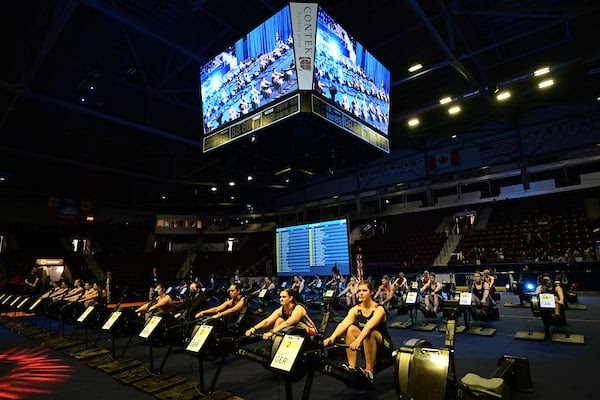
Going hybrid for the first time ever, the 2023 World Rowing Indoor Championships presented by Concept2, saw more than 1700 athletes competing either virtually or in-person at the Paramount Fine Foods Centre in Mississauga, Toronto, Canada.
The two days of racing had world records falling across a variety of distances and age groups, as well as para rowing and team events. The first-ever World Rowing Versa Challenge saw ten women and eight men compete across two days and four different events.
The 23-39 Men’s 2000m was one of the highlight events, with the two-time defending champion, Ward Lemmelijn of Belgium, competing against Oliver Zeidler of Germany. Zeidler, the reigning World Rowing Champion in the men’s single sculls, won the race in a supersonic time of 5:37.3, well below the magic 5:40 mark, ahead of Lemmelijn and Jakub Podrazil of Czech Republic.
For the 23-39 Women’s 2000m, it was a battle between Sydney Payne and Kasia Gruchalla-Wesierski, the two Canadian Olympic gold medallists, racing in front of their home crowd, versus the “Queen of the Erg”, Olena Buryak. Competing virtually from Kiev, Buryak – who also won the 500m race on Friday – left no doubt that she was still unbeatable on the indoor rowing machine, winning another World Rowing Indoor Champioship title ahead of Gruchalla-Wesierski and Payne.
Friday, the Open Men’s 500 m category saw three-time World Rowing Indoor Champion, Phil Clapp of Great Britain securing a fourth consecutive gold medal in this event. Clapp scored a time of 1:11.2 and held off a late surge from Cameron Wharram from Canada who, despite the support of the home crowd, fell short by 0.1 seconds. Matt Snare from the United States finished third.
The first-ever World Rowing Versa Challenge tested the skills and strengths off all ten women and eight men competing, to crown the most versatile indoor rowers in the world. After an intense battle over two days, in a format that got the crowd entertained and cheering for each of the four challenges, Joel Naukkarinen of Finland and Elizabeth Gilmore of the United States were crowned World Rowing Versa Challenge champions.
In total, six World Records were broken at the 2023 World Rowing Indoor Championships – with the most impressive being Andrew Benko of the United States, who won both the 500m and 2000m in the Men 55-59 age category and breaking his own World Record in the long distance.
The timing and results software was produced and operated by race management company Time Team of the Netherlands. World Rowing Productions of Munich, Germany brought all of the elements together to create the live stream broadcast.
The 2024 World Rowing Indoor Championships will take place in Prague, Czech Republic.
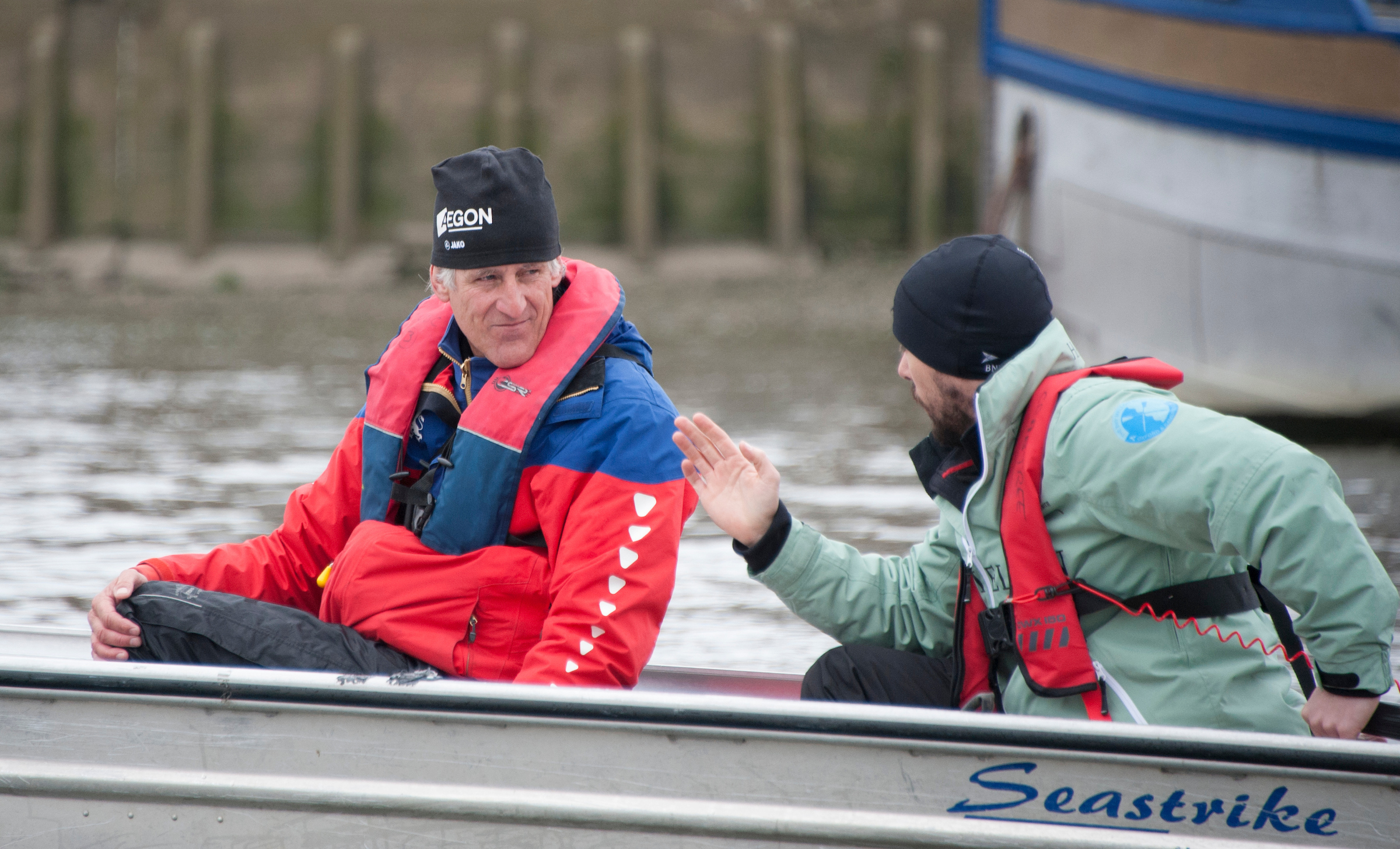
Putney. London, Varsity Fixtures, Mark EMKE, (left) NED Coach, with Mark BEER (right) CUBC Development Coach, in discussion, in the launch. OUBC vs Molesey BC. and CUBC vs Select NED crew. on the championship Course Putney to Mortlake. ENGLAND.
Saturday 21/03/2015
[Mandatory Credit; Intersport-images]
BY BILL MANNING PHOTO BY PETER SPURRIER
Great coaches typically have few team rules and many suggestions. These coaches build a culture, and this—rather than adhering to many rules—drives the athletes’ behavior. Demanding obedience through rules will get you only so far. Building something positive that athletes want to belong to and will sacrifice for wins races.
Rules too often give young athletes a mistaken belief that they are doing enough. Conforming to rules makes them feel they deserve good outcomes. In truth, following the rules means only not doing anything egregiously wrong. It does not mean doing things correctly or to the best of one’s ability.
One consequence of too many rules is that it makes each rule less significant. Let’s be honest: Most of us can’t even remember the Ten Commandments, so there’s no way athletes are going to remember 10 boathouse rules. Few of us follow all of the Commandments, yet we expect everyone to follow multiple rowing rules? Better to define desired behavior more succinctly: “Does it make the boat faster?” “Do the right thing.” “Would you be happy if your mother knew?” A short, simple, well-defined mantra inspires and unites a team in a way that an exhaustive code of conduct cannot.
Good behavior cannot be legislated. This applies to athletes as well as coaches confronted by a rule-breaking athlete. Rules too often restrict a coach from doing what’s best. They make everything black and white; break a rule and suffer the consequences. Far better to leave room for coaches to use their judgment.
With what rules do exist, leave the penalty for violating them undefined in advance. This allows for discretion when a rule is broken. Keep the option of maintaining firmness while also retaining flexibility so that each situation can be handled on an individual basis productively. Mitigating circumstances and contributing factors should be considered when confronting rule breakers. One size fits all rarely.
It’s also valuable to factor in the ramifications of disciplinary action. Does the punishment contribute to improved future behavior or does it drive the athlete away? Too often, the punishment harms the other rowers just as much as the rule breaker. Maintain alternatives and options. Tailor the response to the individual and the situation. Don’t be so stubborn that you cause additional damage.
Never use the erg as a punishment. If erging is punishment, then it is not training, and athletes will resist erging. Far better to require offenders to apologize to their teammates and/or do some menial work around the club that benefits everyone.
Coaches judge athletes every day. Athletes expect this and accept it when they believe the coach has their best interests at heart. If you have shown concern for your athletes, do not fear disciplining them when necessary. As long as a sense of fairness and concern for the well-being of both the team and each individual are maintained, the athletes will comply, and the team will become stronger.
Wembley, Great Britain, USA., Striker, ALEX MORGAN, jumps over Saki KUMAGAI as she heads towards the Japanese goal during the USA Women's Football Team 2-1 win over Japan to win the Gold Medal at the 2012 London Olympic , Women's Football, Gold Medal Match at Wembley Stadium, USA vs Japan, 21:00:55 Thursday 09/08/2012 [Mandatory Credit: Peter Spurrier/Intersport Images]
BY OLIVIA COFFEY PHOTO BY PETER SPURRIER
When I was in high school, I played four different sports, and if you asked me back then to name my favorite, rowing wouldn’t even be in the top two. I loved my teammates, my coach, and the program, but rowing, as many of you know, is hard.
It’s especially hard for those just starting out, mostly because they lack the fitness and strength to cope with the demands. The first few weeks of the season were always tough, and I remember thinking in the middle of a hard practice that I’d do just about anything to swap places with the coxswain. The coach never switched us, though, and I’d struggle my way through a lot of the early-season workouts.
Gradually, as the weeks progressed, I got fitter, and by our championship regatta, felt a little more confident in my ability. The feeling was short-lived, though; our season was only three months long. By the time I was getting my feet under me, I’d stop rowing altogether.
I’d spend the rest of the year playing soccer, basketball, and ice hockey, and when spring rolled around again, I’d be just as unprepared to row as I had been the year before. I could have avoided all this by rowing year-round, and probably would have had a much faster erg score for college recruiting, but I’m really glad I didn’t.
Playing other sports allowed me to develop as an athlete, avoid injury at an early age, and gave me time to learn to love rowing and all the effort it requires. So if you’re a younger athlete struggling with the sport, give yourself a break from the boat. Grab a tennis racket or a basketball and go play some games. You’ll have plenty of time to log meters when you’re older.
The Workout
If you can, try to be a multi-sport athlete throughout high school.
If you row in a year-round program, use the offseason to take a break from the boat and develop skills in another activity.
The Federal District Court in Orlando issued a preliminary injunction in mid-February requiring that Florida Institute of Technology (FIT) reinstate men’s rowing to varsity status by Feb. 24 and provide the team with full funding, staffing, and other benefits by March 12.
The decision came after a group of male rowers at the school filed a Title IX lawsuit last October, arguing that the university’s decision in June 2022 to cut the program, along with four others, discriminates against men.
The lawsuit complained that athletic opportunities for men at FIT are not proportionate to undergraduate enrollment—a Title IX requirement. At FIT, about 69 percent of the students are male and about 30 percent are female, but 58 percent of athletes are male while 41 percent are female, leading to a participation gap of 123 male athletes (nearly 11 percent of students).
Instead of complying with Title IX by cutting opportunities for women, the plaintiffs asked FIT to reinstate all the cut sports (including women’s teams) and add opportunities for men. The lawsuit alleges also that FIT fails to meet Title IX criteria for equal treatment and scholarships.
FIT’s cuts were not motivated by Covid-related budgetary shortfalls. The school shifted the five programs to club status to focus resources on a smaller number of teams so it could be more competitive in the Sunshine State Conference.
It began with a simple question: What does it take to make a business succeed? The answer, John Chatzky would discover, was much closer to home than he imagined.
Having spent more than 30 years as a real-estate developer in New York City, Chatzky, known throughout the rowing world simply as “Chatz”, was no stranger to business success. The traits he came up with—leadership, grace under pressure, endurance, courage, commitment—weren’t revolutionary by themselves, but in listing them, he was struck by a sense of familiarity. These were the very same things he’d come to expect from rowers in his crews.
Thus was planted the seed of what would become Swing Ventures, the investment fund Chatz founded in 2014 and now runs with Hal Ebbott, the firm’s managing director. Named for the sensation one feels when a boat is moving beyond the sum of its parts, Swing invests in companies whose founding teams include at least one rower.
Though the thesis may seem unorthodox, Chatz is quick to point out that all investors seek to identify leaders capable of expending tremendous effort over a long, often painful period of time. All Swing has done is segment the population into a group comprised of those who already possess such traits.
“Rowing demands an obsessive focus,” Chatz said, “and an ability to fixate on goals that may be months, if not years, away.”
“Rowing demands an obsessive focus,” Chatz said, “and an ability to fixate on goals that may be months, if not years, away.”
From that initial thesis, Swing has grown by leaps and bounds. Having made approximately 15 investments to date, it now has holdings in industries ranging from computer vision and financial services to machine-learning and high-end cycling wheels. It’s a broad array, to be sure, but look closely and you begin to see the through line.
“All of our founders are immensely talented,” Chatz said. “And they’re quintessential rowers in that they simply won’t quit; it’s just not in their DNA.”
He would know. After steering the University of Pennsylvania heavyweights during some of their strongest years, Chatz was graduated with a keen sense that he still had more to give. “More,” it would turn out, meant making the 1980 Olympic team and winning the Grand Challenge Cup at the Henley Royal Regatta.
Asked about the impact of his experience on the water, Chatz is emphatic: “Without rowing, I simply would not be who I am today. I owe my self-confidence to rowing, as well as my discipline and desire to excel, not to mention dozens of close friends. That’s why I knew I had to give back to the sport, no matter what path my life took. And no amount will ever be enough.”
Ebbott is equally emphatic. “Rowing is just a teaching tool. The question that really matters is what you do afterwards. It’s about how you carry that work ethic and sense of community forward into your life.”
As evidence, he pointed to the fact that their founders include an Olympic gold medalist, IRA champions, and those who never rose above the 3V. Their ability with an oar may have varied widely, but their abiding similarity is that they were all rowers. What matters is that they had the experience and understood what it means.
The two met in 2015 when Ebbott was fundraising for his company, Foray. Swing invested, and after Foray’s intellectual property was acquired, Ebbott reached out.
“After giving a lot of thought to what I’d do next, I was confident I didn’t want to run a company again,” he said. “At least not right away. But I wanted to stay close to the energy and talent that often surround startups, ideally in a capacity that allowed me to leverage the experiences I’d had for the benefit of others.
“John and I had fostered an extremely close, communicative relationship during my time at Foray, and I thought that by taking a more intentional, systematized approach to Swing’s sourcing, diligence, and portfolio support, there was a huge possibility to improve the quality of its opportunities and the level of assistance it could provide.”
Chatz remembers being struck instantly by how much sense it made.
“It was obvious to me right away—both for pre- and post-investment work. Someone who’s been there himself has a unique perspective on what to look for, and once we’re invested, it makes a big difference that founders know our advice is coming from operational experience rather than business-school case studies.”
So far, it seems to be working. The first deal Ebbott brought to Chatz was Triplemint, a tech-enabled real-estate platform founded by Yale rowers David Walker and Phil Lang. Triplemint merged recently with The Agency, a global brokerage, forming an entity valued at $350 million.
“Of course, I’m loath to say it was all luck,” Ebbott laughed, “but it’s definitely proven to be a good confirmation of the overall hypothesis.”
Swing companies have raised more than $40 million in venture-capital funding last year alone, listed products on the London Stock Exchange, and been used by clients such as Microsoft, Dell, Xerox, and AT&T.
Despite these successes, Chatz is circumspect in his outlook.
“You have to be very patient and calm. These things take time, and founders have enough to worry about without investors breathing down their necks. We see our role as support system more than anything else. We want to be the people you call, good news or bad.”
This personal approach was there from the very start. Chatz remembers vividly his first meeting with a would-be founder. The woman was Michelle Darby, a University of Washington alum and three-time IRA champion. “Within two minutes,” he said, “you could feel it—a kinship, a sense of seeing the world the same way.”
Her company, Roomzilla, now services hundreds of clients around the world, but what stuck most with Chatz was the need for a personal connection.
“There was a drive, a focus, and a commitment that I’d been longing to make part of my professional life. I knew not only that I could help her but also that she could help me.”
This holistic people-first approach is clearly being felt. Said Matt Doran, CEO of Advntr: “We’d met plenty of folks promising to help who never did. Not only did Swing perform, [they] did so with the same urgency as the founders. We’d never witnessed such passionate support.”
Melissa Pancoast of The Beans was similarly effusive. “When things get tough, they’re usually my first call. Without them, we simply would not have made it through the pandemic with our team intact.”
And Paul Lippe, formerly the general counsel at Synopsys and now CEO of xMentium, put it succinctly: “I’ve dealt with probably 100 VCs in my career. Swing is the best partner.”
It’s easy to get along when things are going well, which is why it’s a truism of investing that you should be judged first by your failures. By that measure, Swing may be even more impressive.
Brad Werntz, a two-time Swing founder, described a particularly stressful period during which it was clear that Skedaddle, his first company, would need to be wound down.
“I was not getting enough sleep and had atrial fibrillation. Even though the investment was going to fail, John checked on my health and progress more regularly than even close friends and family.”
Asked whether that relationship has changed in the years since, Werntz replied, “The main change has been an ongoing growth in my respect for John and Hal.”
It’s those stories, Chatz says, that make the work so satisfying.
“At the end of the day, these are marriages. You’re in it for the long haul and you have to care about the people behind the business if you’re really going to help. Plus, we trust our founders. In that way, it’s just like a crew. You can’t always see what people are doing, but you trust that they’re giving it their all.”
In addition to the level of support they provide, founders mentioned again and again the pair’s dynamic. Despite the 30-year age gap, Chatz describes his relationship with Ebbott as a partnership and emphasizes the benefits of differing perspectives.
“I tend to be more optimistic, whereas he defaults to a cautious, guarded position. In meetings I often play a more congenial role, whereas Hal’s focus is on due diligence and an investigation of the underlying fundamentals. But it works. The balance is what matters.”
Ebbott echoes this sentiment. “The point in collaborating is to catch each other’s blind spots. Plus, echo chambers aren’t just bad for business, they’re boring, too.”
This philosophy tends to inform other areas of their thinking as well. Both Chatz and Ebbott were quick to realize the risks of such a targeted investment approach. The thesis at the heart of Swing Ventures is deliberately expansive, and neither wanted their enterprise to become self-contained and nepotistic.
“Rowing is an expensive sport,” Chatz said, “which means that you’re more likely to come across a certain type of person from a certain type of background. Not always, but certainly more so than in the population at large.”
In a sector that has been criticized, rightly, for its lack of diversity, Swing’s portfolio is replete with women- and minority-led companies. Its interest in impact extends well beyond founder makeup, however.
“You can have as diverse a C-suite as you want,” Ebbott said, “but if the companies they’re building are all designed to serve the one percent, then what’s the point?
“Of course, we’re looking at an investment’s return profile. But we aren’t interested in an app that solves nonexistent problems or makes the lives of the already-comfortable marginally more pleasant. There’s clearly money in that, but at some point you’re going to start asking yourself questions about what you’re doing and what it means, and it’s a lot easier to work hard when the answers feel good.”
So far they do. Though hardly a comprehensive list, Swing’s portfolio includes The Beans, an app that helps those in the middle class overcome their anxiety about money; SparkChange, a provider of specialized carbon data that allows investors to reduce their carbon footprint while driving up the cost of pollution; and Turazo, a platform that offers tools to improve diversity in hiring and retention among the Fortune 500.
The ethos of giving back pervades all aspects of the fund. Each summer, Swing hires a class of associates—also rowers—and the internship program has become so successful and widely known that it attracts a wave of referral candidates each year who must surmount an acceptance rate in the single digits. Alums have gone on to work at such firms as McKinsey, Barclays, Salesforce and Bank of America and pursued business degrees at Harvard, Duke, and Cambridge.
The formula, Chatz says, is simple: “Pay people to do meaningful work and treat them well while they do it.”
That hires would be paid was something on which Chatz and Ebbott agreed from the start.
“Even if people were willing to work for free, we didn’t want that,” Ebbott said. “Not only would it limit our talent pool but also it would imply something about the kind of work being done. We pay because what they do has value; it’s a practical position as much as a principled one.”
Past hires are quick to confirm this. Arushi Guddanti, now a financial analyst at Walmart, said of her experience, “It’s very rare to come across a culture that inspires you to be better and challenges you to give it your best.”
Lily Fauver, who works at Spot & Tango, described work after Swing as something of a shock when she realized that one-on-one training and personalized feedback aren’t always the norm.
Brihu Sundararaman, a Swing alum and founder of Shuttle Labs, said his experience at the fund was instrumental in fostering his love of startups.
In March 2020, the program took on a new life.
“Everyone’s summer jobs were falling through as a result of the pandemic,” Chatz remembered. “It struck me as a great chance to make sure kids still had a worthwhile experience.”
In addition to the three full-time hires, Swing formed what came to be known as the Task Force, a group of nearly 20 additional interns who worked with various portfolio companies conducting research, building go-to-market sales strategies, and generally assisting as needed. In a notable case, one was responsible for securing a $250,000 line of credit that helped a company weather an especially perilous stretch. So impressed were some of the founders that some associates were hired to work directly for the companies after the summer.
Direct investment is only way Swing endeavors to benefit the sport. The fund maintains a charitable arm that has supported over 70 current and aspiring National Team athletes as well as more than 20 university programs, regattas, and organizations.
However remarkable the list, it fails to do justice to Swing’s actual impact. Asked to describe Chatz, founders, interns, athletes, and colleagues all used the same word: mentor.
“He’s someone you can always call,” one said.
“He’ll do whatever he can to help—and not just financially,” said another. “Sometimes his advice is the most helpful thing of all.”
As for the future, Swing remains on the hunt for new ideas.
“We love meeting with founders,” Chatz said. “It’s one of the best parts of the job. As our current portfolio matures, we want to make sure we’re investing in the next wave of game-changing companies. Momentum might be on our side right now, but we have no intention of letting up.”
The result, when you zoom out, looks a lot like a great crew. There are individual components, yes, but thanks to a steady hand on the rudder, the pieces work together, supporting one another, creating a whole far greater than the sum of its parts.
Boston, USA ." 2012 Head of the Charles". ..Description; Charles River. Cambridge, Massachusetts, Tideway Scullers Crew Meeting in the Harvard University Boathouse. 2012 Head of the Charles. ..15:28:17 Friday 19/10/2012 ...[Mandatory Credit: Peter Spurrier/Intersport Images]
BY TAYLOR BROWN PHOTO BY PETER SPURRIER
Goal-setting is often cited by coaches, parents, and teachers as a necessary component of achievement. Goal-setting itself, however, is not all it takes to achieve greatness. Winning teams and losing teams all set goals.
Achieving excellence is the process that comes after goal-setting. The process can be created intentionally or left unattended. When intention is brought to the process, goals are more likely to be achieved. When the process is left unattended, goals are forgotten and left unattained.
The most high-performing teams, organizations, and individuals do not leave goal achievement to chance. They engineer systems deliberately to support the process toward goal achievement.
One of the most popular systems is Objectives and Key Results or OKR. Using this system is simple and has the potential to align individual and organizational attention and energy.
Objectives are what you’re striving toward and generally involve the big picture. Key Results are how you’re going to achieve those larger Objectives. For each Objective you set, there should be three or four Key Results that support the process of attaining the Objective. Additionally, for Objectives and Key Results to be effective, they must be specific and time-bound. This means they cannot be vague or have unclear timelines.
Imagine you’re a rower in your junior year of high school and you want to row in college. The goal can seem incredibly lofty. Using the Objectives and Key Results system, however, the goal is translated into specificand time–bound language that does not seem quite as scary.
Here’s an example:
Objective No 1: Get recruited and accepted at a Division 1 rowing university.
Done by: 12/15/2022
Recognize that large Objectives with a significant number of variables will be less controllable than Key Results. For instance, you cannot control the coaches’ decision-making or the other rowers’ level of skill. Therefore, Key Results should focus on variables more in your control and should be clearly measurable. Measurable Key Results make it very clear when you’ve attained them.
Key Result No. 1: Visit 10 Division 1 rowing universities and speak to head coaches.
Done by: 06/01/2022
Key Result No. 2: Submit early-action applications
Done by: 11/01/2022
Key Result No.3: Drop 10 seconds on 2,000-meter PR
Done by: 09/01/2022
Key Result No.4: Attain 3.8 GPA
Done by: 11/01/2022
These OKRs are for illustration purposes only and do not represent all the steps required to row at a Division-1 university. When each of these Key Results is achieved, new Key Results can be set toward the same Objective, and when the Objective is attained, a new Objective can be created.
Goal-setting systems do not have to be complicated and arduous. Simply writing down a main objective and the steps (Key Results) in the achievement process will move you toward your goals. The important part is putting pen to paper and mapping out what you want to accomplish and how you want to accomplish it. Now go find that pen!