Home Blog Page 159

Getting Started With Coxswains

BY ANDY ANDERSON
PHOTO BY LUKE REYNOLDS

The year 2021 ended with an email from an old friend who coached with me at Trinity College:

Dear Doc,

Thought you’d be amused to hear that I’m soon to return to the coaching life—after a 40+ year layoff—at a local Catholic girls high school. Just a few miles from my house—85 percent minority students and the only girls crew in the area. Not sorted whether I’ll be coaching JV crew or novices, but think I might prefer the former. Was telling the athletic director and the head coach that the only aspect (despite the layoff) I feel a bit unprepared for would be coaching novice coxes. In any case, I’d like your thoughts on best coaching practices nowadays, good YouTube sources, etc. This is a pretty new program and operates only January through May as they have insufficient funding for a full academic year.

With USRowing’s focus on reaching out to underserved rowers, I wonder if you have thoughts about potential funding sources. A very little money could have significant impact. For some of the families, even coming up with the $350 fee is pretty tough. In any case, if you have a few minutes later this week for a phone/Zoom call, I would appreciate it. Thanks.

Dear Old Friend,

As I told you last night in our Zoom, which included another college friend who is coaching in a young program near me in Massachusetts, I’m delighted to hear that you are getting back to coaching and giving back to the rowing world, from which we have all benefitted. I think that you’ll find it to be a lot of fun. Coaching coxswains is always a challenge, but jump right in. They are essential, no matter what you old-school oarsmen think. (Doctor Rowing was a coxswain and took a lot of guff. All ’swains do.)

The first thing coxswains need to know is that the safety of their crew and their equipment is paramount. It is exactly the same as driving a car. That means learning the traffic pattern of your river and knowing when to start and stop rowing. I always tell my coxswains that of the many responsibilities that the position entails, the only one that cannot be performed by anyone else is steering. A rower could give commands, could call 10s, but no one else can steer. So that should always be their priority, especially at the beginning. 

Here we got into a discussion: “I hate that all the fours nowadays are bow-coxed so that the coxswains can’t do any coaching,” said my friend. “How can they coach the boat on timing or bladework?” 

I heartily disagreed. It takes a lot of experience for a coxswain to be able to provide valuable coaching. In the early stages of their careers, coxswains should work on steering and boat management. Let the coach do the coaching. There’s so much they need to master—starting pieces even with other boats and at the same time. They need to make sure that the shell is always pointed correctly down the river. They need to learn the commands and give them at the right time and with an authoritative voice. And it is crucial for coxswains to be able to see where they’re going, hence the bow cox. For high-school rowing, give me safety and not hitting things any time.

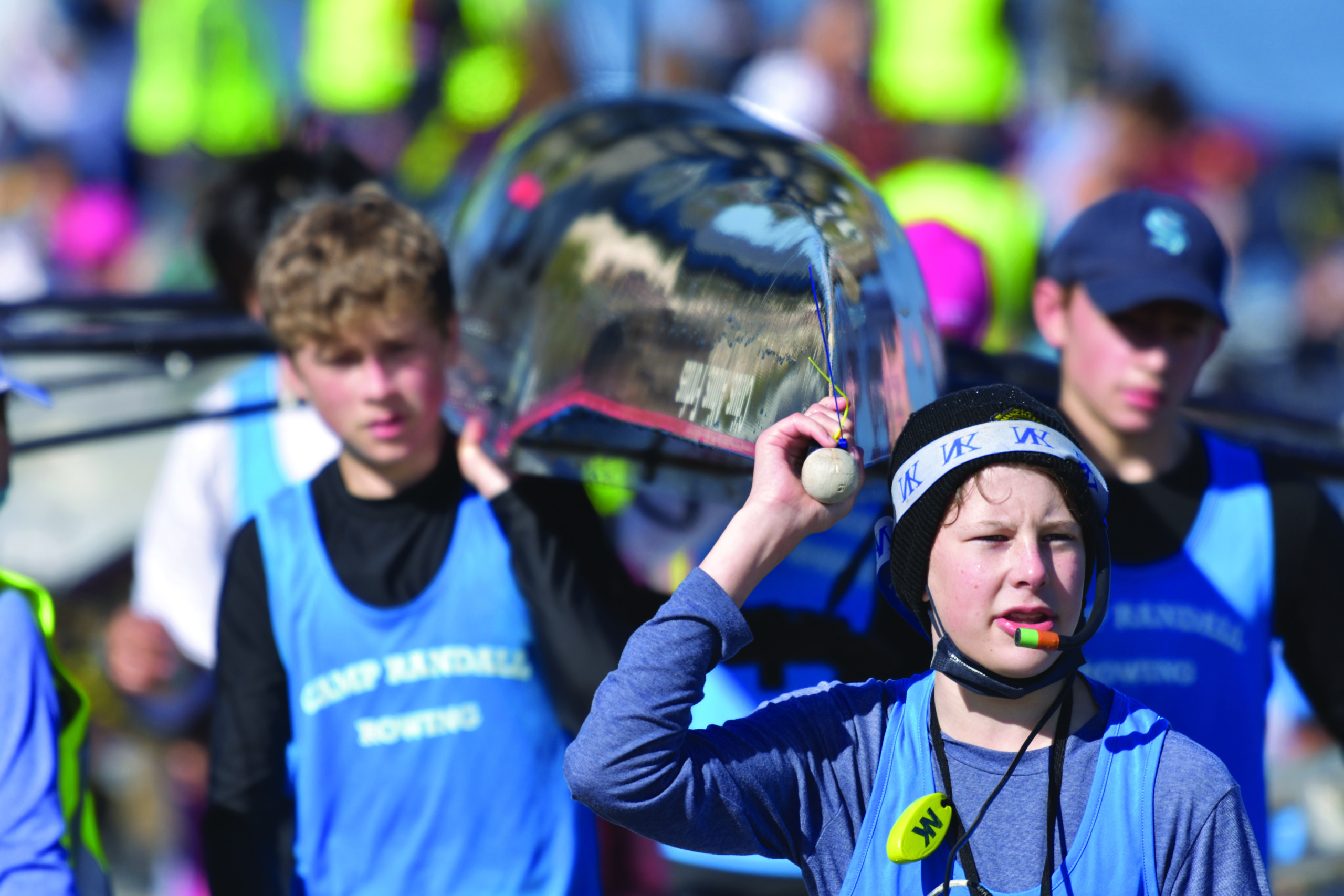
Teach your coxswains, not by giving them something to read or a video to watch, but by spending time with them. The first day, tell them to stand right next to you, as you give all the commands while they listen and watch. “Hands on. Lift it out of the rack. To the shoulders, ready, up. Walk it out.” Etc. Give the commands on the dock, putting the boat into the water, getting into the boat. On the second day, tell them, “I will say the commands quietly, and you will repeat them.” Inevitably, they will either scream them out, or more likely they will repeat them in a conversational manner. “These are commands, Roger. Make them sound commanding.” Demonstrate. On the third day, ask the coxes if they are ready to do the whole thing themselves. Maybe they will ask for another day before they are ready. That’s OK. You want them to be assured so the crew will have confidence in them.

At the beginning, if you are rowing with either a pair or a four, they will complain that the boat doesn’t steer. That’s true; it doesn’t steer well with so little momentum, especially if the rowers aren’t putting much power on it. The tiller is useful only if the boat has some movement. If they can’t keep it from going to starboard with the rudder, starboard needs to put more pressure on.

An incredibly valuable video is the USRowing safety video on its website. It shows coxswains and rowers what could go wrong. They will tremble and laugh at the Ejector Crab sequence, but it is vital that they know what to do in case of mishap. NEVER SWIM AWAY FROM THE BOAT should be repeated over and over. I begin every new season showing this to everyone. There are a lot of good videos of drills on YouTube. Search out the ones you deem appropriate for the right time of your season.

Here’s an important thing: Never let go of your oar. Your oar is your friend; you need it to balance the boat; you need it to row the boat. Only bad things happen if you let go of it.

There is information out there about funding and inclusion, too. It’s a vital part of the sport. Confer with other coaches in your area. I will come back to this in another column, but as you note, it is a priority for USRowing.

My final words are: “Make it fun.” It’s awesome to be in a shell that begins to move. Introduce pulling hard as soon as you can. That’s when you begin to see those little smiles cross their faces. “Wow!”

How Many are Too Many?

Putney, Great Britain, 17th March 2019, Umpire Rob CLEGG, marshalling the two crews at the start of the Pre Boat Race Fixture, Oxford University Boat Club vs Oxford Brookes, Championship Course, River Thames, England, [Mandatory Credit; Peter Spurrier/Intersport-images],

BY MARGOT ZALKIND
PHOTO BY PETER SPURRIER

The enthusiastic young coach had a boathouse full of novice junior scullers, all eager to go out on the water. She accommodated, placed them in singles and doubles, and then went back to get her launch on the water. By the time she came close to where they had strayed, they were like chickens let loose—all over the water, perilously close to the hazards, the shore, and sometimes even each other. 

Could she oversee all of them? No. Was this safe? No. Crew parents went into a frenzy. So what is the recommended safety guideline for coach-to-athlete ratio? This is a question we are often asked. The answer is, “It depends.”

There are so many factors to consider. How experienced are the rowers? How experienced is the coach? The coxswains? How many singles and how many sweep boats? What is the situation? The weather? And of course, making sure that everyone has passed the monitored swim test. 

Scenario one: You have two experienced eights rowing on a calm body of water 2,500 meters long and 10 racing lanes wide. This can be a very safe situation, and one coach for the two boats could be considered a good ratio.

Scenario two: Now take the example of 18 novice singles out on a rain-swollen river that has debris and barge traffic. A safe coach-to-athlete ratio here might be one coach to two athletes. (Or, better, take out quads that day. Or don’t launch.)

There is not a one-size-fits-all answer because every time a crew heads out on the water, it’s a judgment call.

Questions that need to be answered before the athlete’s launch:

· How experienced is the coach? (and are you/they well-versed in rescue?)

· How experienced are the rowers?

· If there are coxswains, how experienced are they?

· What are the hazards on the body of water and what are the conditions on the water (and what will they be for the next two hours)? Are hazards well marked? 

· Are the athletes familiar with the body of water or are you a visiting team on an unfamiliar body of water?

· How many athletes will safely fit in your launch? (Look at the information plate on the hull, or if a wakeless launch, ask the manufacturer.) And make sure you have enough PFDs for every rower you are in charge of. 

· Has the coach been trained in how to approach a boat safely and how to rescue rowers? 

How fast can you get a boatload of athletes to safety if the need arises? (And are you carrying all rescue equipment and a communication device?)

To make sure  the coach is not overextended on the water, here is some basic advice:

Before the season, establish guidelines for the program using the questions above and other issues at your venue that need to be taken into account.

· Do not take out more athletes than the coach can keep an eye on.

· Design practice so that boats stay together for easier monitoring.

· Have enough PFDs in your coaching launch for every rower under your supervision. And wear one yourself. 

Every program needs to develop and follow guidelines that makes sense for them, for their waterway, and their athletes’ expertise.

Margot Zalkind and the Foundation for Rowing Education (Mark Wilson, Jim Dietz, Jeff Freidrichs) The Foundation for Rowing Education is a nonprofit that creates and shares information about boating safety, coaching the coxswain, coxing, trailer driving, and launch driving.  Visit www.RowingEducation.org or info@RowingEducation.org.

Picture This

Racing at the 2020 C.R.A.S.H.-B's. Photos by Lisa Worthy.

BY JOSH CROSBY
PHOTO BY LISA WORTHY

Lying on a patch of grass outside the St. Paul’s School boathouse, we took a few deep breaths before coach Chip Morgan began our first-ever pre-race visualization session. I don’t remember his exact words, but I do remember how he talked us through the following day’s race, start to finish, in specific detail. He had us see in our minds a strong and speedy start, a smooth settle to our race pace, perfect oar placement on entry and exit, and a powerful, race-winning sprint to the finish. 

More importantly, he had us visualize the not-so-perfect aspects of the race too—obstacles and distractions that we were likely to encounter. Coach Morgan took it a step further still. We also visualized our personal fears on race day. My nightmare? That my forearms would lock up; I wouldn’t be able to hold onto the oar and that would be the sole reason we would lose. My coach had me see the point in the race where I may notice my forearms starting to tense. He taught me that my response would be to focus on a firm, but relaxed, grip on the oar. When my forearms actually tensed up at the 1,200-meter mark in the race the next day, I was ready for it. My forearms stayed strong and we won.

The below erg workout will help you work on both your fitness and visualization skills. 

The Workout:

Warm-Up: 1,500 meters Picture your favorite place to row. Bring in the colors and the details of the surroundings. Imagine yourself pushing off the dock into choppy water. Stay calm, get moving, and focus on technique.

Row 1,000 meters easy at 22-24 strokes per minute, and then the last 500 meters at medium intensity at a 24-26. 

Wave 1: 2,000 meters You’re in a single with just a ripple on the water. A single sculler is paddling alongside you. Not just any sculler—the most competitive person you know.

1,000 meters easy intensity at a 24 focusing on technique. Imagine a bobble or two that you fix right away.

750 meters medium intensity at a 26. The other single is moving on you. Go with her. 

250 meters hard intensity at a 28-30. Make your move here. See her fade off of your stern deck. 

Wave 2: 1,2500 meters Imagine you’re in a coxed four with some of your favorite rowing friends when another four rows up on you. They want to spar. Game on!

250 meters easy at a 22-24. The crew is alongside you now, close enough that you can hear them breathing.

4 x 250 meters hard at a 24, 26, 28, and 30. Visualize losing the first one and the specifics you need to do to change that outcome. See yourself winning the next three.  

Wave 3: 1,000 meters Take it back to the boathouse as the sun sets. See the colors on the water and notice your blade washing out a bit. Then see your blade entering and exiting with perfection. 

500 meters medium at a 24-26

500 meters easy at a 22-24.

World Rowing Delegation Makes Visit to the Los Angeles 2028 Headquarters and Proposed Rowing Venue

Peter Spurrier Sports Photo email pictures@rowingpics.com Tel 44 (0) 7973 819 551 Photo Peter Spurrier Martin Cross's Olympic Gold medal from the LA 1984 games - picture taken at the RRM

PROVIDED BY WORLD ROWING
PHOTO BY PETER SPURRIER

A delegation of World Rowing representatives was in Southern California last week to visit the Los Angeles 2028 Olympic and Paralympic Games headquarters. They discussed, amongst other topics, the collaboration between LA28, World Rowing and US Rowing in the years leading to the Games.

World Rowing was represented by Jean-Christophe Rolland and Tricia Smith, President and Vice-President respectively, and its Executive Director, Vincent Gaillard. They were accompanied by Nobuhisa Ishizuka, Chair of the US Rowing Board.

They attended a series of meetings with key members of the Los Angeles 2028 Organising Committee, including Casey Wasserman (Chairperson), Janet Evans (Chief Athlete Officer), Kathy Carter (Chief Executive Officer), John Harper (Chief Operating Officer), Doug Arnot (Consultant, Games Delivery) and Niccolo Campriani (Sports Director). They also met Gene Sykes, Chairperson of the US Olympic and Paralympic Committee.

Prior to these meetings, the delegation had the opportunity to visit the proposed venue for Classic rowing, the Long Beach Marine Stadium, previously used for the 1932 Olympic Games and located at the heart of the city of Long Beach. The maximum possible length for racing in Long Beach is 1500m, marking an exception that World Rowing accepted to make to showcase the sport at the heart of the Games.

In the context of the proposal made to the International Olympic Committee to include Beach Sprint Rowing at the 2028 Olympic Games – on the back of its confirmed inclusion at the 2026 Youth Olympic Games in Dakar, Senegal, and the 2026 Commonwealth Games in Victoria, Australia – the delegation also presented how this discipline would uniquely add value to the LA28 Games, targeting a full venue share with other inshore events in the Olympic program to ensure a financially sustainable approach. A decision regarding the inclusion of Beach Sprint Rowing is expected by the IOC before the summer.

“It was a very fruitful visit, which will contribute to strengthen our partnership with Los Angeles 2028 for years to come, said World Rowing President Jean-Christophe Rolland. We are looking forward to actively supporting their ambition to, once more, make Olympic and Paralympic history in Los Angeles, including, we hope, through the inclusion of an exciting new form of rowing that will fully embrace the LA spirit and beach culture”.

The Los Angeles 2028 Olympic Games are scheduled to take place from July 14 to 30 2028, followed by the Paralympic Games from August 15 to 27 2028.

Getting Technical

England, 1987 Henley Royal Regatta, River Thames, Henley Reach, [© Peter Spurrier/Intersport Images], Ladies Challenge Plate, Semi final, exhausted, Tideway Scullers School [TSS] after beating, Yale University USA.,

BY VOLKER NOLTE
PHOTO BY PETER SPURRIER

In one of my first identification camps for the German junior national team many years back, I had the privilege of meeting the legendary Karl Adam, one of the most influential and successful rowing coaches ever and a true visionary.

I remember well what he said to us: “Technique brings centimeters, fitness meters.”

For Adam, this meant that while he would still focus on technique, he didn’t worry overly about the small details. He based his regime primarily on physical development, bringing interval training to rowing, putting his athletes in small boats, and spending considerable time on strength and cross-training.

The same philosophy holds true for masters athletes. But after diving into serious training, many older rowers soon realize they are limited by their inability to recuperate quickly.

Instead of growing discouraged, however, we should remember that there are many centimeters to be gained through technique training. The challenge is to make this training meaningful. Instead of resorting to the same old drills, try new ones or play games on the water.

It’s also important to keep an older body agile and pliable. Perform a mix of balance exercises and extreme variations in stroke rate and stroke length. This reprieve from intense training will allow you to find centimeters—and, eventually, meters when you can again give it your all in your next physical session.

Racing Complete at USRowing’s 2023 Winter Speed Order

PROVIDED BY USROWING
PHOTO BY LISA WORTHY

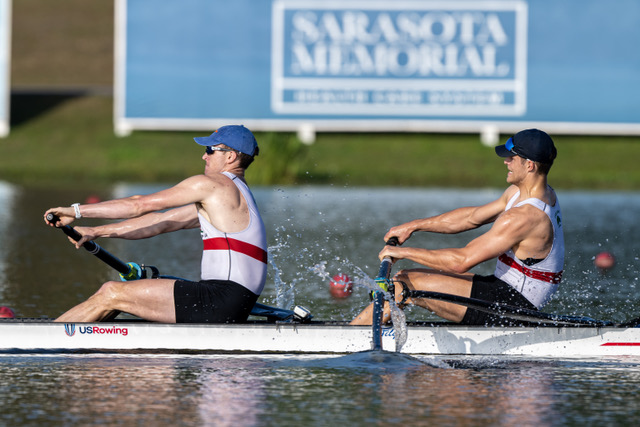
Racing concluded with finals in the men’s and women’s single sculls, lightweight single sculls, and pairs Sunday morning at USRowing’s 2023 Winter Speed Order at Nathan Benderson Park in Sarasota, Fla.

The closest race of the day came in the lightweight men’s single, where the top four finishers crossed the line within 1.07 seconds of each other. Texas Rowing Center’s Jasper Liu (Phoenix, Ariz./University of Pennsylvania) edged out teammate Zachary Heese (Pelham, N.Y./University of Virginia) by 0.09 seconds to take the victory in a 6:59.58. Heese crossed in a 6:59.67. The two rowed together in the lightweight men’s double sculls at last year’s world championships.

“I knew today was going to be really competitive, expecting to have six boats across at the halfway (point) and see who was tougher in the second half and who had the most juice left,” Liu said. “I found myself down in about fifth at halfway and had to fight for it.”

New York Athletic Club’s Sam Melvin (Huntington Beach, Calif./Columbia University), the 2019 Word Rowing Under 23 Championships’ gold medalist in the lightweight single, finished third, crossing in a 7:00.23, while Penn AC’s Jamie Copus (Oxford, England/Oxford Brookes University), a multiple time British National Team member who is hoping to make the U.S. team in 2023, finished fourth in a 7:01.05.

“The goal is the lightweight double and trying to qualify that at worlds this year,” Liu said. “Today was a really good sign for U.S. lightweight men’s rowing – having four boats that close and pulling fast percentages. I think we are going to have a really competitive selection process for the first time in a while. There’s a saying that you can’t make a fast double with two fast people. You need three or four fast guys to make a fast double, so it’s really good to have and it’s going to push us the rest of the year.”

In the lightweight women’s single sculls, USRowing Training Center – Princeton’s Michelle Sechser (Folsom, Calif./University of Tulsa) took the victory over her doubles partner, Sarasota Crew’s Molly Reckford (Short Hills, N.J./Dartmouth College), by 2.61 seconds. Sechser clocked a 7:30.69 to win the race, with Reckford finishing with a time of 7:33.30. The duo has raced the lightweight double sculls the last two seasons, winning a silver medal at the 2022 World Rowing Championships and finishing fifth at the Tokyo 2020 Olympic Games.

“Today’s race was fantastic. It was really nice to show up at the racecourse and have beautiful glass water conditions after the team here endured a couple of days of wavy, challenging conditions,” Sechser said. “It was so awesome to be in this final with doubles partner Molly Reckford and Mary Jones – two incredibly fast, strong, veteran rowers – and just getting to line up with the best in the country is always a great day.

Whitemarsh Boat Club’s Audrey Boersen (West Olive, Mich./Grand Valley State University) finished third in a 7:36.75, with Cambridge Boat Club’s Mary Jones Nabel (Huntsville, Ala./University of Tennessee) taking fourth.

“It was a really fun week,” Sechser said. “(USRowing Chief High Performance Officer) Josy (Verdonkschot) has this fantastic new plan in place. The team was able to come together. We did three weeks of erging up in Colorado Springs and came here and did two weeks of training as a group, so to finish this really nice block with three opportunities to go out and lay it all down on the line is as good as you can ask for.”

Texas Rowing Center’s Sophia Vitas (Franklin, Wis./University of Wisconsin) finished 2.67 seconds ahead of ARION’s Lauren O’Connor (Belleville, Wis./University of Wisconsin) to win the final of the women’s single sculls. Vitas clocked a 7:27.71 to O’Connor’s 7:29.88. TRC teammate Kara Kohler (Clayton, Calif./University of California, Berkeley) finished third in a 7:31.55, with Cambridge Boat Club’s Emily Kallfelz (Jamestown, R.I./Princeton University) taking fourth in a 7:36.19. Vitas raced in the women’s double sculls at last year’s world championships, while Kohler raced the women’s single and Kallfelz raced in the women’s quad. O’Connor is seeking her first national team berth this season after finishing second to Kohler in the single at the 2022 Senior National Team Trials.

“It was a lot of fun,” Vitas said. “There were fast conditions. After having to deal with the wind (earlier this weekend), it was nice to have some flat water to work with. Each race was a little bit different. I learned a little bit more each time I went down the course. It was fun to compete against all of the fast women from around (the country).”

In the men’s single sculls, California Rowing Club’s Sorin Koszyk (Grosse Pointe Park, Mich./Cornell University) continued his strong showing in Sarasota by winning the final by five seconds over CRC teammate Ben Davison (Inverness, Fla./University of Washington). Koszyk, who raced the double sculls at last year’s world championships, finished with a time of 6:49.29, with Davison crossing in a 6:54.29. Davison raced the single at last year’s worlds, finishing eighth. Craftsbury Green Racing Project’s Jacob Plihal (Vashon Island, Wash./Northeastern University) took third in a 6:48.76, with CRC’s Andrew LeRoux (Venice, Fla./Princeton University) finishing fourth in a 7:00.59.

“Today, I was just trying to do my own thing, get into a rhythm, and just put down a good piece,” Koszyk said. “I thought this week was pretty good. I went through each race just trying to put down a solid piece and peak for the final. We’ll just go back to Oakland and just keep training with the guys and see what’s fast.”

USRowing Training Center – Princeton’s Charlotte Buck (Nyack, N.Y./Columbia University) and Jessica Thoennes (Highlands Ranch, Colo./University of Washington) won the final of the women’s pair, finishing 1.52 seconds ahead of USTC-Princeton teammates Kelsey Reelick (Brookfield, Conn./Princeton University) and Molly Bruggeman (Dayton, Ohio/University of Notre Dame). Buck and Thoennes, who were part of the women’s eight at both last year’s world championships and the Tokyo 2020 Olympic Games, crossed the finish line in a 7:06.59.

“It was super fun,” Buck said. “Jess is one of my favorite people to race with. We’ve done a lot of pair racing together, and we learned a little bit from each race this week. We knew since the conditions were going to be better today, that was going to favor our fitness. So, we just wanted to go out there and see what we could do.”

Reelick and Bruggeman, who also were part of last year’s eight, crossed in a 7:08.11, with USTC-Princeton’s Claire Collins (McLean, Va./Princeton University) and Teal Cohen (Dallas, Texas/University of Washington) finishing less than a second back in a 7:08.84. The CRC/CBC composite crew of Meghan Musnicki (Naples, N.Y./Ithaca College) and Alie Rusher (West Bend, Wis./Stanford University) finished fourth in a 7:09.32. Collins won a bronze medal in the event at last year’s world championships (also racing in the eight), while Cohen raced in the women’s four. Musnicki is a three-time Olympian and two-time Olympic gold medalist who is returning to competition after taking last year off, while Rusher was a Tokyo 2020 Olympian.

“We always want to learn something from each race, and we’re still getting better at racing the pair,” Buck said. “So, to take from each race, get a little better, and check a lot of the boxes that were on our list of things we wanted to achieve felt really gratifying.”

In the men’s pair, CRC’s Michael Grady (Pittsburgh, Pa./Cornell University) and Liam Corrigan (Old Lyme, Conn./Harvard University) finished 2.4 seconds ahead of teammates Nick Mead (Strafford, Pa./Princeton University) and Justin Best (Kennett Square, Pa./Drexel University) to win the final in a 6:24.31. Mead and Best finished in a 6:26.71. Grady raced the pair with Best at last year’s world championships, while Corrigan raced in the men’s eight and Mead raced in the men’s four.

“We had a good start, pretty fast through the 500 (meter mark),” said Corrigan. “I think we were just very internal and found a good rhythm. We had about a length most of the race. It felt good.”

CRC’s Oliver Bub (Westport, Conn./Dartmouth College) and William Bender (Norwich, Vt./Dartmouth College) finished third in a 6:28.80, with CRC’s Andrew Gaard (Madison, Wis./University of Washington) and Henry Hollingsworth (Dover, Mass./Brown University) taking fourth in a 6:29.01.

“It was good,” Grady said about this week’s racing. “It was kind of a short prep for a regatta like this – three weeks to hop in a lineup after the altitude camp. It was nice to build off each piece and think of how we can fine tune small critiques from race-to-race. Our focus was no big changes, just small changes.”

Click for full results.

This week’s speed order not only served as an opportunity for rowers to test their speed ahead of next month’s National Selection Regatta but also gave them a chance to earn automatic invitations to the first Olympic Events Selection Camp scheduled for April 30-May 21 in Chula Vista, Calif. The top three finishers in the men’s and women’s single sculls and pairs received invitations to the first selection camp, while the top two finishers in the men’s and women’s lightweight single sculls earned automatic invites.

The first selection camp, in addition to the National Selection Regatta, will determine the athletes who will make up the boats that will race at the 2023 World Cup II this June in Varese, Italy. Select athletes also will be provisionally named to the 2023 Senior National Team, although boats will not be finalized until the conclusion of the second selection camp.

The 2023 World Rowing Championships will take place September 3-10 in Belgrade, Serbia.

USRowing would like to thank Filippi Lido, the Official Boat Supplier for the U.S. Senior, Under 23, and Para Rowing National Teams. Under the agreement, Filippi is providing USRowing a fleet of boats for international competitions including the World Rowing Cup regattas, World Rowing Under 23 Championships, World Rowing Championships, Olympic Games, and Paralympic Games, as well as a domestic training fleet for the USRowing Training Center.

Finals Set at USRowing’s 2023 Winter Speed Order

PROVIDED BY USROWING
PHOTO BY LISA WORTHY

Finals are now set at USRowing’s 2023 Winter Speed Order at Nathan Benderson Park in Sarasota, Fla.

After posting the fastest time in Saturday morning’s quarterfinals of the women’s single sculls, Texas Rowing Center’s Sophia Vitas (Franklin, Wis./University of Wisconsin) came back to comfortably win her afternoon semifinal in a 7:36.51. Racing in the first of two semifinals, Vitas finished 4.10 seconds ahead of ARION’s Kristi Wagner (Weston, Mass./Yale University), who also won her quarterfinal earlier in the day. Vitas and Wagner rowed together in the women’s double sculls at the 2022 World Rowing Championships in Racice, Czech Republic. Craftsbury Green Racing Project’s Grace Joyce (Northfield, Ill./University of Wisconsin) finished third in a 7:43.69 to claim the other spot in tomorrow’s final. In the second semifinal, ARION’s Lauren O’Connor (Belleville, Wis./University of Wisconsin) defeated TRC’s Kara Kohler (Clayton, Calif./University of California, Berkeley) by 2.8 seconds. O’Connor clocked a 7:33.55 to earn the victory. Cambridge Boat Club’s Emily Kallfelz (Jamestown, R.I./Princeton University) finished third in a 7:38.86. Kohler raced the event at last year’s world championships, while Kallfelz and Joyce raced in the women’s quadruple sculls in Racice. O’Connor finished second to Kohler at the 2022 Senior National Team Trials in the single.

In the first semifinal of the men’s single sculls, California Rowing Club’s Sorin Koszyk (Grosse Pointe Park, Mich./Cornell University) clocked a 6:51.41 to finish more than seven seconds ahead of Craftsbury’s Jacob Plihal (Vashon Island, Wash./Northeastern University), who clocked a 6:58.86. CRC teammate Ben Davison (Inverness, Fla./University of Washington) finished third in a 7:01.22. Davison, who raced the event at last year’s world championships, clocked the fastest time in the morning quarterfinals, while Koszyk, who raced in the double sculls last year, also won his first race of the day. In the second semifinal, Andrew LeRoux (Venice, Fla./Princeton University) claimed the victory in a 7:02.29. LeRoux, who was an alternate at last year’s world championships, finished 1.35 seconds ahead of New York Athletic Club’s Eliot Putnam (Littleton, Mass./Cornell University). TRC’s Kevin Cardno (Huntsville, Ala./University of Alabama, Huntsville), who raced in the quad in 2022, finished third in a 7:06.12.

In the lightweight men’s single sculls, Penn AC’s Jamie Copus (Oxford, England/Oxford Brookes University), a multiple time British National Team member who is hoping to make the U.S. team in 2023, won the first semifinal by just under two seconds over NYAC’s Sam Melvin (Huntington Beach, Calif./Columbia University). Both Copus and Melvin won their quarterfinals this morning, with Melvin clocking the fastest time in the day’s earlier round. Copus won the afternoon semi in a 7:09.48, with Melvin crossing in a 7:11.33. NYAC’s James Francis (St. Louis, Mo./Oklahoma City University) finished third in a 7:12.92. In the second semifinal, Texas Rowing Center swept the top three spots with Jimmy McCullough (Philadelphia, Pa./University of Delaware) finishing ahead of Jasper Liu (Phoenix, Ariz./University of Pennsylvania) and Zachary Heese (Pelham, N.Y./University of Virginia). McCullough, who raced the event at last year’s world championships, finished with a time of 7:12.24, one second ahead of Liu. Heese finished another 0.27 seconds back in third. Liu and Heese raced the lightweight men’s double sculls in Racice.

In the lightweight women’s single sculls, Sarasota Crew’s Molly Reckford (Short Hills, N.J./Dartmouth College) posted the fastest time of the morning in the second of three semifinals. With the top two finishers advancing to Sunday’s final, Reckford bested Whitemarsh Boat Club’s Sophia Luwis (McLean, Va./The College of William & Mary) by nearly eight seconds to earn the victory in a 7:37.54. Reckford won a silver medal in the lightweight women’s double sculls at last year’s world championships with partner Michelle Sechser (Folsom, Calif./University of Tulsa). Rowing for Cambridge Boat Club, Sechser won today’s first semifinal by 1.59 seconds over Miami International RowHouse’s Liza Ray (Miami, Fla./Columbia University). Sechser, who posted the fastest time in yesterday’s time trial, finished with a time of 6:42.59. Whitemarsh’s Audrey Boersen (West Olive, Mich./Grand Valley State University) won the third semifinal by just over five seconds. Boersen clocked a 7:38.77 to defeat Cambridge Boat Club’s Mary Jones Nabel (Huntsville, Ala./University of Tennessee). The Tennessee grad represented the U.S. in the lightweight single last year in Racice.

After winning yesterday’s time trial, USRowing Training Center – Princeton’s Kelsey Reelick (Brookfield, Conn./Princeton University) and Molly Bruggeman (Dayton, Ohio/University of Notre Dame) came back to clock the fastest time of Saturday morning’s semifinals. Racing in the first of two semis, Reelick and Bruggeman, who were members of the U.S. women’s eight at the 2022 World Championships, crossed the finish line with a time of 7:04.07, finishing 5.50 seconds ahead of USCT-Princeton teammates Charlotte Buck (Nyack, N.Y./Columbia University) and Jessica Thoennes (Highlands Ranch, Colo./University of Washington), who also were members of last year’s eight. Craftsbury Green Racing Project’s Daisy Mazzio-Manson (Wellesley, Mass./Yale University/University of Texas) and Emily Froehlich (Fishers, Ind./University of Texas) finished third to also advance to the final.

In the second semifinal, Claire Collins (McLean, Va./Princeton University) and Teal Cohen (Dallas, Texas/University of Washington) defeated the CRC/CBC composite crew of Meghan Musnicki (Naples, N.Y./Ithaca College) Alie Rusher (West Bend, Wis./Stanford University) by 2.54 seconds to earn the victory in a 7:06.66. Collins won a bronze medal in the pair and also raced in the eight at last year’s world championships, while Cohen was part of the women’s four. Musnicki, a three-time Olympian and two-time Olympic gold medalist, is returning to competition after taking last year off, while Rusher was a Tokyo 2020 Olympian. USTC-Princeton’s Alina Hagstrom (Seattle, Wash./Oregon State University) and Regina Salmons (Methuen, Mass./University of Pennsylvania) finished third. Both were part of the women’s eight in 2022.

In the men’s pair, CRC’s Michael Grady (Pittsburgh, Pa./Cornell University) and Liam Corrigan (Old Lyme, Conn./Harvard University) recorded the fastest time of the morning in winning the second of two semifinals. Corrigan and Grady clocked a 7:25.24 to finish just over two seconds ahead of CRC teammates Chris Carlson (Bedford, N.H./University of Washington) and Pieter Quinton (Portland, Ore./Harvard University). CRC’s Andrew Gaard (Madison, Wis./University of Washington) and Henry Hollingsworth (Dover, Mass./Brown University) finished third to also advance to the final. Grady raced the pair with Justin Best (Kennett Square, Pa./Drexel University) in 2022, while Corrigan was part of the men’s eight with Carlson and Gaard. Quinton and Hollingsworth raced in the men’s four in Racice.

In the first semifinal, CRC’s Oliver Bub (Westport, Conn./Dartmouth College) and William Bender (Norwich, Vt./Dartmouth College) finished just over three seconds ahead of CRC teammates Nick Mead (Strafford, Pa./Princeton University) and Best. Bub and Bender finished with a time of 6:29.00, with Mead and Best finishing in a 6:32.23. Craftsbury’s Ezra Carlson (Eureka, Calif./University of Washington) and Alexander Hedge (Morristown, N.J./Columbia University) finished third. Mead was part of the men’s four at last year’s world championships, while Bub and Carlson were alternates.

This week’s speed order not only serves as an opportunity for rowers to test their speed ahead of next month’s National Selection Regatta but also gives them a chance to earn automatic invitations to the first Olympic Events Selection Camp scheduled for April 30-May 21 in Chula Vista, Calif. The top three finishers in the men’s and women’s single sculls and pairs will receive invitations to the first selection camp, while the top two finishers in the men’s and women’s lightweight single sculls will earn automatic invites.

The first selection camp, in addition to the National Selection Regatta, will determine the athletes who will make up the boats that will race at the 2023 World Cup II this June in Varese, Italy. Select athletes also will be provisionally named to the 2023 Senior National Team, although boats will not be finalized until the conclusion of the second selection camp.

Speed order racing runs through Sunday. Follow the links for the most up-to-date scheduleheat sheets, and results throughout the weekend.

The 2023 World Rowing Championships will take place September 3-10 in Belgrade, Serbia.

USRowing would like to thank Filippi Lido, the Official Boat Supplier for the U.S. Senior, Under 23, and Para Rowing National Teams. Under the agreement, Filippi is providing USRowing a fleet of boats for international competitions including the World Rowing Cup regattas, World Rowing Under 23 Championships, World Rowing Championships, Olympic Games, and Paralympic Games, as well as a domestic training fleet for the USRowing Training Center.

Cal Sweeps Day One Of Las Vegas Invitational

PROVIDED BY CAL ATHLETICS

LAS VEGAS – The California Golden Bears men’s rowing team got its season underway Friday at the Las Vegas Invitational with a successful outing, sweeping all three races with the varsity eight, 2V and 3V lineups. Originally scheduled to start on Saturday, several of the races were moved up to today due to predicted high winds slated for this weekend.
 
The 3V kicked things off going up against Drexel University’s 2V and Oregon State’s 3V, winning by over 16 seconds with a time of 6:02.44. The men’s 2V followed up with an even more dominant performance defeating Oregon State’s 2V by over 28 seconds with a time of 5:55.22. Rounding out the races was the 1V, who defeated Oregon State’s 1V by just under 20 seconds with a finishing time of 5:49.53.
 
All three boats will close out the Las Vegas Invitational tomorrow with the 2V and 3V taking on the University of San Diego at 7:15 a.m., followed up by the 1V who will take on Colgate at 7:45 a.m.
 
Friday’s Results
1V
1. Cal 1V – 5:49.53
2. OSU 1V – 6:09. 41
 
2V
1. Cal 2V – 5:55. 22
2. OSU 2V – 6:23.46
 
3V
1. Cal 3V – 6:02.44
2. Drexel 2V – 6:18.79
3. OSU 3V – 6:29. 26
 
Friday’s Lineups
1V
Coxswain:  Luca Vieira
Frederik Breuer
Angus Dawson
Gennaro di Mauro
Ollie Maclean
Tim Roth
Gus Rodriguez
Balthasar Issa
Bow:  Campbell Crouch
 
2V
Coxswain:  Grant Fisher
Tyler Kurth
Fred Roper
Daton Wolfaardt
Elliott Kemp
Bret Holt
Harry Manton
Marcus Cameron
Wilson Morton
 
3V
Coxswain:  Savannah Adamo
Christian Tabash
Harry Cox
Dane Halkiw
Jamie Arnold
Matthew Gallagher
Guy Ferrera
Farley Dimond-Brown
Henry Furrer