Home Blog Page 94

2023 Canadian Rowing Hall of Fame Inductions

Rowing Canada 2023 Hall of Fame
Photo and story courtesy of Rowing Canada Aviron

Rowing Canada Aviron is pleased to announce the 2023 inductees to the Canadian Rowing Hall of Fame. RCA recognizes and celebrates the accomplishments of Canadian rowers at the highest levels of the sport, and those whose efforts have contributed directly to those results. Eight outstanding individuals have been selected by RCA’s Hall of Fame committee and are being recognized for their contributions to our sport, as athletes and builders.


Athlete: Derek Porter
A World Champion, 3-time Olympian, and Olympic gold and silver medalist, Derek Porter had a legendary rowing career. Porter achieved swift success in the men’s single by winning gold at the 1993 World Rowing Championships in the Czech Republic followed by an Olympic silver medal at the 1996 Summer Olympic Games in Atlanta, USA. Derek was previously inducted into the Canadian Rowing Hall of Fame as the stroke of the 1992 Olympic gold medal men’s eight.

Athlete: Lesley Thompson-Willie
Lesley had a remarkable rowing career spanning over 36 years with 8 Olympic and 19 World Championship appearances. In that time, Lesley won 5 Olympic Medals (1 gold, 3 silver, & 1 bronze) and 10 World Championship medals thus establishing herself as one of the most revered coxswains in the world. She was also inducted into the Canadian Rowing Hall of Fame as a member of the 1992 women’s gold medal eight crew as well as the Canadian Olympic Hall of Fame in 1994.

Crew: 1964 Olympic Gold Medal Pair (Roger Jackson and George Hungerford)
Fate threw these two talented rowers together to compete at the 1964 Tokyo Olympic Games. This last-minute pairing resulted in Canada’s only gold medal at these Olympic Games. Both Roger and George were inducted into Canada’s Sports Hall of Fame as well as awarded the Lou Marsh Trophy.

Crew: 1997/98 Women’s Pair World Champions (Emma Robinson and Alison Korn)
Emma and Alison achieved rowing excellence by winning back-to-back World Championships in the women’s pair, while also doubling up at the same regattas to anchor the women’s coxed eight to two podium finishes – silver and bronze. Both Emma and Alison are two-time Olympians, competing in the 1996 and 2000 Olympic Games, winning silver and bronze respectively.

Builder: Jean-Christophe (JC) Marly
JC Marly has been committed to creating an inclusive rowing community experience in Toronto for over twenty years. The culmination of his efforts has been the construction of new facilities at the Hanlan Boat Club. His vision and dedication to the sport of rowing have had a lasting impact on innumerable athletes of all ages.

Builder: Nancy Storrs (Posthumously)
Beyond an amazing athletic career, Nancy Storrs was instrumental in launching masters rowing in Canada in the 1980s. Nancy organized the Ontario Ergometer Championships for over 30 years, helping the event grow to be a major indoor championship. Nancy also became the voice and familiar face of the Royal Canadian Henley Regatta in 1987. Her outstanding contributions to rowing have earned her several athletic, coaching, and volunteer accolades throughout her career including an induction into the US Rowing Hall of Fame in 1991.

RCA congratulates all of the 2023 Canadian Rowing Hall of Fame inductees and looks forward to celebrating their accomplishments in the Canadian rowing community this year.
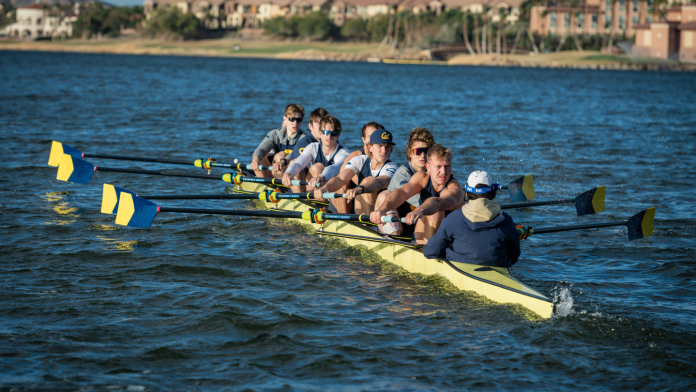
Cal Men’s Rowing Sweeps First Day At Las Vegas Invitational

Cal Men's Rowing 8+
Story courtesy of Cal Athletics. Photo courtesy of Cal Athletics/ Matthew Carter/ KLC fotos

HENDERSON, Nev. – The California men’s rowing team’s 2024 campaign got off to a great start on Saturday at the Las Vegas Invitational as the Golden Bears won all four races they competed in at Lake Las Vegas in Henderson, Nevada. With high winds predicted for later in the day, the team had to adjust and races were moved up several hours sooner than they were expected to start. In addition, the course length was cut short to a distance of 1,975 meters with the exception of the V8+ race which was held at 1,900 meters.

“We row in pretty good water most of the time on the estuary or at Briones and we talked about racing in conditions like this and so to actually have to do it is a really good simulation of what some bigger races later in the year might be like,” Cal head coach Scott Frandsen said. “When we talk about it, we need to be really preparing to race in really rough conditions. I thought the guys handled it really well and also mentally, not having much of a warm up and having to get into that first race. That’s a challenge, but I think everyone had a pretty good attitude about it.”

The V8+ kicked things off in the morning going up against UC San Diego and Santa Clara and won easily with a time of 5:20.8 – a margin of over 17 seconds over second place UCSD.

The men’s 2V8+ took the course next and went up against UCSD and Santa Clara and also won in resounding fashion in a time of 5:47.5 – 13 seconds faster than second place UCSD.
The 3V8+ had the largest margin of victory of the day defeating both UCSD and Santa Clara by a difference of nearly 25 seconds in a time of 5:45.6.

The V8+ raced one more time in the morning and took on Drexel and UCSD and once again won in convincing fashion with a time of 5:30.96, 15 seconds faster than second place Drexel.

“It was a great trip for the team in terms of team building and getting into some crews and seeing how that all goes and being able to have multiple trips down the racecourse at least for the for the varsity this weekend,” Frandsen said. “I was pleased with how it all went and excited to get back into sort of a longer block of training now.”

All three boats will take the course again Sunday to close out the Las Vegas Invitational (race schedule below).

Sunday Schedule (all times PT, subject to change)

6:40 a.m. – 2V8+ vs. Drexel, Oregon State
7 a.m. – 3V8+ vs. Santa Clara, UCSD
7:10 a.m. – V8+ vs. Drexel, Oregon State
7:40 a.m. – 2V8+/3V8+ vs. Santa Clara 2V8+

Saturday Results
V8+ (1,900 meters)

1. Cal – 5:20.8
2. UCSD – 5:38.4
3. Santa Clara – 5:47.8

2V8+ (1,975 meters)

1. Cal – 5:47.5
2. UCSD – 6:00.6
3. Santa Clara – 6:11.07

3V8+ (1,975 meters)

1. Cal – 5:45.6
2. UCSD – 6:09.38
3. Santa Clara – 6:11.48

V8+ (1,975 meters)

1. Cal – 5:30.96
2. Drexel – 5:46.14
3. UCSD – 5:46.8

Saturday Boat Lineups
V8+

Coxswain – Luca Vieira
Stroke – Alex Baroni
7 – Harry Manton
6 – Tobias Kristensen
5 – Wilson Morton
4 – Noah Anger
3 – Nathan Phelps
2 – Jamie Arnold
Bow – Pablo Moreno

2V8+

Coxswain – Iliad Izadi
Stroke – Tommy Barrell
7 – Luciano Andreuccetti
6 – Bret Holt
5 – Florian Unold
4 – Thomas Heerding
3 – Matthew Gallagher
2 – Marcus Cameron
Bow – Robbie Prosser

3V8+

Coxswain – Ethan Nghiem
Stroke – Farley Dimond-Brown
7 – Guy Ferrera
6 – Dan Bradbery
5 – Henry Furrer
4 – Leonard Brahms
3 – Kazimir Kujda
2 – Matthew Waddell
Bow – Bradley Horvitz

STAY POSTED

For further coverage of Cal men’s rowing, follow the Bears on Twitter (@CalMrowing), Instagram (@calmrowing) and Facebook (Cal Crew).

Alabama Rowing Defeats Eastern Michigan on Senior Day

Photo and story courtesy of Alabama Athletics

The Crimson Tide competed against the Eagles on Saturday morning in its lone home event of the spring season

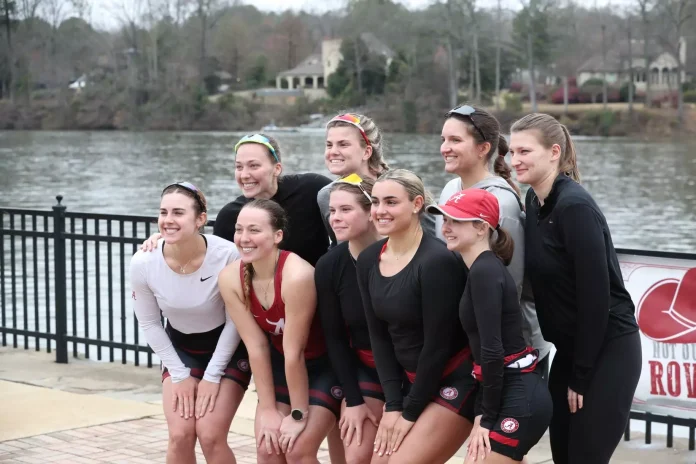
TUSCALOOSA, Ala. – Alabama rowing opened its spring season Saturday morning in Tuscaloosa, hosting Eastern Michigan in an exhibition-style race.In the sprint portion of the dual, the Crimson Tide sent four different Varsity 4+ crews onto the water with Lauren Schneiderman’s crew crossing the line in 10:01.27. Four additional Varsity 8+ crews took to the water as Reagan Labiak’s crew led the pack with an 8:19.26 finish with Ashley Sizelove’s crew on its tail, finishing only 0.6 seconds behind (8:19.86).The morning of racing would also include six 2,000-meter exhibition pieces featuring a variety of Varsity 8+ and Varsity 4+ crews.Alabama seniors Eleanor AlexopoulosRaegan BeightolRachel FullerElla KemnaReagan LabiakAbby PesanskyElizabeth StrubleMichala Struble and Sydney Wenstrom were recognized after the race.

HEAD COACH GLENN PUTYRAE

“We saw what we wanted to see, which is all our crews racing really hard. They’ve been training and putting in a lot of work, and to see them put that work into their racing was exciting. It’s a good first step. [This senior class has] made an indelible impact on this team, as every senior class does, but this class has been through a lot and they helped us accomplish some things that we haven’t ever accomplished in the past, so they helped us make history [with a program-first NCAA Championships appearance], and they’re not done yet.”

RESULTS

  • Collegiate Varsity 4+
    • 1. Schneiderman (10:01.27); 2. Minor (10:13.07); 3. Lewis (10:23.99); 4. Gianfagna (10:28.22)
  • Collegiate Varsity 8+
    • 1. Labiak (8:19.26); 2. Sizelove (8:19.86); 4. Gidley (9:06.49); 6. Jacobs (9:43.89)

LINEUPS

UP NEXT

  • Alabama returns to the water March 16-17, in Oak Ridge, Tenn. for the Cardinal Invite

For the latest information on the team, follow @AlabamaRow on X and Instagram and Alabama Rowing on Facebook. General athletic news can also be found at UA_Athletics on X and Instagram and AlabamaAthletics on Facebook.

What Rowing Coaches Can Learn From Poker

Being “results-oriented” is a common and oft-lauded approach to coaching. I’m sure many of you reading this have this phrase on your resume or have used it in an interview. I know I have. Today, I’m challenging you to put the results aside for a moment and focus on being process-oriented instead. Just as the best poker players do. 

I know poker may seem like an unlikely source of coaching insight, but bear with me. The best coaches are open to inspiration and education from even the most unlikely sources—even casinos. 

In professional poker, being focused on the results is detrimental to performance and will only distract from assessing your performance accurately. You can win with a bad hand and lose with a good one. For example, the best hand in Texas Hold’em, the most popular poker variant, is two aces. The worst hand is 72. If both those hands are all-in before any other cards come, the two aces will win 87.4 percent of the time. 

If that scenario plays out, and you lose while holding two aces against a player with 72, did you make the wrong decision? Of course not. So the biggest determinant of consistent success is not the outcome but the quality of your decisions. The challenge is understanding how and why the decisions were made. 

This is where coaches and poker players have a lot in common. Both must make decisions with imperfect information. Poker players don’t know what cards their opponents have. They don’t know what card will be dealt next. Coaches must recruit without knowing which athletes will pan out. They must select line-ups without wholly accurate on-the-water evaluations. They must write a training plan without knowing whether a different one would produce fitter athletes. 

Both at the table and on the water, the challenge comes in assessing performance accurately after the fact. The best way to do this is to look at the information you had at the time and ask whether you made the best possible decision. If you made the same decision time and again in parallel universes, what would be the results? How likely would you be to win again and again, whatever “winning” means in a particular scenario. 

This is really hard to do. As psychologist Daniel Kahneman argues, humans tend to engage in “attribute substitution.” Rather than doing the hard work of answering this difficult series of questions critically, we choose to answer the simpler one: “Did it work?”

This misses the point and robs us of the opportunity to set the foundation for long-term, ongoing success. You can make the wrong call in selecting a crew and still win. You can train your team improperly and still come out on top if you just happen to have a great group of athletes or your opponents falter. You will never be better until you can examine past decisions critically, setting aside the outcome and determining how to make those decisions better in the future. 

“To win at poker, you have to be very good at losing,” posits Tommy Angelo, the famous poker coach. The same is true for coaching. Only one team wins the national championship at your level each year. But every coach, with the right approach, can learn just as much, if not more, from a well-examined loss. 

It all comes down to making the right decisions. And a little luck.

Perfectionism Isn’t a Virtue

BY KAYLEIGH DURM

Recently, I had the opportunity to write a letter of recommendation for a coxswain, and while I was working on it, I was pondering ideas also for this month’s column. All too frequently I think, “What is there to say that I haven’t said already,” and then an idea will land in my lap. This month is no different, and it’s a concept we all need to hear and sit with for a while before the season begins.

In the letter I wrote, I said this:

“She was confident in her strengths, open about her weaknesses, and willing to push through the discomfort that all soon-to-be recovering perfectionists experience when we lean into the reality that perfectionism isn’t a virtue. It’s a myth that robs of us of the joy and satisfaction we could otherwise experience in the face of a job well done.”

Let me say it again, and louder for those in the back who didn’t hear me the first time: Perfectionism isn’t a virtue, it’s a myth.

For many of us who find rowing and become coxswains, it feels like a role we were born for. It’s an outlet for the strong-willed, assertive women who are mislabeled “bossy” little girls, it’s a space for us to embrace mental athleticism when our physical attributes fall short (no pun intended), and it’s a uniquely challenging opportunity that excites us in ways that conventional ones don’t. There’s something special about being a coxswain that I’ve never been able to put my finger on; it’s just a feeling that you have to experience to understand.

But being a coxswain is also hard. It’s isolating, it’s complex, and it provides numerous opportunities for us to lean into the worst parts of ourselves—the overly critical, invalidating, discrediting, anxious perfectionist that kicks you when you’re down and never fails to find a way to talk you out of the successes you’ve earned.

Do you feel called out yet?

It wasn’t until a few years ago that I acknowledged the toll that my own pursuit of perfection was taking on my mental health. When you’re already burned out and you feel unsupported and undervalued, it is shockingly easy to plant yourself firmly in your own way and tell yourself that you’re the problem. Things aren’t getting easier because you are not good enough, smart enough, capable enough, determined enough, and on and on and on. In most cases, though, you’ve set expectations so far outside the realm of reasonable possibility that no person could realistically attain them, let alone someone who is taking every opportunity to say to herself, “Hey, in case you forgot, you suck at your job”.

So how do we stop doing that? Well, I don’t know. I’m still figuring that out and probably will be for a really long time. But here are the things I’m committing myself to that have helped me begin seeing the light at the end of the very long tunnel. With the spring season right around the corner, I encourage you to come up with some commitments of your own to help guide you down the road of recovering perfectionism, and if you’re struggling to come up with any, I invite you to join me in mine.

1. Don’t let the idea of perfection get in the way of progress.

If you never make it to the execution phase because you’re stuck in the planning, or rather, procrastination phase, you’re intentionally stunting your own growth. Not just as an athlete but as a person. Not every “t” needs to be crossed and every “i” dotted before you try a new call or practice a new drill. The joy in learning comes from the process, not in doing it right the very first time.

2. Don’t talk yourself out of trying just because you might fail.

Failure isn’t the mistake; it’s the idea that you shouldn’t bother trying again.

3. Get comfortable being uncomfortable.

The perfect line, the perfect call, the perfect drill execution, none of it exists—and that is fine. Accepting that as a recovering perfectionist is uncomfortable, but it doesn’t mean that you’re settling for mediocrity (and coaches would do well to stop pushing that narrative). There’s far more growth to be gained in the flexibility of trying new things than there is in the rigid pursuit of perfection.

I’m a process person. I like the strategy of how to do something more than I care about the end result (not always, but usually). It was a harsh and humbling wake-up call when I realized that I was deliberately depriving myself of the thing I enjoy most simply because I’d convinced myself that if something wasn’t perfect, then the entire effort was a waste. Trust me: when you’re training for a 20-mile race and that moment of clarity hits you in the middle of an agonizing 12-mile run, it’s an unwelcome shock to the system. I felt called out by the part of myself that I’d been ignoring for a long time, the part that just wanted to have fun doing the things I love without the need for it to be “perfect” for it to have been worthwhile.

I love coxing more than I love rowing, which is another thing that can be tough to explain (especially to rowers), but I want other coxswains to find just as much joy in our role as I do. In order for that to happen, though, we have to get out of our own way first. It’s easy to put the blame on our coaches and our teammates for making our jobs hard(er), but we need to take a step back and recognize that we put out the energy we think we deserve. If we undervalue ourselves, downplay the work we put in, and diminish the role of the coxswain on our teams, how can we possibly expect coaches and rowers to do any differently?

Chapter 64 of Lao Tzu’s Tao Te Ching includes the line “A journey of a thousand miles starts under one’s feet,” or, as it’s more commonly stated, “a journey of a thousand miles begins with one step.” The road of recovering perfectionism is long and winding, and we have to be the ones to take the first step. In the time between now and the start of the season, let your guard down and give yourself the freedom to take that first step. Just do it. Don’t think about it, don’t overanalyze, just go. Commit to embracing the mistakes you make and learning enthusiastically from every single one. Be self-aware and humble enough to know when you can do better, but don’t let perfect be the enemy of good. Acknowledge the discomfort that you’ll experience and, most importantly, don’t be afraid to let people see you trying.

One last time: Perfectionism isn’t a virtue, it’s a myth. This season, let’s pursue the joy in excellence relentlessly and leave behind the myth that we don’t deserve it if we weren’t perfect in the pursuit.

Floating Classroom

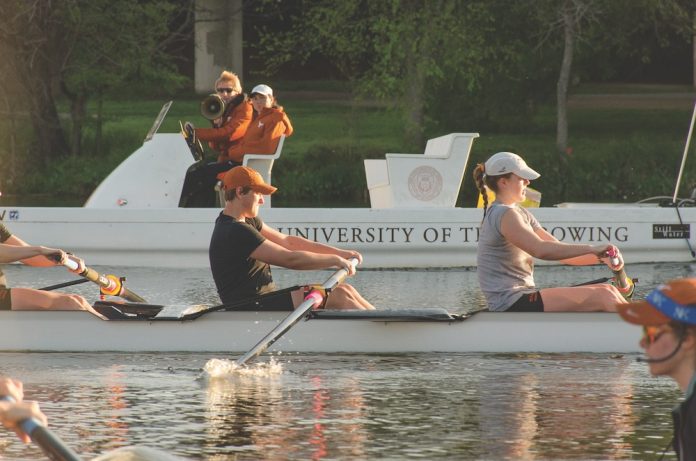
Photo courtesy Texas Athletics.

BY BILL MANNING

Coaches are teachers. Knowing the subject matter—rowing and sculling technique—is a prerequisite but also insufficient unless coaches know how to teach it. The ability to teach the desired technique, not simply knowing it, leads to the best outcomes in the shortest period of time. (There’s tremendous value in creating an environment in which athletes can mess around and figure it out on their own, but rarely is there enough time for this.)  All coaches can follow a simple teaching progression to instruct their athletes more effectively.

Begin by telling athletes what to do. This is obvious and widely accepted but rarely yields good results alone. The explanation must create a picture in their minds as crystal-clear as possible. It’s not enough to speak; a coach must communicate, and often this requires repeated and varied ways of stating the desired behavior.

Explain what should be done rather than what not to do. For instance, “Don’t sky” is less helpful because it’s less specific than “Keep the blade down before the catch.” Positive instructions are explicit and give clear direction toward the desired behavior. Negative instructions leave open too many other possible actions. Tell your rowers what you want them to do rather than one of the many things you don’t want them to do.

Next, explain why. When athletes understand the “why” behind the “what,” they’re more motivated to get it right. Doing so can be as simple as showing a much faster crew (“See what the varsity does that helps them go fast”) or as complicated as explaining the physics behind it (“By keeping the blade down, you miss less water and connect the blade better, thus moving the boat faster”). Too often, we underestimate the curiosity and intelligence of our athletes. By neglecting to involve these powerful traits, we miss learning opportunities. Understanding is empowering.

Knowing what to do and being motivated to do it, athletes now need help learning how to do it. If “what” is direction, then “how” is instruction. Work back from the desired behavior to the underlying actions that can produce the correct outcome. Demonstrate and describe how to do what is wanted: “Square the blade down to the water by rolling the knuckles of your inside hand up and away….Keep the chin and chest up and thus the hands up.…Keep the lower edge close to the water by sitting tall and keeping the hands relaxed as the knees rise.…Loosen your grip.”

Combining demonstration with description is the best way to convey how to do it correctly. Without verbal explanation, your athletes won’t know what to focus on or what actions bring about the desired result. After you show and tell the athletes, they should attempt to imitate; crucially, the coach should correct to refine the imitation and improve it. There must be accountability to the repetition, and it doesn’t serve your athletes to avoid correcting them. Negative feedback can be delivered when there’s a positive atmosphere and trust. Hold your rowers to the appropriate standard for their age, capabilities, and ambitions.

Typically, successful coaches introduce the “what,” explain “why,” teach “how,” and repeat until athletes get it right.

The Connected Coach

BY MADELINE DAVIS TULLY | PHOTO BY LISA WORTHY

It’s not unusual for coaches to feel as though they’re on an island. Peers are spread out across the country, seen infrequently and almost always under the stressful and adversarial conditions of competition. There’s often hesitation about sharing too much about the team or showing vulnerability to competitors. In reality, 90 percent of what coaches go through—the good and the bad—is the same across institutions, conferences, and divisions. There’s far more that unites the experiences of coaches and rowers than differentiates them. 

Your opponents are not your enemies. They are your greatest resource—for accountability, knowledge, and, yes,  friendship. We do better when we feel understood, challenged, and able to speak openly to others who can relate to what we’re going through. You’ll be a better coach and person for having peers with whom to commiserate and share ideas, for having a few good people to whom you can turn who understand what you’re going through, what you’re striving for, what challenges you’re facing. 

In an ideal world, this would happen organically, but too often this just isn’t the case. This is why it’s crucial to take the initiative in creating your own coaching tribe. 

Shortly after Covid began, I was fortunate to find myself building a group text with five other female coaches from five different schools in four different conferences stretching from coast to coast. That running conversation on text and Zoom—sometimes logistical, often vulnerable, always hilarious—became a place where we could set aside the reality that sooner or later all of our crews would race and instead be there to cheer each other through good times and support each other through challenging ones.

That group text preserved my sanity on more than one occasion and provided some great ideas that I applied to my own team. Knowing that I had that group to turn to made every new situation easier to face, made me feel more confident (or at least less alone) and enabled me ultimately to be a better coach and leader. 

So get out there and begin building your coaching tribe. Do so intentionally and wholeheartedly. Don’t be shy. Deepen your relationship with coaches you already know and introduce yourself to those you don’t. Put yourself out there by sending that text or, better yet, making that call. You’ll be surprised by how many coaches out there are in need of this kind of connection, whether they know it or not.  

Minding a Rower’s ‘P’s’

BY BILL MANNING | PHOTO BY LISA WORTHY

For most coaches, the challenge when teaching rowers is where to begin. Troubleshooting a rower’s stroke helps detect what’s actually going on and what can be improved. Though the stroke cycle is continuous, focusing on its elements generally makes the whole better. A handy hack for coaching better is looking at the stroke with “the P’s” in mind.

Posture. “Posture proceeds performance,” former Boston University men’s rowing coach Rodney Pratt preached. Rowers should sit on their seats square and level, weight distributed evenly left to right, neither too far forward nor too far back. Their hips should be elevated (lift the belly button) so their pelvic bones—the sit bones—are the primary point of contact. 

Rowers should be able to sit in this position comfortably for an extended period. If not, ask them to put their hands on the gunwales, lift off the seat gently, and sit back down. This will help center their weight on the seat.

Next, check that the bottom of their feet connect to the foot stretchers. Engaging with the foot stretchers balances the boat and creates the potential for power.

Rowers should keep the oar collar(s) firm against the oarlock(s) through the entire stroke cycle. This light lateral pressure keeps the lever engaged against the fulcrum of the pin, thus balancing the boat and making the drive more effective.

Preparation. Everything in the stroke cycle depends on what’s done before. The recovery begins with rowers separating the handle from the body and forming a rectangle—outstretched arms making up two sides, shoulders and handle the other two. Look for the pivot from the hips, the pelvic tilt, being low in the torso and early on the slide. Too often, body weight doesn’t shift forward because rowers are reaching from their shoulders and rounding the upper back. After pivoting, the body is positioned and remains patient as the knees rise. The recovery is sequential but overlapping. It should position rowers so they’re poised to reverse direction. Pause drills reinforce proper preparation.

Pushing with a firmly braced body initiates the change of direction. While pressure on the foot stretchers and handles should be equal, emphasize pushing. The tendency to pull rarely needs reinforcing, but the need to push always does. Just like the recovery, the drive should be sequential but overlapping. This is achieved by the trunk’s prying open against the continued push of the legs. The pertinent mantra: “Push…push pry…push to prevail.”  

Rowing with greater resistance—meaning a heavier boat—helps teach prying against the leg push. In a single, hold the oars closer to the collars, and in sweep, row inside-arm-only to achieve this effect. Rowing a team boat with some sitting out works, too.

Pulling seemingly comes next, but too often pulling replaces pushing rather than adding to it. While the arms draw the handle toward the body, this depends on continued pressure being applied through the shoes (every action has an equal and opposite reaction). If the finish is weak, the problem almost always is insufficient pressure on the feet rather than too little on the front of the handle. Maintain posture and keep pressing. 

Power properly applied cures most problems. Rowing powerfully with the feet on top of the shoes rights many wrongs.  “More power!” is often the best coaching advice one can give.