Home Blog Page 7

Back on the Water

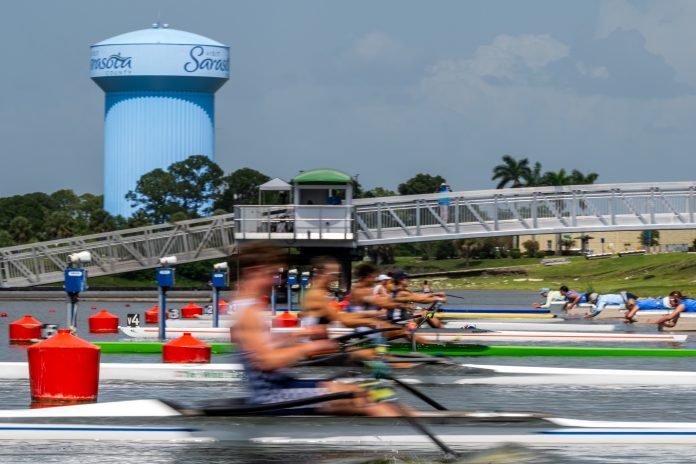
At the start of the 2,000-meter racecourse, Nathan Benderson Park, Sarasota-Bradenton, Florida. PHOTO: Lisa Worthy.


Nathan Benderson Park hosts the American Youth Cup Series I Saturday and Sunday, February 14-15 (with practice on the Friday) and then the Sarasota Invitational on the last weekend of February with middle school races on Friday, juniors on Saturday, and masters on Sunday.

Beefing Up Your Flexors and Extensors

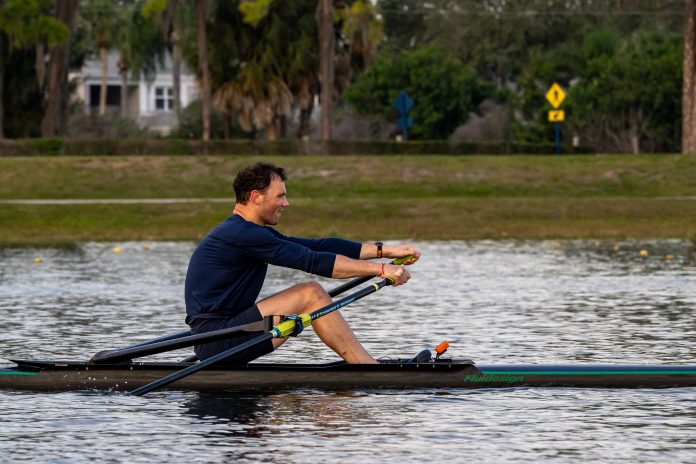
Strengthen your flexors and extensors before getting back on the water. PHOTO: Lisa Worthy.


Now is the time to ready the forearms for the indoor-to-outdoor seasonal shift. Digital flexors and extensors that have not feathered or rolled a blade all winter require some pre-season conditioning.

Sweep rowers need to isolate the functions of their hands to adjust blade position and handle height. Tendon strength develops more gradually than muscle, so proactive attention to the hand and forearm muscles helps ward off potential tendinitis in your wrist and elbow.

Extensor muscles function primarily to move the fingers, wrist, and elbow out of flexion. Flexor muscles are stronger, providing grip and power. Focus on developing extensors before the coxswain commands “hands on” again.

Sample exercises for the elbow includes pushups, dumbbell chest presses, dumbbell triceps kickbacks, and dumbbell overhead triceps presses.

For wrist extensions, place your forearm along an armrest or table with your wrist hanging over the edge and your palm facing down. With a weight in your hand, lift it toward the ceiling. Lower slowly and repeat.

For wrist rolls, attach one end of a rope to a light weight and the other to a dowel about the diameter of an oar. Hold the dowel with your palms facing down and roll the weight upward. To increase the difficulty, straighten your arms.

Exercise finger and thumb extension by placing a rubber band around the outside of your thumb and index finger and pulling them away from each other. Repeat with your thumb and other fingers, then all fingers together. To progress, repeat with a thicker band.

Marlene Royle, who won national titles in rowing and sculling, is the author of Tip of the Blade: Notes on Rowing. She has coached at Boston University, the Craftsbury Sculling Center, and the Florida Rowing Center. Her Roylerow Performance Training Programs provides coaching for masters rowers. Email Marlene at roylerow@aol.com or visit www.roylerow.com.

Coxing: A Feast for the Eyes

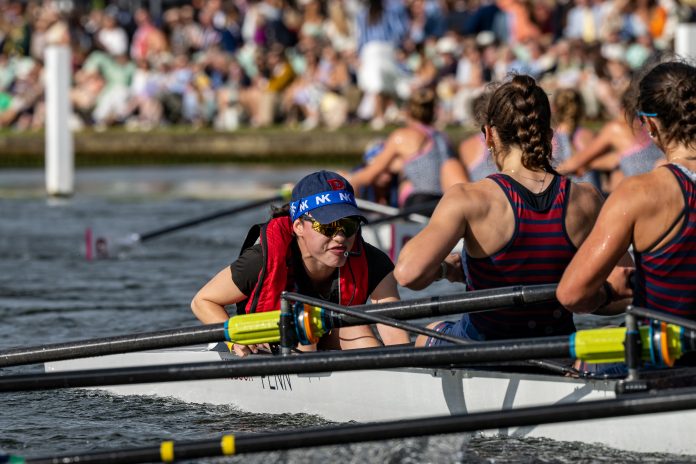
PHOTO: Lisa Worthy.


So you’ve been working hard all winter, soaking in knowledge, bonding with your rowers, and probably curating some erg-room playlists.

You’ve been with your rowers since day one, making keen technical observations and learning the perfect thing to say halfway through the team’s hardest workout. Now you have to figure out how to apply what you’ve learned when you’re back in the stern (or bow).

I spoke to Izzi Weiss about the transition from land to water in the spring. Izzi coxed at the University of Virginia for four years and won gold and bronze medals with the U.S. Under 23 team. Weiss runs Inside Turn, a coxswain consultancy that helps coxswains at every stage of their career take the next step.

First, don’t underestimate the importance of the emotional connection you’ve created with your rowers over the past few months of training. If you’ve paid attention to your rowers and approached practices with intention, you can reap the rewards on the water.

“You get to establish strong bonds on land and have more time to help rowers with what they’re working on,” Weiss said. “You can build a rapport that’s different from being in the boat.”

Sure, you may not be on the erg with your rowers (or maybe you are!), but if you’ve been engaged in your land sessions and invested in your rowers’ development, then you’ve demonstrated that you’re with them every stroke.

Now, you have an opportunity to strengthen those bonds on the water.

“There’s a sense that you’ve really showed up for them, and now they can show up for you and work together in a different way,” Weiss said. “You’ve been there for them in really hard situations, and they trust you and rely on you.”

From a practical standpoint, because you’ve seen how your rowers react to hard training, you’re better attuned to when they might need extra encouragement or input.

The move from winter training back onto the water is an opportunity to help your rowers technically as they get back into a boat. For a coxswain, winter training is a feast for the eyes; you can see so much more standing in the erg room than sitting in the stern. You can see where rowers begin a session and how their technique changes from fatigue or stress. 

“Obviously, in the fall and spring, you work with people on their bladework, but in the winter you can see how their bodies are moving when they’re rowing in a way you can’t in the boat,” Weiss said.

On the water, “you can see [their bodies] only if they’re in the boat next to you, and in that case you can’t help them in that moment.”

Use the winter to connect what you’re seeing the bodies of your rowers do with what you see their blades do on the water.

“Try to understand people’s body position and technical growth areas beyond the handle and the oar,” Weiss said. “If you know that so-and-so drops her chest into the catch, then, when her blade is moving away from the water, you can put together what’s happening. If you remember how she ergs, that gives you a lot more context on what could be happening on the water that’s causing poor bladework.”

This enables you to give better feedback when looking at blades. Pointing out the problem is far less effective for fostering improvement than offering a solution. Observing stroke after stroke on land can give you the confidence to present solutions to struggling rowers once you’re back on the water.

“The most important carryover to me is that you get on the water and you know more about your rowers than when you finished the fall,” Weiss said.

If you walk into the boat bay in the spring with renewed excitement and a better understanding of your teammates, it should pay dividends on the water immediately. 

Hannah Woodruff is an assistant coach and recruiting coordinator for the Radcliffe heavyweight team. She began rowing at Phillips Exeter Academy, was a coxswain at Wellesley College, and has coached college, high-school, and club crews for over 10 years.

Coach Development: Continuing Education

Kemp Savage, John Gartin, Becky Robinson, and Janet Raymer at The Conference for Rowing Coaches, Saratoga, N.Y., Dec. 6, 2025.


Hey coach, what’s your plan this year for professional development and continuing education?

Doctors, lawyers, and accountants—real professionals in the eyes of society—all have continuing-education requirements for certification in most states. For accountants, it’s usually 40 hours.

Like lawyers themselves, the requirements for attorneys vary widely, but ever-changing laws compel professional development.

To maintain their board certifications, physicians must complete continuing medical education (CME) every two years (in most cases). An entire industry of conferences—in appealing destinations—has grown to address the necessity of CME.

We rowing coaches want to be respected as the legitimate professionals we are, but what’s our record when it comes to professional development and continuing education?

Mixed, at best.

USRowing offers certification levels, currently from 0 to 3, that enable rowing coaches to earn credentials from the USOPC-recognized national governing body of our sport. While those certification levels get plenty of criticism from veteran rowing coaches (some of it deserved), third-party validation is invaluable, especially for schools, which are understandably risk-adverse and sensitive to liability.

The safety training required for Level 1 certification alone is worth the relatively minor investment of time, money, and energy. Anyone who purports to be a rowing coach in America should have at least that level of certified professional skill.

USRowing Level 1 certification, like most rowing continuing education and professional development in the post-Covid era, is available online. That’s great for containing costs and making it accessible. In other words, no excuses.

If you’re not pursuing continuing education and professional development, “you’ve stunted your growth,” said Peter Steenstra, head rowing coach at Bates College, which has won the NCAA Division III national championship five times. “You’re not getting better.”

Steenstra and his college boatmate Mark Davis, head coach of Seattle Prep, run The Conference for Rowing Coaches, successor to the late Jim Joy’s Joy of Sculling Conference.

Ohio State head coach Emily Gackowski agrees with Steenstra that the greatest benefit is the in-person experience. The casual atmosphere of a coaching conference fosters serendipitous exchanges and provides opportunities to learn that just don’t happen looking at a screen.

“Conferences are a chance to acquire contacts and establish a connection with others,” said Gackowski, who attended the 2023 Women’s Coaching Conference on a Shimano scholarship as an assistant coach before becoming head coach in 2024.

“I found the conference to be extremely insightful. A lot of coaching staffs, at both the club and collegiate level, end up in an echo chamber because we don’t want to show our cards and give away our competitive edge.

“That makes it tough to bring in new ideas and thought processes, and ultimately coaches fall into the trap of hearing only voices that agree.

“Attending a conference gives you the opportunity to learn from others and talk with others without feeling like you’re giving away your edge. It allows you to expand your network.”

The most valuable lessons of a conference commonly occur between the formal presentations. Chance encounters, friendly introductions, and impromptu conversations spark discussions, offer insights, and start relationships that can be far-reaching and transformative. You enhance your odds of success when you surround yourself with other rowing coaches who are just as motivated to improve.

“Just being together is what makes that happen,” Steenstra said. “When you hear stories from older coaches about how they dealt with conflicts on the team or with administrators—stuff for which there’s no playbook—you learn from those experiences.”

Not to mention getting your next job or hiring your next assistant.

“This is how I met Mari Sundbo, the person I ended up hiring as our recruiting coordinator,” Gackowski said. “I often thank myself for going outside my comfort zone to get to know others, because Mari is incredible, and I never would have known her had I not attended the WCC.”

Act like a real professional and attend a rowing conference this year.

Chip Davis is the founder and publisher of Rowing News. An oarsman from birth, he rowed on championship crews at St. Paul’s School and Dartmouth College, where he captained the lightweights. Now he sculls in Vermont when the weather is suitable and ergs the other half of the year.

Vanderbilt Rowing’s Culture of Respect

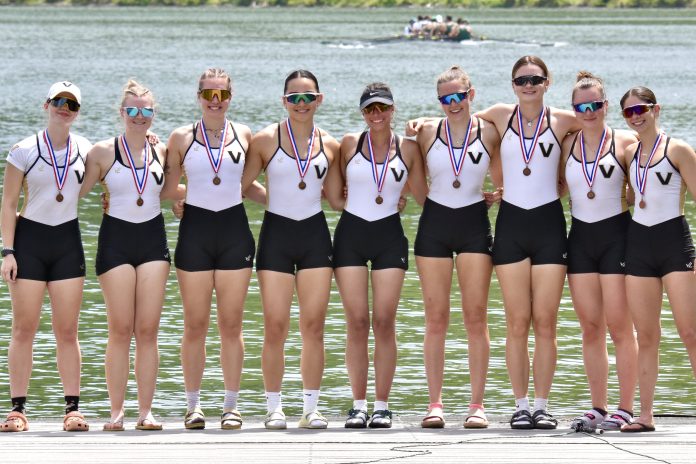
Vanderbilt’s recent results have been highlighted by the women’s eight, which has finished on the podium in each of the last three ACRA championship regattas, taking silver in 2023, then back-to-back gold medals in 2024 and 2025. PHOTO: Courtesy Vanderbilt Rowing.


By Bob Ford

The first time Jon Miller became aware that Vanderbilt University had a rowing program was when he stole one of their boats.

To put the tale in a more favorable light, “borrowed” might be a better verb, but when you drop somebody else’s boat in the water and go rowing off, the distinction is thin.

Miller, home in Nashville for the summer after his sophomore year of rowing at Michigan, ran into a high-school classmate who also had become a college rower.

“She said, ‘Hey, there’s this double out at the lake. I think it’s Vanderbilt’s. We should go row it.’ I don’t think we got permission,” Miller said. “So we took this double out a couple times, and that’s the only reason I even knew Vanderbilt had a team.”

He could be forgiven the oversight. Vanderbilt’s rowing program began in 1985 but didn’t gain much traction until Miller graduated from Michigan, moved back home to Nashville, and two years later, in 2009, agreed to become head coach of the Commodores.

“I was like, maybe I’ll do this for a year or two,” Miller said. “And here I am now.”

Rowing is a club sport at Vanderbilt, and the coaches are not school employees. Miller and his five assistants receive modest volunteer stipends, but everyone has a day job or postgraduate studies that take precedence once practice finishes as the sun rises over Percy Priest Lake, 10 miles east of Nashville.

Competing in the American Collegiate Rowing Association, Vanderbilt won its first ACRA championship regatta medal in 2010 and has improved steadily on both the men’s and women’s sides under Miller and his staff.

The last several years–once free of Covid restrictions that limited training to single sculls and solitary ergometer sessions–have seen a remarkable stretch of success. Beginning with a 2021 gold for the men’s four at the Head of the Charles, a win that had an enormous impact on recruiting, Vanderbilt has made sure no one in the rowing community is still unaware the program exists. The recent results have been highlighted by the women’s eight, which has finished on the podium in each of the last three ACRA championship regattas, taking silver in 2023, then back-to-back gold medals in 2024 and 2025.

“What we’re accomplishing now is what I always thought we could. It took a little longer than I thought it would, and that’s just the truth of it,” Miller said. “I was a pretty young coach who made some mistakes. It took a while to refine what would work for us. The big thing is, they buy in. There’s a mutual respect for what we’re trying to do. They know I’m not perfect, I know they’re not perfect, but all of us show up trying to give our best every day.”

Cornelius Vanderbilt had his own success on the water, building what became a shipping empire from a humble ferry service with one small boat operating between Staten Island and Manhattan. Vanderbilt did not row the boat but he chased business with such zeal that other captains dubbed him “The Commodore,” somewhat derisively. This bothered Vanderbilt not at all.

He would certainly take pride in the current rise-from-nothing success of the rowing program at the university that bears both his name and his nickname.

Competing at the club level brings a unique set of challenges. ACRA is the largest governing body in collegiate rowing, with more than 152 member institutions. There are no scholarships, and facilities vary widely. Vanderbilt is better off than many club programs–with a travel budget for occasional trips to regattas, very good equipment, and an enviable erg room. On the other hand, the Commodores don’t even have a boathouse at the lake. The boats are on trailers or blocks, some with covers, some not. When rowers flip over the boats to begin the day, they need to evict all manner of intruders.

“It seems like every year we lose a frosh because they roll it over on the first day and there’s a bunch of ants or wasps in their seat. They flip out, and you never see them again,” Miller said. “You just shrug and think it wasn’t meant to be. And we’ve got mice and other rodents that chew up the wiring in the boat, so we go through a decent amount of wiring.”

Club sports at Vanderbilt fall under the umbrella of the athletic department but are administered by the Recreation and Wellness Center. The purpose is to make sports—there are approximately 30 club teams at Vanderbilt—available to anyone in the student body who wants to participate. Miller doesn’t make cuts, and easily three-quarters of his rowers come to the program with no prior experience.

“An advantage of not having scholarships is that everyone there wants to be there,” said Sarina Samuel, who was in the eight for three years and just graduated. “No one is paying you to wake up at 4:40 in the morning and be out there in the freezing cold working as hard as you can. That mentality and that culture is unique. The culture of the program is that we’re the underdogs. We don’t have a boathouse. We don’t have university funding in the same way as some other programs. My freshman year, we couldn’t even fill an eight. It’s been special to be part of that program, and I’m excited for what they can do next.”

When Miller began building the women’s eight, he told the women he was hoping to put in the boat that he had very ambitious plans for it.

“He could see the potential in the team before anyone else,” said Norah Kolb, who is a senior this year and two-time ACRA First Team All-American. “He said in a couple of years we’re going to be this and do this, and I just had never heard a coach talking about their goals that far out and being so secure in them.”

There was a different lineup in the eight every year once it became established, of course, and different lineups at different races. Three women were constants in the boat that medaled at the three consecutive ACRA regattas: Samuel, Kolb, and Amelia Simpson. What makes that most interesting is that each represents one of the paths to club rowing.

Samuel began rowing with a private club in Miami Beach when she was in seventh grade and wanted to stay with the sport. Kolb, from Newtown, Conn., was a competitive swimmer in high school, burned out on that, and decided to try something else. She had never rowed. Simpson, from Brisbane, Australia, had ridden horses growing up but wasn’t a competitive team athlete. “I wasn’t a competitive anything,” said Simpson, who graduated this year.

Combine that obvious learning curve for the newcomers with the technical aspects of being in an eight, and you can see the distance that had to be traveled to get to the top step of the medal stand.

“We sat those women down, and none of them knew what ACRA was, and none knew that we hadn’t even sniffed the grand final in the women’s eight,” Miller said. “But we told them that they would medal at ACRA before they graduated. They didn’t know how tall a task that was. They were just like, ‘Hey, that seems like a good goal. Let’s do it.’ So, you don’t have to deal with: ‘Shoot, coach, how are we going to do that?’ That group just bought in.”

In 2023, the women’s eight came in second to Bowdoin in the grand final, nearly three seconds behind. It was an amazing accomplishment, but it still wasn’t satisfying.

“We were crushed. It was a weird feeling that it didn’t feel as good as we thought it would,” Miller said. “We knew that we were trying to win gold.”

That happened the following spring, when the eight edged Purdue (by 0.28 of a second) to claim the title. This past spring, completing the cycle of improvement, the team won the grand final by open water over Northwestern.

“You get the right people in the right culture,” Simpson said. “I’d say we were never satisfied. We wanted to stay greedy, to stay hungry.”

“It’s not glamorous,” Kolb said. “You show up in the cold, and there’s spiders in the boat, and you have to wade through the mud to get your boat, but that’s the grit that made this team stronger. We’re racing side by side against DI programs, and we know what they have access to, and it just makes it so much more special.”

“I was leaning very strongly toward going to a Division I school,” Samuel said. “When you’re in high school and that’s what your friends are doing, you want to prove you can do it, too.

“But I can remember one of my first conversations with Jon, and the passion he had for the program, and the action items he had. I was super excited to be part of a program that’s progressing. I’m motivated by progress, and it was great to be part of a program that was growing and gaining momentum.”

It isn’t all early-morning wake-ups and late-night erging, of course. Their journey is longer than 2,000 meters and more lasting than a gold medal that might end up in a drawer. The coaches and the rowers have built something special on a foundation that was decidedly modest. That is the journey that will last for them, and who needs a boathouse when you have that?


Bob Ford, a seven-time Pennsylvania Sportswriter of the Year, wrote for The Philadelphia Inquirer for more than 30 years, during which he covered plenty of rowing. His rowing-related thrills included stories about Prince Albert of Monaco, grandson of Jack Kelly, the fabled Philadelphia oarsman—albeit focused on bobsledding.


Parity At Last

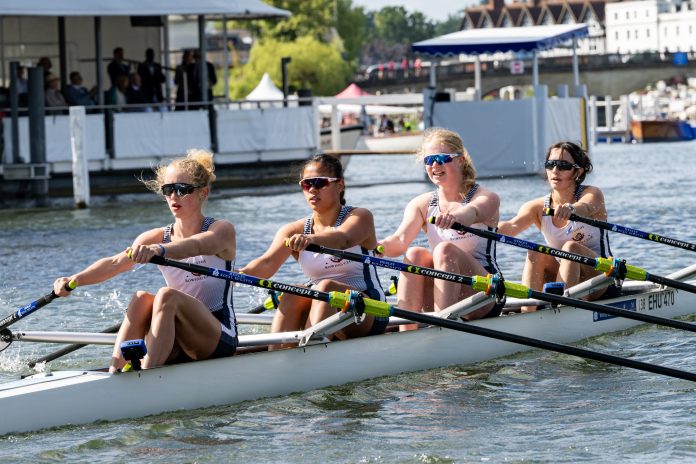
By 2027, Henley Royal Regatta will offer an equal number of open and women’s events, achieving gender parity for the first time. PHOTO: Lisa Worthy.


Henley Royal Regatta has added three new women’s events for student, club, and intermediate quadruple sculls, and with the expected discontinuation of three “open” (men’s) events, the storied regatta will achieve gender parity in the number of events offered for the first time since it began 186 years ago.

Fuel: Managing Food Challenges When Traveling

Fueling for regattas tests the nutrition knowledge rowers have acquired during the season, including how to plan in advance for meals and snacks on the road.


Traveling with a team to a training destination or weekend-long regatta presents many sports-nutrition challenges, especially when some rowers have special dietary needs (vegan, dairy-free, gluten-free, nut-free, etc.).

Add back-to-back races with limited recovery time, and optimal fueling gets even more challenging. To reduce those challenges, many professional, Olympic, and collegiate teams hire a registered dietitian (R.D.) who is also a board-certified specialist in sports dietetics (C.S.S.D.)

The registered dietitian and certified sports dietetics specialist makes arrangements for proper meals and snacks when the team is on the road and occasionally even travels with the crew. Usually, athletes and coaches on high-school, club, and community teams are left to fend for themselves when it comes to figuring out how to eat well.

While a coach, athletic trainer, or parent might step in and attempt to manage fueling needs, this normally falls outside their area of expertise. Because managing a traveling team’s fueling requirements is important, here are some helpful ideas drawn from a webinar presented by Professionals in Nutrition for Exercise and Sport and the American Sports and Performance Dietitians Association.

During rowing events that involve travel and hotels, food challenges arise inevitably, such as needing food for a team that competes hours later than scheduled because of weather delays; replenishing a dinner buffet that runs out of food because another group got there first; finding budget-friendly food choices at hotels, etc. These are times when a registered dietitian or sports dietetics specialist can take charge, handle food issues, and offer the team a huge advantage.

Fueling for regattas tests the nutrition knowledge rowers have acquired during the season, including how to plan in advance for meals and snacks on the road and how to be adaptable when food expectations fall apart. When rowers understand why it matters what and when they eat, they’re more likely to apply optimal fueling practices, even when routines disappear.

Regatta schedules filled with back-to-back events are challenging for rowers who have little time to refuel optimally. They need to be taught how to take advantage of every opportunity to eat and drink, before, during, and between events, as well as before bed and in the early morning. A team nutritionist can educate rowers during training—before the regatta season—so they understand the important role food plays on a daily basis in enhancing performance, recovery, and injury prevention.

If traveling by plane or bus, some teams get handed a travel pack (fluids, food, protein bars, energy bars, ear plugs, eye mask). This is a nice touch, if allowed by the budget. At the very least, someone should make sure each rower is carrying a water bottle. Never travel without fluids being readily available!

On-site snack shacks may sell hot dogs, french fries, and other inappropriate sport foods. Whoever is responsible for feeding the rowers should find out in advance the location of nearby grocery stores, bring a rolling cooler for fluids, and pre-pack quick carb-based sport snacks (pretzels, bagels, grapes). Gathering information from other teams that have been at the site before can be helpful. Even with the perfect plan in place, however, good intentions often fall apart.

Pre-event anxiety can heighten rowers’ fears about suffering from GI distress or “feeling heavy” if they eat before they compete. Ideally, the team nutritionist has encouraged them to experiment with event-day fueling before the regatta. Popular and well-tolerated carbs include gummy chews, gels, and apple sauce, as well as cut-up fruit. (Athletes generally prefer cut-up fruit, such as orange slices, to a whole piece of fruit.)   

Back-to-back events require that rapid refueling begin as soon as possible. Rowers should prioritize calories and carbohydrates (not protein). When the event begins, someone needs to set out recovery fluids, shakes, and snacks so they’ll be ready and waiting to replenish sweat losses and energy stores. Best scenario: Someone has packed a cooler with a variety of shakes and recovery products ready to be grabbed after the event. Writing the rower’s name on the shake increases compliance.

When rowers finish events at differing times, such as happens at a regatta, swim meet, or track & field event, the best plan is to have the post-event dinner delivered to the venue. This is far preferable to wasting refueling time by waiting several hours to eat a team dinner at the hotel.

By the middle and end of the season, a travel team often tires of travel food. A creative dietitian can nudge hotel chefs or caterers to tweak their standard menus and add some of the rowers’ favorites while keeping in mind the principles of sports nutrition. Offering special meals and fun foods encourages adequate intake of carbs and calories.

Traveling to an international rowing event makes food even more challenging, since what’s ordered may not be what rowers expected. An American rice cake might be entirely different from a Japanese rice cake.

At the elite level, Olympic and Paralympic teams often create their own performance pantry stocked with desired sport foods. Since the main dining hall in the athletes village caters to thousands of athletes, volunteers, and staff representing over 30 sports and over 200 countries, having a customized food pantry can eliminate potential food problems.

Food safety is critically important at all sports events. No athlete wants to lose because of food-related illness. Troubling fact: Self-serve buffets are one of the riskiest food-service environments when it comes to infection control.

When participating in multi-day regattas, you can spot the rowers who do not have a food plan or sports-nutrition knowledge. You don’t want them on your team! With proper nutrition education and pre-travel meal planning, your team will have an advantage. A sport dietitian and dietetics specialist can be instrumental in helping your crew overcome fueling challenges before, during, and after repeated days with back-to-back events.

If you’re going to be a serious competitor, why not eat to win? 

Nancy Clark, M.S., R.D., C.S.S.D., counsels both fitness exercisers and competitive athletes in the Boston area (Newton; 617-795-1875). Her best-selling Sports Nutrition Guidebook is a popular resource, as is her online workshop. For more information, visit NancyClarkRD.com

We’re All In The Same Boat

Nathan Benderson Park hosts the Sarasota Invitational on the last weekend of February with middle school races on Friday, juniors on Saturday, and masters on Sunday. PHOTO: Lisa Worthy.


“My lab partner just isn’t pulling his weight,” a student complained recently to his faculty advisor (not me). “I’m very frustrated and worried about my grade.”

Although the student’s advisor is not a rowing coach or ex-oarswoman, it was crystal clear what the student meant.

I’ve been fooling around with artificial intelligence lately and decided to see what other rowing metaphors are out there, knowing, of course, that I’d know most of them. Claude, the program that is supposed to be good with language queries, helped me out.

This isn’t the first time I’ve thought about how often rowing expressions and metaphors have crossed over into common speech. Our school has rowing, so perhaps more of these linguistic borrowings get used here. For the first time, I thought about how many of them might be used by people with no connection to the sport.

Baseball is the leading contributor of linguistic additions to American English. You might be in a pickle if you strike out. Or you might hit a home run or knock it out of the park when you give a great presentation. Let’s touch base next week, someone might say to you. Has anyone ever gone to bat for you? What about when you need to take a rain check or maybe someone has pinch-hit for you? I’m sure you’d like to be known as someone who is always on the ball.

I have to restrain myself from screaming when I hear someone say, “She’s batting a hundred.” That batting average would be miserable. Batting a thousand is what is meant. And it’s always better to see if your idea is in the ballpark before you get thrown a curveball.

Baseball is the great American pastime, so it shouldn’t surprise us that it leads the league in language contributed to common speech. But rowing holds its own, too. Let’s pull together and make sure that we’re rowing in the same direction.

What else have most of us probably heard? How about when some project that you’ve been working on is dead in the water? Is it because someone on your team has missed a stroke? Or perhaps this idea was doomed from the start because you were rowing into a headwind. If that’s the case, you’d better get everyone to pull together. Maybe you didn’t like the idea much yourself but because you didn’t want to rock the boat, you just shut up and rowed.

A lacrosse player addressed my school in chapel and said, “Exams are coming up next week, and I’m feeling stressed. I know that we are all in the same boat but if we pull together we can get through this.”

I wanted to shout, “Way enough!” Lacrosse players should use lacrosse vocabulary. In a flash, however, I realized that imitation is the sincerest form of flattery.

Speaking of “way enough,” have you ever been engaged in some activity—let’s say moving a heavy piece of furniture—and, tired, sweaty, and fed up with all of the advice you’re getting about the proper way to lift a sofa, someone yells, “Way enough”? Naturally, you freeze immediately, but the non-rowers don’t, and chaos ensues.

Claude included “up the creek without a paddle”—an instance when humans triumph over AI. Only the most clueless person refers to an oar as a paddle. But be generous to your friends. Like the lacrosse player, they can learn. Spread the language of rowing. But don’t catch a crab.

Or as Claude says, “The beauty of rowing metaphors is they often emphasize teamwork, coordination, and the idea that everyone’s efforts matter to move forward effectively.”

Who says AI isn’t intelligent?

Doctor Rowing, a.k.a. Andy Anderson, has been coxing, coaching, and sculling for 55 years. When not writing, coaching, or thinking about rowing, he teaches at Groton School and considers the fact that all three of his children rowed and coxed—and none played lacrosse—his single greatest success.