BY CHIP DAVIS
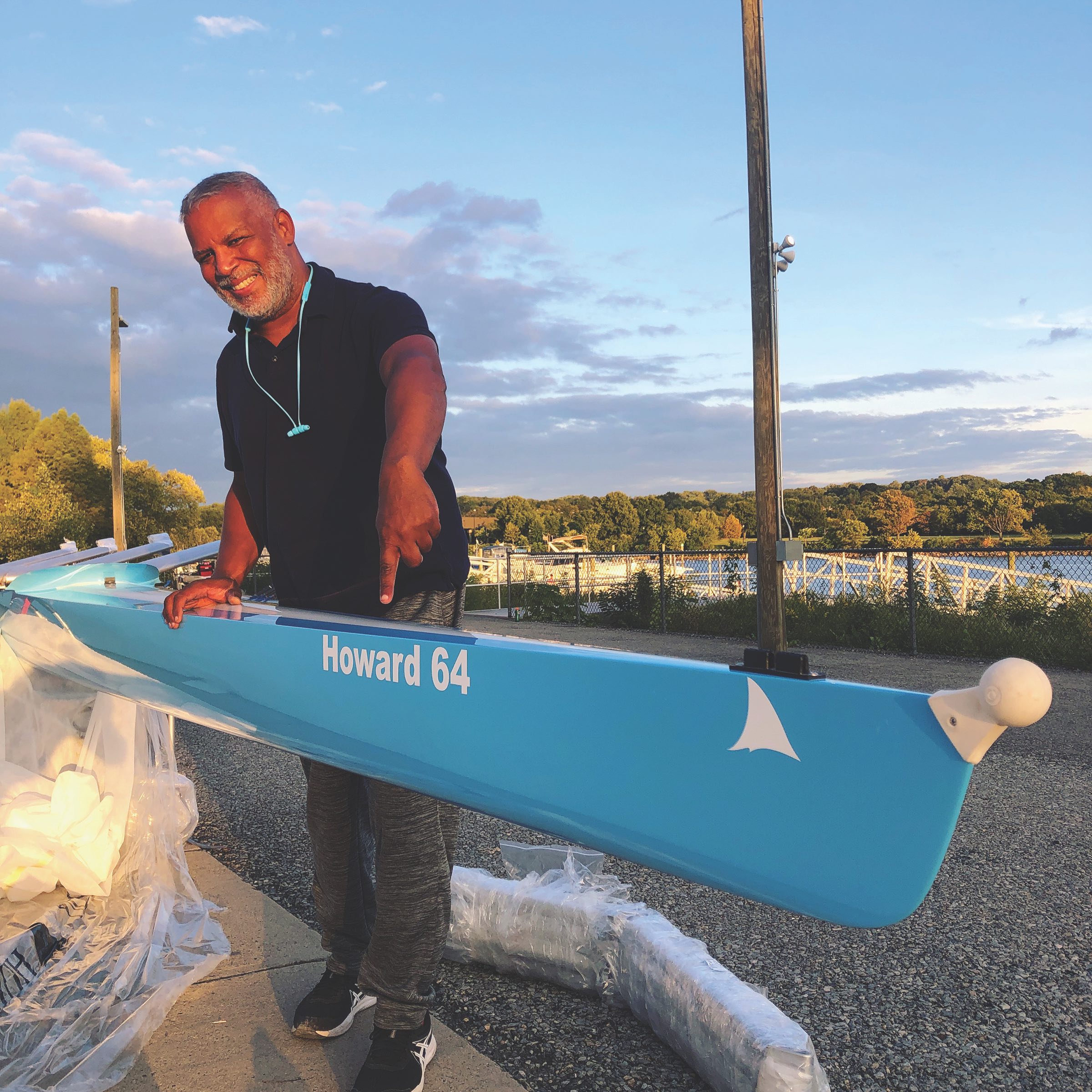
PHOTO BY PETER SPURRIER
At the 2022 World Rowing Championships in September, the U.S. National Team won three medals, each representing a great accomplishment by the crews that earned them. And there’s hardly any shame in qualifying for the A final at any world championship, as several U.S. crews did.
But as a rowing nation—in fact the largest, richest, and on every other level fastest—the United States of America, with USRowing as the sport’s national governing body, continues to underperform on the Olympic and Paralympic stage, and badly.
Great Britain won 12 medals—seven of them gold—having entered only 17 of the 29 total events at the world championships. America’s total of three medals—two in Olympic events, and none of them gold—came from having entered 25 events, the most of any country. Italy was second in number of events entered—22—and landed second on the medals table with nine, five of them gold. In medal standings, the once-mighty U.S. ranked a dismal 14th.
“I’m not happy about the result,” declared Josy Verdonkschot, USRowing’s newly hired chief high-performance officer. “I said two would be the minimum. Three, it would be satisfactory. Four, I would be happy.”
Verdonkschot was named the new boss just this year, telling Rowing News in an exclusive interview in August, “I’m the CEO for high performance. Simple as that.” He’s one of the most successful Olympic coaches in the world, having led The Netherlands to five medals (tied with New Zealand for the most) at the Tokyo Games.
He’s hardly the first great Olympic rowing coach to come to the U.S. after success in other countries, following greats like Kris Korzeniowski, Mike Spraklen, Igor Grinko, Hartmut Buschbacher, and Tim McLaren. But if he wins Olympic gold with the U.S., he’ll be the first to do so. Only longtime and former Olympic coaches Mike Teti and Tom Terhaar, who are both products and former coaches of U.S. collegiate rowing, have coached a U.S. crew to Olympic gold since 1964.
“The pair and the [lightweight] double did a great job,” at this year’s world championships, said Terhaar, who coached the U.S. women for over 20 years, including the 11 undefeated years during which the eight won every World Cup they entered, all eight world championships, and three Olympic golds.
“Two medals in two small boats—which seems to be a common theme that we need to have more of—was a really good performance. They did an awesome job and they deserve a lot of credit.”
In December, Terhaar left USRowing for steady employment as the director of rowing at Columbia University while USRowing tried to figure out the next step after a zero-medal performance at the 2020 Tokyo Olympics. At Verdonkschot’s invitation, Terhaar came back last summer to coach the men’s eight.
Terhaar believes the men’s eight did “an excellent job of improving and making good steps, especially considering selection was done late and the group got together late.”
Ellen Minzner, USRowing’s director of para high performance, has a similar take on the plight of the National Team. “It shows we’re in a building year. Specific to the para program, I thought we had a strong result in the men’s PR1 single.
“In the [para] four, while it was behind where we’ve placed historically, it was actually a pretty good race that that crew put together with a very young crew, brand-new coxswain, two brand-new people on the team.”
Precious little time—about 10 months from the publication of this story—remains for U.S. crews to qualify for the 2024 Paris Games. The majority of spots in the 14 Olympic and five Paralympic events will be based on the results of the 2023 World Rowing Championships, which begin Sept. 3. Ominously, the U.S. squad is just getting started, while other countries barely took a break after Tokyo 2020.
Why is that? The reasons for the delayed start in preparing for the 2024 Games, and hence the LA 2028 Games as well, go back to the last two Olympics. And they’re not the fault of the athletes, or the coaches.
It’s a familiar situation for the U.S. National Team, one that seems to repeat itself every Olympic quadrennium: a disappointing medal haul (or none at all in the case of Tokyo 2020) from a lack of funding and adequate athlete development that guarantees the same result the next cycle.
So how is it that the U.S., formerly one of the sport’s most successful nations in Olympic rowing (including three straight golds in the women’s eight and 12 in the men’s eight) was 14th on the medals table this year?
American Rowing Has the Athletes
On the junior—now called U19—level, and with the under-23 national teams, USRowing puts together successful crews every summer, drawing on the strengths of the country’s high-school and college programs and increasingly well-funded, well-run junior club programs. In winning their second-consecutive U19 world championship this summer, the U.S. junior women’s eight set a world-best time for the event. At each of the last three World Rowing Under-23 Championships since 2019 (there was no event in 2020), the U.S. men’s eight has won silver, and the women’s eight has won gold twice and bronze in 2019.
But American rowers generally treat a run at the Olympic team like graduate school: two to four years of pursuing something they loved in college while barely getting by or racking up debt before launching their careers, starting families, and getting on with “real life.”
Meanwhile, many of their international competitors receive comprehensive coaching and medical support, get paid, and can make a career of rowing.
With rare exceptions, rowers can no longer go from college to the Olympic podium like the storied University of Washington crew in The Boys in the Boat and others in pre-Eastern Bloc times. It typically takes more than four years, a single quadrennium, for an elite rower to develop into a medal-winning Olympian.
“I won my first Olympic medal in my 11th year on the National Team,” said Teti. “You know what that’s called? Normal. Kay got her first Olympic medal her 11th year, too,” he continued, referring to his spouse, Kay Worthington, the two-time Canadian Olympic gold medalist.
Currently, USRowing has only one year-round training center, in Princeton, and Verdonkschot recognizes the need for better, long-term development opportunities for U.S. elite rowers.
“We want to create a hybrid system where, on one hand, we create centers where people are able to train in an efficient and sufficient way. On the other hand, we have to acknowledge that the United States is a very big country and that we cannot just rely on the fact that everybody puts their lives on hold and comes to one place. We should aim for a hybrid system where we bring the athletes together more frequently but where they have their own home base.
“The important part is we have to create a system that is uniform over those places where people are training. If I can have the groups together for 160 days at camps or at a training center like we did this summer, I do not care so much about the other 200 [days] as long as we are monitoring what they are doing and giving feedback.”
It all costs money, of course. Australia is widely believed to have spent about $50 million in the four years leading up to their four-medal success at the 2020 Tokyo Olympics. In a candid moment at the 2016 Rio Games, where Great Britain won the most medals, a GB Rowing official complained to Rowing News about having had less than $48 million to prepare. By contrast, for each of the last two Olympic cycles, USRowing has worked with roughly $12 million.
“Our biggest gap is on the athlete-funding side,” said Minzner. “The opportunity to train at a serious level and make a full-time commitment in the Olympic year needs to be backed up by sufficient direct athlete support, training, stipends, et cetera, that make that commitment feasible.”
American Rowing Has the Money
The American rowing community—with its wealth, education, professional accomplishments and connections to power—has what it takes to solve all of USRowing’s problems, beginning with money. Colleges and private schools routinely spend millions of dollars building and renovating boathouses. Dartmouth recently opened a $7.5-million boathouse addition that includes tanks for rowing indoors on moving water. Yale’s Gilder Boathouse renovation cost $7.5 million in 2000, and alums spent millions more on the renovation of Gales Ferry, the Thames River training site Yale uses in the lead-up to the annual Harvard-Yale race. Princeton University and St. Paul’s School both spent millions renovating on-campus boathouses located by man-made lakes, dug expressly for use as rowing courses. Over time, rowers have proven repeatedly that when they care about something and are engaged, they will donate millions of dollars.
And that’s just for facilities. Top NCAA rowing programs award 20 full-ride scholarships every year. With costs of attending now surpassing $80,000 a year (Yale, $84,575; Stanford, $82,216; Washington, “only” $58,470), each crew racing down the course can represent nearly three-quarters of a million dollars in annual student expense. Increasingly, the salaries of coaches are paid from donated endowments.
Huge amounts of rowing money flow beyond campuses. Last year’s Henley Royal Regatta in the United Kingdom featured 55 crews from the U.S., more than ever before in its 183-year history. East Coast schools can spend even more on a trip to the West Coast, and vice versa, for regattas like the San Diego Crew Classic and the Heads of the Charles, Schuylkill, and Hooch. Training trips are the norm for hundreds of crews in the U.S. The pages of this magazine regularly carry advertisements from smart convention and visitor bureaus that know the economic impact a traveling rowing team can have on their region—without the added public safety and clean-up costs typical of concerts and festivals. Full hotels, busy restaurants, and active airports and gas stations without any messy behavior are great for tax revenues and the peaceable utilization of parks and waterways.
Most of that money comes directly from the U.S. rowing community. Even at huge state schools with big-time TV contracts for their football and basketball broadcasts—like Cal and Washington—almost all of the budget for rowing programs comes from alumni donations, not the athletic department or general fund. Even scholarships, which the universities use to comply with Title IX legislation to ensure continued federal funding, are endowed and paid for by contributions from alumni rowers.
So why can’t USRowing tap into all of that charitable giving? They can, or could, to some extent. The National Rowing Foundation, the charity established for the financial support of national-team rowing in the U.S., has raised and donated millions of dollars over many decades for the benefit of USRowing. Many NRF donors are successful private-equity investors who have earned tremendous wealth by combining financial capital with management expertise. That proven combination—funding and management—is exactly what USRowing needs to develop Olympic medal-winning crews.
In the for-profit corporate business world, as well as with high-functioning, successful nonprofits, the boards of directors are comprised of people who have a stake in the success of the organization, have special and valuable expertise, or, in the case of nonprofits, give a lot of money. USRowing’s boards, including the current one, generally aren’t.
The Structure of USRowing
USRowing is the brand name for what is officially the United States Rowing Association, a non-profit 501(c)(3) corporation and the product of the 1982 merger of the National Association of Amateur Oarsmen and and the National Women’s Rowing Association. The association’s history dates to 1872, and it’s long been ahead of the gender-equity curve. Before current board chair Nobuhisa Ishizuka, the previous three board chairs were women—Marcia Hooper, Meghan O’Leary, and Erin O’Connell. By contrast, the 2020 Tokyo Games marked the first Olympics to feature an equal number of men’s and women’s rowing events. An urgent priority for the association is to increase diversity, equity, and inclusion. And while other Olympic sport federations in the U.S. and around the world, from gymnastics to swimming to bobsledding, have been stained by scandals, including sexual assaults, abusive coaching, and financial malfeasance, the United States Rowing Association has a record that is almost perfectly clean.
The association is governed by a 12-member board of directors comprised of four regional directors elected by member clubs in each region, four “athletes” basically defined as National Team members from the past decade, and four at-large directors elected by the other eight directors. Individual members of the association have no direct role in electing the board, and board members have no obligation to support the non-profit association financially. The bylaws spell out three main responsibilities: setting policy, hiring and firing the CEO, and overseeing the budget. In practice, the CEO operates the organization through her staff on a budget set by the board. But the board is neither responsible nor accountable for whether the association has enough money both to administer the sport domestically and to compete internationally. The result is as predictable as the budgeting process is nontransparent. USRowing has published the proposed budget for last year, but not the actual numbers. The association has also not released last year’s IRS Form 990, the tax return for nonprofits.
[Editor’s Note: After this story went to press on Tuesday, October 11, and appeared in the Rowing News app on Wednesday, October 12, USRowing’s 2021 financial report was available for download on the USRowing website.]
USRowing CEO Amanda Kraus
When USRowing announced the hiring of Kraus in August 2020, she was already at work behind the scenes. Well into her third year in charge, she likes to say she’s just getting started.
Kraus is ambitious and busy. She’s attentive to stakeholders, responsive to inquiry, pleasant, and unfailingly professional, unlike some of her predecessors at USRowing. She came to the CEO position from a very successful run as the founder and leader of Row New York, where she transformed the lives of many young people of color, almost all of whom went on to college through rowing, and raised remarkable amounts of money to make it all happen. She has been lauded multiple times by many, including Rowing News. She is not working at USRowing in lieu of better opportunities.
But three years in, her reign at USRowing is not going particularly well. By her own admission, she underestimated the depth of disappointment—often verging on outright animosity—many in the rowing community feel about USRowing. When she took over, she also didn’t realize the depth of the association’s financial hole. She brought optimism and ambition to the task, and, until recently, had the full support of such rowing-community pillars as the National Rowing Foundation and the Intercollegiate Rowing Association.
She’s the ninth executive leader—chief, director, or acting—in the past 30 years for USRowing, a span that includes the 12-year leadership of Glenn Merry, who was dismissed by a quarrelsome edition of the USRowing board of directors after the 2016 Rio Olympics. Four of the five board members on the finance committee, including both the chair and treasurer of the board, resigned at the same time.
Merry balanced budgets, kept USRowing in the good graces of the Olympic committee (thus earning their continued funding) and headed the organization while the U.S. women’s eight won everything they entered for 11 straight years, the men’s eight won its first Olympic gold in 40 years, and the United States was awarded the 2017 World Rowing Championships, the country’s first since 1994. Merry’s run at USRowing has proven a tougher act to follow than many thought it would be.
In 2017, there was no replacement or succession plan at USRowing, so the board handed responsibility first to two staff members and then to only one as the association spiraled into legal conflicts over sponsorship and employment agreements. When the search for a new CEO was conducted, the board selected a former staff member to return and lead the association. After a couple of years, it clearly wasn’t working. He resigned, and Kraus was hired.
In January 2021, before the delayed Tokyo Olympics, the U.S. Olympic and Paralympic Committee (USOPC) hired the law firm Arent Fox, “with the full support and participation of USRowing,” to review and assess complaints and concerns expressed by “certain elements of the athlete population” about how the National Team was selected and run. At the time, Kraus told Rowing News she welcomed the review, but she has told other media outlets since that it was something from before her time that she inherited.
The summary of the Arent Fox review stated: “It is important to note that USRowing’s financial resources are limited. The recommendations not only require establishing specific roles, structures and accountability. They will likely require funding which may not be available.”
The report concluded: “The new emphasis on fundraising, if successful, will assist with the resources which have been lacking. This state of affairs is, however, not just based on a lack of resources, but rather mostly a lack of attention to basic good practices, ill-defined roles of key figures who should have been accountable for athlete welfare, and athletes’ distrust of the organization based on this lack of attention.”
In July 2021, U.S. crews raced in nine events at the Tokyo Olympics—having failed to qualify for the Games in the other five events—and won no medals, for the first time since 1908.
“Change is clearly necessary,” Kraus told The New York Times.
Help is Available
In April 2021, Kraus convened a “High Performance Council,” chaired by Olympic medalist and former Bain & Company partner Pat Manning, “to begin a collaborative effort to help develop the best long-term strategy for the U.S. National Team and Para-rowing.” Over four months, at least 57 different people, according to a copy of the council’s work obtained by Rowing News, gave input.
None of the individual elements of the council’s work was particularly novel or revolutionary, but collectively they presented a clear and authoritative take on what could be done to improve the U.S. National Team.
“There is a widely held desire to fundamentally transform the U.S. Senior National and Para rowing teams through Paris 2024 and LA 2028,” said the executive summary. “Executing the strategy will require funding levels to be doubled by Paris ’24 to approximately $8 million per year and then doubled again to approximately $15 million per year by LA ’28. This will bring us near current Team GB resource levels.” The report also recommended significant governance changes to the association.
Typically, the USOPC has contributed about half of USRowing’s budget for an Olympic quadrennium. In addition to membership dues and revenue from the National Rowing Foundation and other charitable foundations, financial opportunities exist for USRowing beyond the American rowing community. The Veterans Administration recently announced a nearly half-million-dollar grant to the association (see page 23) for the ninth-straight year. Most successful Olympic teams in other sports rely on commercial sponsors and partners, but USRowing hasn’t had a real title sponsor since paper company Champion International’s major support in the 1990s.
Blown deals with major brands like Subaru, Mount Gay Rum, Nike, and Apple Computer litter the history of USRowing, and it often seems as if the association’s board and staff either don’t believe in sponsorships or understand how they work. When the association has secured a sponsorship, as with current official partner Filippi, USRowing confuses matters by enlisting competing brand Hudson Boat Works as the association’s official boat supplier for the under-19 team. When the under-23 and under-19 world championships were held as a combined event, USRowing ended its press releases with consecutive paragraphs recognizing each as “the official boat supplier.”
USRowing Had the Opportunity
USRowing had the opportunity to run and fund the National Team differently for the current quadrennium. In October 2021, the social-media account of a recent Olympian seemed to announce that Steve Redgrave, the most successful Olympic oarsman ever, and rowing’s biggest celebrity, would be USRowing’s National Team director.
Besides being considered the greatest ever on the water, Redgrave has achieved huge success off the water. He helped parlay Great Britain’s only 1996 Olympic gold in any sport (men’s pair with Matthew Pinsent) into a funding increase for GB Rowing that was massive. He helped London win the 2012 bid to host the Games, and after he became the chairman of the Henley Royal Regatta, he so modernized the venerable event—without corrupting its traditions—that it became best-in-class for hospitality, live digital video, and revenue. So impressed was the Chinese National Team that it hired him and consequently became a competitive fixture in Europe-dominated elite rowing.
Redgrave is exactly the right guy to send out on the links to golf and schmooze with potential donors, sponsorship partners, and mainstream-media decision makers. He has the fame to headline automatically any banquet, award ceremony, or fundraiser, and he could be the rainmaker for an association lost in the desert since its last Olympic medal in 2016. A figurehead of his luminous stature could make U.S. National Team crews faster without coaching a single athlete for a single stroke.
Rowing News has learned that a group of longtime generous supporters of the National Rowing Foundation pledged more than $5 million when they recruited Steve Redgrave and his wife, Dr. Ann Redgrave, to come to the U.S. team. The group reportedly included Manning; fellow High Performance Council member and Olympic medalist Ted Patton; NRF co-chair Jamie Koven, an Olympian and former world champion in both the single and eight; and successful businessman and investor Chuck Pieper, who, like Amanda Kraus, has been awarded USRowing’s John J. Carlin Service Award for his decades of support.
Choosing Control over Support
The potential support represented a significant increase over past NRF assistance, which recently has been around $1 million. Led by CEO Kraus, USRowing hasn’t pursued the work product of the High Performance Council and rejected the Redgrave package because of “strings attached” that would have required Kraus and the board to surrender their total control of the National Team. Currently available National Rowing Foundation support is a third of what it’s been recently, and USRowing must apply to an NRF grant committee that reviews applications to determine the best way to allocate funds from NRF donors to support the National Team.
All 12 members of the current USRowing board of directors were contacted for this story. Most, including board chair Nobuhisa Ishizuka, did not respond. Four of the five who did respond directed inquires to Kraus and her staff. Kraus made herself available briefly, and when asked pointed questions about the value of the board and the decision to pass on the Redgrave package, stood her ground.
“The newly constituted board that came together in March, 2022 has been really helpful in shaping a new direction for the team,” said Kraus. “And with supporting the hiring of Josy [Verdonkschot] and the athlete council and high-performance committee. And fiscal oversight and really understanding that their role is to make sure they have a strong CEO in place and to hold me accountable. I don’t think they’re a hindrance at all.”
USRowing has started its own charitable foundation, Kraus noted, and she said she would never “second-guess” the decision to pass on the Redgrave opportunity.
The USRowing staff directory lists 41 positions, including “Safety and Well-Being Associate,” “Diversity, Equity, and Inclusion Associate,” and both a “Director of Youth, Masters & Safety” and a “Youth, Masters & Safety Associate.” Under “Coaches,” only two—Casey Galvanek, U19 Head Coach, and Laurel Korholz, Head Coach, USRowing Training Center-Princeton—are listed. Korholz is widely known to be planning her departure from USRowing to accept a position at Columbia University to assist Terhaar coaching the men’s heavyweight crew.
[Editor’s Note: USRowing announced the departure of Korholz on October 13, after this story went to press.]
The Cost of Not Fixing It
When U.S. crews don’t do well at the Olympics, the athletes—and all those who support them—suffer directly the disappointment of coming up short, after all the time and effort put toward a goal that rewards the victorious with honor, glory, and little to no material gain. The coaches often suffer the loss of their jobs, and future athletes suffer the loss of USOPC funding, which comes largely based on success. The USRowing board of directors has essentially no accountability and suffers no direct consequences, while the sport and everyone who loves it miss out on the opportunity for rowing’s version of Alpine skier Mikaela Shiffrin or gymnast Simone Biles to inspire us and attract new rowers to expand the sport.
Turning down millions in badly-needed funds to retain complete control of a national-team system that clearly isn’t competitive against the leading rowing nations isn’t working so far for USRowing. And now the current board and staff have very little time to find replacement donors and attract new sponsors before Paris 2024 and LA 2028. The shame is that the American rowing community has both the athletes and the money to do much better at the Olympics, but USRowing hasn’t found a way yet to take advantage of that damning and irrefutable fact.