Home Blog Page 14

Sarasota Crew To Host Youth Speed Order

A youth speed order for singles and pairs will be held at Nathan Benderson Park, home of Youth Nationals. PHOTO: Lisa Worthy.


Sarasota Crew will host an youth small-boat speed order at Nathan Benderson Park from the Saturday to Tuesday before Thanksgiving, Nov. 22-25, featuring four practices, a time trial, and finals, open to all men’s and women’s youth singles and pairs.

“We’re hoping to give kids more opportunities to show their speed on the water and test themselves in a fun environment,” said Rick Brown, Sarasota Crew’s director of operations and development. “It’s great water, great weather, and a chance for anyone who comes to be on the water at a time of the year when most of the country is not.”

An additional camp option, including coaching, video review, nutrition, lifting, mobility, evaluation of rowers’ strengths and weaknesses, is also offered in addition to the speed order.

“We thought adding the speed order to the camp was a logical step—we really don’t have much of that opportunity for youth rowers in the country,” said Brown.
Organizers are offering transportation of shells to and from Pittsburgh, Penn. and Lake Mercer, NJ as well as rental of shells at Nathan Benderson Park.
“Time to start matching the Brits,” said co-organizer Jay Hammond.

Penn Women, RowAmerica Rye Juniors Win Big at Head of the Schuylkill

The Head of the Schuylkill drew 138 crews from Canada, including coxed quads from St. Catharines Rowing Club.


The University of Pennsylvania women finished first and second in five events at the Head of the Schuylkill Regatta, October 25-26, in Philadelphia.

“PWC enjoyed another exceptional Head of the Schuylkill Regatta,” said Bill Manning, Penn’s head coach. “The City of Philadelphia, the Philadelphia rowing community and Boathouse Row, our alumnae, and the weather all turned out to make a great day.”

RowAmerica Rye racked up 11 wins, including the men’s high school trainer singles (JV), men’s high school quads (frosh/novice), men’s high school fours with cox (varsity), women’s high school fours with cox (varsity), The Michael O’Gorman women’s high school eights (frosh/novice), The Paul Coomes women’s high school quads (varsity) women’s high school quads (JV), women’s high school fours with cox (JV), men’s high school fours with cox (frosh/novice), women’s high school eights (varsity/first boats), and women’s high school eights (JV and lower boats).

St. Joseph’s Prep won the men’s high school eights (varsity/first boats), The Michael O’Gorman men’s high school eights (frosh/novice) and men’s high school fours with cox (JV).

Mirroring national trends in tourism, in which Canadian visits to the U.S. by car fell 35 percent in September, Canadian entries in this year’s regatta were down 22 percent (138 crews, from 175 in 2024). Still, St. Catharines Rowing Club brought a formidable armada of sculling boats, winning the men’s high school coxed quads varsity and JV events, as well as the men’s high school doubles (JV).

Potomac’s Michael “Tony” Madigan scored an eight-second victory against his friendly rival, CRI’s Simeon John, who won the Head of the Charles by seven seconds over Madigan the prior weekend, re-setting his own course record. Madigan is the defending youth national champion and finished fifth at the 2025 World Rowing Under-19 Championships. Both have won multiple Canadian Henley golds and have developed a healthy rivalry and could be the future of American sculling on the elite level.

Results  |  Livestream

Rowers Flock to Philly for 55th Head of the Schuylkill Regatta

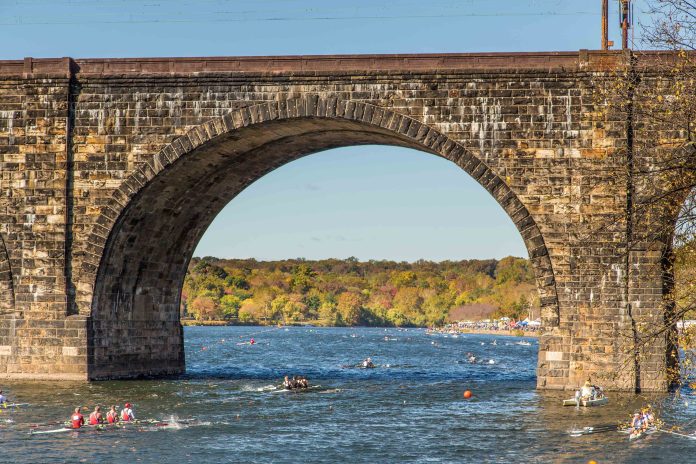
The Head of the Schuylkill is one of the world's largest regattas, attracting over 9,000 competitors to Philadelphia. PHOTO: SportGraphics.com.


Over 9,000 competitors will race 2,380 boats down Philadelphia’s Schuylkill River, home of historic Boathouse Row, October 25 and 26, in the 55th Head of the Schuylkill Regatta. Attracting entries from almost 300 clubs, the regatta course runs 2.4 miles from above the Strawberry Mansion Bridge near Hunting Park Avenue to the Sculpture Garden, above Boathouse Row on Kelly Drive.

Conshohocken’s Whitemarsh Boat Club has the biggest local entry, with 57 boats competed, followed closely by Penn A.C. Rowing Association with 51. New York’s RowAmerica Rye—fresh off a win in the women’s youth eight at the Head of the Charles—has the largest visiting entry, wiht 50 crews scheduled to race. Ontario’s St. Catharines Rowing Club bring the largest foreign entry, with 28.

Racing starts on Saturday, Oct. 25 at 8:00 am with the Para singles and runs through Sunday, Oct. 26, ending at 5:00 pm with mixed veteran (60+ years) quads.

Livestream  |  Results

From The Editor: An Autumn of Rebirth

The November, 2025 issue of Rowing News features an interview with world champion Michelle Sechser. PHOTO: Lisa Worthy.


Spring is the season of rebirth and renewal (and in rowing the one that really counts), but this autumn has some resurrection vibes, especially with the U.S. National Team—now the Gemini.com National Team, thanks to a $6.5-million dollar gift from U.S. Olympians Cameron and Tyler Winklevoss (story).

For the first time since 2019, right before the current leadership of USRowing began work, a U.S. crew in late September crossed the line first at a senior World Rowing Championship. The U.S. women’s four broke the 0-for-78 worlds-events losing streak with a powerful gold-medal performance in Shanghai, followed the next day by Michelle Sechser’s win in the lightweight single.

Even at 38 years of age, Sechser shows no signs of being in the autumn of her international competitive career. And despite falling short of two of her biggest goals—to win an Olympic medal, at the Tokyo Games in 2021 and in Paris last summer (Rowing News interview)—Sechser speaks about rowing with a joy that’s infectious.

In the first year of the quadrennial leading up to the LA 2028 Games (which won’t include lightweight events for the first time since 1992), Sechser gave openweight flat-water sculling a try and says she’ll give Beach Sprints—the contrived Olympic replacement for lightweight events—a try in the years to come.

It’s a new, albeit autumnal, beginning.

CURRENT ISSUE OF THE MAGAZINE

Coach Development: Coping With Uncertainty

Josy Verdonkschot, Kris Grudt, and Jesse Foglia at the 2025 World Rowing Championships in Shanghai. PHOTO: Lisa Worthy.


The only certainty is that nothing is certain. Pliny the Elder said that, or something like that. This is as true in coaching as it is in life. One minute you’re planning practice, the next you’re dealing with an injured athlete or an NCAA rule change or even a global event that trickles down to the boathouse. Uncertainty is an unavoidable reality, and learning to thrive in it takes practice.

Recently, I led a workshop for head coaches within a local college athletic department. They were feeling weighed down by the seemingly never-ending stressors of the job—winning, recruiting, budgeting, team management, staff development, long hours, and on and on. Not to mention outside stressors they brought up—campus leadership, national tensions, and, invariably, work-life harmony.

A common theme exacerbating a lot of the stresses these coaches were facing was uncertainty. Neuroscience backs this up. Research shows that uncertainty actually impacts our brains and bodies more negatively than bad news itself. In studies, people experienced higher anxiety, spikes in amygdala activity, and stress responses such as elevated heart rate and cortisol when they didn’t know when a small shock was coming compared to knowing it was certain. That lack of control, when unchecked, fuels stress, fear, and eventually burnout.

The good news, though, is that there are some mindset shifts and practical tools that I’ve seen be effective in helping coaches manage their response to uncertainty so they can lead better with imperfect information and focus on what really matters.

Keep the main thing the main thing.

If everything feels urgent, nothing important actually gets done, or gets done well. When you’re too busy picking fights with your administrator or re-rigging the boat yet again, you miss out on evaluating the team performance trends or ensuring that the team is actually living your team values.

The best coaches I know hold their personal values and team philosophy in their core. They use them to anchor every decision, from whom to recruit to how to respond to a misbehaving team member. Crucially, this knowledge also dictates what they don’t focus on. They can cut through the noisy distractions, decide what to let go of, and how to stay focused on the long-term development of their team, instead of getting whiplash from chasing the latest distraction.

(While Jalen Hurts didn’t invent the idea—Stephen Covey did— the Philly quarterback talks about it a lot. And he’s never wrong.)

Control what you can control.

It’s easy to waste a lot of energy worrying about things that, ultimately, we have no control over. We all do it. How much time have you spent fretting over the weather forecast or how another team is training? It’s only natural. But it’s a waste.

My recommendation: Use the circle of control. Take a look at everything that’s stressing you out. Group them into three categories: what you have control over (the circle of control); what you have influence over (the circle of influence); and what you simply cannot affect (the circle of concern). Be honest about where things really fall. For example, you do not have control over where a recruit chooses to go. You can influence it, but it’s up to that recruit ultimately. That falls in the circle of influence, at best.

Then you need to focus your time and attention on the first two circles and do your best to let go of the third. When you double down on the controllables, you feel more effective and therefore more steady, which is exactly what your team needs from you.

Make a plan.

Uncertainty leads so many coaches into two traps: overreacting (scrapping a training plan after one bad erg piece) or freezing (waiting for the perfect moment to lock in a lineup). Neither helps their crew improve.

Now that you’ve focused your actions on what really matters and what you have control over, you have to take action, even if it’s not perfect. Identify one or a few things you can tackle this week. Determine what obstacles could get in your way and decide how you’ll respond before they come up. Communicate this clearly to your fellow coaches and your athletes. Then, get going.

A good plan won’t eliminate uncertainty, but it will give your team, and you, the confidence that you’re steering the ship, even if the waters are choppy.

Uncertainty isn’t going anywhere. But when you know what matters, what you can control, and what your plan is, you can be an effective leader despite it. So instead of drowning in the unknown or lashing out with reactive actions, take a breath, consider these three ideas, and you can get back to leading your team with clarity and confidence.

Madeline Davis Tully competed as a lightweight rower at Princeton and on the U-23 national team before coaching at Stanford, Ohio State, Boston University, and the U-23 national team. Now a leadership and executive coach, she is the founder of the Women’s Coaching Conference.

World Rowing Beach Sprint Finals Draws Record Entry

Beach Sprint racing starts with a beach run to the boat, a slalom row, a turn, a sprint back to the beach and a run up the beach to the finish line. Races take around two to four minutes and are about 600m in length (500m of rowing and 100m of sprinting). PHOTO: Lisa Worthy.


November’s World Rowing Beach Sprint Finals, the world championship for the new Olympic sport, will feature a record entry of 55 countries (up from 51 in 2024). Host nation Turkey, Egypt, Great Britain, and the United States are the only countries entered in all ten events, the most ever held at a World Rowing Beach Sprint Final.

“It is great that we participate in all categories, but at this point our focus is to extend the pool of senior athletes,” said USRowing’s Josy Verdonkschot, The McLane Family Chief High Performance Officer, “Part of the senior team participated in the European club [Beach Sprint] champs, to experience the course. Now they are in Italy for a final preparation camp before the World Beach Finals.”

The men’s solo event has attracted the most entries, 40. Chris Bak of the United States is the defending champion and will be challenged by New Zealand’s Fin Hamill, who recently won the Head of the Charles in the single and Henley Royal Regatta in the double.

“Chris Bak is our stand-out athlete in the men’s solo, interesting to see if he can maintain his crown with ever increasing competition,” said Verdonkschot. “We have some great athletes with great results in the past, but we need to create a bigger pool of candidates to keep improving.”

Other challengers include Tokyo 2020 Olympic champion (men’s four) Spencer Turrin of Australia and current European Beach Sprint Champion, James Cox of Great Britain, as the new Olympic event continues to draw athletes from traditional flat-water rowing.

Entered in the women’s solo event are Tokyo 2020 Olympic single scull gold and bronze medallists, Emma Twigg of New Zealand and Austria’s Magdalena Lobnig, the reigning World Rowing Beach Sprint champion. Twigg won the silver medal in the single at last year’s Paris Olympics.

“We should also be competitive in the other two Olympic events, Christine Cavallo in the women’s solo and Sera Busse, from this year’s worlds women’s quad with Chris in the mixed double,” said Verdonkschot.

The mixed double is the third of the three new Olympic events. The additional seven events at the World Rowing Beach Sprint Finals are the men’s and women’s under-19 solos and doubles, the under-19 mixed double, the inclusion (one Para) mixed double, and the mixed quad.

Entries  |  Livestream

Breaking the Streak

The U.S. women's four of The U.S. four of bow Camille Vandermeer, Azja Czajkowski, Teal Cohen, and stroke Kaitlin Knifton outlasted Romania to win the 2025 World Rowing Championships. PHOTO: Lisa Worthy.


The U.S. National Team women’s four highlighted a two-gold, four-medal performance at the 2025 World Rowing Championships in Shanghai in late September.

The U.S. finished fifth on the medals table, tied with Ireland. Great Britain, China, and The Netherlands topped the table, with three golds each. Romania won two golds and three silvers, including the inaugural running of the mixed eight.

With the victories, USRowing broke a five-year winless streak at senior worlds, with gold medals in the women’s four and lightweight single. The U.S. women’s pair of Jess Thoennes and Holly Drapp won bronze, as did the men’s eight.

“They did a great job, well executed. All credit to the women,” said Josy Verdonkschot, The McLane Family Chief High Performance Officer for USRowing.

The U.S. women’s four of bow Camille Vandermeer, Azja Czajkowski, Teal Cohen, and stroke Kaitlin Knifton trailed the fast-starting British and Dutch crews in the first 500, powered through the field to take a length lead in the middle of the race, and then hung on to win the gold, less than a second ahead of Romania in second and New Zealand in third. The Netherlands, Great Britain, and China rounded out the A final.

It had been six years since a U.S. crew last won a senior World Rowing championship event (in the women’s lightweight double and PR3 pair at Linz Ottensheim, Austria, in 2019). The U.S. men’s four won Olympic gold in Paris last summer, but the senior men haven’t won a World Rowing championship gold since 2009 in the men’s coxed pair and 2008 in the men’s lightweight eight—events canceled by World Rowing since then.

Lightweight single sculler Michelle Sechser added a second gold for the U.S. with the full support of U.S. Olympic rowing boss Josy Verdonkschot, who said he was more than happy to support Sechser in the non-Olympic event.

“She thoroughly enjoyed it,” said Verdonkschot, who believes the team has a responsibility to athletes like Sechser who have given “so much over so many years” to Olympic pursuits. “All credit to her to pull it off.”

The U.S. women’s pair of Washington alumnae Thoennes and Drapp won bronze less than a second back from the French pair and more then 10 seconds ahead of the Italians but more than five seconds behind Romania, whose stroke Simona Radis went on to win another worlds gold in the mixed eight.

After leading the field off the start, stroked by Olympian Pieter Quinton in the same seat, the U.S. men’s eight battled the defending Olympic-champion Brits for second down the course as the Dutch slipped away to a length lead. Great Britain nipped the U.S. at the line for silver, but it was a promising performance for the American big boat, with the rest of the A final field open-water behind.

For coxswain Rachel Rane, it was her first medal at a senior worlds.

“Nobody I’d rather do it with than these guys. I’m grateful,” said the Texas alumna, who won back-to-back NCAA national championships in 2021 and ’22 and gold in the U.S. women’s eight at the 2022 World Rowing Under-23 Championships. “I’m excited to see what’s next.

“We prepare. Everything that gets thrown our way, whether it’s wind or wake, we turn it into an advantage as much as we can.”

Half of the oarsmen in the U.S. men’s eight were entered also as the U.S. men’s four. In the overwhelming heat and humidity of Shanghai, they backed off their racing efforts in the second half of the B final of the four after failing to make the A final.

Technical difficulties with the boots that hold the bows of boats at the start as well as other delays led to long days on the water in sweltering conditions that Verdonkschot called “a little bit over the edge.” Still, it was a bad look for a U.S. National Team crew at a World Rowing championship. Asked if he was OK with the men’s four shutting down, the normally loquacious Verdonkschot paused and said, “No.”

Many big-boat crews doubled up in the four and eight, something World Rowing needs to have happen in the Olympic regattas to come, where quotas limit qualification spots to only seven eights and nine fours. With the elimination of repechage heats after the Paris Games, the racing becomes even less compelling to watch, with just three- and four-boat heats in the eights leading to the final, if no one doubles up.

The International Olympic Committee wants medal-awarding A finals on more than just the last two days of the Olympic regatta and full six-lane races in the daily two-hour TV broadcast windows. Combined with the tides that affect the course currently selected for the LA2028 Games, it’s a tall order for World Rowing to figure out a fair and workable regatta schedule.

The women’s eight, featuring a healthy field of 10 entries, provided a preview of what racing could look like at the Los Angeles Olympics if organizers stick to their announced plan to race 1,500 meters instead of the standard 2,000 because of limitations of the chosen course in Long Beach.

Romania went off at 49 strokes a minute, and the Dutch crew, full of Olympic medalists, raced past it with relatively short, punchy strokes to take an almost length lead after the first 500 meters. Both crews never settled below 40, racing mostly at 42 and 43 strokes per minute and leaving all others—rowing longer strokes at lower ratings—a length or more behind.

Racing in the U.S women’s eight gave seven of the crew their first senior World Rowing championship experiences, as only coxswain Nina Castanga and Charlotte Buck had been there before.

“This was the year to find new people,” Verdonkschot said. “Some really good.”

Their fifth-place finish duplicated the disappointing fifth at last year’s Paris Olympics.

In preparation for racing a shortened Olympic distance in 2028—a decision to which USRowing was “not a partner” (Verdonkschot)—an elite-level international regatta will be held on the shorter Olympic course in Long Beach next fall.

The purpose will be to “see what the problems are,” Verdonkschot said, and a follow-up regatta may occur in 2027. Besides the shorter distance, the proposed course also experiences tides, with a slack tide for “only a fraction of the day.”

“If it’s not consistent, it’s not fair,” Verdonkschot said, “especially with the new progression system. With the number of boats that participate, it’s one race to decide who goes to the final. No one wants to be working for four years and find out it’s going to be a lottery. The only thing I want is to have fair racing.”

Verdonkschot came to the U.S. preaching the need for more sculling and small-boat rowing in a nation where the eight remains the premier event and almost sole determinant of championships, from scholastic through collegiate rowing. Over the past 30 years (not including this year), the average finish of U.S. National Team senior eights has been silver for the women and fourth for the heavyweight men. For sculling events, only the women’s quad and lightweight double have averaged A final appearances, both sixth.

The best domestic programs, such as the University of Washington (which traditionally selects fall head-race eights from pairs trials) have trained in pairs and sculling boats for years.

“It’s not perfect but it teaches self-reliance as well as teamwork,” said Washington men’s coach Michael Callahan. The Huskies pick both their Head of the Lake (Seattle) and Head of the Charles lineups using pairs and singles, with top oarsmen rowing in pairs.

“Development guys race singles for lineups in eights and coxed fours,” Callahan said.

Small-boat and sculling events are proving most popular at regattas, such as October’s Benderson Chase at Nathan Benderson Park in Sarasota, where the youth-sculling events drew the biggest fields by far.

In addition to relishing the two golds and a bronze won in Olympic events at this year’s worlds, Verdonkschot is optimistic that as many as 17 Olympians—one third of the Paris squad—will be coming back to compete for spots in the crews that will race in LA2028. Some have taken a year away to heal injuries, to start families, and to complete studies. All will be competing for a place on a team that is the best in the world in two events—for the first time since 2019.

There should be fewer platitudes like “headed in the right direction” and “made more A finals than ever” now that the U.S. women have won worlds golds to go with the men’s Olympic gold and bronze from Paris. The next step is up, to the dominating level of The Netherlands, Great Britain, and Romania, however long and fair the Olympic racecourse is for 2028.