Home Blog Page 13

Back to Bak to Bak

Four-time Beach Sprint gold medallist Chris Bak. PHOTO: Julia Kowacic.


By Martin Cross

Team USA delivered a sensational set of results on the final day of the World Beach Sprints Championships. And that man from Cincinnati, Chris Bak, was right at the heart of an incredible medal haul.

On the sun-kissed waters, just off the beach in Antalya, Turkey, the 29-year-old was almost unstoppable. In the final of the singles, he beat his great friend and rival, Ander Martin of Spain, to win his second world title in a row, third in the event, and fourth overall.

Then just two hours later, Bak and his partner, Sera Busse, took a brilliant silver in the mixed doubles, losing out to the Lithuanian world champions in the sprint up the beach by centimeters.

The Stars and Stripes hadn’t stopped being waved over the beach all morning. Early on Sunday, the USA mixed quad powered to a convincing victory over their Spanish opponents.

These championships showed why Beach Sprints is such a game-changing addition to the Olympic program. Before I had immersed myself in the world of Beach Sprints, I thought it came in a pale second to exciting new Olympic events like kayak cross, where paddlers launch off a ramp that’s 4.5 meters high. That contest was a smash hit at the Paris Games, but if promoted properly, Beach Sprints could be the standout event at LA 2028.

There is significantly more jeopardy, and therefore excitement, for the spectators and viewers in Beach Sprints. And so much of that was on display in the Antalya championships.

Take just one of the semifinals of the men’s solo. The German Olympic oarsman Moritz Wolff was head to head against Martin of Spain. And the man from Berlin had a narrow edge on his rival at every stage of the course—until dramatically, with just meters to go before Wolff was going to win a final spot, the 25-year-old stumbled on the sand, his legs failing to carry him to the victory that was so close to his grasp. Anders passed by a prostrate Wolf to win a place in the final.

The jeopardy is there because the quarterfinals, semifinals, and finals are raced within a 45-minute window. There’s practically no time for the athletes to rest or recover. So the lactic acid builds up in the muscles after a pulsating 80-meter dash over the golden sand of the Antalya beach; the sprint up to over 50 strokes a minute on the outward 250-meter leg into the ocean; the swerves to right and left around the slalom buoys; and then the shock of stopping dead for the 180-degree turn at the top of the course.

If the athletes have any energy left, it’s a sprint back to the beach, heart rates through the roof again, ending with a splash and rapid exit from the boat. Then an exhausting 80-meter sprint back to the red buzzer.

The closeness of Martin’s semi against Wolff probably meant the Spainard had little to give against Bak, who had controlled his semi more effectively against Mathis Nottelet of France. Endurance is such a crucial issue in this event.

Just as crucial for the viewers and spectators is to watch the whole event unfold. Don’t make the mistake I did of just dipping in to watch the A final because you will miss all the thrills and spills of an incredible contest over the three final rounds.

Moreover, if you’d caught the earlier rounds, you’d have noticed that the men’s solo was notable in that the two finalists were both coastal specialists. There were some big names from flat-water rowing whose reputations were left on the sands of Antalya.

The Kiwi Finlay Hamill, finalist in the Diamond Challenge Sculls at Henley and winner of the Head of the Charles, set off at a furious pace but messed up his navigation on a slalom buoy in his first head-to-head contest.

The Australian Olympic fours champion from Tokyo, Spencer Turrin, went out to Lithuania’s Zygimantas Galisanskis, an experienced coastal competitor.

The same was not the case with the women’s solos, though. There, the final was contested by two legends of the sport: Emma Twigg of New Zealand and Magdalena Lobnig of Austria. Twigg had looked in great form through the championships, fastest in the time-trial round and serene through the early knockouts and quarterfinals.

The Tokyo Olympic champion’s only error came when she misjudged the jump into her boat at the start of her semifinal against the Scot Laura McKenzie. The British athlete led out. But Twigg was fearsome on the 180-degree turns.

“Today I decided I was going to take the turns pretty hot,” Twigg said, “and it worked out for me.”

On the other side of the draw, Lobnig had arrived at the championships following a night spent in a cell at Antalya airport because of a visa irregularity. The Tokyo Olympic bronze medalist had to fly back to Austria, get her papers in order, and return to Turkey. It was hardly the ideal preparation for the 2024 world Beach Sprint champion. But the 35-year-old clearly improved each day. In the quarterfinals, she dispatched the USA’s Christine Cavallo in a tight contest.

By the final, Lobnig was flying. There was little to choose between the two scullers on the outward leg. Twigg had just shaded the sprint, but Lobnig was not fazed. It was the 180-degree turn that proved crucial. The 38-year-old Kiwi came out with a length’s advantage and began to pull away.

At the finish, the 2025 champion gave her thoughts: “LA seems a long way away, especially at my age. But I’m loving it.”

Lithuania’s mixed double of Martyna Kazlauskaite, and Dominykas Jancionis were clearly loving things, too. The 2024 world champions in the mixed double (an event on the program in LA) displayed incredible endurance, holding ratings of 50 or more for much of the 500-meter course. They had seen off Poland and France to reach the final. Waiting for them would be the Green Racing Project athlete Sarah Busse, just out of the USA quad from the Shanghai World Rowing Championships, and Chris Bak—about to embark on his sixth race of the day.

On the surface, it looked like mission impossible. But Bak and Busse had other ideas. They recovered from a slower sprint to lead at the turn by the narrowest of margins. For the first 100 or so meters back to the beach, it looked like Lithuania’s high rating would take them away. But as they approached the beach, Busse and Bak found something. The afterburners went on, and the U.S. crew hit the beach almost level. It looked like Bak might outsprint Jancionis. The American made a full-length dive for the buzzer and missed out by just 0.24 seconds. The race was incredible.

The USA mixed quadruple scull was more dominant in its contests. The quad is not in the Olympic program, but the importance of a strong squad to choose from is clear. So Malachi Anderson, Audrey Boerson, Annelise Hahl, and Kory Rogers, together with cox Coral Marie Kasden, can consider themselves key parts of Team USA’s Olympic setup. And their victory over Spain in the gold-medal race was never in doubt.

For the crowds, too, it was an amazing atmosphere, where the spectators have the chance to experience a much closer relationship with the competitors than is possible in flat-water rowing. That much is apparent when leading athletes run in ahead of their opponents and have the chance to salute and acknowledge the crowd. The word most mentioned is the Beach Sprint “vibe.” With music pumping out, the atmosphere is joyous.

Part of Sunday’s crowd were the U19 athletes who had finished their finals the day before. The men’s contest was especially memorable as, on this very beach, during the European semifinals a month before, the Spanish athlete’s legs had given way. He had collapsed on his final sprint into the buzzer—while in the lead.

This time, though, Ignacio Ramon-Borja Garcia’s nerve, and legs, held. He took the gold from Germany’s Felix Krones. France’s Lou Phillipe took gold in the women’s U19, and Austria took a brilliant gold in the U19 mixed doubles event.

The U19 racing was thrillingly close and gave the crowd the chance to see what a crucial role boat handlers play in this sport. Often former coastal rowers turned coaches, they play a crucial role in helping athletes into the boat, giving them a push off the beach, and steering them around the buoys by using their arms. They are like Formula One pit crews, and their participation adds a brilliant dimension to this sport.

The USA’s boat-handling team shared in all the glory of those Sunday medals. And it’s no exaggeration to say that, with less than three years to go until the crews line up on the sands of Long Beach to go for Olympic gold, it’s the USA that has taken an early advantage.

The Next Level rowing program run by Marc Oria has benefited not only Chris Bak but also Kory Rogers, who was part of the winning quadruple. Oria had taken his team out to the European championships–in Antalya—where they raced in the coastal endurance event so they could get used to the conditions ahead of the worlds.

 For Niki Van Sprang, a Dutch Olympic oarsman doing the post-race interviews for World Rowing, it was an amazing experience, and not just because it was Van Sprang’s first exposure to Beach Sprints.

“The course and beach are cool, the atmosphere is cool, and the athletes are super cool,” he said. “Just before the men’s final, there was Chris Bak and Anders Martin sitting next to each other and chatting. Then Anders put his head gently on the shoulder of Chris. It was a beautiful gesture that typifies the relationship between the athletes, and what’s so great about this sport.’

Let Bak, a student of authors like Eckhart Tolle and Paulo Coelho have the last word.

“It’s a title that’s only borrowed; I’m happy to borrow it one more year. This competition is insane. Every competitor this year was absolutely phenomenal.” 

Crash Landing

La Salle (left) clashed with MIT (right) in the men’s collegiate eights event at the Head of the Charles. PHOTO: Lisa Worthy.


La Salle (left) clashed with MIT (right) in the men’s collegiate eights event at the Head of the Charles after swinging wide at the Eliot Bridge turn and into overtaking MIT’s path, hitting the buoys marking the closed arch and then rowing into the path of Williams. Two minutes worth of penalties relegated the Explorers to 42nd—and last—place.

2025 Coach of the Year: Yale’s Will Porter

Yale coach Will Porter with the trophy for winning the NCAA D I varsity eight. PHOTO: Katie Lane.


As Yale’s first varsity eight locked in at the start of the Division I grand final of the 2025 NCAA National Championship Regatta on New Jersey’s Mercer Lake to race the heavily favored ACC champions from Stanford, plus Big 10 champs Washington, SEC champs Texas, Tennessee, and Brown, the Eli women had an advantage.

Before the race, their coach, Will Porter, had instructed them to execute a risky strategy: Go out fast and row hard to grab an early lead, then hang on against the fastest NCAA crew ever. (Known also as “fly and die” when it doesn’t work.)

It worked. Yale blasted out of the start, surprising the field, and in terrible conditions that make moves even more difficult, put in long powerful strokes that kept them in the lead all the way to the finish.

“Watching that race, someone made the comment that they thought they were gonna get caught,” recalled Syracuse head coach Luke McGee. “I whipped around, and was like, ‘There’s no way. There’s too much talent, too much skill that he helped build, for that to happen.’”

“He” is Will Porter, the Yale women’s rowing head coach for 25 years, and the 2025 Rowing News Coach of the Year.

“He’s the best, most unrecognized rowing coach in the country. What the hell?” said Yale lightweight coach Andy Card, who has coached in the same boathouse as Porter since 1999. “Will was a men’s heavyweight coach first, and his crews were good, too!

“Drop Will into any boathouse and have him coach men or women, doesn’t matter, that boathouse will be a winning one in short order.”

Stanford earned the 2025 NCAA title, decided by team points, with the Cardinal second eight and varsity four each winning their events at the championship regatta. Stanford’s first varsity eight had been the fastest all spring, beating both Texas and the Canadian National Team (the Olympic silver medalist, albeit with a very different lineup) by open water in April.

They were undefeated in the regular season and won the ACC championships by sweeping the regatta on Lake Hartwell in Clemson, S.C. in May, with no one coming within five seconds of their NCAA boats, and the first varsity turning in a record time of 5:58.6—the fastest NCAA eight, ever.

But Porter had been developing his group through two- and three-crew cup races every weekend throughout the spring

“We have that tri race with Yale and Cornell and Syracuse. He’s a big proponent of keeping those cup races going in the tradition of the sport,” McGee said. “Even when we’re competitors, he’s always got time for discussing ideas, a willingness to talk and to share, which is certainly appreciated.

“Since I first started coaching women, he’s been super supportive. But he’s a real competitor. He makes boats go really fast, and I know every time you race against him, you get the full measure of it. Hard to beat, that’s for sure. We got close once, but definitely, definitely hard to beat.”

Stanford won its Friday heat at the NCAAs and its Saturday semifinal, going a second faster than Yale’s winning time in the other semifinal. For the grand final, racing was rescheduled for early Sunday morning in an attempt to avoid the worst of the windy weather, but the water was rough, whipped up by a stout and gusty tailwind. It was race-able—if only just—in conditions that compress finishing times and margins, something Porter recognized, and took advantage of, to win the race of the day.

“It’s Mercer,” Porter said. “Getting a margin is important, and it’s hard to come back” in such rough water and with such fast times—Yale went 6:08 for the win, an NCAA regatta record, despite the rough water.

Length and power were the keys to Yale’s success in the grand final, Porter said. “Some athletes can do it, some athletes can’t row with that much length” to sustain a lead taken aggressively from the start.

“Will obviously did a great job developing that group,” McGee said.

“Will keeps it simple but not simplistic,” Card said. “Since rowing demands high fitness, technical skill, and mental toughness, that is what he expects from each of his rowers and coxswains on the water daily. He’s matter-of-fact about it, just gives ’em the information they need, and his best crews—that is, most of his crews—act on that decisively.

“Will is the first to say that good rowers make good coaches, not the other way around, and that’s true,” Card said. “Will is good at finding good rowers and bringing out their best.”

“We knew the final would be a drag race and we wanted to be part of it,” Porter said. “It’s one of those things you need to have the fitness base to give you the confidence to really send it, and we did. I am proud of them.”

HONORABLE MENTIONS

A few short years ago, at the 2022 Eastern Sprints, Harvard’s lightweight men finished seventh of nine teams in the Jope Cup points standings, with the varsity second to last in the petite finals. Some supporters of the program were asking if it was time to move on from coach Billy Boyce, who had been the head coach since 2016, following five seasons as an assistant on the heavyweight staff.

They were wrong; it wasn’t.

It might have been time for more training volume and other adjustments made by Boyce and associate head coach Ian Accomando. It was also the last time the Crimson lights weren’t competitive, peaking in 2025 with a second consecutive undefeated season at Eastern Sprints and the IRA national championships, followed by the program’s first-ever Temple Challenge Cup victory at Henley Royal Regatta. Boyce’s lightweights added wins in the lightweight four and eight at the Head of the Charles to round out the year.

Lily Siddall coached the Tufts women to back-to-back NCAA Division III national championships, winning both the first and second eights at the 2025 regatta. Read more about her in our feature story beginning on page 44.

Just about all Washington coach Michael Callahan has done since being named last year’s Rowing News Coach of the Year is continue to win. A defeat against archrival Cal at the Mountain Pacific Sports Federation (successor to the Pac-12) championship after Washington’s dramatic come-from-behind win in the Schoch Cup set up a much-anticipated third meeting at the IRA national championships. White-cap conditions in the semifinal caused a crab that kept Cal from advancing to the grand final, which Callahan’s Huskies won, again.

Cincinnati Juniors, Belen Jesuit Win Head of the Hooch Youth Eights

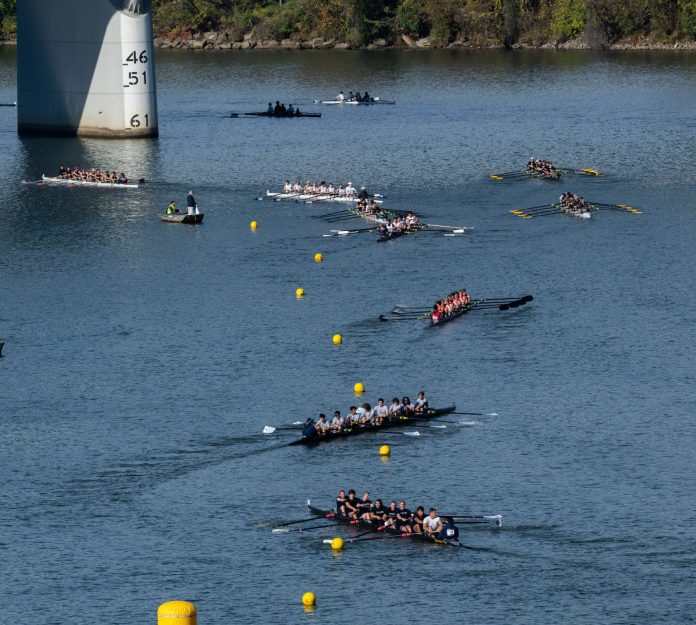
Over 9,400 racers—53 percent of them youth—competed at the 2025 Head of the Hooch Regatta. PHOTO: Julie Kobin.


Hundreds of the top junior and college clubs crews travelled to Chattanooga, Tenn. for the Head of the Hooch Regatta, which, coming at the end of many programs’ fall seasons as well as featuring a traditional fun and festive vibe, lays legitimate claim to the title of The Last of the Great Fall Regattas.

“We had another great event in spite of a little fog Saturday and some rain Sunday,” said Ulrich Lemcke, president of the regatta. “Water was good in spite of it all, so all competitors were in good spirits and we heard nothing but compliments.”

Vanderbilt won the women’s collegiate eight by more than 30 seconds over second-place Florida, with Clemson third. Alabama won the men’s event, ahead of UNC and Georgia Tech.

Cincinnati Juniors nipped Chicago by less than two seconds to win the women’s youth eight event, which included 72 finishing crews. Chicago finished second also in the men’s event, won by Belen Jesuit.

An Atlanta Composite entry averaging 50 years of age won the women’s masters eight on both raw and adjusted time. Catawba’s age 64 crew won the men’s event by 10 seconds (adjusted time) ahead of Atlanta, with the fastest raw time.

Results

Tigers Win, Virginia Impresses at Princeton 3-Mile Chase

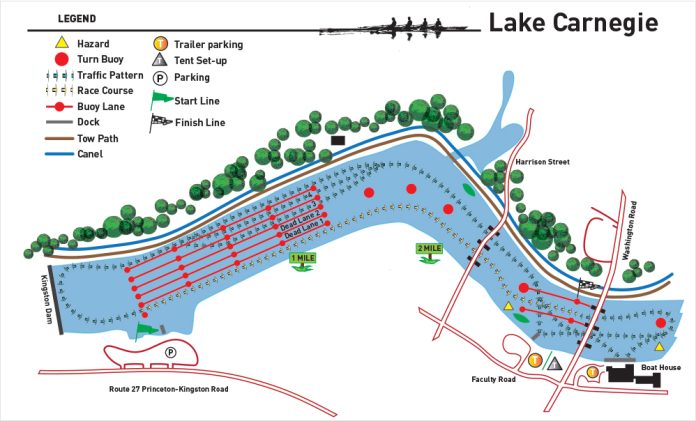
The Princeton 3-Mile Chase is held on Lake Carnegie.


Princeton heavyweight men’s eights finished first, second, and fifth at the Princeton 3-Mile Chase, Sunday, Nov. 2. Princeton’s women won their open eight event by less than a second over Virginia, whose A and B entries finished second and third. Virginia also won and finished third in the women’s coxed four event.

“We had a great day of racing on Lake Carnegie,” UVA head coach Wesley Ng said. “The coxing was fearless and decisive. I’m very encouraged by our focus and approach this fall.”

While the head race is neither a championship event nor counts towards anything, the college-only Princeton Chase has long been used by coaches as a benchmark at the end of the fall training season under better and more controlled racing conditions than huge head races like the Head of the Charles.

“I am proud of how our athletes went out and attacked the challenge this weekend. We showed really solid performances from all boats this weekend and I am excited about the progress that the program is making,” said Iowa head coach Jeff Garbut, who brought his top two eights to New Jersey, while less experienced oarswomen stayed home to race in the Iowa Chase, which includes juniors and masters.

Cornell won the men’s lightweight eight event, eight seconds ahead of Penn in second, and more than 20 seconds ahead of hosts Princeton in third and fourth. Georgetown was fifth in the field of 20 eights.

Results

Head of the Hooch Draws Another Huge Field

Head of the Hooch Regatta, "The Last of the Great Fall Regattas."


The 2025 Head of the Hooch Regatta, “The Last of the Great Fall Regattas,” draws 2,220 entries from 193 clubs, according to RegattaCentral, to Chattanooga, Tenn. the weekend of Nov. 1-2.

The majority-youth (53 percent) rowers will race over 9,400 seats, with many rowing in multiple events. Atlanta Rowing Club masters oarsman Adriaan Venter, who picked up rowing after watching a head race and trained his way on to the South African National Team, entered in five events: the mixed masters eight, the men’s open four with coxswain, the men’s masters single, the men’s masters eight, and the men’s open quad.

Including six pair events, the Head of the Hooch offers one of the widest ranges of events, with the youth doubles—over 100 entries and more the 30 waitlisted in both the men’s and women’s events—and youth coxed fours (120 entries) drawing massive junior fields. Youth team points trophies will be awarded for men’s and women’s teams.

Sponsored by the Tennessee Valley Authority for over 20 years, the Hooch has adapted and grown, with the current event site in Chattanooga on the Tennessee River its third location since its founding on the Chattahoochee River in Roswell, Georgia in 1982. From 1997-2004, the Hooch was held on Lake Lanier in Gainesville, Georgia, site of the 1996 Atlanta Olympics regatta, which it eventually outgrew.

Racing begins 8:52 am on Saturday, Nov. 1 and runs through Sunday, Nov. 2 at 2:40 pm, after clocks are set back an hour overnight for daylight saving time.

Schedule  |   Results

Coxing: Making the Most of Launch Time

Are you making the most of your time in the launch? PHOTO: intersport-images.com


No matter your program, the day will arrive when you’ll get to the boathouse and see that you’re up for a ride in the coaching launch. Maybe it’s a small-boats session; maybe you’re in a rotation of coxswains competing for a seat. Either way, time in the launch is an incredibly valuable way to develop your skills.

First, always be mentally and physically prepared to go in the boat. Even if you don’t have your CoxBox with you, you should be ready to hop in. Whether it’s part of the plan or an impromptu decision by the coach, coxswains can be replaced mid-session, so be ready.

I talked with Abby Knight, head junior coach at Cambridge Boat Club, about how coxswains can get the most out of their time in the launch. Since CBC spends a lot of time in small boats, coxswains in the program have ample opportunity to ride in the launch.

Be prepared.

“The first thing I’m looking for when a coxswain is going to come out in the launch with me is: Do they have a notebook?”  Knight said.

Don’t expect yourself to remember everything. It’s useful to have a record of practice notes to which you can refer throughout the year and beyond. Many coxswains bring a small notebook to every practice, and you can make the most of it when you’re in the launch (one that is small and waterproof is a good investment).

“If you’re not taking notes, you’re not really soaking in everything you can get out of the opportunity of being in the launch,” Knight said.

Really listen and observe.

During practice, you’re trying to manage traffic, run drills, steer, and listen to and give feedback. The launch is your opportunity to do one thing at a time, so this is an excellent occasion to get granular with what your coach is saying.

“The launch is the time when coxswains can slow down and listen very specifically to the words I’m using when I’m coaching,” Knight said. “I always try to relay to my coxswains that I want them using the exact same technical words I’m using.

“I expect them to be writing down what technical cues I’m using so they can have that as a template for their calls, whether that’s in practice or in racing.”

As a coxswain, you want to choose your words carefully to reinforce and complement the coaching. In the launch, you can ask why certain phrases are or aren’t used in your program. Asking the why behind the words will yield insight into your program’s technical priorities.

Watch the rowing.

This should be a really fun part of being in the launch. Challenge yourself to see what your coach is seeing but also to make your own technical observations. See if you can identify the individual or collective technical issues within the boat.

“This is a coxswain’s opportunity to get a really good look at the rowers,” Knight said. “What are you noticing technically from them, what is the coach pointing out technically for them? Then when you’re in an eight or a four you know specifically what each rower is working on.”

Try to connect what you see and feel in the boat with what your coach is saying to your rowers. If there’s something that’s tough to understand or different from what you observe in the boat, this is a great moment to ask questions. Connecting what you see from a side view to what you can see in an eight (or feel in a four) will increase your ability quickly to give accurate technical feedback to your crew.

If you’re watching other coxed boats, this is a fine opportunity to take note of steering feedback given to other boats and to ask your coach where you should be on the river.

“A big part of managing practice is your being where I want you to be,” Knight said. “So this is your opportunity to see where I’m telling the coxswains to point, which is a little easier to see from the launch.”

Ask questions.

This is a precious opportunity to be one-on-one with your coach. Pick your moments well (don’t interrupt!), and it’s a sure bet your coach will love talking rowing with you.

“I’m looking for coxswains to be inquisitive— anything to show me that they are trying not just to get better but also lean into what we’re trying to do as a group,” Knight said.

Using your time in the launch well will sharpen your skills as a coxswain and help advance the technical development of your team by ensuring that you and your coach are sending the same message. 

Hannah Woodruff is an assistant coach and recruiting coordinator for the Radcliffe heavyweight team. She began rowing at Phillips Exeter Academy, was a coxswain at Wellesley College, and has coached college, high-school, and club crews for over 10 years.

Letter to the Editor:

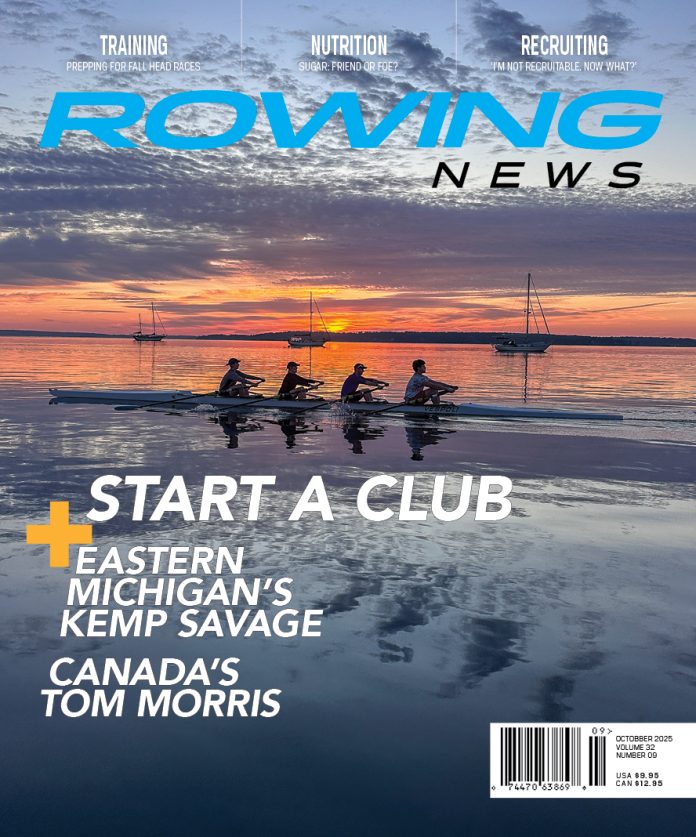
Rowing News, October, 2025 cover. PHOTO: Amy Wilton.


It is risible that coaches lament the demise of freshman and novice rowing. Two decades ago, the coaches voted to euthanize it!

Four of our 1980 Olympic eight learned to row in college, as well as the cox. By not transforming more mature bodies in college, we face an inefficient trajectory for the future of fast crews in America.

Sean P. Colgan
Lightweight, heavyweight, sweep, and scull U.S. National Team member, 1972-1984
New Zealand