Home Blog Page 136

Llandaff make history as Henley opens in style

PHOTO BY LISA WORTHY | STORY COURTESY HENLEY ROYAL REGATTA

Thousands of spectators streamed in early for the second ever Tuesday start in the 184-year history of Henley Royal Regatta. It was like it had always been this way. Likewise on the water, as Llandaff Rowing Club looked at home as they made Henley history by becoming the first club crew to contest The Princess Elizabeth Challenge Cup (Junior Men’s Eight). 

The rule change this year has opened up the PE to clubs as well as schools for the first time in its 77-year history. All eyes had been on the international entries, but Llandaff stole everyone’s thunder, making all their own luck in Race 13 by easily beating The King’s School, Chester. 

With an eight who had never rowed here before, Llandaff thrived where others felt the pressure. Llandaff made a strong start, were 1½ lengths up by the Barrier (1:56) and extended their lead down the Course. 

In the wake of their victory, Llandaff’s coach Ole Schlottmann, explained what it means to  Llandaff – who only have a 1,250m stretch of the River Taff near Cardiff to train on – and what the rule change could mean to all club juniors and British Rowing. 

Broadening the British base

I think we achieved something for Britain here to actually make rowing more accessible. It will do wonders for the British Junior Rowing Team.”

“I’m really proud of what we did today,” Schlottmann said. “It’s not just for the boys. I think we achieved something for Britain here to actually make rowing more accessible. It will do wonders for the British Junior Rowing Team.”

“It’s such a lift for the boys. And when they bring that back to Llandaff Rowing Club, all the younger teams will look at this and will really want to do it.”

“And if you think about what we’ve got at Landaff, we’ve got 1,250 metres of water. It’s a very fast flowing river and there’s a lot of current. Obviously, in the winter it’s mostly flooded and we’ve got two bends and one bridge to contend with, so it’s really hard for the eights.”

“It brings such an important push into clubs to bring up the levels really, and to want more.

“It brings such an important push into clubs to bring up the levels really, and to want more. Hopefully this will open it up. For me, that’s the best message.”

It was an especially proud day for Schlottmann, who only started coaching again when his son, Kai, was 12 as he was able to watch him in the 7 seat today. 

Henley pathways 

One of the unique features of Henley is the pathway it provides from junior to Olympian. The women’s entry has doubled since 2019 because of the three new events introduced in 2021 and the PE rule change should help broaden the base in junior rowing. 

“It was a fantastic first day, we saw some high-quality racing across the events and they will have to be even better tomorrow.”

“The Stewards were clear in wanting to open the Princess Elizabeth to clubs, it was time,”  Sir Steve Redgrave, Chairman of the Committee of Management said. “Although some of the focus has been on international clubs coming to Henley for the PE, the hope is that British clubs and a wider base of young rowers thrive in this event.

“It was a fantastic first day, we saw some high-quality racing across the events and they will have to be even better tomorrow.”

Brisbane tomorrow 

Llandaff will face one of the favourites Brisbane Boys’ College, Australia on Wednesday after they had earlier beaten Monmouth School in comfortable fashion leading by three lengths at the Barrier (1:55) “Tomorrow we’re racing against the Brisbane crew who are pretty tall and strong. I wouldn’t say we’re equal or better but on a good day we might be able to beat them.”

American eights 

The big American eights flexed their muscles on day one, including Marin Rowing Association, USA, a San Francisco Bay club who came with fast times and a big reputation, and dominated Dulwich College in the PE in the afternoon session. They lie ahead in Llandaff’s half of the draw. 

Quadruple Dutch 

It was a great morning for the Dutch entries with four of their boats going through to the next round, including two in The Prince of Wales Challenge Cup (Intermediate Men’s Quad Sculls).

The only defeat came in the double Dutch Race 11 where Triton & Dudok van Heel beat K.S.R. Njord.
Henley Royal Regatta Underway Tuesday, June 27 to Sunday, July 2

STAFF REPORTS | PHOTO BY LISA WORTHY

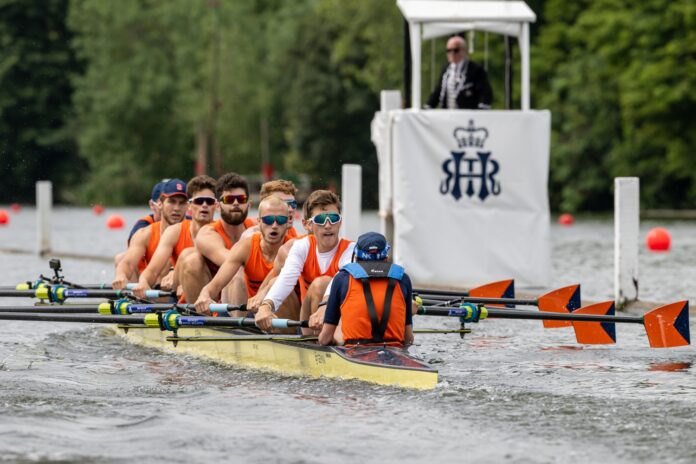
The 2023 Henley Royal Regatta takes place June 27 through July 2 on the River Thames by the town of Henley-on-Thames, England.

There are 732 entries from 17 countries, making the 2023 iteration of the event the second highest ever in its 184-year history, according to race organizers. The number of female rowers entering the 2023 Henley Royal Regatta will be twice that of 2019.

“Every edition of Henley Royal Regatta is unique, but a Regatta in a year before the Olympics is always significant,”  Sir Steve Redgrave, Chairman of the Committee of Management, said.  “We really see where crews are in their preparations, and the difference at Henley is that the gladiatorial nature of the racing means there are no hiding places. And, of course, this is the last chance to see the British squad before Paris.”

USRowing Announces 2023 Under 19 National Team Selection Camp Invitations

PHOTO AND STORY COURTESY USROWING

Sixty-seven athletes have been invited to USRowing’s 2023 Under 19 National Team selection camps in Chula Vista, Calif.

Camp invitees are competing for spots on USRowing’s Under 19 National Team in the men’s and women’s four with coxswain, quadruple sculls, and eight that will represent the U.S. at the 2023 World Rowing Under 19 Championships August 2-6 in Paris.

Athletes not selected for the world championships’ squad will continue to train for the 2023 CanAmMex team. CanAmMex is an annual collaboration camp between Canada, Mexico, and the U.S. that includes a week of training followed by a regatta. This year’s regatta will take place July 14-15 in Sarasota, Fla.

Caitlin McClain will serve as the women’s head coach for Paris, while Eric Gehrke will serve as the men’s head coach.

Supporting McClain on the women’s side are Skye Elliot and Mike Wallin, while Brian de Regt and Wallin will work with Gehrke with the men’s boats. CanAmMex coaches include Asiya Mahmud, Kevin Harris, and Matthew Grau. The U19 selector is Nick D’Antoni.

Athletes invited to participate are listed below.

U19 Women’s Selection Camp Invitees
Maisy Ballantyne – Marin Rowing Association
Carly Brown – Detroit Boat Club
Joely Cherniss – Marin Rowing Association
Angelina DiPaola – Cincinnati Junior Rowing Club
Isabella Furman – Greenwich Crew
Lizzie Hedeman – Community Rowing, Inc.
Lila Henn – Redwood Scullers
Kennedy Housley – Sarasota Crew
Charlotte Jett – Norcal Crew
Sumner Kerr – River City Crew
Beatrice Knight – Marin Rowing Association
Audrey Leurck – Cincinnati Junior Rowing Club
Ingrid Lofgren – Milwaukee Rowing Club
Rosie Lundberg – Saugatauck Rowing Club
Grace Murphy – Fairmount Rowing Association
Claire Perkoski – Chicago Rowing Foundation
Olivia Petri – Redwood Scullers
Ashley Rohloff – Princeton National Rowing Association/Mercer
Ava Schetlick – Virginia Rowing Association
Rebecca Schmidt – Niskayuna Rowing
Brooke Seebeck – Oak Neck Rowing Academy
Sofia Simone – Sarasota Crew
Eleanor Smith – RowAmerica Rye
Rebecca Stelmach – Oakland Strokes
Vienna Sun – Redwood Scullers
Emily Tierney – Blair Academy
Emily Turnbull – Andover Crew
Ella Warden – Whitemarsh Boat Club
Ella Wheeler – Northfield-Mount Hermon
Lindsey Williams – Narragansett Boat Club

U19 Men’s Selection Camp Invitees
Nathan Abrials – Gonzaga High School
Edward Achtner – Molesey Boat Club
Andrew Bittner – Belmont Hill School
Charles Boldt – Indianapolis Rowing Club
Cole Bruen – Albemarle High School
Arturo Castelo – Belen Jesuit Preparatory School
Henry Cooper – Pocock Rowing Club
Rahil Bundon – RowAmerican Rye
Nathan Fineman – Oakland Strokes
Kyle Fox – New Trier High School
Keenan Heinz – Oakland Strokes
Theodore Herzog – Saugatuck Rowing Club
Christian Lawrence – St. Louis Rowing Club
Nicolas Leach – Pacific Rowing Club
Lucas Liow – RowAmerica Rye
Marcus Lorgen – Phillips Exeter Academy
William Mathes – Sarasota Crew
Luke Meisenbach – San Diego Rowing Club
Colton Millar – Sarasota Crew
Ryan Miller – Indianapolis Rowing Club
Tyler Murphy – Orlando Area Rowing Society
William O’Donnell – New Trier High School
Andrew Orio – Wayland-Weston Rowing Association
John Salvi – New Trier High School
Sandro Scalifi – Atlanta Junior Rowing Association
Brady Shanle – Tempe Junior Crew
Leo Shetler – Los Gatos Rowing Club
Noah Silverstein – New Trier High School
Jack Skinner – New Trier High School
Luke Taylor – Middlesex School/Cambridge Boat Club
Cole Thomas – RowAmerican Rye

U19 Selection Camp Coxswain Invitees
Kannan Alford – New Trier High School
George Bentley – Saugatuck Rowing Club
Aleksandra Belov – Austin Rowing Club
Ella Casano – Saugatuck Rowing Club
Lucy Herrick – Chicago Rowing Foundation
Gabrielle Zammit – Princeton National Rowing Association/Mercer

No Complaints

BY CHIP DAVIS | VIDEO BY ADAM REIST

As final selection camp for the 2023 U.S. National Team gets under way in Princeton and Lake Mercer, N.J., from June 26 to July 16, the Olympic future looks bright for Team USA. The U.S. won eight medals—seven in Olympic events—at World Rowing Cup II in Varese, Italy, in June.

Returning to Princeton from Varese, Josy Verdonkschot, USRowing’s chief high performance officer, allowed that he’s “pretty satisfied” with the results. 

“If this is the direction we are taking, I cannot complain.”

Verdonkschot has good reason to be pleased. The eight-medal haul is the best showing for the U.S. at a World Rowing Cup event since 2013, during the 11-year undefeated streak of the women’s eight.

It’s remarkable also for what it didn’t include: eights. The U.S. didn’t enter a big boat for either the weak men’s event or the even weaker women’s—which featured only three crews. Five world best times were set at Varese, but the winning times of the eights were furthest from the gold-standard times of any of the 14 Olympic events. Great Britain ruled the men’s sweep events, winning the pair, four, and eight. The best women’s eights—Romania and The Netherlands—took a pass on Varese, with the Dutch sending only a development squad.

“I got a positive feeling about where we are, especially if you look at the events we competed in,” said Verdonkschot. “So I think we can look at our targets now about qualifications and about medals. Eight would be a nice target, nine would be great.”

In accordance with published selection procedures (necessitated by lawsuits against USRowing whenever the national governing body names the Olympic rowing team), the women’s pair of Alie Rusher and Megan Musnicki, the men’s double of Sorin Koszyk and Ben Davison, and single sculler Kara Kohler all earned spots on the U.S. National Team for September’s World Rowing Championships by virtue of having won April’s national-selection regatta and performing well (basically by making the grand final) at the Varese World Rowing Cup. All seven athletes went to the California Rowing Club after Varese to continue preparing for Worlds and, ultimately, the Olympics.

For Kohler, who has won sculling medals in both the Olympics (quad, 2012) and world championships (single, 2019), it’s a return to form after a 13th-place finish at last year’s worlds.

“I’m very happy for her,” said Verdonkschot of Kohler’s renewed success and training with California Rowing Club. “She’s happy in the environment where she is right now at this moment, she prefers this road. So I support it.”

While the three boats that have earned their places on the team already have gone back to the California Rowing Club, many of those who will make up the rest of the squad will be from CRC. The men’s four that won a bronze at Varese is three-quarters CRC oarsmen. Verdonkschot will select a final lineup that might be the same four oarsmen or might feature a change or two. The two athletes not selected for the four will join the group of about 16 being considered by Steve Gladstone for the men’s eight in the first week of final selection camp. 

All six of the CRC oarsmen in last year’s fourth-place U.S. eight were invited to the final selection camp, as were CRC’s Justin Best and Michael Grady, who won the petite final as the U.S. at last year’s worlds. The top 11 pairs and five eights at this year’s worlds will qualify for the Olympics. In total, 12 of 32 male invitees to the selection camp are officially from the California Rowing Club, while others like Yale’s Nick Rusher and Brown/Cal oarsman Gus Rodriguez have trained there.

CRC operates out of the Ebright Boathouse at the T. Gary Rogers Rowing Center, home of the University of California, Berkeley crew. Former U.S. Olympic coaches Mike Teti and Tim McLaren, along with Skip Kielt, coach a small group of aspiring rowers at what became, after the Tokyo Games, the de facto men’s Olympic training center when USRowing neither retained Teti nor announced a clear plan for elite rowers until Verdonkschot came to the U.S.

“You really got to credit the Rogers family, because after everything kind of shut down, they said, ‘Hey, let’s keep it going,’ and these guys all wanted to come and they stayed, so it was good,” said Teti.

“We’re trying to help these guys achieve their dreams. That was Gary Rogers’ whole reason for starting the club. As he always used to say to me, ‘What I’m supporting is the dream.’”

The late Gary Rogers was a Cal oarsman who tried to represent the U.S. in the 1964 Olympics in the four.

“They were having a hard time. They couldn’t get a coach. They didn’t have a place to row and they didn’t have a boat,” said Mike Teti. “Gary swore that if at some point he became a person of means he would support anyone who wanted to try out for the team.” 

Although Rogers, a successful entrepreneur and philanthropist, died in 2017, his family continues to support the California Rowing Club.

Among those not selected for the eight could be enough oarsmen who can scull to put together a competitive quad to be coached by Kris Korzeniowski. Only the top seven quads at this year’s worlds qualify for the Paris Games, with two more Olympic spots up for grabs at next summer’s aptly named Final Olympic Qualification Regatta. The men’s pair and single will be determined at the trials at the conclusion of the camp.

On the women’s side, Sophia Vitas and Kristi Wagner have been selected already to be the double on the strength of their World Rowing Cup performance, when they missed victory by only seven one-hundredths of a second, but they still must go through the trial since they didn’t win the April NSR. They also finished seventh in the quad in Varese, doubling up with the other U.S. women’s double of Emily Kallfelz and Lauren O’Connor, who were fifth and join the pool of athletes at final selection camp, where the quad will be selected by Guenter Beutter.

The lightweight women’s double of Molly Reckford and Michelle Sechser also won silver in a fast and tight World Rowing Cup final, but aren’t necessarily the U.S. crew for worlds because they didn’t race as a double at the April NSR. Mary Jones Nabel, who has the unfortunate distinction of being one of three world-class lightweight scullers when there are only two Olympic seats, is believed to still be in the mix for selection. For the men, there are four good lightweight scullers who have yet to put together a medal-winning double.

The women’s four of Molly Bruggeman, Kelsey Reelick, Madeleine Wanamaker, and Claire Collins set a World Rowing Cup best time in winning the Varese World Rowing Cup and won’t face further selection, Verdonkschot said. “Well, I mean, they’re the best in the world.”

Verdonkschot wanted Princeton coach Lori Dauphiny or Washington coach Yaz Farooq to coach the women’s eight, but neither was available this summer, so Jesse Foglia, head coach of the USRowing Training Center–Princeton, will handle the duty.

Since being hired by USRowing in December 2021, Verdonkschot has done it his way, developing world-class sculling and small boats from the remains of the U.S. National Teams of the last two years, which failed to win a single medal at the last Olympics or achieve victory at worlds. It’s a stark departure from the eights-first approach not just to the Olympics but practically all rowing in the U.S. 

“A medal is a medal,” Verdonkschot has said repeatedly. “My job is to put the best athletes in the best positions to succeed.” 

Verdonkschot’s lowest-hanging-fruit approach to winning Olympic medals by putting the top U.S. rowers in the weakest events now coincides with a slow period in international eights. With the exception of Great Britain’s continuing dominance of men’s sweep rowing and fast women’s eights from The Netherlands and Romania, the eights fields have little speed and no depth. Defending Olympic women’s-eight champion Canada has been adrift since inexplicably not retaining the services of coach Michelle Darville (now with The Netherlands), and the Canadian men’s eight is also relatively slow so far this year. 

Verdonkschot’s strategy, California Rowing Club’s continuing development of elite rowers, and weak eights fields have come together at the right time for the U.S. to qualify at least eight boats and win medals at the 2024 Paris Olympics.

“We cannot presume that everybody stands still,” warned Verdonkschot, “but we also have to presume that we will get better in the final preparation.”

USRowing Announces 2023 Under 23 National Team Selection Camp Invitations

PHOTO AND STORY COURTESY USROWING

Sixty-seven athletes have been invited to attend USRowing’s 2023 Under 23 National Team selection camps this summer. Athletes selected through the camps will represent Team USA at the 2023 World Rowing Under 23 Championships July 19-23 in Plovdiv, Bulgaria.

On the men’s side, the U23 Men’s Sculling Selection Camp will select the men’s quadruple sculls crew for Bulgaria. Led by Conshohocken Rowing Center Executive Director Craig Hoffman, the camp is being held in Conshohocken, Pa. The U23 Men’s Sweep Selection Camp is being run by Dartmouth College Men’s Assistant Coach John Graves out of Hanover, N.H. The camp will select the men’s eight and men’s four with coxswain.

The U23 Women’s Sculling Selection Camp is being held at the Oklahoma City High Performance Center under the direction of OKCHP Head Coach and High Performance Director Reilly Dampeer. The camp will select the women’s quadruple sculls crew that will represent the U.S. in Plovdiv. Spearheaded by University of Oklahoma Women’s Head Coach Sarah Trowbridge, the U23 Women’s Sweep Selection Camp also is being held in Oklahoma City and will select the women’s eight and women’s four with coxswain that will be heading to Bulgaria.

The selection camps got underway earlier this month and run through July 7.

Men’s Sculling Selection Camp
Cedar Cunningham – Washington State University
Matthew Davis – University of Pennsylvania
Stewart Fuqua – Yale University
Harry Hall – University of Washington
Charles Jones – University of Pennsylvania
Jason Kennedy – University of Pennsylvania
William Kynast – Northeastern University
Matthew Lexa – United States Naval Academy
Owen Maier – Williams College
James Patton – Harvard University

Men’s Sweep Selection Camp
Ian Burnett – Brown University
Adam Campain – Cornell University
Jack DiGiovanni – Brown University
Jordan Dykema – Harvard University
Joshua Golbus – Brown University
Dylan Green – University of Wisconsin
Grant Gwadz – Boston University
Bret Holt – University of California, Berkeley
Samy Houdigui – Dartmouth College
Jacob Hudgins – Dartmouth College
Joseph Kiely – University of Notre Dame
Tyler Kurth – University of California, Berkeley
Caitlin Levin – Brown University
Cameron Matossian – Yale University
Wilson Morton – University of California, Berkeley
Aidan Murphy – Northeastern University
Nicholas O’Neill – La Salle University
Braden Porterfield – Northeastern University
James Robinson – Cornell University
Keith Ryan – University of California, Berkeley
Travis Senf – Stanford University
Erik Spinka – Princeton University
Samuel Sullivan – University of Pennsylvania
Nicholas Taylor – Princeton University
Julian Thomas – Dartmouth College
Blake Vogel – University of Washington

Women’s Sculling Selection Camp
Meena Baher – Harvard University
Rosemary Barney – University of California, Los Angeles
Lauren Benedict – University of Virginia
Cathleen Castle – University of Rhode Island
Victoria Dettinger – Northwestern State University
Gabrielle Graves – University of Michigan
Natalie Hoefer – University of Notre Dame
Caeley Tierney – Duke University
Paige Wheeler – Ohio State University
Aidan Wrenn-Walz – Harvard University

Women’s Sweep Selection Camp
Camille Arnold Mages – Northeastern University
Violet Barletta – Yale University
Juliette Camahort – Stanford University
Patricia Condon – Southern Methodist University
Lauren Day – United States Naval Academy
Lale Edil – University of Oklahoma
Eva Frohnhofer – University of Virginia
Victoria Grieder – Rutgers University
Hannah Heideveld – Rutgers University
Georgia Koerwitz – University of San Diego
Megan Lee – Duke University
Dahlia Levine – Brown University
Mia Levy – Yale University
Morgan Linsley – Duke University
Evan Park – Oregon State University
Helen Ross – University of Victoria
Quincy Stone – Marin Rowing Association/Stanford University
Tess Thompson – Ohio State University
Olivia Vavasour – Brown University
Isabel Wilkowski – Brown University
Morgan Zahner – Ohio State University

Water Wisdom

STORY BY CHIP DAVIS | PHOTO BY LISA WORTHY

Half your weight (in pounds)—that’s how many ounces of water you should drink a day, says Yuri Elkaim, a nutritionist, fitness expert, former pro soccer player and strength and conditioning coach. Unless you’re a coxswain currently, that’s a significant increase from the old “eight cups a day” (64 ounces).

Specific needs vary among individuals, of course, but another good way to make sure you’re hydrated properly is to keep drinking water until your urine is “clear and copious.” In other words, what comes out should look like what went in. 

Hydration is a safety issue most often in the heat and humidity of summer. Water is vital for regulating body temperature, transporting nutrients, removing waste, and even lubricating joints and muscles. Beyond poor performance, dehydration can result in illness, heat stroke, and even death. Rowers whose urine is dark yellow before a practice or race, especially in the heat of summer, should not launch until hydrated adequately.

At the other extreme is hyponatremia, which results from overhydration—when too much water drives your sodium levels too low. When you sweat, not only water comes out; you also lose electrolytes and sodium. As Nancy Clark has pointed out in these pages, if you crave something salty during or after rowing, listen to your body and ingest something salty. A good sports drink can replenish what was lost, as will a bag of chips or a packet of soy sauce or salt in an emergency.

A simple way to understand dehydration and hyponatremia is to think of sodium as the constant your kidneys are trying to maintain, despite fluctuations in water intake and outflow, while performing the vital function of filtering your blood. Drinking too little water results in dehydration; too much (without sodium replenishment) can lead to hyponatremia. 

In rowing, as in life, the key to health and success is to keep things in balance. 

SMU Varsity 8 Named American Athletic Conference Boat of the Year

STORY COURTESY AAC | PHOTO COURTESY SMU

IRVING, Texas – The SMU Varsity 8 has been named the 2023 American Athletic Conference Women’s Rowing Boat of the Year as voted by the league’s head coaches. In addition, Mustang freshman Meg Flanagan, who was a part of the Mustang V8, has been named the conference’s Newcomer of the Year.

SMU’s Varsity 8 captured the American Athletic Conference title on May 14 in Oak Ridge, Tenn., and propelled the Mustangs to their third consecutive team championship. The crew consisted of Flanagan, Megan Hewison, Sarah Abrams, Alice Fahey, Nicole Campbell, Emily Baker, Daisy Butterworth, Gracie Condon and coxswain Sasha Radvanovic.

Baker, Butterworth, Fahey, Hewison and Radvanovic were all named to The American’s all-conference first team.

The Mustang V8 went on to win the petite final and finish seventh overall at the 2023 NCAA Rowing Championships.

Masters Regionals Set for This Weekend

PHOTO AND STORY COURTESY USROWING

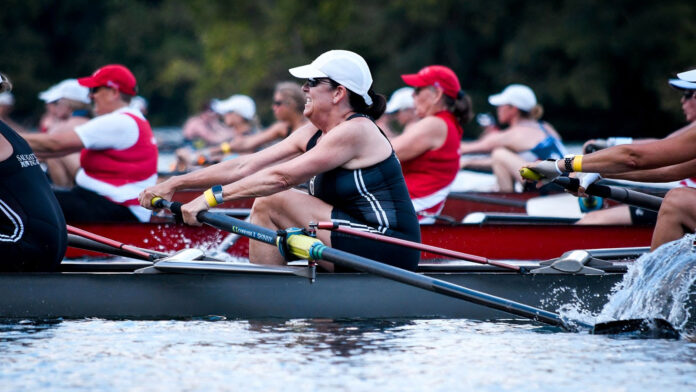
The USRowing Masters Series kicks off this weekend with the USRowing Southwest, Southeast, and Northwest Masters Regional Championships. In addition, the Diamond States Masters Regatta and Stars & Stripes USRowing Central Masters Regional Championships will be part of the series for the first time.

The Northwest regional will see 752 entries from 39 clubs racing this weekend on Dexter Lake in Lowell, Ore. The largest of the masters regionals, more than 680 athletes are scheduled to race across 123 events. Sammamish Rowing Association leads the way with 92 entries. Lake Union Crew is bringing 59 boats, while Station L Rowing Club had 49 boats scheduled to race. The women’s mixed double sculls on Sunday is listed as the most popular event with 17 entries. Racing begins Friday and runs through Sunday.

The Southwest championships is the second largest of the five regattas and features 417 boats, 25 clubs, and 422 total athletes racing Saturday and Sunday on the Lower Otay Reservoir in Chula Vista, Calif. San Diego Rowing Club has the largest presence at the regatta, with a whopping 83 boats expected to compete. River City Rowing has 48 boats competing, while East Bay Rowing Club will have 40. There are 124 events with the women’s C quadruple sculls having the most entries with 11.

With just 38 events, the Southeast regional will take place Saturday and Sunday at Langley Pond in Aiken, S.C. The regatta has 218 boats from 27 clubs entered, with around 250 athletes scheduled to race. Atlanta Rowing Club has the most entries with 43 boats expected to compete. Nashville Rowing and Sarasota County Rowing Club have entered 27 and 26 boats,  respectively. The men’s masters single sculls will feature 25 entries.

This year, USRowing is partnering with two regattas to fill out the masters series. The Diamond States Masters Regatta will have racing across 57 events, with 415 boats from 47 different clubs scheduled to race. Capital Rowing Club is the largest competitor with 60 boats. The second largest, Chinook Performance Racing, entered 50 boats, while Riverfront Recapture will bring 32 boats. The men’s masters G-J single sculls is the largest event with 17 scullers expected to race.

In Oklahoma City, the Stars & Stripes USRowing Central Masters Regional Championships will see racing across 29 events on Saturday, with 134 boats from 12 clubs expected to compete. Oklahoma City High Performance Center will have 39 boats racing, followed closely by OKC Riversport with 35. The men’s masters single sculls has the most entries with 12 boats expected to compete.