

To continue reading…
This article is exclusively for Rowing News subscribers. For as little as $5 a month, you can get access to the best quality, independent reporting on all the issues that matter to the North American rowing community.
By Kieran Harrington
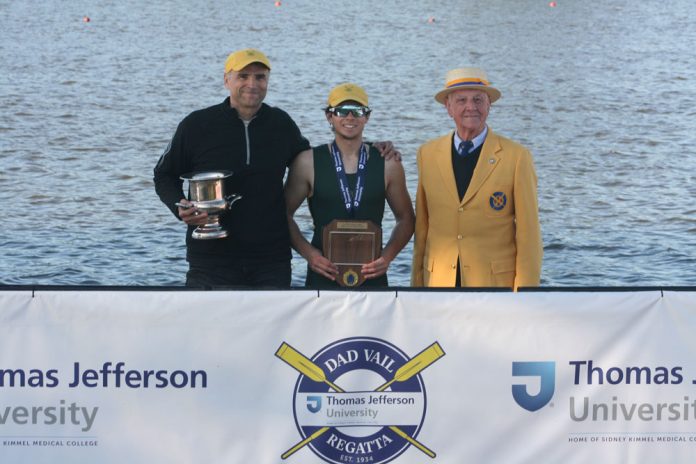
Run since 1934, the Dad Vail Regatta has grown over the years, continually working to offer more racing opportunities for collegiate athletes. Inspired by and named after Henry Emerson “Dad” Vail, the regatta was designed to provide opportunities for new and developing collegiate programs that may not have the boats or speed to compete with the nation’s top colleges. In order to fulfill this goal, the Dad Vail Regatta offers seven championships, including men’s and women’s overall team trophies, men’s and women’s sculling trophies, and small boat trophies available to Division I, II, III, and club collegiate programs.
Out of the seven championships awarded, two stand out. The National Intercollegiate Sculling Championship directly impacts smaller collegiate programs and supports the development of sculling. Bill Jurgens, who rowed in, coached at, and now heads the Sustainability Committee for the Dad Vail Regatta, said that the Sculling Championship “looks to promote the development of the sport of sculling as it rises in popularity.” Similarly, the Small Boat Championship benefits teams that do not have the capacity or depth to field competitive eights. These teams can compete in fours and pairs while gaining recognition at that level. One example is the University of Tampa Spartans. Without the ability to offer scholarships or recruit large numbers of athletes, the team views the Dad Vail Regatta as an opportunity to showcase its abilities. In a recent press release, Head Coach Bill Dunlap said, “The Jefferson Dad Vail Regatta is our championship.”
In addition to encouraging smaller crews to develop through competitive racing, the Dad Vail Regatta has expanded qualification opportunities for the Intercollegiate Rowing Association (IRA) championship by awarding bids to the top four finishers in the men’s heavyweight varsity eight. Previously, only the top two finishers received bids, but with permission from the IRA, the regatta responded to the increased speed and competitiveness of Dad Vail crews by expanding eligibility.
However, this does not apply to the women’s heavyweight varsity eight. Operating under the NCAA structure, women’s teams qualify for the NCAA National Championship by winning their respective conference championships and instead use the Dad Vail Regatta as preparation for end of season racing.
The weekend begins on Friday, May 8, with time trials and semifinals that narrow down the field. On Saturday, crews race for points, trophies, and championships. “We want the regatta to be the best experience possible for rowers and spectators,” Jurgens said. Featuring a beer garden, high-quality livestream, and food vendors, Camden County, New Jersey’s Cooper River Park provides an engaging atmosphere for athletes, spectators, and alumni who come back to relive their glory days. Paige Propp, head of Drexel University Rowing’s Alumni Association spoke about the connection that racing again brings not only to alumni, but also their family, friends and community saying “Its really about the nostalgia…it is as much about racing as it is about connecting as a boat again.”
