

To continue reading…
This article is exclusively for Rowing News subscribers. For as little as $5 a month, you can get access to the best quality, independent reporting on all the issues that matter to the North American rowing community.
Danish physicist Niels Bohr once said that an expert is someone who’s made all the mistakes one can make in a narrow field. By that standard, I’m an “expert.”
After a longish spell rowing after college, hitchhiking, bike messengering, bartending, and running a nightclub in Manhattan, I listened to the little voice in my head that whispered, “Hey, you can do it better than a lot of coaches you’ve had.” (By now, no doubt, I’ve spawned more than a few young coaches who’ve entertained the same whispers about me.)
The charge of a coach at any level is to develop. Any coach with a shred of competitiveness will begin with “How do I make the kids better?” That’s always the right question. So, too, is the default: “How fast can I make them on land and water?”
There’s a lot more to it, though. When you’re a dad with two sons who competed in college and a third who is still in high school, there’s no avoiding youth sports. My personal involvement in high-school rowing is slight, but my experience with guys who did row in high school is extensive.
I can extrapolate only from my kids and their youth coaches in football, basketball, and a little baseball. My perspective is grim. If 10 percent of the fisherman catch 90 percent of the fish, then it’s likely 90 percent of the youth coaches are responsible for the “that sucked” attitude so many kids have when they pull the sports plug. Youth rowing doesn’t have the “daddy coach” problem that plagues baseball and basketball (I think) but it certainly has its share of unserious coaches.
A mission statement for youth coaches should include these principles:
It’s all about you only insofar as you get satisfaction, even thrills, from watching your athletes succeed beyond what they and you dreamed possible.
How good you were in your rowing prime is relevant in only one way: Your aim is to make the kids you coach better than you were.
A coach should not be a dream buster. Mr. Woods, my high-school algebra teacher, once told me when I was struggling, “You’ll never go to a great college like my alma mater, Notre Dame, with your results.”
Mr. Woods was right; I never did go to Notre Dame. But he was also wrong. What he said shook me, and I vowed that I’d never try to motivate through negativity. As a coach, you’re a “youth farmer” with the power to grow or ruin your crop. Tend it carefully.
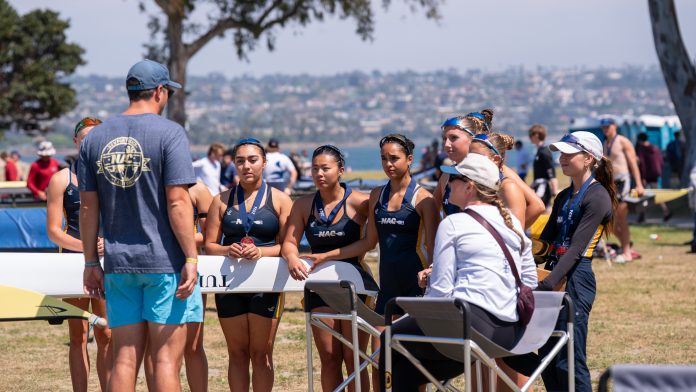
For most of my career, I’ve been a college coach focused on the unique problems of college rowing. Equally important, however, is youth rowing and the coaches who are developing the beginners in our sport.
Soon they’ll become the future of our sport, and as they thrive so too will rowing.
CHRIS CLARK is director of rowing at the University of Wisconsin, where he has coached for more than 30 years. In 2008, he led the Badgers to their first national championship since 1990, and his crews have won numerous medals at the IRAs and Eastern Sprints. He was a standout rower at Orange Coast College, Stanford, and the University of California, Berkeley. As a member of the U.S. national team, he won a silver medal at the 1983 Pan-American Games and in 1986 he rowed in The Boat Race for Oxford.
