

To continue reading…
This article is exclusively for Rowing News subscribers. For as little as $5 a month, you can get access to the best quality, independent reporting on all the issues that matter to the North American rowing community.
Story by Frank Fitzpatrick
Though flat-water rowers move in straight lines, it was a memorable turn that resurrected Chris Bak’s career.
At the 2021 Olympic Trials, the 2019 University of Cincinnati grad had failed to qualify in the lightweight double sculls. At 25, weary of lightweight rowing’s incessant demands, he was ready to retire.
And that’s when the Coastal Rowing Whisperer got in his ear.
Marc Oria, who had coached him at Cincinnati, took Bak aside and persuaded him to switch disciplines, convinced him that he possessed the skills to become a world champion in Coastal Rowing Beach Sprints.
“I didn’t believe what he was saying,” Bak said. “But from the beginning, Marc did. He believed I had that ability.”
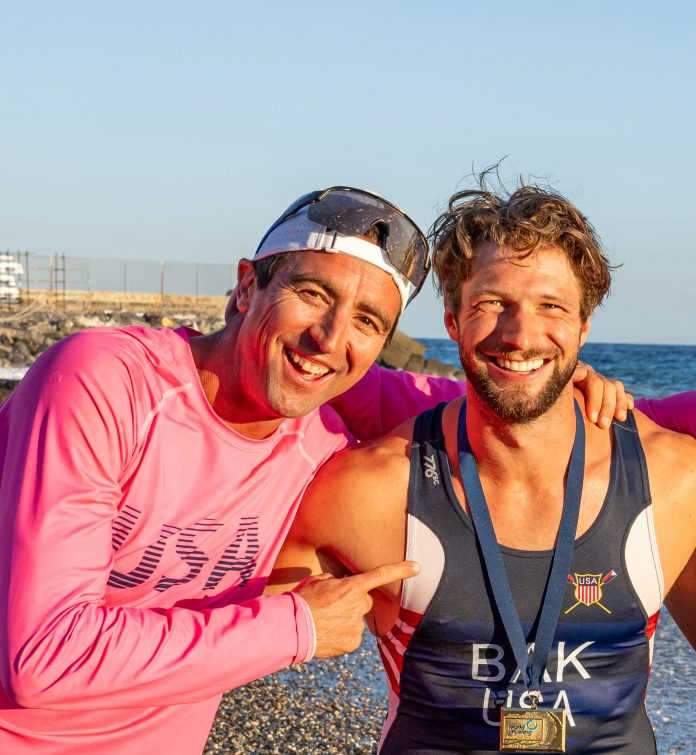
Oria was right. Five years later, Bak is a four-time world champion in the frenetic event that combines running, jumping, and rowing. The sport’s most decorated athlete, he’s favored to be one of two Americans–a male and a female–who will compete in three events when Coastal Rowing Beach Sprints makes its Olympic debut at the 2028 Games in Los Angeles.
Fans of the spectator-thrilling sport are excited about a new opportunity for USRowing to succeed on home waters. In fact, the discipline could outpace the traditional flat-water program’s medal production. Across the Tokyo and Paris Olympics, the United States won only two medals in 14 flat-water events.
Recent results suggest that potential is real. At the 2025 World Rowing Beach Sprint Finals, the U.S. earned two gold medals and one silver. Chris Bak led the way, becoming the first three-time men’s solo world champion and the most decorated Beach Sprints rower in the sport’s history. With LA28 approaching, performances like these make Beach Sprints an important part of USRowing’s Olympic strategy.
When Oria left Barcelona in 2013 for a job in Cincinnati, coastal rowing was virtually unknown here. Since then, he’s built both a formidable infrastructure for the sport in the U.S. and a powerful national team, in large part, say those who know him best, through the force of his personality.
Affable, smart, non-coercive and unfailingly upbeat, Oria, 48, has become a guru-like figure in the sport.
“Marc has a pure joy and love for the sport that is clear and abundant,” said Cara Stawicki, a former world-champion flat-water rower who now serves as a boat handler for the Beach Sprints team. “He honestly cares about every athlete he works with.
“His depth and breadth of knowledge about the sport are certainly an asset, but what distinguishes him from all those coaches who are deeply skilled and have all this technical knowledge is that passion and joy. He takes time with everybody, listens to everybody. He moves very fast and goes at a mile a minute, yet when you’re in conversation with him and you have a question, he’s there and he’s listening and he’s present.”
Married and the father of a 20-year-old Case Western Reserve student, Oria was a lightweight rower on the Spanish national team from 1999 until 2002. His coaching style, he said, incorporates everything he learned from his own mentors, lessons he got playing basketball and tennis, and his own sunny outlook on life.
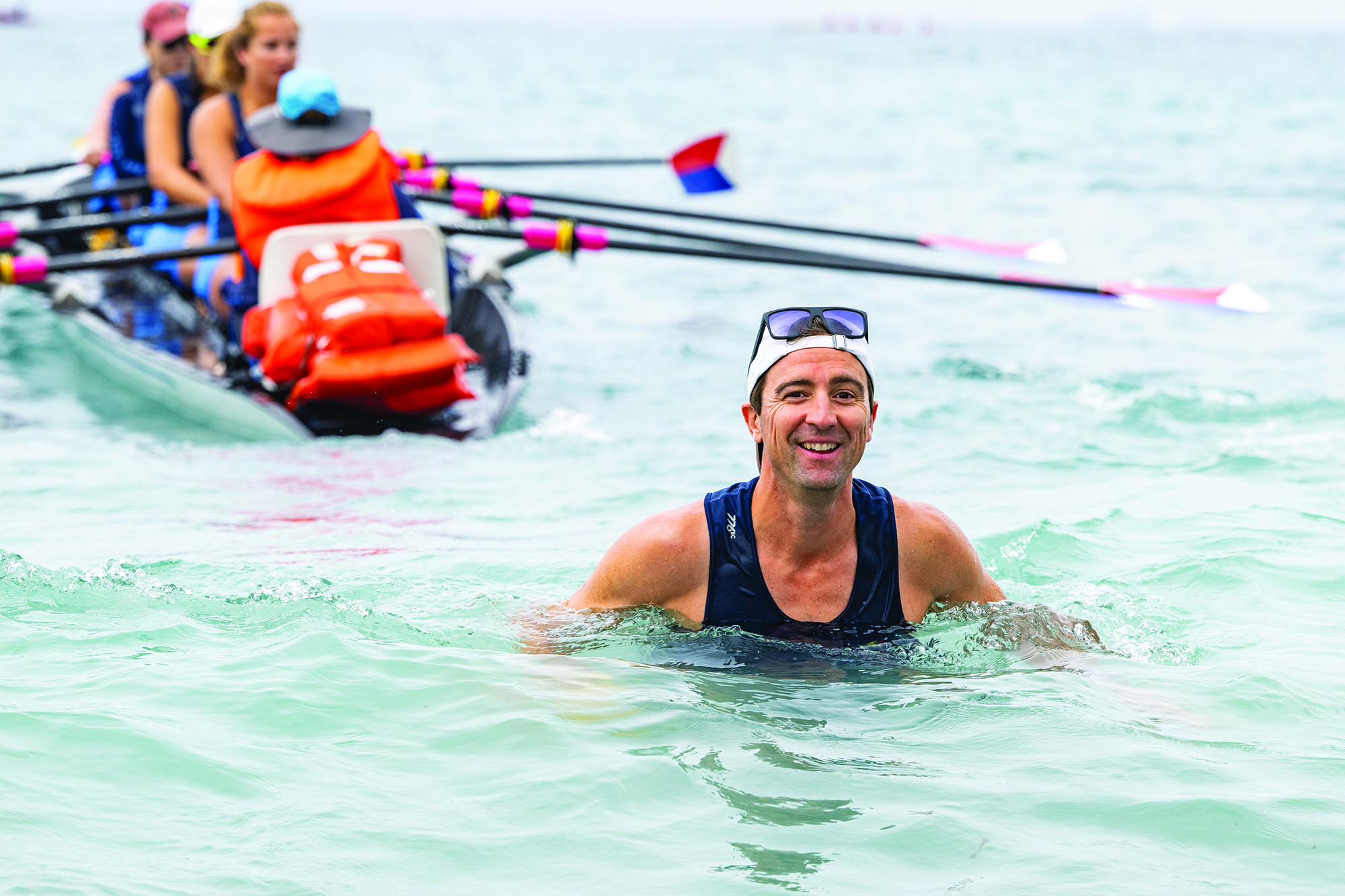
“I’m a positive person,” he said. “I understand the dark side, but I always look for the good. In the end, it’s about fun. If I’m not having fun, the athletes aren’t, either. I need to be positive and enthusiastic with them because when we’re happy we achieve better things.
“If we need to cry, fine, we’ll cry together. But the next day, that’s over, and it’s ‘OK, what’s the solution?’ I like to see life in that way. The opportunities will come. They’re always there. We just need to grab them.”
Oria has used his gifts to persuade flat-water rowers like Bak to test themselves against the peculiar rigors of coastal and Beach Sprints events. In the process, he’s built a community where none existed. He looks not just for excellent rowers but for rowers who are athletes. After all, beach sprinters have to run between 30 and 55 yards through thick sand, plod through knee-deep water, leap into a boat being held in place by two boat handlers, row out to and weave through a series of buoys, and then turn around and do it all in the opposite direction. And, oh yeah, the waves might be six feet high.
“It’s an explosion of athleticism, adaptability, and excitement that all takes place in under three minutes,” Oria said. “The races are raw, fast, and beautifully chaotic. You need to be mentally sharp and physically agile. You have to read the water, react to chaos, stay relaxed under pressure, and push your limits.”
Because ocean conditions can vary from tranquil to tumultuous, a good coach has to have what Booth termed “an adaptive, exploratory mindset.”
“And Marc does that really, really well,” Booth said.
Bak had prepped for his Beach Sprints career unknowingly. Before devoting himself to rowing, he had skied and played tennis and soccer. Oria recognized those latent skills and knew they would translate well.
“I didn’t even see that in myself. But Marc saw it,” said Bak. “He’s just such an extremely positive person. He can make you accomplish things that you didn’t think you were capable of doing. We’d do these 2K tests, and I think I was at 6:16. Marc would say, `You can go 6:15. You can go 6:10, 6:05, sub-6.’ Every single time, I would say, ‘I don’t think that’s possible,’ and every single time, I’d hit that goal.”
Thirteen years ago, Oria, who earned a doctorate in neuroscience from the University of Barcelona and won a post-doctoral fellowship to study in London, took a job at Cincinnati’s Children’s Hospital. He volunteered to help coach the rowing teams at the University of Cincinnati, where he’s now an associate professor in the department of radiologic oncology. He quickly became that school’s women’s coach and rekindled his fascination with coastal rowing.
His affection for the niche sport, which began in France more than 40 years ago, took root in the 1990s when he witnessed an event on the Spanish coast.
“It was this wonderful long-distance race in a beautiful place. I wanted to do it right away,” Oria recalled. “For me, it was a way to stay in shape, have fun, and row in amazing places.”
But the coastal races were in the middle of the ocean, in flat water, too far out for spectators. Searching for a more exciting and fan-friendly remedy, World Rowing representatives met in 2011, and the idea of Beach Sprints rowing was born.
As Oria’s focus shifted, USRowing officials asked him and others, including another pioneering coastal enthusiast, Ben Booth, to think about how the organization might incorporate this new discipline.
“Marc and I had a similar enthusiasm for coastal, and when I met him, I was like, ‘Here’s a guy who knows what he’s talking about,’” Booth said. “We eventually formed a partnership and started Next Level Rowing. That really got things going. Marc has a real talent for recruiting, and he was able to stir people and get them passionate about the sport.”
Next Level Rowing, which brought together coastal rowers and coaches from across the U.S., accelerated the sport’s growth here. The first world championships were held in 2019 without any American representation. But by 2021, pressure from World Rowing officials had made it a global sport. Suddenly, there were coaches and rowers around the world.
Five years later, the Americans can field an impressive cast of rowers—one Oria believes is good enough to challenge for gold in all three Olympic Beach Sprints: men’s solo, women’s solo, and mixed double.
“Every year, we have more coaches,” Oria said. “Every year, we have more athletes. It’s growing.”
No one is sure how many coastal and Beach Sprints rowers there are in the U.S., but they make up only a small fraction of USRowing’s estimated 78,000 members. Next Level Rowing has 56 members, Oria said.
Its growth hasn’t come without choppy water. Practically devoid of funding and sponsors, coastal rowers have found it difficult and expensive to train and compete. Boats were hard to come by. And at past world championships, U.S. rowers would spend six to eight weeks in places like China or Brazil, paying their own way. Now the Olympic connection will provide some financial assistance. In the meantime, Oria will keep hunting for bargains.
Since there are more boats, plus cheaper lodging and airfare outside the U.S., Oria often has his rowers training and racing in places like Colombia, Italy, and Costa Rica.
“Marc is one of the most resourceful people I know,” Bak said. “He’ll always find a way. I remember times when we’d be in some other country and we’d have 10 people squeezed into a tiny Airbnb. People could have said they didn’t want to sleep on a floor, but Marc having that passion and belief convinced us all to make the best of it.”.
This summer, Oria will be preparing his team for October’s world championships in Qingdao, China. He’ll conduct a selection camp in September. After that, a two-year focus on the Olympics will begin. And no matter the stakes, when he’s instructing his athletes, the Coastal Rowing Whisperer’s demeanor will likely remain as serene as a mountain lake.
“Keep an open mind and a light heart,” Oria will tell them. “Leave your ego on the beach and let the water teach you. You need to love the fight, not just the rhythm. If you can smile through the surf and still focus on your blade, you’re in the right sport.”
FRANK FITZPATRICK, a longtime sportswriter for The Philadelphia Inquirer, was a finalist for the 2001 Pulitzer Prize. He covered nine Olympics, including the 2004 Games in Athens when the U.S. men’s eight ended a 40-year drought by winning a gold medal.
