

To continue reading…
This article is exclusively for Rowing News subscribers. For as little as $5 a month, you can get access to the best quality, independent reporting on all the issues that matter to the North American rowing community.
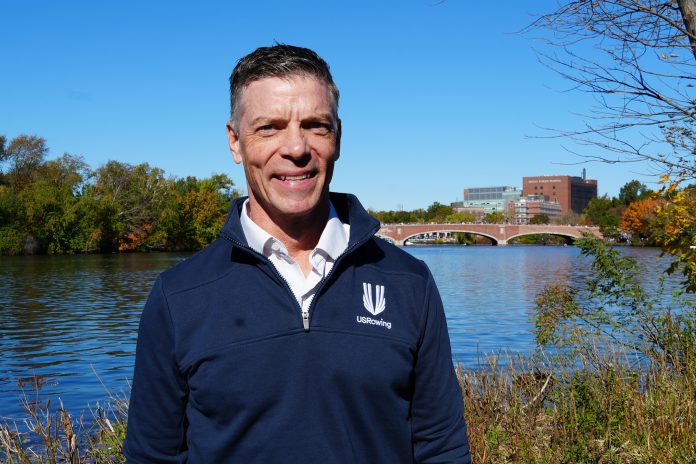
USRowing’s board of directors named Joel Shinofield its next CEO in early October. He comes to USRowing from USA Swimming, where he was managing director of sport development and led the largest division of swimming’s national governing body, with $24 million in individual/club membership revenue, 370,000 members, and overall revenue of over $40 million. USRowing has about 70,000 members and reported revenue of $19.6 million in 2024.
Rowing News: Tell us about yourself, Joel, and what you hope to accomplish as the new CEO of our national governing body?
It’s an interesting question because who I am is informed by sports. Sports completely changed my life. I joined the high-school swimming team when I was a freshman not knowing anything about it after not making the basketball team. I read a huge banner in the hallway that said, “Swim team going to Mexico.”
It was an inner-city high school, no windows, in Minneapolis, and here I was: Never been on a plane, never gone some place warm in the winter, and I’m thinking, “This is a fantastic idea. I’m going to join the swimming team.”
Turns out that nobody ever went to Mexico. They just put the sign up every year to get kids like me to put a Speedo on.
I was just a kid who didn’t have a ton of direction, wasn’t having a lot of academic success, and then that coach, and then my club coach, completely changed my life by just telling me that if I worked on these things and avoided others, I could be successful.
And that meant that I went to a college that I never anticipated going to, and that led to my being involved in sports for the rest of my life. I first just wanted to give back at a level where I could thank Neil Anderson and Jesse Thomas for what they did for my life, and so I followed them in becoming a coach and a teacher. And then that led into other community-serving capacities, but I always stayed with coaching as that central connection to what I really valued.
Whether I was in high-school coaching on the side or in college coaching to help pay my way through school or after I graduated, making sure I could find time in whatever profession I was in to coach has been the way I’ve given back, because it made such a difference to me.
Jesse Thomas, my club coach, was one of the last varsity members of the Tennesse State University Swimming and Diving program. In the 1970’s HBCU [historically Black colleges and universities] swimming teams were prevalent across the country, when there was a much wider array of sports offered by HBCUs, and if he hadn’t been given that opportunity, I wouldn’t have had him as a coach, and so making sure people have access to sports has always been a critical element for me, because when people have access they grow the sport, they grow joy, and they gain from them.
The second time sports changed my life was when Jean Freeman, the longtime pioneering women’s coach at Minnesota, convinced me to quit my job—I was working in downtown Minneapolis and coaching on the side—to become a full-time coach and her volunteer assistant.
That changed my life because the woman who would become my wife was coaching rowing at Minnesota at the same time. We had a shared strength coach between the teams who was also a rower, and she thought we’d be great together, so that’s how we met.
Because we’ve both been involved in sports, it’s been a huge part of our kids’ lives. That network of people—I think it’s incredibly important to have other people who are helping you raise your kids, because by ourselves we can make a lot of mistakes, and other people can help us smooth those out, so coaches and people around us in that community have been really important.
That’s why I wanted to be here—recognizing how much this community cares and how much it does for one another, and then some of the similarities between the communities of swimming and rowing.
Rowing News: What’s your No. 1 priority in the first three months on the job?
Making sure we have a decision-making framework that allows for transparency so people are engaged in conversations about decisions ahead of time and we can move forward in a unified way.
I want people in the rowing community to feel connected, that the information they care about and the things they care about are communicated in both directions. With good bi-directional communication, we can move forward going into 2027 and ’28 and begin to unify the community.
I don’t expect 100 percent alignment from college to club to scholastic to masters, but if we can get to 80-percent alignment so that everybody understands why we’re making decisions, we’ll be a much stronger community going into LA and beyond. With 80-percent alignment and the quality of human beings involved in this sport, we’re going to be in good shape.
Rowing News: How will you measure that?
We’re going to do a lot of work getting feedback from the community. One thing we did with our team-services group at USA Swimming—the group that goes out and works directly with our clubs—is we began evaluating each one of those visits. At first, our staff was a bit resistant, but I reassured them: “People really value these visits. You’re going to get rated highly, and we’re also going to get insightful comments that are going to frame what we need to do next.”
It turned out the staff was rated 4.9 out of 5 in terms of engagement with the clubs. But the comments are where I spent a lot of my time, because that’s where you got details on the things that were not quite as good as they could be, or where people would express that they wanted more or needed more help. And that allowed us to design future programming to support the community better. So, I want us to be as open to that feedback as possible, and we’ll measure how that feedback changes over time.
Rowing News: What will be the measures of success in LA 2028?
That’s a great question, and those are going to be things that Josy [Verdonkschot] has in his performance plan that are very measurable between us and the USOPC [United States Olympic and Paralympic Committee] and they’re going to be very visible in terms of what our athletes accomplish.
Then there are things that we need to do to make sure we are hitting goals around people’s awareness of the sport.
And that’s going to be the storytelling we do about our athletes leading into the Games. As a media company focused on our sport, Rowing News is going to be telling a lot of great stories as we go forward, Chip, but we can’t rely as much anymore on NBC and the Procter & Gamble ads that attracted people to sports in the past, because people don’t consume the Olympics the way they used to. When we were growing up, we watched the Olympics fully on linear TV as well as all the interlude stories about the athletes.
People are now seeing just the racing footage of the events they’re watching, and they’re not actually watching the full broadcast anymore. You know NFL Red Zone? That was largely how people were consuming the Olympics in ’24.
And so we’re going to do a lot of our own storytelling to make sure that going into the Games, people recognize who our athletes are, how they got there, the coaches who dedicated their time, the parents who dedicated their time. I’m hoping we can partner with you on making sure that that storytelling is really good. But that’s going to be one of the measurables. Are people aware? Do they recognize all of the incredible stories in this community? And then can we use those stories to move forward?
I don’t want our elite athletes judged solely by medal count, however; there are a lot of uncontrollables there. As coaches, we don’t tell athletes to make their goal to necessarily win a gold medal, right? We tell them to focus on the process day in and day out.
And so I want the athletes to be measured by what they put into getting there. Certainly, the medal count is important, but I also want these people valued for being people and the unbelievable work they put in—the dedication, the teamwork that got them there. I want our community to know about that.
The other element I will look at as we get to ’28 and measure ourselves is: How much alignment have we forged? Do we feel like we have really good connectivity between the different areas of the organization and within our community? Have we made progress in our relationship with the scholastic side? Have we made progress with our partnerships on the collegiate side? Is the sum greater than our current parts? Are we all working in different ways to grow the sport?
Rowing News: In five years, when you look back and you say, “It’s gone really well for USRowing,” what will that look like to the rowing community?
It will look like this: Whether you’re going to a college event or a scholastic event or the Head of the Charles or a USRowing-hosted regatta, you’ll feel like you’re part of a unified community. There will be subtle differences, of course, because people will serve their individual components of the community differently, but you’ll feel like when people talk about rowing in general, they’re talking about a unified community, where there’s no bogeyman in the room and everybody feels comfortable being part of the community and talking about ways we need to change.
They can point out places where we’re not as good as we should be and feel like that’s a positive conversation. Because at the end of the day, we’re all holding ourselves to a high standard.
It’s hard, because the role of an NGB [national governing body] is twofold. First, there’s the high-performance mandate, which ensures that there are elite pathways, that we can name teams to the Paralympic Games and the Olympic Games and all of the other international competition, and that those athletes have a voice in the organization, that 33-percent component in the change to the Ted Stevens Act.
The other mandate, the grassroots mandate, is that we serve the growth of the sport at all levels: junior, collegiate, masters, access, the officials who make sure that things happen, the referees.
What I would like to get to in this community is an understanding that those two things can happen, that they are not in conflict, and in fact, when they work well together, they propel the sport forward.
Rowing News: Where do you think that mandate comes from?
Directly from the Ted Stevens Act; we exist because of it, including the 33-percent voice for athletes. That has placed greater pressure on NGBs, specifically the requirements around the U.S. Center for SafeSport and the audits the USOPC now conducts.
Rowing News: What do you want readers to come away knowing about you and what’s going to happen at USRowing?
First and foremost, that I care deeply about the success of this sport, which means I care deeply about the people in the sport. Whether you’ve been involved in rowing your whole life or you’re a high-school kid who thinks this might be the sport that changes your life or you’re an adult who just got into a boat and has finally found your home, I want to make sure we provide the resources so you feel like this is a place for you. To me, that is key.
What I care about also is that the resources we provide the community at both levels of our mandate—high-performance and grassroots—help people improve their experience.
