

To continue reading…
This article is exclusively for Rowing News subscribers. For as little as $5 a month, you can get access to the best quality, independent reporting on all the issues that matter to the North American rowing community.
When the spring regattas are over, you have time to recover and begin preparing for the fall season, all while making the most of the beautiful summer weather. That is a good time to work on your technique without having to stick to a strict training schedule. But on what should you focus?
Begin with balance, the foundation of every aspect of rowing technique. Or, put another way: If your boat isn’t balanced, you can’t row with good technique, or at least it’s very difficult.
If your boat isn’t balanced, you can’t work on the correct sequence of movements during the drive or the recovery. Power transfer during the drive will be compromised, and the recovery will be poor as well, since in an unbalanced boat the blades hit the water unevenly.
When rowers are fighting balance, the correct movement sequence of your major body joints is compromised throughout the entire stroke. That’s why many coaches train intensively with crews while some rowers stabilize the boat—a technique known as “part-crew rowing.” Once the boat is stabilized, certain exercises or specific technical elements—such as the entry, the drive, the lift—are easier to execute.
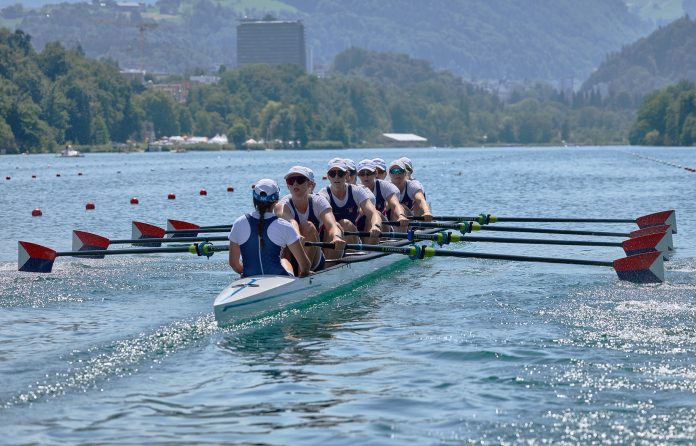
On the water, it’s noticeable immediately when crews are rowing with poor balance. Clear signs are differences in hand height and the way blades touch the water during recovery.
To limit the effects of poor technique, many rowers keep their blades close to the water during the recovery so an out-of-balance boat doesn’t sway excessively. One consequence: The blades slap the water frequently, not only slowing the boat but also impairing strokes. This makes it difficult, if not impossible, to prepare for and execute a correct entry of the blades into the water.
Another sure sign of an unbalanced boat occurs during the release phase when rowers don’t lift their blades out of the water cleanly and tilt them back onto the water immediately.
How do you achieve good balance? It begins with rigging the boat correctly. The foot stretcher must be adjusted so that you can sit comfortably and move freely. Common mistakes: foot plates set at an angle that’s too steep; foot position that’s too high in the boat; foot stretchers positioned too far toward the stern or bow.
The first two rigging errors make it difficult to move freely from one end of the rowing stroke to the other. Incorrect longitudinal adjustments of the foot stretchers affect the direction of the handle forces and the oar angles negatively, especially during the release.
The next step is to synchronize the timing of the entry and release so that all blades enter and exit the water at exactly the same time. This is particularly important for the finish of the stroke. Timing your release, finish position, and hands-away correctly—and performing these actions simultaneously—builds a solid foundation for the boat’s balance.
Additionally, if force transfer to the handles is even on both port and starboard sides, you’ll begin the recovery from an ideal end position. At the end of the stroke, your hands should be in the position farthest from the bow, with blades out of the water in the feather position. From there, your hand movement should be sternward and downward toward your knees. This keeps your blades off, and at the correct distance from, the water for the remainder of the recovery.
You then should move toward the stern linearly by keeping your body centered in the boat during the recovery while keeping your hands in a lowered position. A balanced boat and blades far enough off the water will enable you to execute a proper catch and entry, which must be well timed and performed in unison by everyone in the boat.
An up-and-down movement of your hands during the drive or the recovery affects balance directly. With the exception of the release and entry movements, your hands should move horizontally and, ideally, at the same height above the gunwales.
Scullers, of course, must maintain a slight difference in hand height so they can cross over during the perpendicular position. This difference should be kept as small as possible and should not change during the drive or the recovery. When the height difference between the hands of scullers during the recovery is large, it causes the boat to tilt toward the side of the lower hand, immediately disrupting balance.
Begin determining whether your boat is balanced while at a standstill on the water. Rowers often differ about this position, so if you can’t agree, place a level across the boat.
Next, develop a feel for rowing in a balanced boat. This can be achieved by first making it easier—for example, by having part of the crew sit still while the oars skim the water (part-crew rowing).
Then, rowers should let their oars skim the water while the entire crew rows. This way, rowers can develop a sense of when the boat is in balance while rowing and at what height the oar handles need to move during the drive and the recovery. The only way to learn how to keep a boat balanced is for everyone to row together while blades are off the water.
A good way to instill balance is to challenge rowers with specific exercises: pause drills; rowing with hands carried low in the boat deliberately (large circles); rowing with squared blades; rowing in a sweep boat with only one hand on the handle or with the inner hand shifted farther toward the sleeve (“wide grip”); sculling with hands positioned away from the handles toward the sleeves (also called “wide grip”); switching the crossover from left-over-right to right-over-left.
When rowers can perform these exercises cleanly and fluidly, balancing the boat during normal rowing becomes much easier.
Volker Nolte, an internationally recognized expert on the biomechanics of rowing, is the author of Rowing Science, Rowing Faster, and Masters Rowing. He’s a retired professor of biomechanics at the University of Western Ontario, where he coached the men’s rowing team to three Canadian national titles.
