

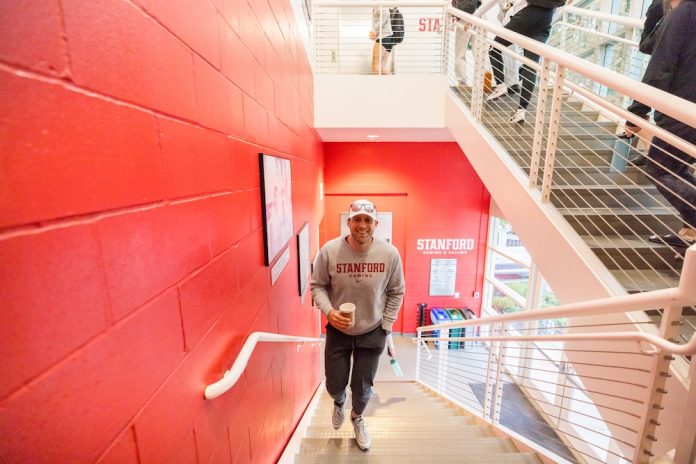
Ted Sobolewski was named Stanford’s Farwell Family Director of Men’s Rowing in the summer of 2019, just in time for Covid to cancel his first racing season.
To continue reading…
This article is exclusively for Rowing News subscribers. For as little as $5 a month, you can get access to the best quality, independent reporting on all the issues that matter to the North American rowing community.
Then it got worse.
The summer after the canceled spring season, Stanford announced that it was eliminating 11 varsity sports:
“We understand that the timing of this announcement, in early summer and against a backdrop of uncertainty and change across our country, is certainly far from ideal,” the university declared in a masterpiece of understatement.
Stanford—one of the nation’s top academic institutions and the best overall at intercollegiate athletics (26 Directors’ Cups in 29 years)—intended to cancel men’s and lightweight women’s rowing in an attempt to save money by reducing the breadth of varsity sports.
Instead of doing battle with the university, Sobolewski took a shrewder, more productive approach, similar to the collaborative, consultative way rowers at Nova Southeastern University responded to their cancellation—a sage and constructive strategy that resulted in the program’s reinstatement (Rowing News, November 2021).
Besides contacting alumni, Sobolewkski rekindled relationships with coaches who would otherwise be rivals, on the water and in recruiting, such as Al Acosta, a former rower at the University of California, Berkeley who now coaches the Cal women—Stanford’s biggest rival—and also coached Stanford’s lightweights.
“I got involved in a couple of Zoom calls and some attempts at fundraising,” Acosta recalled. “I was happy to show up and try to connect people.”
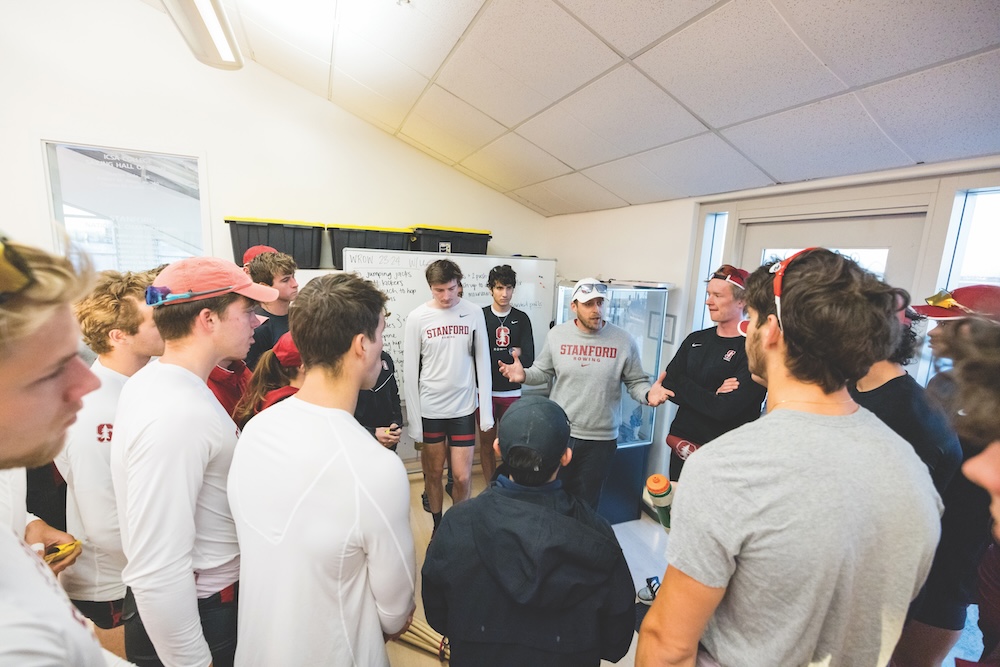
Sobolewski rowed as an undergraduate at Northeastern University from 2005 through 2008 and sculled on the U.S. Under-23 National Team in 2006 and 2007.
He began his coaching career in 2011 as a volunteer assistant under the coach who had recruited him, John Pojednic, guiding the Northeastern freshman crew to a bronze medal at the Eastern Sprints.
He then coached at Princeton National Rowing Association, leading the Mercer junior women to multiple medals at USRowing Youth Nationals and Royal Canadian Henley Regatta through 2015.
In 2016, Sobolewski returned to Northeastern, serving as Pojednic’s associate head coach through the 2019 season before being named Stanford’s head men’s coach.
Pojednic was impressed by the canny behavior of his former Northeastern colleague.
“I remember sitting on the beach with my wife and reading the news ticker that Stanford had just cut sports,” he said. “The way he responded to the initial announcement was very savvy and professional, working with the university. Frankly, I never could have done it that way. I would have been pissed off and rallying the troops.
“Ted is very good at stepping out of the launch and getting right on the phone. He picked up the yoke and began pulling the wagon, getting everybody into a room, metaphorically speaking, and getting a conversation going about why this would be devastating to the sport as we know it here at Stanford.”
The Stanford rowing community responded, rallying to raise enough awareness and money to reinstate the heavyweight men’s and lightweight women’s varsity programs. (Stanford has long lacked a lightweight men’s program.)
A small number of donors gave huge financial gifts, and a large number gave smaller amounts that added up. Stanford allowed the gifts to be pooled so that the total would meet the minimum for establishing endowments. Alumni contributions financed the creation of the the Stanford Rowing Association to ensure that the programs continue.
“The alumni of Stanford rowing and Stanford University are remarkable human beings,” Pojednic said. “They invest themselves fully in the things they care about. They believe the experience of rowing, alongside the academic experience, creates remarkable people.”
With the end of college sports as we know it upon us, Stanford’s experience offers some lessons about not only how to survive a cancellation crisis but also how to emerge stronger and better equipped to succeed in the future.
Since coming back from the dead, Stanford’s heavyweight men have thrived, while Stanford’s women—both the reigning NCAA champion openweight crew (Rowing News, September, 2023) and the IRA second-place lightweights—have done even better.
“Obviously, the women’s team is unbelievable,” Pojednic said. “We’d love to get up to speed with where the women are.”
Sobolewski is pleased and grateful.
“We have what we need to win,” he said, citing support from the athletic department in the form of a training table that’s “almost too good” and plenty of gear that’s “almost too much.”
“They’ve put themselves on a serious track,” said Paul Cooke, head coach of men’s rowing at Brown University. “They’re showing a lot of resilience, and I admire them for that. It’s good for the sport.”
In crafting Stanford’s resurrection, Sobolewski envisioned a revived heavyweight men’s program bigger and better than the one he was hired to coach before it was canceled. He credits his predecessor, Craig Amerkhanian, for establishing the team’s original endowment and for the Cardinal’s remarkable past racing successes, which were achieved with a limited roster coached by only two coaches with limited resources.
“Two things were glaring: They didn’t have enough staff members or enough coaches. It was just he and Niles [Garratt, the Alben Family Assistant Men’s Rowing Coach], kind of a skeleton crew,” Pojednic said.
They didn’t have a boatwright, a rigger, or a third coach, staples at every top college rowing program.
“Through that whole process, Ted and I were in close contact.” Pojednic said, “At first, it was kind of a joke, ‘Maybe we can get you to come out here and coach with us,’ and I was like, ‘Well, that seems a little bit far-fetched on a number of levels.’ So we just kind of joked about that for about six months.”
By the time the position was created and posted, it was anything but a joke.
“They were able to put quite a bit of support behind the position,” Pojednic said. “Eventually, I accepted.”
“It’s not just a third coach, it’s John,” said Sobolewski. “It’s been fun.”
For Pojednic as well.
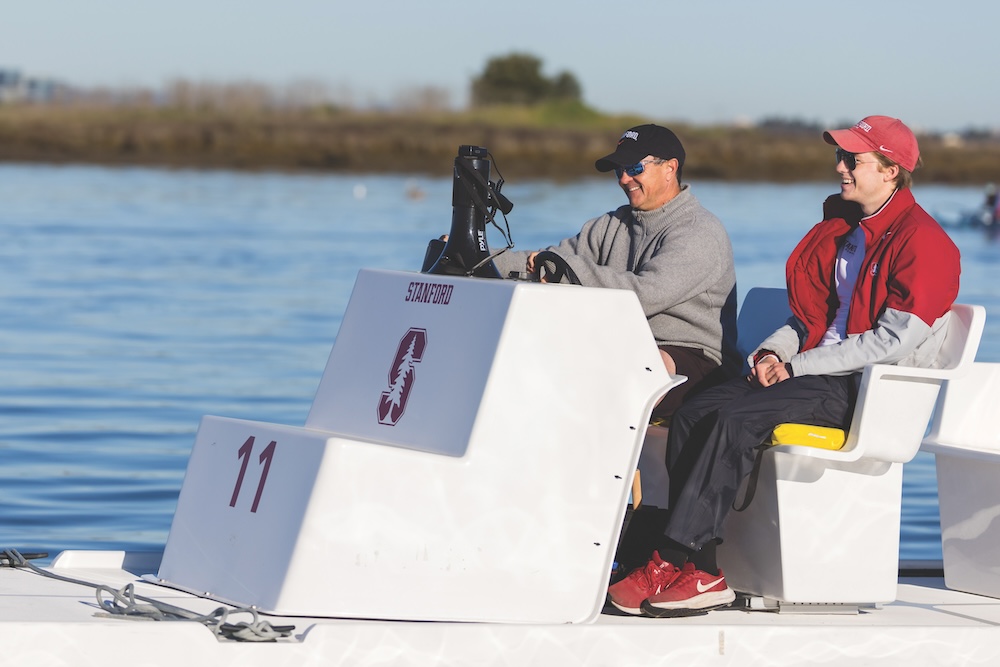
“Personally, I don’t ever want to be a head coach again,” said Pojednic, who left an unsupportive environment at Northeastern. “I really enjoy recruiting the kind of guys we’re recruiting and developing the athletes we have. Ted gives me a pretty long leash, and I really appreciate that. I get to do the things I love—building relationships with really exceptional people in the recruiting process, getting them here to Stanford, and then helping them understand how to to move the boat as well as they can and what their trajectory can be as an individual athlete.”
Sobolewski has formed a strong relationship with Stanford’s admissions office and is seeking more financial aid; more scholarships would be “a game changer.”
“They are very serious about making sure that anybody who is admitted as an athlete is going to contribute at a high level to the classroom environment, to the social environment, and to the world as a Stanford alum after graduation,” said Pojednic.
Which is why the Stanford coaches spend a lot of time and effort making sure the person is “an OKG—our kind of guy.”
“It’s an amazing place because you can row all the time,” Pojednic said. “We have to blend West Coast water time with East Coast attitude to make sure we’ve got the requisite training, toughness, and team-building.”
In the 2023 IRA petite final, the Stanford men finished second to Brown, one of only three Ivy League programs to finish ahead of the Cardinal (Princeton and Yale were third and fourth in the grand final). Although they graduated two stars in senior co-captains Henry Stewart and Flinn Traeger, who went on to race as a pair at Henley, Stanford’s varsity could be even better this year and for years to come—despite the fact that half the varsity consists of freshmen.
“We’re a young crew, but we don’t have to act young or race like we’re young,” Sobowleski said. Before the start of this year’s racing season, Sobolewski called his new crew “objectively better than 365 days ago.”
It’s a young roster because the attempted cancellation of the program robbed Stanford men’s rowing of an entire recruiting class. When Stanford announced the reinstatement of the cut rowing programs in the spring of 2021, it was too late to recruit for the Class of 2025. But a solid group of freshmen this year, including six athletes from the hyper-competitive and fast ranks of British schoolboy rowing, has created Stanford’s “most competitive two-eight environment ever,” Sobolewski said. “I believe in these guys.”
Even with plenty of promising freshmen and sophomores, Sobolewski, because of the missing class of recruits, must deal from a short deck. The opposite is true on the other end of the megaphone, however, as Stanford now features, for the first time in its men’s rowing history, a full complement of three full-time coaches, including Pojednic, and three support staff.
The replenished resources, besides making a stark difference at last year’s IRAs, augur well for the future.
“The freshman class coming next [September] is absolutely unbelievable, and we’re moving in a similar direction with the guys arriving here in the fall of ’25,” Pojednic said. “We’re looking forward to building a complete roster of recruited athletes.
“I don’t even know the last time Stanford was able to compete for team points at the Pac-12 championship or the Ten Eyck championship at the IRA because we haven’t fielded a third eight.”
For now, they struggle to boat three complete eights. “There ‘s been maybe four days this year when we’ve had three eights on the water,” Pojednic said. “We’re keeping this thing going with a four and some pairs.”
Added Sobolewski: “It’s made for an interesting year.”
The three non-recruited juniors on the roster may be the best entirely walk-on class in the country. Two of them, Logan Morley and Noah Tan, coxed in high school and got to Stanford on their own, and the third, James Fetter, swam in high school.
“He sits down one day in the morning and pulls a 19-minute 6K and then you see a video on YouTube later in the day. He’s a trained concert pianist! Just a freaking amazing kid,” Pojednic said. “He’s worth like four guys.”
Stanford will try to race three eights at the IRA Sarasota Invitational against Washington, Harvard, Yale, Brown, and Northeastern—essentially an IRA national-championship semifinal field—March 29 and 30.
“We’re throwing them right into the frying pan,” said Pojednic. “It should be some great racing. It’s the kind of trip we’d like to be able to make every year—a lot of great teams, a lot of good racing, a legitimate venue.”
“We recognize them as a competitor,” said Brown University coach Cooke. “We think they’re going to test us and we’ll be testing them and we look forward to seeing how that all goes.”
In the meantime, being young shouldn’t be a problem.
“We’ve been here before in 2019,” said Pojednic, recalling his past with Sobolewksi. “We had five freshmen in our varsity at Northeastern and finished fifth at the IRA.”
The Cardinal’s eighth-place finish at the 2023 IRA could well be just the beginning of their success on the water—after some big wins off the water.

