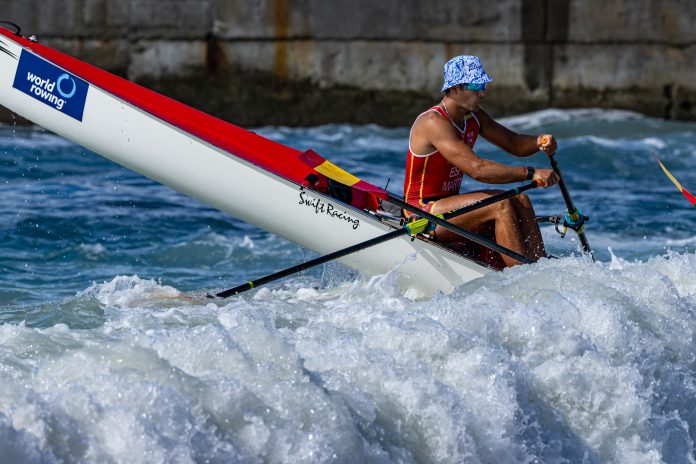
In Beach Sprint rowing, competitors sprint to a boat, row a 250 meter slalom course through the surf, turn 180° back to shore, and sprint to the buzzer on the beach. Photo: Lisa Worthy.
The San Diego Crew Classic will add a new event: Beach Sprints.
For the first time, attendees will have the opportunity try out the “wilder cousin of rowing” on Friday, March 27th. The Crew Classic will host a Beach Sprints demonstration, beginning with a workshop where attendees can learn about the newest Olympic sport debuting at the 2028 Olympic Games in Los Angeles.
“We believe that Beach Sprints are a great way to marry the sport of rowing with the SoCal vibe of more traditional beach sports like surfing,” says Crew Classic Executive Director Bobbie Smith. “It definitely suits the California side of rowing.”
Participants will also be given the opportunity to try out Beach Sprints and get hands-on experience. In addition to the workshop, a special Beach Sprints exhibition race will showcase top Beach Sprints athletes competing in the sport.
“San Diego is the perfect home for Beach Sprints. The ocean, the culture, the energy, it all fits,” said Marc Oria, PhD, US Beach Sprint Head Coach. “The Crew Classic joining our growing movement is a landmark moment, and with LA2028 on the horizon, the momentum behind this sport has never been stronger. Whether you’ve been following Beach Sprints from the start or you’re stepping onto the sand for the first time on March 27th, welcome. The best is still ahead of us.”
The 2027 San Diego Crew Classic will feature Beach Sprints races as a part of the official program as the regatta expands to include new aspects of the sport of rowing.
Trinity College men won both the 2025 Knecht Cup Regatta and Division III national championship. Photo: courtesy of Kevin MacDermott / Trinity College.
The Knecht Cup Regatta returns to Camden, New Jersey’s Cooper River race course April 11-12 with new trophies and expended events, including Para rowing for the first time.
Last year’s regatta drew over 350 crews, making it one of the largest college regattas in the world, second only to the American Collegiate Rowing Association’s club national championship regatta.
Boston University’s lightweights won the Ann Harris Smith Memorial Trophy for varsity eights in 2025, ahead of MIT and Drexel. Eventual men’s Division III national champions Trinity won the William J. Knecht Memorial Trophy for men’s varsity.
In addition to the traditional eights, the Knecht Cup Regatta features less common collegiate events, including singles, doubles, quads, and coxed quads.
“Without regattas like the Knecht Cup we’d have very little competition,” says Dominican University coach Ivan Rudolph-Shabinsky. Dominican, a small—about 1,000 undergrads and a few hundred graduate students—school located about 15 miles north of New York city serving primarily minority ethnicity students who are the first in their families to attend college, has a Division II rowing program that runs on a $25,000 budget and competes mostly in sculling events. All of the rowers are on some form of scholarship so that they can attend college.
“We’re a little bit different than the colleges that have historically had rowing,” says Rudolph-Shabinsky, who is a professor at Domincan, started the rowing program, and also runs Rockland Rowing as the president of the board.
The Knecht Cup Regatta also attracts better-known rowing programs from across the country, including Wisconsin, the University of Connecticut, Fordham University, Georgetown, Boston University, and Radcliffe.
This year’s regatta adds newly named trophies will recognize the legacy and impact of Albert P. Wachlin, Lois Trench-Hines, Mark Valenti, and Ann and Marie Jonik.
“Al represents the very spirit of what my father built on the Cooper River,” said Laura Knecht Blanche, regatta director and daughter of Bill Knecht, of Wachlin. “He worked beside my dad from the beginning, and he has carried that standard of excellence forward for decades. Naming this trophy in his honor is our way of recognizing the man who makes every lane fair and every race possible.”
“My goal,” Wachlin says, “is to make things better and more fair for competitors by installing the best starting platform, stakeboat and buoy system available.”
That commitment to fairness is precisely why the Knecht Cup Regatta is honoring him.
The best rowing coaches realize that it’s all about different strokes for different folks. Photo: Amy Wilton.
Story and Photos by Amy Wilton
Were you the kid who sat in the last row of class with your head on your desk while the history teacher droned on about the Great Emu War in Australia in 1932? I was. Not because I was lazy or uninterested in learning—just uninterested in learning that way.
I’m sure there were some kids who took in every word. They probably wrote fascinating term papers about how the Australian government deployed soldiers to combat a large population of emus that was damaging farmland. On the other hand, if Mr. Berube, my very kind and monotone teacher, had given me an assignment to create a 3D model of the soldiers and emus in battle, I would have been all over that. Glue, cardboard, questionable historical accuracy—sign me up!
What in the world do emus have to do with rowing? Nothing, but how we process new information is very relevant.
There are many variables that affect how much a rower gets out of a practice: psychological state, coach-athlete relationship, learning environment, motivation, intentionality, to name a few. Two rowers can do the exact same workout, and the outcomes can be very different.Learning a sport is not just mechanical; it is also psychological, relational, and emotional. And rowing, for all its numbers and metrics, lives squarely in that messy human space.
Rethinking “Learning Styles”
In scientific communities, the consensus is that “learning styles” don’t exist. Despite many studies, no conclusive evidence has been found to support the idea. In fact, most studies contradict it. A widely cited 2008 review of research testing the “meshing hypothesis”—people learn better when instruction matches their preferred style—yielded no credible proof.
That surprised me, someone who has taught rowing, art, photography, swimming, and preschool. In every case, I’ve noticed people assimilating information in a multitude of ways. Some needed to hear it, some needed to see it, and some needed to do it wrong about 20 times first.
Maybe what I thought was a preference for a learning style was something else. Maybe people were employing learning styles appropriate for the task. Let’s talk about those styles and how they relate to rowing.
The Pathways to Learning
Auditory
This is how most rowing is coached. You, rower, are in the boat, eyes forward, while the coach is in the launch, giving suggestions through the megaphone. You listen and try your best to implement the change the coach has recommended.Sometimes it clicks immediately. Sometimes it doesn’t.
Visual
Often coaches will video their rowers because words sometimes aren’t enough. There are many reasons video is effective. We rowers might feel we’re implementing the change the coach asked for. It’s only when we see images of ourselves that we realize that the huge adjustment in hand height we thought we made was actually very small.
Ego is another reason video is helpful. Sometimes we can’t believe we’re making those mistakes. The videos, by showing proof, enable us to see what the coach has been describing for weeks. It turns abstract language into something concrete, and occasionally uncomfortable.
Kinesthetic
Kinesthetic learners have to feel the change to make it work for them; words go in one ear and out the other. The coach can tell them a hundred times not to feather with the outside hand, but until they put the oar in their hands on land and hold their outside wrist flat while feathering with the inside hand, the message won’t land. Drills are another way this type of learner thrives—lots of repetition so the body absorbs the feel of the stroke. For these athletes, learning lives in muscle memory, not sentences. These are the folks who’d want to make the 3D model of emus in Australia.
Some people need to see the idea, some need to hear it, and some need to feel it. Drills are an effective way to imprint proper rowing technique neurologically; the repetition allows a rower’s body to absorb the correct sequencing. All learning is some combination of these three elements, and the savvy coach is one who knows how their rowers learn best.
Coaching Experience and Instinct
Experienced coaches don’t think about the learning styles of their rowers; they just coach. It’s like driving a car. After a while, you don’t need to think about signaling because your hands just do it.
Phil Carney, Wesleyan University’s men’s coach, has been at his job for over 35 years. When asked about how he deals with the different learning styles of his rowers, he said, “I just deal with guys as they present to me with no real individual plan.”
What strikes me about that answer isn’t its simplicity but its honesty. After a while, coaching becomes instinctual. Any good teacher, whether teaching rowing or fourth grade, naturally assesses how the student learns and makes adjustments. Good coaches aren’t running learning-style flow charts in their heads. They’re watching, listening, adjusting, and responding in real time.
The most important thing I’ve learned from great coaches is that athletes will give back only as much as their coaches give them. When coaches are deeply invested, athletes tend to rise to meet the effort. I’ve had coaches who didn’t seem to care; neither the athletes nor the team was a priority, it seemed. Unsurprisingly, the coach’s lack of investment was reflected in the performance of the athletes. Rowers are perceptive; they know when a coach is all in or just running a practice.
Learning, especially in a sport as technical and demanding as rowing, requires vulnerability. Coaches must be willing to explain the same thing in multiple ways, to admit when something isn’t working, and to meet athletes where they are. Rowers, for their part, must be willing to listen, to fail publicly, and to trust that the coach’s criticism is meant to build up, not tear down.
The rowers who improve the most aren’t always the most talented. Rather, they’re the ones willing to be receptive long enough to absorb the lessons.
The only way to get to “just knowing” is through time and experience. Rookie coaches tend to correct rowers using the same words over and over again, all the while hoping for a different result. Because of inexperience, they aren’t acquainted with how other coaches deliver the same information.
Sara Gronewold, director of the Craftsbury Sculling Center in Vermont, was on the U.S. national team in the 1990s. Team culture back then was never to ask for help. The attitude:
“There’s something wrong with you if you can’t figure this out.”
One day when Gronewold was rowing a pair, an assistant coach corrected her by repeating the same admonishment. Because Gronewold couldn’t understand what the coach wanted, she wasn’t making the change.
After practice, she asked the coach to describe the change she wanted in a different way. Suddenly it clicked.
“As coaches, we have the words we think make perfect sense for what we’re trying to convey,” Gronewold said, “but if those words aren’t working, it’s your responsibility to find new words that will work. That’s what teaching is.
“Part of this is a growth mindset,” Gronewold continued. “You are always trying to see how much better you can do. The coach’s job is to facilitate that process. If you want the best outcome, you have to be dedicated to communicating and teaching the members of your team effectively.”
The national team is unique because there are so many talented people waiting to step up. But when coaching a high-school, college, or club team, where coaches must work with what they have, thinking about teaching and learning styles is essential.
Early Coaching Lessons
My first job after I graduated from college was to coach the novice women’s crew at my university. I had no coaching experience besides teaching kids how to swim. What did I do? I repeated everything my varsity coach had said to me.
It took years of observing and assimilating the teaching styles of other coaches before I felt effective. My first head coaching job was at Megunticook Rowing, a club program in Camden, Maine. At first, I worked as an assistant to Ry Hills, recently retired Bowdoin College coach. After six months, she announced,“OK, I’m moving on. Now you’re the head coach.”
Good thing I was paying attention those first few months and learned a lot from Hills. For example: to serve your rowers well, you need to get to know them personally; and to keep your athletes motivated, use humor and fun, especially with novices.
“Getting to know the rowers outside of practice builds trust between coach and athlete,” Hills said. “It shows you’re interested in them as people, not just as a seat in the boat. It also helps you see what might work best for them.”
Adaptability on the Water
Another important trait for coaches is adaptability. Say you send your boats out to warm up at the beginning of practice and you notice someone struggling.
“Sometimes coaches have to bend the practice to deal with what is happening on the water,” Hills said. “If your plan isn’t working, stop the boat and create an analogy. Because kids learn differently, sometimes you need a different approach. Telling a rower to pretend they’re rowing uphill to get them to stop rushing the slide really works.”
At Craftsbury, there are many expert coaches, all of whom teach in different ways. I’ve been coaching there for 25 years and at every single camp I learn a new way of encouraging rowers to keep pressure on the foot stretcher throughout the stroke or to tap down and away at the release.
So much of coaching is delivery. Unflappable is the word that describes the best coaches I’ve watched. When a big issue comes up, they remain calm and steady and deal with it step by step. These are the coaches to whom rowers respond best. Coaches who raise their voice and yell may scare rowers into submission, but those teams suffer high turnover. Athletes leave because they lose respect.
Severina Drunchilova, a yoga teacher at Portland Power Yoga in Maine, says, “A person won’t learn until they’ve opened themselves to the process.”
Rowers need to feel they can trust their coaches before they put themselves in the vulnerable position of learning. Performance is the space between the delivery of information and the reception of it. Athletes will perform when they’re open tolearning, and they’re open to learning when they trust the coach.
Learning Requires Vulnerability
In the summer, I’ve coached with Gronewold at Craftsbury, a great place to be immersed in your favorite sport. You eat, sleep, row, talk about rowing, watch rowing videos, eat some more, go to bed, and repeat. The relaxed summer-camp atmosphere enables rowers to dig into parts of the stroke that need work.Each week, there are about 35 campers and six coaches. During some on-water sessions, all the coaches circulate among the rowers on the lake. In others, each coach tends to four to six scullers, and we work on one part of the stroke.
One summer, during the open row, I came upon a rower in his 60s who was dragging his blades on the water. I suggested he hold his hands lower on the recovery. No go. I rephrased it. No go. I asked him to stop and showed him how to tap down at the release, elbows out, and keep his hands closer to the gunwale. Still no change.
Finally I asked him what he did for a living. “I’m a brain surgeon,” he said.
Ah, I get it. In his everyday life, this man was not allowed to try something new and risk making a mistake. I reminded him that out there on the water he is not performing surgery, no lives are at stake, and risk-taking is encouraged.
After he relaxed and opened up to the process of learning, he made the change. To learn something new, you must put yourself in the vulnerable place of making mistakes. As my yoga teacher says, you can’t learn until you let your guard down.
Another key element of successful learning is to be an active listener. Better yet, a reflective listener. When the coach gives you a suggestion—“tap your hands down at the release”— repeat it to yourself—“tap my hands down at the release.” When you stop rowing, confirm: “What I hear you saying is if I tap my hands down more at the release, I’ll be better able to keep my oars off the water. Is that correct?” That clarification can save a lot of time.
Shared Responsibility
My best coaches followed the ideas I mentioned earlier. In high school, Mr. Geci, my non-monotone English teacher and cross-country coach in Litchfield, Conn., somehow managed to bring a ragtag group of small-town kids together and teach us to be a team. He had an inside scoop on all of us because he also knew us from the classroom. We knew that he cared. We knew that if there was something difficult in our lives outside of the team, he would listen. Mr. Geci taught us about community and taking care of each other, even though we were from different grades and parts of town.
My high-school rowing coaches, Melissa and Jamie Robinson, then fresh Trinity College grads, taught me how to work hard, tolerate the burn, and that persistence pays off. They also taught us that if they timed us unloading the trailer after a regatta we would get it done twice as fast.
Paul Wilkins, current assistant coach at UCLA’s club program, was my coach at George Washington University. From Wilkins, I learned how to push further physically than ever before and to focus. Thanks to the team culture he created, we all believed in ourselves and each other.
I am naming my coaches because I believe it’s important to thank the people who’ve had a positive impact on your life. Part of why I became a coach is that they were such terrific mentors, about sports and life. I wanted to be able to pass on the feeling of self-worth I gained from being part of a team—a team that felt seen by the coach and honored and respected by the other athletes.
So drop your old coach a line and say thanks. At its best, learning in rowing is a shared responsibility—coaches offering clarity, care, and adaptability, and rowers meeting that effort with trust, curiosity, and the courage to try.
Amy Wilton is a professional photographer who lives in Maine and coaches at Portland Community Rowing Association.
On March 3, 1976, Yale oarswomen stripped in the athletic director's office, showing the phrase "Title IX" written on their bodies, to protest the lack of equitable facilities at the boathouse, despite the 1972 law requiring it.
This March 3 is the 50th anniversary of the Yale women’s protest chronicled in the award-winning film “A Hero For Daisy” that led to national recognition and adherence to the gender equity laws known as Title IX.
Although the legislation was enacted in 1972 and required gender equity in federally-funded institutions, including practically every university, by 1976 women still did not have equal facilities in many boathouses, including Yale’s. Captain Chris Ernst and 18 of her teammates stormed the athletic director’s office and stripped to reveal “Title IX” written on their bodies to protest the fact that the law was not being followed.
Half a century later, Title IX continues to be a major influence on universities and collegiate athletics. The courageous oarswomen of Yale brought it to the nation’s attention 50 years ago.
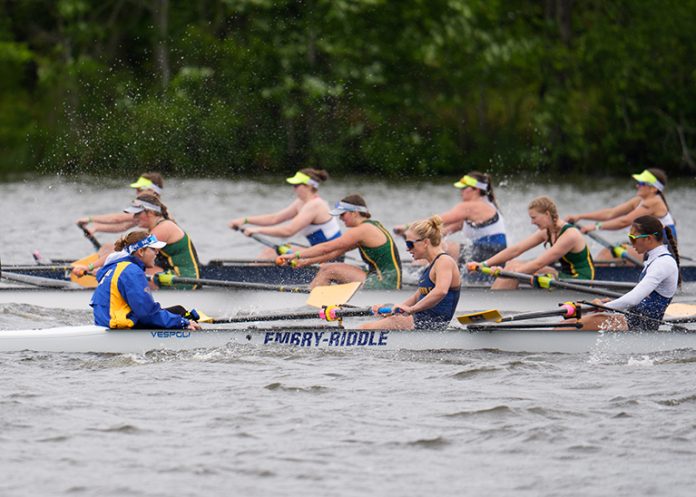
Embry-Riddle won its first-ever DII rowing championship on Saturday, May 31, on Mercer Lake in West Windsor, N.J. Women's rowing became the first program in Embry-Riddle Aeronautical University's NCAA Division II era to win a national championship. Photo: Katie Lane.
By Luke Reynolds
Delegates at the NCAA Division II business session on January 16, 2026, voted 167-60-78 to approve an exception allowing women’s rowing to retain its Division II championship status.
The vote occurred during the 120th NCAA Convention in Washington, D.C., as part of Proposal No. 2026-14 under Championships Administration.
The legislation provides an exception to minimum sports sponsorship requirements for women’s rowing and field hockey, ensuring both sports will continue to conduct Division II championships.
The proposal followed coordinated outreach from Division II rowing coaches and administrators in advance of the convention. Programs engaged athletics directors, conference offices and institutional leadership to communicate the impact of retaining championship access for current and prospective student-athletes.
“The lobbying effort by the D2 rowing coaches and administrators was very inspiring to me,” said Matt Weisse, head coach at Cal Poly Humboldt. “I got to know a number of my fellow coaches through this process and was so impressed with the efforts by everyone. I hope that we can continue to make a push as we look to add more Division II rowing programs.”
Women’s rowing has been an NCAA championship sport at the Division II level since 2004. The Division II Women’s Rowing Championship is one of 26 championships currently conducted within the division.
The vote provides immediate clarity for institutions sponsoring women’s rowing as they finalize recruiting classes, competitive schedules, and budget planning for upcoming seasons.
The 2026 NCAA Rowing Championships will take place May 29-31, 2026, at Lake Lanier Olympic Park in Gainesville, Georgia.
That sounds like a goal too far, a torture too cruel. Just break it down, though. And add an incentive. Take that ergometer for a 10,000-meter ride every day, for 100 days, don’t miss a day, and you’ll get your million.
That’s what Temple men’s rowing coach Brendan Cunningham did the summer before his junior year at the school where he now coaches. The challenge was presented to him by an older brother who had preceded him in the sport.
Brendan’s father had just died that spring. Brendan was drifting a bit. Gavin White, Temple’s legendary coach, saw that, and also saw potential. He was thinking about giving Cunningham some scholarship money. Brendan’s brother Luke presented Brendan the challenge: Go a million meters on the rowing machine that summer, and Luke would get him a PlayStation.
“When he came back to school, his roommates had a PlayStation,” Luke said.
“It was a great deal for my roommates,” Brendan said.
Better yet, Brendan had a spot in Temple’s first varsity eight, plus some scholarship money.
He hadn’t been averse to the work required by the sport. His high-school coach, Dave Krmpotich, had won a silver medal at the 1988 Olympics and would bring his own pre-Olympic workouts to the boys for their winter workouts. If that seemed insane to them, they took pride in the insanity.
So Cunningham, entering his second season as Temple’s coach last fall, knew the value of setting distant goals. In 2024, one of his rowers, Ryan Yates, had texted Cunningham and asked him what it would take for them to go to Henley the next year, to row in the Henley Royal Regatta.
The coach texted back, “Win Dad Vails.”
Photo: Tim McCall / Temple Athletics.
That used to be a regular thing—Temple’s men dominating the varsity eight in the big local race of the year. Walk in what they call the Great Room, the lobby of the East Park Canoe House, just below the Strawberry Mansion Bridge along the east bank of the Schuylkill River, there’s a banner noting Temple’s Dad Vail Varsity Eight Championships. Every year from 1983 to ’87, missing in ’88, then every year from 1989 to 2001. Another miss in 2002, then titles in 2003 and ’04.
Then there was a drought.
Brendan was there early in the drought, and experienced the reason for it.
“We were in the boathouse for the first fall. Then that winter, Gavin was like, ‘We’ve been evicted,’”Cunningham said.
Evicted? The building had been condemned. The rowers had noticed—but had not really cared—how their cramped space was, in fact, falling apart.
“I remember being up there, you’re doing ergs, you couldn’t see the walls; there would just be dust,” Cunningham said.
For the rest of his time (and quite a few years thereafter), Temple would row out of tents in the parking lot.
“There’s no porta-potties, so you make do,” Brendan said of the years under the tent. “You don’t know any better. Gav always found a way to make it feel like a great experience.”
But years in the tent, and then their dock falling into the river so they had to walk the boats farther down river to launch them—it all took its toll. Recruiting grew more difficult.
Eventually, new administrators took over at Temple, all out-of-towners, and looked at the books. They decided some sports had to be cut. They looked at everything like they were outside business consultants and they decided rowing would be one of the sports to be axed.
I was writing for The Philadelphia Inquirer at the time and I got in Gavin White’s car right after he was told rowing was done. White was in shock, just short of a rage, but he also told me the sport couldn’t keep going the way it was being neglected.
The outcry, however, was such that the sport was saved; that’s how it works sometimes. No one pays attention until it’s going to be gone. A benefactor, Gerry Lenfest, wrote a big check to restore the boathouse, which is how the years 2018 and 2021 were added to that Dad Vail banner in the lobby.
But what about 2025? Could they get to Henley?
Photo: Lisa Worthy.
Cunningham’s own journey began by watching two older brothers rowing on the Schuylkill for Monsignor Bonner High. Dan had been the first to row, and the first to spot a path to college, St. Joseph’s in his case, where he was eventually a captain. The commitment began in the morning.
“You need at least nine people to show up at 5 o’clock in the morning for practice that’s 30 minutes from the high school,” Dan Cunningham said of rowing for Monsignor Bonner, located in Upper Darby, just outside Philadelphia. “We never had anybody miss in four years.”
Next was Luke. First, Luke thought he was a basketball player, and that’s what he began playing at Bonner. In the summer, some of the best games were at the public courts in Narberth, a suburban borough near the city. Luke didn’t pay much attention to the competition. He just knew how to be a wiseass, even guarding the best guy on the other team. That guy’s dad played in the NBA? Luke trash-talked his man by saying he heard the dad wasn’t that great.
The other kid apparently took that a bit personally. Kobe Bryant didn’t just block Luke’s shot. He caught it and threw the ball over the fence into the adjacent playground.
It was the last straw for Luke. Then and there, he decided that maybe his brother’s sport might be a better fit. Sure enough, he proceeded from Bonner to become an all-Ivy rower at Brown. (His wiseass ways have served him well, too, as a standup comedian; a staff writer at The Tonight Show, writing jokes for Jimmy Fallon; and lead writer for the VMA Awards and the ESPYs.)
As important as Brendan’s brothers were his coaches. One of the Bonner coaches, Mike Cipollone, was the father of 2004 gold medal-winning Olympic coxswain Pete Cipollone. In addition to head coach Krmpotich, there was the coach’s brother, Jim, who was always there helping out. The brothers grew up rowing in Duluth, Minn.
“I think he lived over in East Falls,” Brendan said of Jim Krmpotich’s taking charge of winter workouts, including on snowy days. “We were always like, Is school canceled? But practice would never be canceled, because Jim Krump would be able to drive his little Honda Civic to Bonner, and that meant you had to figure it out. If your parents couldn’t drive, you had to walk through the snow. You had to get there. That was the template you had to work off.”
Running the hills over at Cobbs Creek golf course was part of the winter workout, just a little warmup. The course was a couple of miles from the school.
“You’d run over, run the hills, like 10 up-and-downs, then you’d run back, and that was before school,” Cunningham said.
Dave Krmpotich would be out there with them.
“I never saw him wear gloves, ever in my life,” Brendan Cunningham said. “If it was really cold, he’d put socks on his hands. He was just tough as nails. He’d do the warmup runs with us, and beat us. He would do workouts on the erg, and beat us. It was a thing to try to beat Krump. You would hear stories. I think he ran the loop (around the Schuylkill River) one time, got hit by a car, finished the workout, and then went to the hospital.”
“Dave Krump, he never chased you to be at practice,” Luke Cunningham said. “He never pursued you to be on the team. If you’re here, I’m going to work you. How much work can you deal with before failure?”
Since Dan was the first Cunningham to row, Luke went down to the river to watch. He remembers their dad talking about how the rowing races used to be a big gambling enterprise. “Before the NFL, there used to be 100,000 people at the river.”
Luke thought the whole sport seemed kind of glamorous. He envied his brother.
“I very quickly figured out he was out of the house at 4:40 in the morning,” Luke said.
Brendan thinks about it still, ninth-graders being sent out to a busy river in the pre-dawn—crazy! But he turned out to be the lifer. By the time he was done rowing at Temple, Cunningham decided he’d try to emulate Krmpotich and Gavin White’s booming voice from the launch and get into coaching himself. His first stop was at Washington College in Maryland for two years as a graduate assistant.
“I worked for the guy who wrote The Nuts and Bolts Guide to Rigging,” Cunningham said. “Mike Davenport. I knew how to rig and de-rig a boat. I knew to make sure the nuts and bolts were tight. But I didn’t know much about how the pin could move in, the pin could move out, how to change the gearing, how to change the loading. It was just interesting to know if you have two people of different sizes, you can rig differently to get maximum boat speed.”
Next stop was another volunteer gig—at Yale.
“I want to see what it’s like at the top level,” Cunningham said, recalling his pitch.
“Great,” he was told. “We can’t pay you.”
Steve Gladstone, Yale’s head coach at the time, is on every short list of the top American coaches in the history of the sport, in addition to being so respected that he was named athletic director at Cal while coaching in Berkeley.
At Yale, Brendan wasn’t treated as a mere volunteer; he was considered part of the team, and Gladstone understood he was there to learn everything. One gathering, Brendan was told to go sit with the board of directors of the rowing program, to take in their conversation, since he’d be dealing with the money someday if he stayed in the sport.
Gladstone was way ahead of the curve in figuring out that there were ways to measure a recruit objectively, once all ergs produced uniform times. He’d demand a recruit produce a time in competition so it could be believed, but that competition could be anywhere in the world.
After his apprenticeship at Yale, Cunningham was hired as a full-time assistant at Penn, then moved to Drexel, where Paul Savell’s program had become dominant at Dad Vail. A big takeaway from Savell: Talk to these kids, all the time. They’re college students; they want to hear from you.
“You could not have produced a better pedigree of coaches to produce Brendan,” said Luke Cunningham, who’d been an assistant coach himself at Columbia and UCLA while pursuing his full-time career in comedy.
Just inside the Temple rowing office is a cheap version of a WWF wrestling belt. Whichever Temple rower has a big day on the erg, he gets to wear the belt. Luke’s idea. Just to keep things fun while they’re doing the work.
Do they wear the belt proudly?
“Uh, they put it on,” Brendan said.
“He has ways to motivate each rower individually,” Yates, now graduated from Temple, said of Cunningham. “He tries to figure out how each person is motivated, and uses that to motivate them.”
Photo: Tim McCall / Temple Athletics.
The first varsity eight had more incentive. They’d caught wind of a documentary being made about Philadelphia collegiate rowing. They’d heard the filmmakers were hanging around Drexel and La Salle, which had finished 1-2 the year before, with Temple third, less than a tenth of a second behind La Salle.
“We were upset about the film,” Ryan Yates said of the documentary, It’s a Philly Thing.
What’s more of a Philly thing than a grudge fueling your own work? They compared themselves to the Eagles a lot, said coxswain Grace Crosby, combining an underdog mentality (“especially compared to the elite kids on Boathouse Row”) with a belief they were ready to win the big races.
The spring season proved their readiness, with Temple finishing on top of La Salle and Drexel just before the Dad Vails, which were over in South Jersey on the Cooper River again.
“We knew we had to come out swinging and keep going,” said Kevin Harvell, in the five-seat in last year’s varsity eight. “We had a powerful jump.”
Get the bow in front, stay in front, right to plan. They were in front for the first half of the race, but La Salle wasn’t rattled. They were coming fast.
“We were neck and neck for a long time,” Yates said. “To the very end.”
After the race, Yates said, it was a heart-racing two minutes.
They could see folks in Temple colors celebrating on the banks of the Cooper, but that’s not confirmation. Crosby, the coxswain, wanted to tell them they’d won, but she had stayed focused on her own boat until after the line. She didn’t want to say anything to her rowers until she knew for sure.
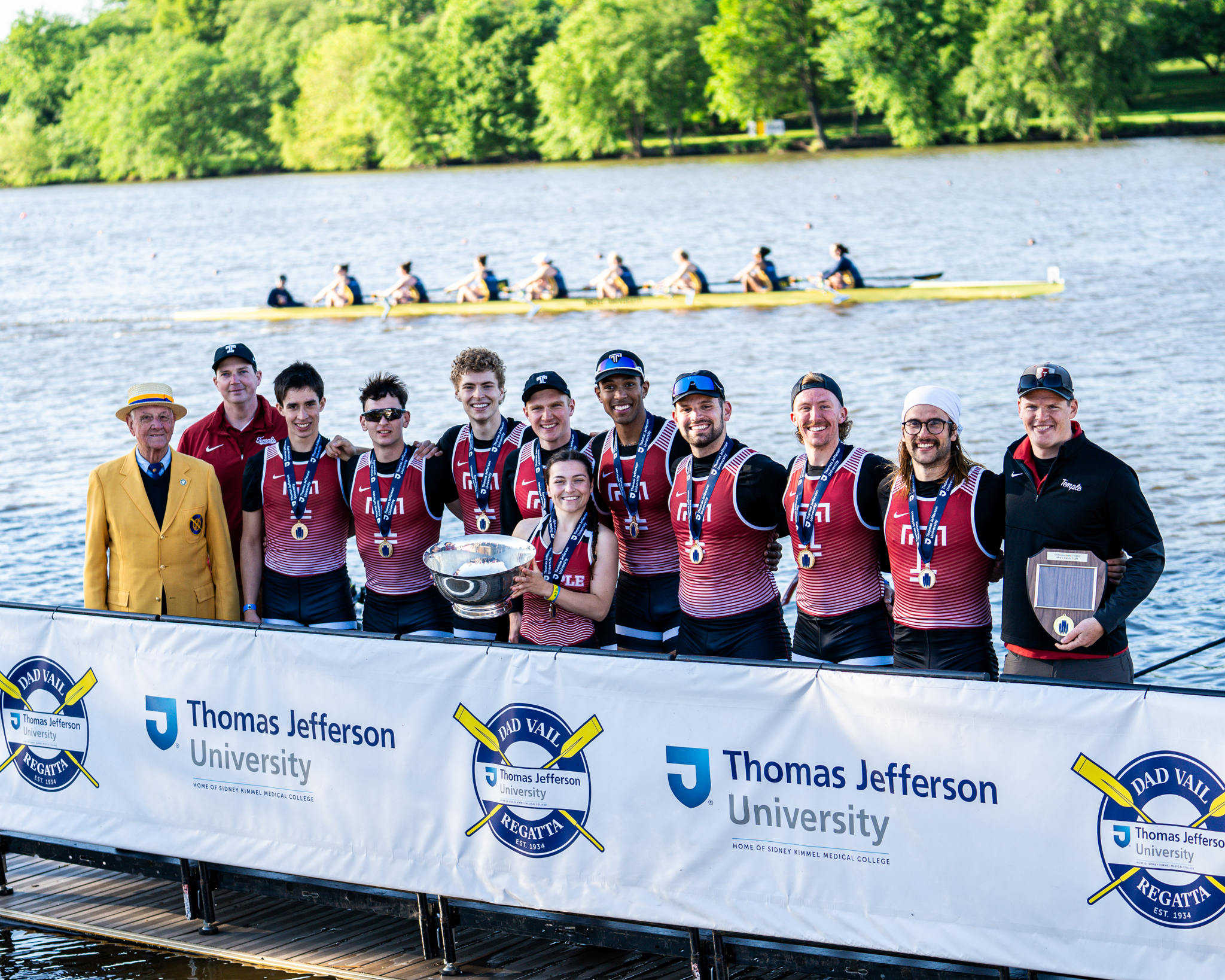
She called over to Cunningham. He confirmed it was official. Temple finished in 5:37.711, with La Salle clocked at 5:38.073.
At the dock, celebration in full swing, Temple’s coach saw Yates and brought up their exchange of a year earlier. They hadn’t spoken about it since the texts.
“You know what this means?” Cunningham said.
“Henley,” Yates said.
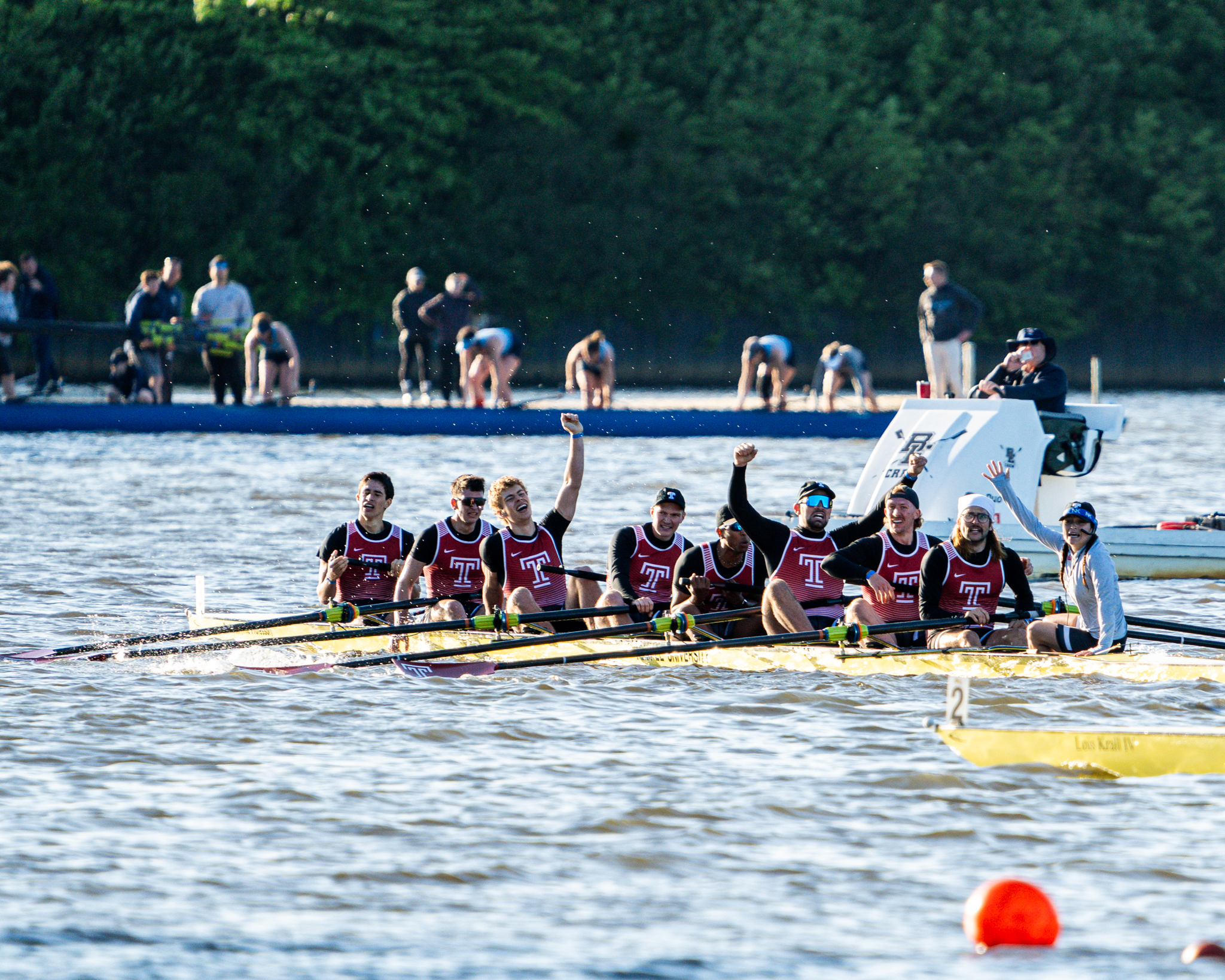
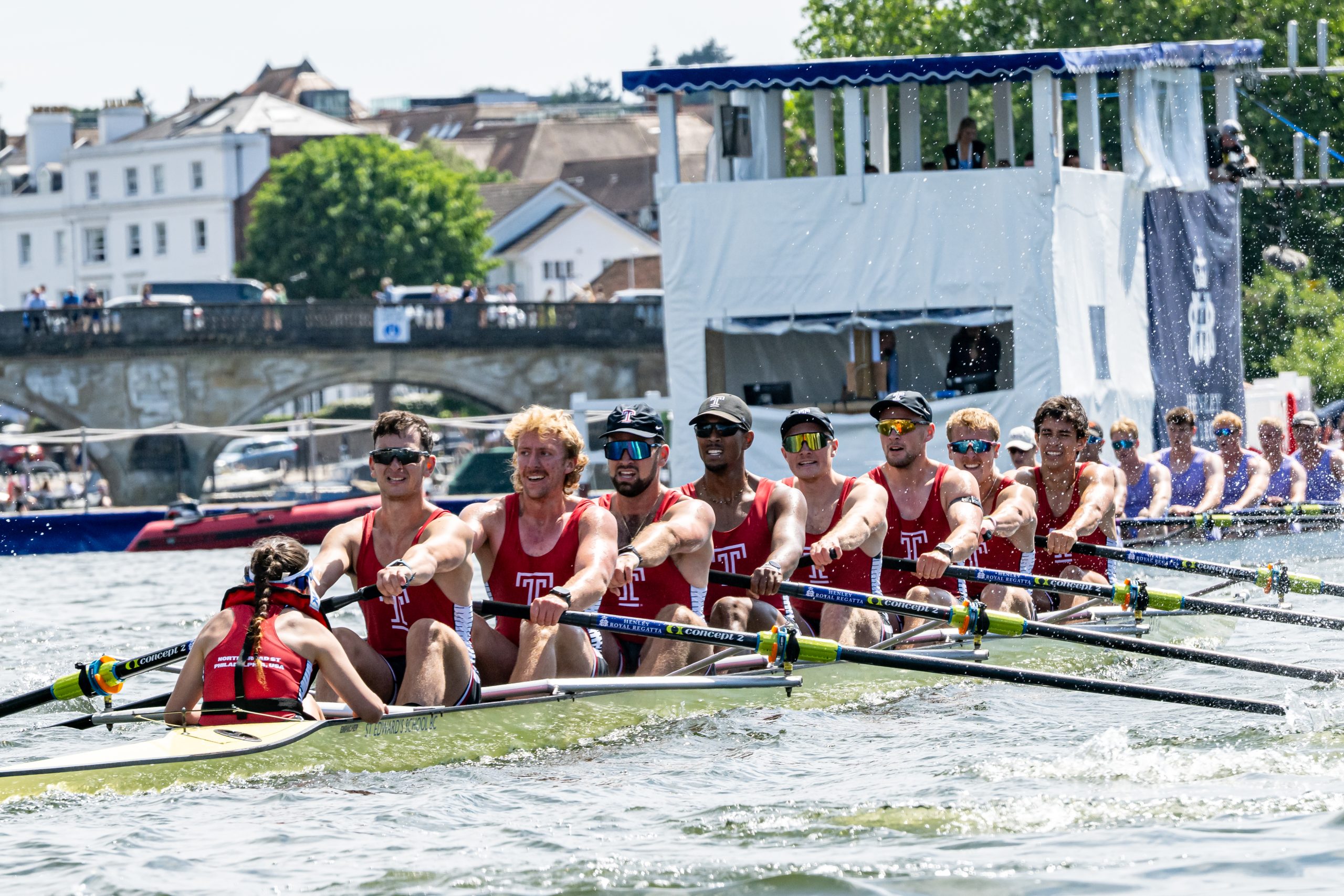
The coach nodded. For this program that had survived a boathouse eviction and the threat of being terminated permanently, and this coach who had jump-started his own path with a million meters on the erg, the 2025 season was not over.
It would end on the River Thames.
Mike Jensenwrote for The Philadelphia Inquirer for 35 years and was named Pennsylvania Sportswriter of the Year in 2023. He covered rowing on the Schuylkill River and at the Beijing Olympics and wrote the weekly Merion Mercy Academy crew newsletter for seven years while two of his daughters were champion rowers at the school. His book, Philly Hoops: How Philadelphia Transformed Basketball, will be published in late 2026.
Since 1983, Austin Rowing Club has hosted the regatta on Lady Bird Lake in Austin, Texas.
Austin Rowing Club, the oldest rowing club in Texas, hosts the 43rd edition of The Heart of Texas Regatta, Feb. 28 to March 1 on Lady Bird Lake. The 1,000-meter sprint race has attracted 675 junior, club, and masters entries, up from 639 entries last year and nearly double in the past 25 years.
“We love hosting teams from across the country,” says regatta director Megan Getman. “One of the things we love about hosting it is that we get to help novices have their first experience with sprint races and help seasoned racers knock off the winter cobwebs.”
The regatta features a seven-lane, fully buoyed course on the lake formed by the Longhorn Dam on the Colorado River, originally as a power plant’s cooling pond.
Dallas United had the fastest women’s junior eight last year but does not return this year. Texas Rowing Center, had the fastest men’s junior eight in 2025 and is entered again this year.