Home Blog Page 64

Saugatuck Athletes Prepare to Compete in the Youth Nationals in Sarasota, FL

Story and photo courtesy of Saugatuck Rowing Club.

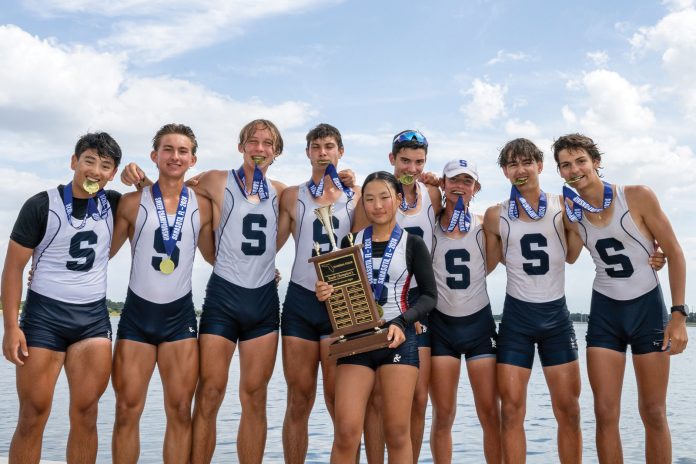
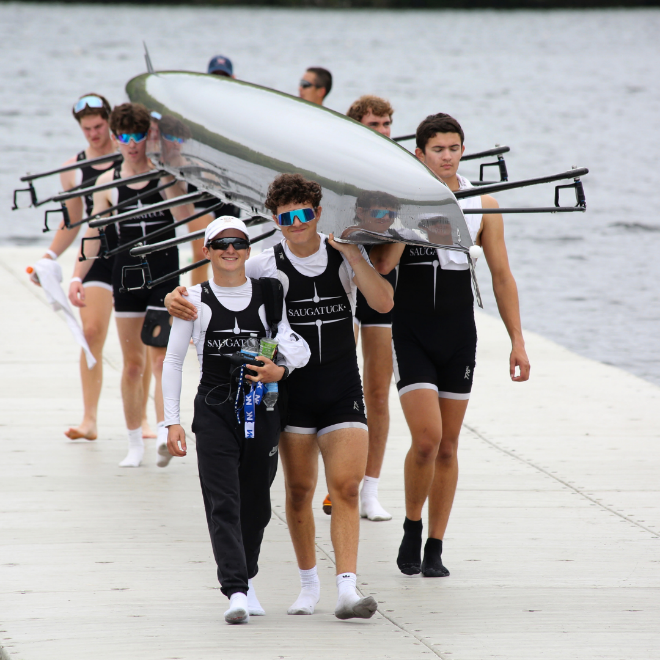
Westport, CT: Saugatuck Rowing Club Junior Athletes returned triumphant from the Northeast Regionals in Lowell, MA, after a stellar performance that landed these young athletes in the top positions. This performance made them eligible to compete in the Youth Nationals in Sarasota, FL  in June. This will be the largest group in Saugatuck Rowing Club history to race at Youth Nationals.

Northeast Regionals Results:

1ST PLACE
Men’s Youth Under 17 Eight
Women’s Youth Under 17 Four
Men’s Youth Under 16 Eight
Men’s Youth Third Eight

2ND PLACE
Women’s Youth Eight
Men’s Youth Eight
Women’s Youth Second Varsity Eight
Women’s Youth Under 16 Eight
Men’s Youth Novice Eight

3RD PLACE
Men’s Youth Four
Men’s Youth Second Varsity Eight
Women’s Youth Second Varsity Eight
Women’s Youth Novice Eight
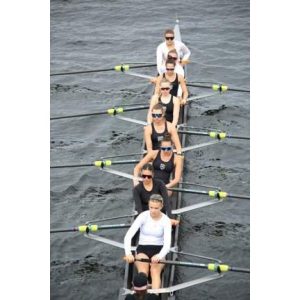
Photo courtesy of Saugatuck Rowing Club.

I am so proud of our athletes who competed at Northeast Regionals, “ says Dave Grossman, Director of Rowing for the Saugatuck Rowing Club, “We had 22 boats race with a total of 126 athletes competing. I am very happy with the maturity and skill level of our athletes. They have been training day in and day out since August for this. Saugatuck did a great job, and nearly 100 athletes will be moving on to race at Youth Nationals in June. Last year, we had 73 athletes race at Nationals. This is a significant increase, showing how serious this group of athletes takes their training and commitment to the sport and team. I can’t wait to see what our athletes accomplish next week. Go Saugatuck!”

In addition to an exciting month of rowing accomplishments, the Saugatuck Rowing Club proudly announced this year’s College Recruitment success stories, with over 25 of its senior athletes’ plans for their collegiate future. SRC Coaches provide their athletes with one-on-one college prep, from personal introductions to campus coaches to guidance through the application process and interview prep.

“Our wish, and goal, is to align our Juniors with the college that will allow them to continue to be outstanding in all of their endeavors, just as they have with us on the water, “says Grossman.
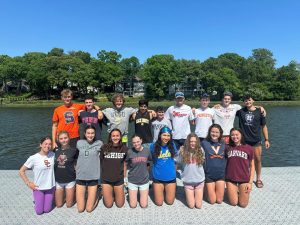
Photo courtesy of Saugatuck Rowing Club.

BOYS
George Huberty- Colby College
Dillon Bhutani- West Point
Cooper Levinson- UCSD
Christian Miller- UCONN
Ben Whelan- UW Madison
Kyle Elliot- UVA
Jack Kiely- Princeton
George Bentley- Navy
Aidan Montanaro- Syracuse
William Shockley- Marist
Pierce Baker -Tufts
Ronan Donohue- USC
Theodore Herzog – Stanford
Gavin Marshall – UPenn
Liam Karacsonyi- Undecided
Antonio Romeo- Holy Cross

GIRLS
Mia Kirkorsky- USC
Hannah Clemens- Dartmouth
Victoria Bazarko- Lehigh
Ella Casano- Stanford
Maia Freeman- UCLA
Claudia Chadwick- Harvard
Shayna Wilson-Spiro- UPenn
Sophie Swords- SMU
Leighton Davis- Boston College
Jane Leahy- University of Virginia

Juniors Registration is currently underway. https://saugatuckrowing.com/
(NEW WEBSITES COMING SOON!)
421 Riverside Avenue, Westport, CT  06880
Pocock CRCA Coaches Poll – Final

Story and image courtesy of the CRCA.
The final Pocock CRCA Coach Poll was announced on June 5th, following the conclusion of the NCAA National Championship.
D1
Rank Team Points Previous Ranking
1 University of Texas 2600 1
2 Stanford University 2540 2
3 University of Tennessee 2360 3
4 Princeton University 2240 4
5 University of Washington 2120 7
6 Brown University 1980 8
7 University of Michigan 1800 9
8 Yale University 1760 5
9 University of California, Berkeley 1680 6
10 University of Pennsylvania 1539 11
11 Syracuse University 1518 10
12 University of Virginia 1358 14
13 The Ohio State University 1354 15
14 Rutgers University 1097 13
15 Indiana University 924 12
16 Duke University 850 16
17 Gonzaga University 445 ORV
18 Oregon State University 442 17
19 University of Alabama 245 19
20 University of Notre Dame 243 18
ORV Columbia University 146
ORV Harvard-Radcliffe 114
ORV Washington State University 102
ORV Northeastern University 100
ORV University of Southern California 83
ORV University of Central Florida 72
ORV University of Miami 60
ORV University of California, Los Angeles 59
ORV Boston University 51
ORV University of Minnesota 39
ORV University of Rhode Island 24
ORV University of Wisconsin-Madison 21
ORV Southern Methodist University 20

D2

Rank Team Points Previous Ranking
1 Western Washington University 158 1
2 Mercyhurst University 155 6
3 University of Central Oklahoma 150 3
4 Cal Poly Humboldt 145 5
5 Seattle Pacific University 122 4
6 Embry-Riddle Aeronautical University 86 2
7 Rollins College 37 8
8 University of Tampa 29 7
ORV Thomas Jefferson University 12

D3

Rank Team Points Previous Ranking
1 Tufts University 730 1
2 Wesleyan University 660 4
2 Williams College 660 2
4 Trinity College 650 2
5 Ithaca College 493 9
6 Smith College 474 6
7 Wellesley College 441 5
8 Bates College 405 7
9 Hamilton College 345 8
10 US Coast Guard Academy 280 10
11 Worcester Polytechnic Institute (WPI) 254 11
12 University of Puget Sound 144 ORV
13 William Smith College 131 12
14 St. Mary’s College of Maryland 121 ORV
15 Clark University 106 13
ORV Rochester Institute of Technology 28
ORV Connecticut College 26
ORV Lewis & Clark College 24
ORV Washington College 18

Coxswain Development: The Science of Seat Racing

Story by Hannah Woodruff. Photo by Lisa Worthy.

Almost every rower and coxswain has heard the call “Pull the boats together and switch!”
Seat racing is one of the highest-pressure situations coxswains can find themselves in during practice, and it’s important to be prepared to perform on these days. There can be a lot on the line, including the final seats for a championship regatta.

Regardless of how your coach runs selection, your primary job as the coxswain is to race the boat well and ensure that the pieces are fair. It’s crucial that you steer well, adhere to rates, and assist with accurate data collection.

The basics are straightforward: Know the plan. If your coach expects the same rates for each piece, know what rate variance, if any, is acceptable. The importance of holding rate cannot be understated; if the boat is over or under rate, the data collected may not be valid.

Make sure you are clear on the calls to start and stop. Practice some of the CoxBox and SpeedCoach functions during lower-stakes practices so you can act quickly and leave your hands on the steering as much as possible when the time comes.

If pieces are being timed simultaneously by your coach and by your GPS, clarify whether you are stopping on the coach’s call or running the piece until the GPS has ended. Just as on race day, you never want to stop before the line.

If your team allows coxing during seat racing, it’s a great opportunity to practice your race-day calls. Speak with your coach beforehand to establish the level of similarity he or she is looking for between pieces. It’s important to know if you have full authority to race the piece at your discretion.

For silent seat racing, you have a terrific opportunity to observe how the boat moves and the way different rowers on the team influence the feel and pace of the shell. It’s also a good time to focus on your steering.

If you’re on a buoyed course, you can practice precisely where you like to look to keep the boat straight between the lines. If you’re not on a buoyed course, watch the way your tiny adjustments affect the boat. Assess your line and any stationary points of reference as you go within a piece, and once you’ve crossed the finish line, you can even turn your head to check your wake to see how your steering looks. If you have your steering dialed in, you have the gift of a day simply to observe the rowing and develop your boat feel.

There’s also the matter of your own seat racing. If you’re part of a program that does coxswain seat races, you already know that you need to seize the chance when it comes. As is the case for rowers, you may get only one switch to demonstrate your abilities in a particular crew.

If you’re switched on the water, take a deep breath and get yourself and your equipment situated. If there’s time, take a moment and speak to your stroke or bow seat to get a pulse on the boat and what they’ve been working on.

Most important, trust yourself and don’t let the pressure of the moment get to you. You earned yourself the opportunity.

Washington Sweeps IRA National Championship

Photo by Lisa Worthy.

The University of Washington swept the heavyweight events at the 121st IRA National Championship Regatta, winning the first, second, and third varsity eights on Sunday, June 2 after winning the varsity four on Saturday on Mercer Lake, West Windsor, N.J.

“I’ve been really fortunate to have an amazing staff this year,” said Washington head coach Michael Callahan. “Nate Goodman did an amazing job with the group. When it’s going well, it’s contagious. The boathouse has been so great that way. It’s been really good internal competition that has raised each other up.”

Princeton repeated as women’s lightweight national champions, winning the varsity eight and adding to the points trophy with a silver in the double and a bronze in the four.
“What we’re most proud of is winning the team points trophy again,” said coach Paul Rassam. “That’s not easy for our team. We don’t get a lot of recruits. They’re ferocious racers. Whether they’re in first, second, third, fourth. There’s only so much of that you can teach.”

Harvard’s men’s varsity lightweights led start to finish to add the national championship to their Eastern Sprints title. “IRAs is different just because IRAs is so much more drawn out,” said coxswain Anya Cheng. “There’s a lot of time to sit and wait and think. Our mentality going into it was to eliminate all the noise and just row the race that we know we could row. We knew that when we hit our top speed, we were going to win. So we just focused on that.”

Wesleyan held off Williams by two-tenths of second to win their first Division III national championship.

Commissioner Gary Caldwell, who has worked at 31 of the 121 IRA regattas, retired at the end of the event. “It’s been an honor and privilege to serve the student-athletes for all these years,” said Caldwell.

Coach Development: More Than Wins and Losses

Photo by Lisa Worthy.

For coaches who have been at the top, it may be surprising how quickly that feeling passes and how it feels a lot more like relief than jubilation.

Wins and losses are not the measure of a coach but merely one fleeting accounting of the competitive landscape. When coaches are clear about why they’re coaching, they can tally up their wins, and losses, in order to achieve lasting, repeatable, sustainable victory.
The peak of spring season may not feel like the time to contemplate such heady ideas but it is, in fact, the most important time to be doing just that. If not now, when freshly singed by the fire of competition, when else will you be able to look yourself squarely in the eye and assess, truly assess, your reasons for coaching? When emotions are heightened and nerves are frayed, we have a clearer view into our own hearts and have a better chance of reading what’s written there.

Wins and losses are fleeting. I’ve won national championships and been back on the recruiting trail mere hours later. I’ve suffered heartbreaking losses and found quick solace in the resiliency and perspective of young people. As hooks on which to hang your self-worth, both states are too evanescent. And, crucially, others get a say in your race results; the enemy gets a vote.

For a long and fulfilling career, coaches must identify what it is that lights their fire, regardless of outside factors. I hope we’d all agree that there isn’t just one coach or team, the national champion, that has had a successful year. And for those who have been at the top, it may be surprising how quickly that feeling passes and how it feels a lot more like relief than jubilation. So we need to take the next step of defining what it is exactly that we’re working so hard to achieve each year.

None of this is to imply that achieving competitiveness means sacrificing lasting success. Quite the contrary: Competitive excellence follows from leaders who are clear about their values and priorities, who are sure of themselves and why they do what they do.
Time can teach you a lot, but not everything and not without your active participation. Be curious about yourself. Elevate the expectations and aspirations you have for yourself and others. Do the work to find your own victories and build a career, and life, that allows you to be victorious as often as possible. You are more than your wins and losses.

So, as you reach the end of your spring season, I challenge you to find what gave you energy and joy this year, what kept you motivated, engaged, and creative. Write that down clearly and succinctly. Put it somewhere you can see it and work to have more of that next year. Start there.

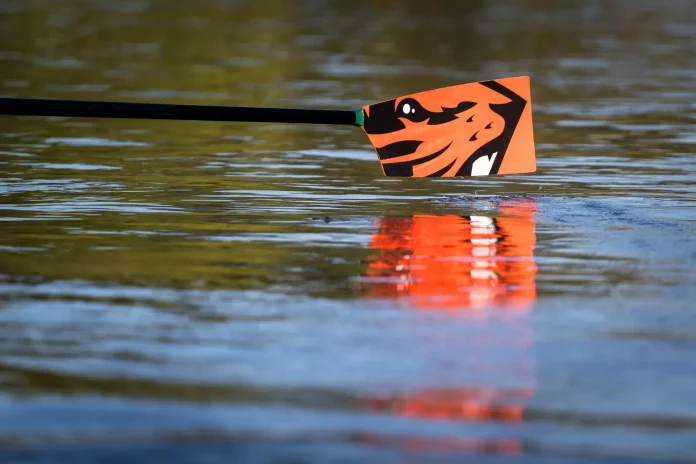
Kate Maxim Resigns as Oregon State Women’s Rowing Head Coach

Story and photo courtesy of Oregon State Athletics.

CORVALLIS, Ore. – Oregon State women’s rowing head coach Kate Maxim has resigned from her position, Vice President and Director of Intercollegiate Athletics Scott Barnes announced Monday.

“I’d like to personally thank Coach Maxim for her hard work and dedication these past 13 years,” Barnes said. “Her support of our student-athletes has been nothing short of extraordinary, and I am grateful for her contributions to Oregon State Athletics. The women’s rowing program is in a great place because of her leadership, and we wish Kate and her family all the best in their future endeavors.”

After spending six years as an assistant coach at Oregon State from 2006-12, Maxim was appointed head coach on July 7, 2017, and the program had remarkable success under her leadership.

From building the program back into a regular member of the Top 20 national rankings to a 14th-place finish at the 2022 NCAA Championships, Maxim led the Beavers to a fourth-place finish at the Pac-12 Championships this season behind a trio of top-ranked opponents and nearly made a second trip to the NCAA Championships.

“I’d like to thank Scott Barnes for the life-changing opportunity to work with remarkable student-athletes as the head coach for women’s rowing the past seven years. Thank you to Jeff Macy, Ryan Bucher and Kimya Massey for challenging me and advising me as I discovered the kind of coach I truly wanted to become. I also want to thank my dear friend and mentor, Emily Ford, for taking a chance on me and hiring me as an assistant for the Beavers in 2006. At that time, I never dreamed I would spend 13 of my 20 years of coaching in this amazing community and beautiful location.

“It has been a transformative experience to build this program into a nationally competitive team alongside fantastic coaches, dedicated support staff, and with strong support from an enthusiastic and generous alumni base and creative athletic department,” Maxim added. “This program is well-positioned to continue competing among the Top 20 teams in the country, and I look forward to cheering them on as a lifelong fan. Now is the right time for me to grow in a new direction, and I will take all the lessons learned and all the love I have for these incredible athletes with me into a new chapter. Finally, to my husband, Erik, and son, Leif – thank you for always believing in me. This could not have been possible without your patience, love and unwavering dedication to building a beautiful life together.”

Oregon State leadership will immediately begin a national search for Maxim’s successor.

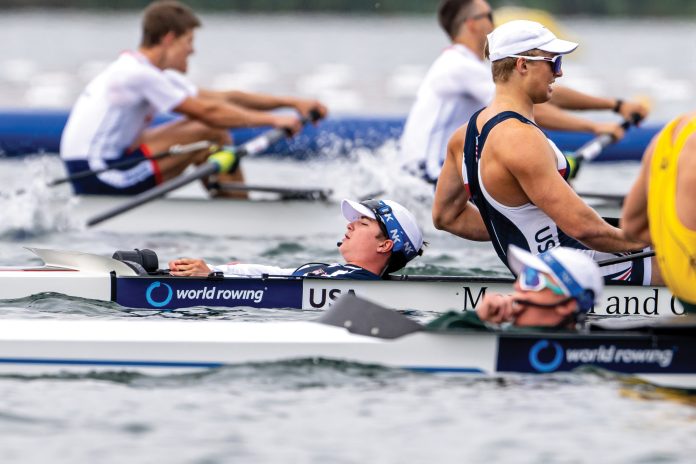
Texas, Western Washington, and Tufts Crowned NCAA Champions

Photo by Tom Walsh.

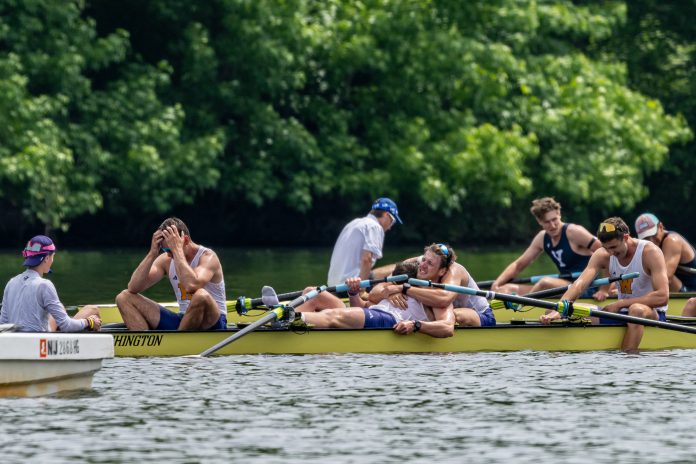
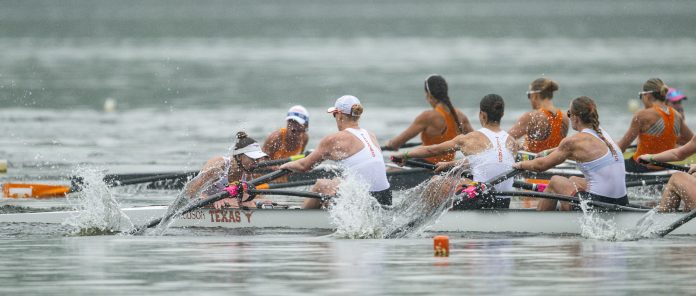
The 2024 NCAA National Championship provided its fair share of record-setting finishes. Despite adverse weather on Sunday that forced a change in schedule, DI racing concluded eventfully with the Texas Longhorns claiming their third national championship after winning the varsity eight and varsity four events, while bringing home the silver in the second varsity eight. Dave O’Neill said to Texas Athletics, “I could not be more proud of this team. They did something very special today, and it all started with our first team meeting back in August. I give them a lot of credit for buying in, doing the work and making each other better every step of the way.”

Photo by Tom Walsh.

Stanford finished second in the overall points standings and took home the national championship in the second varsity eight event. This is the fourth year in a row that the Cardinal finished top-two at the NCAA championship. The squad also won their third straight PAC-12 Championship, which is sure to be their last one as the university joins the ACC starting with the 2024-2025 year and the PAC-12 rowing championship dissolves.

Photo by Tom Walsh.

#3 ranked Tennessee lived up to that polling and finished third in the points standing, the best-ever finish for the Volunteers who didn’t even qualify for NCAAs for the past two seasons. New head coach Kim Cupini and her squad, featured in Rowing News earlier this spring, finished third in both the varsity and second varsity eight events while capturing fifth place in the varsity four. Coach Cupini told utsports.com, “From the very beginning, [this team and coaching staff] believed in themselves, each other, their goals and the process. I’m so proud of how every one of them handled the changes and committed to what it took to reach the podium at the NCAA’s.”

Photo by Tom Walsh.

Of course, victories came throughout the field, not just for those on the podium. For the first time in program history, Gonzaga advanced all three crews to the C Finals. Jacksonville’s varsity eight finished 21st, the best-ever finish for not only the Dolphins but for any MAAC team.

Before the DI championships wrapped up, the Division II and III national champions were named on Saturday. In the DII field, Western Washington earned their ninth national championship, winning the varsity eight event and finishing fifth in the varsity four. The Vikings led the eight wire-to-wire, finishing over three seconds ahead of Mercyhurst. In the tightest field in the history of the DII NCAA Championship, the top four teams were separated by merely four points: Western Washington (22 points), Mercyhurst (21), Central Oklahoma (20), and Humboldt (19).

Tufts earned their first-ever NCAA DIII championship after a strong performance in the varsity eight, which the Jumbos lead from the 500m mark to the finish, coming in over three seconds ahead of Wesleyan, who also finished second in the points standings. Williams, who defeated Tufts in the heats on Friday, finished third. The Tufts second varsity eight finished second behind the Ephs, who finished third in the points standings.

Full Results. Point standings. Full video replay.

Princeton Lightweight Women Win Third Straight IRA Championship

Story and photo courtesy of Princeton Athletics.

WEST WINDSOR – The No. 1 Princeton Lightweight Women’s Rowing Team used the 1V’s IRA gold to secure the Commissioner’s Cup at Mercer Lake on Sunday morning.

The double of Sidney Bae and Amelia Boehle secured a silver medal (7:40.1) in the 2x Grand Final to begin the action for the Tigers.

The BU boat rowed out to a 1:49.85 in the first 500m and led throughout to take the gold (7:35.0). Oklahoma City took silver (7:44.3) while Stanford (7:45.5), Georgetown (7:47.7) and MIT (7:56.2) rounded out the field. This is Bae’s first IRA medal while Boehle collected her third.

The varsity four of Penelope EffronClaire Brockman, Hannah Hoselbarth, Mimi French and Nathalie Verlinde caught the MIT boat in the final 500m to nab the bronze medal (7:24.78) behind Stanford (7:19.9) and BU (7:23.1).

In third place in the team standings with one race to go, the varsity eight went wire-to-wire, rowing to a 6:35.1, 1.8 seconds in front of the field. Stanford was second at 6:37.0 while Radcliffe was third at 6:38.8.

With the 1V win, the Tigers won the Commissioners’ Cup as the top women’s lightweight point total for the third straight season (67 points) by one over Stanford (66 points).

“The thing I’m most proud of today is the seniors rowing a great race and winning the team trophy by one point,” said Paul Rassam. “The fight by the double, the four and the eight showed out there shows how difficult it is to take the team trophy. We rely on everybody and after missing the Eastern Sprints trophy by one point, we said let’s go for it and they pulled it off.”

Princeton’s 1V has not lost a race to another lightweight boat since the 2019 IRA Championships.

“Today and always, the main thought is love,” said senior Sarah Fry who did not lose a lightweight race during her career. “Our team does a really good job of loving each other and every stroke that we take is for everyone on our team, family and coaches which allows us to race with a clear mind.”

Fry has won three IRA gold medals and was recently a C. Otto von Kienbusch finalist.

“It’s about the beauty of collective striving,” said Fry talking about her time at Princeton. “There’s a beautiful thing that happens when there is eight people in a boat giving every ounce of their energy and soul to what they are doing. That moment where everyone is all in and we get to the core of ourselves in those sprint pieces, final 250m and every day on the water, there’s nothing like it. It’s always about the boat, it’s never about one individual. Striving for something great with the people you love is the best thing you can do.”