Home Blog Page 29

Stanford Wins NCAA National Championship, Yale Takes Varsity Eight

Yale's first eight celebrates winning their NCAA final ahead of favorite Stanford, June 1 on Lake Mercer in West Windsor, N.J. PHOTO: Katie Lane.


Stanford won the Division-I NCAA Women’s Rowing Championship on Lake Mercer in West Windsor, N.J. where Yale prevailed in the first varsity eight final, upsetting the number-one ranked Cardinal first varsity, and earned second place in the overall team championship

Stanford’s varsity four broke seven minutes (6:56.5) in winning their final to start the Cardinal’s national championship early Sunday morning. Stanford’s second eight won their final, setting up a possible sweep in the last race of the morning. But Yale’s first varsity exploded off the start, built nearly a length lead, and held of for the win in 6:06 on white capped waters.

Texas and Washington, the only other teams to place crews in all three grand finals—first eight, second eight, and four—finished third and fourth, respectively.

Embry-Riddle Aeronautical University Wins Division-II NCAA Women’s Rowing National Championship

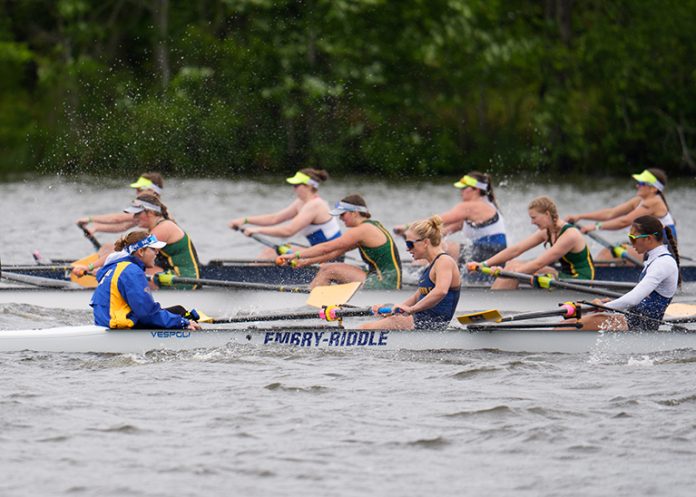
Embry-Riddle won its first-ever DII rowing championship on Saturday, May 31, on Mercer Lake in West Windsor, N.J. Women's rowing became the first program in Embry-Riddle Aeronautical University's NCAA Division II era to win a national championship. Photo: Katie Lane.


Embry-Riddle won its first-ever DII rowing championship on Saturday, May 31, on Mercer Lake in West Windsor, N.J., ahead of Humboldt and Western Washington with 24 and 21 points, respectively.

“This group has truly earned every moment of this national championship. Two years ago, we made a deliberate choice to raise the bar by training harder and racing at a higher level,” said Head Coach Grant Maddock. “That commitment set the course for where the program is today. What we’ve accomplished is special, but it’s just the beginning of what this team is capable of.”

Women’s rowing became the first program in Embry-Riddle Aeronautical University’s NCAA Division II era to win a team title. When including NAIA championships, the rowing national championship is Embry-Riddle Athletics’ third team title and first women’s.

Embry-Riddle is the eighth different program to win the NCAA II women’s rowing championship, which has been held every year since 2002 except 2020. 

Entering as the third seed in eights, Embry-Riddle won the eights final in windy conditions in the morning, ahead of Western Washington and Humboldt. Following a weather delay of roughly 10 hours, Embry-Riddle’s four placed third in their grand final and accumulated eight points to secure the overall team title with 26 points. Humboldt finished second overall with 24 points and Western Washington was third with 21 points. 

Tufts Wins Second Straight NCAA D III Championship

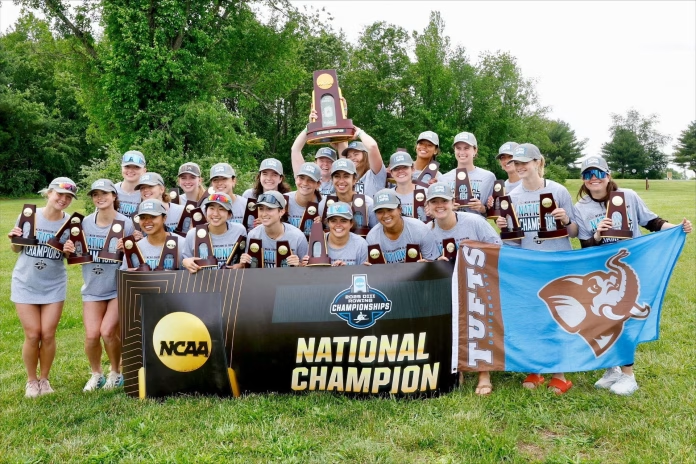
Tufts won its second straight NCAA championship on May 31 with a dominating performance on Lake Mercer in West Windsor, New Jersey. Both the Jumbo first and second varsity eights led their races from start to finish. PHOTO: Tufts University.


Tufts University women’s rowing team won its second straight NCAA Championship May 31 on Lake Mercer in West Windsor, N.J. Both the Jumbo first and second varsity eights led their finals from start to finish. Tufts scored a perfect 56 team points, ahead of second-place Williams with 49 and Wesleyan 45 points. Tufts successfully defended their 2024 title when they won their first national championship in Ohio with 54 points.

Fresh Faces Lead D I Rowing Programs to NCAA Championship Regatta

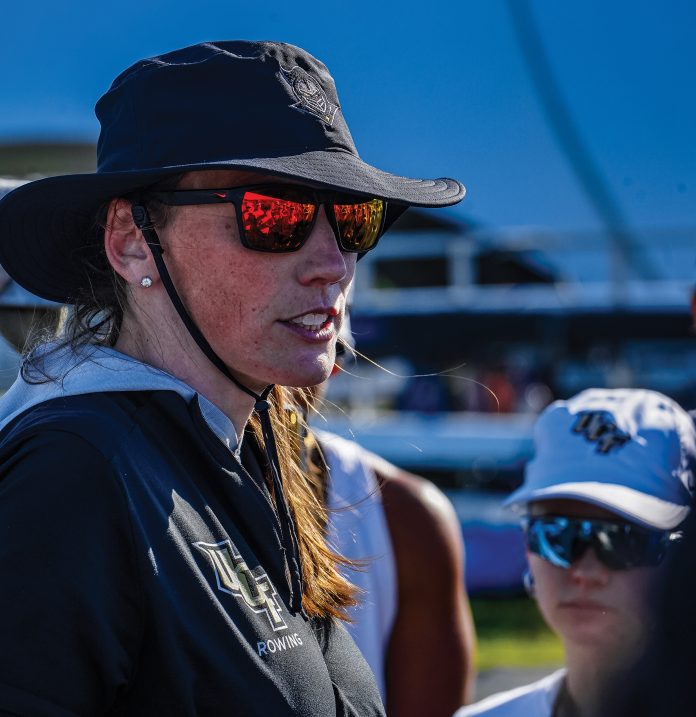
Mara Allen coached the UCF Knights to a sweep of the 2025 Big 12 Championship, winning every race by open water. PHOTO Courtesy UCF Athletics.


More than one third—eight of 22—of the field of Division-I rowing programs invited to the 2025 NCAA Rowing Championships are led by first- or second-year head coaches. The eight-school Ivy League leads all conferences with six bids, four of which—Brown, Dartmouth, Harvard, and Penn—have first- or second-year head coaches. Boston University, Tennessee, UCF, and Virginia do, too.

“It’s pretty surreal, I’d say unexpected,” said Dartmouth’s second-year women’s head coach Graves, whose crews earned a bid to NCAAs for the first time since 2011 after strong showings at the Ivy League Women’s Rowing Championship. “It’s fun to see them around the best teams in country and I couldn’t be more excited.”

Most of the eight new head coaches led successful 2025 spring seasons on the strength of programs built by predecessors who retired or moved on. Wes Ng, the first-year head coach of Virginia, took over one of the country’s top programs following Kevin Sauer’s retirement. In his previous job, Ng built the Penn women’s program up to earn regular bids to NCAAs, a level of performance continued by first-year Penn head coach Bill Manning this year.

“It’s wonderful to continue the success that the program experienced prior to my arrival and to help the senior class go out four-for-four with NCAA racing,” said Manning.

UCF hired Mara Allen away from Texas, where she was an assistant coach, in the summer of 2023. Earlier this spring Allen coached the Knights to a sweep of the Big 12 Championships, winning every race by open water, included a 16.8-second margin in the first eight final. UCF enters the NCAA regatta ranked 14th.

Second-year Tennessee head coach Kim Cupini’s program is among the favorites to win medals along with Stanford, Texas, Washington, Yale, and Princeton—all coached by experienced veterans.

Racing at the 2025 NCAA Rowing Championships starts Friday morning, May 30 and runs through Sunday morning June 1 on Mercer Lake, West Windsor, N.J.


From The Editor: What’s Right—and Wrong—About Rowing, and Some Solutions

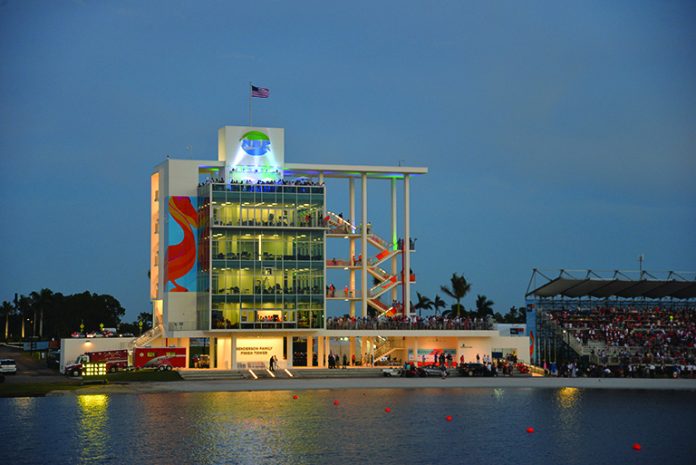
The Benderson Family Finish Tower at Nathan Benderson Park, Sarasota, Fla. PHOTO: Intersport-images.com.


As the president of World Rowing, Jean-Christophe Rolland might have the toughest job in rowing. Fortunately, he’s an Olympic-champion oarsman, so he has the grit, determination, and resilience to endure discomfort, to work cooperatively, and to keep going when others quit.

The affable Frenchman, frustrated and infuriated—as he says in the Rowing News interview in the June issue—by the failure of most national teams to support the World Rowing Cup by showing up and racing, has managed to keep rowing’s place in the Olympic Games through his work on the International Olympic Committee.

Unfortunately, that “go along to get along” approach has cost lightweight rowing’s place in the Olympics as well as undermining the integrity of Olympic rowing by shortening the race distance to 1,500 meters for the LA 2028 Games.

Because so much work went into arriving at that bad decision, Rolland says, the decision must stand. That’s Old World thinking at its worst, especially since a proper Olympic regatta could be held on the purpose-built world-class venue at Nathan Benderson Park in Sarasota (just as the LA 2028 whitewater canoe and kayak events will be held in Oklahoma City, and the Paris Games surfing events were held in Tahiti).

As reported throughout the June issue of the magazine, rowing is thriving and more popular than ever, just not at the international elite level. But as I write in the June issue of Rowing News, our sport faces a big challenge—the coming “demographic cliff.” The good news is that on both the Olympic and domestic levels, there are solutions. I offer 10 of them, including “row-up music” and crews picking their own lanes before the start, to make our sport even better.

These potential improvements build on what is already a great sport. Tom Matlack’s exciting recollection of the journey that his Wesleyan crew took to victory in 1986 tells the story of what rowing has to offer all of us: Hard work and working together lead to success.

Fields Set For IRA, NCAA National Championships

2025 ACC champions Stanford will compete as the top seed in the I Eights, II Eights, and Fours events at the 2025 NCAA Championships regatta May 30 through June 1 in West Windsor, N.J. held at Mercer Lake in West Windsor, N.J. PHOTO: Stanford Athletics.


With the announcement of bids and seedings set, the IRA and NCAA national championship regattas will decide the collegiate national champions May 30-June 1in New Jersey.

On Camden’s Cooper River at the IRA regatta, Cal is the favorite for the men’s heavyweight title, while Harvard is for the lightweights and Princeton is for the women’s lightweight title.

On Mercer Lake in West Windsor, Stanford is the top seed and overwhelming favorite for the 2025 NCAA Division I Women’s Rowing Championship. Cal Poly Humboldt is the top seed in Division II, and Tufts is the top D III seed.

Virginia, Vanderbilt Win ACRA National Championships

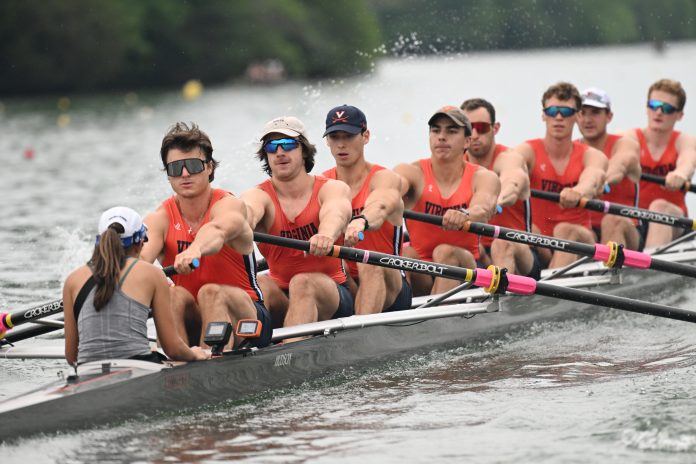
Virginia men's rowing won the 202 ACRA National Championship. PHOTO: Karl Cheng.

At the 2025 American Collegiate Rowing Association Championships, May 18, on Melton Lake in Oak Ridge, Tenn., the University of Virginia’s men’s first and second eights both won their grand finals at the collegiate club rowing national championships.

Vanderbilt won the women’s first eight, and Bowdoin won the women’s second eight

“It was a great weekend,” said Virginia coach Frank Biller, “a lot of fun.”

That fun included coaches from competing schools gathering before dawn each morning of the three-day regatta to pull logs and other debris washed onto the course by heavy rains.

“We just do that,” said Biller of the camaraderie among club coaches, whose programs are not funded by their universities’ athletic departments. “It’s not even a question that we would do that for each other.”

Full Results  |  Video

Vesper Hires Krakic, Brown to Boost Performance


Vesper Boat Club has hired Ivo Krakic as director of rowing and Marqus Brown as head coach of the racing team, as the venerable Philadelphia club pursues high-performance objectives going into the summer.

“Vesper is excited to breathe new life into our storied racing program with the hiring of Krakic and Brown,” said Vesper board member Greg Ansolabehere.

“With an emphasis on big-boat competition, Ivo and Marqus will guide Vesper athletes to podium-level finishes domestically and abroad. In addition to competing at all the regattas we know and love, Vesper intends to forge relationships with other clubs in the rowing community and create new racing opportunities.”

Krakic, a 2017 alumnus of Drexel University who rowed on the Croatian national team, is in his third year as the head coach at La Salle University. He has led the Explorers’ first and second men’s varsity eights to their highest-ever national rankings, finishing 18th and 16th, respectively, at the Intercollegiate Rowing Association national championship.

Brown, a La Salle grad and Philly native, has extensive experience across the country, having trained as an elite athlete with Penn AC, coached at the University of Washington, and most recently having run a youth rowing program in Texas.

“They’re both bringing serious experience to the table, and it’s a big step for Vesper as they continue to build their high-performance pipeline,” said Vesper’s communications secretary Allison Mueller. “The summer team is gearing up now, and they’ve had athletes competing at Olympic trials and speed orders, so this feels like a natural evolution.”